I had admired pictures of it before, but I had forgotten that it was in Vienna until I was leafing though a pamphlet at the tourist office there in early July. I found that not only was it in the city, but that we could get there via a quick ride from the Ring Road on the no. 1 tram.*
Kegelgasse, the bermed pedestrian street below the photo above.
Friedensreich Hundertwasser† was a painter and later worked in the field of applied art, creating flags, posters, and stamps.
From the 1950s, he also wrote and spoke passionately about “an architecture in harmony with nature and man” — and in what he called “new values” of a “yearning for romanticism, individuality, creativity, especially creativity.”
In 1977, the mayor of Vienna was persuaded to give Hundertwasser a chance to try out his ideas on an apartment building. An architect (and then another) was assigned to help him create the technical drawings.
Beyond the fountain above, the quiet internal courtyard of the building.
In 1980, at a press conference about the Haus, Hundertwasser expressed his philosophy of “window right” and “tree obligation.” You can read it here.
Some of his other statements about the building are below.
“Windows in rank and file are sad, windows should be able to dance.” — F.H.
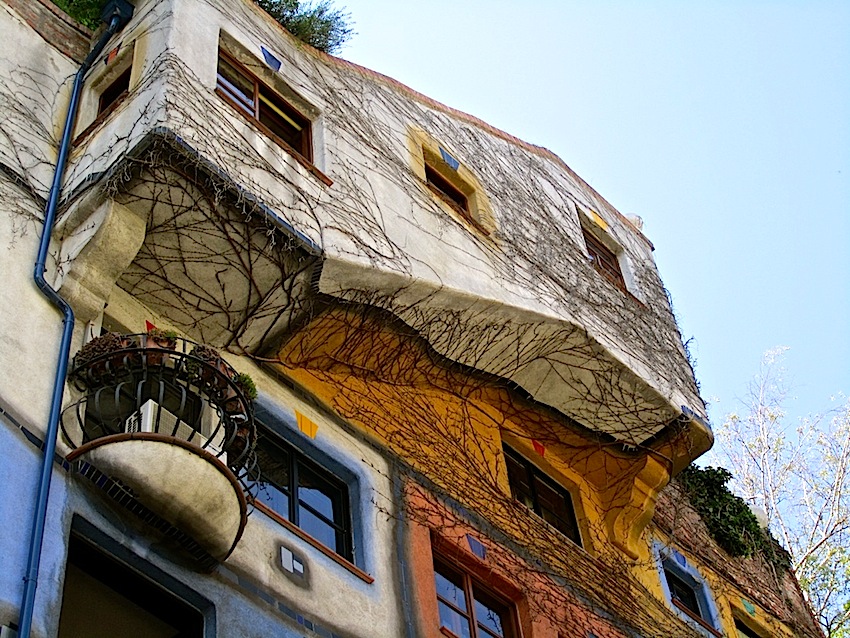
Photos above and below: The facade of the north side. Hundertwasser believed that every tenant should have the right to choose the decoration around his or her own windows.
A person in a rented apartment must be able to lean out of his window and scrape off the masonry within arm’s reach. And he must be allowed to take a long brush and paint everything outside within arm’s reach. So that it will be visible from afar to everyone in the street that someone lives there who is different from the imprisoned, enslaved, standardised man who lives next door.
— F.H. (more of his words on the “apartheid of window races” here.)
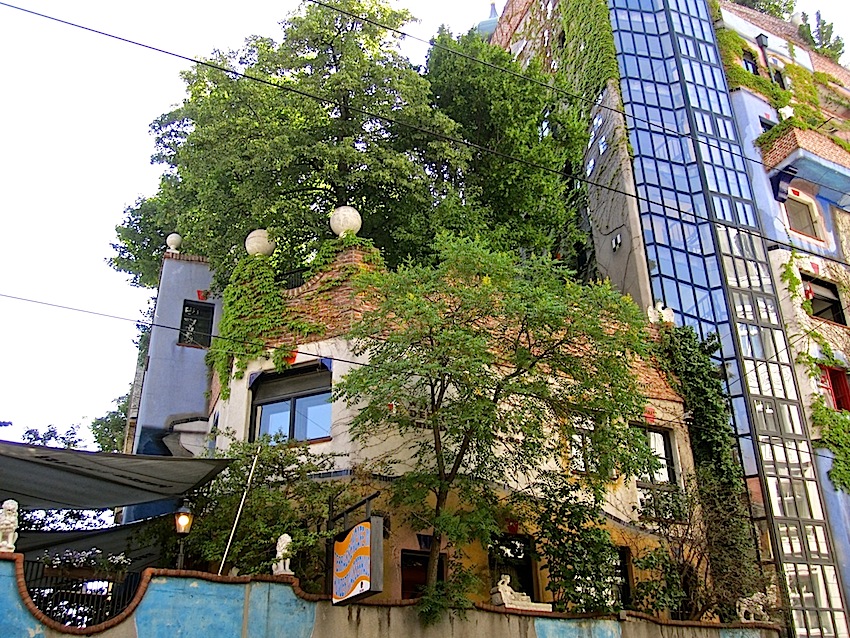
Photos above and below: The Lowengasse side of Hundertwasserhaus. It does not stand alone, but is closely surrounded by traditional 19th and early 20th century apartment buildings. On this side, I could see why some critics called the work “kitsch.”
“Romanticism has been declared kitsch and so we have been robbed or romanticism,” wrote Hundertwasser. “May one not dream? . . . The absence of kitsch makes life unbearable.”
In a[n apartment] house, an individually different, organic design of the outer wall of each individual apartment is of fundamental significance, so that the resident can identify with his house from the outside.
[The terraces] open to the street are a gift for everyone . . . . [They] take away the house’s vertical aggressivity, street noise is lessened because the echo is no longer caught between the rows of buildings.
If the terraces are green and have trees on them, it is like a natural hill with people living in it. Walking through a city with ascending terraces is like wandering through a gentle, green valley.
Photos above: The pedestrian street along the north side of the building.
A lively, uneven floor in the public area means a regaining of the human dignity which man is deprived of by the levelling tendencies of urbanism. . . .
If modern man is forced to walk on asphalt, concrete FLAT surfaces, the way they are thoughtlessly conceived with the ruler in the designer offices, alienated from his natural relationship to the earth which goes back to the dawn of time, from contact with the earth, a crucial part of man is blunted, with catastrophic consequences for his psyche, his emotional balance, his well-being and health.
Man forgets how to experience things and becomes emotionally ill.
Thus, the flat floor becomes a true danger for man.
The building contains 52 apartments, 16 private terraces, 3 communal terraces, and 250 trees and bushes, according to Wikipedia.
To scroll through larger versions of the photos, click on ‘Continue reading’ and then on any thumbnail in the gallery.
*The 1 tram starts out in front of the Opera House and moves along the west and north sides of the Ring Road. Just stay on until it veers off east on Radetzky Street. Hundertwasserhaus is on Löwengasse — on the left — right after you cross Blütengasse.
†He was born Friedrich Stowasser, but changed his name in the late 1940s. His adopted name translates as “Peace-Realm Hundred-Water.” He died in 2000, after working on a number of architectural projects in the 1980s and 90s.
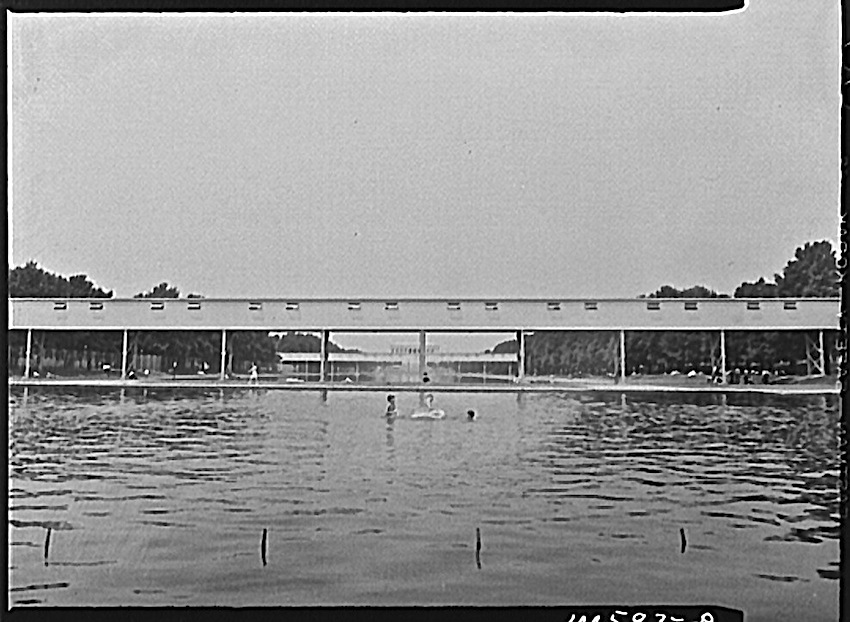
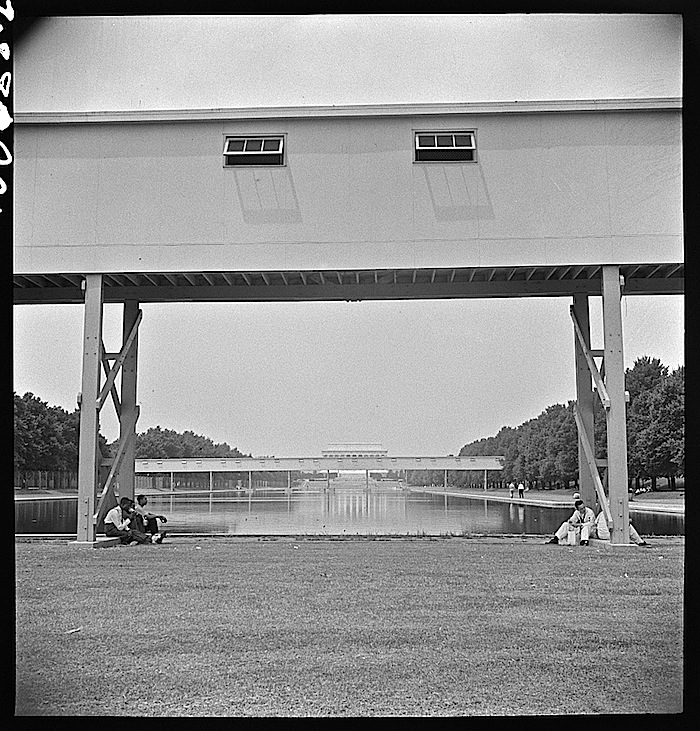
The Lincoln Memorial Reflecting Pool in July 1942. Two raised corridors crossed it and connected Department of War buildings. Photo by Marjory Collins, via Library of Congress Prints and Photographs Division.
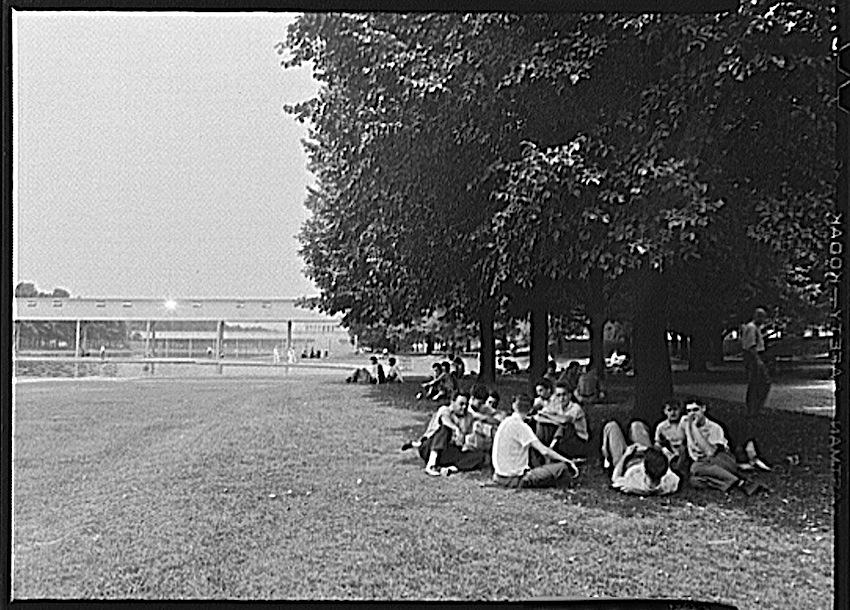
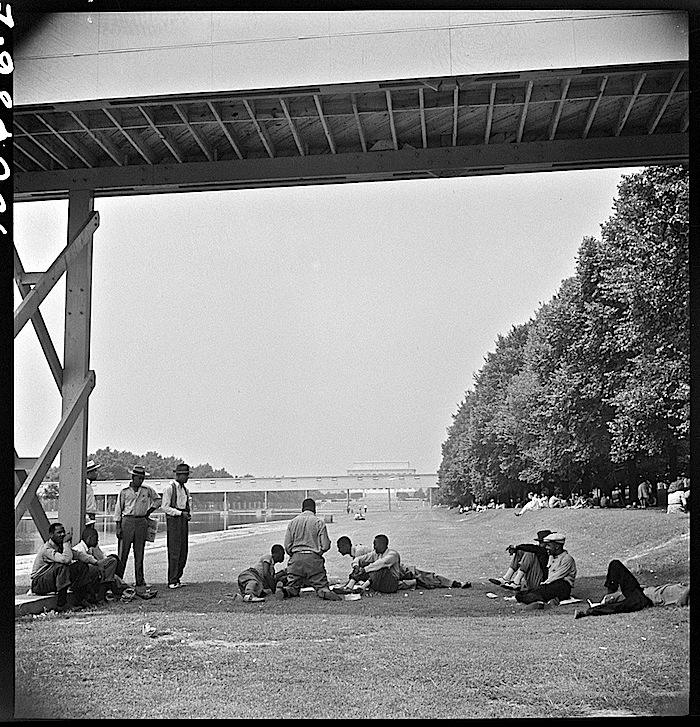
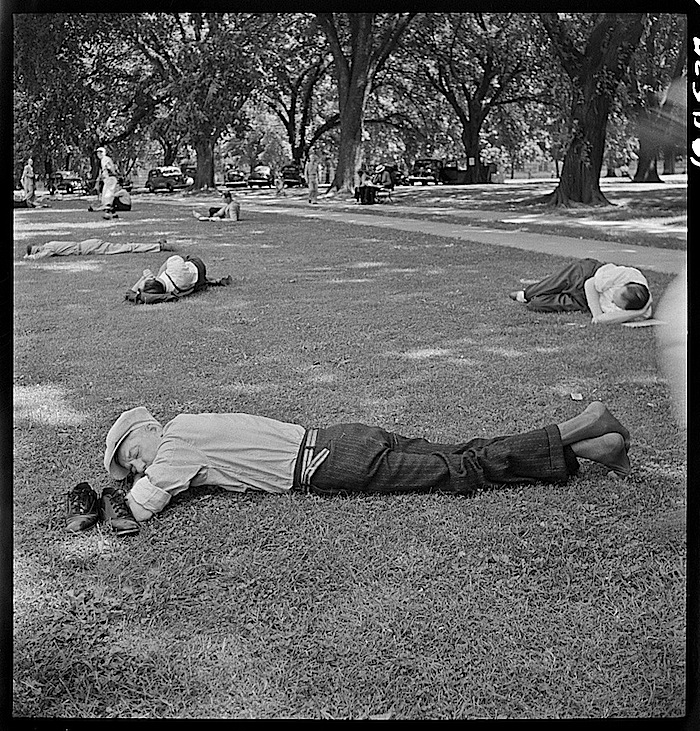
Along the sides of the water, under the trees, government workers were eating lunch on the grass.
These men took advantage of the additional shade cast by the structures.
“Temporary” buildings for various military branches were constructed along the north side of the pool in 1918. The offices on the south side — and the corridors — were added during World War II.
The walkways were removed in 1947. The last of the buildings came down in 1970.
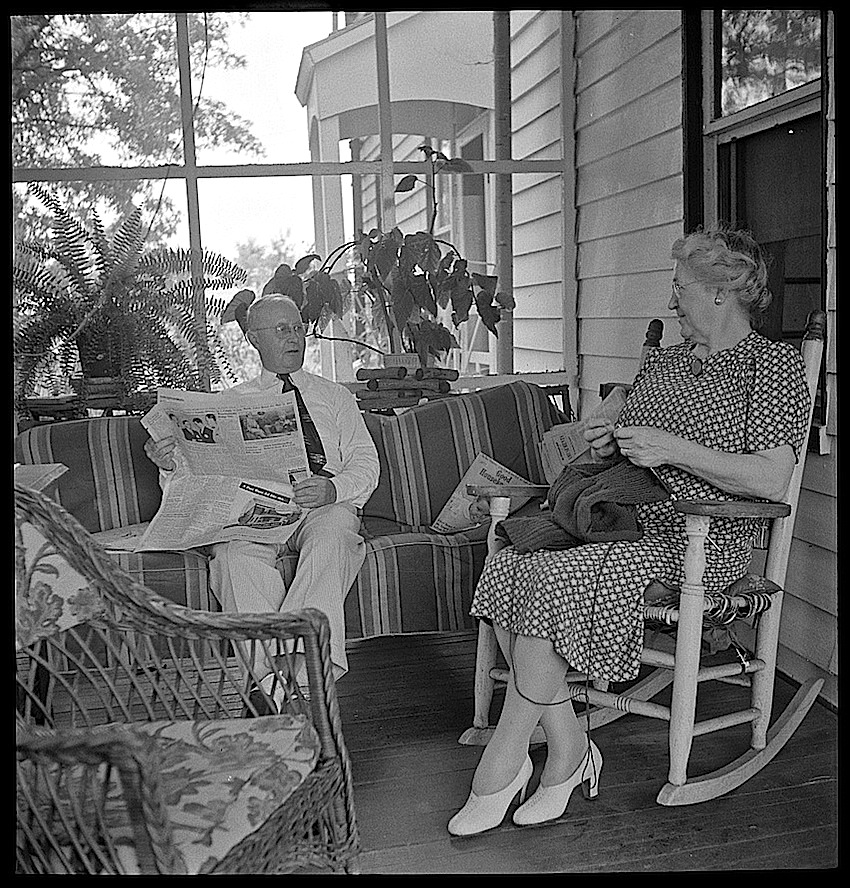
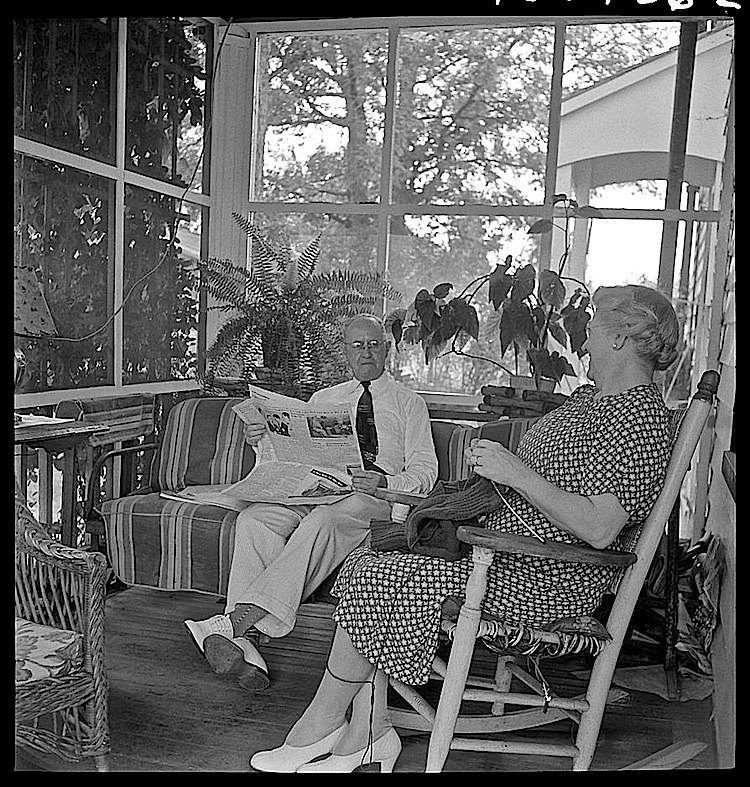
Mr. and Mrs. Herbert on their porch in Mechanicsville, Maryland, June or July 1942, by Marjory Collins, via Library of Congress Prints and Photographs Division (all three photos).
All the elements of a good screened porch are here: a slipcovered glider and a wicker chair, a rocker with a cushion (because the caned seat is nearly gone), a Boston fern and an angel-wing begonia, a newspaper and a copy of Good Housekeeping. Both Herberts are wearing summertime white shoes.
Only a little iced tea could make it any nicer. Judging from the way they are dressed, I would guess this is a Sunday afternoon.
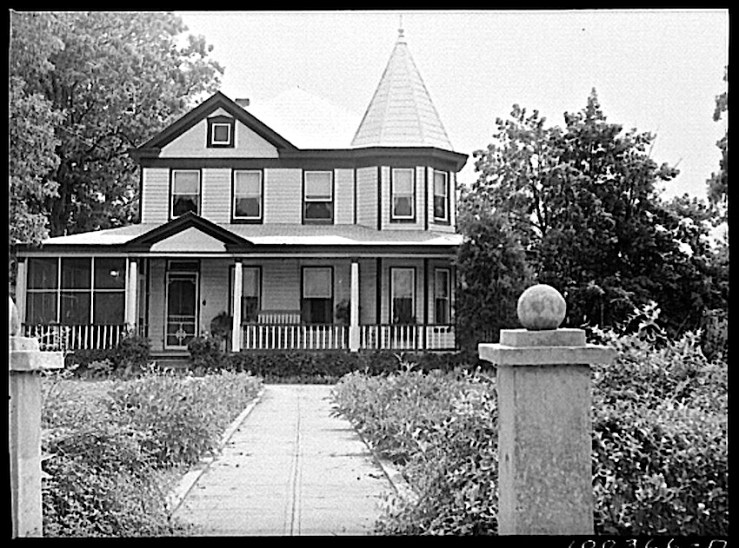
The couple — Charles P. and Bessie D. — built their Queen Anne house in 1909, although, curiously, it appears that they only bought the land beneath it in 1914, according to a Maryland Historic Sites Inventory Form filled out in the 1990s or later.
Charles had moved to the the area to be an express agent for the railroad. Bessie was the town dressmaker. They lived in the house until their deaths during the 1960s.
A photo attached to the Inventory Form shows that the screening on the east side of the porch was later removed and some lacy trim was added along the entire front. I could not find the house in a current Google Maps satellite view, however.
As usual, I wish we could see more of the garden.
Marjory Collins took these pictures about six months after moving to Washington, D.C., to join the documentary photographers of the U.S. Office of War Information. Her “upbeat, harmonious images” of that time “reflected the OWI editorial requests for visual stories about the ideal American way of life,” according to a biographical essay about her by the Library of Congress.