The Sunday porch: Lincoln, Vermont

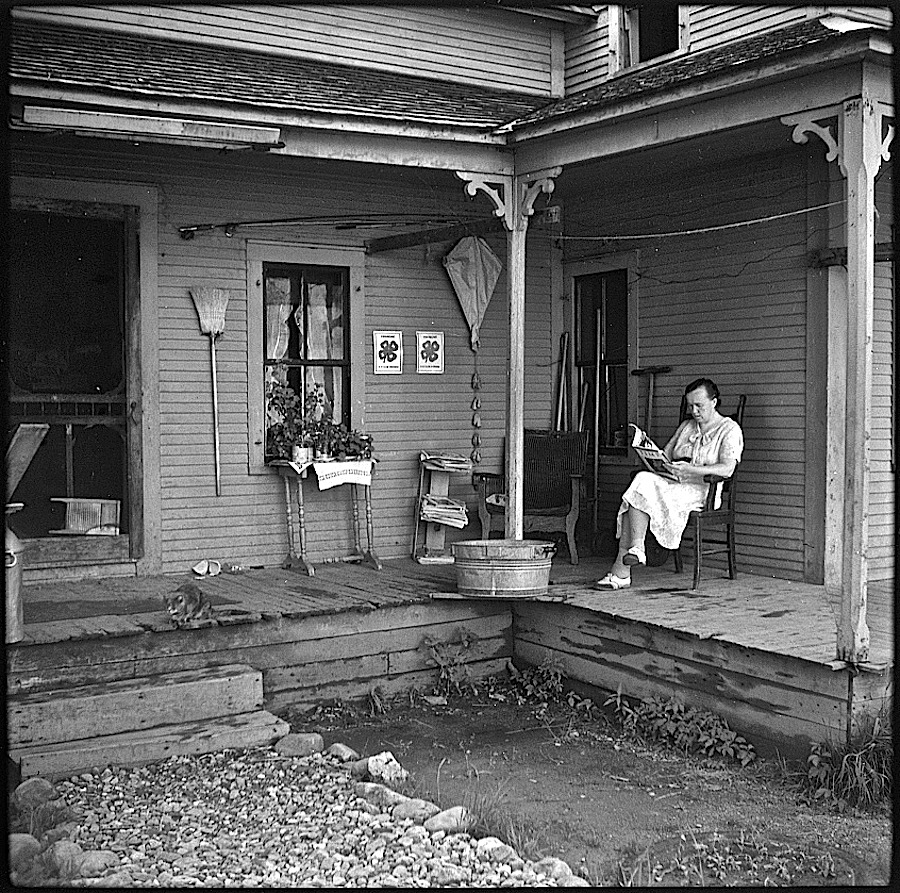
The Sunday porch/enclos*ure: Lincoln VT, 1940, by L. Rosskam, via Library of Congress“Front porch. Lincoln, Vermont,” July 1940, by Louise Rosskam, via the FSA/OWI Collection, Library of Congress Prints and Photographs Division.

The porch as a farm woman’s summertime mission control room. . .

Her broom (and 4H posters) are on the wall, and more cleaning and gardening tools are behind the chair.  She has stacks of magazines (and TIME in hand).  Her potted plants are doing well.  Above them are fishing poles and a kite.

The cat dozes above the steps — I think the scrub board behind the broken screen is there to keep him out of the house.

The wash tub is setting on a shelf built across the angle where the two sides of the porch meet.  This puzzled me until I realized that it must be there to catch rainwater from the roof.

The photographer, Louise Rosskam (1910-2003), was “one of the elusive pioneers of what has been called the golden age of documentary photography,” according to the Library of Congress.

Like many of her photos, this image was attributed for many years to her husband Edwin, who was also a photographer.  At the time it was taken — as part of a series on rural Vermont — he was working as an editor for the Farm Security Administration (FSA) of the U.S. government.

Her first professional photography work had been in the mid 1930s for the Philadelphia Record.  The paper would only actually hire Edwin, so he recouped her wages by including them on his expense vouchers under “gas and oil.”

The couple then produced documentary photo books on San Francisco and Washington, D.C. (but only Edwin’s name appeared on the covers).  After 1939, when Edwin went to work for the FSA, Louise began to take freelance photographs.  In the 40s, they both worked for Standard Oil Company.

Near the end of her life, Louise began to write to institutions like the Library of Congress correcting the credit given to Edwin for her own photos.  There’s an interesting interview with her from 2000 here.

Vintage landscape: New Orleans

Vintage landscape/enclos*ure: Ursuline Convent, New Orleans, Library of Congress“Doorway and courtyard of the Ursuline Convent, New Orleans,” between 1920 and 1926, by Arnold Genthe, via Library of Congress Prints and Photographs Division.

The Old Ursuline Convent was completed in 1753 in a French Colonial style.  It may be one of the oldest buildings in the Mississippi Valley. It was a convent only until the 1820s, however, when the nuns turned it over to the Bishop of New Orleans and moved to a larger place in Treme.

At the time of this photo, the building was a rectory for the adjoining church of St. Mary’s, the home parish for the area’s many Italian immigrants.  Today, it is part of the Catholic Cultural Heritage Center of the Archdiocese of New Orleans.

Vintage landscape: woodland teahouse

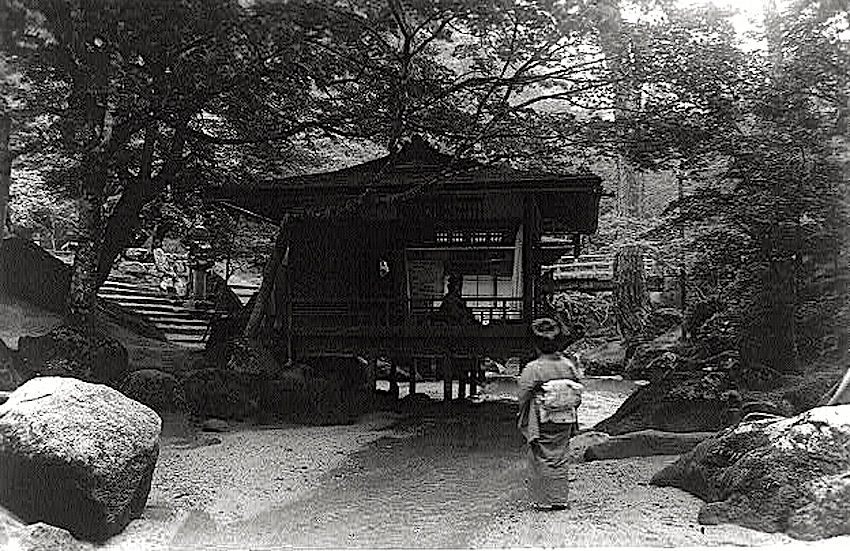
Japanese teahouse, Library of CongressTea house in a woodland, Itsuku-Shima, Japan,” between 1890 and 1923, photographer unknown, via the Frank and Frances Carpenter Collection of the Library of Congress Prints and Photographs Division.

The garden may be on Itsukushima Island (now called Miyajima).

I’m sorry there was no Sunday porch two days ago; there was also no weekend internet service in our house.

What carols, like the blazon of a king,
Fill all the dawn with wonder?
Oh, hush,
It is the thrush,
In the deep and woody glen!

— Edwin Markham, from “A Lyric of the Dawn

Vintage landscape: Meridian Hill Park

Orpheus with his lute made trees. . .*

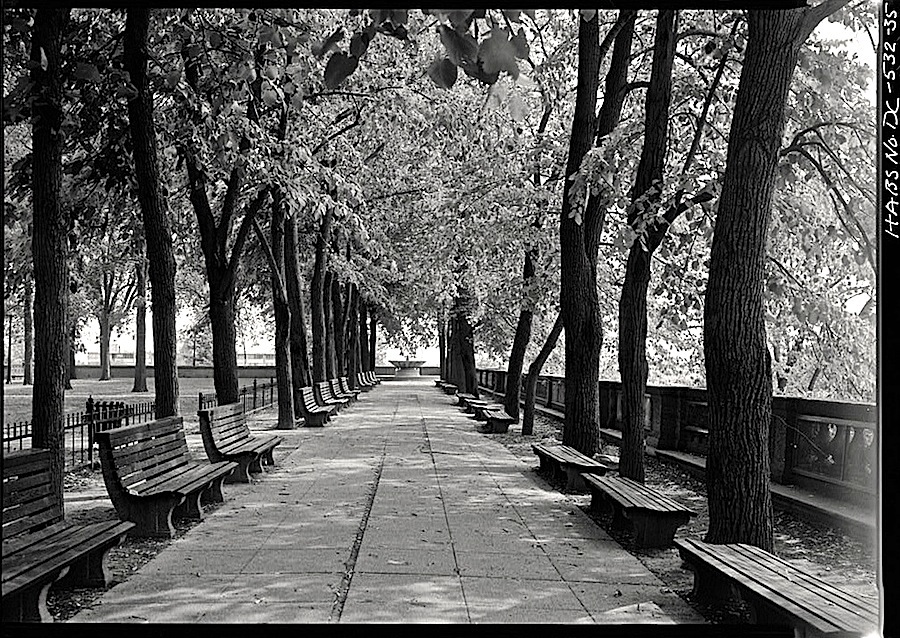
Vintage landscape/enclos*ure: Meridian Hill Park, D.C., 1976, via Library of CongressThe Linden Walk, Meridian Hill Park,* Washington, D.C., August 1976, by Jack Boucher for an Historical American Buildings Survey (HABS), via Library of Congress Prints and Photographs Division.

This HABS has photos from 1976 and 1985. The report, which contains a very detailed description and history of the park’s design, was completed in 1987.

Unfortunately, the report notes that the linden trees shown above had to be cut down between 1976 and 1985 because they were threatening the 16th St. retaining wall (on the right side). They were replaced quickly, however, as you can see here.

The HABS report summarizes the importance of Meridian Hill Park this way:

One of the first public parks in the United States to be designed as a formal park, generally considered to be in the continental tradition, rather than in the “natural” mode associated with the English park; Meridian Hill Park was constructed [from about 1914 to 1936]. . . . Under the guidance of the Commission of Fine Arts, the park benefited from the finest criticism of the day. The technologically innovative use of exposed aggregate concrete provided a facsimile of the stone and mosaic masonry traditionally employed in the Italian Garden. The Park represents an effort in a democratic society to match the major European city park.

Today, the last Friday in April, is Arbor Day in many states in the U.S. The day was established to encourage people to plant and care for trees.

The words themselves are a delight to learn,
You might be in a foreign land of terms
Like samara, capsule, drupe, legume and pome,
Where bark is papery, plated, warty or smooth.

Howard Nemerov, from “Learning the Trees


*Meridian Hill Park is bounded by Fifteenth, Sixteenth, Euclid and W Streets, N.W.  The quote above the photo is by William Shakespeare, from Henry VIII.

Life in gardens: Rochester, N.Y.

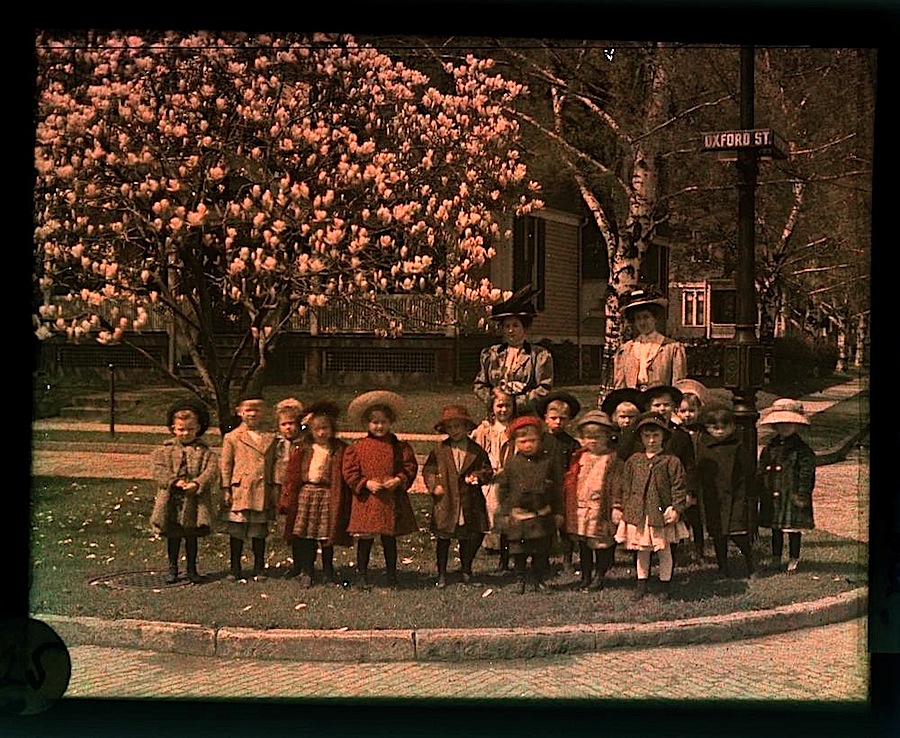
Rochester, NY, c. 1910, via George Eastman House Collection“Schoolchildren with teachers under Magnolia trees on Oxford* Street,” c. 1910, an autochrome by Charles C. Zoller, via George Eastman House Collection on flickr.

Click on the photo to get a better look.  I like the outfits, particularly that of the little girl on the far right.

The Collection describes the process of making an autochrome like this:

After decades of wishing for a practical color process, photographers were thrilled when Auguste and Louis Lumière announced the invention of the autochrome process. . . in 1904. The process used a screen of tiny potato starch grains dyed orange-red, green and violet. Dusted onto a glass plate, the dyed grains were covered with a layer of sensitive panchromatic silver bromide emulsion. As light entered the camera, it was filtered by the dyed grains before it reached the emulsion. While the exposure time was very long, the plate could be processed easily by a photographer familiar with standard darkroom procedures. The result was a unique, realistic, positive color image on glass that required no further printing.


*Commenters on the image’s flickr page thought the cross street in the picture was either Harvard St. or Brighton St.