Each time we’ve travelled to the north of Rwanda, we’ve passed the small Chinese cemetery in the Rulindo District. Last month, we stopped for a few minutes.
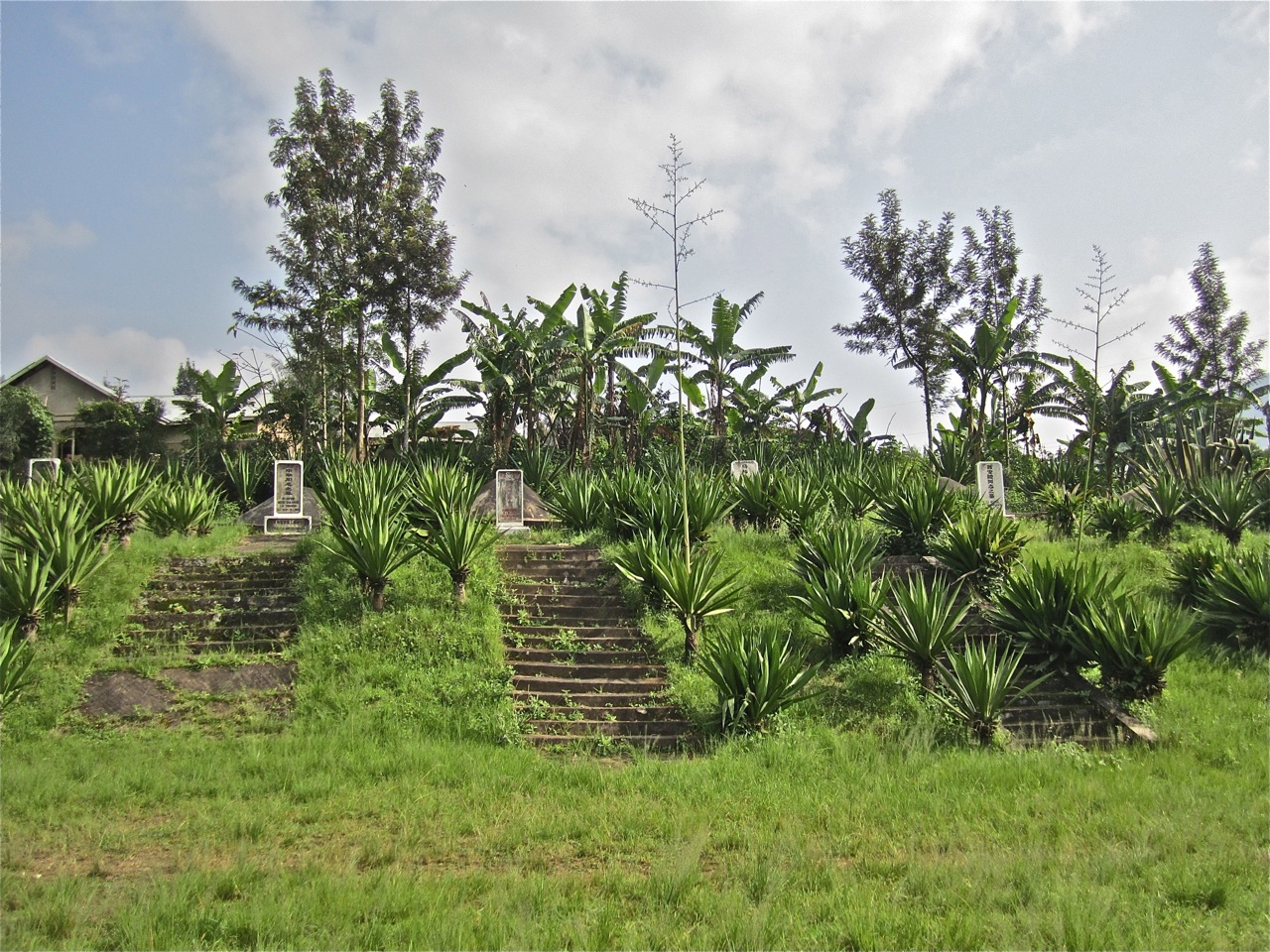
The cemetery is located just off the road to Muzanze, about 50 minutes from Kigali. It holds the remains of 10 Chinese citizens who died in Rwanda during the 1980s and 1990s, while they were working on development projects of road construction or health services.
The graves are in a row near the top of a hill, with a set of stairs leading up to each one.
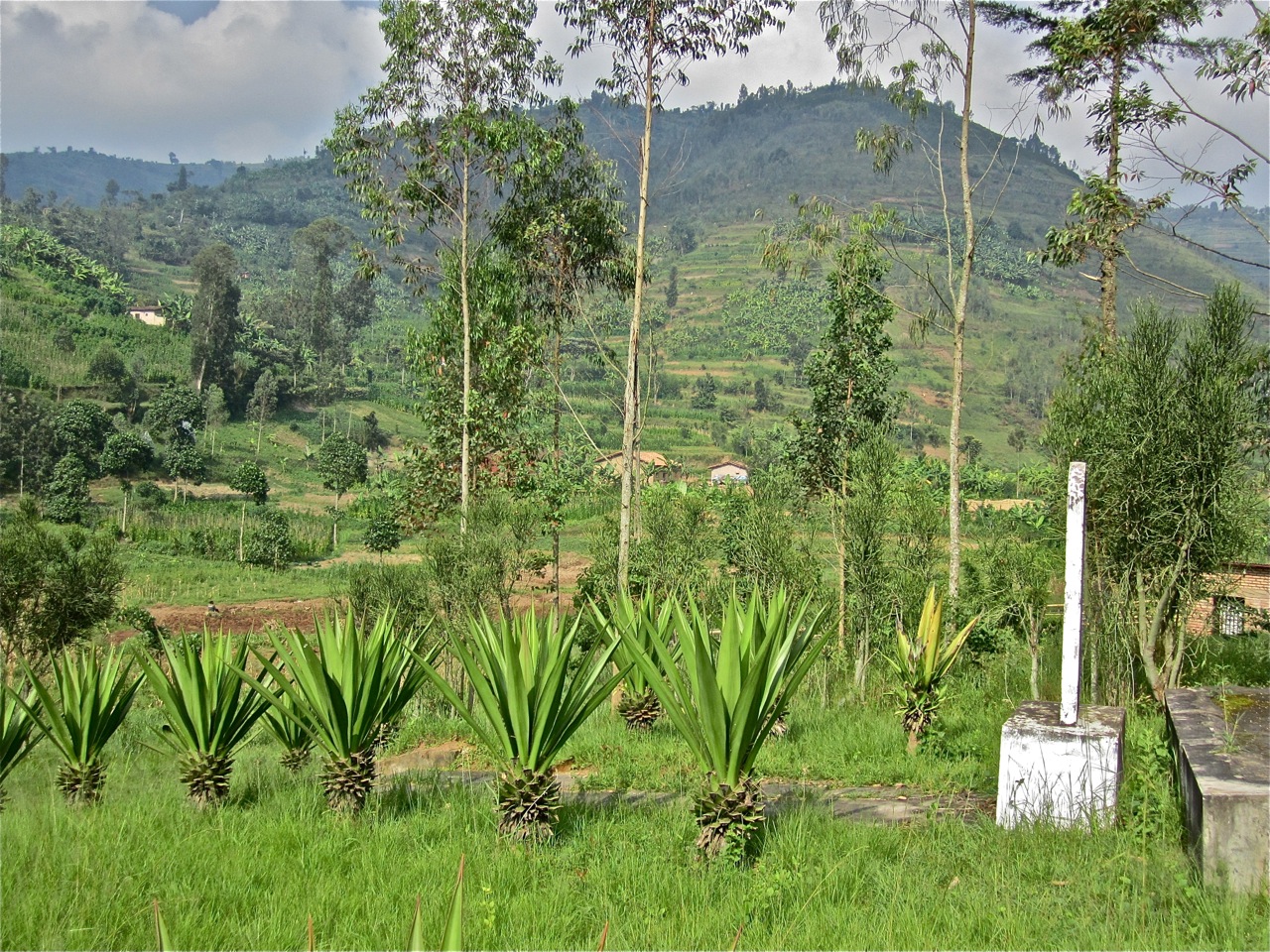
The material elements are now-weathered concrete, grass, and agaves.
The arrangement is simple, the effect poignant.
The cemetery is cared for, and the Chinese community, led by Ambassador Shll Zhan, held a ceremony there for the Qingming Festival on April 5 of this year.
When I looked at these pictures, I remembered two photos I had taken in 2007 of another small, touching cemetery garden. It holds the graves of eighteen Algerian retainers who had followed their Emir into imprisonment in France in 1848.
Abd al-Qadir and his household were held in the Château d’Amboise in the Loire Valley. Those who died before he was released in 1852 were buried there.
The memorial garden on the grounds of the château is beautiful. It was built in 2002, according to one source, but I have been unable to find out any more about it.
The square markers are set in a rectangle planted with low mounding plants. A hedge of rosemary diagonally intersects the space.
A year ago today, my husband and I took a different way home from Georgetown and discovered Dumbarton Oaks Park, one of the country’s garden design treasures. I took a lot of photos and blogged about it a couple of days later, here.
The 27-acre, Washington, D.C., park was designed by Beatrix Farrand and given to the National Park Service in 1940. It has been in a poor condition for decades, but since 2010, the Dumbarton Oaks Park Conservancy has been working to restore it.
On Saturday, July 7, the Conservancy will hold a Storm Clean-Up to remove debris from the June 29 derecho storm. They are asking for volunteers to join them from 9:00 a.m. to noon, starting at the Lover’s Lane Entrance on R Street.
For more information, see here and contact Ann Aldrich, aaldrich@dopark.org.
I’m afraid I’ve let all the work we’ve done on our Kigali garden recently move well ahead of writing posts about it.
We — the gardener, two temporary workers, and I — made some substantial changes during June. So much so that we’re now taking a week or so of relative rest before the gardener and I start phase two. (When I got up in the middle of the night about a week ago, I thought I was going to die, my muscles were so sore.)
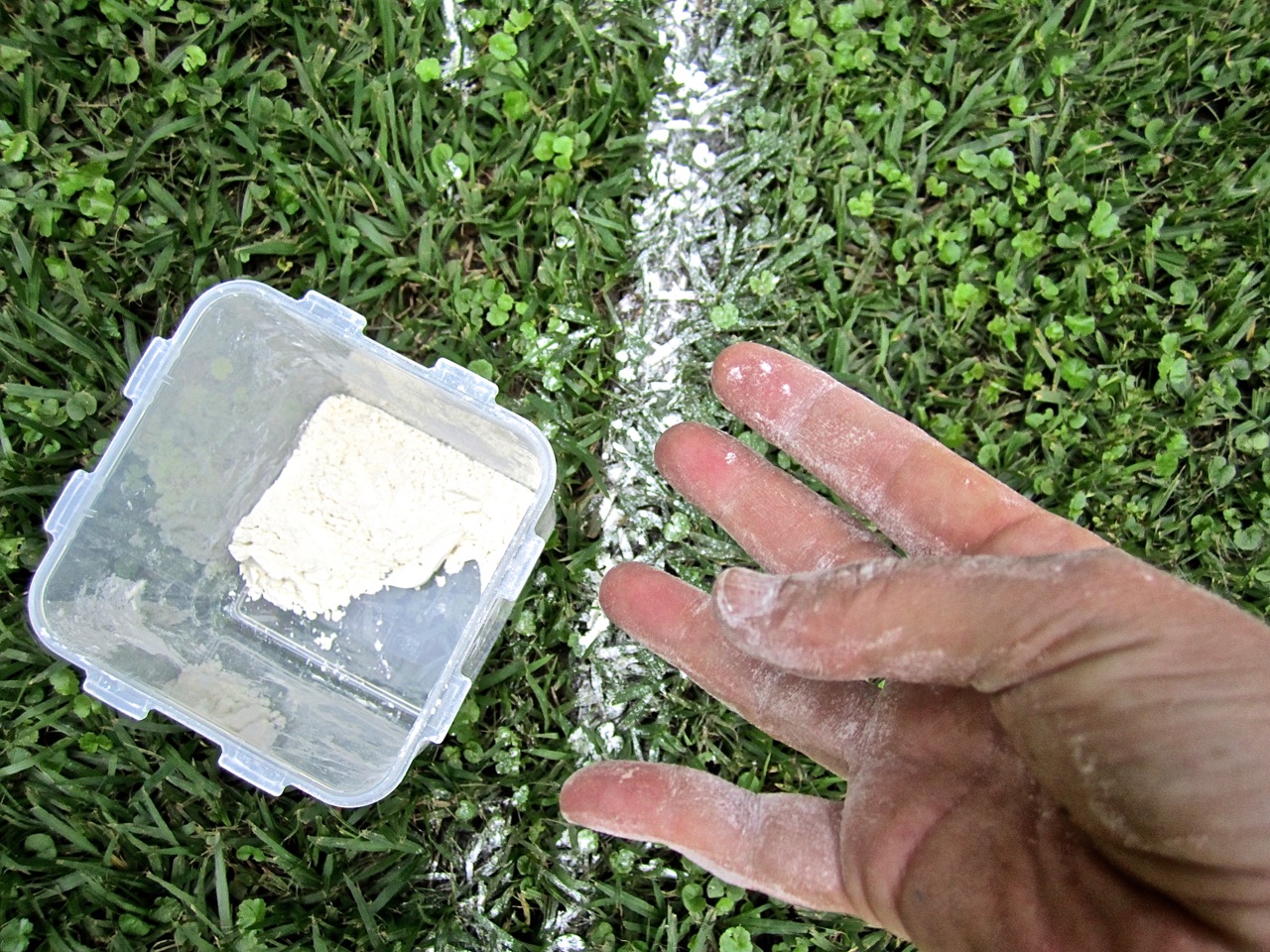
Hint: I’ve been using flour to mark the new outlines of planting beds.
So while we pause, I’ll back up and give you some “before” pictures and a little site analysis.
(I’m going to use the present tense while describing the old garden features, so as not to give away the changes we’ve made).
This is a good-sized, “working” diplomatic garden that hosts two or three receptions or ceremonies a month. It’s very pretty and lush, with mature trees and many flowering shrubs. But it also has some problem areas — places where purpose is ill-defined, opportunities for drama or charm are missed, transition points are weak, and many plants are too old or badly pruned or overcrowded.
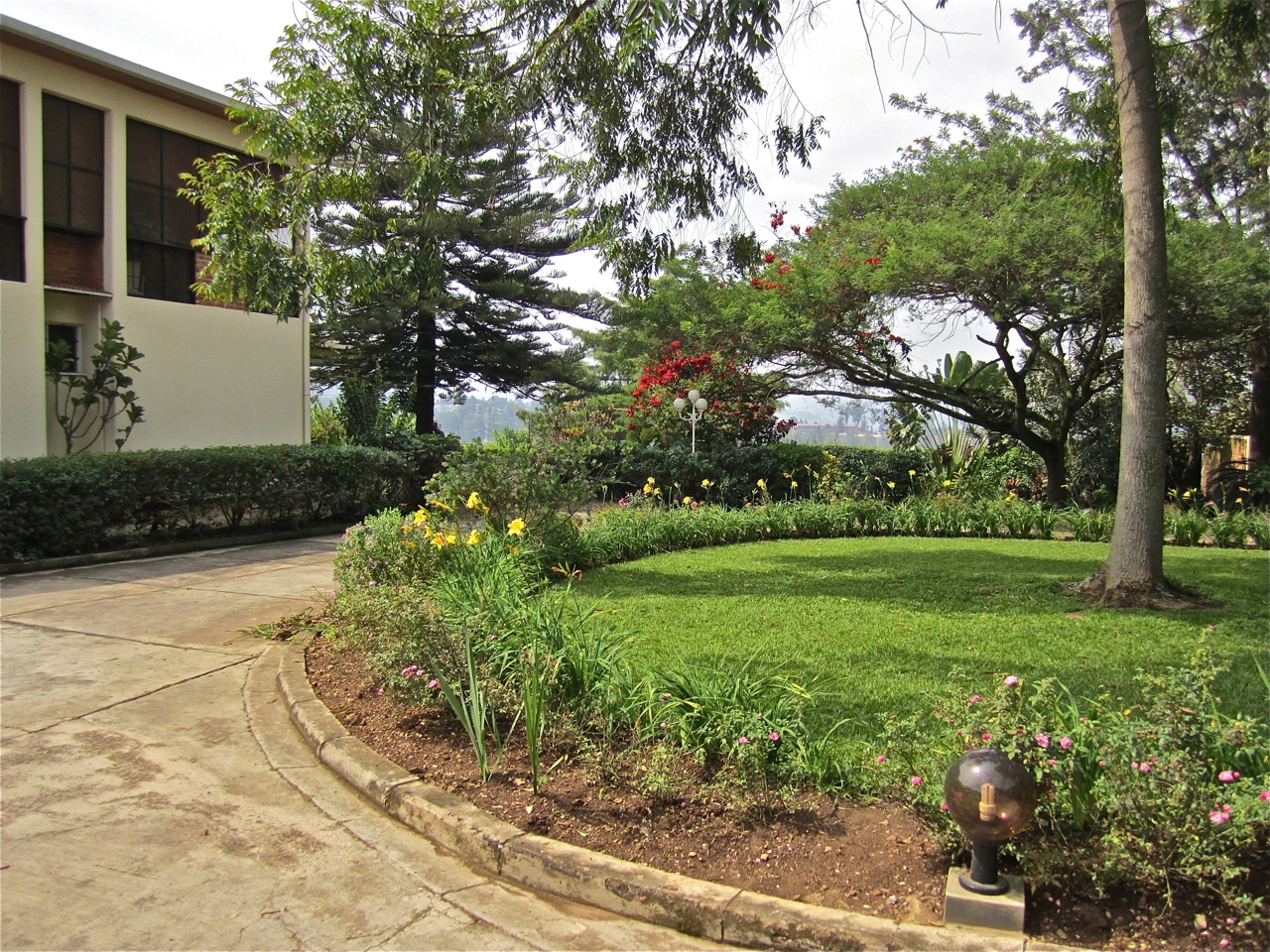
The first photo below shows the view when you enter the gate to the property: one end of the house, the circular driveway, and a semicircle of grass edged by day lilies and miniature roses. (If you look left, you see the back of the house and a parking area.)
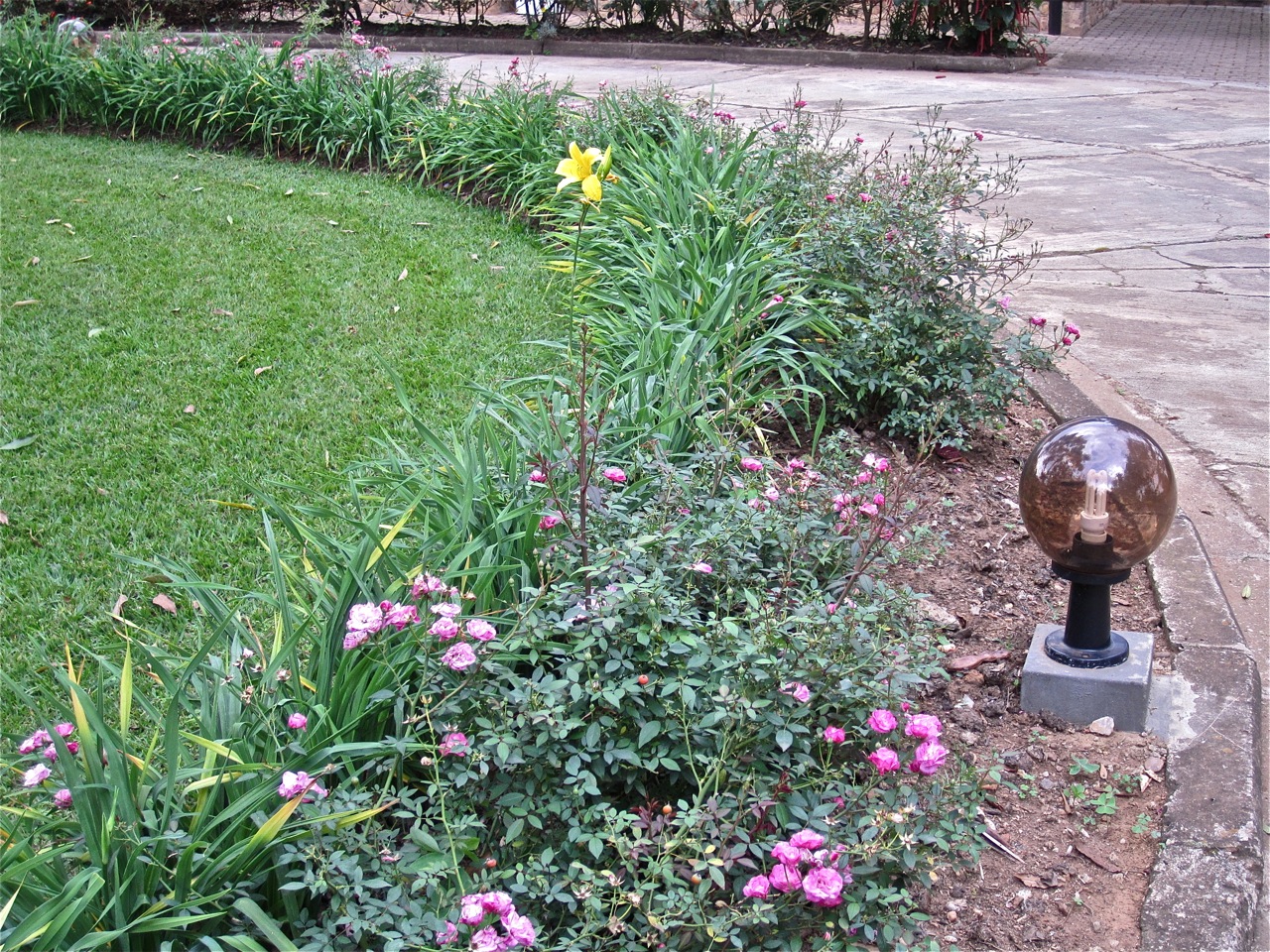
In the semi-circle, shown above and below, the miniature pink shrub roses (possibly “The Fairy” variety) are planted in a line along the curb, and the yellow day lilies are lined up right behind them. I’m not fond of the yellow/pink combination, but my main concern is that the single-file arrangement — the first thing you see when you walk or drive into the enclosure — is skimpy and makes a weak impression.
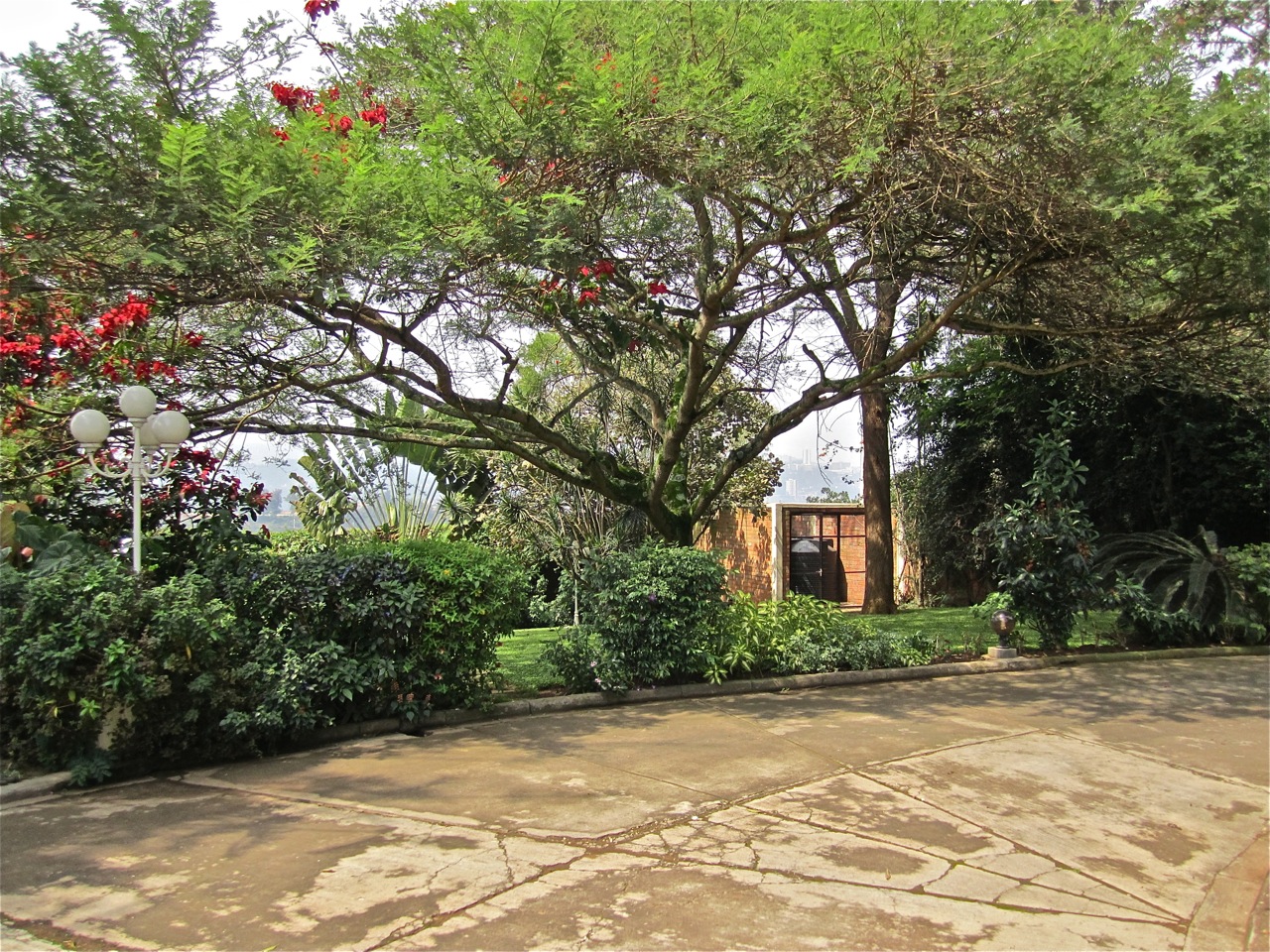
Looking right across the semi-circle, below, you see a beautiful spreading acacia tree, but its impact is obscured by the shrubs and plants growing along the edge of the drive.
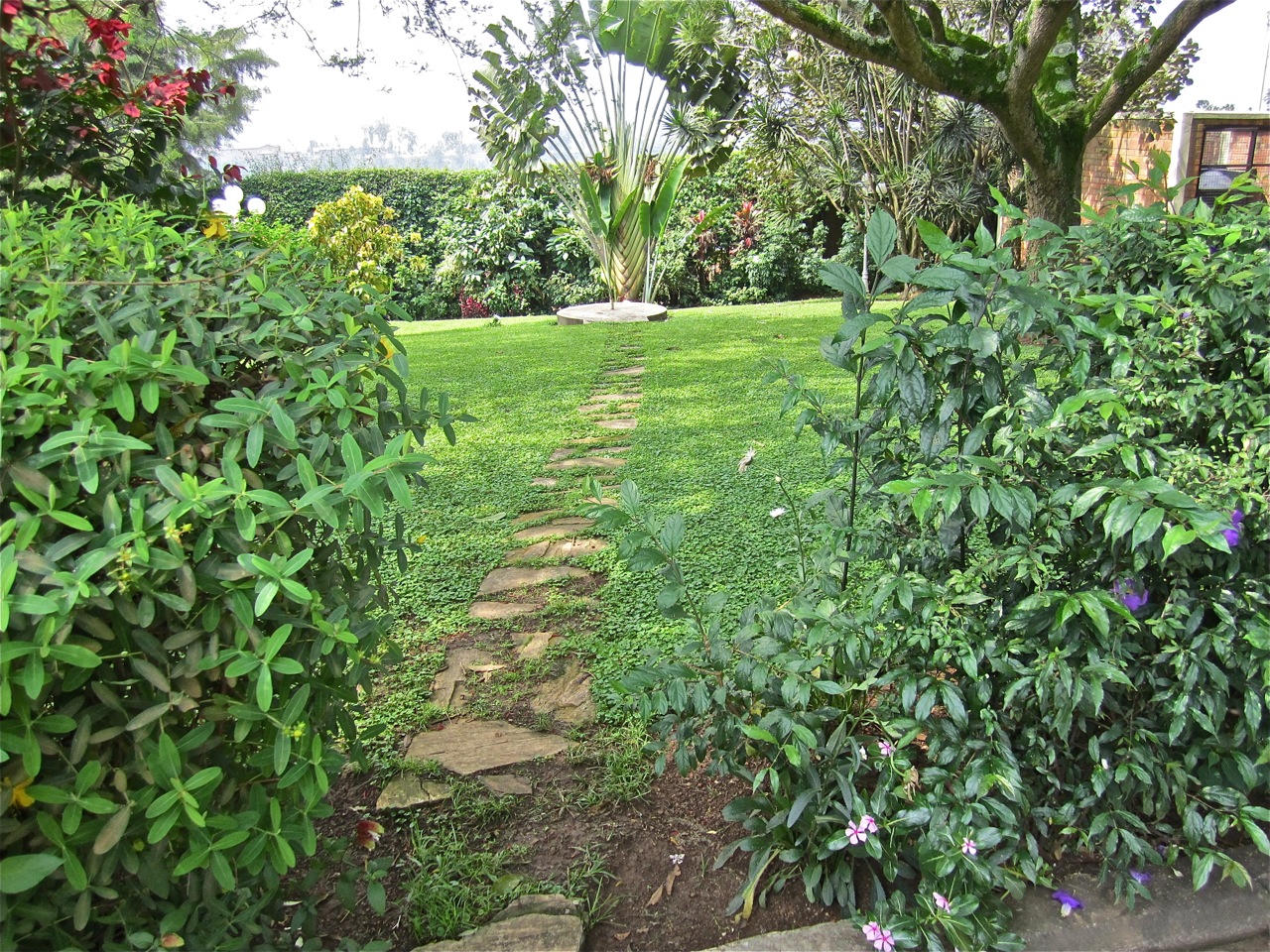
If you slip in a small space between a couple of those shrubs, as in the photo below, you find an old stone path leading to a no-longer-used concrete flagpole base. And to the left of the concrete base are steps to the long front lawn.
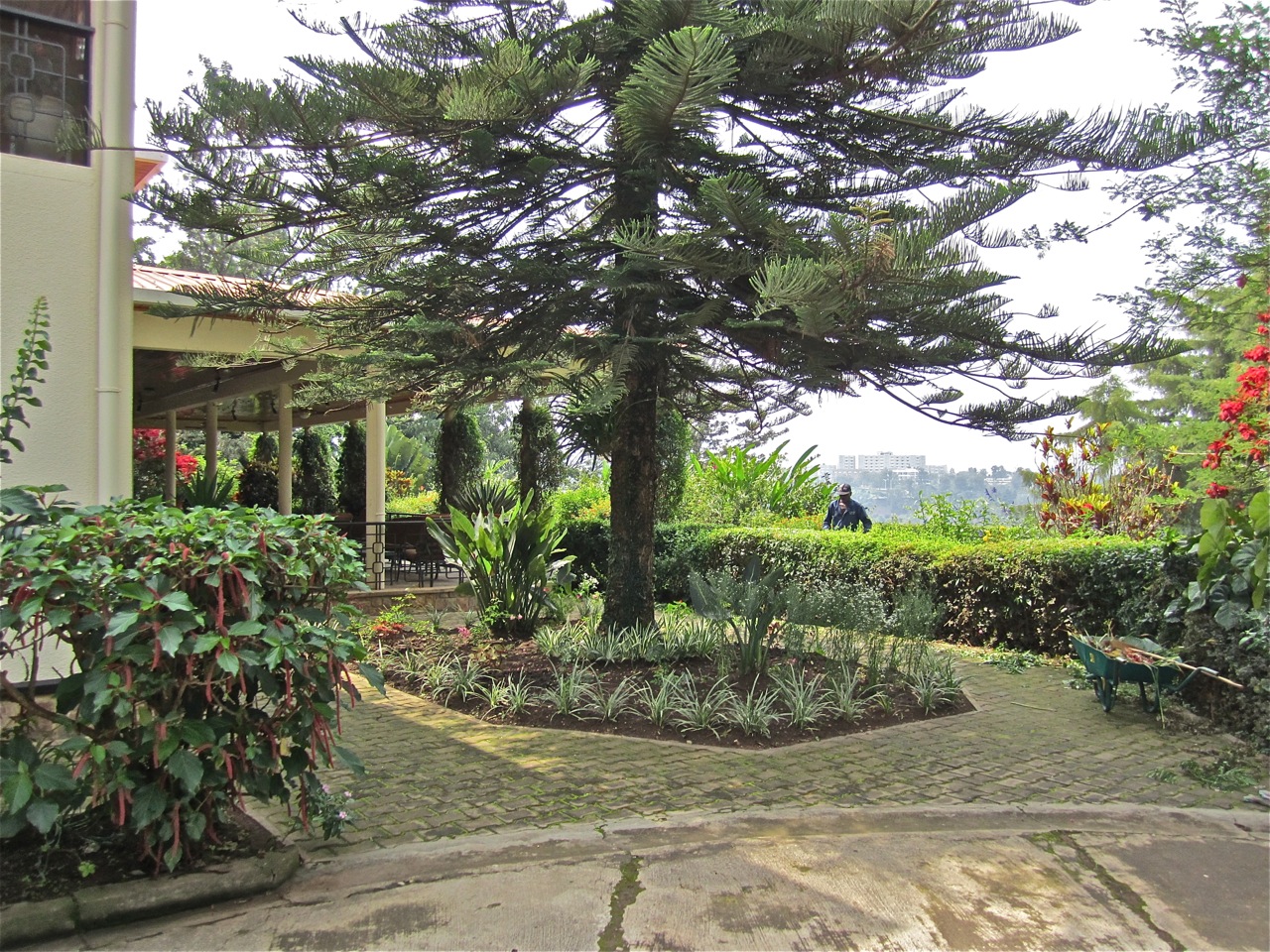
Below, the photo shows the side entrance to the front terrace. (If you back up to the starting point in the first photo above, walk down the drive along the side of the house, you reach this point.) This is where we welcome guests. Because of the planting bed in the center, and the clipped hedges at the edge, the paved walkways only comfortably allow for two people to stand side by side.
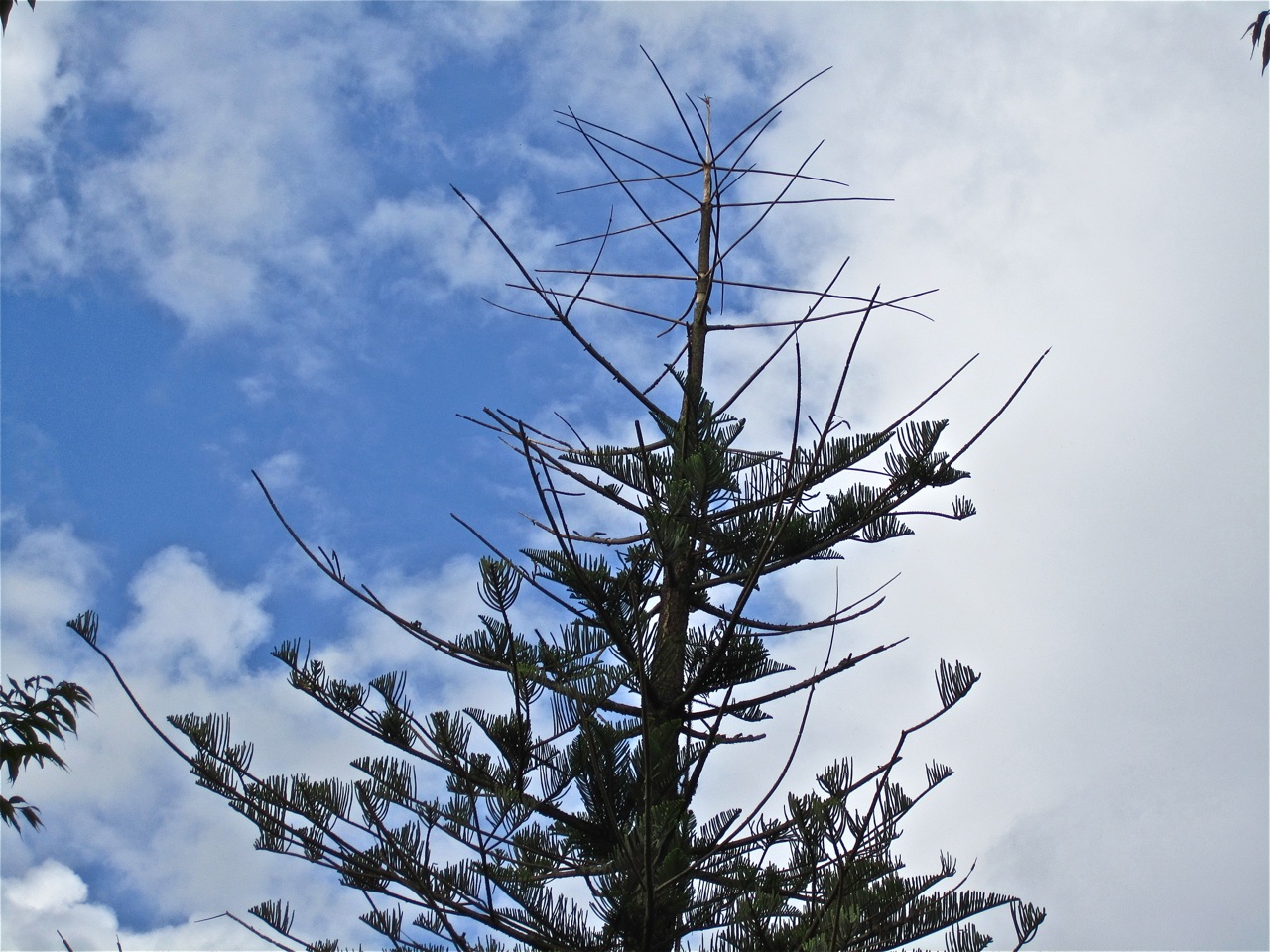
The hedge is made up of plumbago, lantana and other flowering plants, but the blooms are mostly sheared off. In center of the planting bed is a tall Norfolk pine and a rather skimpy assortment of small roses, asters (I think), lirope, coleus, and a bird of paradise.
Unfortunately, the tree is dying.
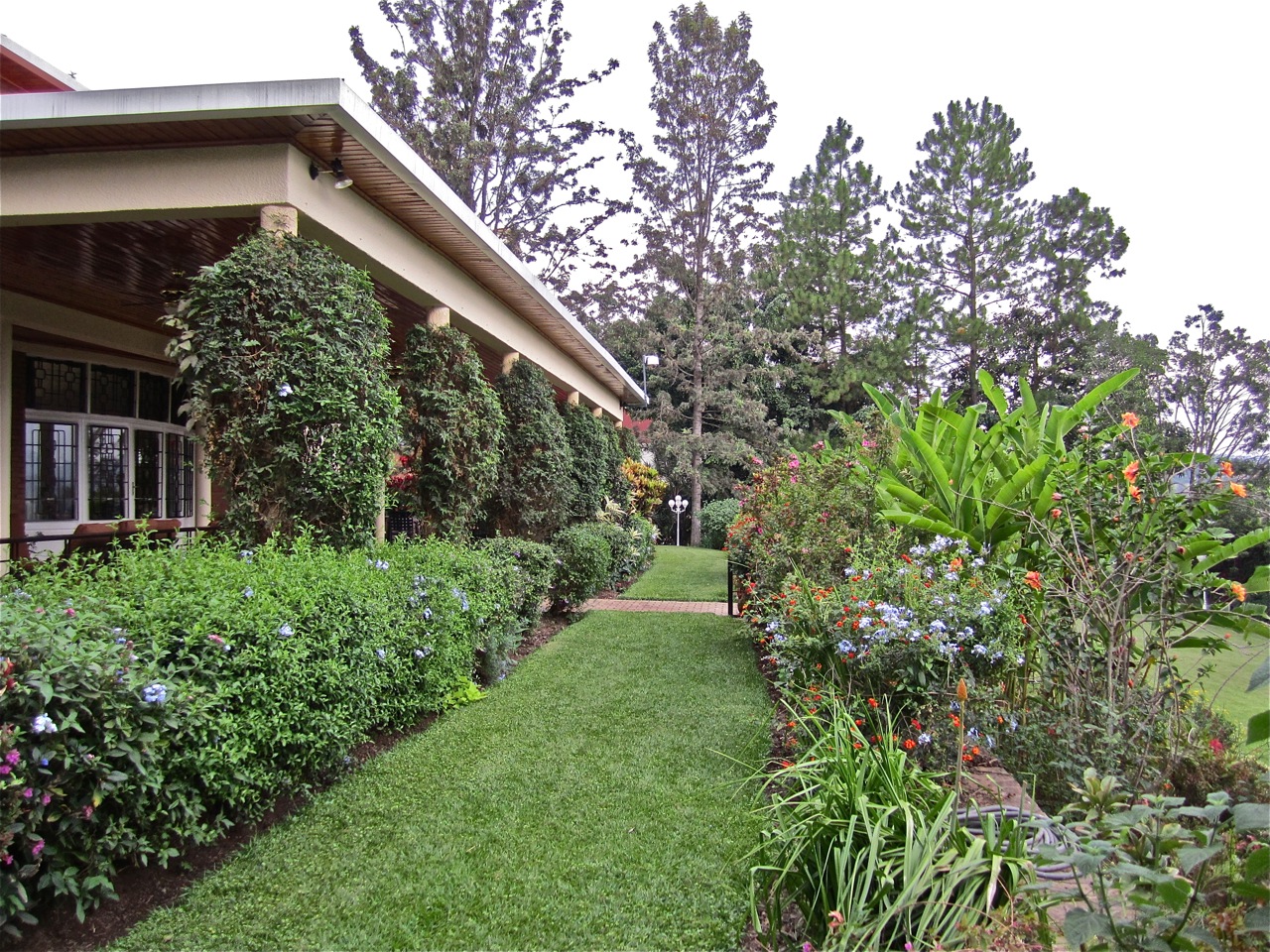
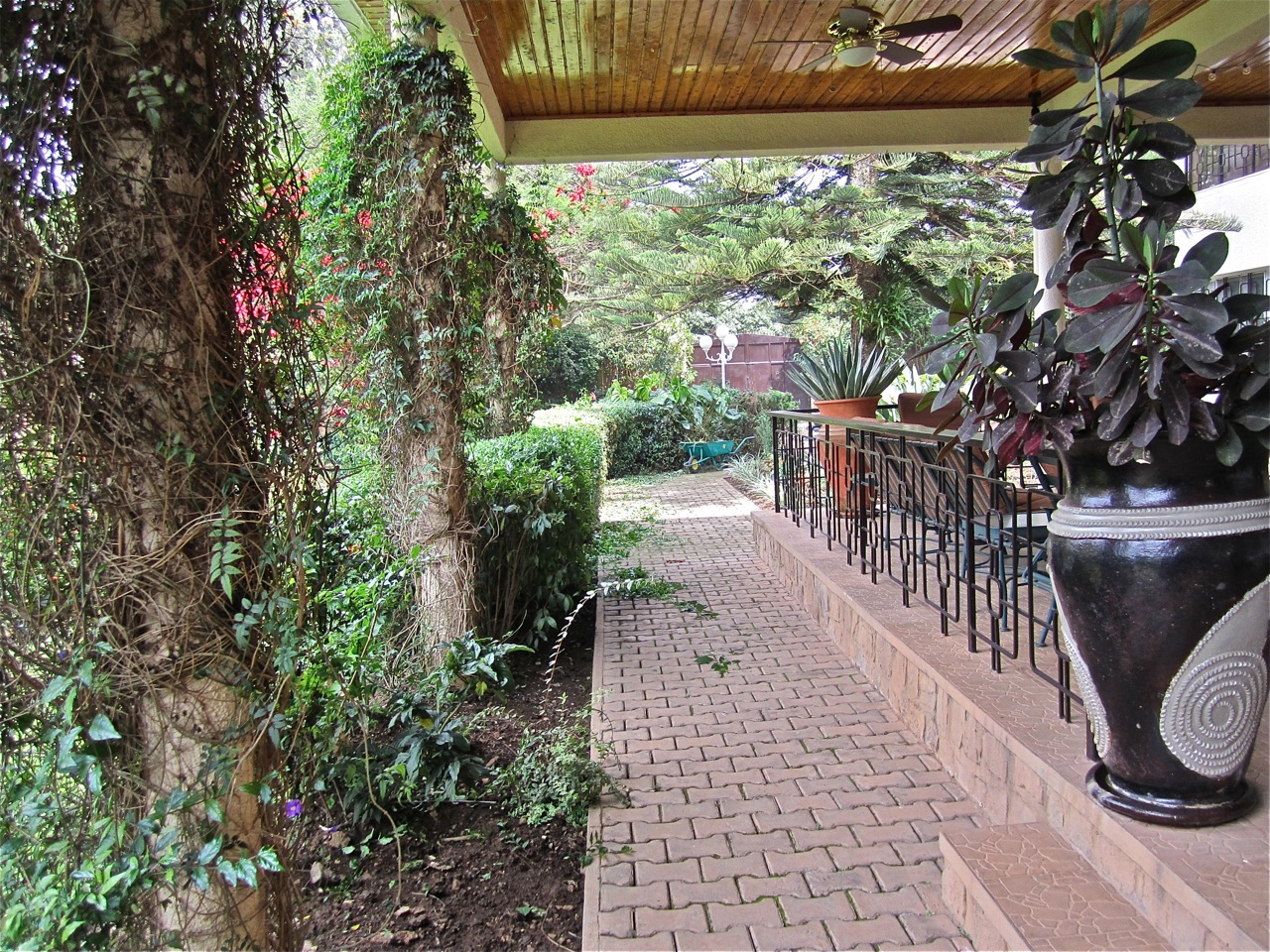
If you step through this area, you’ll be on a long terrace along the front of the house. As you can see in the photo below, in front of the terrace are two rows of (mostly) clipped shrubs and a path of grass between them. Plumbago and jasmine are growing up the house columns. The vines and shrubs attract colorful little birds right up to the terrace. However, the vines on the backsides of the columns are bare and brown from constant shearing and a lack of light.
The shrubs right along the terrace make it feel closed in, and I believe that mosquitoes hide in there in the evening.
While the arrangement is rather pretty, the grass path serves little purpose — it’s mostly blocked by the shrubs on one end, and it’s too narrow for seating. The tall plants on the right in the picture above — particularly the 6’+ lobster claws (Heliconia rostrata) — obscure the view of the hills and the city.
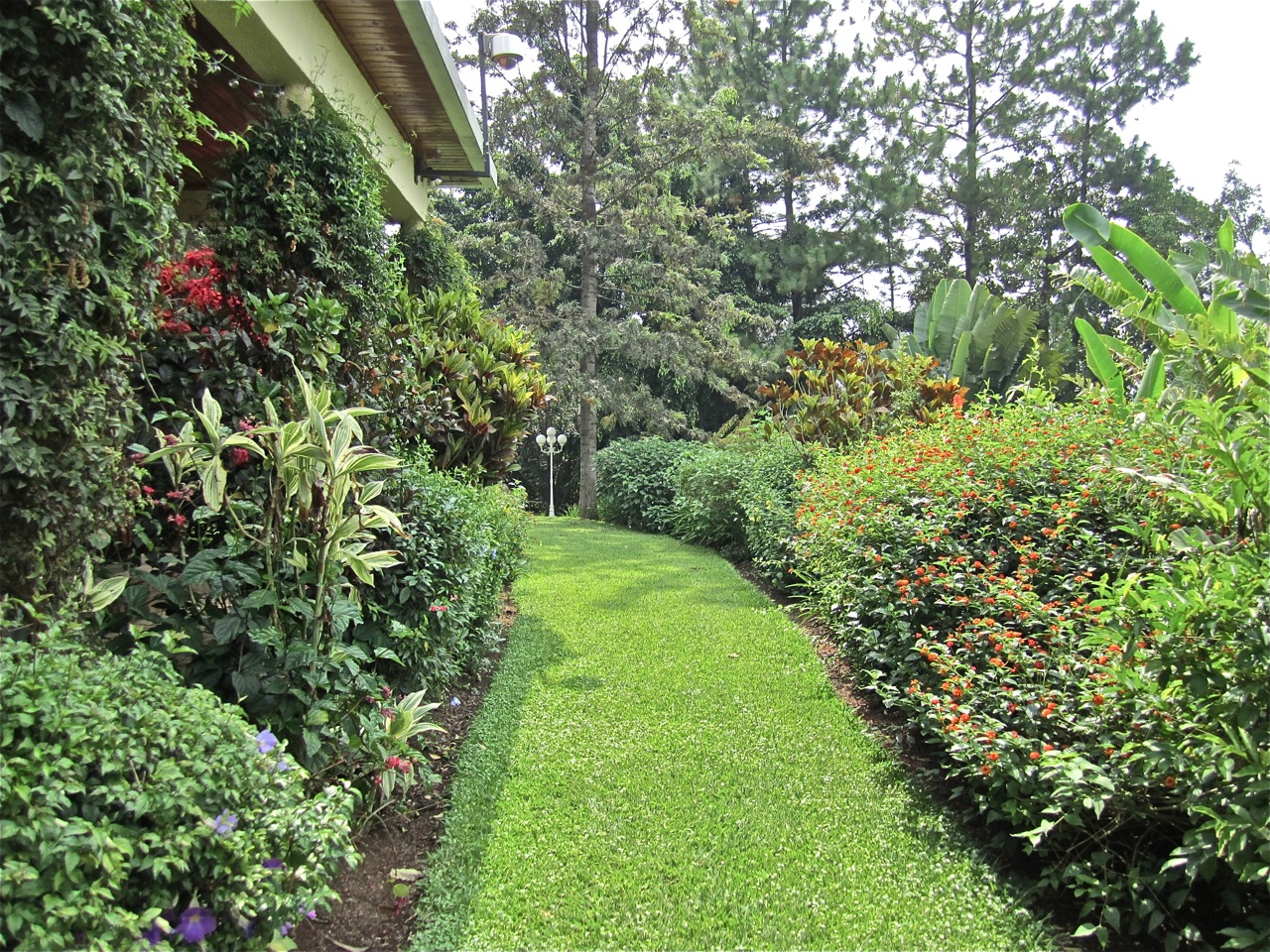
There are a lot of great plants in the beds on either side. And I always imagine Alice running through some part of Wonderland when I look down this side of the path (above).
Unfortunately, the terrace side of this strip (above) gives me an unpleasant crowded feeling, and the leaves of the vines die off from lack of good light.
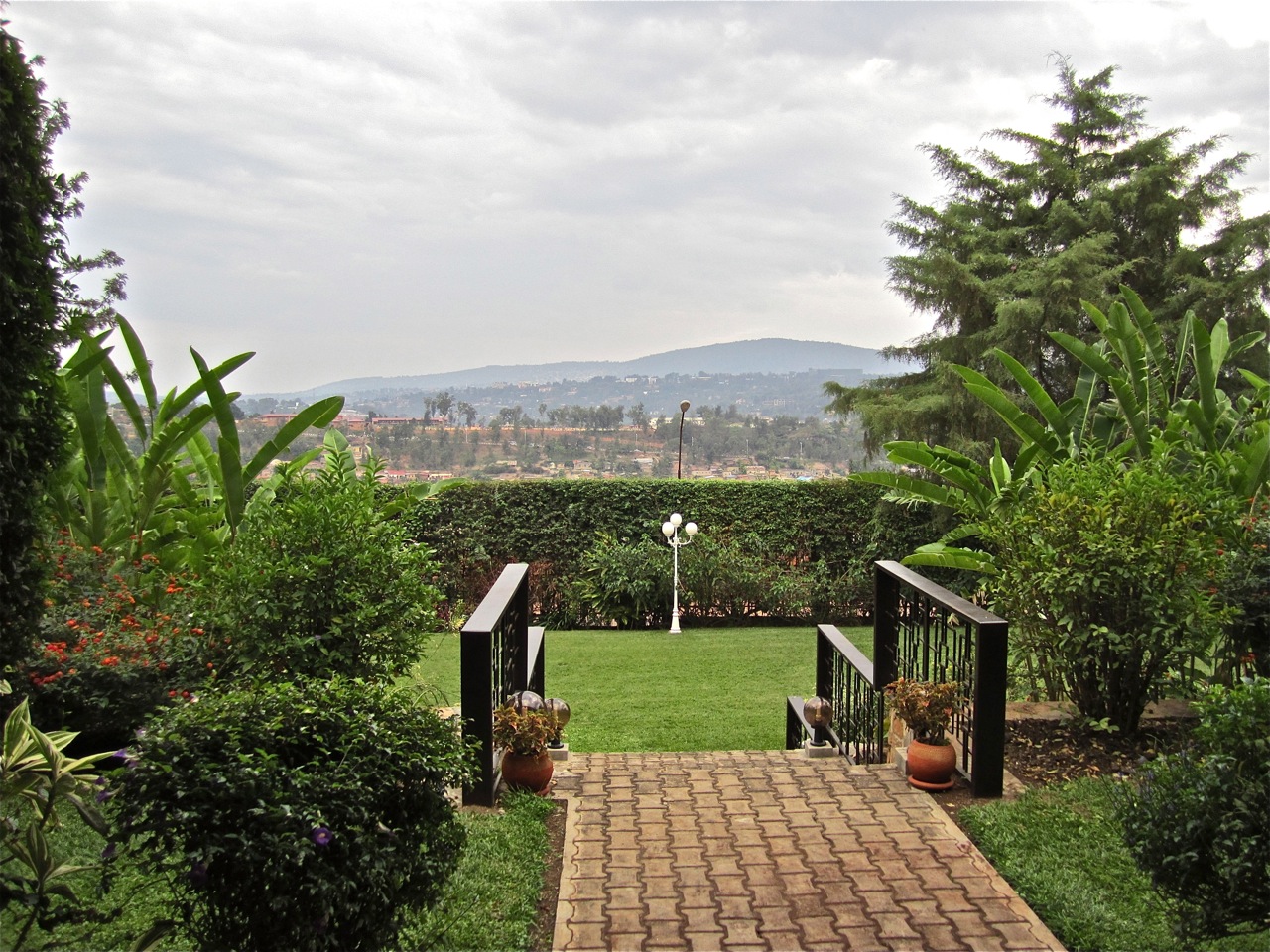
Above is the view from the center of the terrace. It’s somewhat blocked by the tall lobster claws on either side of the steps. Down those steps are two levels of stone retaining walls and then a long lawn.
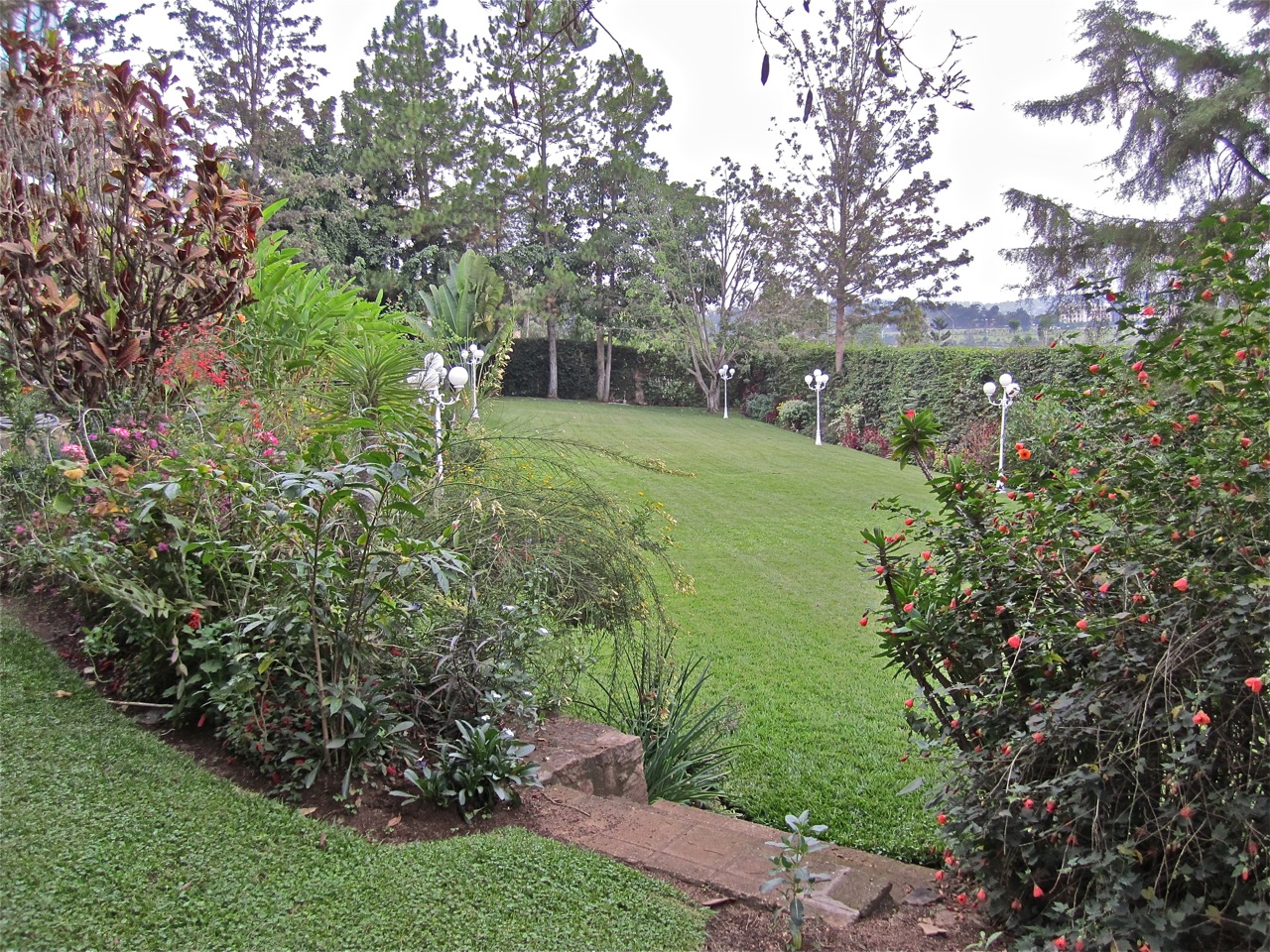
Above is a view of the lawn from one end (at the steps just to the left of the flagpole base in the earlier picture). When we entertain large groups, the embassy puts up one or two tents in the center of the lawn.
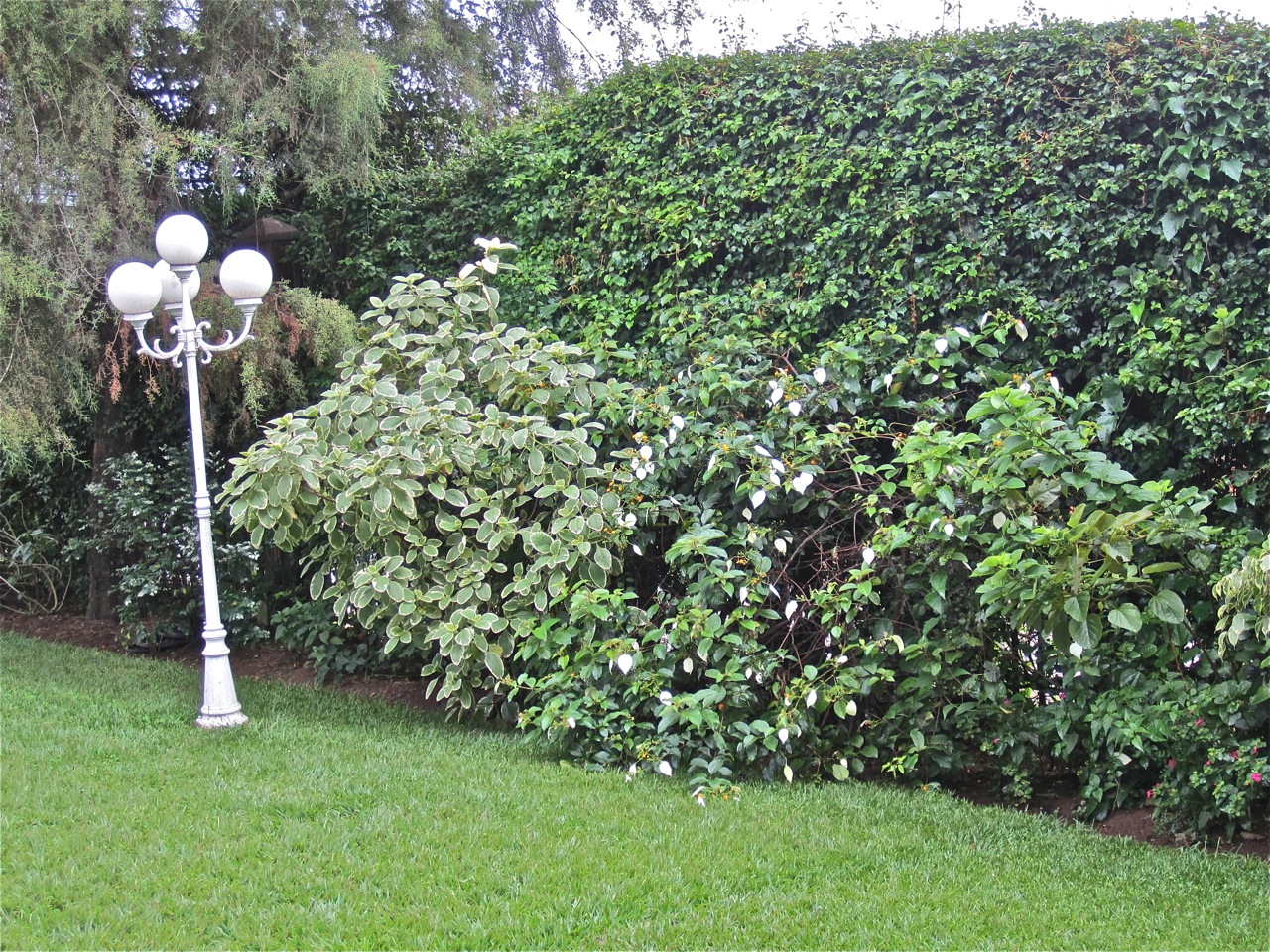
On the right side of the lawn, at the front of the property, there is a clipped bourgainvillea hedge and a variety of interesting shrubs and plants, all sharing a very narrow strip of ground. The slight dip at the edge of the lawn makes it look like the plants in front are sliding under the hedge.
In the photo above, you can see how pretty the shrubs are, but again how little room they have. Since this picture was taken, the gardener has cut these bushes along their sides to keep them from intruding onto the grass. Now you see a lot of bare stems — not very attractive.
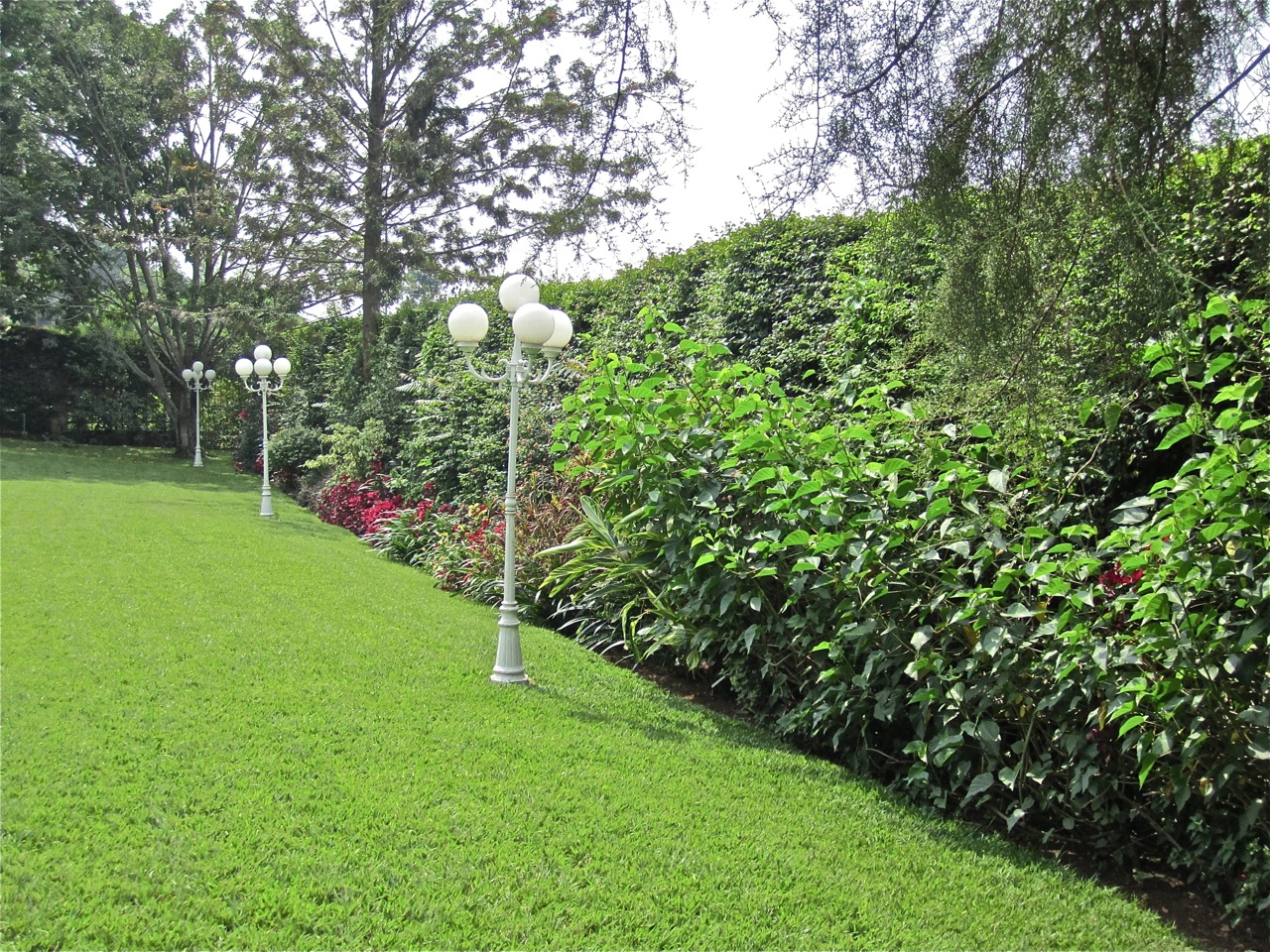
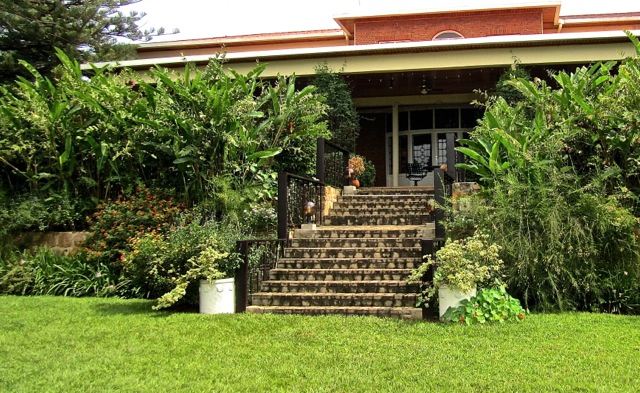
The white, curlicue, Victorian light posts in the above photos really bug me, I must admit, because, as you can see in the picture below, the lines of the house are attractively modern and simple.
Above is the view from the lawn at the bottom of the center terrace steps. You can see, to the right and left, how tall and thick the lobster claws are. (Are you getting the idea that maybe something’s going to happen to those plants?)
You can also see from this photo how the two levels of stone retaining walls that branch out from either side are an important feature of this part of the garden.
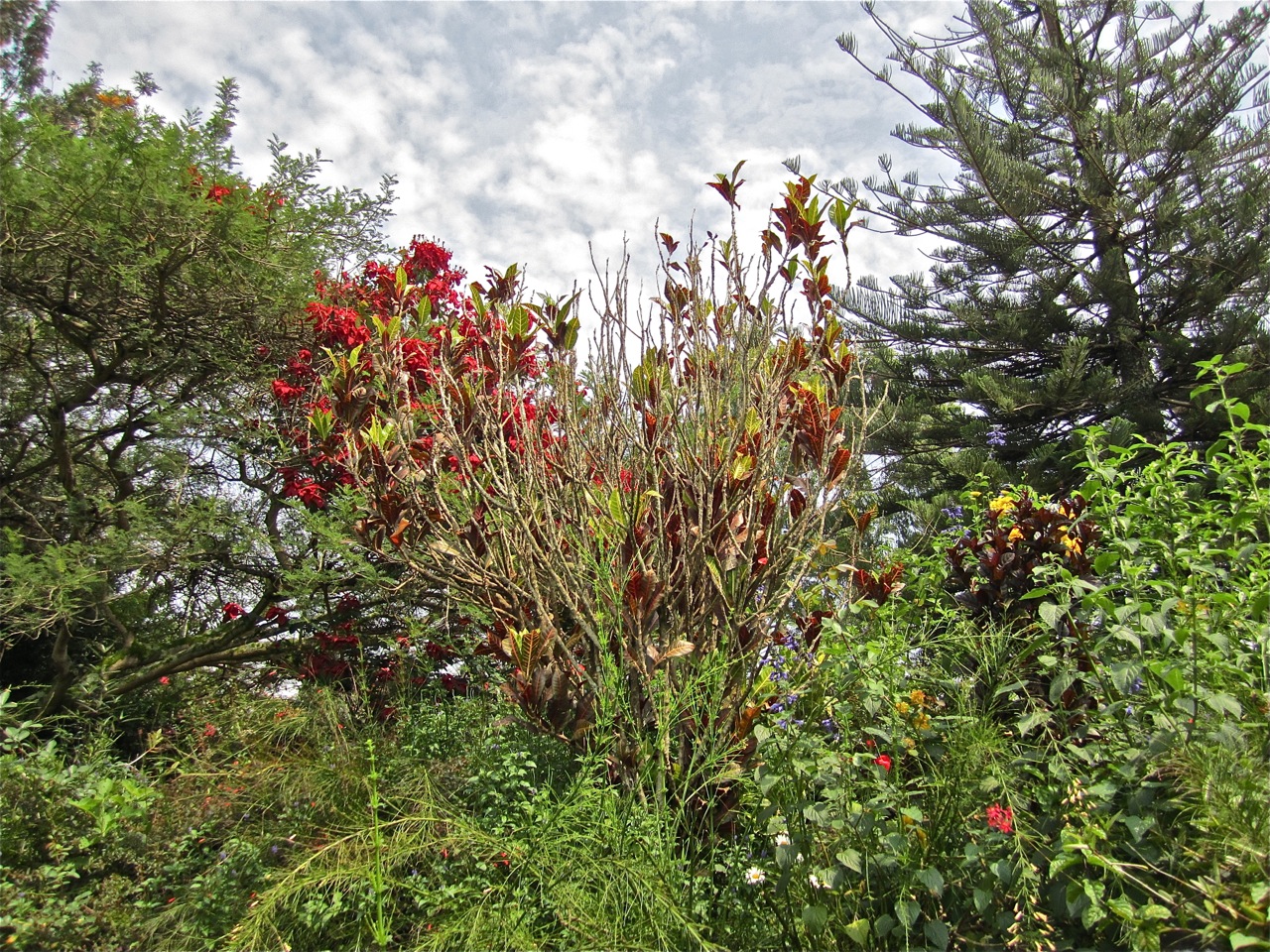
The planting beds at the top of the lower retaining walls are full of great plants, but it’s a real thicket in there. I have sometimes found three shrubs growing out of the same 8″ spot of ground. And this old croton (above) is so overgrown that it’s lost half its leaves. And at its current height, you look up onto the undersides of the remaining leaves, rather than down onto the colorful tops.
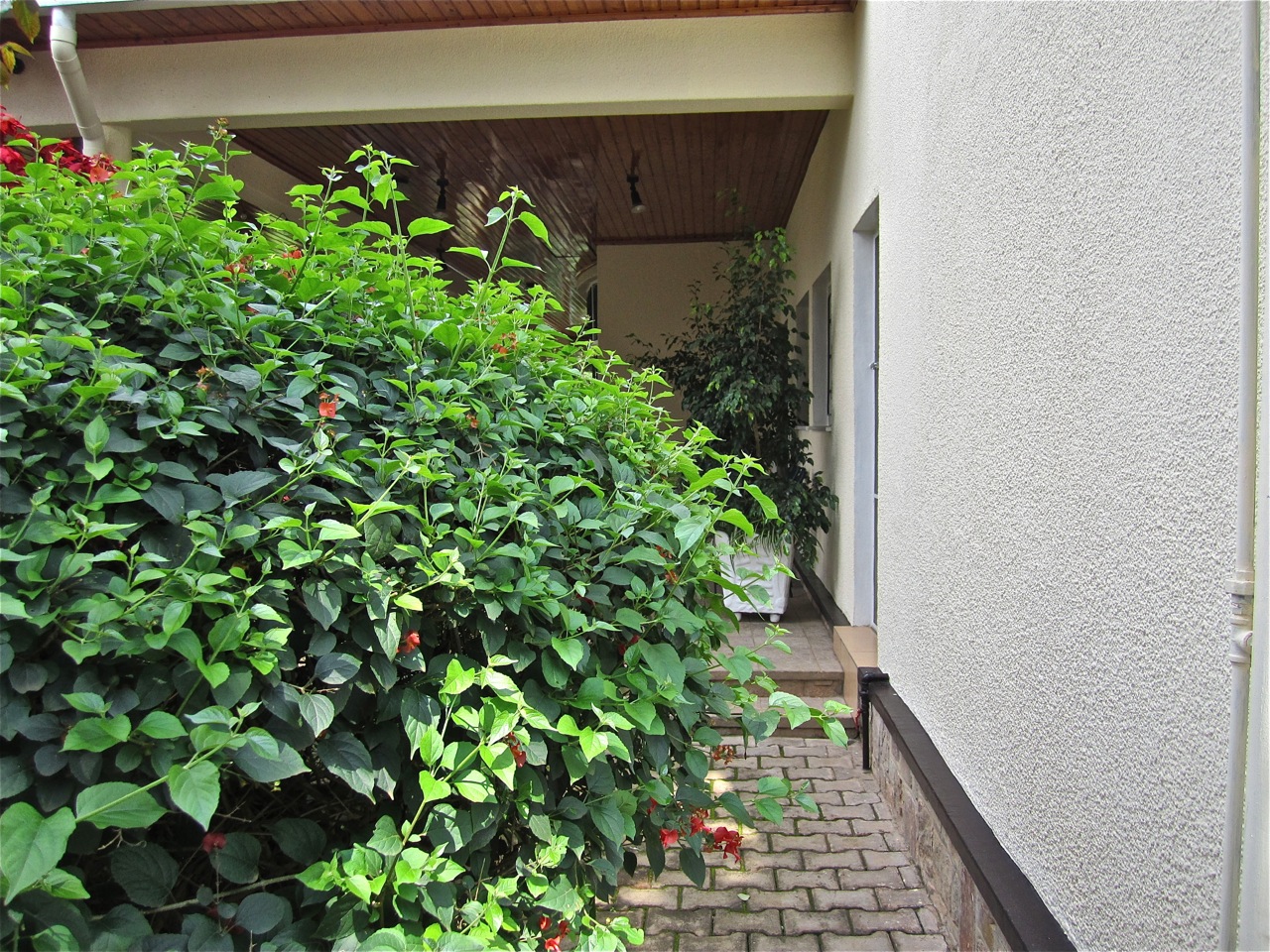
Above, going back up to the terrace and walking its length to the opposite end of the house, the path to the side yard is almost blocked by a very large, very clipped shrub (also shown below).
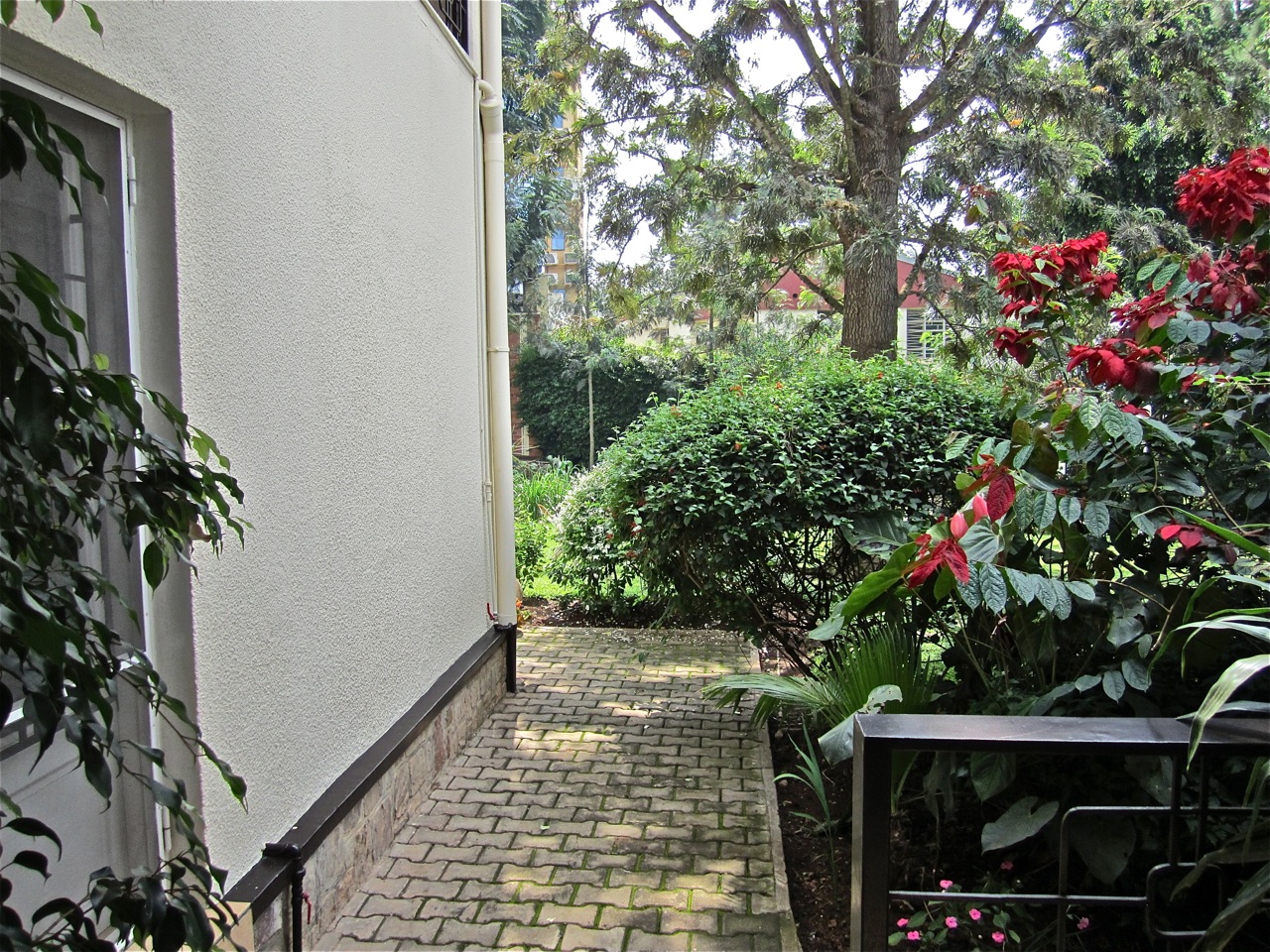
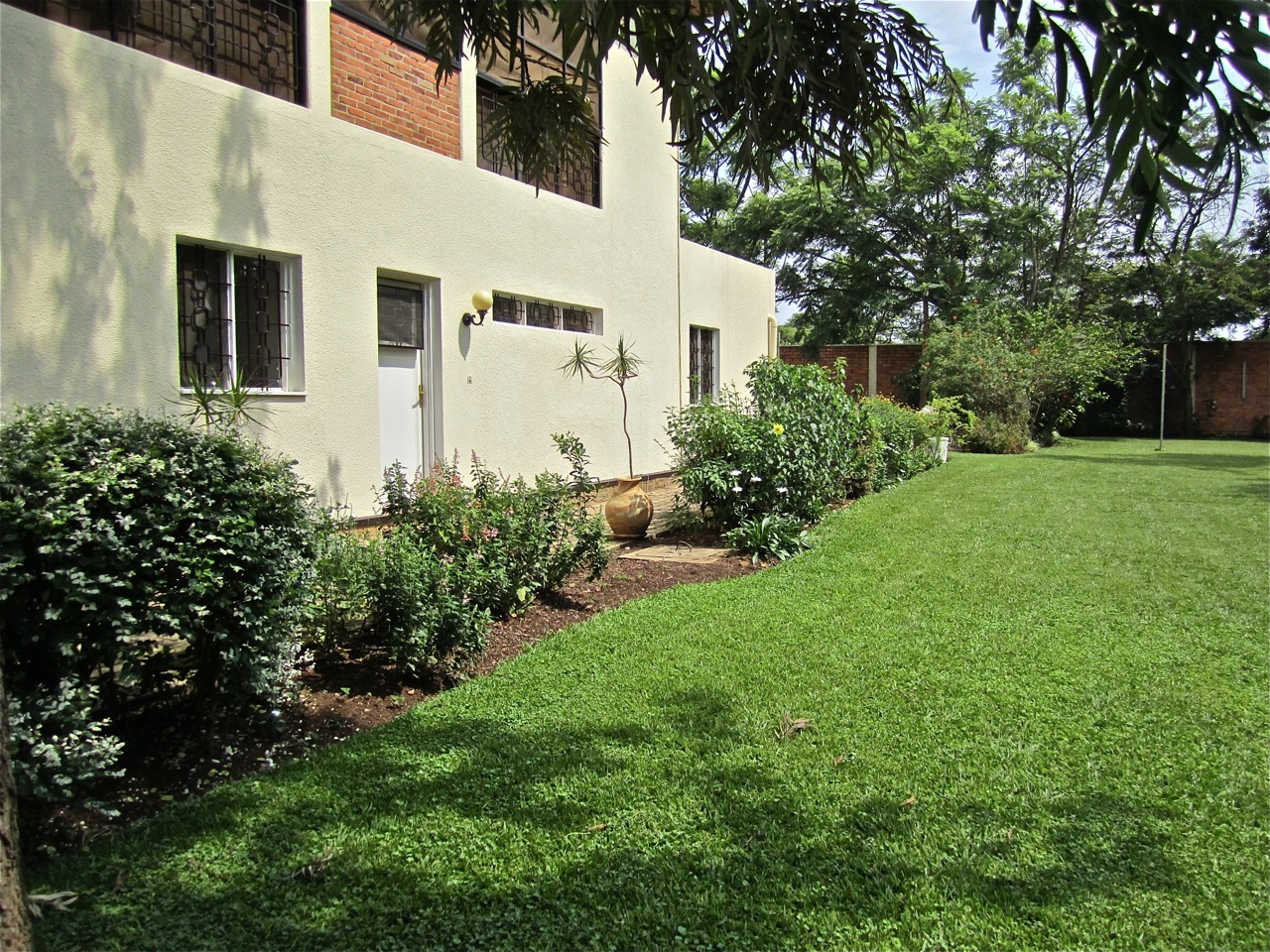
Squeezing past the bush, you come to the side yard and the other end of the house (below), which has a narrow planting strip along the sidewalk . . .
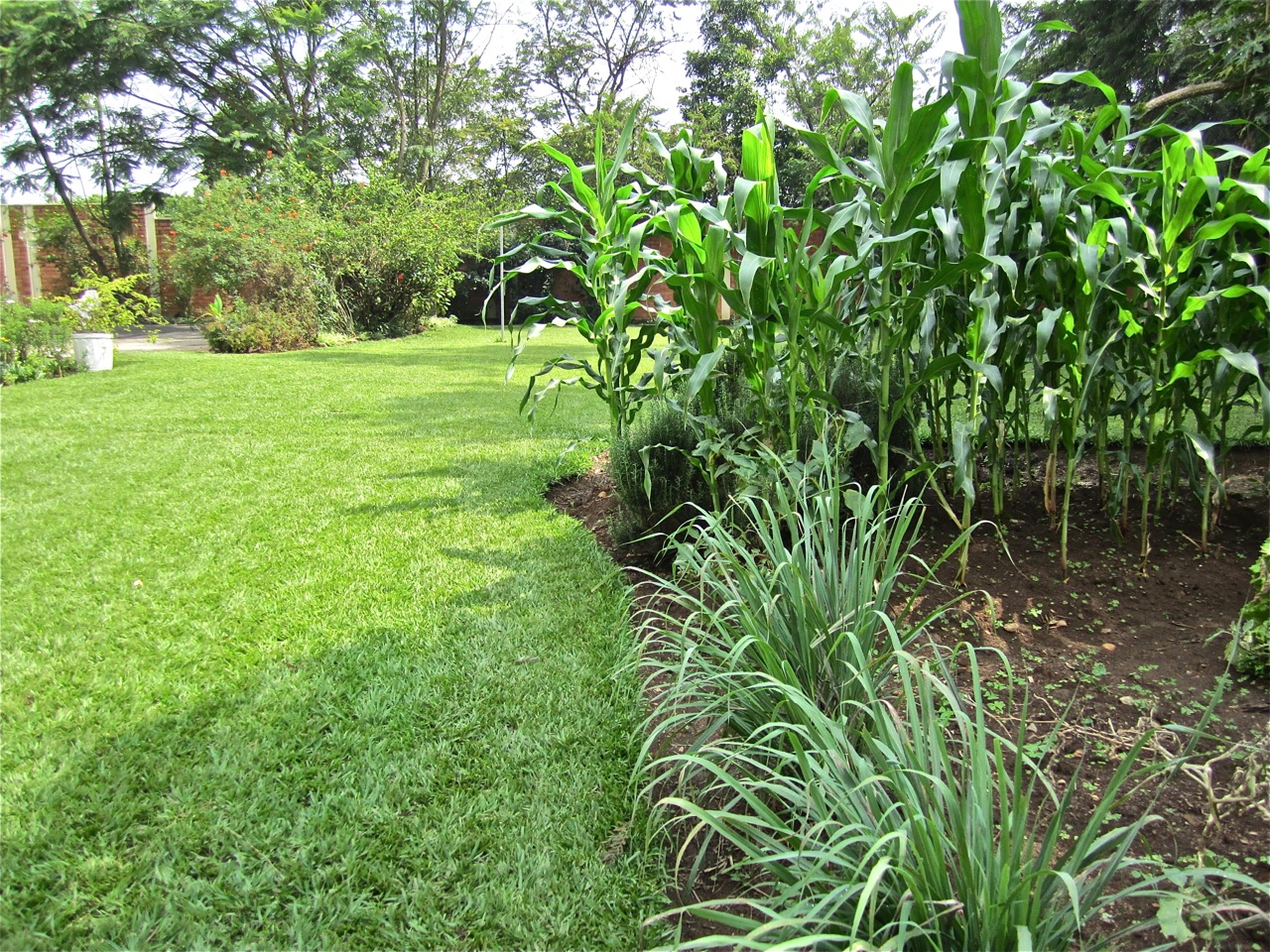
and, across from that (below), a large vegetable garden whose edges have become rather freeform over the years. There’s a lot of sunny grassy space between these two beds, which isn’t needed for entertaining.
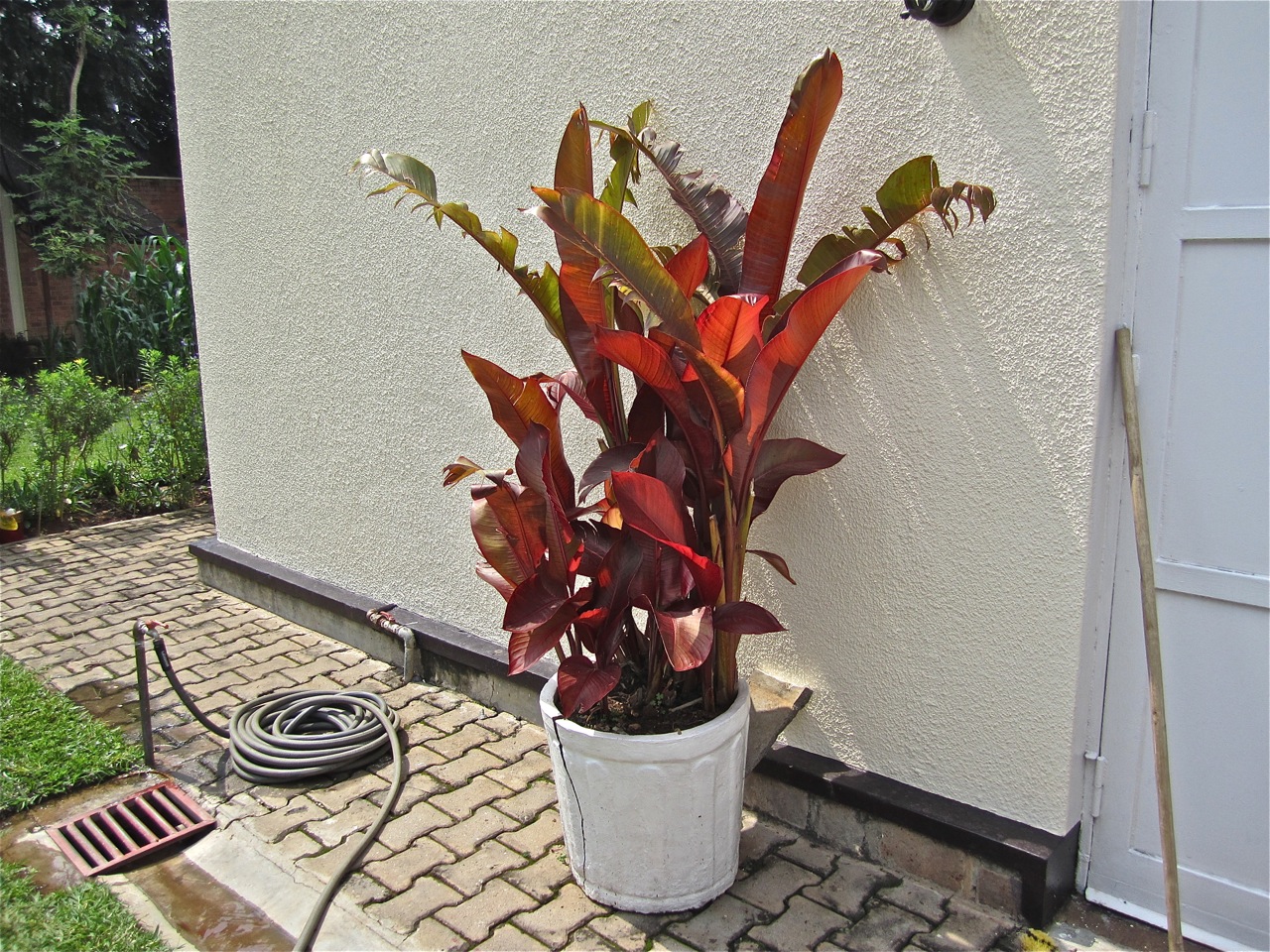
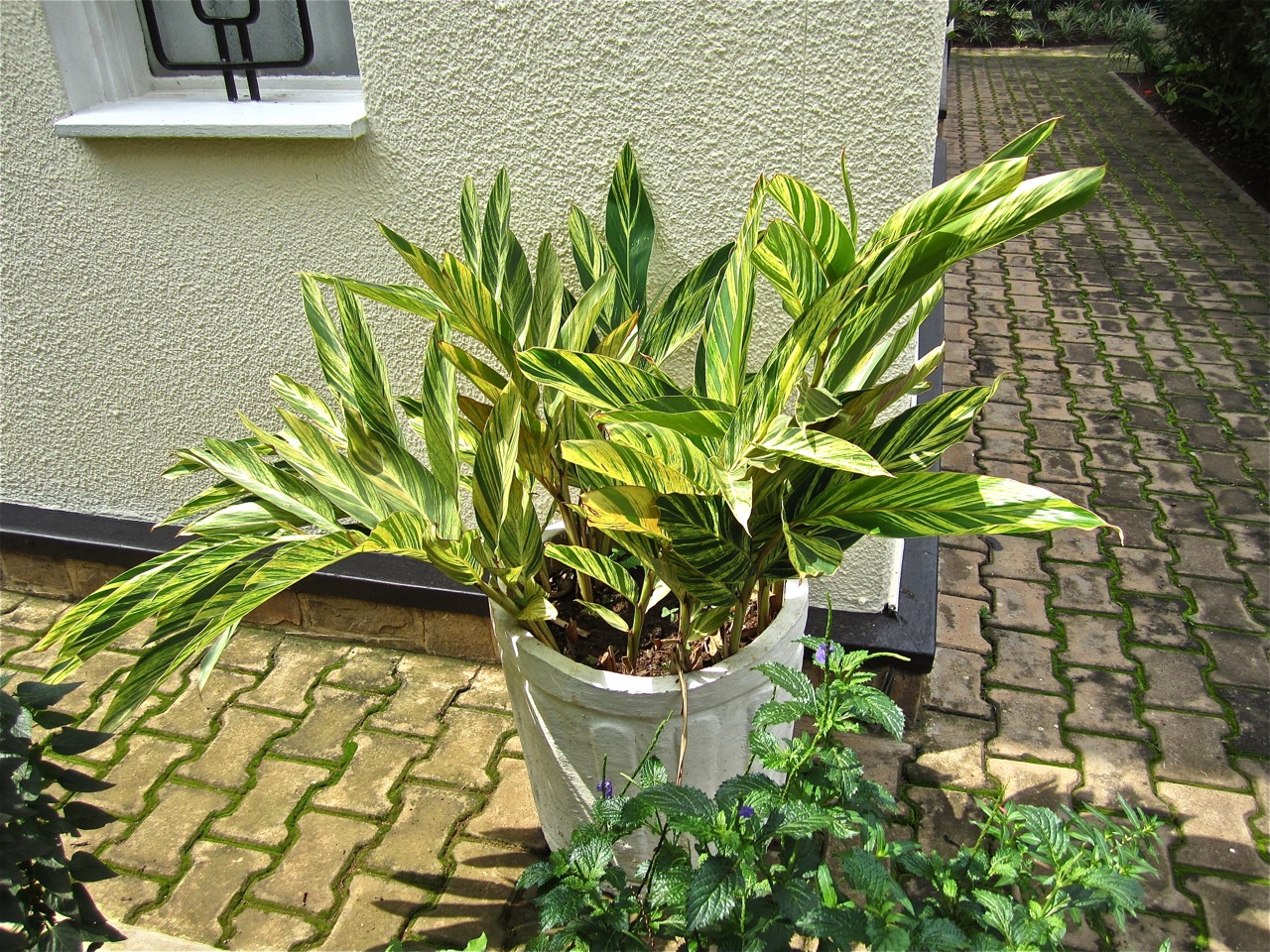
There are a number of potted plants in the garden, including these two (below), which have been left at the back of the house. They hold burgundy cannas (which are breaking their pot) and bright variegated gingers, but almost no one sees them. On the terrace, we also have variegated yuccas planted in very nice tall pots, but so deeply that only the ends of their squished up spiky leaves show (and they’re a bit dangerous at upper-body level).
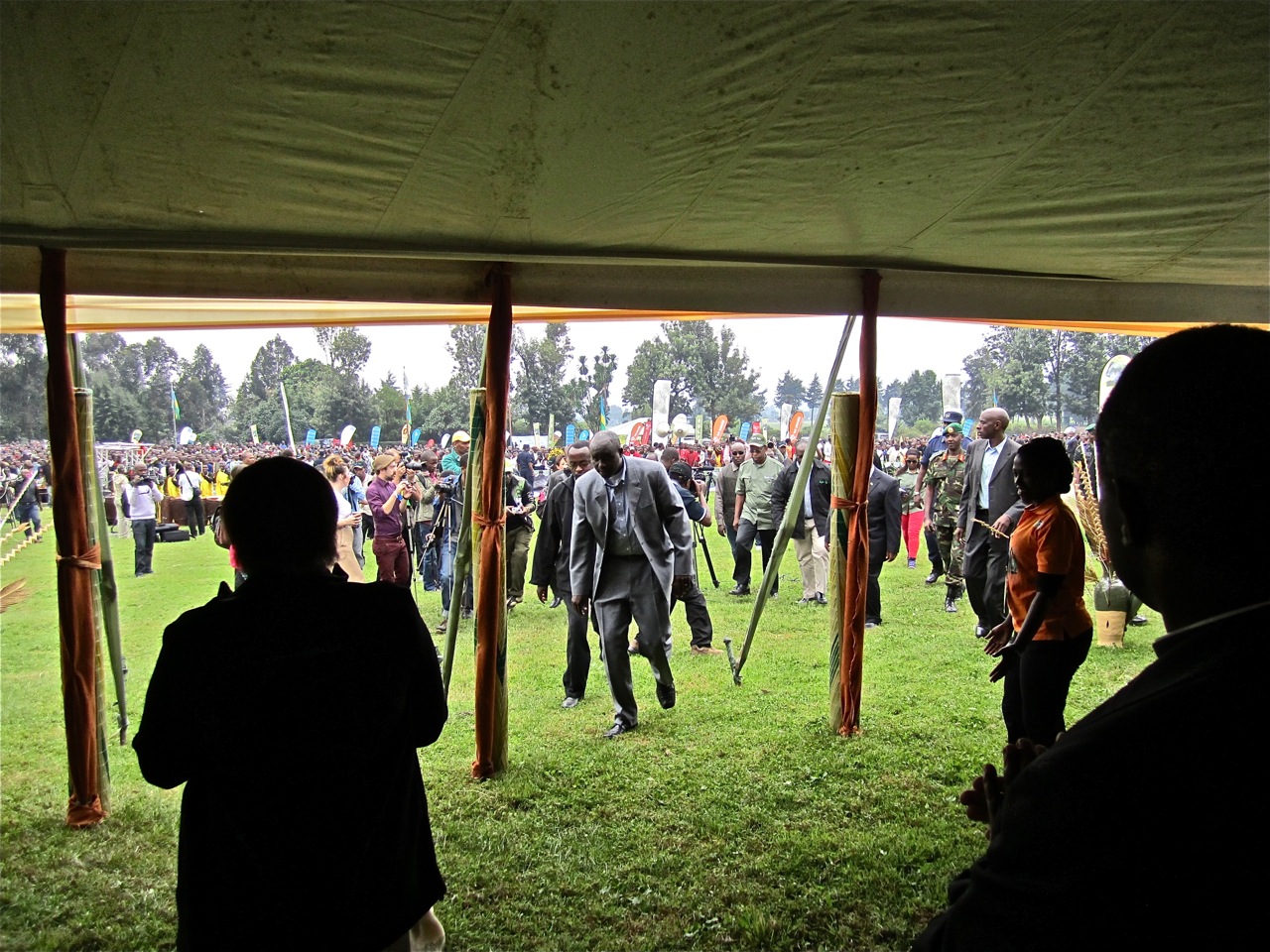
I know I promised news of our garden renovation for my next post, but I didn’t want to wait too long before sharing my photos of the baby gorilla naming ceremony on Saturday in Kinigi-Musanze in the north of Rwanda.
The Rwanda Development Board has been holding a naming ceremony (Kwita Izina) for each year’s babies since 2005 to raise awareness of conservation in the Volcanoes National Park and to highlight the work of the various Rwandan tourism enterprises.
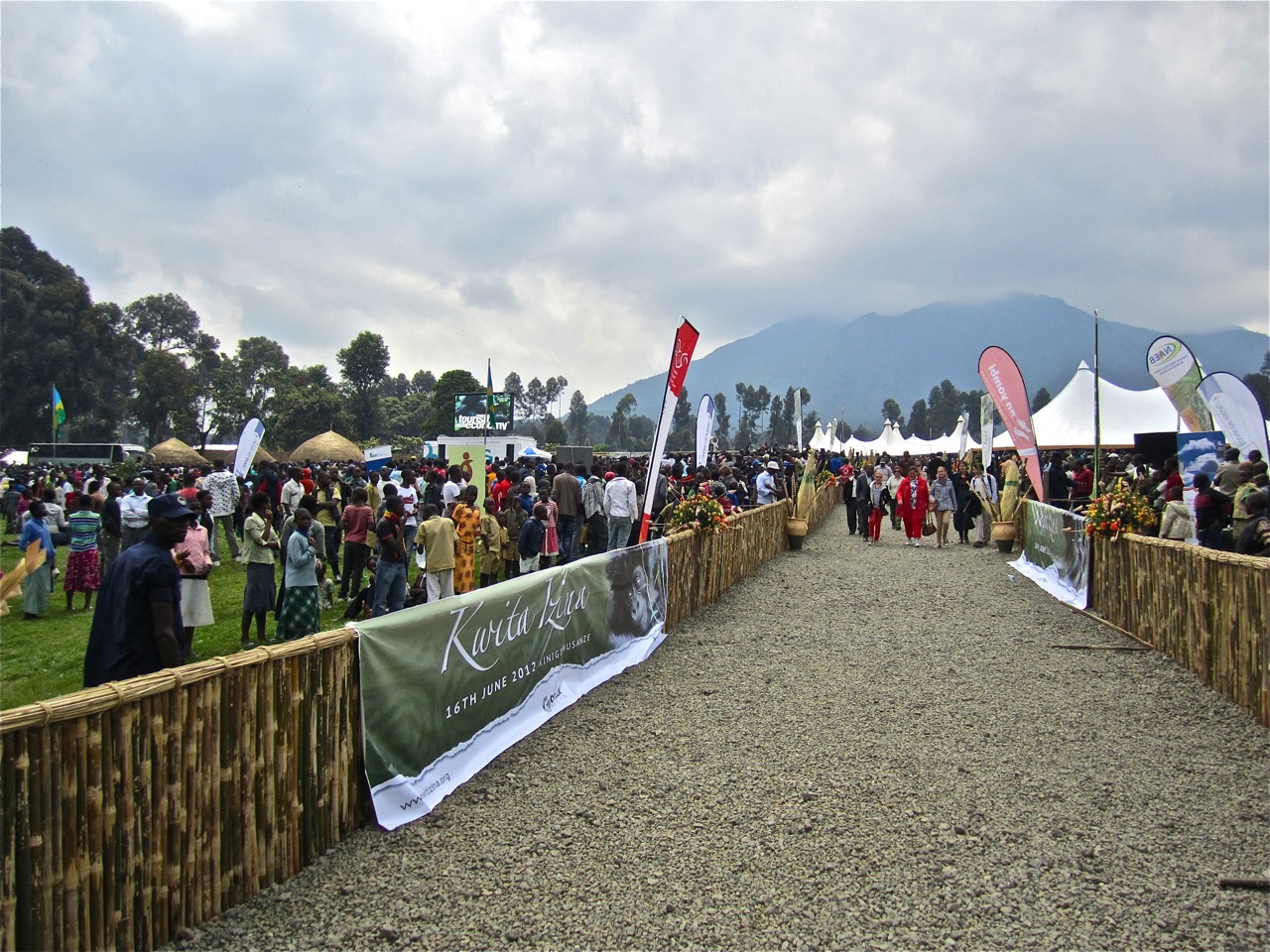
Banana stalks are traditionally used to mark the way to an important event. On Saturday, there were banana stalks staked up on both sides of the road from Kigali to Kinigi-Musanze (a 2-hour drive) about every 25 yards.The tents and banners of the event. Unfortunately, the sky stayed overcast so we never really got a good view of the volcanoes.
Unfortunately, good animal conservation practices did not allow for the actual presence at the ceremony of this year’s 20 babies. But we had a card with their pictures, their mothers’ names, and a place to write their new names as they were called out. You can ooh and aah over more of their really cute pictures at this link.
This baby’s mother is Nchili, and he likes kissing. Photo via kwitizina.org.This baby’s mother is Rwandrushya. According to http://www.kwitizina.org, he has already challenged the silverback of his group.
However, we did have a fun bit of theatrics with 2o children costumed as gorillas.
The “baby gorillas” arrive. Click the photos to enlarge them.The “baby gorillas” cavort for the crowd as their park ranger observers take note.
They did a really good job of mimicking the movements of real young gorillas, and they were even accompanied by observers taking notes. However, the masks were maybe a little too toothy.
The baby gorillas pose for the press.
We had a great morning, although it was quite cold — next year I will bring a blanket — and it was too overcast to see the volcanoes’ peaks.
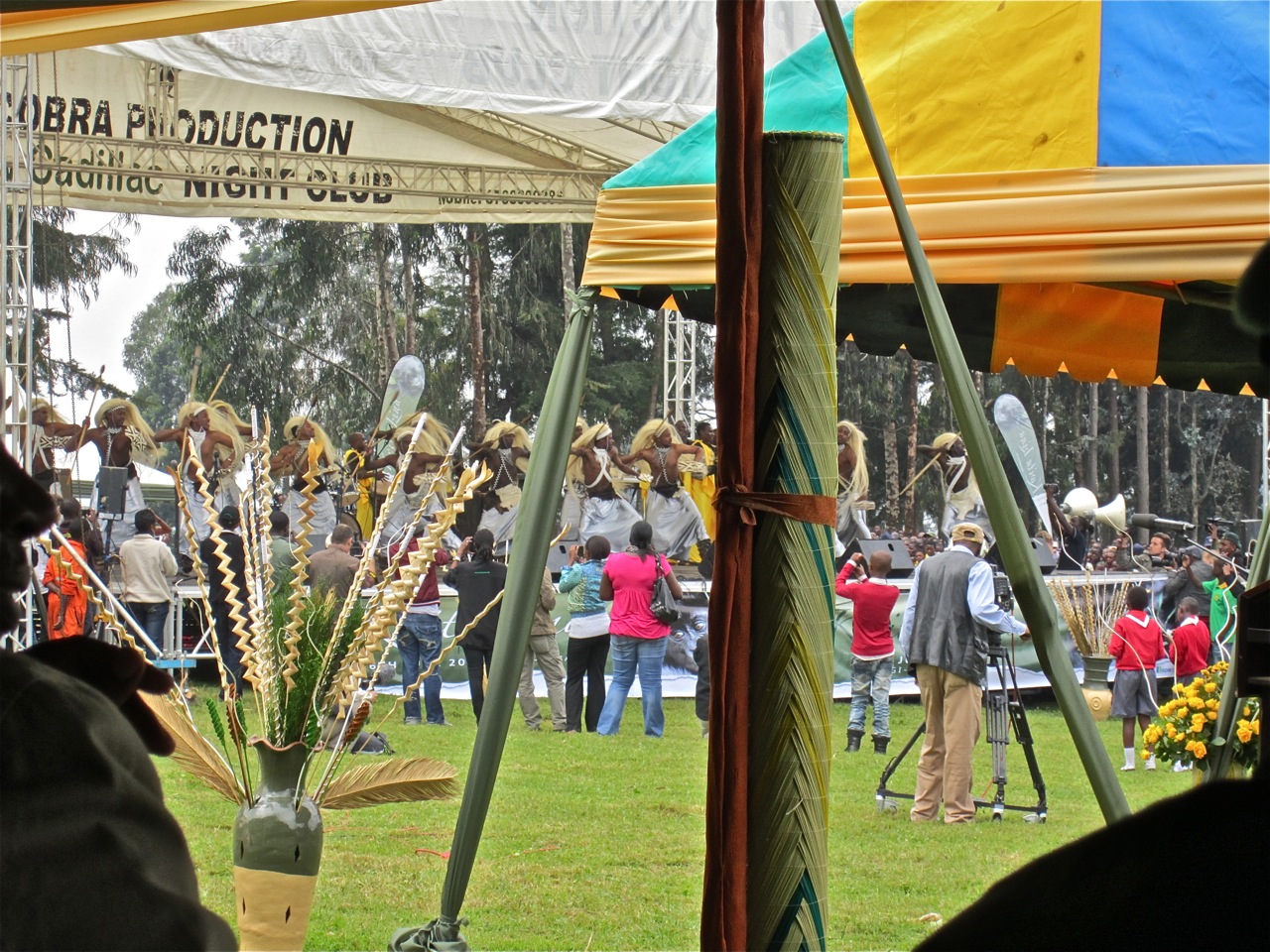
A Rwandan drumming group entertains before the naming ceremony.They were followed on the stage by traditional Intore dancers.The arrival of the Prime Minister. Unfortunately, the rumor that Robert DeNiro was coming to the ceremony turned out to be untrue.The baby gorillas onstage as the Mayor of Musanze announces a baby’s name.A faint glimpse of a volcano peak behind the tents.
Gorilla tourism in Rwanda has contributed to a 26.3% growth in the mountain gorilla population since the last census in 2003. Tourism brought US$200 million in revenues to Rwanda in 2010.
Hand-colored photographs by the American Colony of Jerusalem taken between 1900 and 1946, showing the Jordan River, olive trees, and “Bethlehem, Juda, and Blue Galilee.”
All photos via the Matson Collection of the Library of Congress.













 enclos*ure