Washington, D.C., has been enjoying a few days with temperatures only in the mid 80’s and the humidity just below 50%.
For us, this is good. Our summer days usually begin with humidity at more than 80%. There’s an old story that, until air conditioning, the British government considered Washington a tropical hardship post and authorized its diplomats to wear Burmuda shorts. This is probably a myth, but everyone here finds it entirely plausible.
So to take full advantage of the current break, in the last few evenings we have looked for restaurants with outside tables. We chose two with very different patios: The Tabard Inn, with red brick, lush green vines, sculptures, and antique urns; and Two Amys, minimalist in comparison, but projecting some Italian chic with its yellow brick, modern red-orange chairs, and pretty glassware.
I’ll enjoy looking at these pictures again at mid-week, when the temperatures are predicted to be back up near 100°.
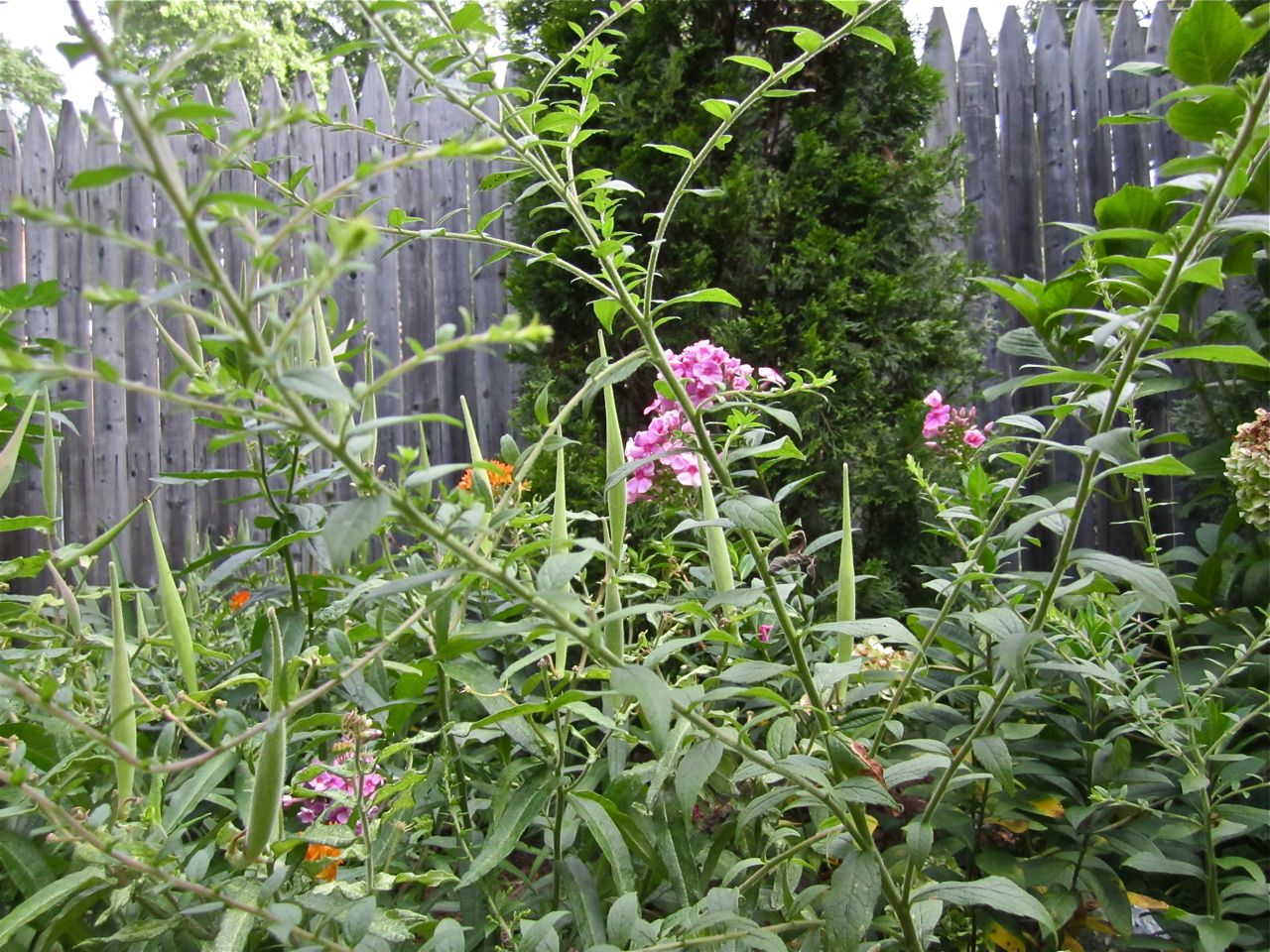
Goldenrod, butterfly milkweed, and common tall phlox.
I’m having more of an in-between-bloom day. The milkweed has about finished, although the pods are nice, but the goldenrod and cutleaf coneflowers need another week or so. I do have some nice phlox blooming though. Continue reading “Garden Bloggers’ Bloom Day in July”→
On July 4th, my husband and I walked home through Georgetown after lunch. When we reached R Street, we decided to cut through Montrose Park and then over behind Dumbarton Oaks.
This is how we came upon Dumbarton Oaks Park, a section of Rock Creek Park with an exceptional pedigree, but a difficult present existence. It is an almost lost remnant of the Country Place Era of American garden design (1880 – 1940).
The Dumbarton Oaks garden, which was designed by Beatrix Farrand for Mildred and Robert Bliss, is famous, but the park behind it is far less known. I had never heard of it — not from garden history classes nor during visits to the DO garden — until this April, when I received an e-mail about the launch of efforts of save it.
Laurel Pool damaged by runoff.
But the DO Park, also designed by Farrand, is on the National Register of Historic Places. “To landscape historians,” writes Adrian Higgins of The Washington Post, “it is hallowed ground.”
In 1928, these 27 acres of former farmland became a naturalistic extension of the Bliss estate’s formal gardens. A series of paths and meadows were composed along a small tributary of Rock Creek and planted out with drifts of native and exotic wildflowers, bulbs, and woodland shrubs. Eighteen waterfall dams were built, as well as two arbors and several benches and footbridges — all in the rustic Arts and Crafts style.
In 1941, when Dumbarton Oaks was given to Harvard University, this part of the property went to the National Park Service.
Over time, however, it seems that the highly designed and delicately crafted landscape was just too much for the Park Service to handle. Photos taken in the late 1980s show it in very bad condition. Through the decades, there has been serious damage from runoff to the stream-edge areas, and invasive weeds and vines have smothered and pushed out Farrand’s trees and plants.
The formation of the Dumbarton Oaks Park Conservancy offers some hope for its restoration. Headed by Rebecca Trafton, a garden designer and documentary maker, it is currently raising money and hopes to present a work plan in October.
The DO Park is a remarkable place even now, and the strength of Farrand’s vision and of her artful use of materials still shines through. The refrain “this is how it’s done” ran through my mind as we walked along. If you visit Dumbarton Oaks, please walk down Lover’s Lane on its east side and take a look.
Click on any thumbnail in the gallery below to scroll through the enlarged photos. The order follows a walk from one end of the path along the stream to the other.
Looking back to the Montrose Park entrance, lichen-covered stone.
Crossing the stream on a footbridge.
The stream was dammed to create waterfalls.
A memorial, although to what is lost.
Laurel Pool somewhat damaged by runoff.
Rhododendron along the path. Farrand also had planted drifts of mountain laurel, but I didn’t see any remaining.
Old stone pool.
Old stone pool and rhododendrons.
I have no idea. . . but beautiful.
The stream, an unnamed tributary of Rock Creek Park.
The stream.
The stream.
The stream and waterfalls.
Stone bench. There used to be a rustic arbor over this long bench.
Photo of the long stone bench from the 1930s. Library of Congress, Historic American Buildings Survey.
A footbridge over a waterfall.
Native tree.
A bench in a meadow.
Stream dam.
The back of the Georgetown Safeway parking garage, which overlooks the last part of the path. Porcelain berry vine and wild grape have taken over this area.
Ancient, broken rhododendron.
Rhododendron.
Old rhododendrons at the edge of the path.
Couple walking along the path.
Emerging from the park behind The British School on Wisconsin Avenue.
I would like to share more of my photos from the Bishop’s Garden that particularly show the wonderful patterns, shades, and textures of the varied foliage. Please click on any thumbnail in the gallery.
I spent yesterday morning at The Bishop’s Garden of the National Cathedral. I’m embarrassed to admit that I had never visited this popular Washington garden before.
I’m sorry I waited so long. The place has the beautiful patina of an old piece of silver.
The partially walled space was designed by Frederick Law Olmstead, Jr. as a private garden for the Bishop. But in 1916, Florence Brown Bratenahl, the wife of the Dean, took over the garden’s installation and re-worked the plan for public access, opening it in 1928. She was the cathedral’s Landscape Designer from 1927 to 1936. Today, the garden is maintained by the All Hallows Guild, which Mrs. Bratenahl founded.
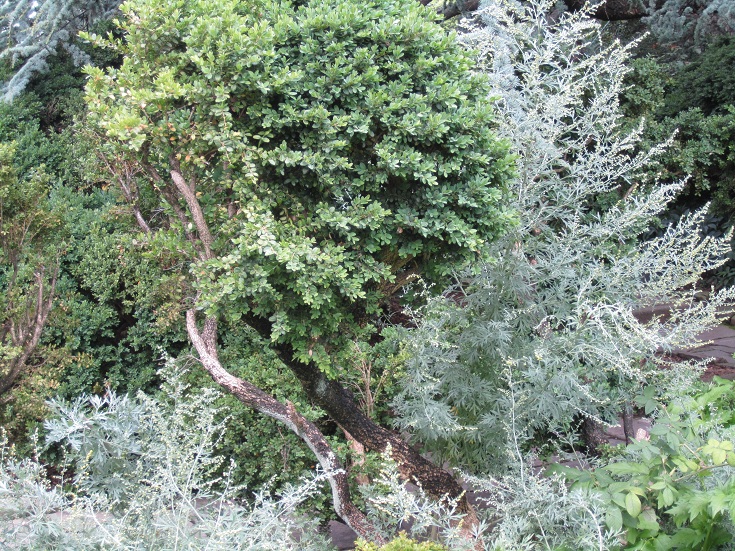
An old boxwood and companion plants.
The garden sits on the south side of the cathedral immediately off an access road and parking area. One parking space actually blocks a bit of the Norman-style arched entryway.
On stepping inside, however, you are immediately enveloped by the long branches of an old weeping cherry and encounter the first of many antique boxwoods.
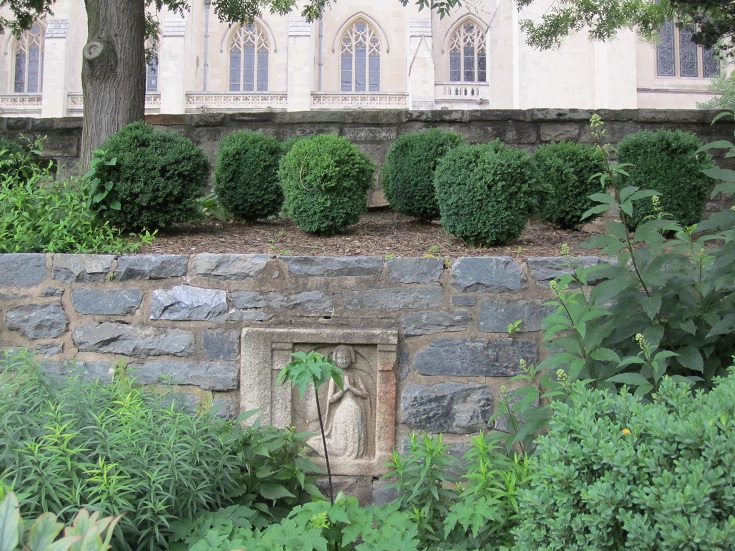
Younger boxwoods grow in a bed set on a higher tier of a wall with 15th c. bas relief.
In the 1920s, Mrs. Bratenahl brought in mature boxwoods from George Washington’s Hayfield Manor, from the Ellersbee Plantation in Virginia, and from other historic sites in the region. I wasn’t able to discover from online research how many of the current bushes are from this time.
Original or not, however, they are very, very old and I like the way many have limbed up and split open at their centers, creating spaces through which other plants have grown. (I believe I was also seeing some of the damage caused by the huge snows we had here in 2010.)
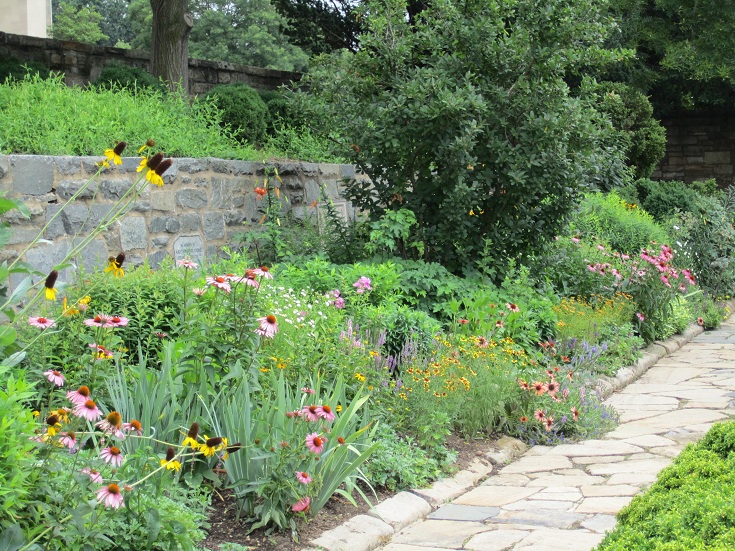
The upper perennial bed.
This lovely garden contains almost every shade and shape of green leaf, set against aged bark and moss-grown stone — all beautifully punctuated, but not overtaken, by the flowers of old-fashioned perennials, annuals, and herbs.
My only real reservation about the design was the central rose garden, which I think has too many brightly colored, glossy-leafed hybrid teas. I would prefer to see bushes with more subtle appeal and interesting foliage.
The fact that the south side of the garden is open to a parking lot for St. Alban’s School is really too bad as well. In Olmstead’s original plan, I believe that area merged into woods and a stream. However, one of the gardeners working there told me that there are plans to put in some kind of view barrier, probably a tall hedge, possibly as early as this fall.
Please enjoy the gallery below. Click on any thumbnail photo below to scroll through all the enlarged pictures.
The 1926 plan for the garden.
Entering the garden.
Ferns and hardy begonias.
Perennials growing through an old boxwood.
Old open boxwood with perennials growing at the base.
Cedrus atlantica ‘Glauca’ and boxwoods.
An old boxwood and companion plants.
Support for the cedar.
Norman Court, a fountain designed by Florence Brown Bratenahl.
Another view of the cedar and boxwoods.
The upper perennial bed.
Rudbeckia maxima in the upper perennial bed.
A very small-leafed boxwood.
Younger boxwoods grow in a bed set on a higher tier of the upper wall with 16th c. bas relief.
Goldfish in the pool of St. Catherine.
I like the rusty orange tint of these coreopsis.
Pomegranate and parsley. Would make a good name for a blog.
What is the name of the tree? I just cannot remember.
The pattern of the stone is echoed by the variety of sages planted along the yew walk.
The cathedral and Russian sage.
The lower perennial bed. The center “tree” is an enormous yew.
Closeup of the old yew.
The Hortulus (Little Garden) with its herbs and Carolingian stone font.
New plants. I like it that the gardeners only lightly mulch the beds.







 enclos*ure