Today, I’m repeating a porch from August 2012, but it is a nice one. (We were traveling this weekend.)
“Cottages at Maplewood [Waseca, Minnesota],” c.1880-c.1899. By Detroit Publishing Co., via Library of Congress Prints and Photographs Division.*
Maplewood Park on Clear Lake was a national vacation attraction at the end of the nineteenth century. (Click on any image to enlarge it.)
Above: Maplewood’s pavilion for Chautaquas. From the 1870s to 1920s, the Chautaqua movement brought speakers and companies of musicians, dancers, and actors to camps like Maplewood for up to a week at a time.
The Waseca Historical Society still hosts a Chautaqua at Maplewood Park every July.
To read about a similar sort of summer cabin living, which also continues today, see this 2012 New York Times article, here.
Above: the view of Clear Lake from Maplewood.
*All photos here: c.1880 – c.1899, by Detroit Publishing Co., via Library of Congress Prints and Photographs Division.
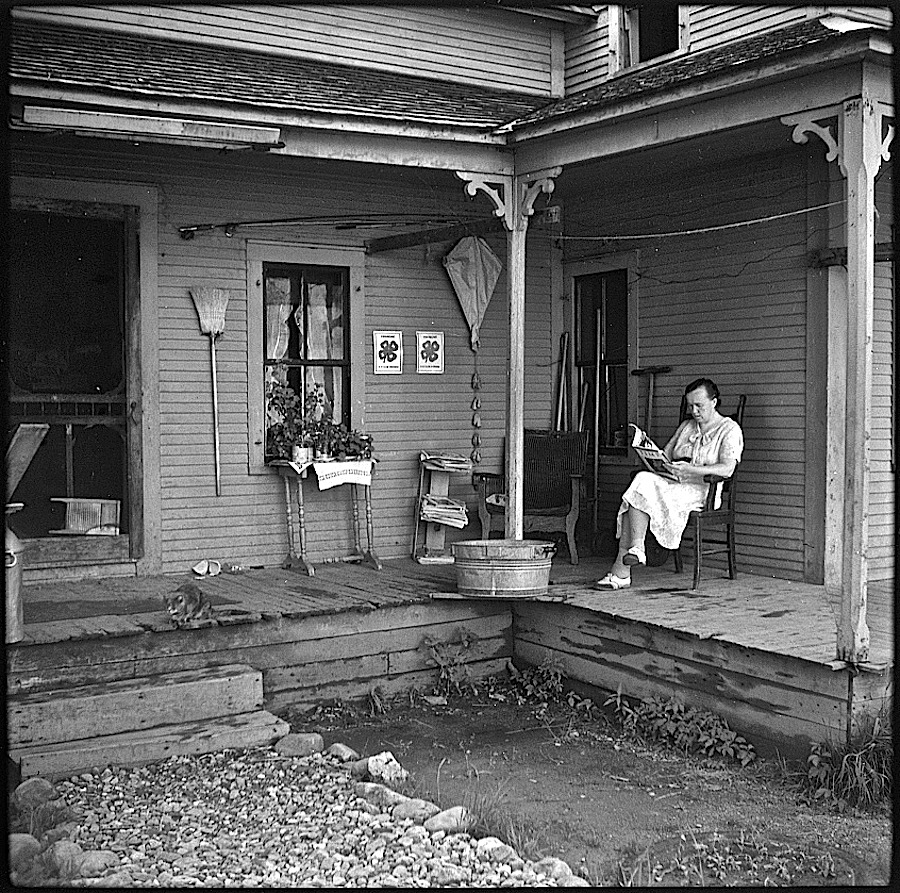
“Front porch. Lincoln, Vermont,” July 1940, by Louise Rosskam, via the FSA/OWI Collection, Library of Congress Prints and Photographs Division.
The porch as a farm woman’s summertime mission control room. . .
Her broom (and 4H posters) are on the wall, and more cleaning and gardening tools are behind the chair. She has stacks of magazines (and TIME in hand). Her potted plants are doing well. Above them are fishing poles and a kite.
The cat dozes above the steps — I think the scrub board behind the broken screen is there to keep him out of the house.
The wash tub is setting on a shelf built across the angle where the two sides of the porch meet. This puzzled me until I realized that it must be there to catch rainwater from the roof.
The photographer, Louise Rosskam (1910-2003), was “one of the elusive pioneers of what has been called the golden age of documentary photography,” according to the Library of Congress.
Like many of her photos, this image was attributed for many years to her husband Edwin, who was also a photographer. At the time it was taken — as part of a series on rural Vermont — he was working as an editor for the Farm Security Administration (FSA) of the U.S. government.
Her first professional photography work had been in the mid 1930s for the Philadelphia Record. The paper would only actually hire Edwin, so he recouped her wages by including them on his expense vouchers under “gas and oil.”
The couple then produced documentary photo books on San Francisco and Washington, D.C. (but only Edwin’s name appeared on the covers). After 1939, when Edwin went to work for the FSA, Louise began to take freelance photographs. In the 40s, they both worked for Standard Oil Company.
Near the end of her life, Louise began to write to institutions like the Library of Congress correcting the credit given to Edwin for her own photos. There’s an interesting interview with her from 2000 here.
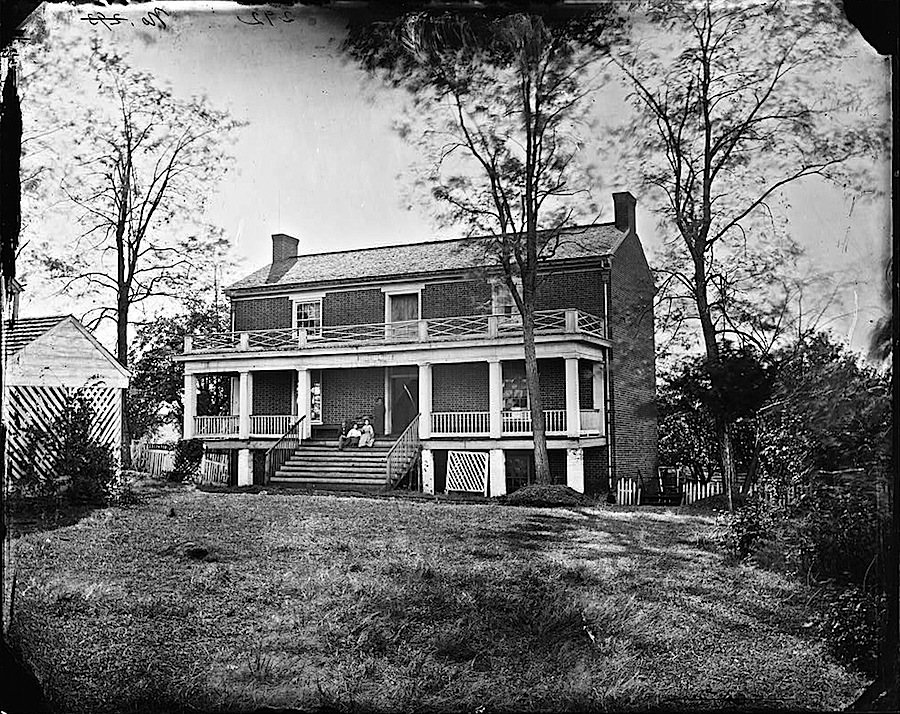
The McLean house, Appomattox Court House (previously Clover Hill), Virginia, April 1865, by Timothy H. O’Sullivan, via Library of Congress Prints and Photographs Division (all photos here).
On Palm Sunday, April 9, 1865, General Robert E. Lee crossed the porch of this house and entered the parlor to surrender his army to Lieutenant General Ulysses S. Grant — effectively ending the American Civil War.
Detail of photo above.
The house — built in 1848 and previously a tavern — was owned by Wilmer McLean, a retired major in the Virginia militia and a wholesale grocer.
Back in 1861, the first major battle of the war had been fought on McLean’s farm in Bull Run, Virginia. (A cannonball had landed in the kitchen fireplace, and afterwards the house was taken over as a Confederate hospital.)
Hoping to avoid the rest of the war,* the McLeans moved to the small southern Virginia village of Clover Hill in 1863. However, during Easter Week of 1865, the family not only hosted the surrender signing, but also the Surrender Commissioners’ meeting the next day. Union Major General John Gibbon and his officers then quartered in the house for a few days.
“The [Civil] War began in my front yard and ended in my parlor,” McLean is reported to have said later.
One can well imagine that he sometimes sat on this porch, reflecting and shaking his head.
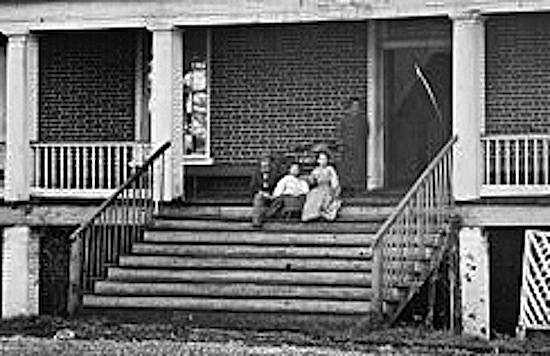
Detail of photo above — possibly the McLean family. Mrs. McLean had two daughters from an earlier marriage and at least three children with Wilmer.
As soon as the surrender was signed, officers of the Army of the Potomac began buying the family’s furniture (whether they wanted to sell or not). Major General Philip Sheridan paid $20 for the little table on which Grant signed the document of surrender terms. George Armstrong Custer took it away on his horse, and Sheridan later gave it to Mrs. Custer, who bequeathed it to the Smithsonian Institution.
That fall, McLean, nearly bankrupt, moved away from the “Surrender House,” as it was now popularly called. He was found in default of his loans, and the house was sold by the bank.
In 1891, it was sold again to Captain Myron Dunlap, who, with other investors, formed several schemes to profit from the fame of the house. By 1893, it was dismantled to become a tourist attraction in Washington, D.C. However, the money ran out before it could be shipped. For 50 years, the pieces were just left on the ground, exposed to the elements, vandals, and thieves.
In 1949, the house was reconstructed on its original site and opened to the public by the National Park Service. There are recent photos of the house and yard here and here.
*McLean was 47 when the war began and was considered too old to fight. A slave owner, he made a lot of money running sugar through the Union blockade. Unfortunately, it was Confederate money, which was worthless by 1865. After moving away from Appomattox, the family returned to Bull Run and then later settled in Alexandria, Va. McLean worked for the Internal Revenue Service from 1873 to 1876 and died in 1882.
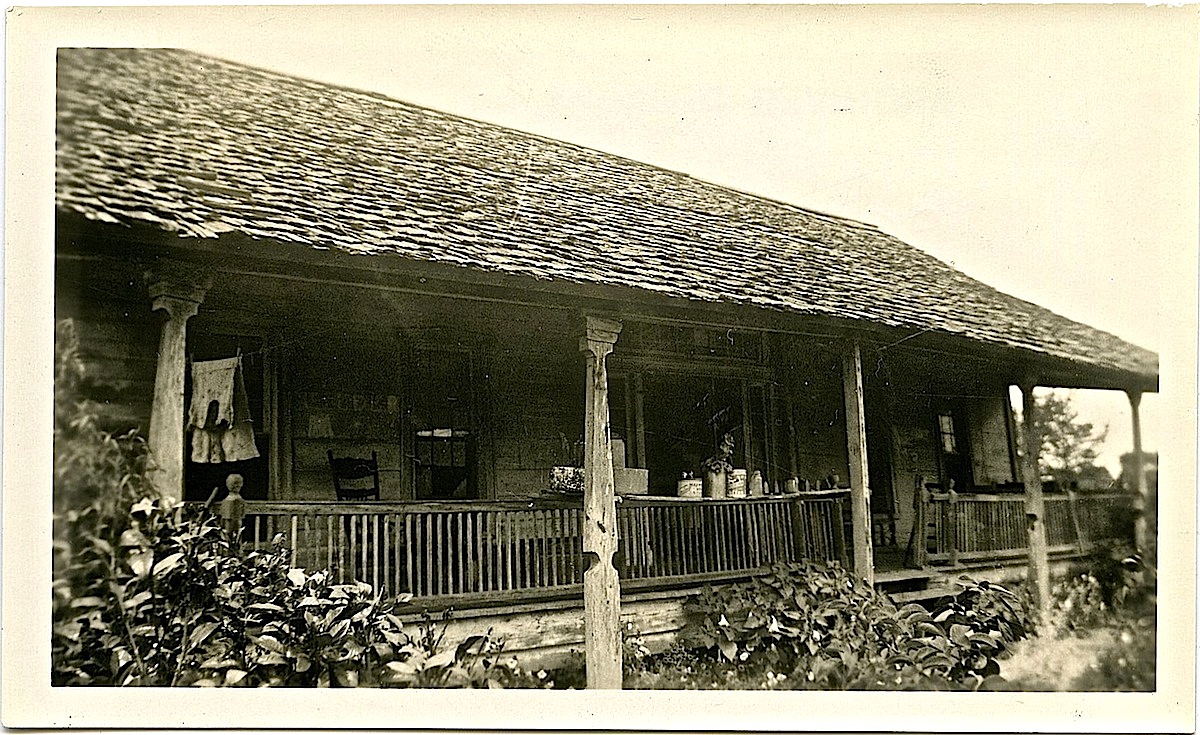
“Unidentified house,” probably by Fanny Ratchford, 1936, via Texas State Archives Commons on flickr. (You can click on the photo to enlarge it.)
It’s interesting to me that the roof of the house extends beyond the edge of the porch. The pretty columns are not attached to the railings, but come down to the ground a few feet beyond them.
There seems to be a word — maybe a name — on the wall above the chair on the left side, but I can’t read it.
ADDENDUM: The way the columns are set makes this a rain porch.
This slideshow requires JavaScript.
Among a little wind grit, in a grid on a grid, somewhere
like the crossroads of outer space and Earth, Texas,
a handful of ragged elms withstand a long sway
of heat and wind. These old guards of a home haunt
the field but wither even as ghosts must. Honor them
with a walk among homesick bricks, and prophesy good.
Entrance porch of the Peter Neff Cottage, Kenyon College, Gambier, Ohio. Photo taken 1951 by Perry E. Borchers for an Historic American Buildings Survey (HABS), via Library of Congress Prints and Photographs Division.
Another 1951 photo of the porch, also by Perry E. Borchers for the HABS (cropped by me).
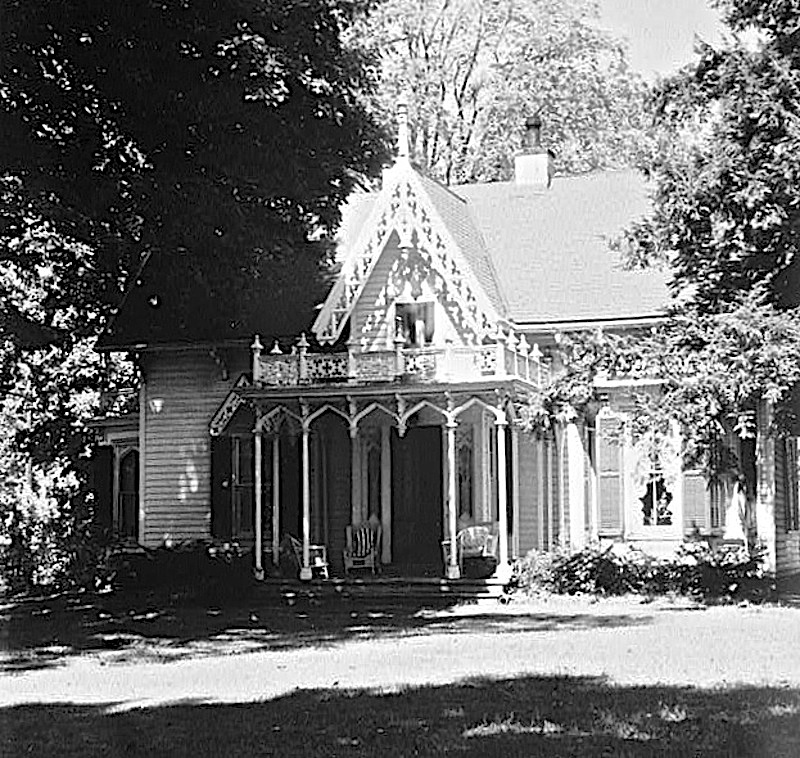
The HABS report for this house said it “may be the finest example of Gothic Revival cottage style and wood detail in Ohio.” It was built about 1860 for Peter Neff, a co-inventor of the tintype and an alumnus and benefactor of Kenyon College.
All was not happy in this charming abode, however. Neff quarreled with nearby Kenyon over the bells of the campus’s Church of the Holy Spirit, “which he claimed had driven him to the brink of nervous collapse,” according to the Historic Campus Architecture Project.
“Place yourself and family in my location, about seven hundred feet distant,” he wrote in a 19-page open letter. “How would you like this ding dong every fifteen minutes? . . . [It is] machinery wearing out flesh and blood to those who have any nerves. It is too much bell-ringing . . . it is a sickening nuisance.”
Neff finally moved away from the campus and its bells in 1888.
The house is now named Clifford* Place and is the residence of the Dean of Students.

 “Cottages at Maplewood [Waseca, Minnesota],” c.1880-c.1899. By Detroit Publishing Co., via Library of Congress Prints and Photographs Division.*
 Above: Maplewood’s pavilion for Chautaquas. From the 1870s to 1920s, the Chautaqua movement brought speakers and companies of musicians, dancers, and actors to camps like Maplewood for up to a week at a time.
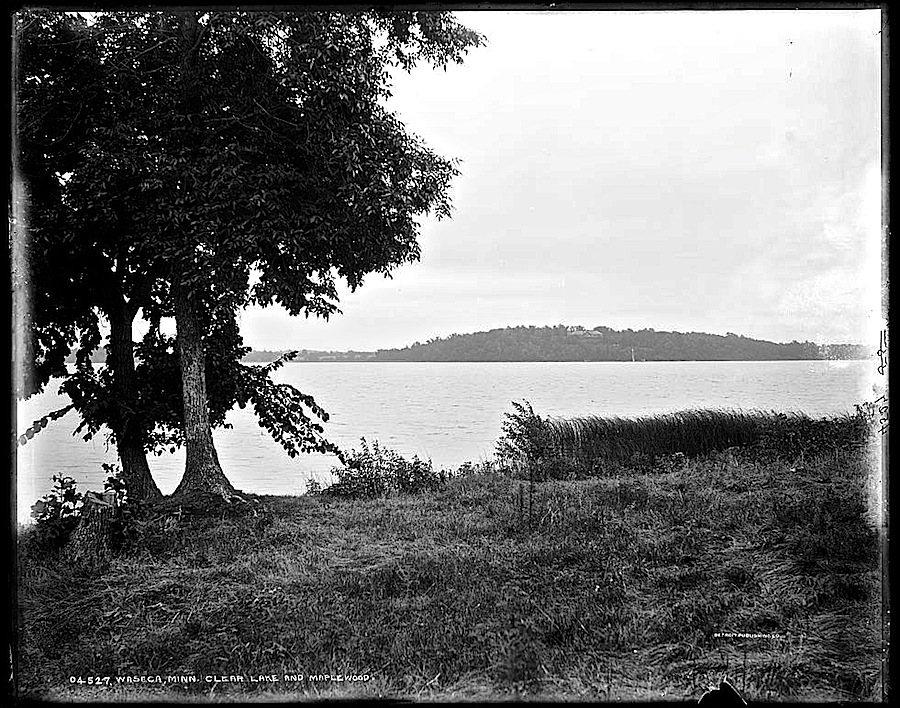 Above: the view of Clear Lake from Maplewood.