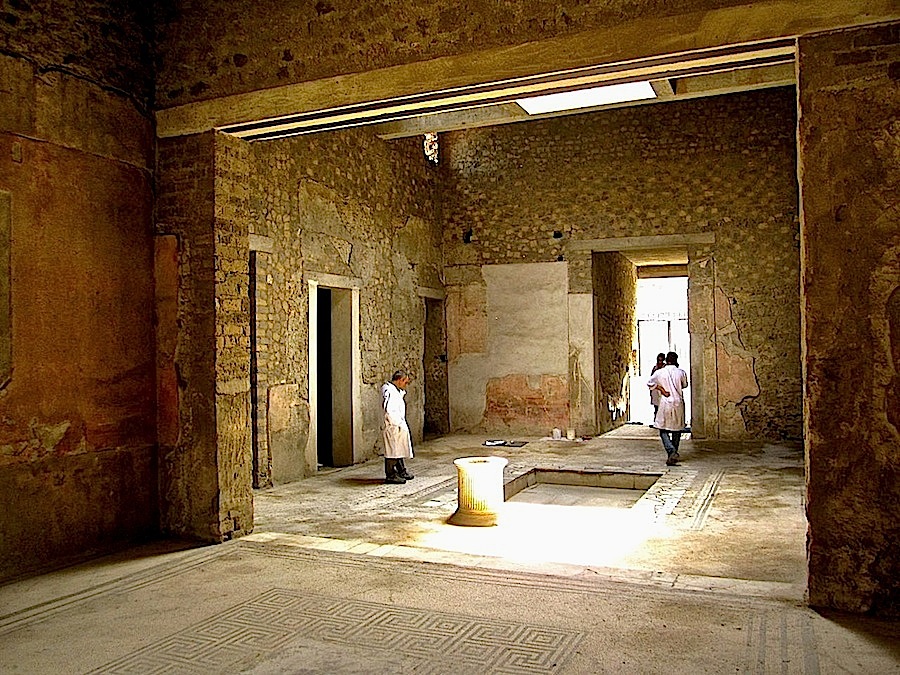
 The atrium of the House of the Tragic Poet, Pompeii, Italy. This house was built near the end of the 1st century B.C. and excavated in 1824.
Well-to-do Roman city houses had no openings to the streets other than the front and back doors. After entering from the front directly from the sidewalk, one walked down an entrance corridor or fauces and into the atrium, which often had an ceiling opening to the sky, like the one shown above.
Underneath the opening was a shallow pool or impluvium to catch rainwater and channel it to a water tank below. The water could later be drawn up through the puteal — in the photo above: the short, round, hollow column beside the impluvium.
At the back of the atrium, opposite the entrance corridor, was the tablinum or central room of the house. The doors of family bedrooms also opened onto the atrium.
When I took the photo above about two weeks ago, I was standing behind the tablinum, looking across it and into the atrium. On the other side was the fauces and then the front door of the house. Behind me was a very small enclosed garden surrounded by a colonnade and some other small bedrooms, a kitchen, and a latrine.
The walls of the atrium of this house used to be covered with six frescoes depicting scenes from the Iliad. The three that survived can be seen today in the National Archeology Museum in Naples.
The house takes its name from one of the frescoes that was in the tablinum, which excavators mistakenly thought to be a picture of a poet reciting his verses.
Visiting Pompeii
To get to Pompeii from Naples, we again took the Circumvesuviana rail line from the Central Station (more information here). We took the “Sorrento” train and, about an half hour later, got off at “Pompeii-Scavi.” The entrance to the site is right there at the station.
Guides
For a 2 to 3 hour guided tour of the site with 8+ people, the cheapest options I found were:
- Mondo Guide, a guide company loosely affiliated with travel writer Rick Steves. Go to this link, and put your name/s on the list for the desired date. If 8 people sign up, they will do the tour and everyone will be charged €12*. If there aren’t at least 8 requests, there will be no tour that day (it didn’t work out for us).
- Tempio Travel, a guide company with a ticket stand right where you get off the train (Infopoint). They guide groups of 8+ as they collect enough people (we waited about 20 minutes). For the price of €12* per person, our guide was OK, and since we have only a moderate interest in Roman history, we were satisfied.
Walks of Rome offers a group tour for a maximum of 12 people for €49 each, which includes the entrance fee. They are recommended on the blog Revealed Rome. (Its author also has a good, inexpensive Kindle guidebook by the same title.) However, they were fully booked for our day. For all these options, except Tempio Travel, book early.
If you have the budget, you can get a personal tour from Mondo Guides (see above) or Gaetano Manfredi (who is also recommended by Rick Steves). There is also a Mr. Caporaso (yourguidetonaples@gmail.com), who was recommended to me in an e-mail from Mr. Manfredi. And, of course, if you do an internet search, you will find many others. It seems that the per-person prices are €50 to €100+.
Of course, you can also rent an audioguide at the entrance.
Tickets and lunch, etc.
The entrance ticket to Pompeii is €11. Contrary to what I read online, the site did seem to be accepting credit cards, but I would recommend having cash to be sure and for a faster line. Mid-morning, near the end of May, it was not bad — about 5-10 minutes.
The ticket is for all day, but once you leave the site, you can’t re-enter. So if you want to stay inside after your morning tour, you will have to go to the busy cafeteria near the forum to buy lunch (the restrooms are there too.) However, there didn’t seem to be any restriction against bringing in a sandwich in a small backpack or bag.
Wear serious sunscreen; the site is almost completely open to the sun.
You will appreciate the ruins much more if you visit the National Archeology Museum in Naples and see the many frescoes and other artifacts that were removed from the site during the 19th and 20th century excavations. (You may also want to check out this series of articles about Pompeii in The Telegraph.)
*Site entrance fee and transport not included.