
 Hymenocallis littoralis, last week in our garden.
Wordless Wednesday: beach spiderlilies
Hymenocallis littoralis, last week in our garden.
Hymenocallis littoralis, last week in our garden.
I was really taken with the cover of Josh Ruxin’s recent book, A Thousand Hills to Heaven. The illustration by Emily Robertson depicts a table set for two in an idealized garden setting among the patchwork fields of Rwanda.

Inside, the book is a thoughtful and engaging memoir of expat life and development work.
The actual restaurant, Heaven, which was created by Alissa Ruxin, Josh’s wife, is one of our favorites. Of course it’s not in the fields, but in a leafy old Kigali neighborhood, in a building completely open to the view on two sides and shaded by old ficus trees.
We had Thankgiving dinner there, and you can see pictures of that evening and read more about the book here, on The Atlantic’s website.
 . . . of Physalis peruviana.

It has rained almost every day this month, and everything in the garden has been growing accordingly. Here’s a little tour — from some photos I’ve taken in the last few days.
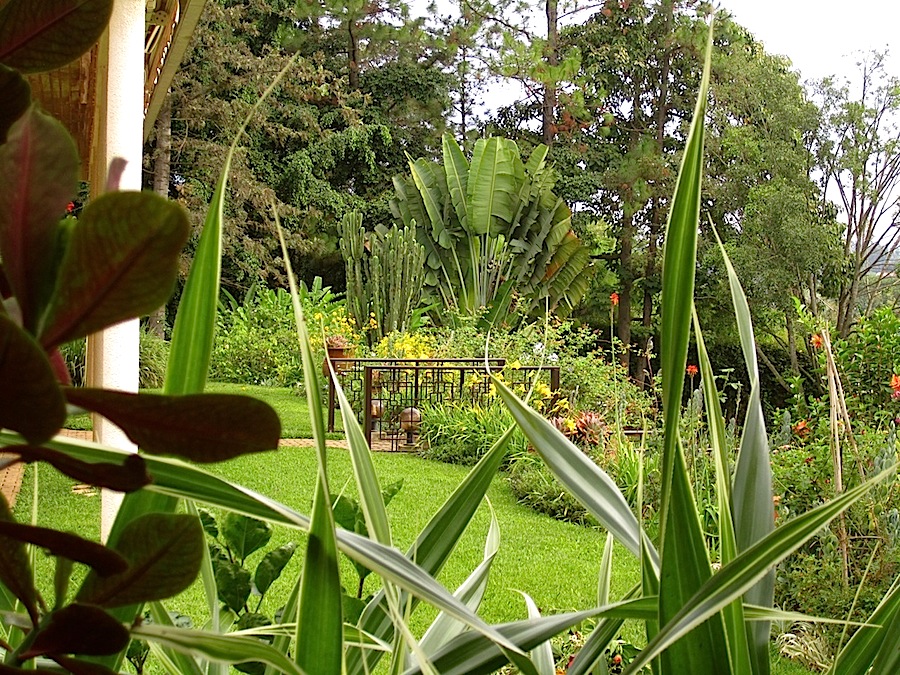 Above: Looking across the upper lawn from the north side. The front terrace of the house is to the left.
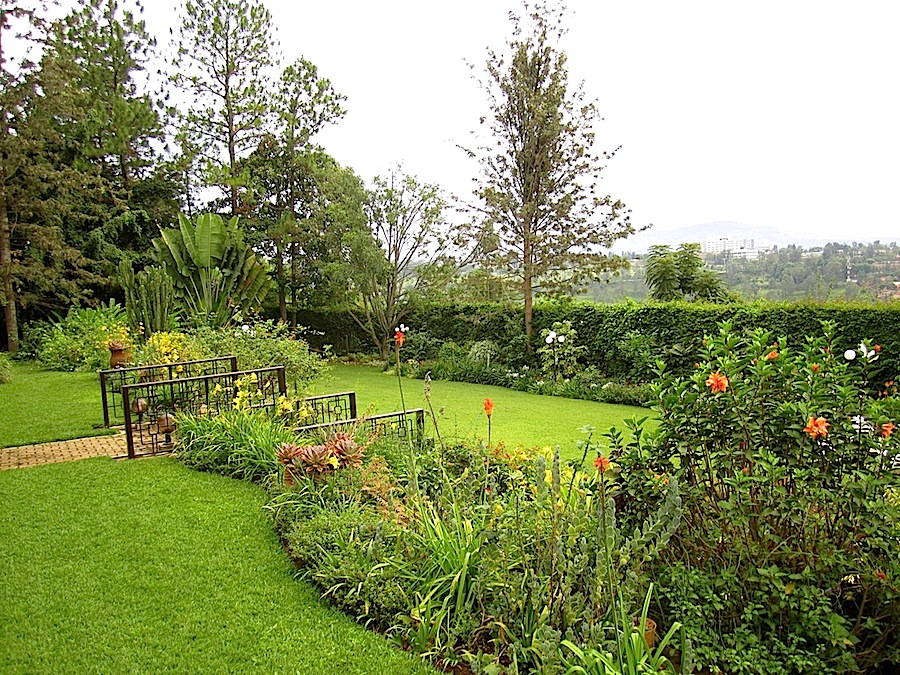 Above: Looking across the upper lawn and the planting beds of the two retaining walls. In the narrow border at the top, there are yellow daylilies, the bright blue-flowering (in the morning) groundcover evolvulus, and orange Kniphofia uvaria (red hot pokers). At the right is an orange tropical hibicus.
There is a cluster of the bronze-tinged succulent graptopelum in a pot, and steel-blue Kalanchoe daigremontiana (mother of millions) thread their way throughout.
This whole area is mostly yellow, with some blue and orange at the edges. The yellow works well with the blue hills and the sky in the distant view (see below). It also picks up the pale yellow of the exterior house paint and the yellow/gold/beige tones of the living room immediately behind the terrace.
 Above: To the right of the orange hibicus is a Clerondendron thomsoniae var. delectum.
Across the lower lawn, the new (well, from a year and a half ago) border is filling out well and beginning to have more flowers. In the hedge above it, I have let various vines, shrubs, and the crowns of little self-seeded acacia trees emerge to provide additional form and texture. We clip the bougainvillea flat behind them.
 Above: A view of the middle border between the two retaining walls that divide the upper and lower lawns. On either side of the step railings, the flower colors are mostly blue/purple, with yellow as a secondary color.
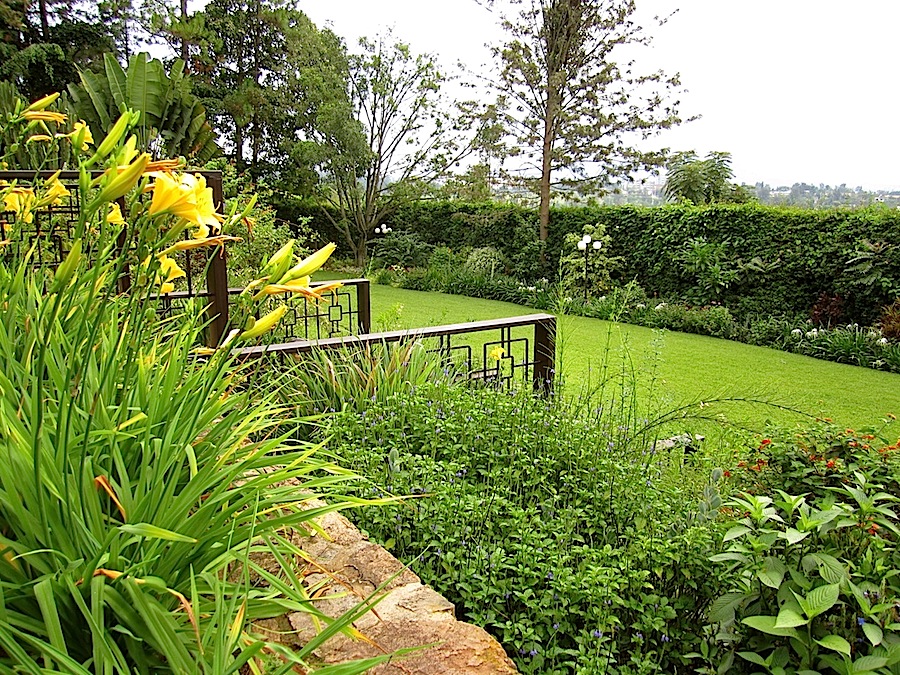 Above: In this section of the middle border are Russelia equisetiformis lutea and an orange Lantana camera (both at the edge), bright blue eranthemum bushes (at the far right), a lemongrass (beside the railing), and. . .
 Above: this blue-purple-flowering perennial — possibly a salvia. Does anyone know its name? It’s about 3′ to 4′ tall and almost a weed, but I use it all over the garden for the color and its quick, robust growth.
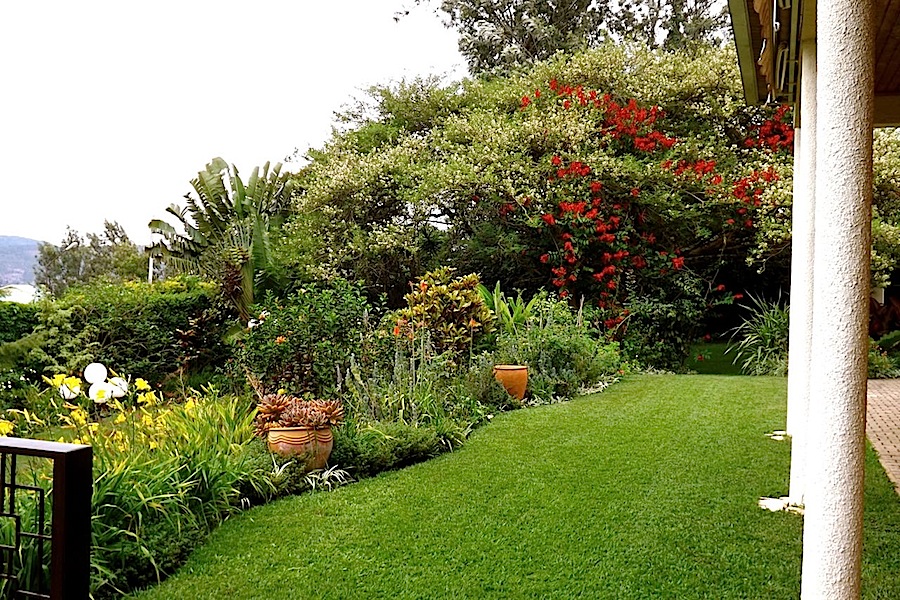 Above: Looking back towards the north, our big acacia tree was blooming last week, looking very impressive with the bright red Mussaenda erythrophylla vine.
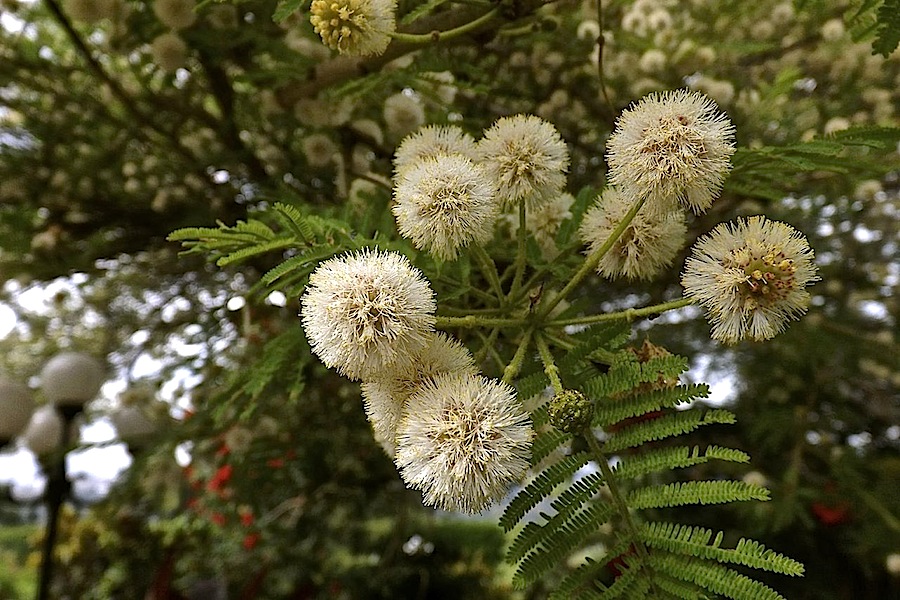 Above: Its flowers are small white puffballs.
 Above: There’s a tall variegated croton in the center, with more kalanchoe, kniphofia, and variegated groundcover irises along the border. Behind the croton, Heliconia rostrata (lobster claws) are peeking out.
Behind the pot is a pink lantana and the stems of a shrub that looks like a privet and has heavily scented white flowers. I limbed it up like a small multi-trunk tree, but some brown birds (they look like small parrots, but they aren’t) keep eating off the leaves. I think I will have to give up on it soon. Behind it are some old scarlet hybrid tea roses and coral pink zonal geraniums. This area is about 50/50 red and pink with a little blue around the edges.
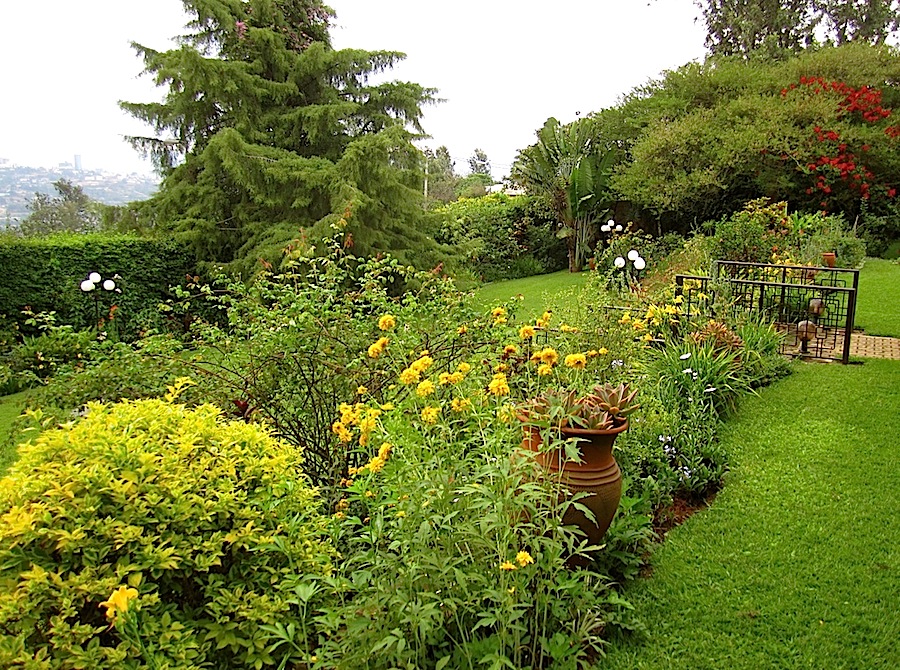 Above: Walking to the south end of the upper lawn and then looking back. There are double Rudbeckia laciniata in the foreground and more graptopelum in the pots. At the left, is a clipped yellow-foliage shrub that I don’t have the name for yet. It’s really a liana, but it is extremely popular in Kigali for shearing into hedges and various balls because it grows so fast. (You just have to clip it back about every month.)
Behind the tall pot, you can also glimpse a few low-pruned light blue cape plumbago and some shasta daisies.
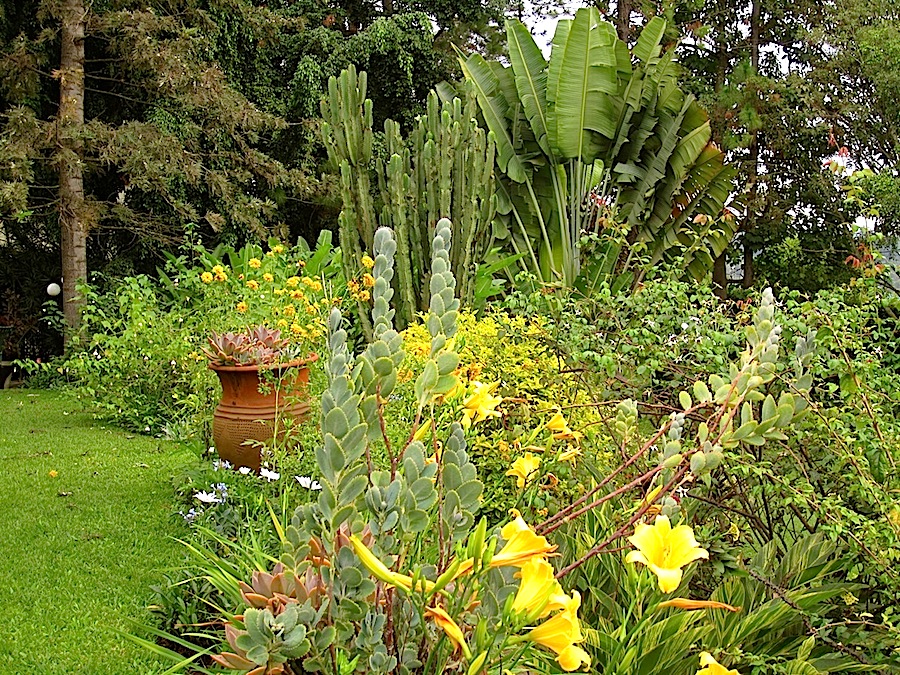 Above: Turning around and looking back to the south. At the far end of this border are light pink Abutilon x hybridum or Chinese lantern bush. The cactus-like plant is a euphorbia. There’s a huge traveller’s palm behind that.
 Above: Our view of Mt. Kigali, from the steps in the center of both lawns. Just beyond our hedge, the land dips down into a valley and then up again — so the brick buildings that you see at the top of the hedge are on the other side of the valley, maybe a half mile away, as the crow flies.
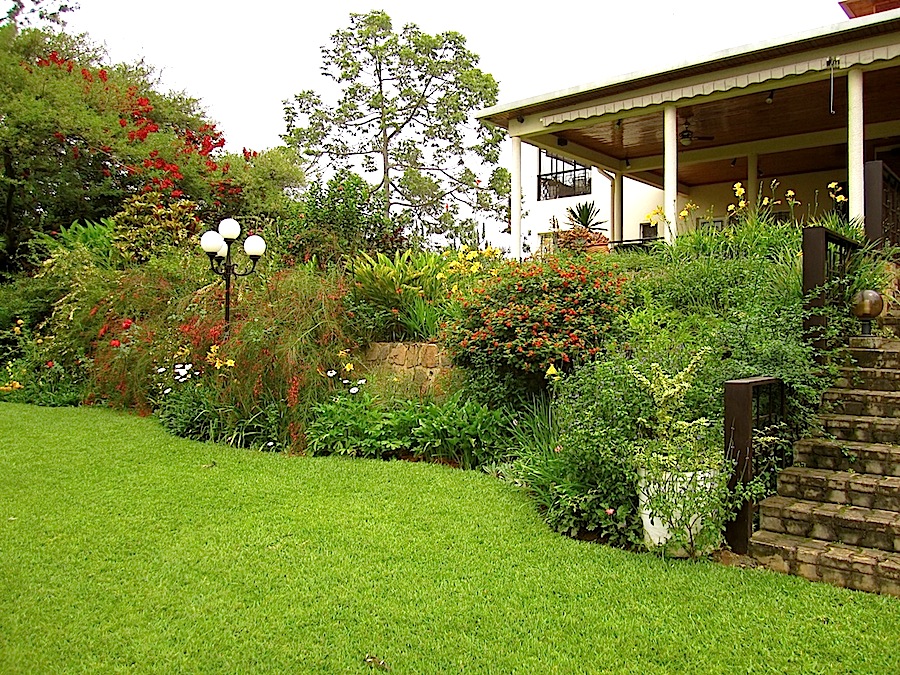 Above: Standing at the bottom of the steps, looking at the north side. The orange lantana from the photo above hangs over the lower retaining wall. Below it are rudbeckia (not blooming), yellow daylilies, some calla lilies, and some shasta daisies. Beside the railing is a Brunfelsia latifolia (aka B. australis) or yesterday, today, tomorrow shrub, more russelia with cream blooms, and a vine/shrub that looks like jasmine, but has unscented yellow blooms.
 Above: This red and yellow section is going strong at the moment. There are lots of Russelia equisetiformis in red, as well as cream, more double Rudbeckia laciniata, dayllilies, and shasta daisies in this border. At the end are more kniphofia, which I use throughout the garden. I love orange, so I put them in every color-themed section, regarding them as a sort of repeating “neutral.”
 Above: Standing at the north end of the lower lawn, looking to the south. At the far end are two pots setting off a group of pine trees.
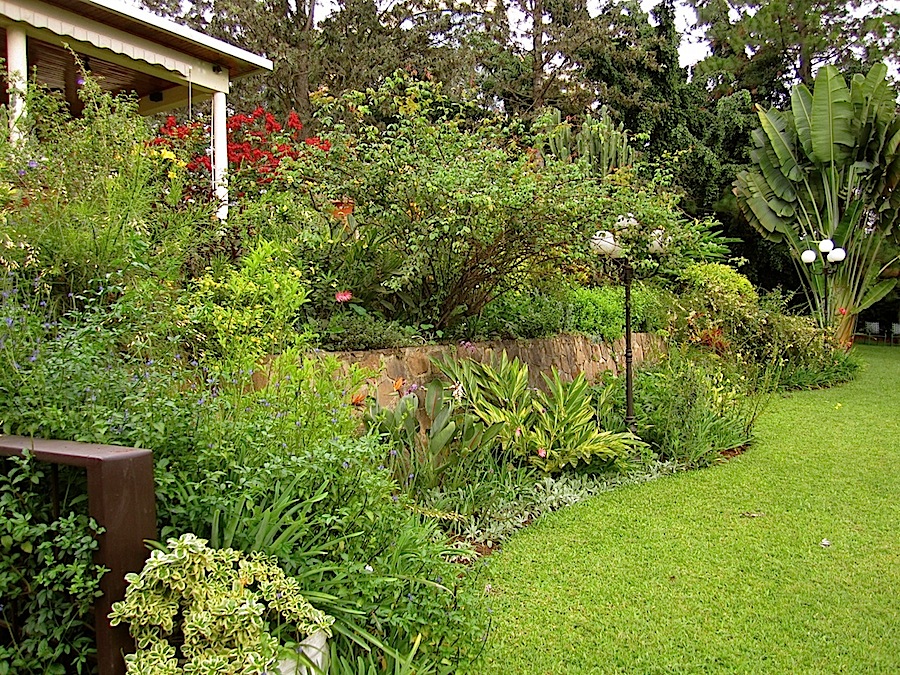 Above: Standing back at the bottom of the center steps looking south. In the center on the retaining wall is a huge white-blooming rose that is soon to be pruned. Below it are orange bird of paradise, variegated ginger, lamb’s ear, Verbena bonariensis and some small purple alliums. A little further down are more double rudbeckia, yellow daylilies, Missouri primrose, and dill.
At the very end is a mix of red and yellow-flowering plants to match the north end of the retaining walls (above), but they are not so well established yet.
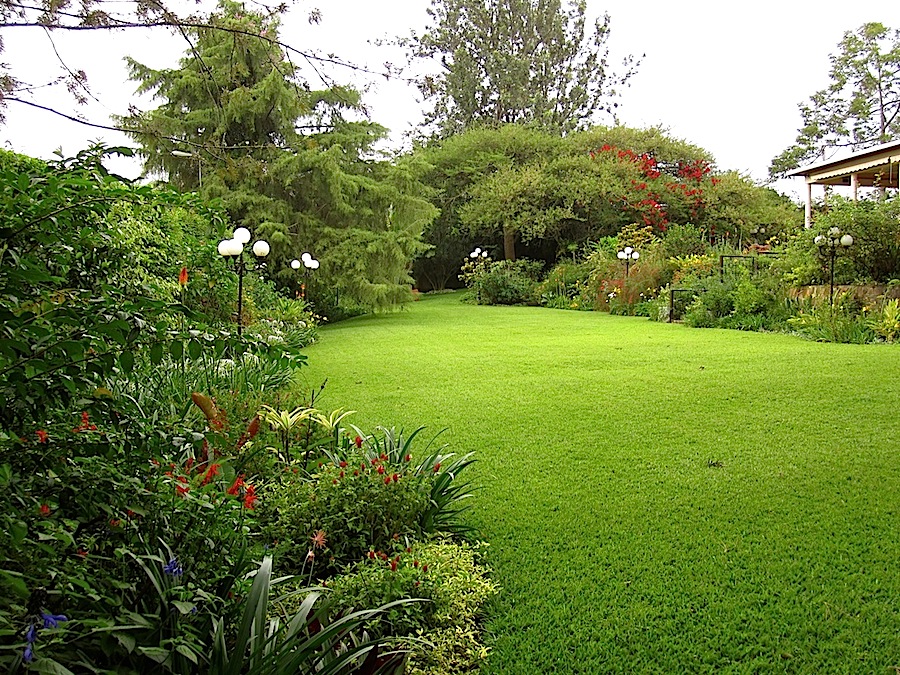 Above: Looking at the lower lawn from the south end. At the left, is a red section, with pink as a second color and blue around the edges. There are red-blooming cannas and cannas with burgundy leaves, red ornamental sage, shrimp plants, and red roses. The pink comes from gerbera daisies and an azalea bush.
After it, are sections with light purple, then yellow, then pink flowers predominating — finishing in the center, across from the steps, with yellow flowers and foliage (and beyond that is a section with light orange, light purple, coral pink and a bit of red). But this long, newer border is not yet as colorful as the other side of the lawn.
The quiet flowerworks in the mind of God . . .
— Howard Nemerov, from “A Sprig of Dill“
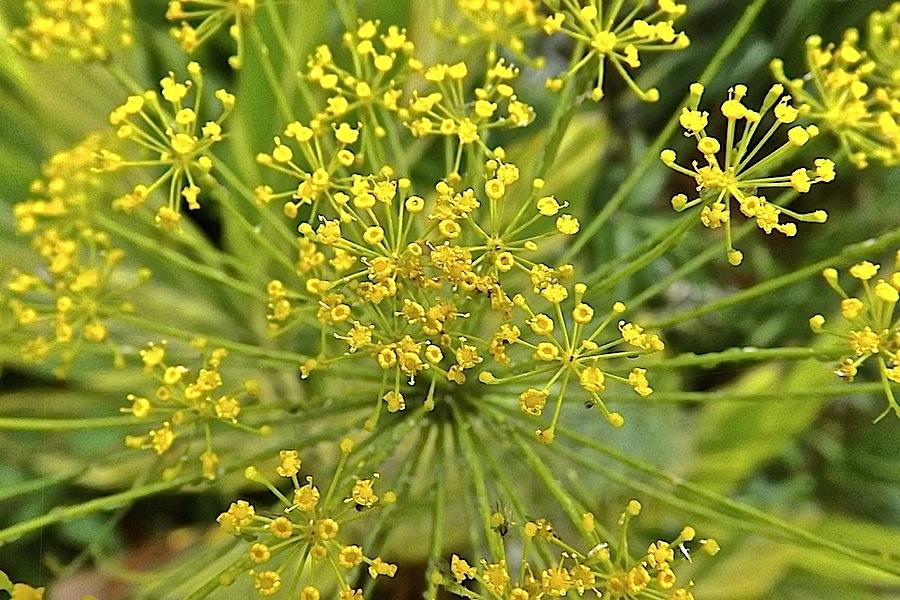
A dillburst in the flower borders.
During the summer, I transplanted a lot of small dill plants from the vegetable garden to the yellow areas of the flower borders. Unfortunately, dill really doesn’t like to be moved, and it really doesn’t like it during the dry season. So all the little plants just remained little.
But lately, after six weeks of rain, they are growing and a few have begun to bloom.
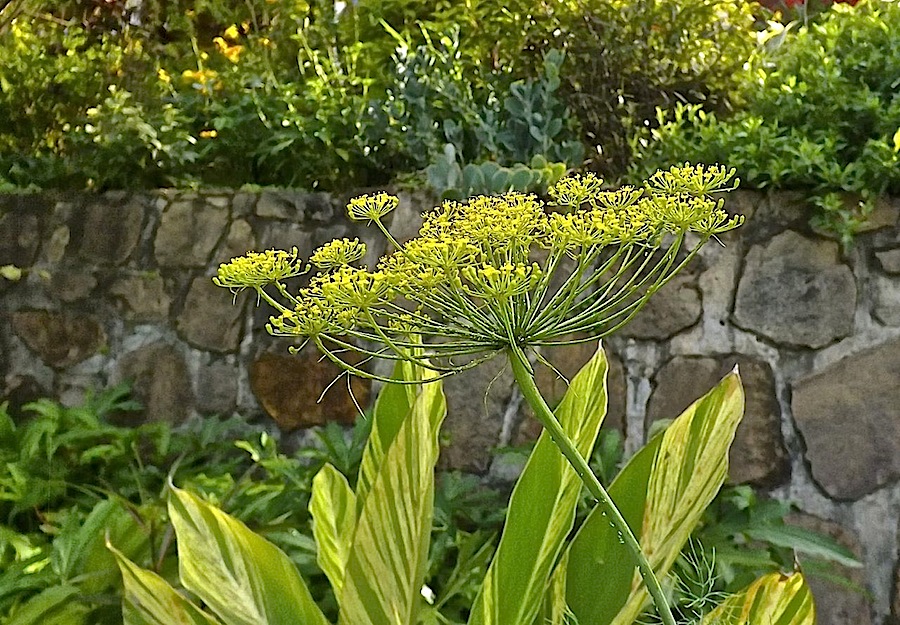 I’ve always thought that dill is a nice ornamental plant.
Eventually, that variegated ginger — of which you can just see a bit above and below — will be huge and dominate this area (and there is another very small one hidden to the left of the dill bloom below).
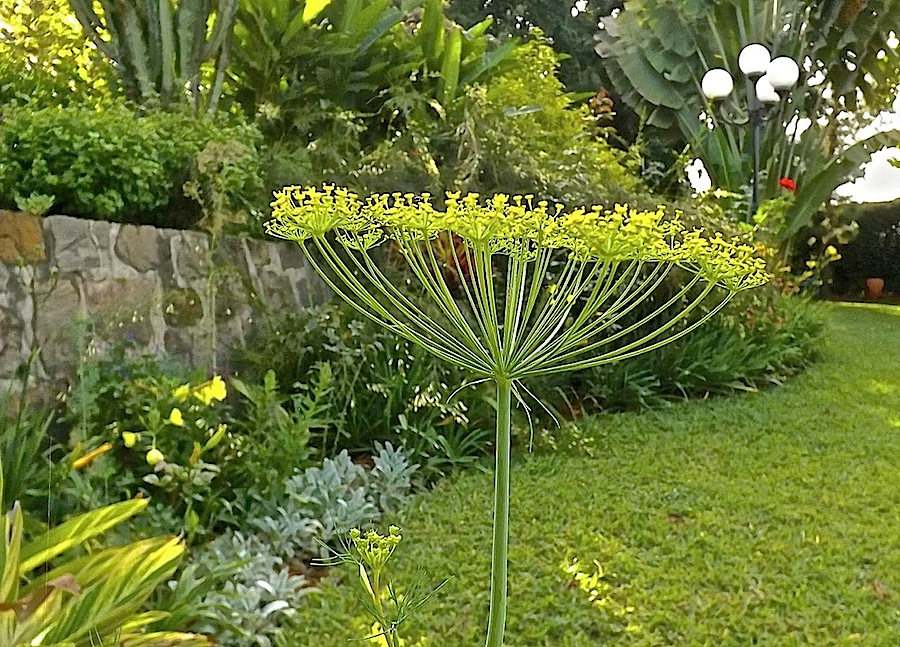
In the meantime, I’m hoping that the dill and Missouri primrose will self seed here as long as there is space. (I will help it along, and I’ve also been sprinkling about Verbena bonariensis seed.)
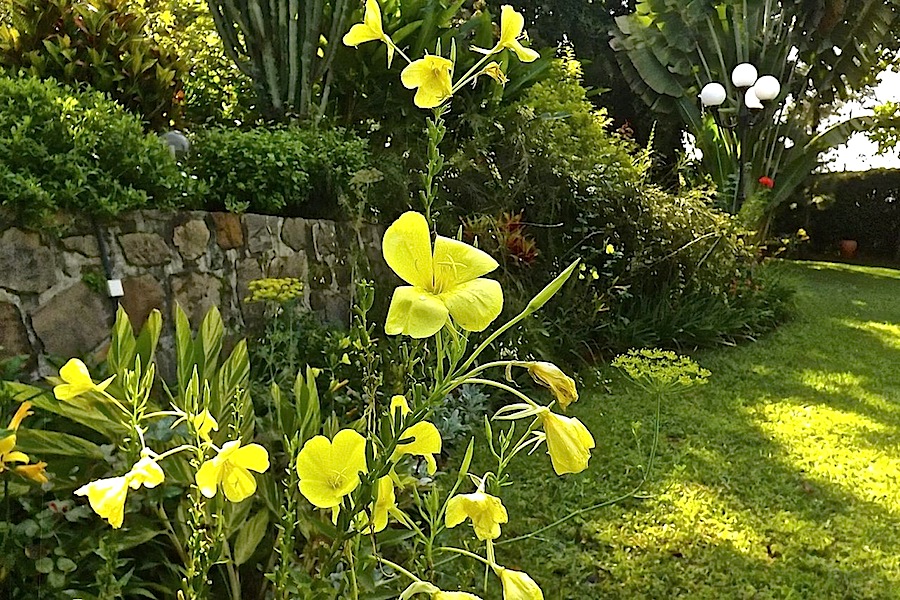 I was pleased to get the picture above. The yellow of the primroses is usually too intense for my camera to capture any details.
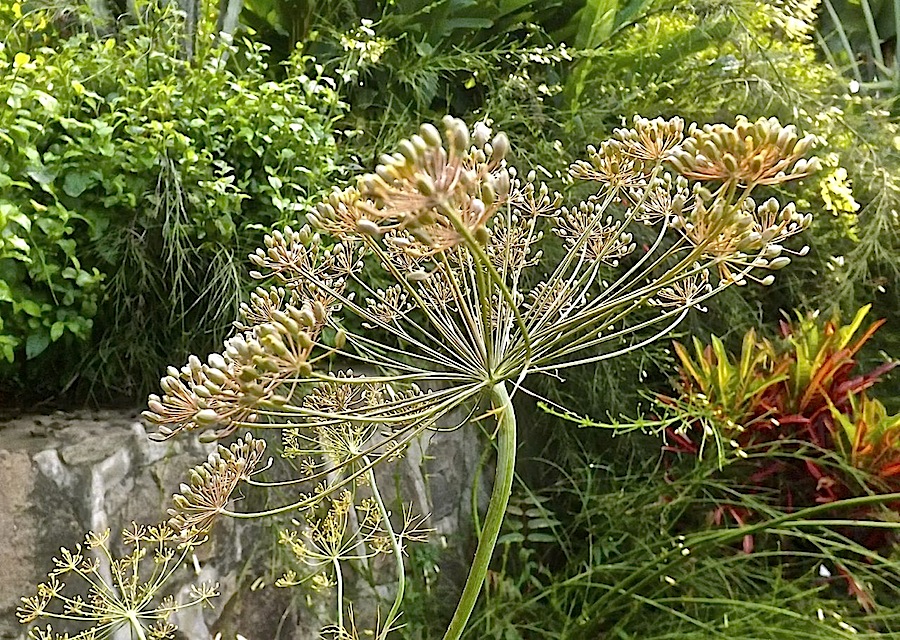 Above, the dill blooms/seadheads are beautiful even as they fade to tan.
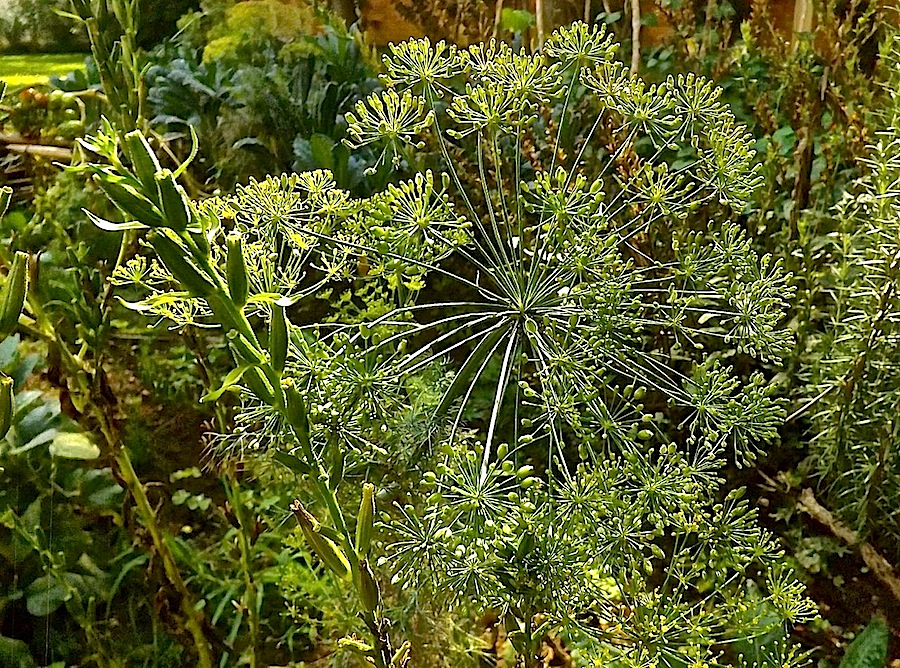 In our vegetable garden, the dillworks continue. . . .
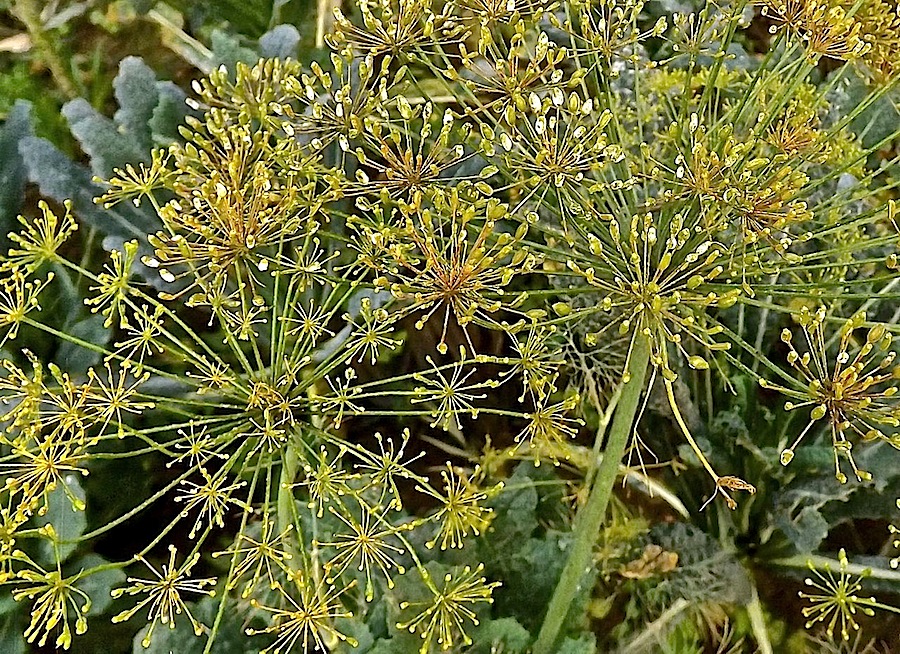 In the background are blue-green Russian kale. Some of the next batch that I grow will also go into the flower beds — like these at the Smithsonian’s Butterfly Habitat Garden.
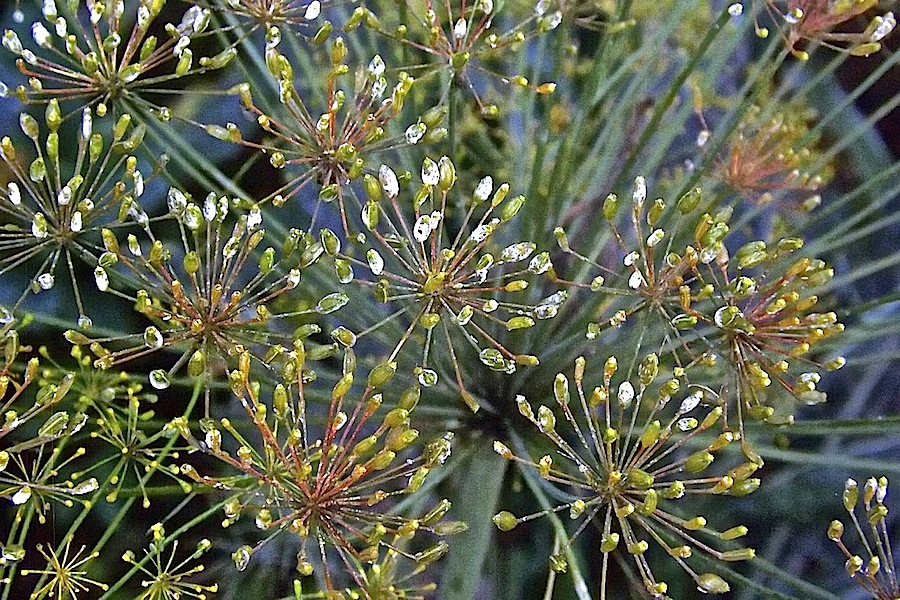
This Bloom Day, I also got interested in the after- blooms of our sunflowers.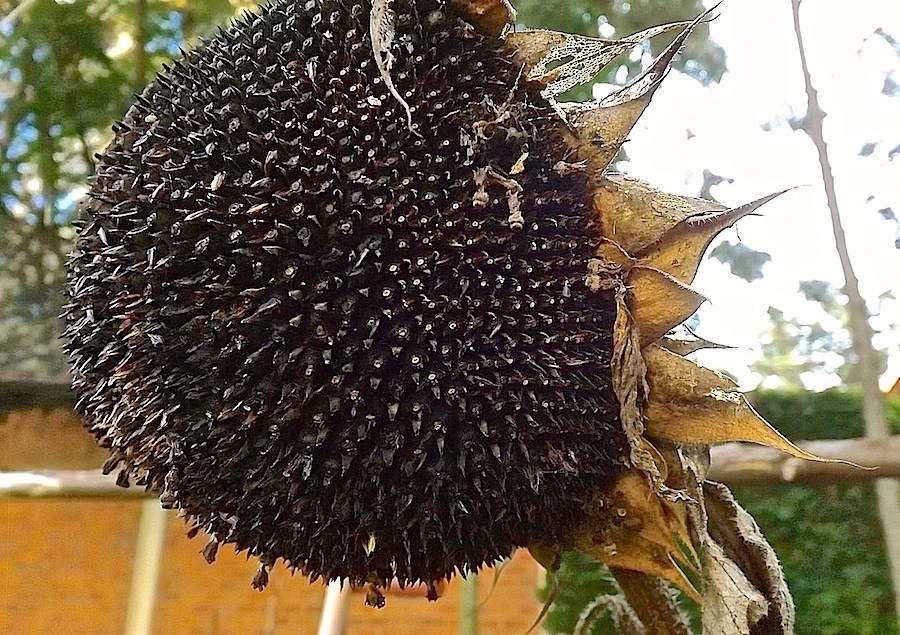
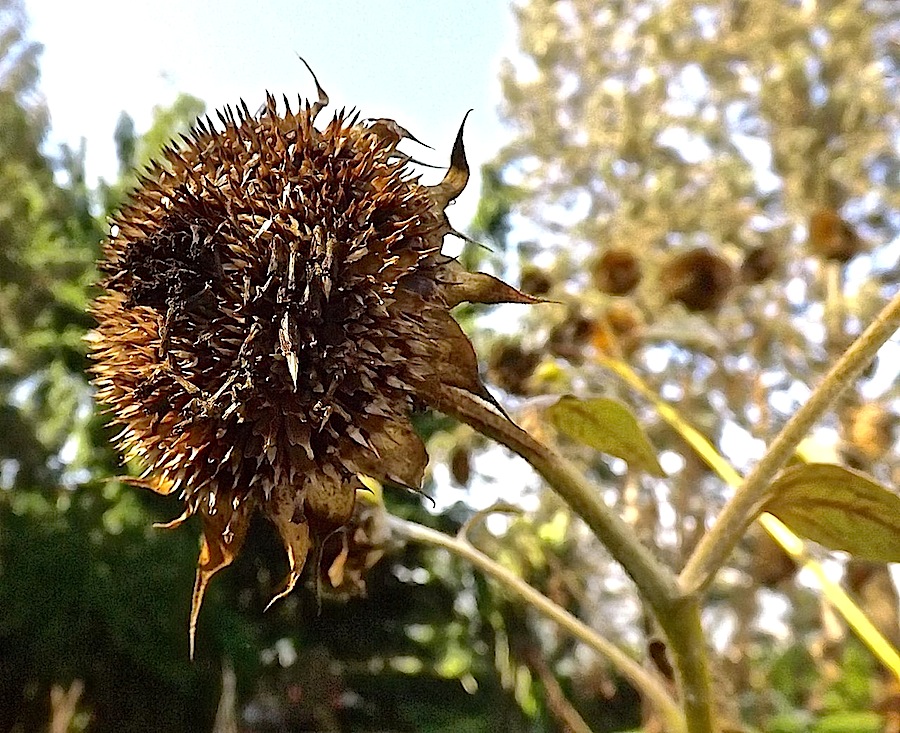
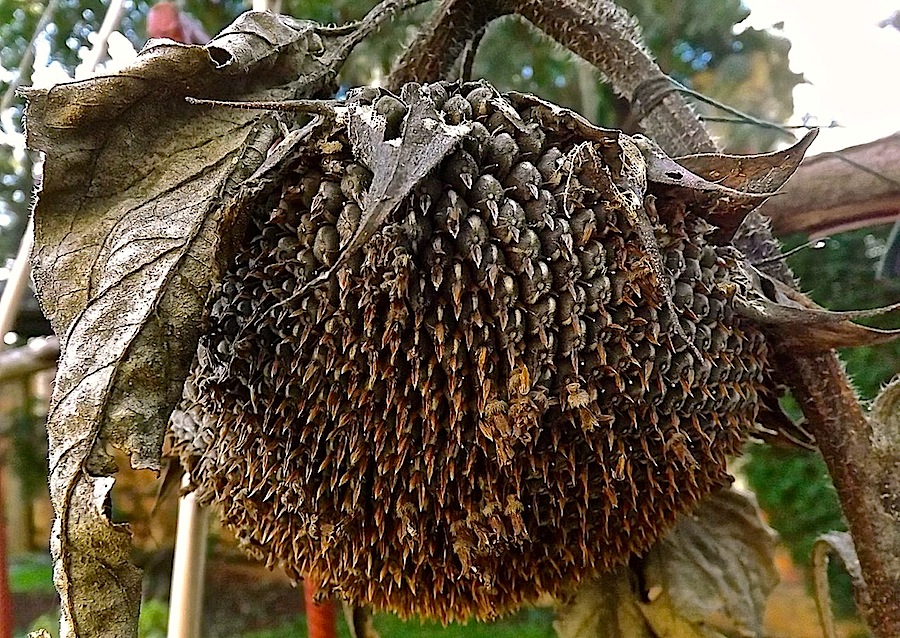
Below is what one of them looked like at the end of summer.
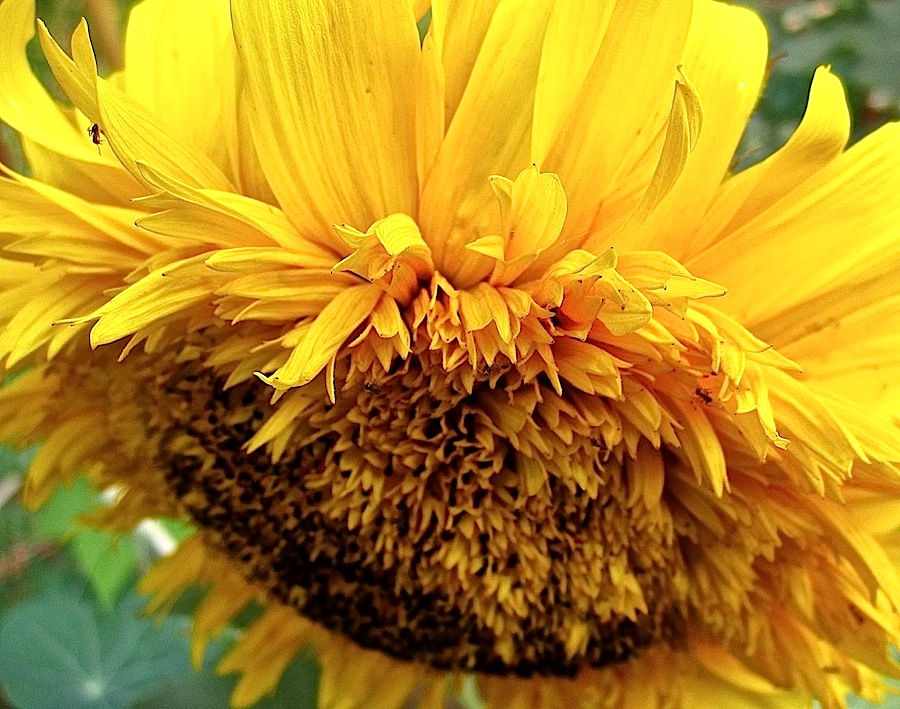
Garden Bloggers’ Bloom Day is the 15th day of every month. To see what’s blooming in other garden bloggers’ gardens, please visit Carol at May Dreams Gardens.
 enclos*ure