Vintage landscape: stump fences

The stump or root fences on the Corner road remind me of fossil remains of mastodons, etc., exhumed and bleached in sun and rain.
— Henry David Thoreau, Journal (July 19, 1851)

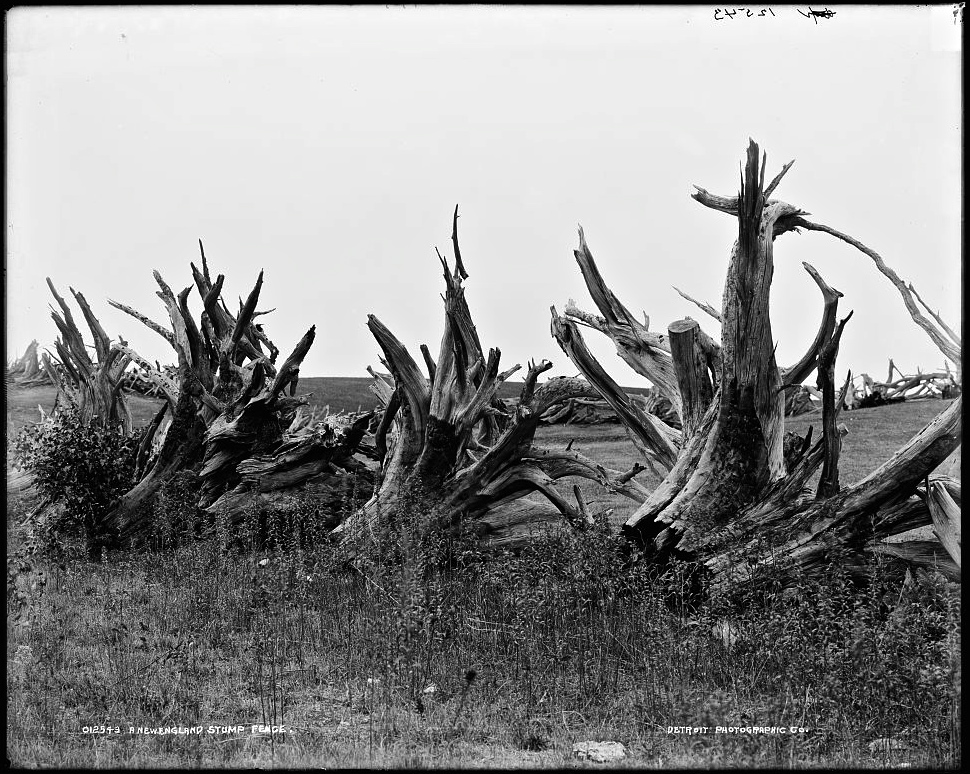
Both photos: “A New England stump fence,” ca. 1890-1901, by Detroit Publishing Co., via Library of Congress Prints and Photographs Division.
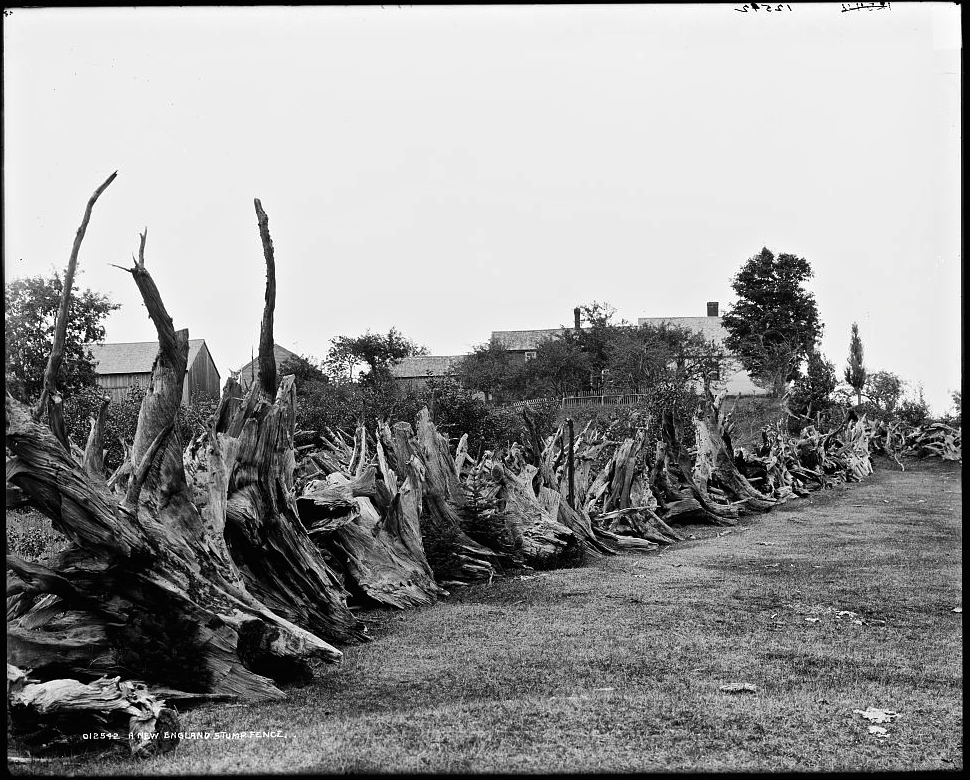
I had heard of  ‘stumperies,’ but not of stump fences (sometimes called root fences), however now I’ve learned that . . .

[s]tump fences, as their name implies, were made by dragging the stumps of trees to the edge of a field and placing them side by side, with their interlacing roots facing outward and their trunks inward. In the days when “ugly as a stump fence” was a simile in common usage, the stump fence had its critics, but in 1837 one observer called it “a singular fence…needing no mending, and lasting the ‘for ever’ of this world.” “The devil himself couldn’t move a stump fence,” farmers used to say, an opinion borne out by the fact that stump fences well over a hundred years old can still be seen in parts of Canada and in the Midwest.

Stumps were often the product of the first clearing of the land, but stump fences didn’t appear in the first generation of a settlement’s fences because stumps need to sit in the ground for six to ten years before they are loose enough to be pulled out and hauled away. Extracting even a loosened stump was never easy; it required oxen and strong chains, something that many settlers lacked at first. In the 1800s, stump pulling would become a cash business and one way that a man could make a good living. Twenty-five cents a stump was the standard price in 1850 when men operating such mechanical stump pullers as the “Portable Goliath,” “The Little Giant,” and “Roger’s Patent Extractor” could extract from twenty to fifty stumps a day.

–Susan Allport, Sermons in Stone: The Stone Walls of New England and New York  (older edition here)

Quotes via the blog Laudator Temporis Acti.

I’m traveling for the next couple of weeks, but I’ll be posting a ‘vintage landscape’ from time to time.
Mount Vernon’s garden and a Wednesday miscellany

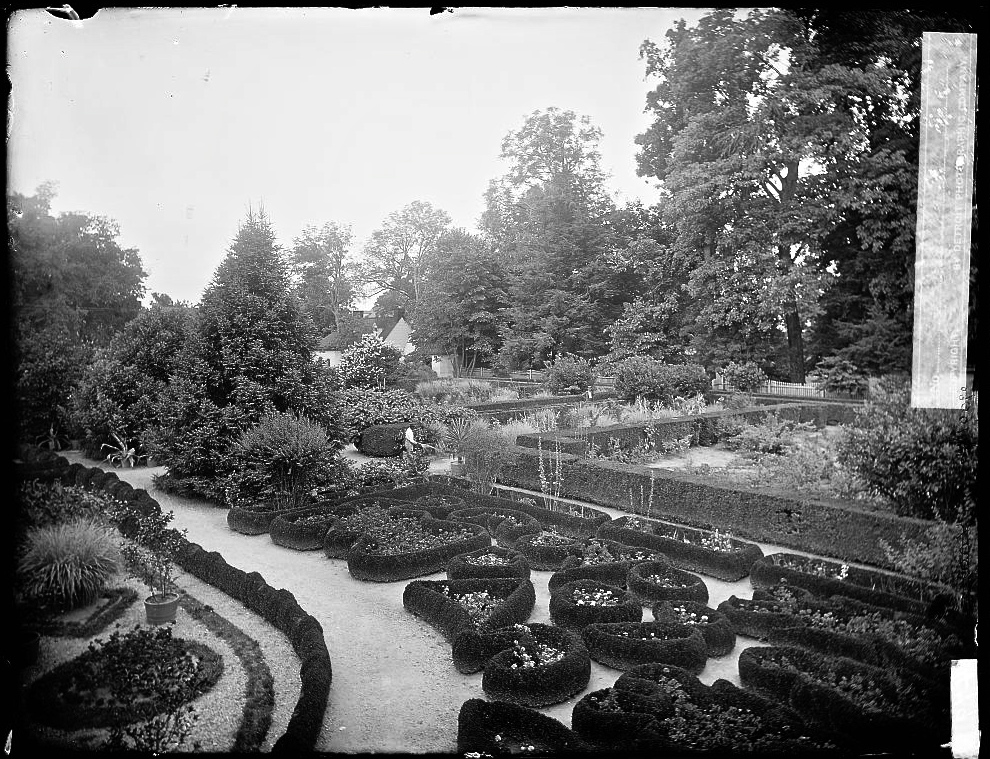
I love this 1902 photograph of the Upper Garden at George Washington’s home, Mount Vernon. It’s so high Colonial Revival.

Early American Gardens has a post this week,  “Mount Vernon after George Washington’s death,” with images from the 19th century.  While looking at them I remembered the picture above and the two below.

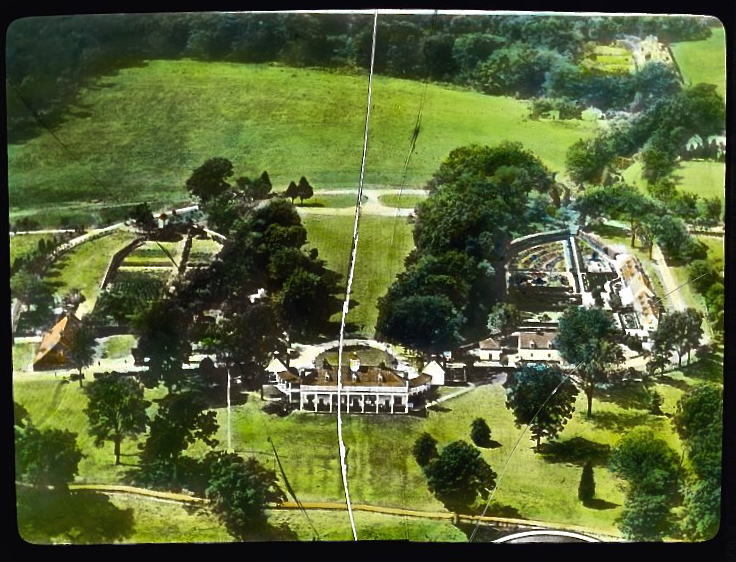
Above is a hand-colored slide from a 1929 aerial photo, part of the lantern slides collection of Frances Benjamin Johnston.  The Upper Garden is on the right side.

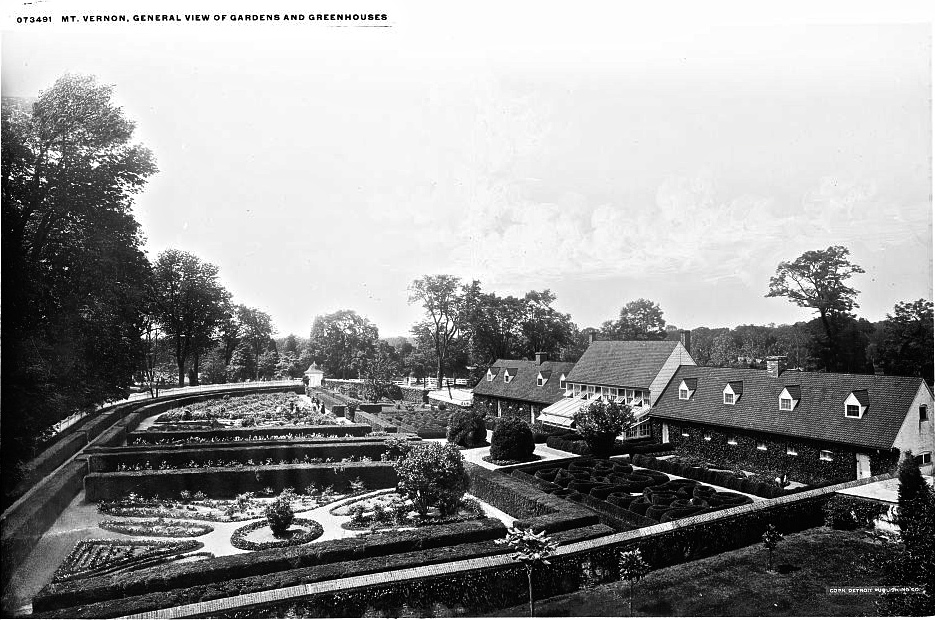
And here is a general view (c.1910 – 1920) of the the Upper Garden by the Detroit Publishing Co.  All three images above via the Library of Congress Prints and Photographs Division.

The 20th century photos are pretty, but they don’t accurately represent the Upper Garden of Washington’s time.  In the late 19th century, restorers thought that the boxwood parterres (many filled with hybrid tea roses) were original to Washington’s time, but research in the 1980s found that they were actually planted in the 1860s or 70s (although they may have been rooted from Washington’s boxwood).

The garden was substantially re-worked in 1985 (the greenhouse was restored in the 1950s), but such is the romantic power of a boxwood hedge that they were largely “kept in place by their own mythology and the mythology they supported of Washington as American royalty,” according to The History Blog, here.

By the early 2000s, the boxwoods were dying, so the Mount Vernon Ladies’ Association, which owns the estate, decided to make an extensive (six-year) archaeological dig on the site.  This culminated in a “new” (1780s) design in 2011.  The area now holds large open beds of vegetables and flowers.  They are bordered by low boxwood hedges and centered by a 10′ wide gravel walkway.

You can read about the restoration in this Washington Post article, here.  However, I really recommend watching this very interesting 30-minute C-Span video about the research and archaeology that informed it.

Miscellany

I’ve almost finished reading the excellent Gardens and Gardening in the Chesapeake, 1700 – 1805, by Barbara Wells Sarudy (aka Early American Gardens).  You can read its first chapter, about the 18th century garden of Annapolis, Maryland, craftsman William Faris, here.

For Anglophiles: thousands of aerial photos of Great Britain have recently been made available online; read about it here.

I recently found this 2010 (inside) art installation by Beilu Liu, which I think is just lovely, here.  It’s called “Red Thread Legend.”  (My Pinterest page — link on the right — is red today.)

In 2011, artist and former urban planner, Kathryn Clark, made a series of map quilts, shown here, representing neighborhoods that have had high foreclosure rates in recent years. Earlier this year, she gave an interesting interview with The Atlantic blog, Citieshere.

I also recently found the blog Miss Design Says, about “all good things Danish.”  It currently has a post about Rabalder Parken, a park that combines a street skate area  with an overflow water drainage system, here.

Of course I saw this on Pinterest: an umbrella that looks like a head of lettuce, here.  It’s from Japan, but the link will help you order it from other countries.

I liked this Q & A  information on rose hips in the New York Times,  here.  And I have recently been looking for some good flower frogs, and I found them here, from a tip from Gardenista.

Finally,  O-Dark-Thirty, the online literary journal of the Veterans Writing Project, launched in August.   The VWP is a 501(c)(3) non-profit based in Washington, D.C.  It provides no-cost writing seminars and workshops for veterans, service members, and military family members. Please visit them here.

ADDENDUM:  Today, Thursday, Washington Post garden columnist Adrian Higgins discusses boxwood blight, a disease that comes from Europe and has infected shrubs in nine states, here.

Vintage landscape: Central Park

“View from apartment 9D, 146 Central Park West, in the rain, New York City, 1946 July 9.” By Carl Van Vechten, via Library of Congress Prints and Photographs Division.

Don’t threaten me with love, baby. Let’s just go walking in the rain.
— Billie Holiday

Central Park: An Anthology by Andrew Blauner was published this April. Read the New York Times review here.

Vintage landscape: flowers and cabbages

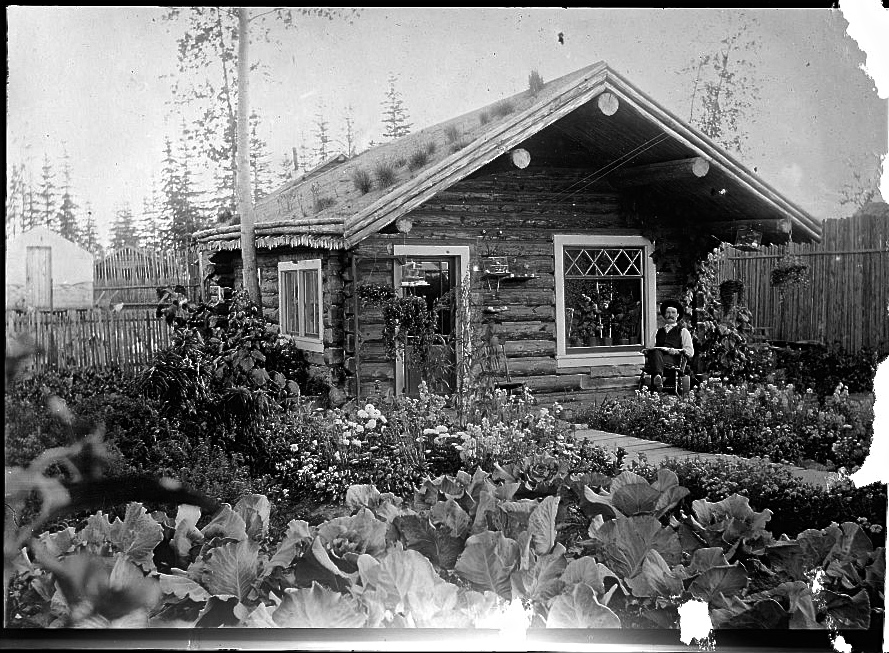
“A cottage & garden, Alaska,” ca. 1909-1920. By National Photo Company, via Library of Congress Prints and Photographs Division.

A similar photo of this cottage was labeled “a sourdough’s home.” The word ‘sourdough’ was slang in Alaska for an oldtimer, probably from the Klondike gold rush.  You can click on the image to enlarge it.

                        O cabbage gardens
summer’s elegy
                        sunset survived
Susan Howe, from “Cabbage Gardens

Another summer, continued

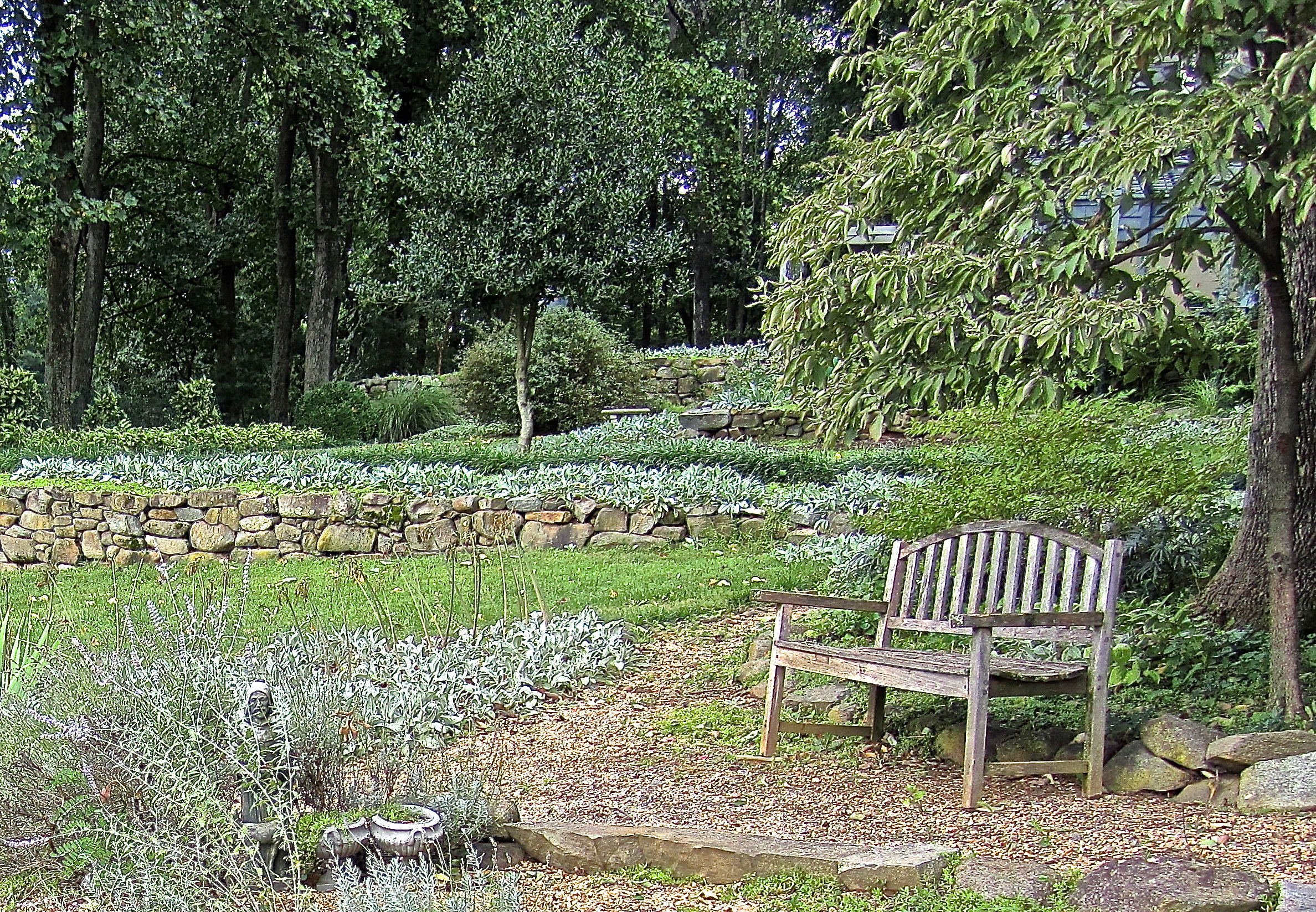
I thought you might like to see some photos of my parents’ garden in Northern Virginia — the one which surrounds  last week’s “Wordless Wednesday” stepping stone.  I took these pictures last August, before we left for Rwanda.

Tara Dillard often writes in her blog about beautiful landscapes shaped by the “poverty cycle.”   My parents have a deer cycle.

Every summer, the deer pass through the garden, the old Christmas tree field, and the woods — eating and eating.  Their numbers have increased over the garden’s 30-year existence, as farmed and forested lands have been lost to suburban development.

The result is a planting palette dominated by species that deer don’t like:  boxwood, cherry laurels, beautyberry, Miscanthus grass, lamb’s ear, Liriope, Hellebores, Russian sage.

The hollies, Aucuba, Hostas, Viburnums, and Solomon’s seal — which deer do like — are protected, with some success, by lines of nylon filament and and smelly sprays.  The two dogs occasionally rise to a bark and a brief pretend chase, but mostly ignore the passing herds.

My mother misses her old daylily collection, but she also loves watching each year’s crop of fawns.  I think the drifts of silvery grey, lavender, lime, and dark green are peaceful and perfectly set off the gorgeous view of the mountains.

Click on any thumbnail below and enjoy.