A dachterrasse and Friday miscellany

I recently discovered the beautiful German blog Gartenblick  (Garden View) by Dusseldorf photographer Sibylle Pietrek.

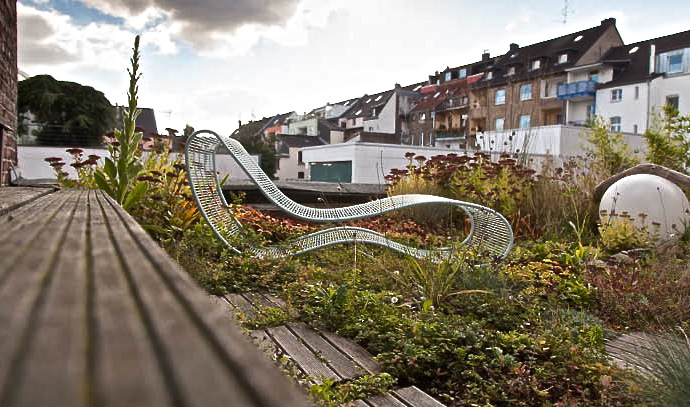
I particularly liked this post about her small, but really lovely, roof terrace (dachterrace).  I was impressed that the designer  — Karim Rashid — could achieve a real sense of an edge of a meadow (with a lounge chair) in so few square feet.
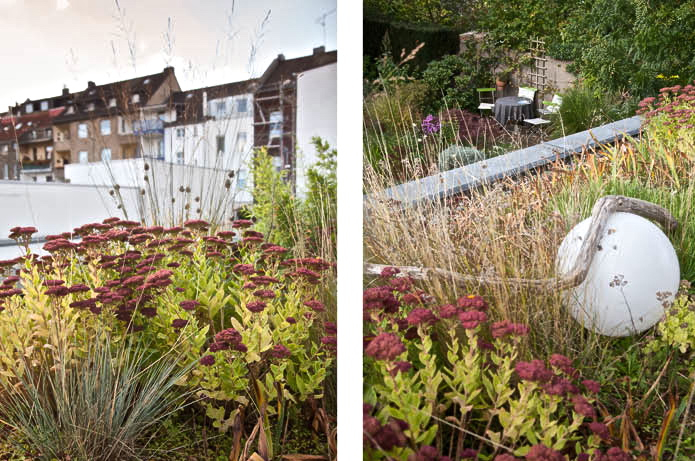
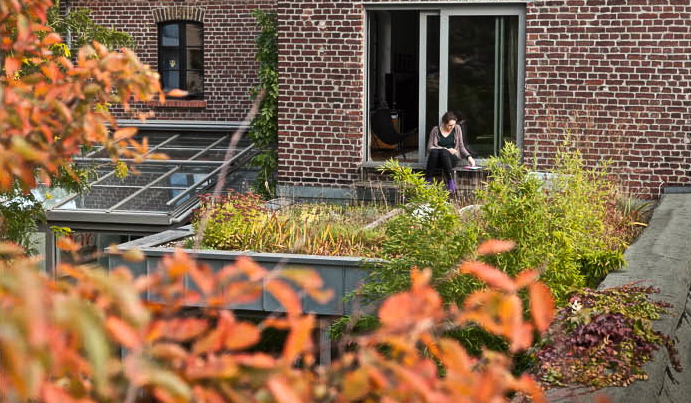
In her post, Sibylle writes that she uses the space for “early evening aperitif, photo shoots, painting, reading, and painting nails.” And to catch the long autumn afternoon sun.  What a nice refuge.

I’m starting to  think about the possibilities for the flat porch roof of our house back in D.C. . . .

All the above photos: ©Sibylle Pietrek, used here with permission.  Please check her blog before pinning or sharing.

Miscellany

Please check out Garden Rant’s review of October annuals at the Smithsonian Institution’s gardens.  Again, why are the S.I. gardens so wonderful and its neighbor, the White House, has this?

Have you seen the online Landscape Architect’s Guide to Washington, D.C., featuring write-ups by 20 L.A.s on 75 historic and contemporary landscapes?  I wish it were somewhat more opinionated (see above), but it’s useful for a visit to the Capital.

The Global Garden,” the weekly series of the Los Angeles Times’s home and garden blog, explores “multicultural L.A. through the lens of its landscapes.”  Now it has created a library of its posts, here. In the last year, the series has looked at sugar cane, shiso, loquat, purslane, moringa, sweet lemon, ice cream bean, and more. It will continue to update the archive with new material.

I really like this garden by the firm Covachita in San Pedro, Mexico (I believe it’s their studio).  It effectively combines edgy modern urban with antique farm.

The “Urban Jungle” columns by Patterson Clark in The Washington Post are always so interesting, especially this recent one about milkweed (Asclepias syriaca — the light pink one).  If yours left pods and white fluff all over your garden in September, consider how — during World War II — you (or your enterprising child) could have been paid about 15¢ a bushel for them.  The Japanese occupation of Java had cut off supplies of kapok — a fiber (then) needed to fill life vests.

ADDENDUM: I clicked on ‘publish’ and then found one more. I have to admit I love this sort of thing.

Vintage landscape: Bluff Hall gate

What a great old gate at Bluff Hall, Demopolis, Alabama, in 1936. I love the fat finials.

The playwright Lillian Hellman may have passed through this gate in the first decades of the 20th century.  Her mother’s family was from Demopolis, and she visited there as a child.  She later used the town as inspiration for the setting of The Little Foxes.  Lionnet is said to have been based on Bluff Hall and another local mansion.

Today the house is on the National Register of Historic Places and is open to the public as a museum.

Photo: by Alex Bush for the Historic American Buildings Survey (HABS), via Library of Congress Prints and Photographs Division.

A-s-c-l-e-p-i-a—

I walked by the White House a few weeks ago to look through the fence at the famous vegetable garden. Then I took a further look around and realized that all of the ornamental beds and pots on public view, on all sides of the house, were planted out in red wax begonias.

Just wax begonias combined with dusty miller.

And I thought, “seriously?”

Yes, this — just this, all around.

I know they’re tough and look neat and give reliable color and my feet were hurting from too much walking, but how dull.

The kitchen garden looked fine and huge kudos, but next year, would it not also be educational for D.C. schoolchildren to learn to spell ‘Asclepias tuberosa‘ — as they tuck them in around the fountains with maybe some native switchgrass and goldenrod* — or even the family to which it belongs, ‘Apocynaceae‘ (formerly thought to be ‘Asclepiadaceae‘), and its subfamily, ‘Asclepiadoideae.’

Or maybe just the word ‘perennial,’ which I have to let spellcheck fix every time I write it.

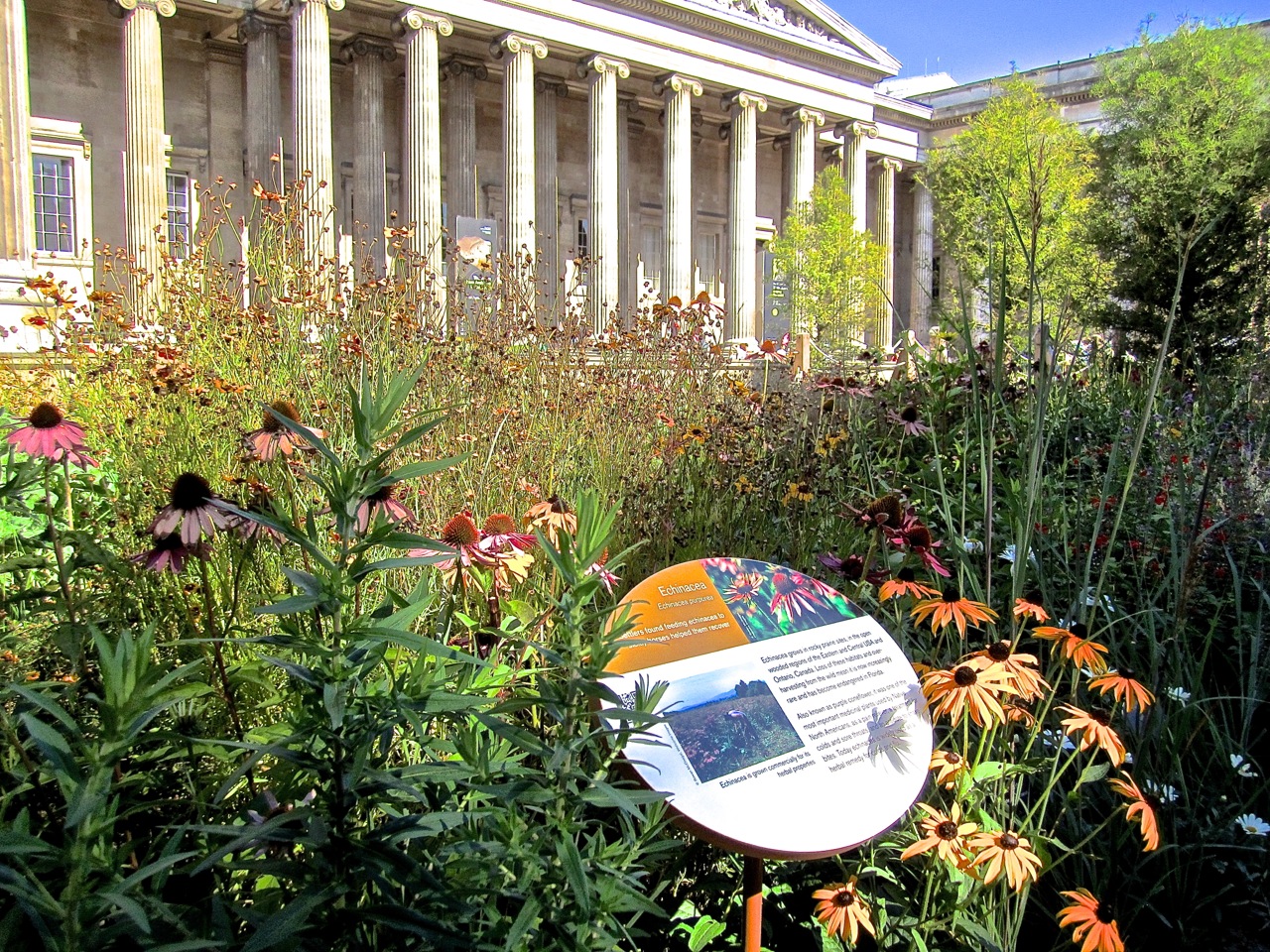
Why do we have wax begonias at the White House, while the British Museum currently has this?  (“North American Landscape:  Kew at the British Museum”)

* and even some scarlet rose mallow (Hibiscus c-o-c-c-i-n-e-u-s), which was planted at the Old Executive Office Building and looked great. (Addendum:  I’m now thinking it could have been this.)

A little more Bloomsbury

I didn’t make it to the Kew Royal Botanic Gardens on this trip*, but the British Museum was (and is, til November 25th) holding an exhibit, “North American Landscape: Kew at the British Museum” on its West Lawn. Admission is free.

The website, here, has a video of the installation and a slideshow of the plants featured.

I loved these flower finials atop a rather stately iron gate on Montague Street, not far from the British Museum.

Looking on Google’s satellite image for the street, the gates seem to be the entrance to a large shared garden on the inside of the entire block.

*and here and here.

Vintage landscape: tobacco flower

“George Barbee, 13 years old topping. . . . Nicholas County, Kentucky” by Lewis Hine, August 1916, via the Library of Congress Prints and Photographs Division.

Tobacco plants have to be topped and suckered in order to produce good leaves for market.   The flowers of Nicotiana tabacum are pink.

Photo by Donald Lee Pardue, via flickr.  

A short documentary about traditional tobacco growing methods is here.