
Outdoor tea in North Vancouver, British Columbia, 1906, by Philip Timms, via the Vancouver Public Library Commons on flickr.
It takes a long time to grow an old friend.
― John Leonard
Outdoor tea in North Vancouver, British Columbia, 1906, by Philip Timms, via the Vancouver Public Library Commons on flickr.
It takes a long time to grow an old friend.
― John Leonard
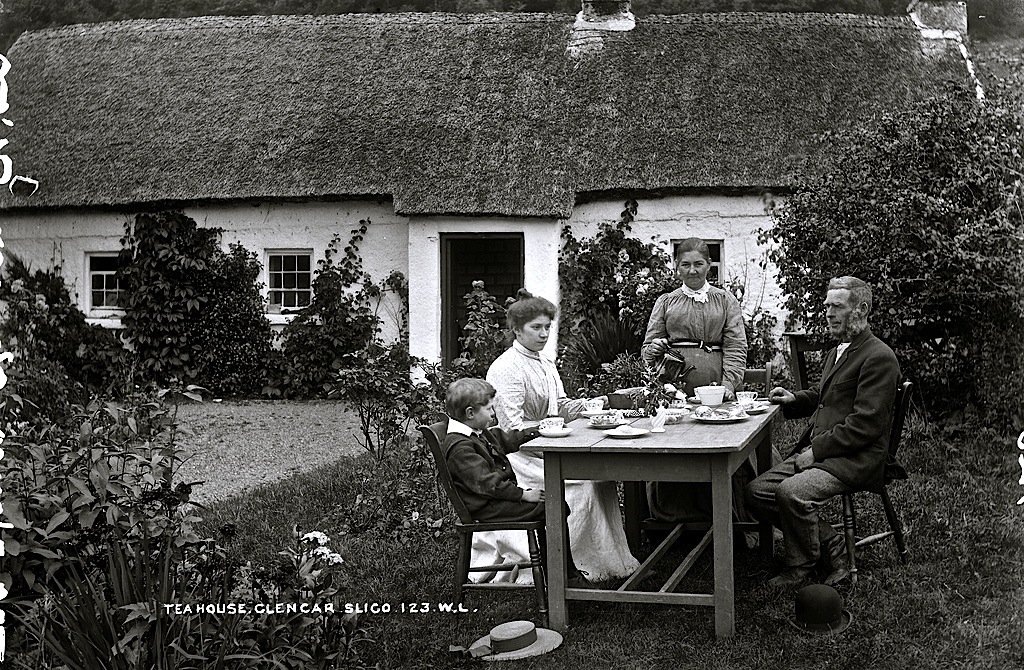 “[H]aving scones, butter and jam at the Glencar Tea House, Co. Leitrim (despite the fact that it says Sligo on the glass negative),” c. 1900, photographer not noted, via National Library of Ireland Commons on flickr.
A commenter on the flickr page pointed out that, from their looks, the two women might be mother and daughter, and, therefore, this could have been a publicity shot for the family’s tea house.
The women in the picture below may have been actual customers.
 “Tea House, Glencar, Co. Leitrim, circa 1890,” by Robert French, chief photographer of William Lawrence Photographic Studios of Dublin.
From the clothes and the way the vines are growing on the house, this photo appears to have been taken at almost the same time as the one above. The mother from the top picture seems to be carrying the plate of scones here.
I wonder if the group being served was a ladies walking club who had been to see the Glencar waterfall, a local attraction?
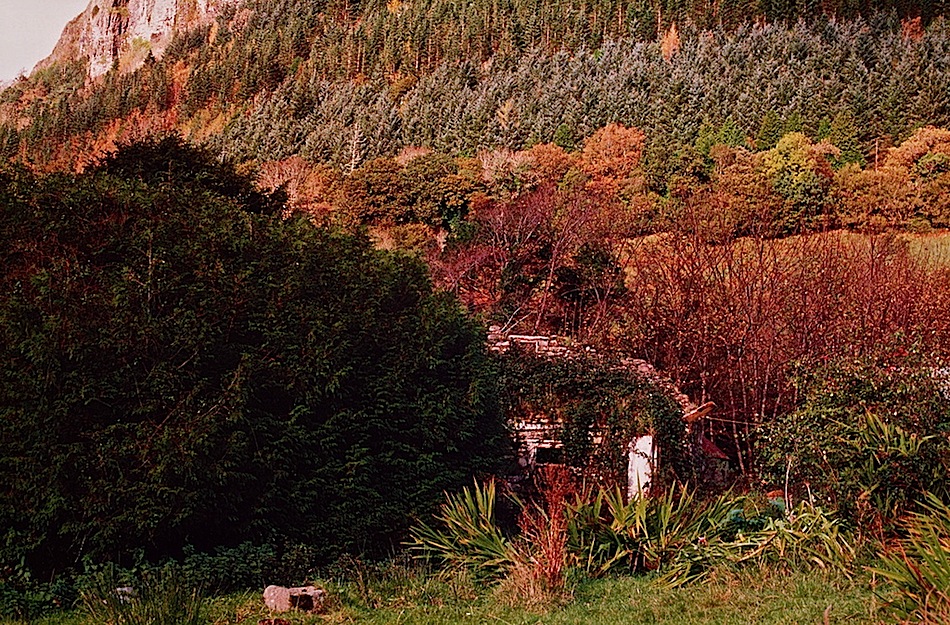 “Tea House, Glencar, Co. Leitrim, 1990,” by Mary Guckian for the Lawrence Photographic Project 1990/1991.
For the Project, volunteer photographers documented the sites of 1,000 100-year old photographs in the Lawrence Collection of the National Library of Ireland, “thereby creating a record of the changing face of the selected locations all over Ireland.”
For this picture, Guckian noted that a house on the site was “in use until 1970s — Family Siberry not interested in re-opening at present, despite suggestions from local councillor that cottage be re-built in former style.”
You can read more about the Lawrence Photographic Project here.
Happy St. Patrick’s Day!
There’s an Isle, a green Isle, set in the sea,
Here’s to the Saint that blessed it!
And here’s to the billows wild and free
That for centuries have caressed it!— Jean Blewett, from “St. Patrick’s Day“
*All three photos here via National Library of Ireland Commons on flickr.
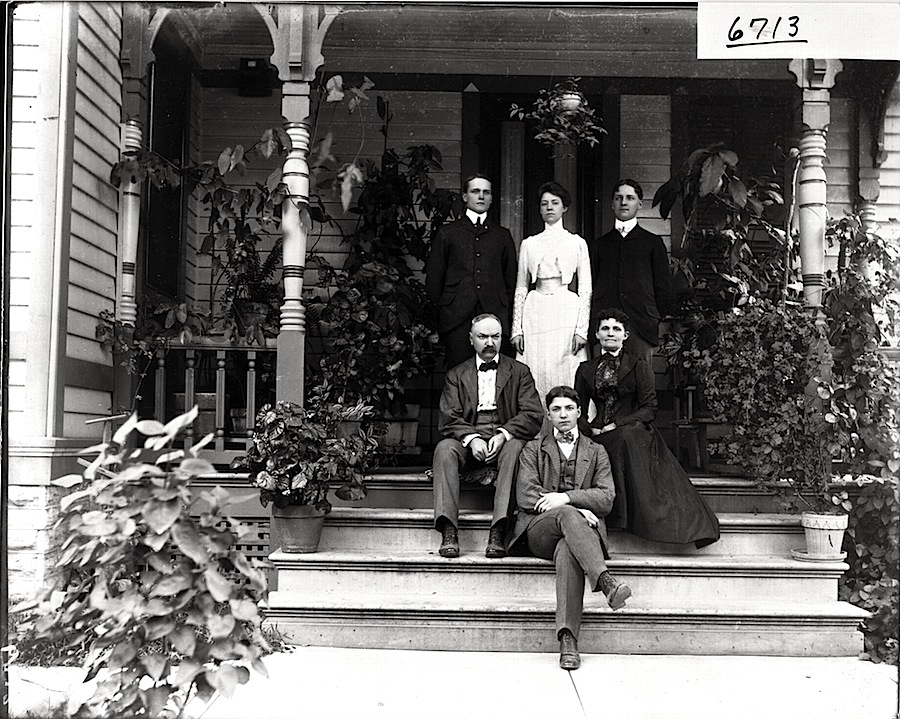 “Flower family on porch, ca. 1905,” by Frank R. Snyder, via Miami University Libraries Commons on flickr.
Impressive porch foliage . . . and in the photo below, by the same photographer.
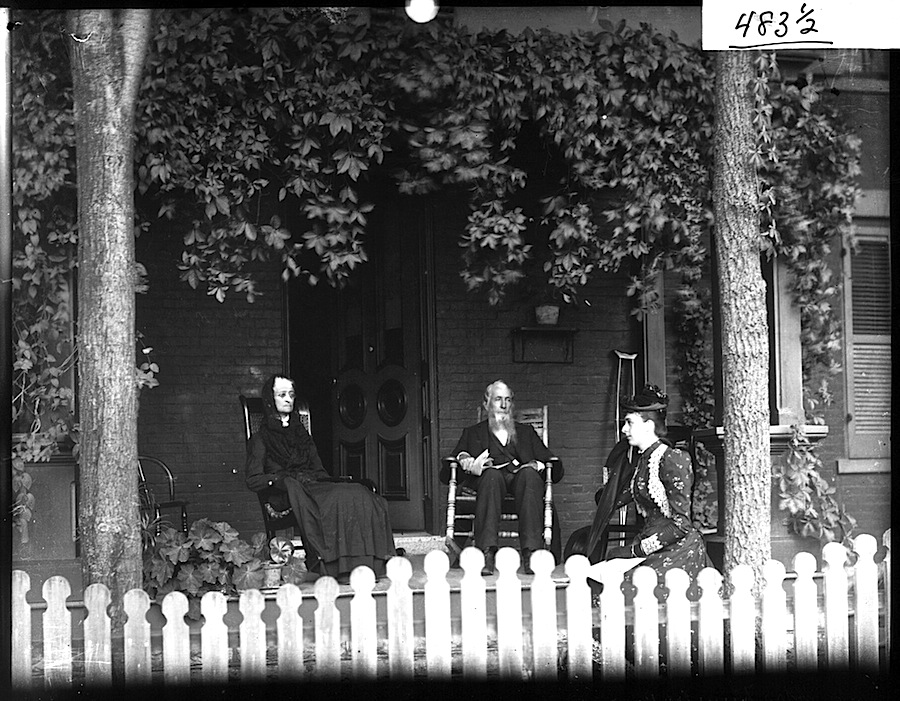 “Mrs. C. E. Kumler family on front porch, not dated,” also by Frank R. Snyder, via Miami University Libraries Commons on flickr.
Snyder was a successful photographer working in Oxford, Ohio, in the early 20th century. After his death in 1958, his family donated his archive of 4,000 negatives to Miami University.
Garden Bloggers’ Foliage Follow Up is the 16th of every month. Check out more beautiful leaves at Digging.
You’ve made your garden; how will you live in it?
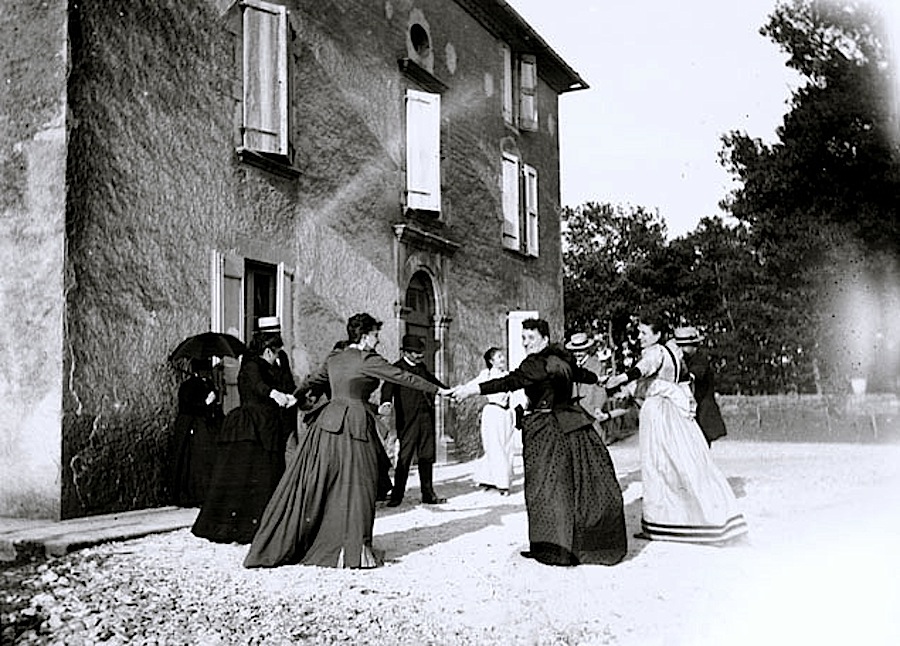 “Une ronde à Saint Edmond, Cornusson, [in the Pyrenees, France,]” c. 1900, by Eugène Trutat, via Bibliotheque de Toulouse Commons on flickr.
[T]he significance of the garden cannot be restricted to the domain of the aesthetic. That the garden affords sensory pleasure and invites the exercise of taste is, to be sure, an important dimension of the significance that gardens have for many people, but not one that even begins to exhaust the place that these same people afford to the garden within a wider conception of ‘the good life’.
— David E. Cooper, from A Philosophy of Gardens
 A library garden (Biblioteca de jardim) in the Jardim do Principe Real, Lisbon, Portugal, in 1949.*
Wonderful.
Unfortunately, I wasn’t able to find out anything about Lisbon’s library gardens. A comment on the flickr page said that they had been abolished in 1980.
Jardim do Principe Real is also called Jardim França Borges in honor of a Republican journalist, whose bust was placed there in 1915. The 2.9 acre (1.2 ha.) park in the Mercês parish was landscaped in a romantic design in the mid-19th century.
 Reading under the cedar of Buçado, above, in the Jardim do Principe Real, Lisbon, Portugal, 1949.
The cedar† and the pretty iron structure supporting its 78′ (23 m.) diameter still stand in the park.
 Above is the Julio de Castilho library garden at the Mirador de Santa Luzia, overlooking the Tagus River in Lisbon, also in 1949.
He who has a garden and a library wants for nothing.
― Cicero
*All photos here taken by Estúdio Mário Novais, via Art Library Fundação Calouste Gulbenkian Commons on flickr.*
†One source called it a Mexican white cedar.
 enclos*ure