Life in gardens: Bélesta, France

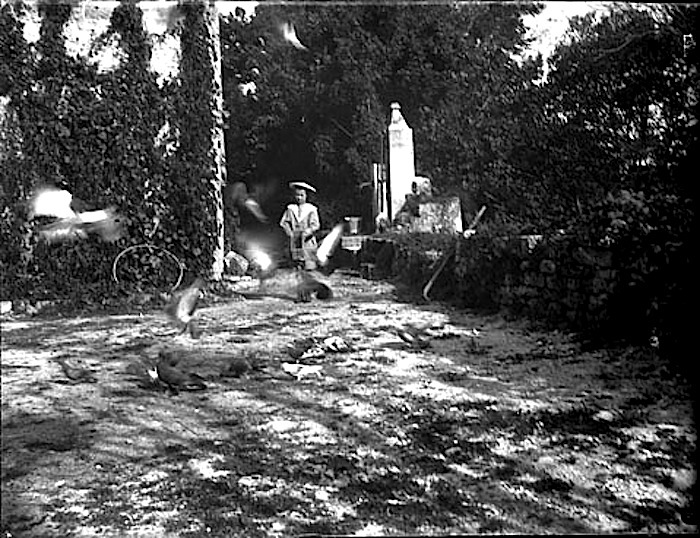
Bebe et les pigeons, Belesta, 1897, flickr Commons

“Bébé et les pigeons, Bélesta,” 1897, by Eugène Trutat, via Bibliothèque de Toulouse Commons on flickr.

Trutat (1840-1910) was a naturalist, geologist, mountaineer of the Pyrenees, and the curator of the Museum of Toulouse.

He was also an early photographer — beginning in 1859 — and was particularly interested in using the medium for science. He eventually took almost 15,000 images and authored a number of books, including Photography Applied to Archaeology and Photography Applied to Natural History.

Trutat took many beautiful pictures of his family and friends, including the one here, of his sons, Paul and Henri. He took several photos of Bébé, a little girl, in October 1897.

There’s more in words than I can teach:
Yet listen, Child! — I would not preach;
But only give some plain directions
To guide your speech and your affections.
Say not you love a roasted fowl
But you may love a screaming owl,
And, if you can, the unwieldy toad
That crawls from his secure abode
Within the mossy garden wall
When evening dews begin to fall,
Oh! mark the beauty of his eye:
What wonders in that circle lie!
So clear, so bright, our fathers said
He wears a jewel in his head!
And when, upon some showery day,
Into a path or public way
A frog leaps out from bordering grass,
Startling the timid as they pass,
Do you observe him, and endeavour
To take the intruder into favour:
Learning from him to find a reason
For a light heart in a dull season.
And you may love him in the pool,
That is for him a happy school,
In which he swims as taught by nature,
Fit pattern for a human creature,
Glancing amid the water bright,
And sending upward sparkling light.

— Dorothy Wordsworth, from “Loving and Liking: Irregular Verses Addressed to a Child

Life in gardens: Napier, New Zealand

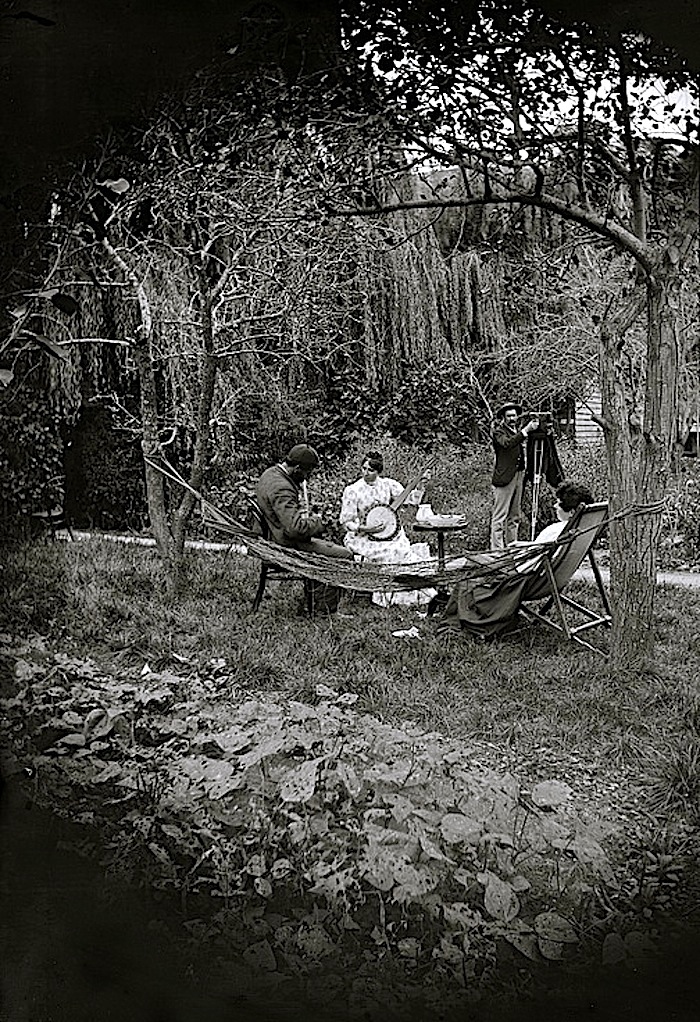
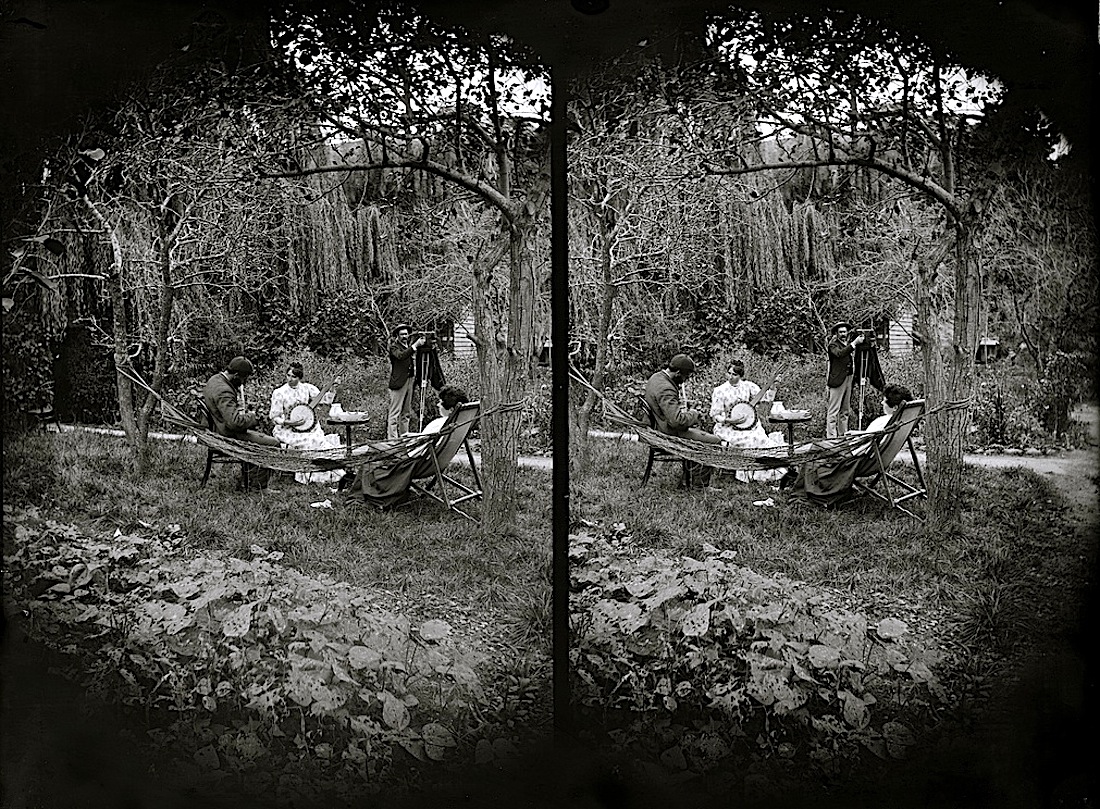
Williams garden, via National Library of New Zealand Commons on flickr“Group in the garden of William and Lydia Williams, Carlyle Street, Napier,” ca. 1890, a stereographic image by William Williams, via the National Library of New Zealand Commons on flickr.

Williams garden, via National Library of New Zealand Commons on flickr

The online catalogue of the Alexander Turnbull Library in Wellington provides further details:

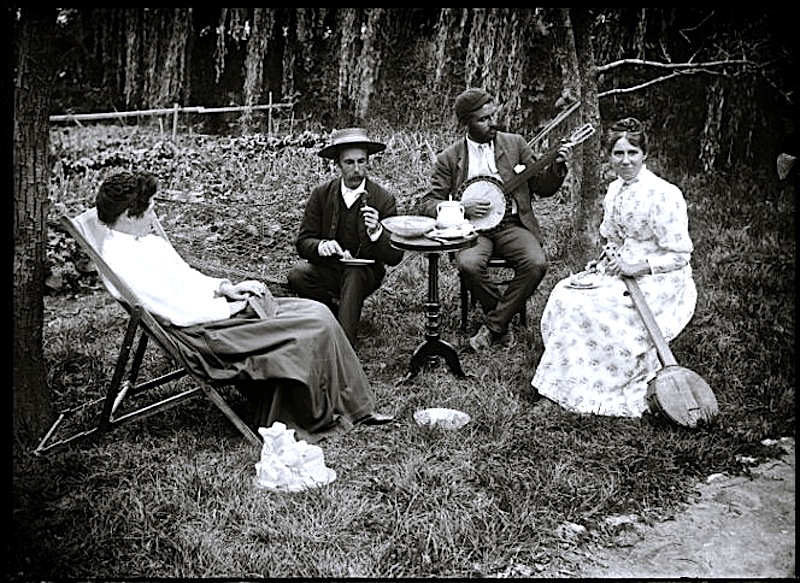
Lydia Williams is in the centre, playing the banjo. Seated at the right is her sister, Amy Devereux. The man with the camera is Russell Duncan. The other man’s identity is unknown but it is possible he was a member of a group such as the Fisk Jubilee Singers, a troupe of Negro singers and musicians who toured New Zealand in the late 1880s. Photograph taken by Lydia’s husband William Williams.

Russell Duncan was later to become a well known photographer and historian of Napier.

Another photo by Williams, below, also from the Alexander Turnbull Library, seems to show the same group, on the same day.

Williams garden, via National Library of New Zealand The man eating may be Williams, rather than Duncan.

What junipers are these, inlaid
With flame of the pomegranate tree?
The god of gardens must have made
This still unrumored place for thee
To rest from immortality,
And dream within the splendid shade
Some more elusive symphony
Than orchestra has ever played.

— Grace Hazard Conkling, from “Symphony of a Mexican Garden

The winter garden: the White House

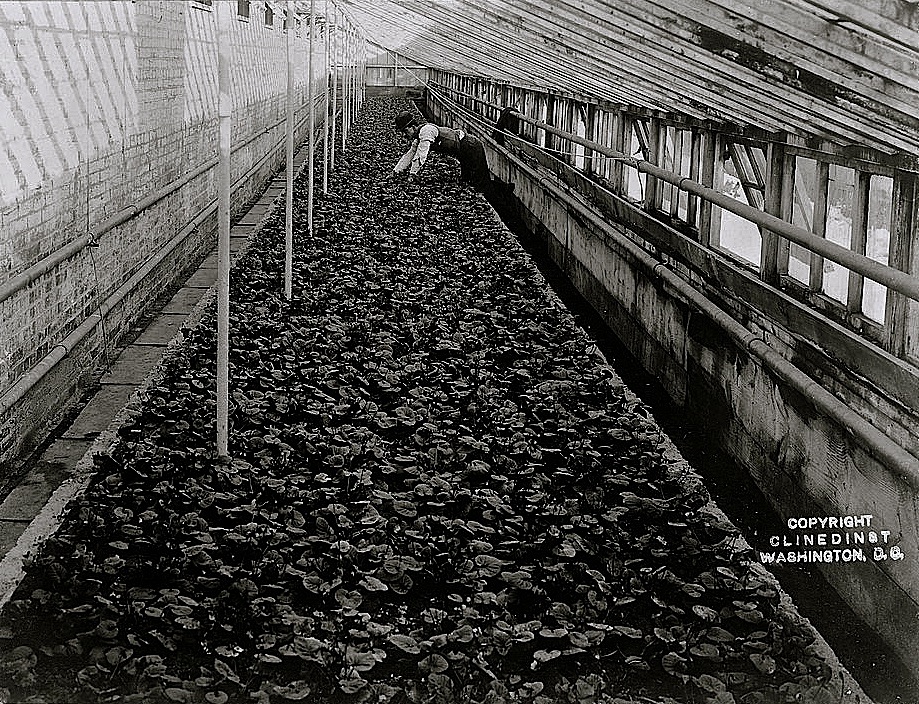
Violet house section of the White House conservatory, early 1900s, by Barnett McFee Clinedinst
The violet house section of the White House conservatory, early 1900s, by Barnett McFee Clinedinst

Wouldn’t it be nice to have a whole greenhouse devoted to growing violets for the house during the cold weather months?

Or orchids and palms?

This slideshow requires JavaScript.

Frances Benjamin Johnston took the above photographs (except one) in 1889 and 1890.

Or azaleas?

This slideshow requires JavaScript.

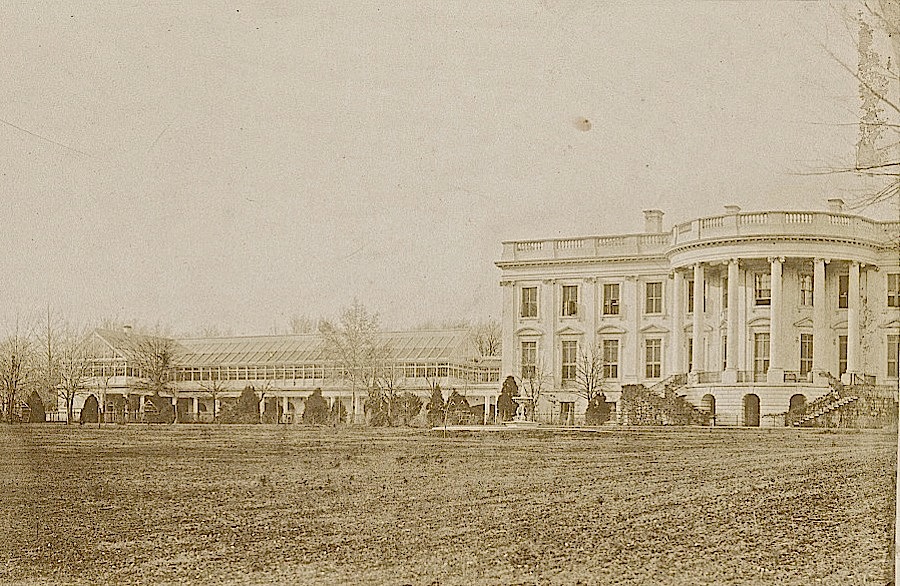
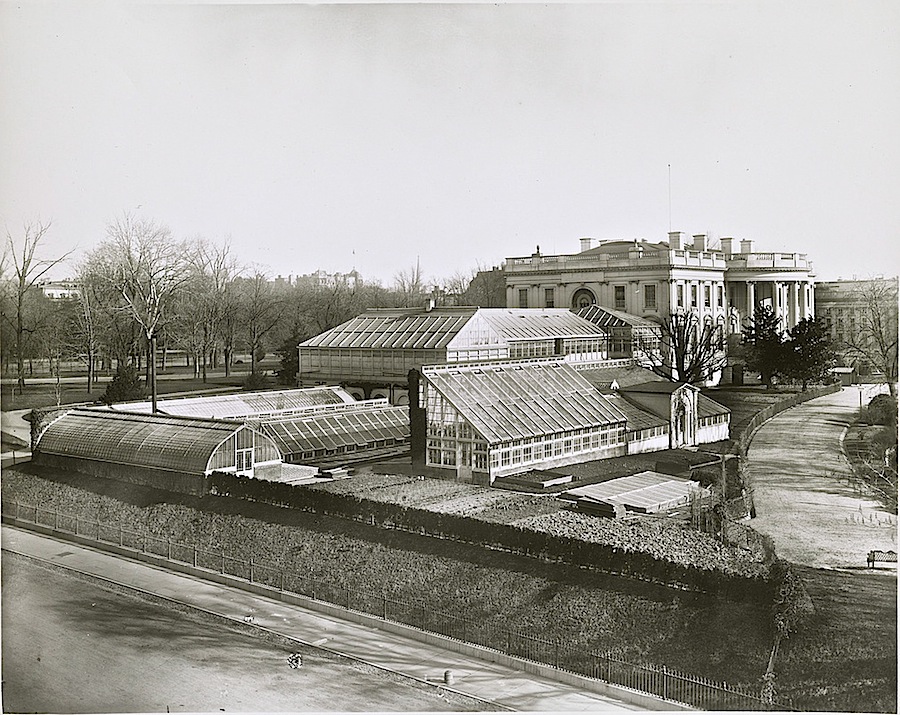
A large conservatory complex occupied the west side of the White House from 1857. . .

The White House and conservatory in 1857 by Lewis Emory Walker.

until 1902, when the West Wing was built.

The greenhouses in 1889 by Frances Benjamin Johnston.

All photos above via Library of Congress Prints and Photographs Division.

Four more winter gardens are here.

The perfect loveliness that God has made,—
Wild violets shy and Heaven-mounting dreams.

Alice Moore Dunbar-Nelson, from “Sonnet

The Sunday porch: Wellington

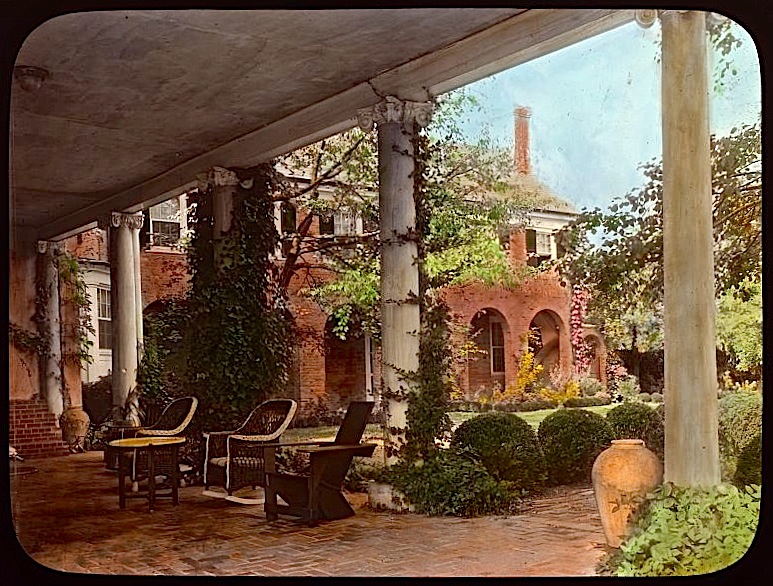
The Sunday porch/enclos*ure: Wellington, now River Farm, about 1931, Alexandria, VA, via Library of Congress.“Wellington,” near Alexandria, Virginia, 1931, hand-colored glass lantern slide by Frances Benjamin Johnston, via Library of Congress Prints and Photographs Division.

The white columned, ground-level porch wrapped around two and a half sides of one wing of the house.  I like the black and white wicker rockers and those terracotta jars.

Today, the house (built in 1757) and its surrounding 25 acres are the headquarters of the American Horticultural Society (AHS) and are called River Farm.

George Washington originally gave the property that name after he purchased it in 1760.  It was then 1,800 acres in size and became one of his five farms around Mount Vernon.

During the 1800s, the property, re-named Wellington, passed through several owners’ hands, becoming progressively smaller in size.  It was only 280 acres in 1919, when it was purchased by local businessman Malcolm Matheson, who restored the house and gardens.

In 1971, when Matheson wanted to retire to Florida, the house and (then) 27 acres were bought by the AHS.  The funds for the purchase had been donated by board member Enid A. Haupt — partly to help the AHS, but also to keep the last of George Washington’s old farm out of the hands of the Soviet Embassy, which had wanted to buy it as a summer dacha for its employees.

Today, River Farm is open to the public  weekdays, from 9:00 a.m. to 5:00 p.m. From April through September, it is also open on Saturdays, from 9 am to 1 pm. Admission is free.

And, of course, it can be rented for weddings and events.

A gardyn saw I, ful of blosmy bowes
Upon a ryver, in a grene mede,
There as swetnesse everemore inow is,
With floures whyte, blewe, yelwe, and rede

— Geoffrey Chaucer, from “The Parlement of Foulys

Vintage landscape: winter ice of ’22

Skating on the Reflecting Pool of the Lincoln Memorial, Washington, D.C., January 1922, by Harris & Ewing, via Library of Congress Prints and Photographs Division.

To scroll through larger versions of the images, click on any of the thumbnails in the gallery.

The Pool and its surroundings were actually still under construction when these skaters took to the ice. From 1922 to the 1980s, people skated on the Pool during very cold periods (it’s no longer allowed).

These photos may have been taken between January 23 and 27, when an Arctic airmass was keeping Washington’s temperatures down below freezing.  On the 28th, it began to snow, eventually accumulating to 28″ (71 cm.).*  

This was the infamous Knickerbocker Storm, so named because, about 9:00 p.m. that night, the flat roof of the Knickerbocker Theater collapsed during a movie, killing 98 people and injuring 133.


*It was D.C.’s deepest snow on record until 2010.