Life in gardens: conversation

This slideshow requires JavaScript.

I like this trio of photos by Louise Rosskam, which capture two men on a town common bench evidently enjoying a funny story or joke.

They were  taken in Vergennes, Vermont, in August 1940.*

New England commons were (and are) community spaces that probably evolved from the lots originally set aside for village meetinghouses or churches.  After the mid 19th century, many began to function like parks.†

Although Rosskam was not employed there, a series of photos that she took in rural Vermont became part of the picture archives of the Farm Security Administration.

In a 1965 oral history interview, she related how she proposed taking these pictures for the FSA, where her husband, Edwin, was a photo editor.

. . . [O]nce I took a vacation in Vermont, and I said to Roy [E. Stryker, head of the Information Division],”Could I take some pictures for you?” you know, “I’ll buy my own film and everything.” And he said, “Oh, here’s some film,” and then he starts rambling along about Vermont and really it didn’t sound as if it had anything to do with what you wanted to do at all. You started talking about hills, farmhouses and how people build a little extension on the house for the old people, and about pickled limes, the sky and how to get to Vermont 50 years ago, you know; by the time you got through listening to him ramble along, you begin to get some sort of formation in your mind of what there was up there so that when you get out there (phone rings)-

LOUISE ROSSKAM: (continues after phone conversation) But I’m sure that everybody sitting around, listening to Roy ramble, as it seemed, began to get his mind turned in the direction to be open to a lot of things that ordinarily he wouldn’t perceive when he got to a place. Don’t you think that’s true?

For many years afterward, her Vermont photos were attributed to her husband.  The records were corrected in 2001.

Laura Katzman, an associate professor of art history at James Madison University, curated two exhibits of Louise Rosskam’s photos and described her work like this:

She was one of those documentary photographers for whom the people and the work were so much more important than her name or her career. . . .  She tried to erase herself as much as possible. It was a pure documentary ideal that was impossible to achieve: let the subject feel comfortable, take yourself out of it and see what happens in the encounter. She did this beautifully because her ego wasn’t invested in it.

You can see four more photos by Rosskam of the Vergennes common by clicking on ‘Continue reading’ below.


*All via the Library of Congress Prints and Photographs Division.

†Vergennes is actually a city — the first chartered in Vermont and currently its smallest (in population). It is approximately 2.5 sq. miles in area.

The Sunday porch (on Monday)

Today, I’m repeating a porch from August 2012, but it is a nice one. (We were traveling this weekend.)

The Sunday porch/enclos*ure: Maplewood Camp, Waseca, Minn., c. 1900, Library of Congress“Cottages at Maplewood [Waseca, Minnesota],” c.1880-c.1899. By Detroit Publishing Co., via Library of Congress Prints and Photographs Division.*

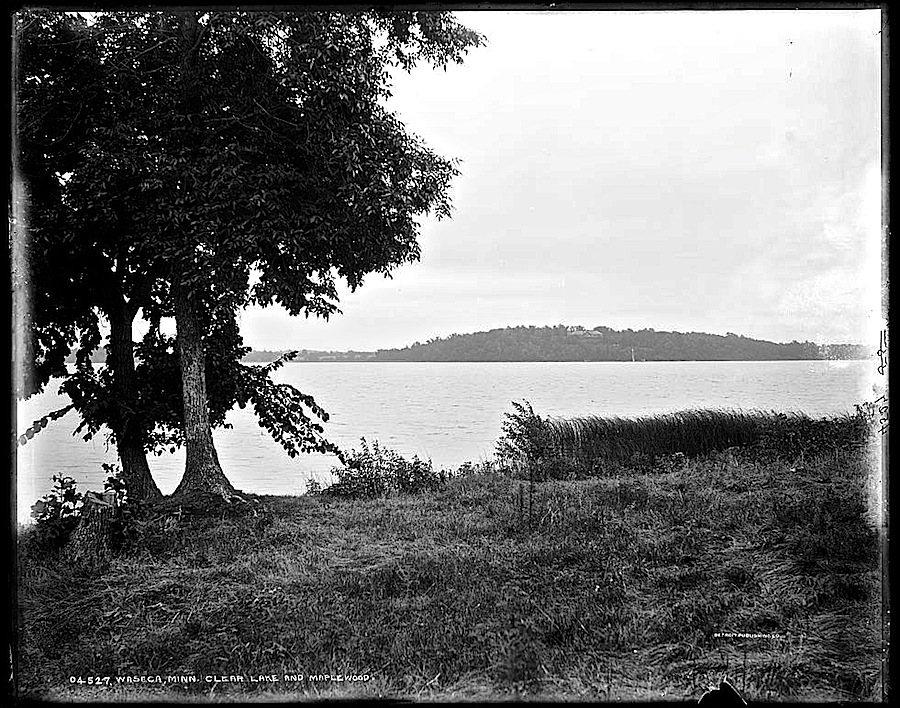
Maplewood Park on Clear Lake was a national vacation attraction at the end of the nineteenth century. (Click on any image to enlarge it.)

The Sunday porch/enclos*ure: Maplewood Camp, Waseca, Minn., c. 1900, Library of CongressAbove: Maplewood’s pavilion for Chautaquas. From the 1870s to 1920s, the Chautaqua movement brought speakers and companies of musicians, dancers, and actors to camps like Maplewood for up to a week at a time.

The Waseca Historical Society still hosts a Chautaqua at Maplewood Park every July.

To read about a similar sort of summer cabin living, which also continues today, see this 2012 New York Times article, here.

The Sunday porch/enclos*ure: Maplewood Camp, Waseca, Minn., c. 1900, Library of CongressAbove: the view of Clear Lake from Maplewood.


*All photos here: c.1880 – c.1899, by Detroit Publishing Co., via Library of Congress Prints and Photographs Division.

The Sunday porch: Lincoln, Vermont

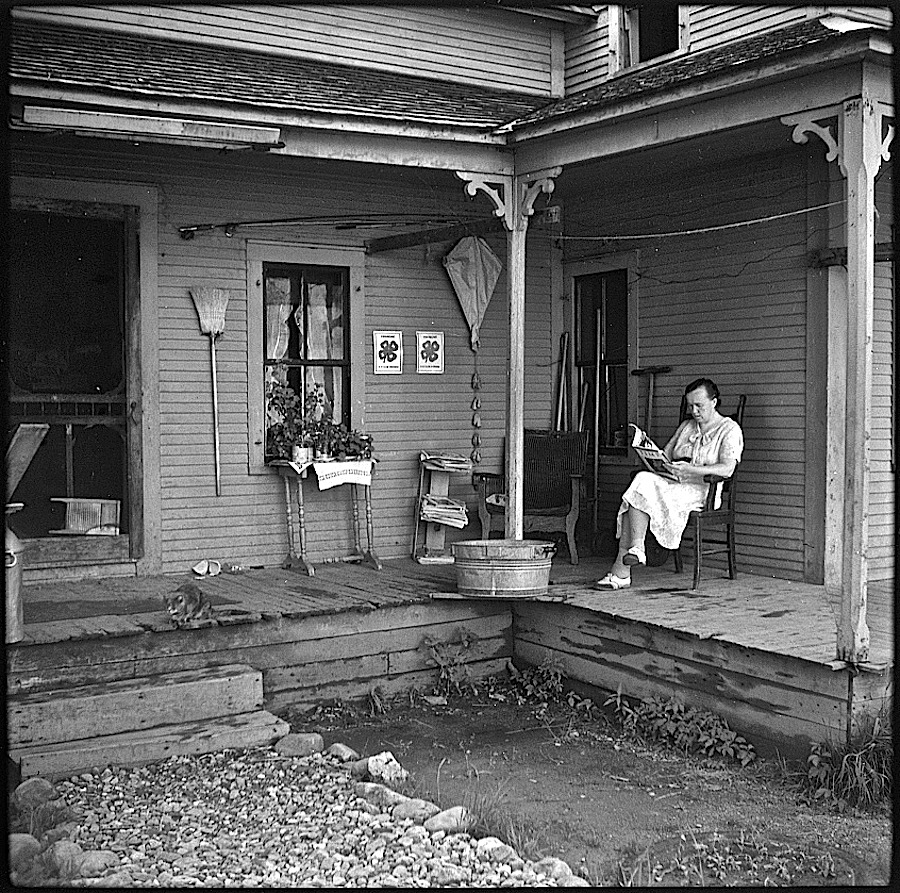
The Sunday porch/enclos*ure: Lincoln VT, 1940, by L. Rosskam, via Library of Congress“Front porch. Lincoln, Vermont,” July 1940, by Louise Rosskam, via the FSA/OWI Collection, Library of Congress Prints and Photographs Division.

The porch as a farm woman’s summertime mission control room. . .

Her broom (and 4H posters) are on the wall, and more cleaning and gardening tools are behind the chair.  She has stacks of magazines (and TIME in hand).  Her potted plants are doing well.  Above them are fishing poles and a kite.

The cat dozes above the steps — I think the scrub board behind the broken screen is there to keep him out of the house.

The wash tub is setting on a shelf built across the angle where the two sides of the porch meet.  This puzzled me until I realized that it must be there to catch rainwater from the roof.

The photographer, Louise Rosskam (1910-2003), was “one of the elusive pioneers of what has been called the golden age of documentary photography,” according to the Library of Congress.

Like many of her photos, this image was attributed for many years to her husband Edwin, who was also a photographer.  At the time it was taken — as part of a series on rural Vermont — he was working as an editor for the Farm Security Administration (FSA) of the U.S. government.

Her first professional photography work had been in the mid 1930s for the Philadelphia Record.  The paper would only actually hire Edwin, so he recouped her wages by including them on his expense vouchers under “gas and oil.”

The couple then produced documentary photo books on San Francisco and Washington, D.C. (but only Edwin’s name appeared on the covers).  After 1939, when Edwin went to work for the FSA, Louise began to take freelance photographs.  In the 40s, they both worked for Standard Oil Company.

Near the end of her life, Louise began to write to institutions like the Library of Congress correcting the credit given to Edwin for her own photos.  There’s an interesting interview with her from 2000 here.

Life in gardens: the Ellipse

What means this tumult in a vestal’s veins? . . .*

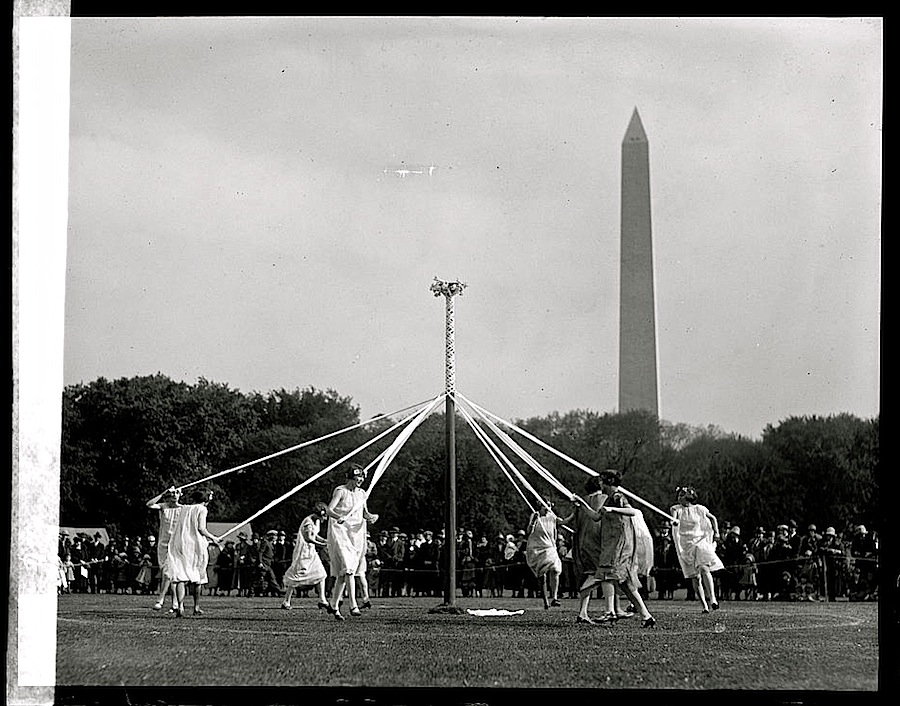
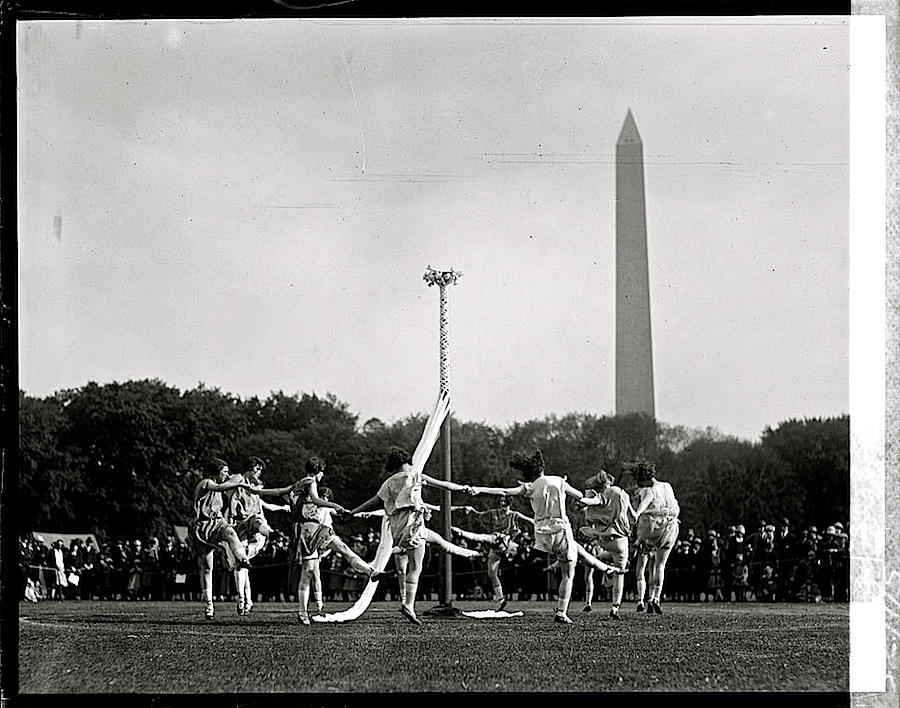
Maypole, 1925, Library of CongressMay pole dancing on the Ellipse, Washington, D.C., May 1, 1925, by National Photo Company, via Library of Congress Prints and Photographs Collection.

Maypole dance, 1925, via Library of CongressClick on the photos for larger views.


*Alexander Pope, from “Eloisa to Abelard

Vintage landscape: woodland teahouse

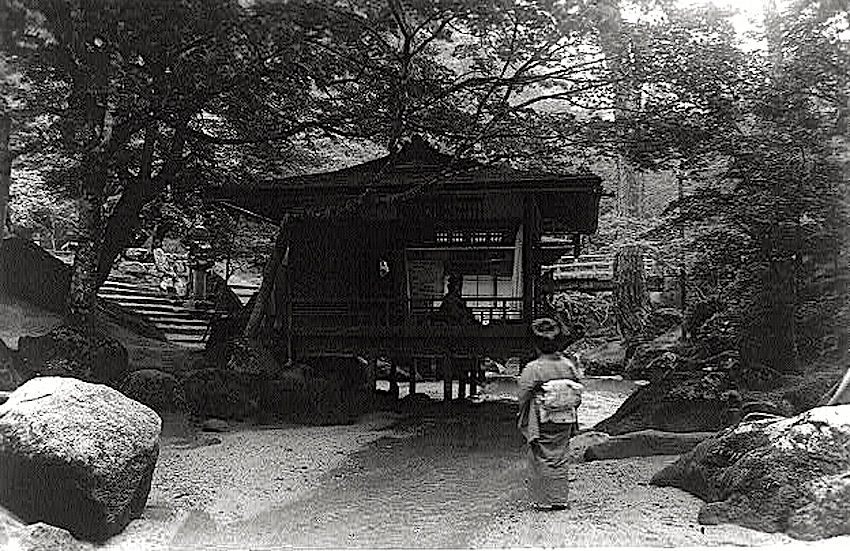
Japanese teahouse, Library of CongressTea house in a woodland, Itsuku-Shima, Japan,” between 1890 and 1923, photographer unknown, via the Frank and Frances Carpenter Collection of the Library of Congress Prints and Photographs Division.

The garden may be on Itsukushima Island (now called Miyajima).

I’m sorry there was no Sunday porch two days ago; there was also no weekend internet service in our house.

What carols, like the blazon of a king,
Fill all the dawn with wonder?
Oh, hush,
It is the thrush,
In the deep and woody glen!

— Edwin Markham, from “A Lyric of the Dawn