We spent December 23 to 27 in Venice, Italy. The photos above show the arcades along Piazzetta di San Marco and Piazza San Marco on Christmas and on Boxing Day (in fog).
The current colonnaded buildings enclosing the square on three sides (and the west side of the Piazzetta) were built in the 16th century. Their arcades front a number of coffee houses, including two of the oldest and most famous in Italy: Florian (1720) and Gran Caffè Quadri(1775).
Of course, we had due caffè espresso at Florian, which was easily possible because tourists are far fewer during Christmas week. The coffees were €6.50 each, but they were very good (and there was a cookie and water).
(The water carafe was adorable, and I now regret that I didn’t buy one and hold it on my lap on the plane. I’m very tempted to order it from their website. Also, check out the wonderful terrazzo floor at their entrance here; I forgot to take a photo of it.)
To scroll through more (and larger) images, click on ‘Continue reading’ and on any thumbnail in the gallery.
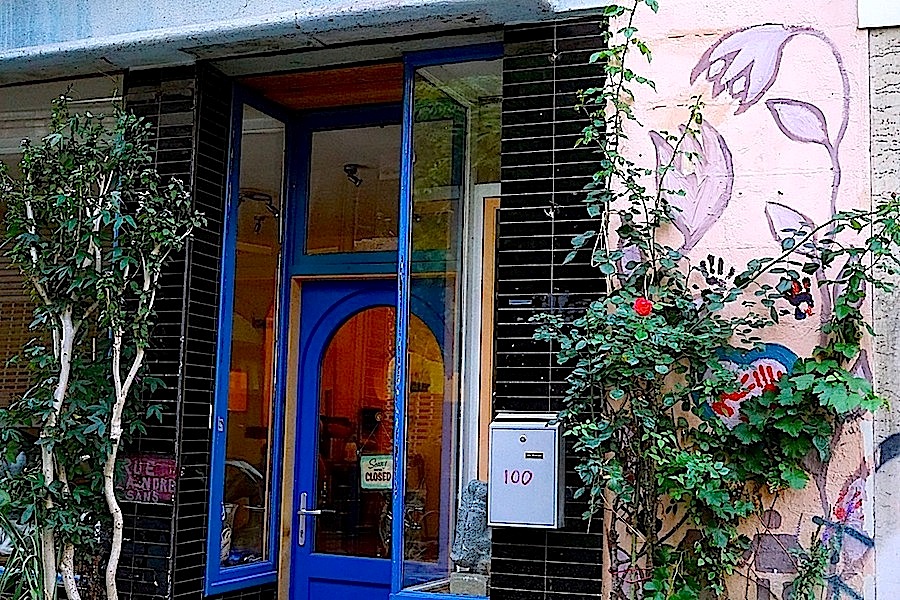
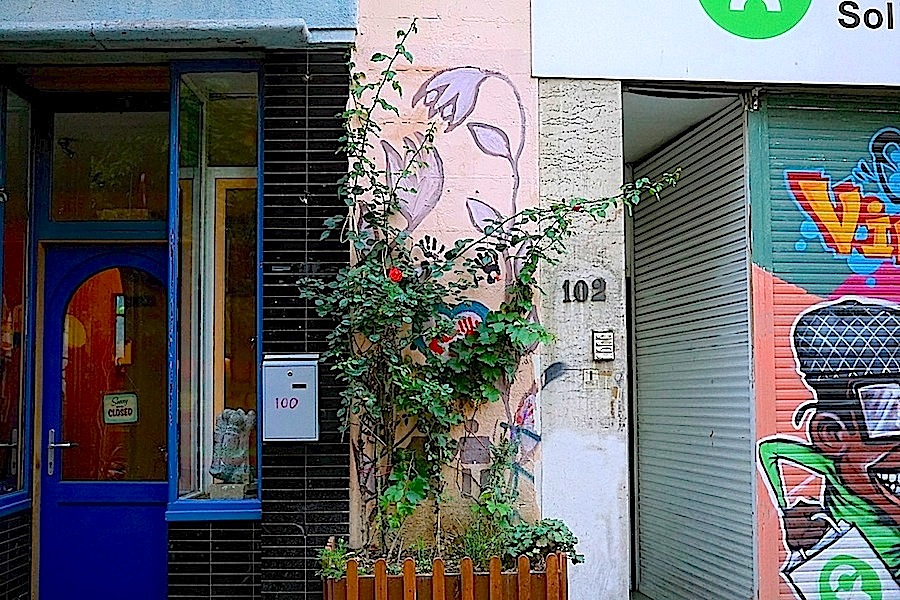
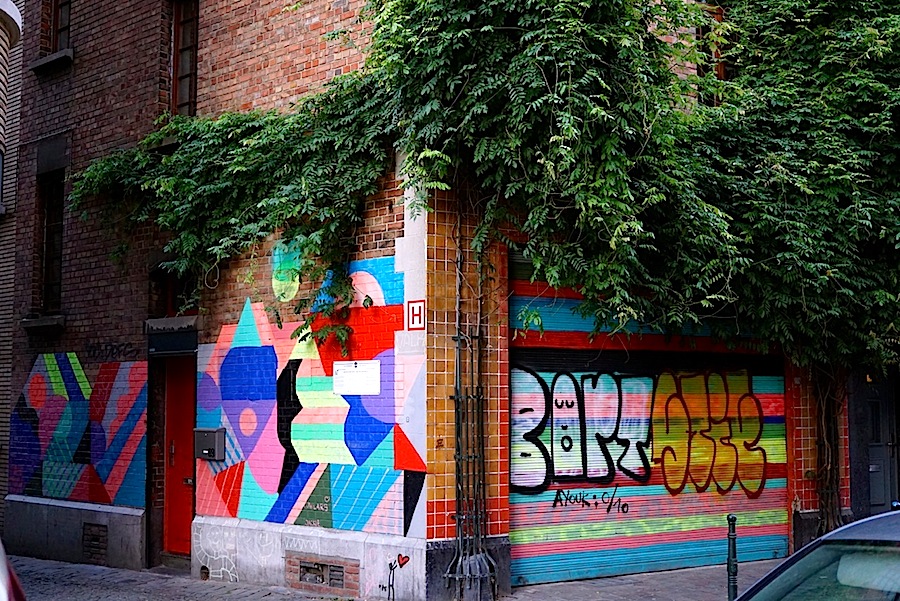
These are not really porches, of course, but two café doorways and a storefront.
They caught my eye while we were walking around the Sainte-Catherine or Sint Katelijne neighborhood of Brussels, which is just northwest of the Grand’Place and La Bourse.
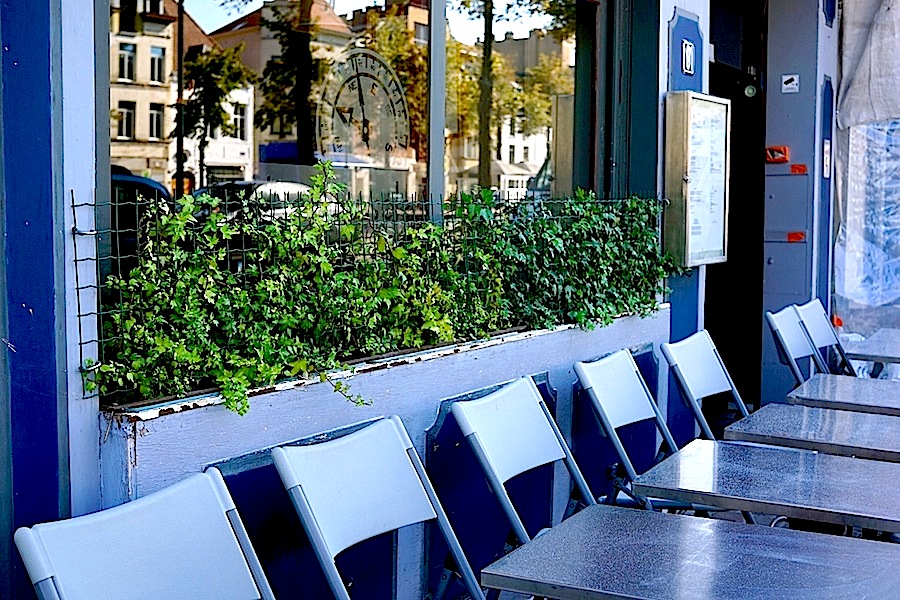
I believe I snapped this blue café, above, on Quai au Bois à Brûler, facing the site of the old Saint-Catherine Bassin or canal port, covered over since the 1870s.
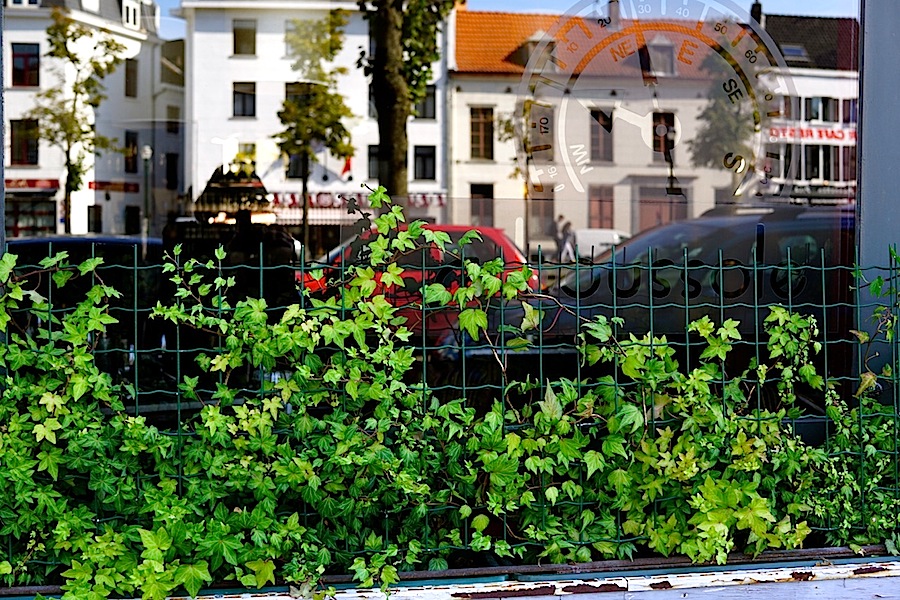
I like the way the ivy is used as both a decorative windowbox planting and low privacy screen.
Above, a mass of vines shades a closed storefront, also along Rue de Flandre.
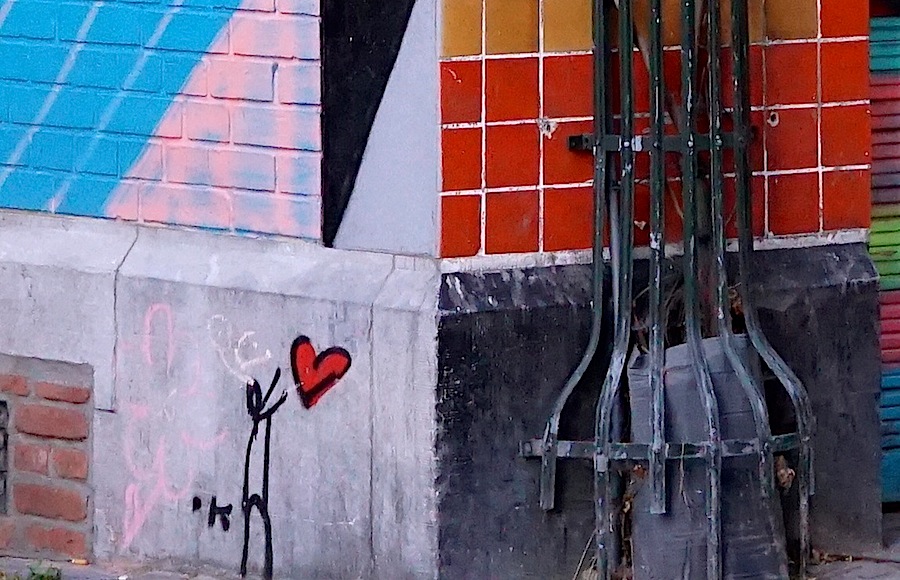
Detail of photo above.
Rue de Flandre is a good street on which to find an interesting restaurant. We liked Viva M’Boma (old-fashioned Belgian food, emphasis on meat/offal) and Domaine de Lintillac (dishes from the southwest of France, emphasis on duck).
This year marks the 25th anniversary of German reunification.
The federal state of Hesse, charged with organizing the celebrations, commissioned conceptual artist Ottmar Hörl to create an installation of serial sculptures.
As many as 1,000 little green Einheitsmännchen or Unity Men will tour Germany. At the moment — until August 30 — they are on the Schlossplatz in the city center of Stuttgart.
For my conceptual idea to release its communicative potential, I work in public spaces — a sphere that belongs to everyone and to nobody at the same time. . . . For this space — outside the confines of museums — I consciously choose motifs that are already firmly rooted in collective memory. By gradually shifting their context or by an act of re-creation, I turn them into a new experience.
In line with my strategy as an artist, it seemed obvious to me for the anniversary of the German reunification to adopt, and rework, the well-known East German Ampelmännchen, or traffic light man, first developed by Karl Peglau in 1961. I turned the two-dimensional pictogram of a little green man into a three-dimensional serial monochrome figure, carved in the round and standing 38 centimeters tall. He is still wearing his hat, but has been given a face, too. In a manner of speaking, this is a new generation Ampelmännchen, the Einheitsmännchen (“Unity Man”): cosmopolitan, friendly, and with a positive outlook for the future, smiling, holding out his hand in a attempt to meet you halfway, full of energy, dynamic, courageous, and advancing with determination. He is a symbol of our mobile society. . . . When our society manages to stay flexible, in motion, in a constant state of flux, there is always room for advancement and improvement. Individuals as well as society as an entity will thus keep their chance to escape the risk of paralysis or deadlock.
In this respect, the “Unity Man” may be regarded as an emblem of free democratic principles, of flexibility, of hope and trust in the future. . . .
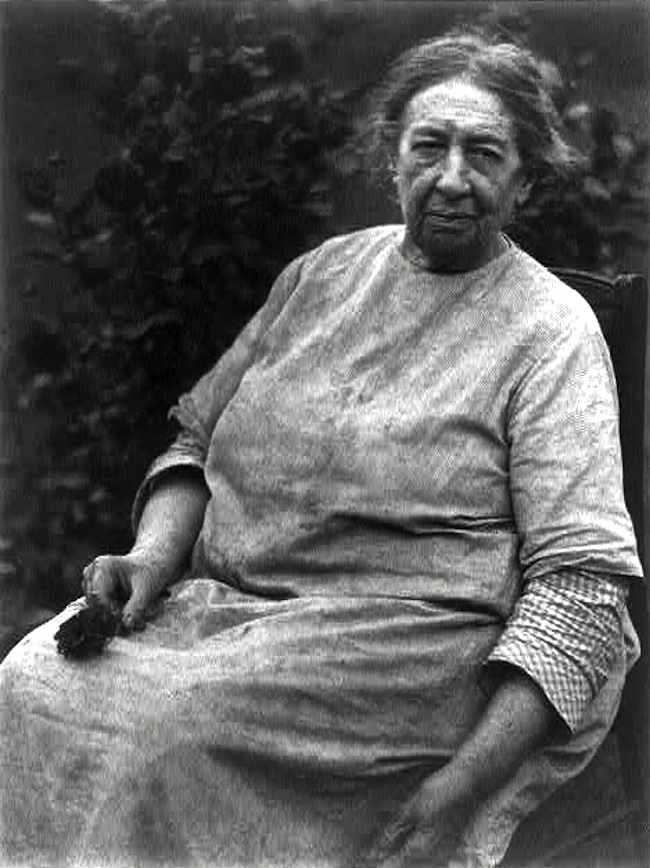
“Woman with dahlias,” ca. 1930, by Doris Ulmann, via Library of Congress Prints and Photographs Division.
In this beautiful portrait of an older Appalachian women, you can just see her stand of dahlias behind her.
In the traditional language of flowers, the dahlia is usually said to represent dignity, sometimes elegance.
A well-to-do New Yorker, Doris Ulmann trained as an art photographer with Clarence H. White in the 1910s. In the 1920s, she began traveling to the southeast to photograph rural people, particularly in the hills of Kentucky and the Sea Islands of South Carolina — people “for whom life had not been a dance.” She also documented Appalachian folk arts and crafts, working with musician and folklorist John Jacob Niles.
I had admired pictures of it before, but I had forgotten that it was in Vienna until I was leafing though a pamphlet at the tourist office there in early July. I found that not only was it in the city, but that we could get there via a quick ride from the Ring Road on the no. 1 tram.*
Kegelgasse, the bermed pedestrian street below the photo above.
Friedensreich Hundertwasser† was a painter and later worked in the field of applied art, creating flags, posters, and stamps.
From the 1950s, he also wrote and spoke passionately about “an architecture in harmony with nature and man” — and in what he called “new values” of a “yearning for romanticism, individuality, creativity, especially creativity.”
In 1977, the mayor of Vienna was persuaded to give Hundertwasser a chance to try out his ideas on an apartment building. An architect (and then another) was assigned to help him create the technical drawings.
Beyond the fountain above, the quiet internal courtyard of the building.
In 1980, at a press conference about the Haus, Hundertwasser expressed his philosophy of “window right” and “tree obligation.” You can read it here.
Some of his other statements about the building are below.
“Windows in rank and file are sad, windows should be able to dance.” — F.H.
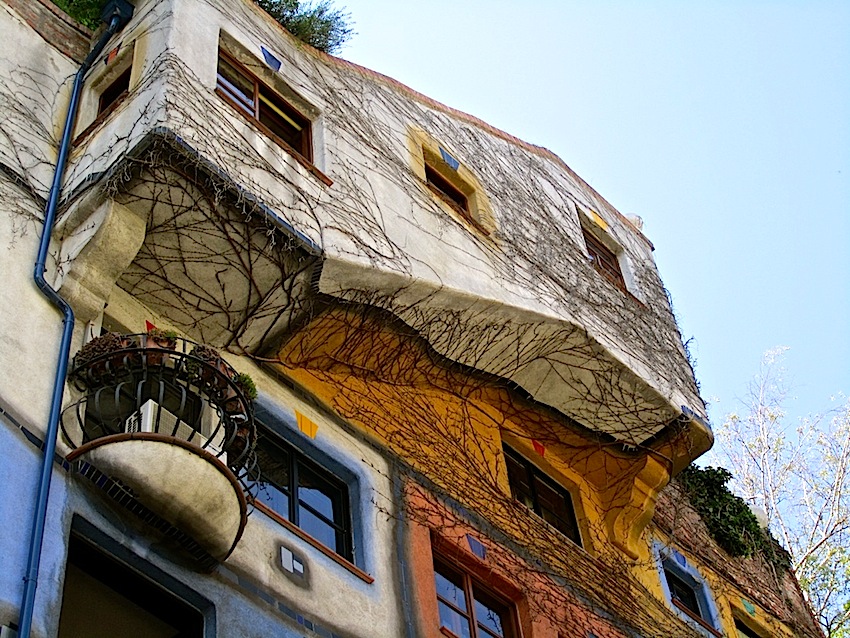
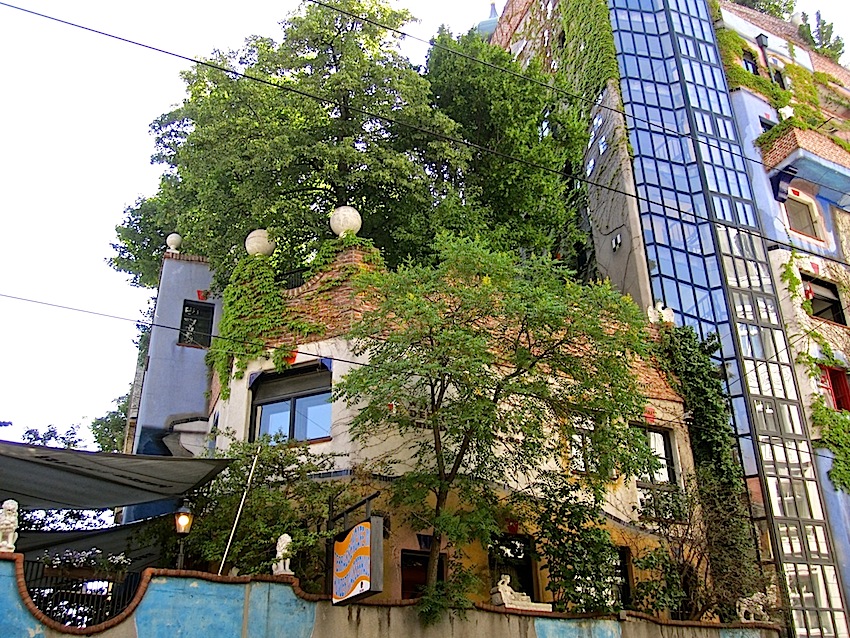
Photos above and below: The facade of the north side. Hundertwasser believed that every tenant should have the right to choose the decoration around his or her own windows.
A person in a rented apartment must be able to lean out of his window and scrape off the masonry within arm’s reach. And he must be allowed to take a long brush and paint everything outside within arm’s reach. So that it will be visible from afar to everyone in the street that someone lives there who is different from the imprisoned, enslaved, standardised man who lives next door.
— F.H. (more of his words on the “apartheid of window races” here.)
Photos above and below: The Lowengasse side of Hundertwasserhaus. It does not stand alone, but is closely surrounded by traditional 19th and early 20th century apartment buildings. On this side, I could see why some critics called the work “kitsch.”
“Romanticism has been declared kitsch and so we have been robbed or romanticism,” wrote Hundertwasser. “May one not dream? . . . The absence of kitsch makes life unbearable.”
In a[n apartment] house, an individually different, organic design of the outer wall of each individual apartment is of fundamental significance, so that the resident can identify with his house from the outside.
[The terraces] open to the street are a gift for everyone . . . . [They] take away the house’s vertical aggressivity, street noise is lessened because the echo is no longer caught between the rows of buildings.
If the terraces are green and have trees on them, it is like a natural hill with people living in it. Walking through a city with ascending terraces is like wandering through a gentle, green valley.
Photos above: The pedestrian street along the north side of the building.
A lively, uneven floor in the public area means a regaining of the human dignity which man is deprived of by the levelling tendencies of urbanism. . . .
If modern man is forced to walk on asphalt, concrete FLAT surfaces, the way they are thoughtlessly conceived with the ruler in the designer offices, alienated from his natural relationship to the earth which goes back to the dawn of time, from contact with the earth, a crucial part of man is blunted, with catastrophic consequences for his psyche, his emotional balance, his well-being and health.
Man forgets how to experience things and becomes emotionally ill.
Thus, the flat floor becomes a true danger for man.
The building contains 52 apartments, 16 private terraces, 3 communal terraces, and 250 trees and bushes, according to Wikipedia.
To scroll through larger versions of the photos, click on ‘Continue reading’ and then on any thumbnail in the gallery.
*The 1 tram starts out in front of the Opera House and moves along the west and north sides of the Ring Road. Just stay on until it veers off east on Radetzky Street. Hundertwasserhaus is on Löwengasse — on the left — right after you cross Blütengasse.
†He was born Friedrich Stowasser, but changed his name in the late 1940s. His adopted name translates as “Peace-Realm Hundred-Water.” He died in 2000, after working on a number of architectural projects in the 1980s and 90s.





 enclos*ure