Vintage landscape: shady spot

%22As you like it,%22 Library of CongressGarden of “As You Like It,” the James Harper Poor House, East Hampton, New York, ca. 1915, by Frances Benjamin Johnston, via Library of Congress Prints and Photographs Division Commons on flickr.

Poor was a New York City businessman (dry goods) and Shakespeare devotee, who, in 1899, bought a shingled American Colonial country house, part of which was built in the 17th century. He then changed its style to English or Tudor Revival — all half-timber and stucco, as was so fashionable at that time.  Today, the property is The Baker House 1650 bed and breakfast.

The Sunday porch: Austin, Texas

A repeat porch from June 2014. . .
Austin dogtrot, 1935, via Texas State Archives“Remains of log dogtrot house near Webberville Road. . . Austin Texas,” 1935, probably by Fannie Ratchford, via Texas State Archives.

Unfortunately, it’s a little out of focus, but still beautiful.

. . .  I woo the wind
That still delays his coming. Why so slow,
Gentle and voluble spirit of the air?
Oh, come and breathe upon the fainting earth
Coolness and life!

— William Cullen Bryant, from “Summer Wind

The Sunday porch: curls

A repeat porch from October 2013. . .
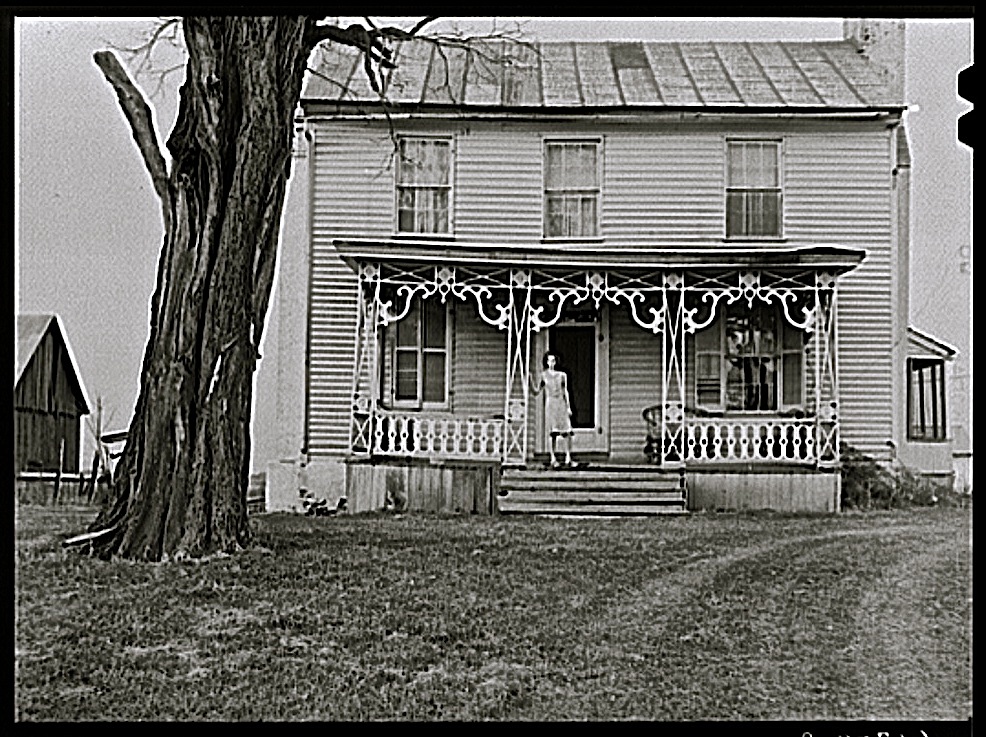
The Sunday porch/enclos*ure: 1940 Kentucky farmhouse, by John Vachon, Library of CongressNicholas County, Kentucky, November 1940, by John Vachon, via Library of Congress Prints and Photographs Division.

What frills attached to such a simple farmhouse and yard.

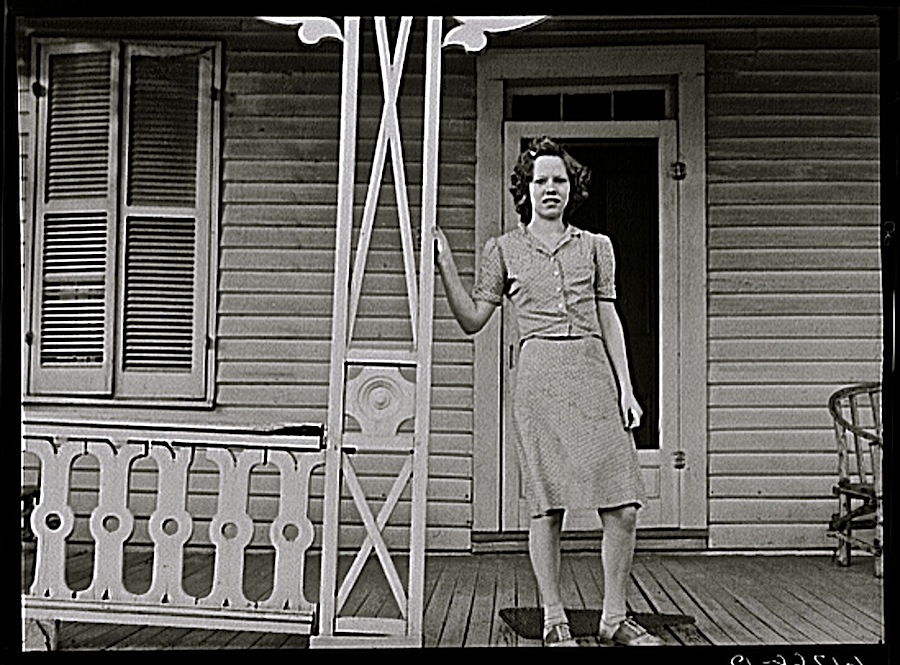
The Sunday porch/enclos*ure: 1940 Kentucky farmhouse, by John Vachon, Library of Congress

Her dress goes with the house and her curls with the porch.

Vintage landscape: Florence

Palmieri, Firenze, ca. 1915, OSU on flickrPalmieri, Firenze [ or Florence, Italy] – Box garden from level of tennis court,” ca. 1915, via Arthur Peck Collection, Oregon State University (OSU) Special Collections & Archives Commons on flickr.

Note the patterns of the clipped boxwood in the middle distance and those on the villa at the top.

Arthur Peck was a Professor of Landscape Architecture at the Oregon Agricultural College from 1908 to 1948. During his long career, he created a teaching library of 24 boxes of glass lantern slides — now in OSU’s archives.

Behind the house the upland falls
With many an odorous tree—
White marbles gleaming through green halls—
Terrace by terrace, down and down,
And meets the star-lit Mediterranean Sea.

‘Tis Paradise. . . .

— Herman Melville, from “After the Pleasure Party: Lines Traced Under an Image of Amor Threatening

The Sunday porch: Washington, D.C.

A repeat porch from September 2013. . .
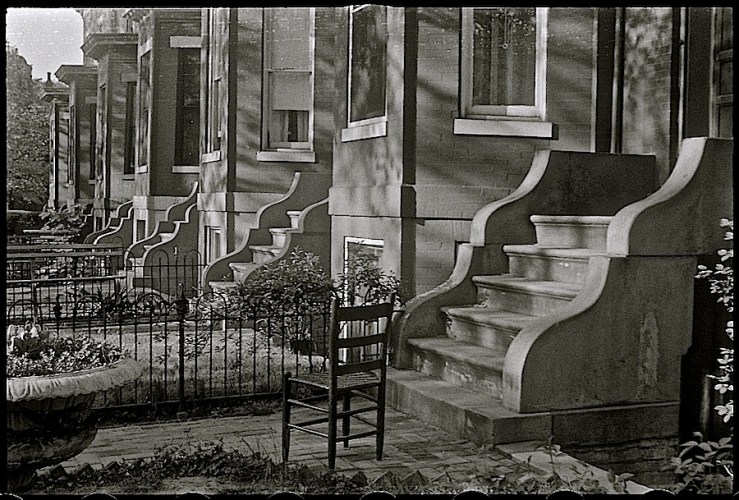
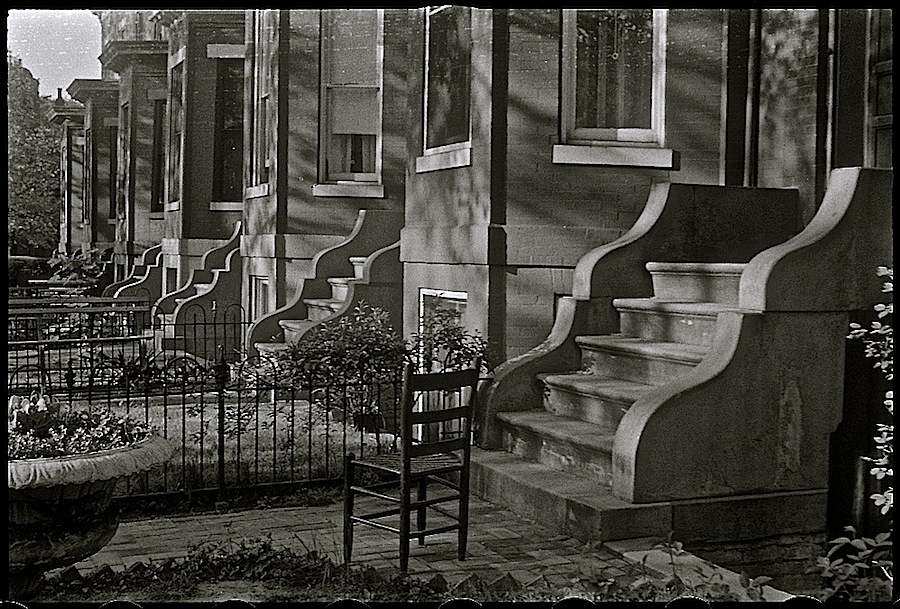
Wash. D.C., rowhouses, via Library of CongressSeven Washington, D.C., rowhouses, 1939, by David Myers, via Library of Congress Prints and Photographs Division.

The name of the neighborhood was not given in the original caption.  It was only described as “one of the nicer old sections of the city.” It looks like Capitol Hill to me.

In his book, The American Porch, Michael Dolan attempts to trace the European, African, and Asian origins of our many types of porches.  The front stoop — several steps and a small landing — came from the Dutch.

Down the coast [from New England], in Nieuw Amsterdam, a different entry was proliferating.  Made of stone or brick, the stoep — Dutch for “step” — was a roofless link between doorway and street.  Though municipal tradition required a building’s occupants to maintain the stoep, the Dutch deemed it public territory.  However, in Nieuw Amsterdam, the stoop acquired a private connotation:  “. . . before each door there was an elevation, to which you could ascend by some steps from the street,” an observer wrote.  “It resembled a small balcony, and had some benches on both sides on which the people sat in the evening, in order to enjoy the fresh air, and have the pleasure of viewing those who passed it.”

The stoops above lack benches, but the owner of the first one has brought down a chair, and two doors down there is a park bench in the tiny garden.  You can see a similar arrangement here.