The Sunday porch: St. Mary’s County

This slideshow requires JavaScript.

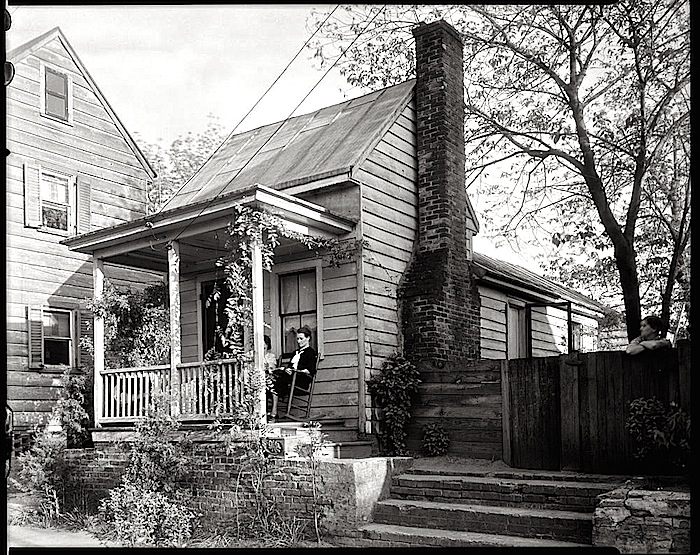
“Lynch Farm, St. Mary’s County, Maryland,” 1936 or 1937, by Frances Benjamin Johnston, via Library of Congress Prints and Photographs Division.

You can scroll through over a year’s worth of Sunday porches here.
Continue reading “The Sunday porch: St. Mary’s County”

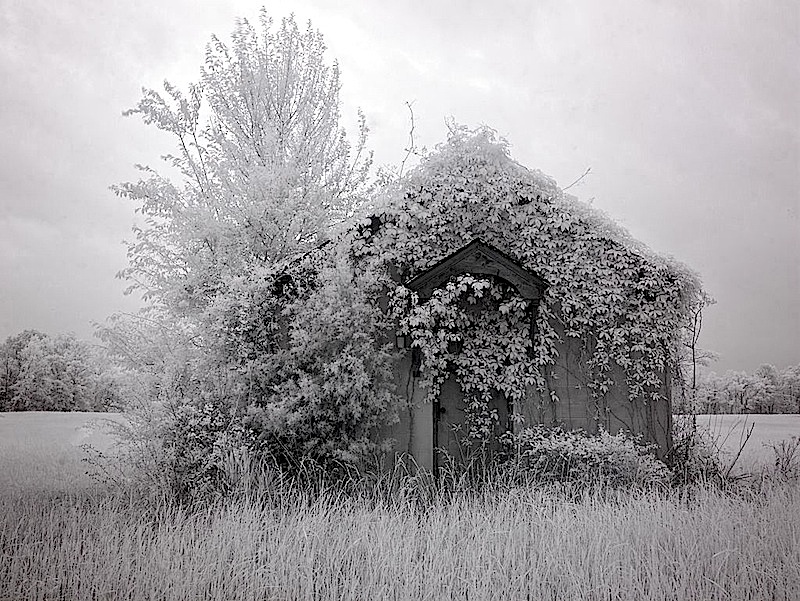
Frozen in vines

C. Highsmith cabin with vines, LoC 2Monroe County, Alabama, May 2010, by Carol M. Highsmith, via The George F. Landegger Collection of Alabama Photographs in Carol M. Highsmith’s America, Library of Congress Prints and Photographs Division.

The infrared treatment of the late spring scene gives it a wintery appearance.

Highsmith has specialized in photographing America’s architectural heritage. She has donated the rights to her work to the Library of Congress for copyright free access for all.

The Sunday porch: the Berry’s

The Berry house“Berry’s house,” between 1910 and 1925,* probably near Selma, California, by National Photo Company, via Library of Congress Prints and Photographs Division (all photos here).

I think this is the farm that Ethel and Clarence Berry bought near her parents’ home in Selma after they became millionaires in the Klondike gold rush.

Ethel was one of the first women miners to go to Alaska, leaving right after her wedding in 1896. The next spring, the couple struck it amazingly rich on the Eldorado and Bonanza Creeks.

When she arrived in Seattle that summer — headed to the bank alone with $100,000 in gold that she’d kept hidden in her bedroll — she was immediately embraced by the popular press as the “Bride of the Klondike.”

The Berrys invested their money in more Alaskan mines (and in oil) and stayed rich.  They moved between the farm in Selma and a home in Alaska until Clarence’s death in 1930. Ethel then moved to Beverly Hills.  She died there in 1948.


*I suspect the photos were taken closer to the earlier year given, judging from the photo of Ethel and her sister (after ‘Continue reading’). Ethel would have been 37 years old in 1910.

Continue reading “The Sunday porch: the Berry’s”

The Sunday porch: small house

Wide enough for two rocking chairs, at least. . .

Small house, via LoCNew Bern, North Carolina, 1936, by Frances Benjamin Johnston, via Library of Congress Prints and Photographs Division.

The Sunday porch: The Appletrees

This slideshow requires JavaScript.

“The Appletrees,” Henry Eugene and Eva Johnston Coe house, Southampton (on Long Island), New York, 1914, by Frances Benjamin Johnston,* via Library of Congress Prints and Photographs Division.

The porch of this 19th century “cottage” is actually an arbor — covered, I believe, in grape vines.  The flower-filled boxwood parterre immediately surrounding the house ends rather abruptly in country fields and woods.

I haven’t been able to discover much about the property and its owners:  Mrs. Coe co-authored a book on American embroidery samplers, and Mr. Coe was evidently considered an arbiter of social acceptance for the wealthy Southampton of his time. He signified who was in and who was out by issuing (or not) invitations to his annual dinner at The Appletrees (or The Apple Trees).

I could not find out whether the house still exists.

This hand-colored glass lantern slide was used by Johnston in her  garden and historic house lectures.


*Photographed when Frances Benjamin Johnston and Mattie Edwards Hewitt worked together.

ADDENDUM, October 2018: A kind reader who lives in Southampton just wrote to me and confirmed that the Coe house no longer exists.

“The last time I was on the property was in the 1960’s. It was a beautiful house and had wonderful out buildings, one of which was a large 2 story barn which was located near the property line that abutted the Catholic Church to the south. The horses were stabled below and the men were housed above.”