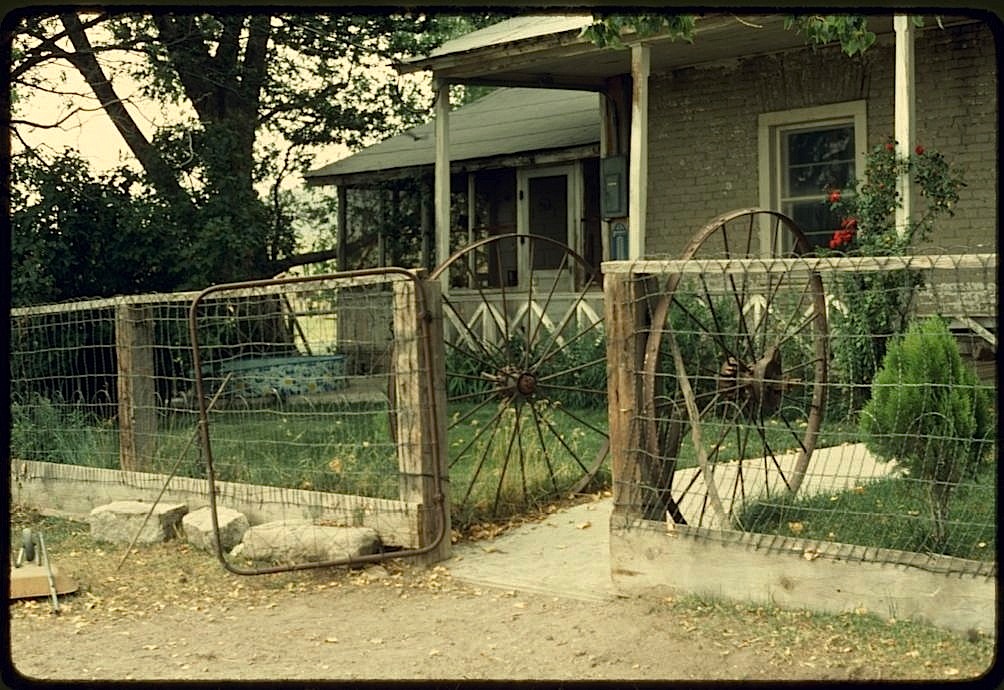
Horseshoe gate on the Pedroli Ranch, Paradise Valley, Nevada, July 1978, (35mm slide) by Richard E. Ahlborn, via American Folklife Center of the Library of Congress (both photos).
The ranch house gate was made by Pete Pedroli about 1950. It has a counterweight for self closing. . .
Photo by Suzi Jones
. . . and a latch made from a bridle bit.
There’s another photo of the house and gate here, by Carl Fleishhauer.
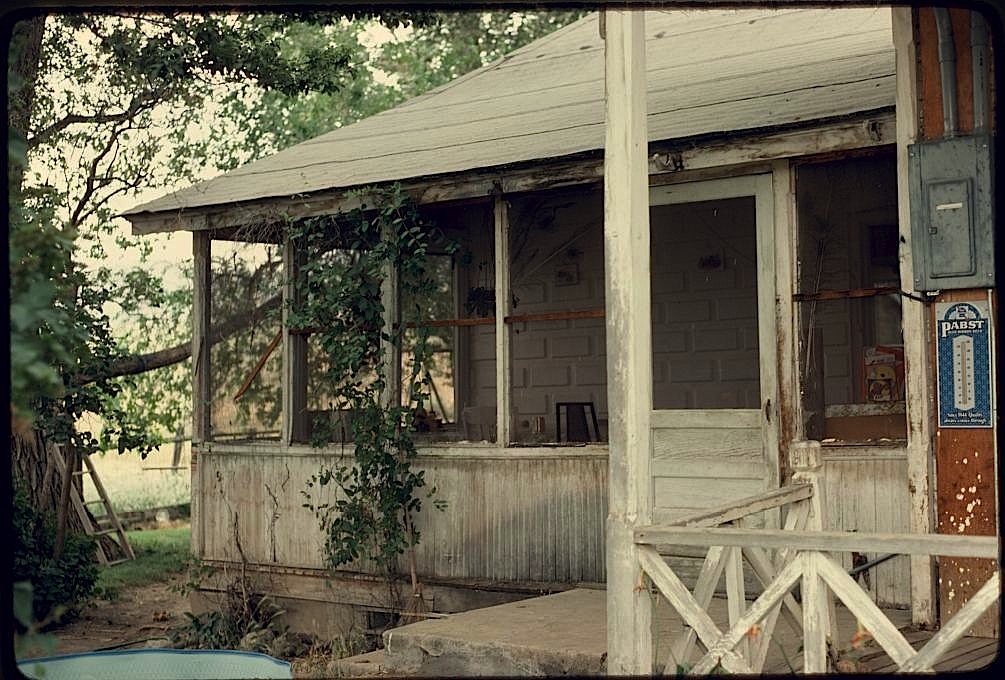
Ranch House with Porch, Paradise Valley, Humboldt County, Nevada, July 1978, (35mm slide) by Suzi Jones, via American Folklife Center of the Library of Congress (all photos here).
The house — of adobe construction — served as the officer’s quarters of Fort Scott in the late 1860s. In 1978, it was the main residence of Fort Scott Ranch.
There is another view here, by Howard W. Marshall.
The photos here are three of over two thousand taken or collected for the Folklife Center’s 1972-1982 ethnographic field project on the Paradise Valley area. The work became the collection* “Bucharoos in Paradise: Ranching Culture in Northern Nevada, 1945-1982.”
Fort Scott Ranch, by Howard W. Marshall.
There’s another photo of the ranch house and its outbuildings here.
Poll results
For the last two Sundays, I ran a little poll asking how readers look at enclos*ure — 1) on a desktop computer or Mac; 2) on an e-reader; or 3) on a smartphone? Of those who responded, 82% use a desktop and the others use an e-reader.
*It also contains sound recordings and motion picture film.
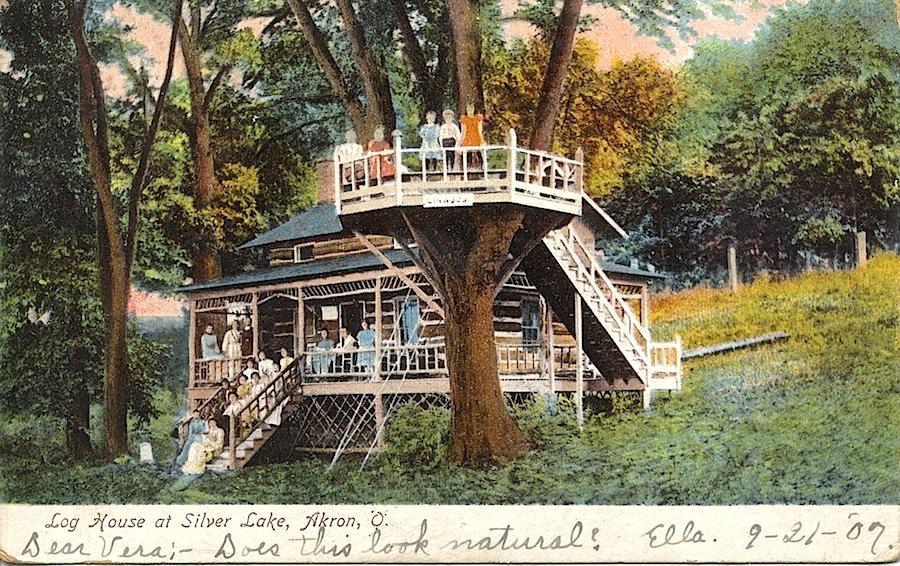
“Log house at Silver Lake, Akron, Ohio,” between 1905 and 1909, by Illustrated Post Card Co., via Walter Havighurst Special Collections, Miami University Libraries Commons on flickr.
. . . I care less and less
about the shapes of shapes because forms
change and nothing is more durable than feeling.
“Fenderson cottage at Lake City on Megunticook Lake in Camden, Maine, in September 1900,” by Theresa Parker Babb, via Camden Public Library Commons on flickr.
Lake City seems to have been a neighborhood of summer homes. From the late 1880s, “a flood” of people from the eastern cities –often rich and prominent– built cottages in and around Camden, drawn by the surrounding scenery and the town’s romantic seafaring past.
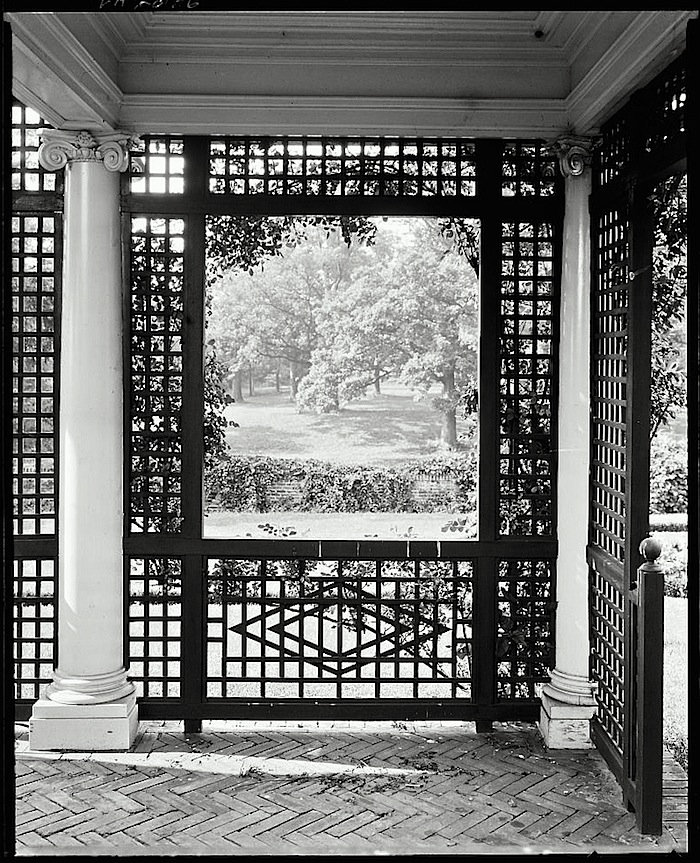
A view from the summer house at Oatlands, Loudoun County, Virginia, in the 1930s, by Frances Benjamin Johnston, via Library of Congress Prints and Photographs Division.
Oatlands Plantation was established in 1798 by a member of Virginia’s prominent Carter family. In 1903, it was sold to William and Edith Corcoran Eustis, and Mrs. Eustis began to revive the old gardens in the Colonial Revival style. Since 1965, the property has been a site of the National Trust for Historic Preservation. It is open to the public from April 1 to December 30.





 enclos*ure