Vintage landscape: the bench

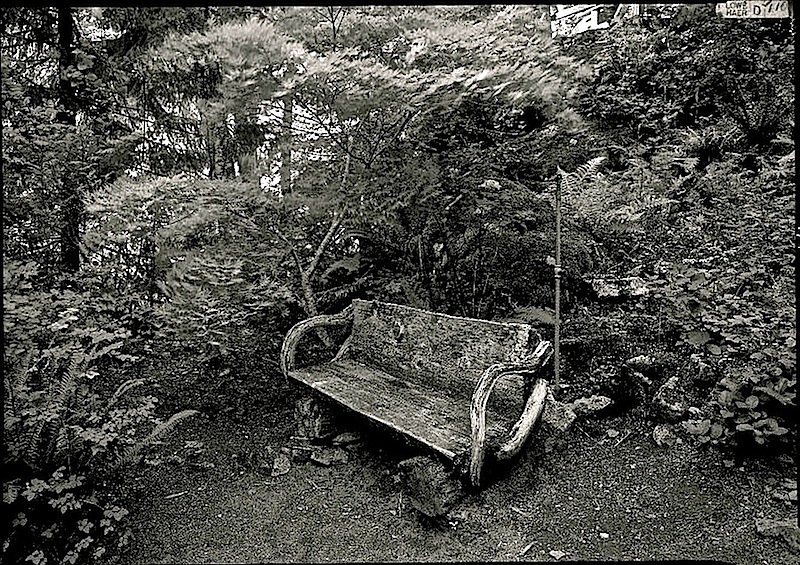
Vintage landscape/enclos*ure: bench at Ladder Creek Gardens, Washington, via HABS, Library of CongressRustic bench at Ladder Creek Gardens, Newhalem, Washington. Photo taken 1989 for an Historic American Buildings Survey (HABS), via Library of Congress Prints and Photographs Division.

The gardens, next to Ladder Creek Falls, were landscaped during the 1930s as a showcase for the Skagit Hydroelectric Project, which now provides power to the city of Seattle.

My husband and I were arguing about a bench we wanted to buy and put in part of our backyard, a part which is actually a meadow of sorts. . . . My husband wanted a four foot bench and I wanted a five foot bench. This is what we argued about. My husband insisted that a four foot bench was all we needed, since no more than two people (presumably ourselves) would ever sit on it at the same time. I felt his reasoning was not only beside the point but missed it entirely; I said what mattered most to me was the idea of the bench, the look of it there, to be gazed at with only the vaguest notion it could hold more people than would ever actually sit down. The life of the bench in my imagination was more important than any practical function the bench might serve. . . .

Mary Ruefle, from “The Bench

The Sunday porch: the portico

This slideshow requires JavaScript.

A late afternoon gathering on the south portico (or back porch) of the White House, probably between 1890 and 1910, photographer unknown, via the Library of Congress Prints and Photographs Division.

Encyclopedia Britannica defines ‘portico’ as a “colonnaded porch or entrance to a structure, or a covered walkway supported by regularly spaced columns. Porticoes formed the entrances to ancient Greek temples.”

The south portico of the White House was built in 1824, principally from an 1807 design by architect Benjamin Henry Latrobe, then Surveyor of Public Buildings.  Latrobe was appointed and supervised by Thomas Jefferson, who loved  neoclassical design and called Palladio’s books “the bible.”

The South of France

Roman temple
“simple and sublime”

Maria Cosway
harpist
on his mind

white column
and arch

Lorine Niedecker, from “Thomas Jefferson

Life in gardens: June 14, 1944

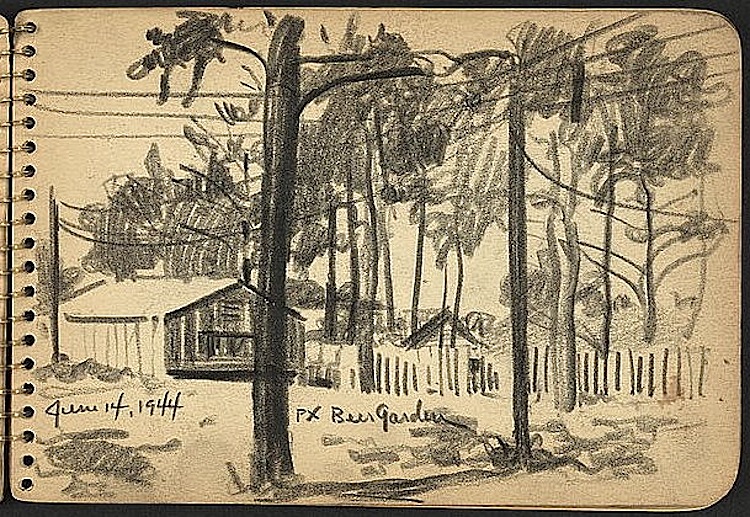
PX Beer Garden, June 14, 1944, via LoC

PX beer garden at Fort Jackson, South Carolina, June 14, 1944, by Victor Alfred Lundy, via the Library of Congress Prints and Photographs Division.

A beer garden is simply a shady outdoor area with tables and chairs where beer and sometimes food is served. The idea originated in the Bavaria region of Germany in the 19th century and soon came to America. There’s a brief history of beer gardens in the U.S. here.

Some American beer gardens were such pleasant, seemingly wholesome places that they rattled the resolve of the temperance movement. A woman on a committee investigating Chicago drinking spots wrote of one: “Isn’t it beautiful? Can it be, is it possible, that after all our ideas are wrong and these people are right?”

Beer gardens, like the one pictured above, were features of at least some homeland military camps and forts in the mid 1940s. Camp Mackall in North Carolina had six. I found a reference to one at Fort McClellan near Anniston, Alabama.  

During his U.S. Army service, Victor Lundy filled eight sketchbooks with scenes of his training at Fort Jackson, his life on a transport ship crossing the Atlantic, and his frontline duty in France.

After the war, he became an architect, admired today for “his sculptural sense of form” and  “innovative use of engineering technology,” according to the Smithsonian Institution.

Vintage landscape: summer shimmer

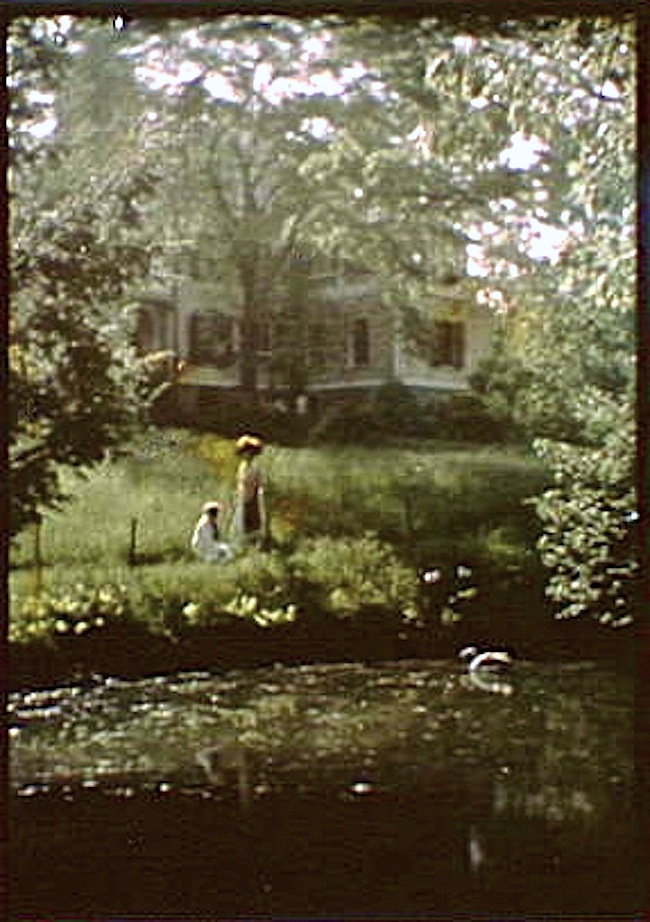
Vintage landscape/enclos*ure: woman and child, Arnold Genthe“Woman and child in a field in front of a white house,” an autochrome taken between 1906 and 1942, by Arnold Genthe, via Library of Congress Prints and Photographs Division.

“If an autochrome was well made and has been well preserved, color values can be very good,” according to the Wikipedia entry on this early color photography technique.

“The dyed starch grains are somewhat coarse, giving a hazy, pointillist effect, with faint stray colors often visible, especially in open light areas such as skies. The smaller the image, the more noticeable these effects are. The resulting “dream-like” impressionist quality may have been one reason behind the enduring popularity of the medium even after more starkly realistic color processes had become available.”

. . . The trees rustle
and whisper, shimmer and hiss.

Amy Gerstler, from “Bon Courage

Another May

Poem on window pane (detail), HABS, Library of Congress

Another May new buds new flowers
Ah why has happiness no second spring

Scratched into a sitting room window pane of Borough House, which was built between 1758 and 1821 in Sumter County, South Carolina.

The words (with slight variations) are from “Sonnet II” by Charlotte Smith  — whose poems were praised by her contemporaries Wordsworth and Coleridge.

I have not been able to find out who might have put them on the window.

Borough House, S.C., HABS, Library of CongressBorough House is architecturally noteworthy because it is partly constructed with rammed earth — an unusual building material in the United States.  (There is more about the house here.) It still stands today, in private ownership.

(I believe that the window with the poem is one of the two left of the front door.)

The photos here are part of an Historic American Buildings Survey (HABS), May 1985, via Library of Congress Prints and Photographs Division.