Streifzug 7: Filderkraut festival

I’m sorry there was no Sunday porch yesterday. . .
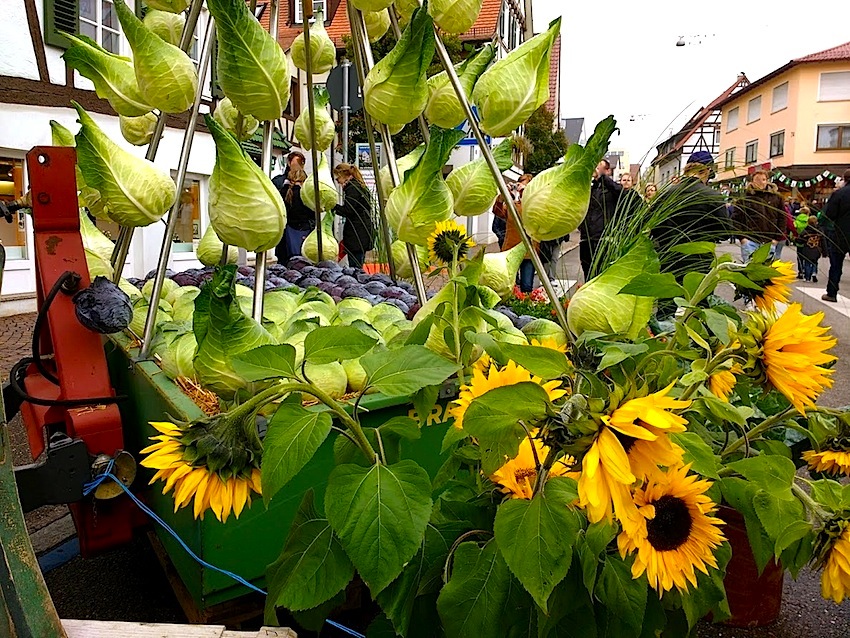
8 Cabbage Fest, enclos*ure

I was at the 37th annual Filderkraut-Fest in Leinfelden-Echterdingen, a town near the Stuttgart airport.

There are very few weekends in the Stuttgart area without a local fest celebrating some aspect of the season.  Since the end of summer, we have celebrated the wine harvest, the potato harvest, the pumpkin harvest, and now that of the Filderkraut.

This very fine variety of cabbage has a distinctive pointy shape.*  It grows particularly well in the rich loess-loam of the Filder plateau, which surrounds the airport.
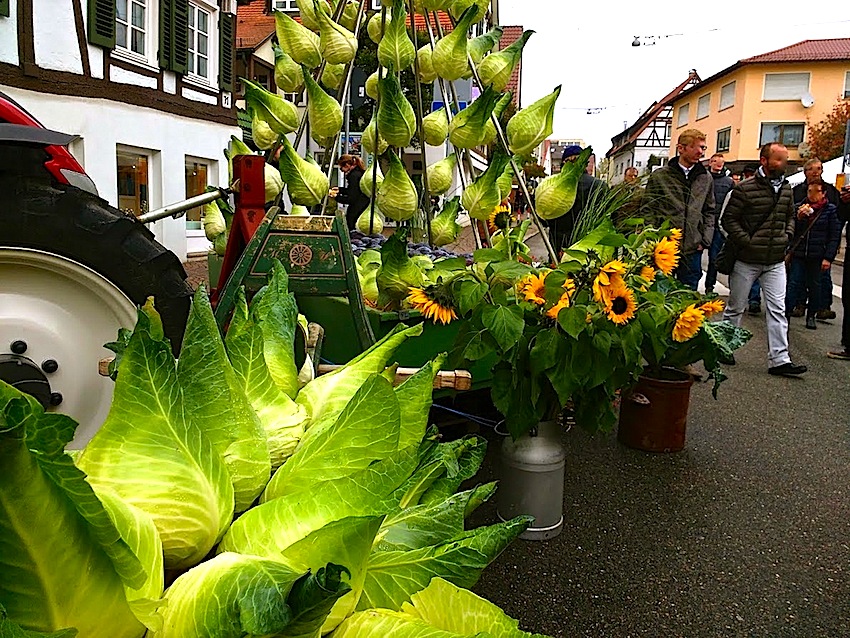
7 Cabbage Fest, enclos*ure

The fest was opened on Saturday by Mayor Roland Klenk, who tapped the first keg and, after about 40 taps, sprayed onlookers with beer.  “That’s not my core competency,” he reportedly said.

Tapping the first keg seems to be the German equivalent of throwing out the first ball in the U.S. — an honor fraught with peril for a politician.

9 Cabbage Fest, enclos*ure

This was not an easy year for cabbage growers, according to an article in the Stuttgarter Nachrichten.  It was too hot and dry, and the heads were smaller than usual.
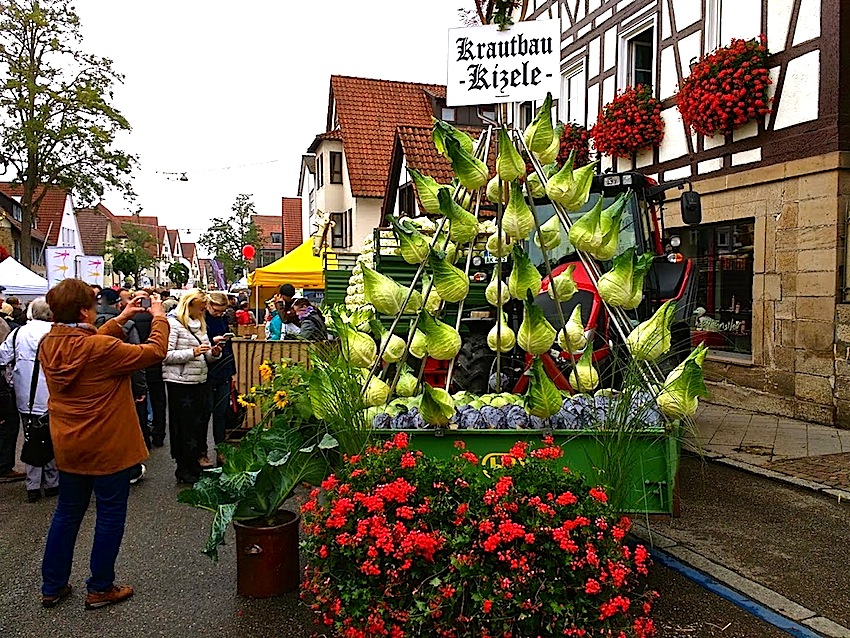
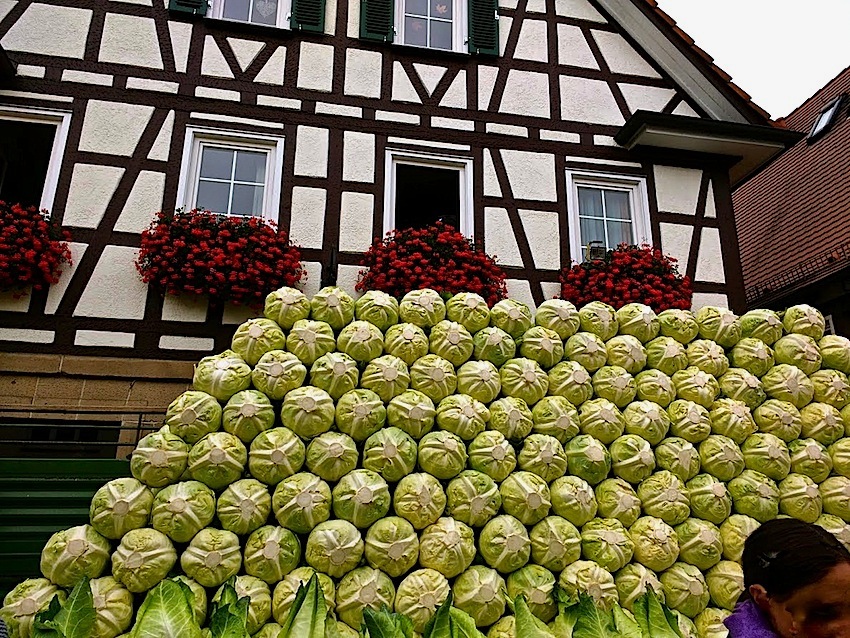
10 Cabbage Fest, enclos*ureAbove: “Kizele’s cabbage display.”

3 Cabbage Fest, enclos*ure

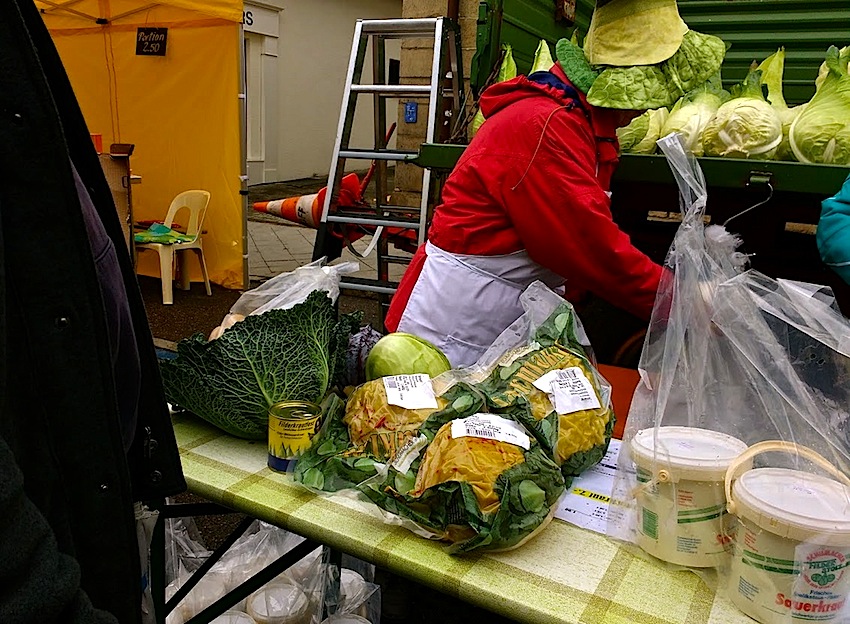
4 Cabbage Fest, enclos*ureAbove: whole heads of fermented cabbages on the table.  Note her hat.
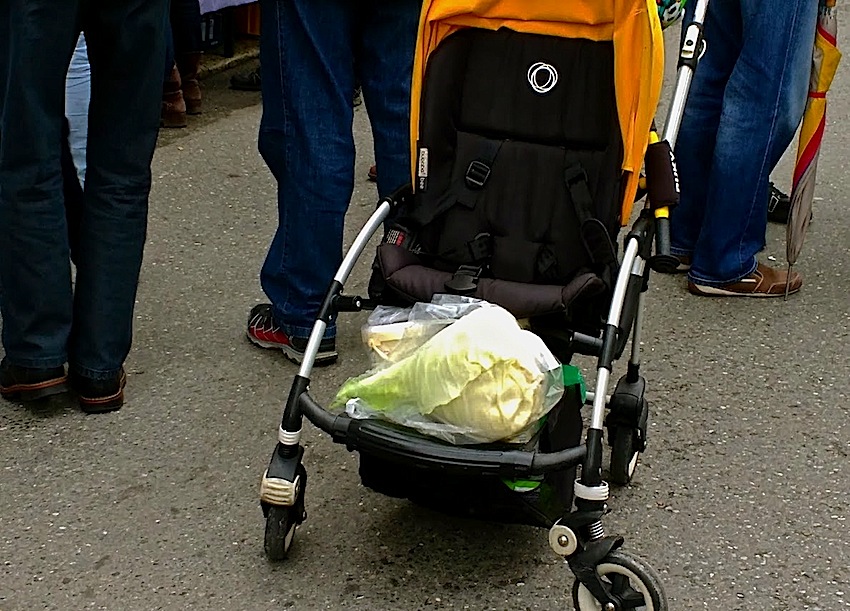
15 Cabbage Fest, enclos*ure

14 Cabbage Fest, enclos*ureAbove: tubs of sauerkraut to take home.
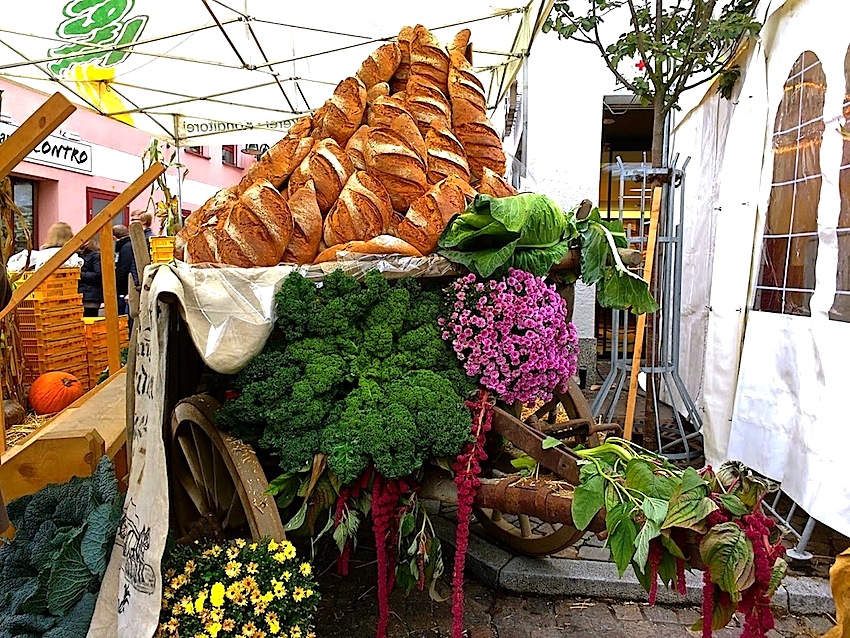
22 Cabbage Fest, enclos*ureAbove: a display of bread and cabbage.

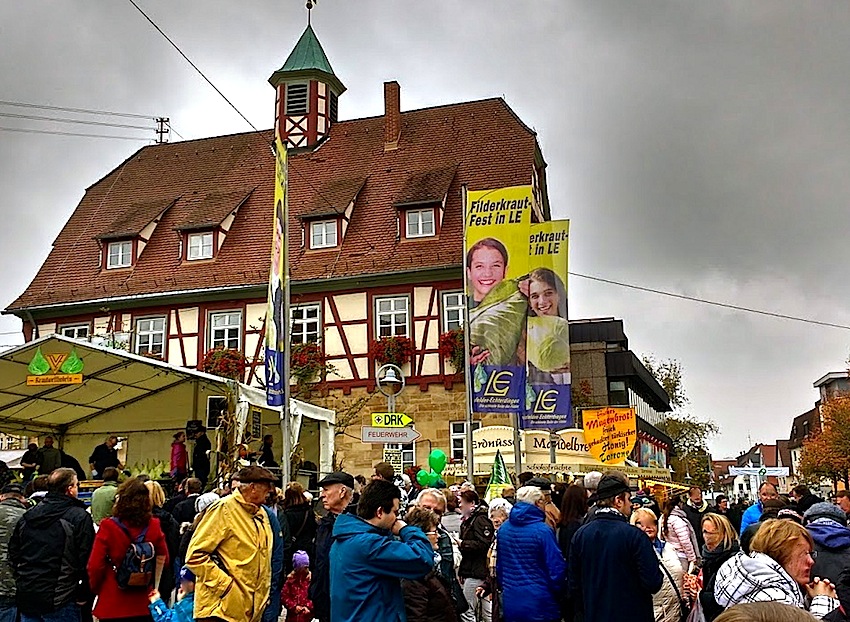
23 Cabbage Fest, enclos*ureAbove: the Rathaus or town hall of Echterdingen.
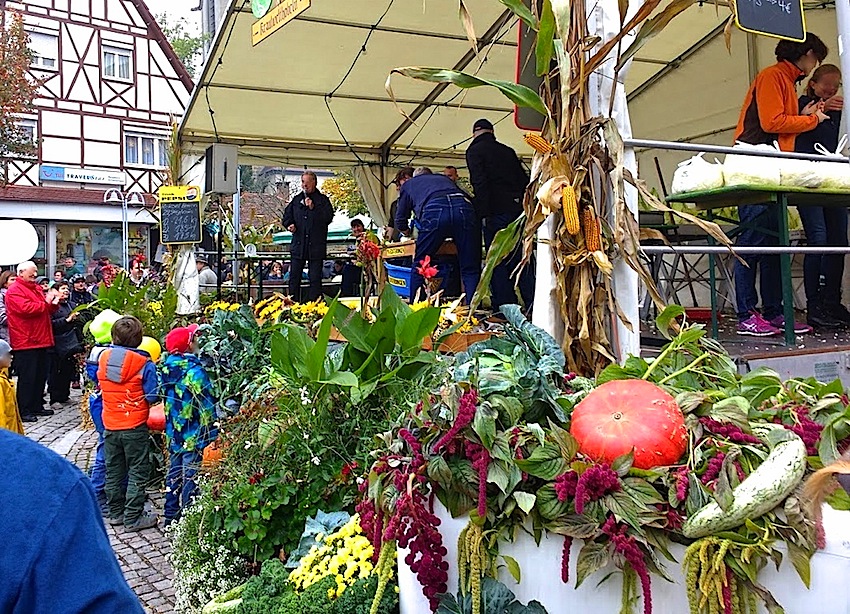
25 Cabbage Fest, enclos*ureAbove: a cabbage shredding race on the stage.
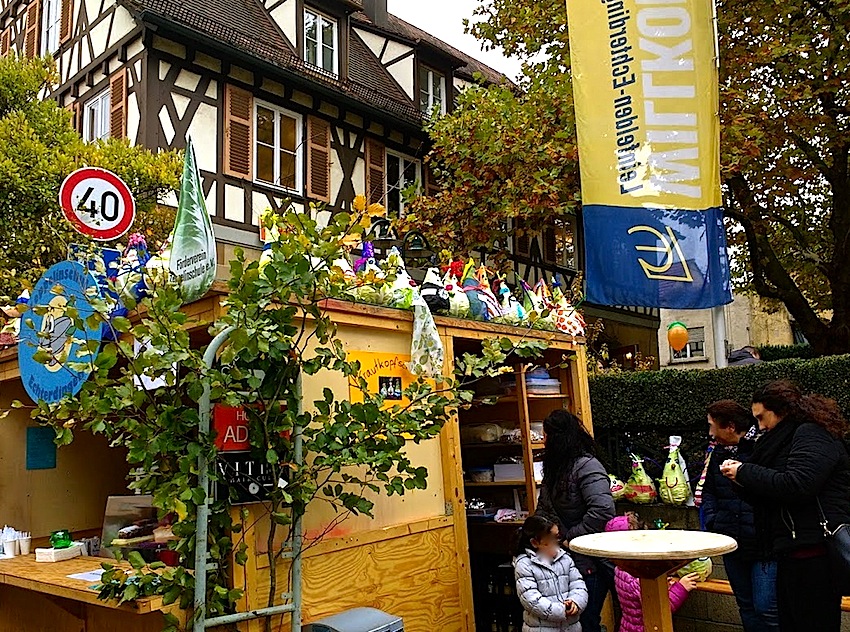
20 Cabbage Fest, enclos*ureAbove: a children’s activity booth in front of the town’s museum.
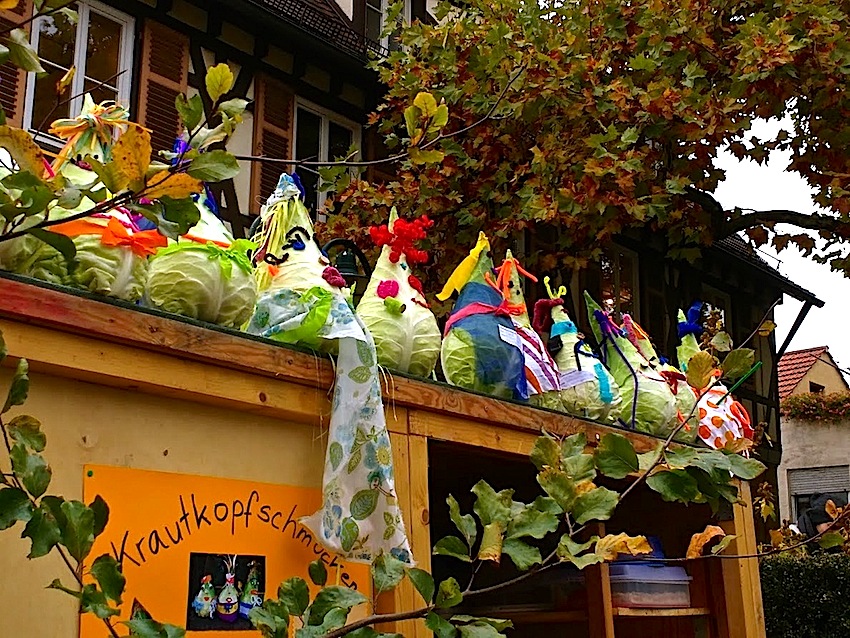
12 Cabbage Fest, enclos*ureAbove: “Pretty cabbage heads.”

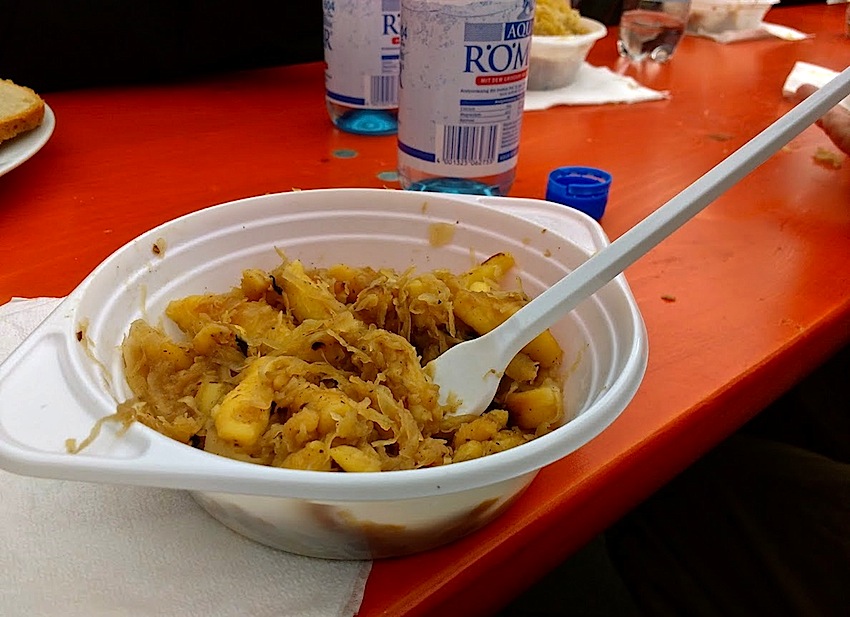
19 Cabbage Fest, enclos*ureAbove: my lunch, sauerkraut and potato dumplings (like gnocchi).

By the way, now is the time in Stuttgart to eat Zwiebelkuchen (bacon and onion flan) with Neuer Sußer or new wine — newly (barely) fermented grape juice.

Streifzug means ‘foray,’ ‘ brief survey,’ or ‘ramble.’

*I mentioned this fest to my mother, and she remembered that, back in Texas, my great-grandmother always told her that cabbages with pointed heads were the best. I don’t think I’d ever seen any until this August.

the moon moves over
the field of dark cabbage and an
exchange fills
all veins.

Jonathan Williams, from “Two Pastorals for Samuel Palmer at Shoreham, Kent”
Streifzug 6: Esslingen

I’m sorry that there was no Sunday porch yesterday; we were out touring Stuttgart with visitors.

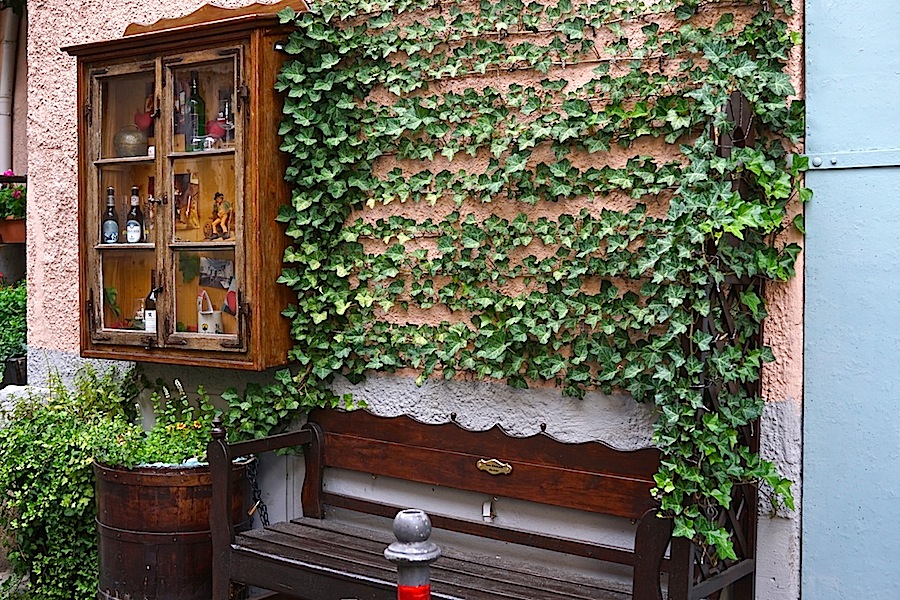
Esslingen, Germany, doorway seat, by enclos*ure

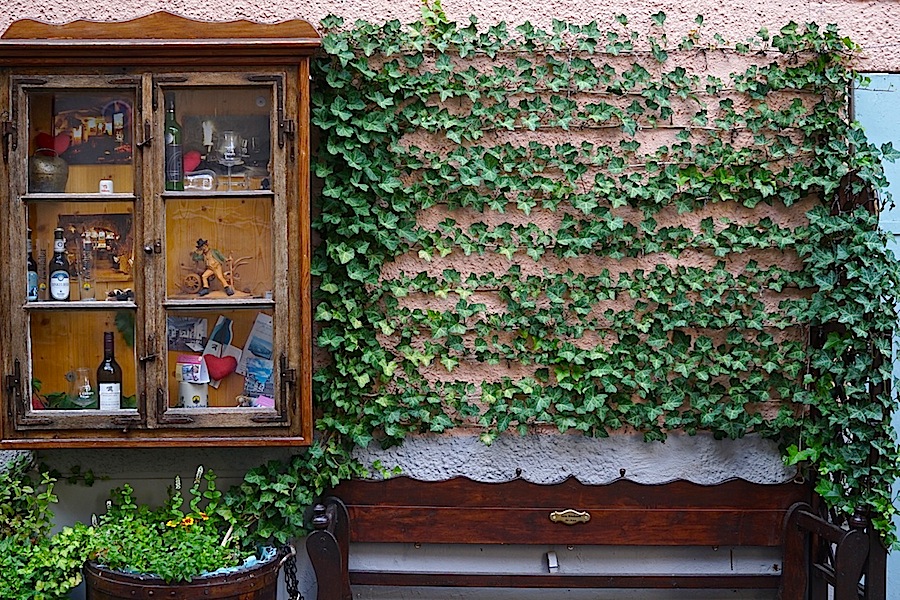
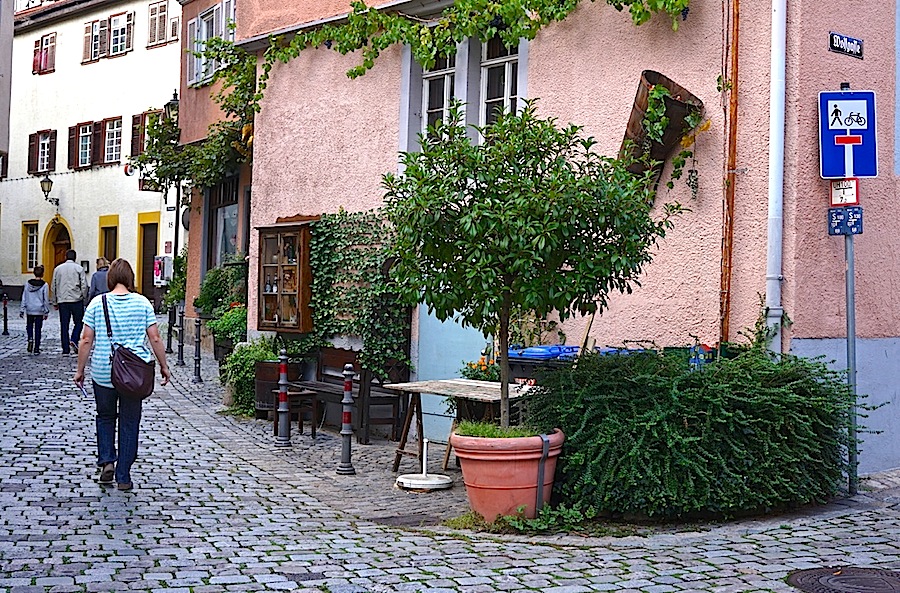
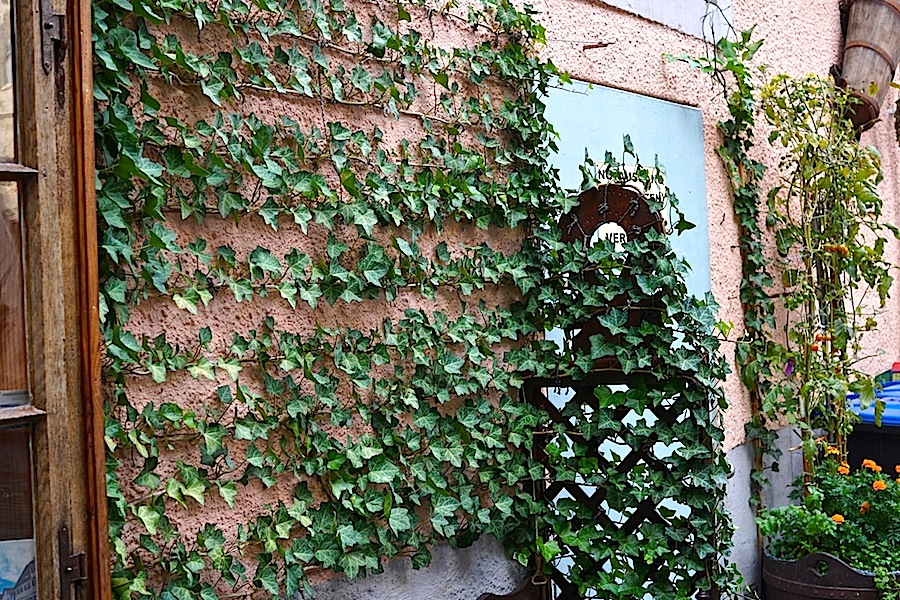
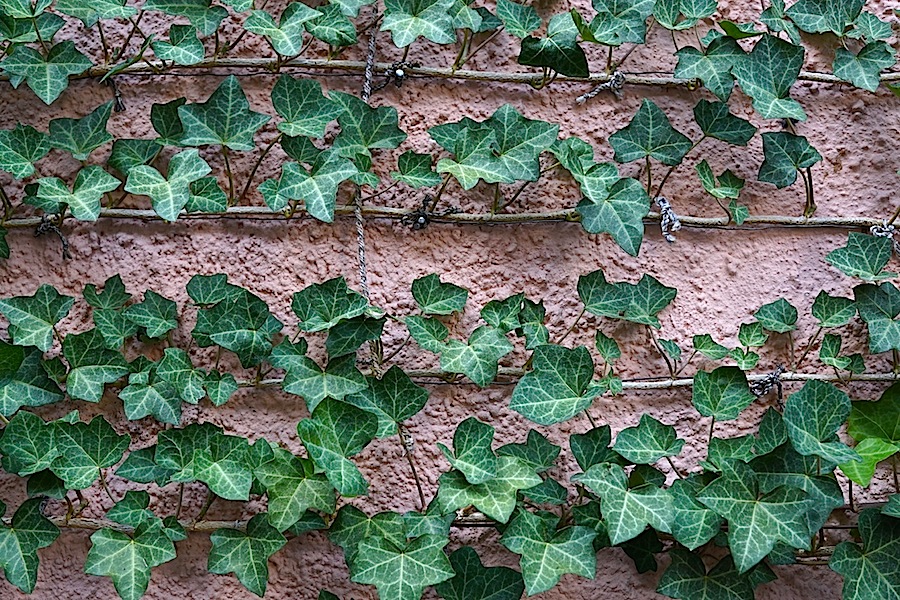
In the early evening, we walked through the nearby small city of Esslingen am Neckar, and I spotted this sweet doorway arrangement with espaliered ivy.

Esslingen, Germany, doorway seat and vitrine, by enclos*ure

Esslingen, Germany, doorway, by enclos*ure

Esslingen, Germany, doorway seat ivy, by enclos*ure

Esslingen, Germany, espaliered ivy, by enclos*ure

Streifzug means ‘foray,’ ‘ brief survey,’ or ‘ramble.’

The Birkenkopf, Stuttgart

This mountain, piled up after World War II from the rubble of the city, stands as a memorial to the victims and a warning to the living.
— plaque at Birkenkopf

This slideshow requires JavaScript.

Allied bombing raids on Stuttgart during World War II  destroyed at least 45% of the city, including nearly all the city center.*

In the mid-1950s, 1.5 million cubic meters of the resulting rubble were moved to a hill in the southwest of the city — raising it by about 40 meters and making it the highest point in central Stuttgart.

This is the Birkenkopf or Rubble Hill, which we visited two weekends ago.  It is sometimes also called Monte Scherbelino or Mount Shards.

A wide spiraling asphalt path leads walkers, runners, and cyclists up through the woods that have grown over the debris. At the summit, a semi-circular berm of broken concrete and ornamental stonework forms a terrace or shallow amphitheater facing a spectacular view of the city.

There are many post-WWII rubble hills (aka Schuttberge or Trümmerberge) in Germany.  London has some as well, and there’s an interesting essay about this kind of ‘made ground’ (“a sort of spatial redistribution of violence”) here.

I have not been able to find the name of the company or person who directed the design of the Stuttgart hilltop area.

You can watch a beautiful short video of the Birkenkopf from the air hereIf you visit Stuttgart, you can reach the site via the no. 92 bus from the Rotebühlplatz U-bahn stop.

To scroll through larger versions of the slides above, click on ‘Continue reading’ below and then on any thumbnail in the gallery.

Roofless walls
Rooks overlook
I told you so
Babbles the brook

Samuel Menashe, from “Ruins

ADDENDUM:  From the Facebook page Birkenkopf-Stuttgart, I learned that the Birkenkopf was designed by Manfred Pahl, a painter and architect working for the city’s Department of Landscape Planning and later with the Verschönerungsverein Stuttgart (beautification association).

There’s an interesting picture of the construction of the hill here.


*Over 4,500 people on the ground and 2,400 Allied aircrew (300 planes) are estimated to have died during the Stuttgart attacks, according to Wikipedia. The city had important industrial resources and several military bases and was a railway hub for the southwest.


Continue reading “The Birkenkopf, Stuttgart”

Streifzug 5: Unity Men

This slideshow requires JavaScript.

A ramble* on Friday, about 7:00 p.m. . .

This year marks the 25th anniversary of German reunification.

The federal state of Hesse, charged with organizing the celebrations, commissioned conceptual artist Ottmar Hörl to create an installation of serial sculptures.

As many as 1,000 little green Einheitsmännchen or Unity Men will tour Germany. At the moment — until August 30 — they are on the Schlossplatz in the city center of Stuttgart.

For my conceptual idea to release its communicative potential, I work in public spaces — a sphere that belongs to everyone and to nobody at the same time. . . . For this space — outside the confines of museums — I consciously choose motifs that are already firmly rooted in collective memory. By gradually shifting their context or by an act of re-creation, I turn them into a new experience.

In line with my strategy as an artist, it seemed obvious to me for the anniversary of the German reunification to adopt, and rework, the well-known East German Ampelmännchen, or traffic light man, first developed by Karl Peglau in 1961. I turned the two-dimensional pictogram of a little green man into a three-dimensional serial monochrome figure, carved in the round and standing 38 centimeters tall. He is still wearing his hat, but has been given a face, too. In a manner of speaking, this is a new generation Ampelmännchen, the Einheitsmännchen (“Unity Man”): cosmopolitan, friendly, and with a positive outlook for the future, smiling, holding out his hand in a attempt to meet you halfway, full of energy, dynamic, courageous, and advancing with determination. He is a symbol of our mobile society. . . . When our society manages to stay flexible, in motion, in a constant state of flux, there is always room for advancement and improvement. Individuals as well as society as an entity will thus keep their chance to escape the risk of paralysis or deadlock.

In this respect, the “Unity Man” may be regarded as an emblem of free democratic principles, of flexibility, of hope and trust in the future. . . .

Ottmar Hörl, from the exhibit’s brochure

The green men are available for sale online here. An unsigned figure is €60; a signed one is €140.


*Streifzug means ‘foray,’ ‘ brief survey,’ or ‘ramble.’

Our garden in July

How to convey the very, very discreet charm of our garden of rough grass and weeds?

This slideshow requires JavaScript.

I often think of this other bit of German ground painted by Albrecht Dürer.

Yesterday, a repairman came over to fix the window/door behind my desk chair. It turned out to be fine; I just did not know how to operate it properly. (German windows are wonderful, but this one is a bit over-engineered.)  He pushed the handle and pulled the frame and said, “And now you can go out into the beautiful . . . looks out, slight pause. . . garden.”

You can read about the beginning of my “garden without (much) gardening” here.

The middle of the month brings Garden Bloggers’ Bloom Day (the 15th) and Foliage Follow Up (the 16th). Please visit Carol at May Dreams Gardens and Pam at Digging to see what’s blooming and leafing out in July.

You can scroll through larger versions of the photos above by clicking on ‘Continue reading’ below.

I grow in places
others can’t,

where wind is high
and water scant. . . .

I make my humble,
bladed bed.

And where there’s level ground,
I spread.

Joyce Sidman, from “Grass