
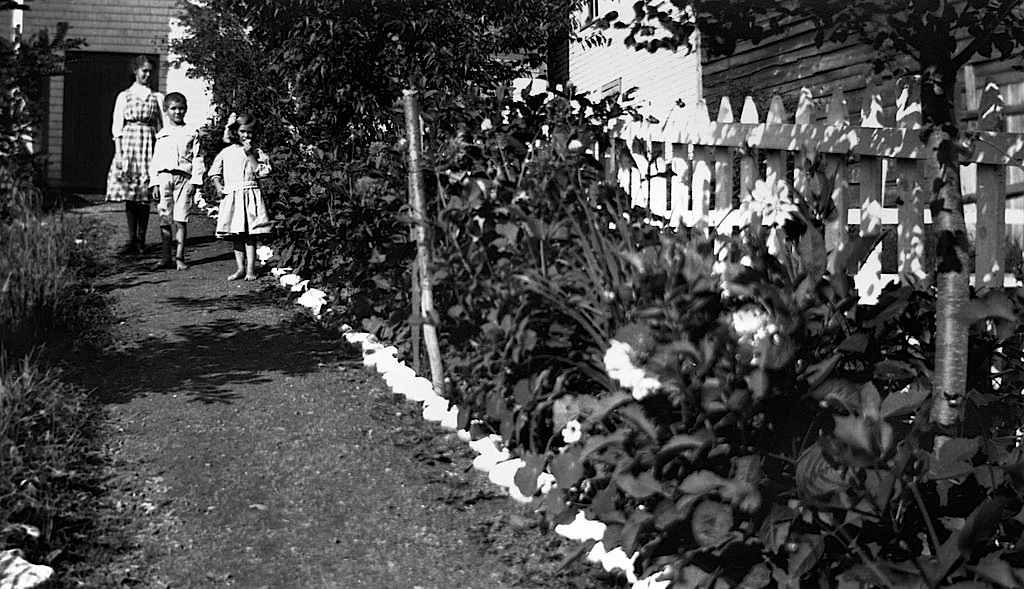
 Children along a summer garden path, ca. 1900, via Nova Scotia Archives Commons on flickr. Click on the photo for a larger view.
Tag: children
Life in gardens: wildflowers
 Children costumed as flowers or insects for an event of the Wild Flower Preservation Society, Illinois Chapter, probably in a Chicago park, ca. 1920, hand-colored glass lantern slides by an unknown photographer, via The Field Museum Library Commons on flickr (all images here).

The Wild Flower Preservation Society of America was founded in 1902 with money given to the New York Botanical Garden by Olivia E. and Caroline Phelps Stokes. The funds were to be used for the protection of native plants.

The Society dissolved in 1933, but much of its work was taken up by the Garden Club of America and by another Wild Flower Preservation Society, founded in 1925 in Washington, D.C. (which seems no longer to exist).
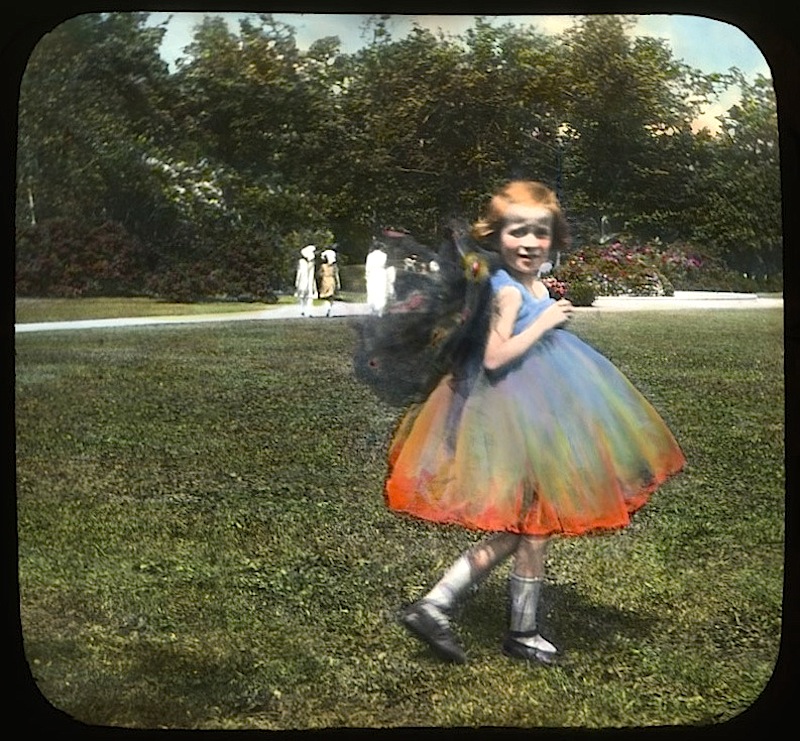

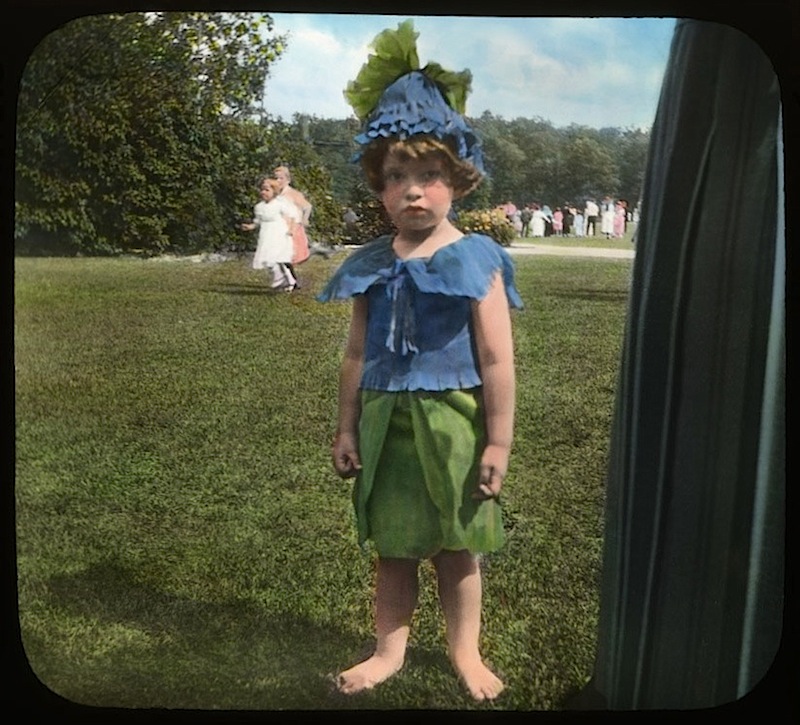
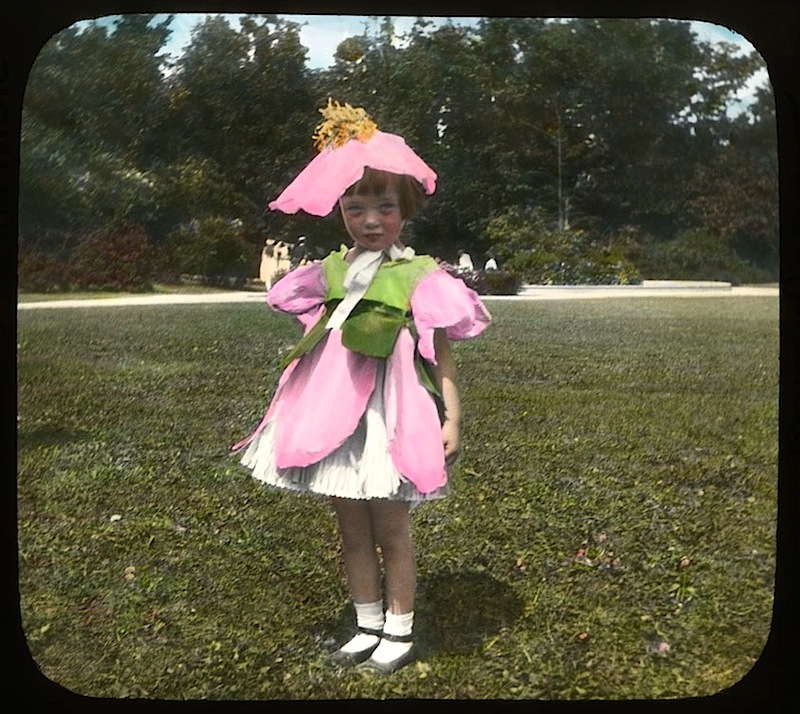
 Above and below: Mayapples.
 Above: a bee.

Click here to see several more of the slides.
Life in gardens: vier kinderen
 “Four (vier) children holding hands in front of a wooden fence,” Indonesia, ca. 1924, attributed to Klaas Kleiterp, via Rijks Museum of Amsterdam.
This image is from a file of bookmarked photos I have labeled “children made to pose in gardens.” I really like the large freeform lattice arbor around them.
Life in gardens: Detroit, Michigan
 Black children standing in front of a half-mile concrete wall in northwest Detroit. It was built in 1941 to separate their neighborhood from a white housing development going up on the other side.
The photo was taken in August 1941 by John Vachon for U.S. Farm Security Administration and is via Library of Congress Prints and Photographs Division.
The 1930s and 1940s were times of great growth for the city of Detroit and the inner-suburbs. The Federal Housing Administration (FHA), founded in 1934, pushed the idea of home ownership as an accessible goal for the average working class. . . .
[However], the FHA’s policies of mandated racial homogeneity in housing developments and redlining made it difficult for African Americans to become home owners. . . . Between 1930 and 1950, three out of five homes purchased in the United States were financed by FHA, yet less than two percent of the FHA loans were made to non-white home buyers. . . .
Public or private housing being hard to come by in the city, some African Americans were able to purchase land lots around the Wyoming Avenue and 8 Mile intersection with hopes of eventually building houses. . . . When the FHA was approached by a developer wanting to build an all-white subdivision west of the site, funding was refused because the area was too risky for investment. In a compromise with the FHA, the developer erected the wall that was to divide the “slum” from his new construction project.
— “The Detroit Wall,” Wikipedia
Life in gardens: beach swing
 “Children swinging on pier rope at beach,” between 1900 and 1920, by Detroit Publishing Co., via Library of Congress Prints and Photographs Division.
 enclos*ure