Bowling, 1861


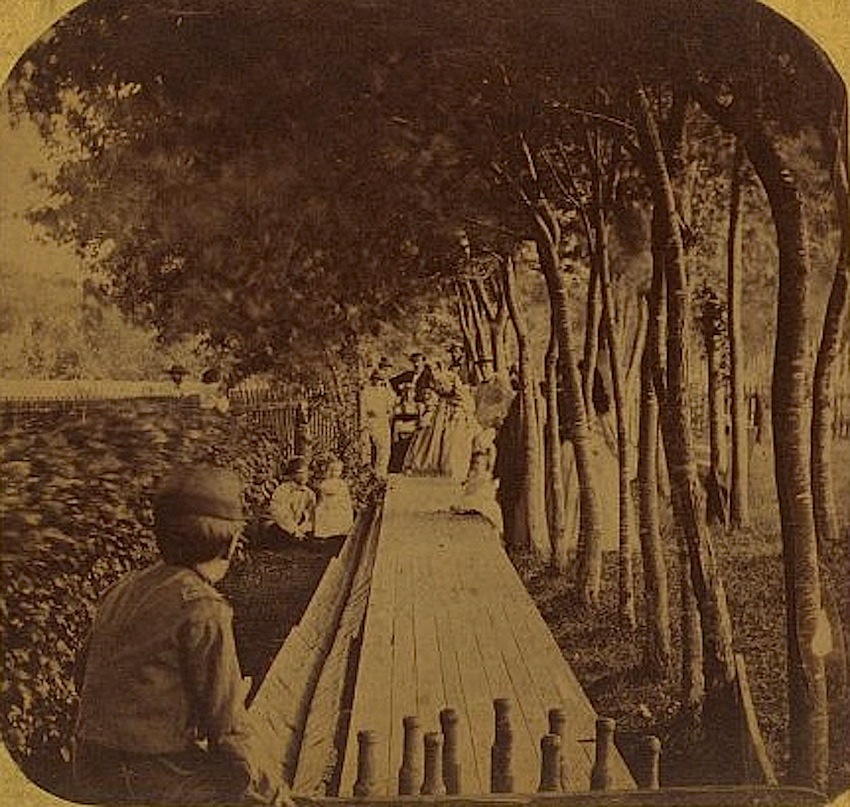
“Group of people bowling on a wooden lane erected in a yard,” July 4, 1861, via Library of Congress Prints and Photographs Division.

I just found this photo. It was taken exactly one year before yesterday’s picture, probably by James Hunter,* who would host the 1862 picnic.

The Library’s online catalogue says that “Mrs. H. Bowling and Coleman Sellers, Jr.,” have been identified in this image, although it doesn’t say where they are — probably the woman bowling (Mrs. H., bowling†) and perhaps the boy in charge of setting up the pins.
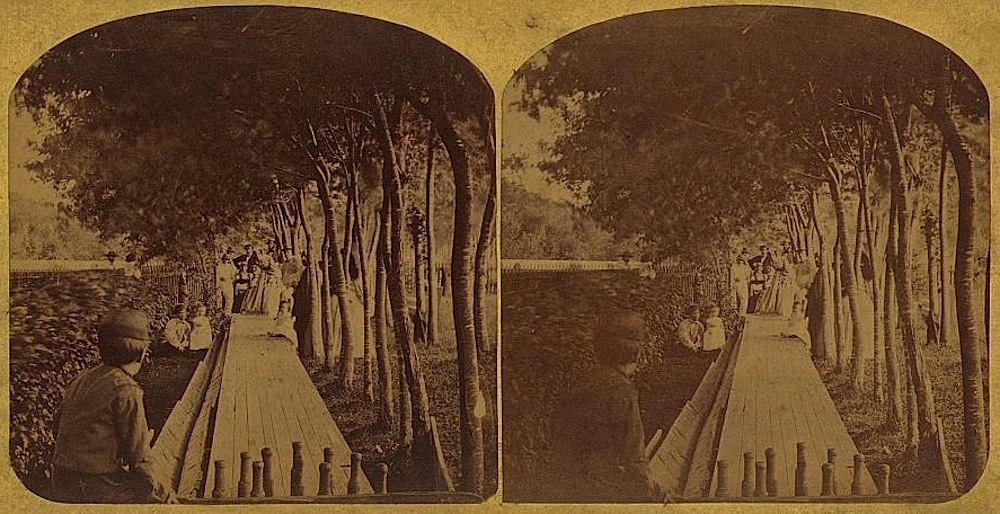
The full stereograph. I do hope they removed the baby from the lane before she bowled.

“By the mid-1800s, the game of ninepins was so popular that wealthy families installed bowling lanes at their estates. . . , ” according to American Profile. “When some states outlawed ninepins [in the 1830s and 40s] because it encouraged gambling, the modern game of tenpins evolved to skirt the laws.” I’m not sure if there are nine pins in this picture or ten. What looks like one middle pin may be two pins lined up.

The image is part of the Charles F. Himes collection of stereographs by amateur photographers, primarily members of the Pennsylvania Photographic Society (1860-61) and the Amateur Photographic Exchange Club (1861-63).


*James Hunter may have been co-owner of the Print and Dye Works in Hestonville, Pennsylvania.

†H. for Hunter? Coleman Junior’s father was Coleman Sellers II, a prominent engineer and inventor from Philadelphia. — as well as an amateur photographer.

Hestonville, Pennsylvania

Fourth of July picnic at Mr. James Hunter‘s, Hestonville, Pennsylvania, 1862, a stereograph by Coleman Sellersvia Library of Congress Prints and Photographs Division.

Hestonville is now a neighborhood of Philadelphia.

The flag

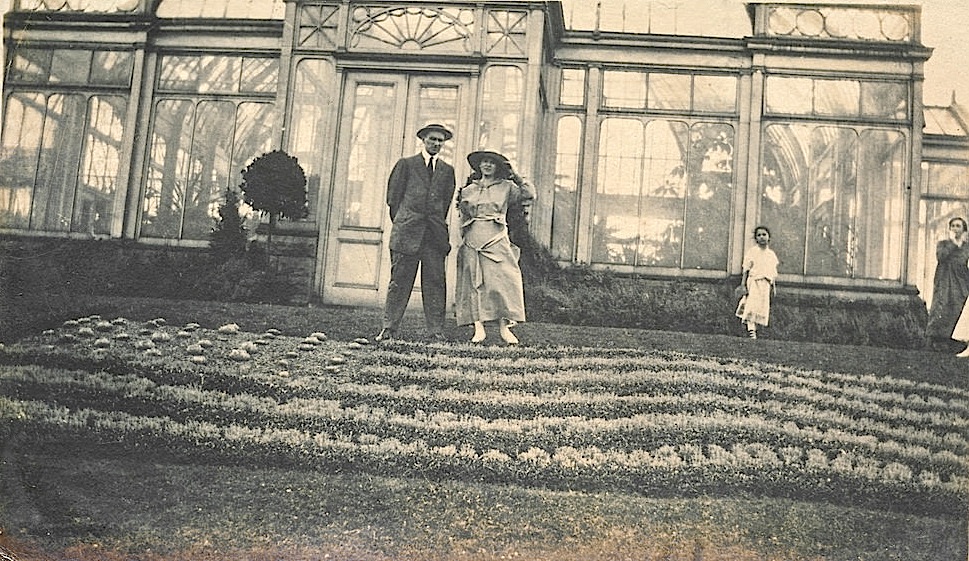
“Couple standing in front of a greenhouse,” ca. 1920, location and photographer unknown, via simpleinsomnia on flickr (under CC license).

The Sunday porch: Vincennes, Indiana

Sunday afternoon on the front porch, Vincennes, Indiana, July 1941, by John Vachon, via Library of Congress Prints and Photographs Division.

Nice striped socks.

Interrupted by visitors.
At least it looks like he didn’t have to leave his book and go inside with them.

Écardenville-sur-Eure

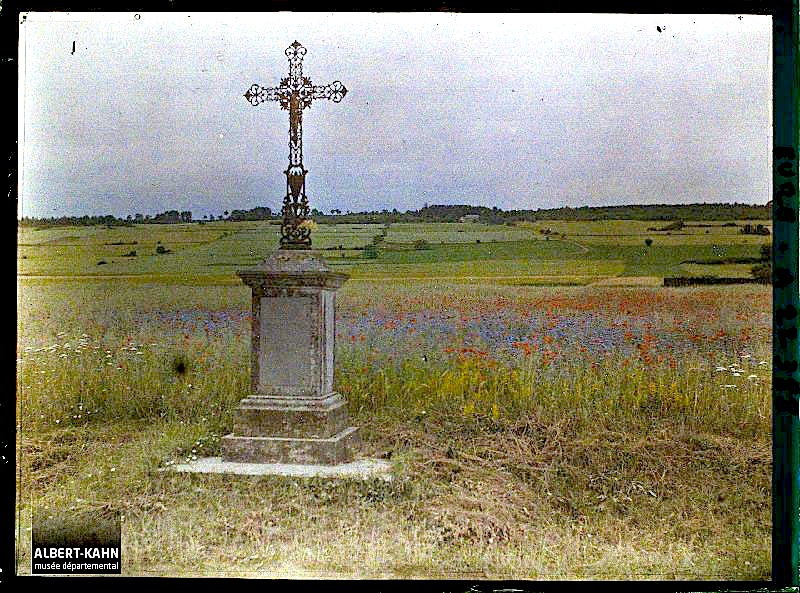
Cross and coquelicots, Écardenville-sur-Eure, Normandy, France, June 30, 1920, by Georges Chevalier, via Archives of the Planet Collection – Albert Kahn Museum /Département des Hauts-de-Seine.

This autochrome is one of about seventy-two thousand that were commissioned and then archived by Albert Kahn, a wealthy French banker and pacifist, between 1909 and 1931. Kahn sent thirteen photographers and filmmakers to fifty countries “to fix, once and for all, aspects, practices, and modes of human activity whose fatal disappearance is no longer ‘a matter of time.'”* The resulting collection is called Archives de la Planète and now resides in its own museum at Kahn’s old suburban estate at Boulogne-Billancourt, just west of Paris. Since June 2016, the archive has also been available for viewing online here.


*words of Albert Kahn, 1912. Also, the above photo (A 22 388) is © Collection Archives de la Planète – Musée Albert-Kahn and used under its terms, here.