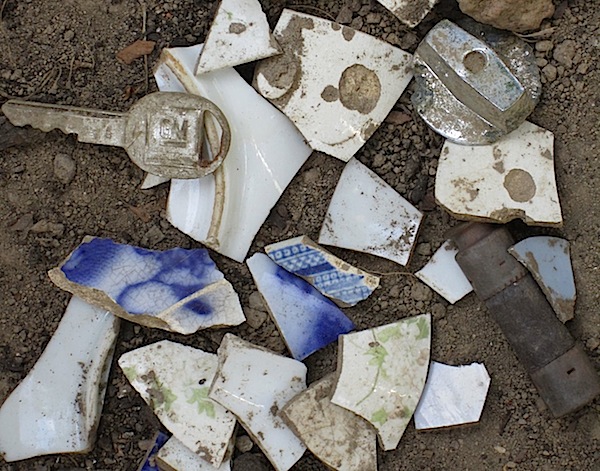
Since I started digging in my new garden this spring, I have found old tile, broken bricks, a GM key, the on/off knob of some large appliance, and something that looks like a fuse (the dog found that and was quite hurt when I put it out of reach).
I also keep finding small pieces of china, mostly in plain white, but some with patterns in blue, pale green, and orange. I keep a jar under the cherry tree to collect them.
I always feel sad about these broken dishes and wonder about their history. Did a child drop a tea cup or run into a cabinet? Did a mother knock a plate off the counter, upset after a fight? Why toss the pieces in the garden?
In my old yard in Chevy Chase, I seemed to hit copper pipe in the ground almost every place I wanted to put a tree or shrub. The original owner, who built the house in 1928 and lived there over 50 years, was a plumber and had installed garden faucets in four spots. Near the big stone grill he also built, I unearthed iron stakes for a horseshoe pit, three duckpin balls, a lot of beer and Orange Crush bottle tops, and a wonderful old concrete flamingo, which still had some pink paint but no legs.
I picture him relaxing among the well-watered flowers in the 1930s, perhaps expecting guests later and perhaps reading Popular Mechanics on how to construct your own round concrete pond, which could be ornamented with regularly spaced, embedded white quartz stones (oh yes).
The round concrete pond.
What bits and pieces from the past have you found while digging in your garden and what story do you tell yourself about them? Please click on “Leave a Comment” below.
I would like to share more of my photos from the Bishop’s Garden that particularly show the wonderful patterns, shades, and textures of the varied foliage. Please click on any thumbnail in the gallery.
I spent yesterday morning at The Bishop’s Garden of the National Cathedral. I’m embarrassed to admit that I had never visited this popular Washington garden before.
I’m sorry I waited so long. The place has the beautiful patina of an old piece of silver.
The partially walled space was designed by Frederick Law Olmstead, Jr. as a private garden for the Bishop. But in 1916, Florence Brown Bratenahl, the wife of the Dean, took over the garden’s installation and re-worked the plan for public access, opening it in 1928. She was the cathedral’s Landscape Designer from 1927 to 1936. Today, the garden is maintained by the All Hallows Guild, which Mrs. Bratenahl founded.
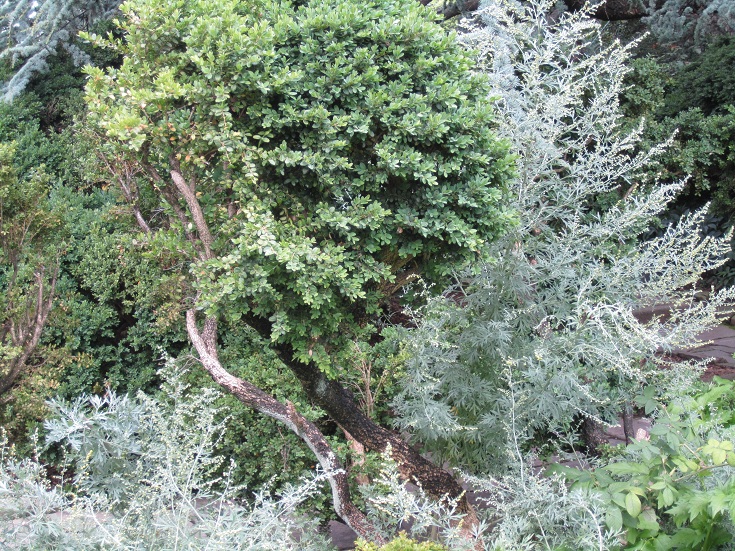
An old boxwood and companion plants.
The garden sits on the south side of the cathedral immediately off an access road and parking area. One parking space actually blocks a bit of the Norman-style arched entryway.
On stepping inside, however, you are immediately enveloped by the long branches of an old weeping cherry and encounter the first of many antique boxwoods.
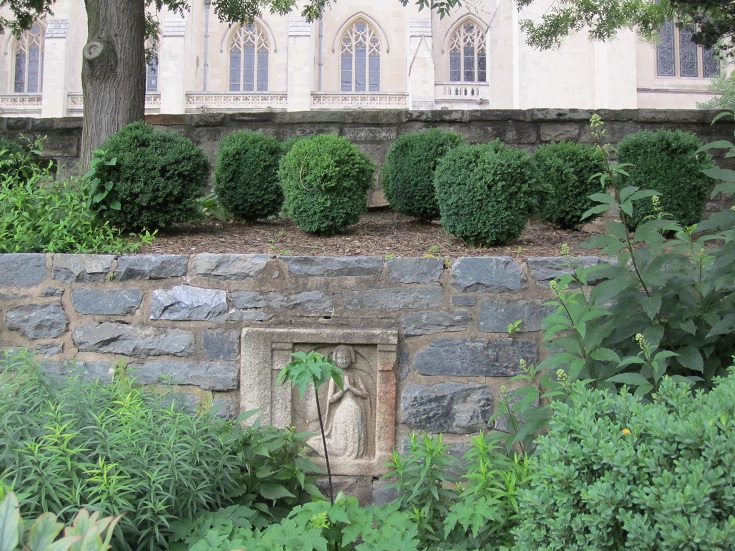
Younger boxwoods grow in a bed set on a higher tier of a wall with 15th c. bas relief.
In the 1920s, Mrs. Bratenahl brought in mature boxwoods from George Washington’s Hayfield Manor, from the Ellersbee Plantation in Virginia, and from other historic sites in the region. I wasn’t able to discover from online research how many of the current bushes are from this time.
Original or not, however, they are very, very old and I like the way many have limbed up and split open at their centers, creating spaces through which other plants have grown. (I believe I was also seeing some of the damage caused by the huge snows we had here in 2010.)
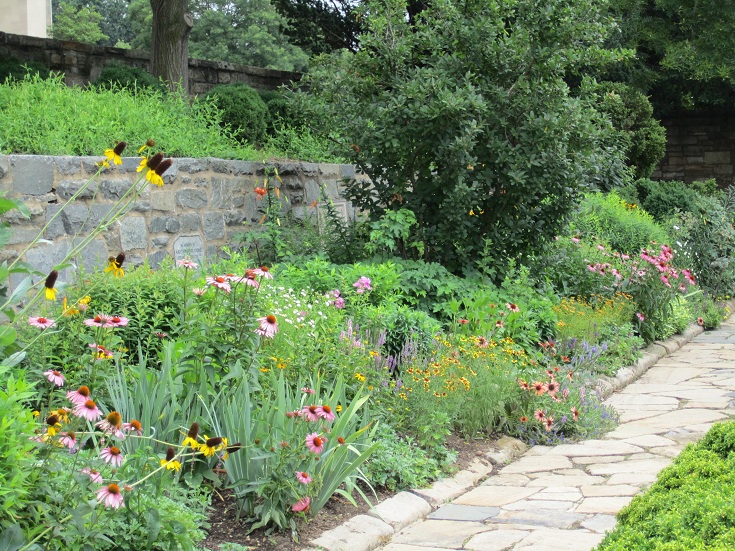
The upper perennial bed.
This lovely garden contains almost every shade and shape of green leaf, set against aged bark and moss-grown stone — all beautifully punctuated, but not overtaken, by the flowers of old-fashioned perennials, annuals, and herbs.
My only real reservation about the design was the central rose garden, which I think has too many brightly colored, glossy-leafed hybrid teas. I would prefer to see bushes with more subtle appeal and interesting foliage.
The fact that the south side of the garden is open to a parking lot for St. Alban’s School is really too bad as well. In Olmstead’s original plan, I believe that area merged into woods and a stream. However, one of the gardeners working there told me that there are plans to put in some kind of view barrier, probably a tall hedge, possibly as early as this fall.
Please enjoy the gallery below. Click on any thumbnail photo below to scroll through all the enlarged pictures.
The 1926 plan for the garden.
Entering the garden.
Ferns and hardy begonias.
Perennials growing through an old boxwood.
Old open boxwood with perennials growing at the base.
Cedrus atlantica ‘Glauca’ and boxwoods.
An old boxwood and companion plants.
Support for the cedar.
Norman Court, a fountain designed by Florence Brown Bratenahl.
Another view of the cedar and boxwoods.
The upper perennial bed.
Rudbeckia maxima in the upper perennial bed.
A very small-leafed boxwood.
Younger boxwoods grow in a bed set on a higher tier of the upper wall with 16th c. bas relief.
Goldfish in the pool of St. Catherine.
I like the rusty orange tint of these coreopsis.
Pomegranate and parsley. Would make a good name for a blog.
What is the name of the tree? I just cannot remember.
The pattern of the stone is echoed by the variety of sages planted along the yew walk.
The cathedral and Russian sage.
The lower perennial bed. The center “tree” is an enormous yew.
Closeup of the old yew.
The Hortulus (Little Garden) with its herbs and Carolingian stone font.
New plants. I like it that the gardeners only lightly mulch the beds.
Note: There is gallery of photos at the end. I’m still having trouble successfully inserting pictures into my posts without tears.
This spring I started my seventh garden. As a Foreign Service spouse, that’s how it’s been: move, make a garden; move, make a garden . . . . Five in Africa, one in Chevy Chase, Md. Now, here we go again.
We bought our 1920’s rowhouse last August. The back garden is about 16′ x 74′. We’re really lucky to have this much space in Glover Park, where normal is a tiny plot in front and a deck overlooking a parking pad out back.
What was already in our long narrow garden was not bad. We have a deck, which sits about 4′ above the ground, a 6 1/2′ tall stockade fence — nicely weathered — and a flagstone sidewalk to the back gate.
There’s a huge old holly tree (a male apparently, no berries) about two thirds of the way back. It provides morning and mid-day shade and shields us from the view of some Wisconsin Avenue shops and restaurants (and their noise). Unfortunately, it also drops its prickly little leaves like crazy in mid spring. Continue reading “The new garden”→
I love spheres in a garden. When I see them, even if they’re staked down in one place, I always imagine that they’re rolling about the garden at will.
While living in Niger a few years ago, I had the idea of making myself some spheres by taking several of the local clay water pots, which are round on the bottom, and planting them upside down. When I went to buy them at a roadside pot stand, I found a few with already broken tops and, naturally, offered a little lower price to the seller to take the damaged goods off her hands. This made her very suspicious, however, and I’m not sure that I didn’t end up paying a premium instead.
The blue spheres in this photo to the right are from the online shop Potted, and I wish I had them for my current little patch of lawn. I spotted them yesterday in an ad in the new online magazine Entra, which I found from a link in the blog Studio G, which I found from a link in Stone Art Blog, which I found googling ideas for gravel. I roll around too.
Potted’s spheres come in blue, orange, and rusted metal. Their website also has a good blog (the link goes to some wonderful posts from their “That’s so potted” contest).
The figures in the photo below are from the sculpture “Last Conversation Piece” by Juan Muñoz. They seem to me to be the ultimate in garden spheres, although they appear to be moving more on bean bags than balls.
They’re at the Hirshhorn Museum of the Smithsonian Institution here in Washington, D.C.





 enclos*ure