Vintage landscape: comfort and joy

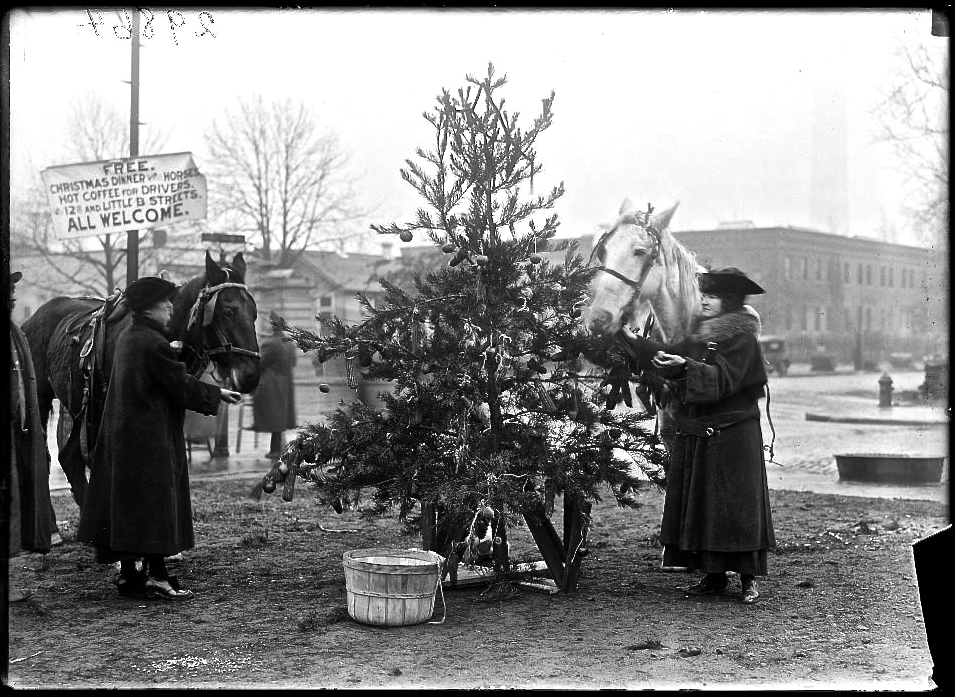
horse xmas tree 1918

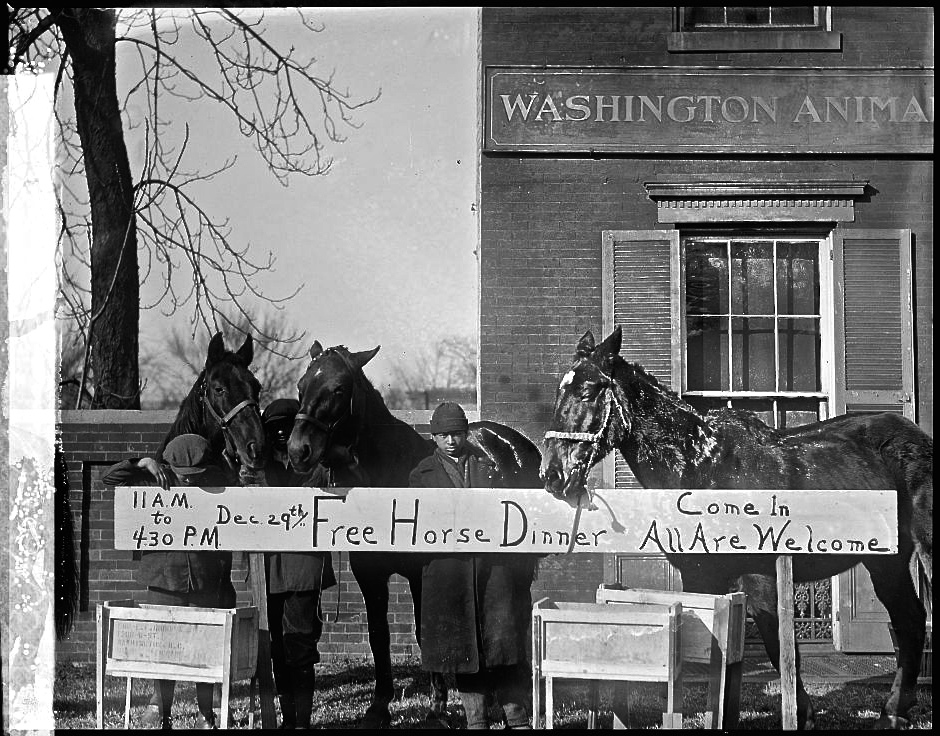
In the first decades of the 20th century, horses toiled to move almost everyone and everything around the city of Washington, D.C.   But one December day a year, for several years at least, they were rewarded with Christmas trees hung with apples and corn and accompanied by troughs of grain.

“Christmas Tree for Horses” was sponsored by the Washington Animal Rescue League.  The 1918 gathering, shown in the photo above, took place at 12th and Little B Streets — the current site of the IRS offices at 12th St. and Constitution Ave., N.W.,  just south of the Old Post Office.  A 1909 map of the area shows a “Horse Fountain” at 11th and Little B Streets.

These holiday horse dinners also took place in other American cities in the early 20th century.

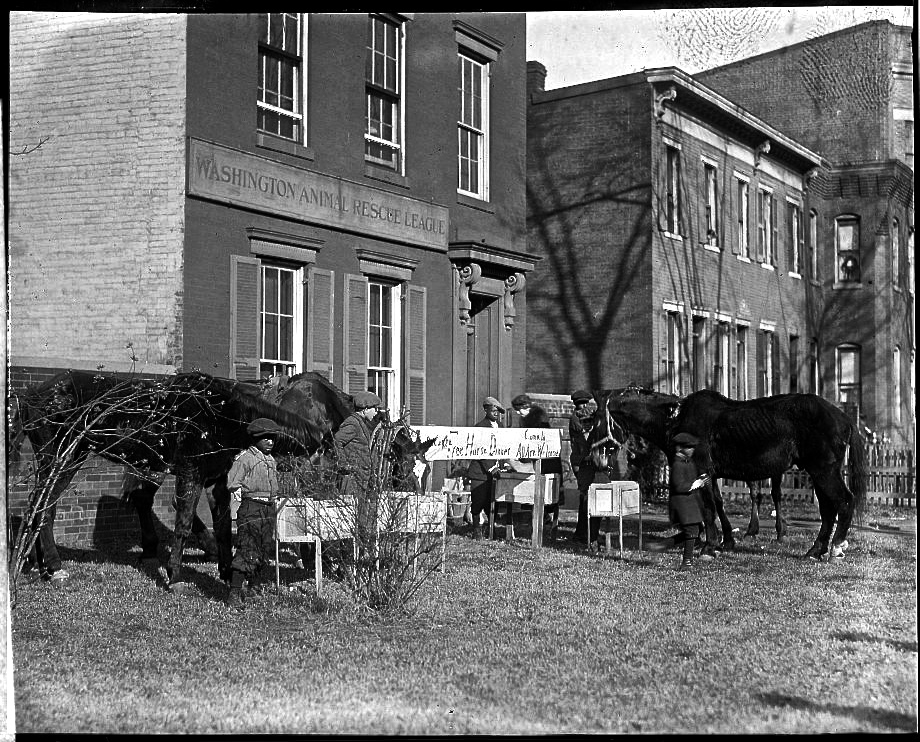
The photos below show the 1923 event in front of the League’s O Street, N.W., offices.

1923-1

The League was founded in 1914 and is the oldest animal shelter in Washington, D.C.  It is now located at 71 Oglethorpe Street, N.W.  (You can find out how to make a donation here.)

1923 -2

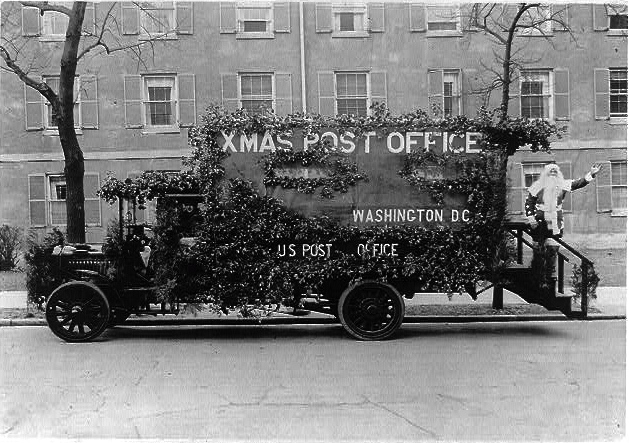
Another kind of antique seasonal cheer comes via this postal service truck liberally festooned with greenery.

mobile post office, LoC

In early December of 1921, it drove around Washington urging residents to mail their Christmas packages early.

All photos via the Library of Congress Prints and Photographs Division.  The three photos  just above  are from the National Photo Company Collection.  The top photo is by Harris & Ewing.

Vintage landscape: the national tree

White House, 19 December 1939, via LoC

On December 19, 1939 — in the photo above — the White House was being decorated for Christmas.  But the “gayly colored” lights on the wreath and trees would not be lit until Christmas Eve when President Roosevelt would also light the “community Xmas tree.”

At that time, what is now known as the National Christmas Tree was called the National Community Christmas Tree (I like that).

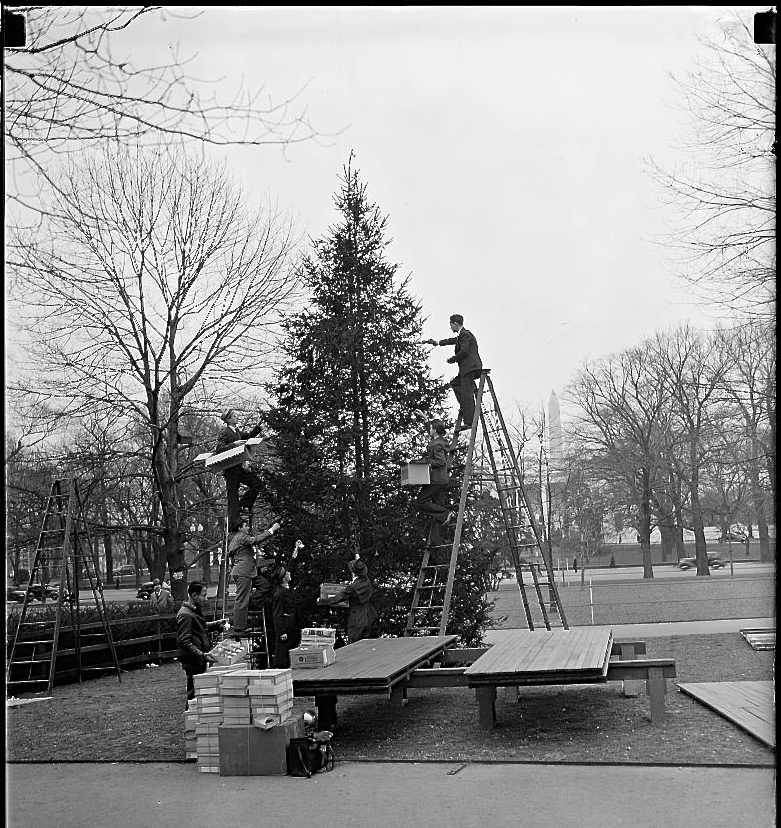
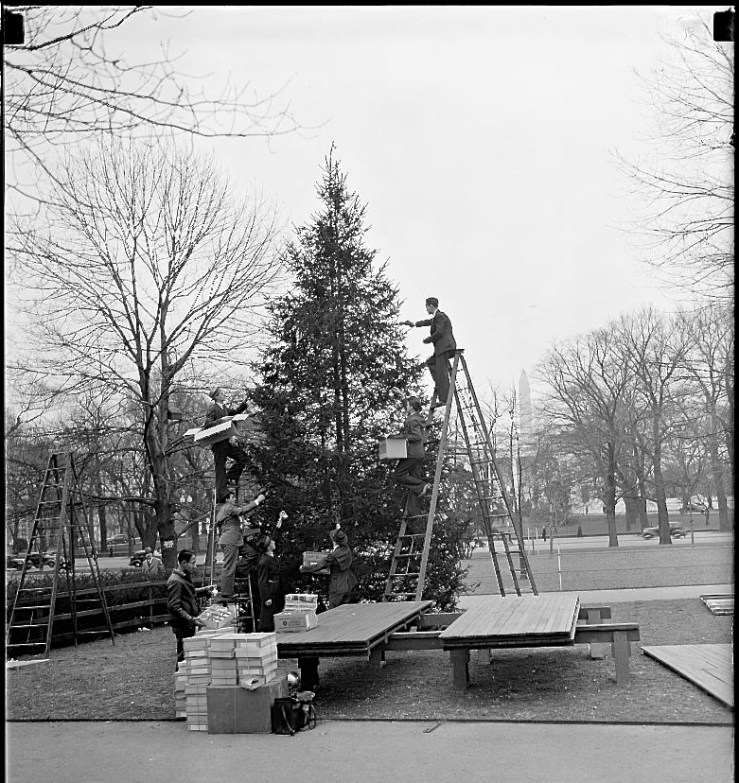
For most of the 1930s, the tree was installed in Lafayette Park, on the north side of the White House.  In the photo below, workers (in suits) decorate the 1937 tree on December 23.
1930's tree, L0C

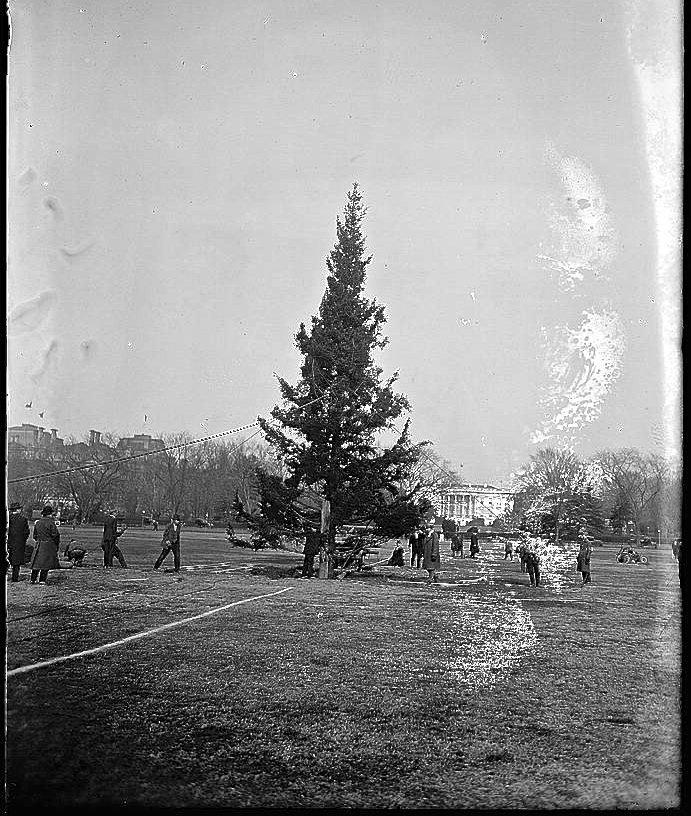
However, the first national tree had been placed on The Ellipse (also its current location), on the south side of the White House, in 1923 (below).

1923 tree setup, L0C

In the early 1920s, according to Wikipedia, “The Society for Electrical Development (an electrical industry trade group) was looking for a way to encourage people to purchase more electric Christmas lights and use electricity, and [Frederick Morris] Feiker [past editor of Electrical World] suggested that President Calvin Coolidge personally light the tree as a way of giving Christmas lights prominence and social cachet.”

The 48′ tall balsam fir was cut and donated by Middlebury College in the President’s home state of Vermont. The Electric League of Washington donated the 2,500 red, green, and white lights.
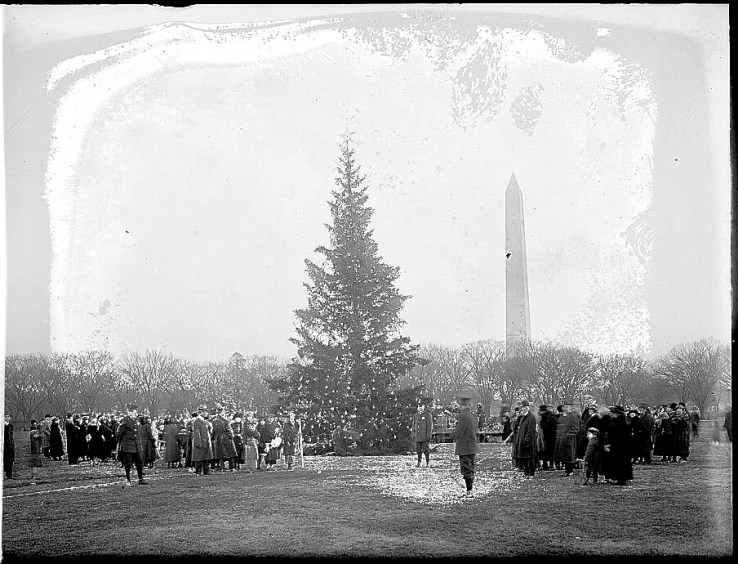
1923 tree, LoC

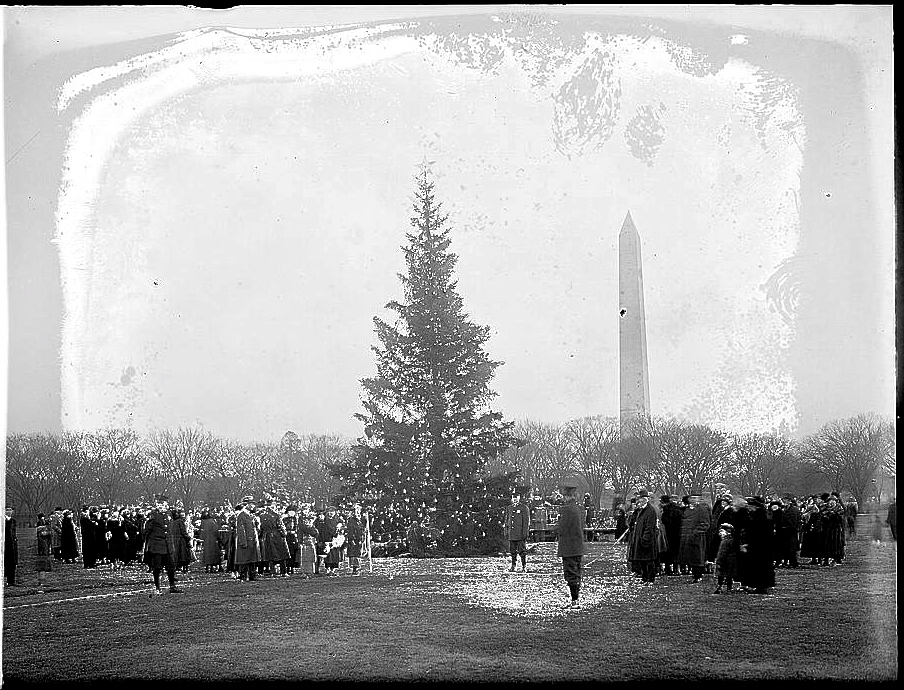
President Coolidge lit the tree on Christmas Eve without making any remarks (below).  A two-hour music concert was then held. Wikipedia notes that “after the white residents of the city had dispersed, African American residents of the city were permitted on the park grounds to see the National Christmas Tree.”
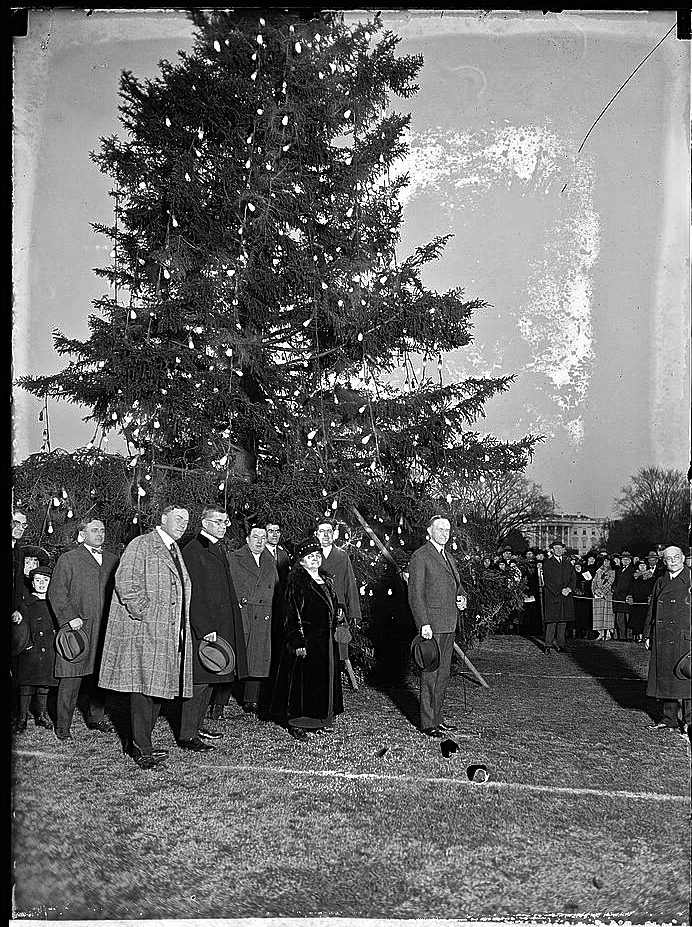
1923 tree lighting, LoC

On December 17, 1924 (below), a live “community” tree was planted in Sherman Park (just southeast of the White House).  This had become necessary after Coolidge, speaking before the American Forestry Association that April, had criticized cutting trees for Christmas decorations. (The national tree had to be replaced in 1929 and has been replaced many times since. From the early 50s to the early 70s, cut trees were used.)
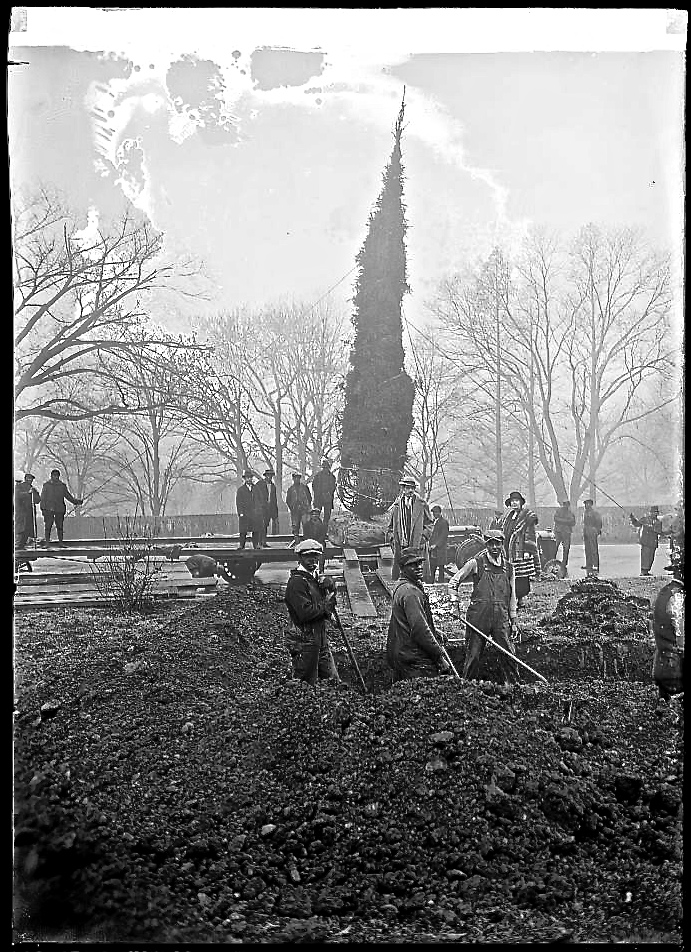
1924 tree planted, LoC

Below is a rather solemn moment from the lighting. The Coolidges’ son had died of blood poisoning earlier in the year, and a new Christmas carol, “Christmas Bells” — dedicated to Mrs. Coolidge — was performed at the ceremony.

1924 tree lit, L0C

Wikipedia has an interesting complete history of the National Christmas Tree here. Two more facts from the article:

“During the 1931 ceremony, a buzzer went off when Hoover lit the tree at 5:00 p.m. Because the button he pressed was not actually connected to the electricity, the buzzer alerted another official to actually light the tree.  The button the president pushed would not be reconnected to actual electricity again until 1980.”

In 1932, “loudspeakers connected to a phonograph were concealed in the branches of the tree, and Christmas carols were played every night from 6:00 p.m. to 10:00 p.m. until New Year’s Day.  The Singing Tree was a hit with the public, and although music and choirs continued to perform each year, the tradition of the Singing Tree lasted for several more decades.”

Facts about this year’s tree are here.

Photo Sources:

1. and 2. Photos by Harris & Ewing via Library of Congress Prints and Photographs Division.

3. to 8.  National Photo Company collection via Library of Congress Prints and Photographs Division.
Season’s Greetings

Sorry to have disappeared for so long. I went outside to organize my garden by color and got a little obsessed with the process, coming in too tired to blog.  I’ll share some photos as soon as the plants recover enough to look like anything.

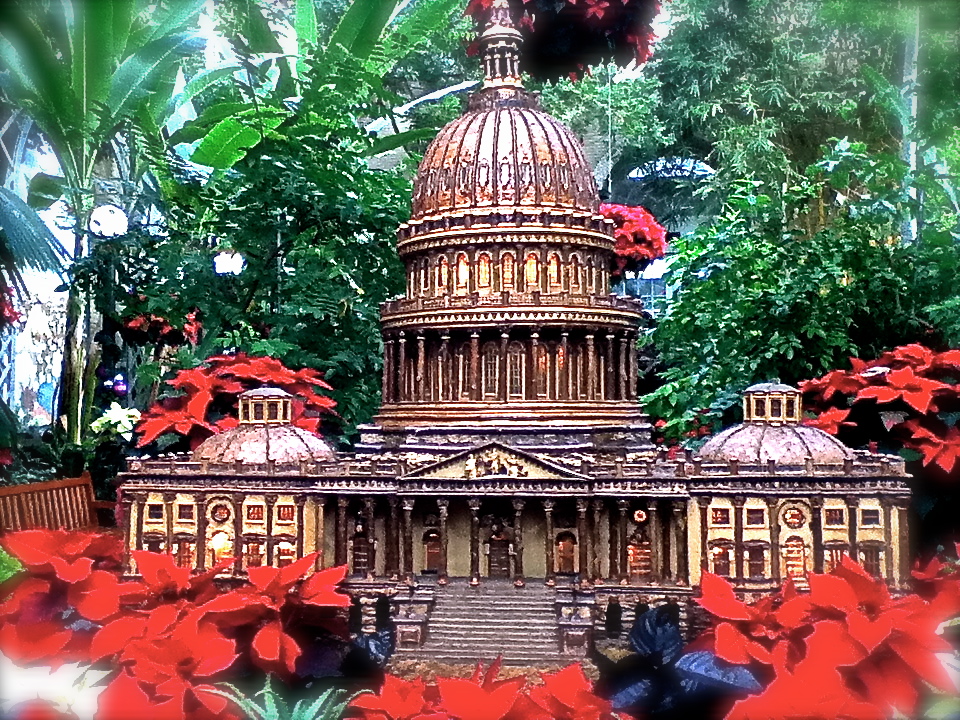
My daughter Laura visited the U.S. Botanic Garden next to the Capitol in Washington, D.C., last week and sent me these photos of its holiday display, “Season’s Greenings.”

IMG_0066
A model of the U.S. Capitol building at the U.S. Botanic Garden.  All photos by Laura Koran.

I guess this makes her my first ‘guest blogger.’

In additions to wreaths, garlands, and poinsettias, the indoor display features model trains running by fairy dwellings in an enchanted forest.

The design company Applied Imagination also created models of many of Washington’s landmark buildings (and one fountain) using dried plant materials (supported by acrylic foam boards).

This slideshow requires JavaScript.

The show will be open to the public through January 1, 2013, and admission is free.

(a little) Miscellany

There’s an interesting behind-the-scenes video of the U.S. Botanic Garden’s year-long preparations for its “Season’s Greenings” display here.

This video is not terribly recent — from The Washington Post on December 1 — but I thought artist Cai Guo-Qiang’s take on the season’s traditional tree “lighting” was kind of a hoot.

The New York Times had an article last week, here,  about the origins of the punch wassail (the word comes from the Middle English phrase waes hael, to your health) and the carol “Here we come a-wassailing ….”   They’re actually about singing to the health of trees, particularly apple trees.

“The historian Roy Christian, in his 1966 book, Old English Customs, described the apple wassailing that was still taking place in several villages in England’s West Country: ‘The villagers form a circle round the largest apple tree in the selected orchard. Pieces of toast soaked in cider are hung in the branches for robins, who represent the ‘good spirits’ of the tree. The leading wassailer utters an incantation and shotgun volleys are fired through the branches to frighten away the evil spirits. Then the tree is toasted in cider and urged in song to bring forth much fruit.'”

James Golden’s Federal Twist garden in western New Jersey is just as gorgeous in early winter as in all the other seasons.  Please take a look here.

A study in steps: mission dome

Steps to the dome of Mission San José de Tumacácori at Tumacácori National Historical Park, 1937.  The park is in the upper Santa Cruz River Valley of southern Arizona.

The photos are part of an Historic American Buildings Survey, via Library of Congress Prints and Photographs Division.
The mission was built in the late 18th century by Franciscan Fathers and local Indian labor.  In the early 19th century, Apache Indians attacked and drove away the priests, and by mid-century, the buildings were in ruins.  Preservation efforts began in 1908.  The building still exists as a National Historic Landmark.

ADDENDUM:  There is another image of the mission and more information about the surrounding park in this New York Times article, here.

Our garden: flower color

I have flower colors on the brain right now.

I’m going to try some (mostly) single-color planting combinations in some sections of the long borders — and dramatic contrasts in others.

This slideshow requires JavaScript.

We have blooms all year round here and lots of space. The main borders are along the lower lawn, so I don’t think  that the colorful arrangements will compete too much with our terrace views of the city and hills.

I’ll probably make a good, old mess at first, but I have a year to experiment and a year to make corrections.

The photos above are some reference pictures I took of all the flowers we have right now (a few things aren’t blooming). I’ve been going around and tagging the colors of the roses and daylilies as they bloom.

I have a number of flowering shrubs in the borders that are too big to move, so I will start my color selections with them.