
Paper beads drying outside, Gifted Hands Center, Kigali, Rwanda.
Life in gardens: Lisbon
 A library garden (Biblioteca de jardim) in the Jardim do Principe Real, Lisbon, Portugal, in 1949.*
Wonderful.
Unfortunately, I wasn’t able to find out anything about Lisbon’s library gardens. A comment on the flickr page said that they had been abolished in 1980.
Jardim do Principe Real is also called Jardim França Borges in honor of a Republican journalist, whose bust was placed there in 1915. The 2.9 acre (1.2 ha.) park in the Mercês parish was landscaped in a romantic design in the mid-19th century.
 Reading under the cedar of Buçado, above, in the Jardim do Principe Real, Lisbon, Portugal, 1949.
The cedar† and the pretty iron structure supporting its 78′ (23 m.) diameter still stand in the park.
 Above is the Julio de Castilho library garden at the Mirador de Santa Luzia, overlooking the Tagus River in Lisbon, also in 1949.
He who has a garden and a library wants for nothing.
― Cicero
*All photos here taken by Estúdio Mário Novais, via Art Library Fundação Calouste Gulbenkian Commons on flickr.*
†One source called it a Mexican white cedar.
The Sunday porch: Santa Barbara
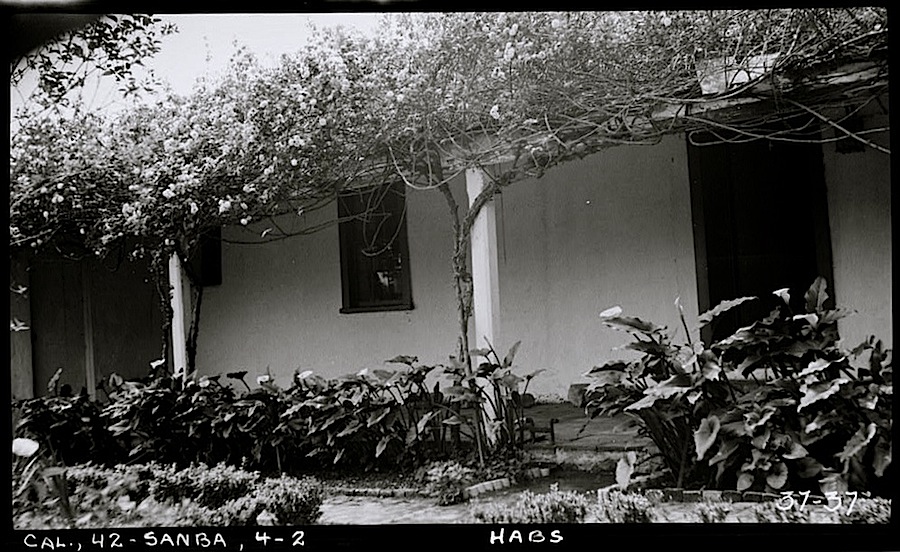 The north porch of the Vhay House, 835 Leguna Street, Santa Barbara, California, April 1934, by C. A. Fletcher for an Historic American Buildings Survey (HABS), via Library of Congress Prints and Photographs Division.*
 The Rafael Gonzalez House, which was owned by Louise and David Vhay at the time of these photos, was built in 1825. It is a typical adobe townhouse of the Mexican California period, with walls over 2′ (.61 m.) thick.
Gonzalez was a soldier and landowner when he built the house for his Italian bride. He became mayor or alcalde of Santa Barbara in 1829. His daughter, Salome, inherited the home in 1866 and lived there until 1923.
The Vhays restored and enlarged the house. It is now occupied by Randall House Rare Books.
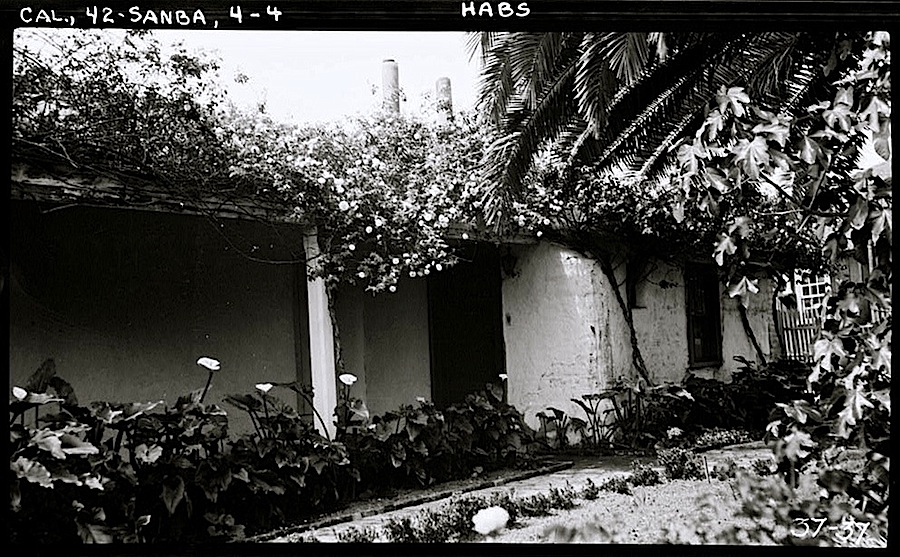 Above: bougainvillea above and calla lilies below, along the north porch, by C. A. Fletcher.
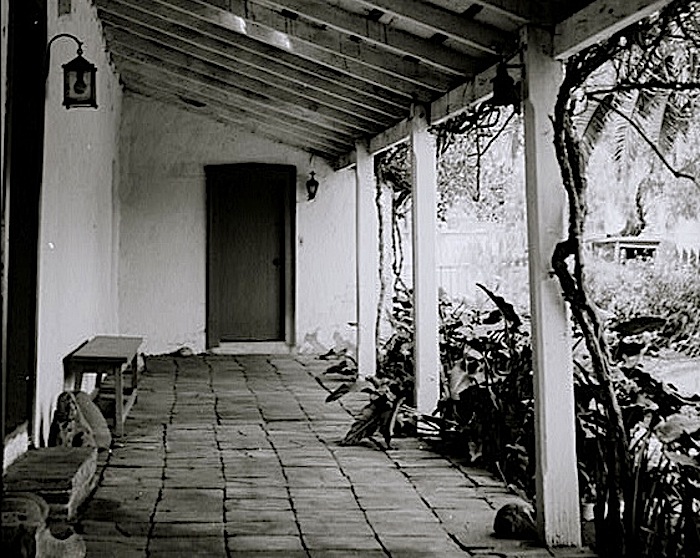 Above: north porch, by C. A. Fletcher (cropped by me).
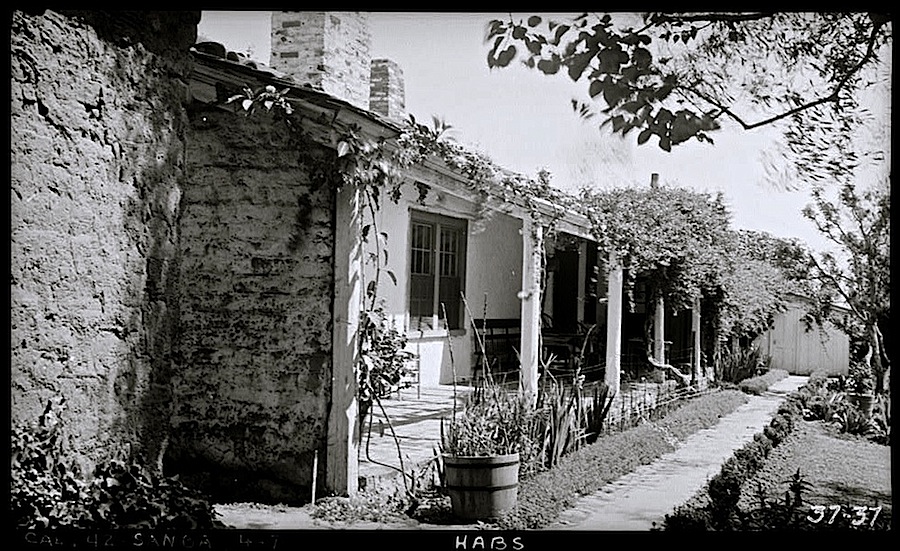 Above: south porch from the southwest. Photographed April 1934, by H. F. Withey.
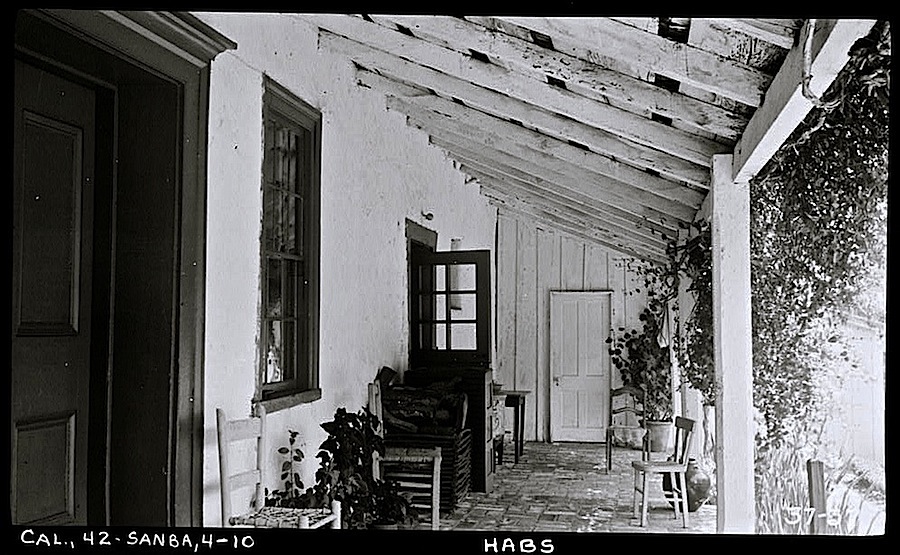 Above: detail of south porch, east end, by H. F. Withey.
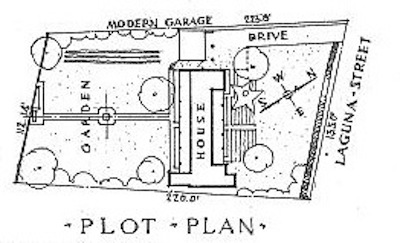
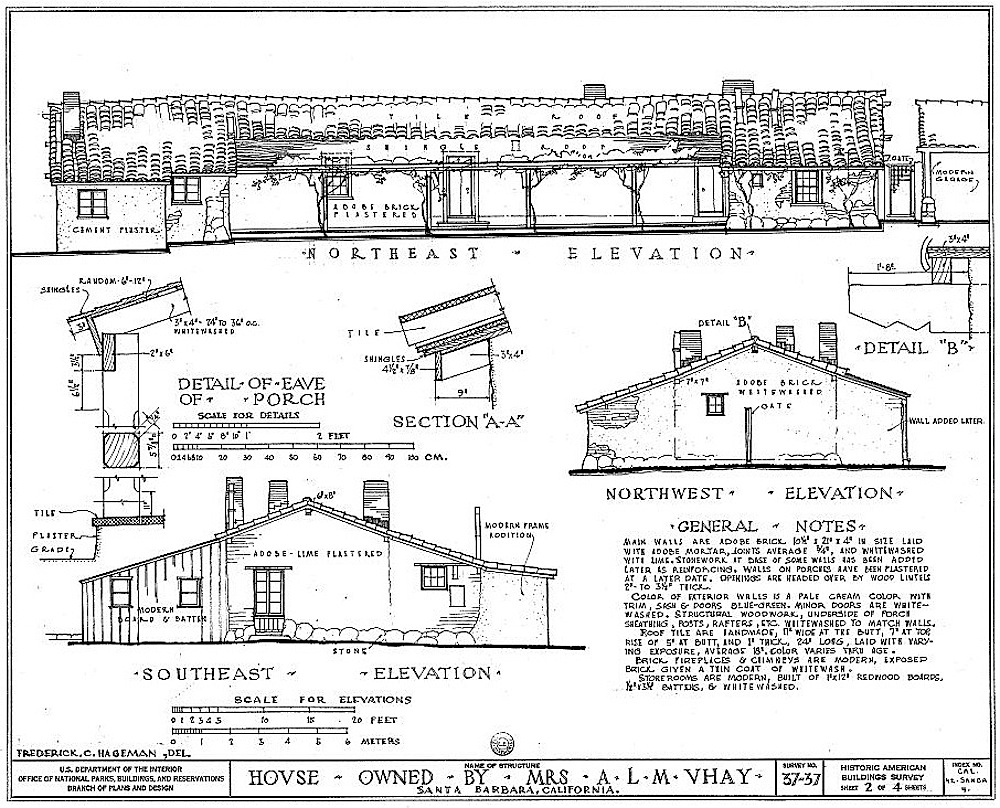 Above: 1934 drawing by Frederick C. Hageman (also the small plan above).
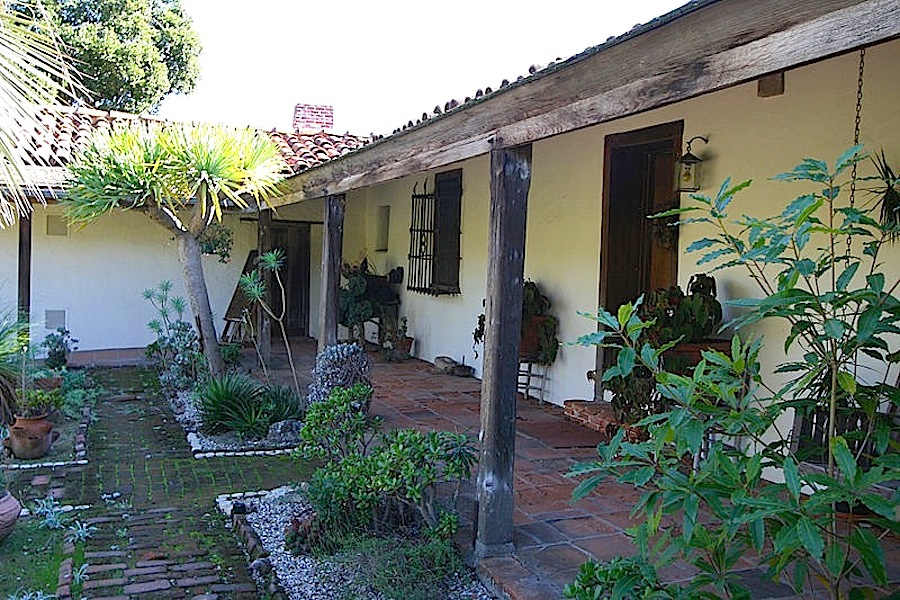 Above: 2010 photo of the Rafael Gonzalez House, now a rare book store, by Dilly Lynn, via Wikimedia Commons. There’s also a nice painting of the house in 1953 here.
The house was designated a National Historic Landmark in 1970.
. . . — for a sec
he even sees the calla lily’s furl
in the gesture of voilà!— Farnoosh Fathi, from “Sympathy“
*All photos and drawings here, except the last image, via Vhay House HABS, Library of Congress.
Life in gardens: Bélesta, France
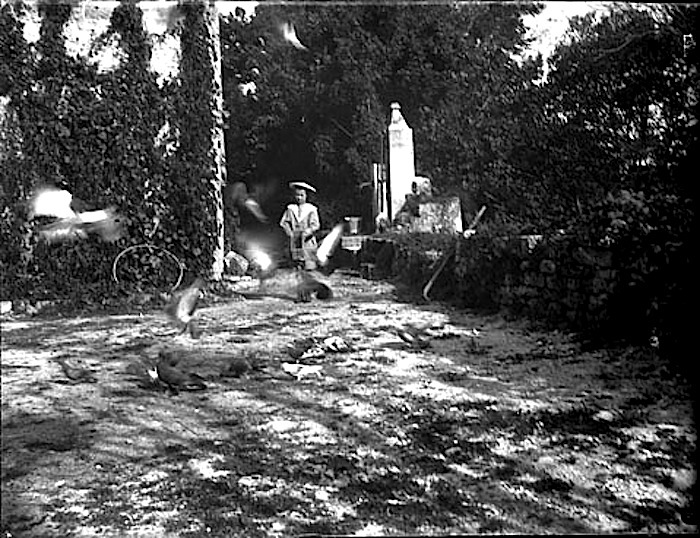
“Bébé et les pigeons, Bélesta,” 1897, by Eugène Trutat, via Bibliothèque de Toulouse Commons on flickr.
Trutat (1840-1910) was a naturalist, geologist, mountaineer of the Pyrenees, and the curator of the Museum of Toulouse.
He was also an early photographer — beginning in 1859 — and was particularly interested in using the medium for science. He eventually took almost 15,000 images and authored a number of books, including Photography Applied to Archaeology and Photography Applied to Natural History.
Trutat took many beautiful pictures of his family and friends, including the one here, of his sons, Paul and Henri. He took several photos of Bébé, a little girl, in October 1897.
There’s more in words than I can teach:
Yet listen, Child! — I would not preach;
But only give some plain directions
To guide your speech and your affections.
Say not you love a roasted fowl
But you may love a screaming owl,
And, if you can, the unwieldy toad
That crawls from his secure abode
Within the mossy garden wall
When evening dews begin to fall,
Oh! mark the beauty of his eye:
What wonders in that circle lie!
So clear, so bright, our fathers said
He wears a jewel in his head!
And when, upon some showery day,
Into a path or public way
A frog leaps out from bordering grass,
Startling the timid as they pass,
Do you observe him, and endeavour
To take the intruder into favour:
Learning from him to find a reason
For a light heart in a dull season.
And you may love him in the pool,
That is for him a happy school,
In which he swims as taught by nature,
Fit pattern for a human creature,
Glancing amid the water bright,
And sending upward sparkling light.— Dorothy Wordsworth, from “Loving and Liking: Irregular Verses Addressed to a Child“
Life in gardens: Napier, New Zealand
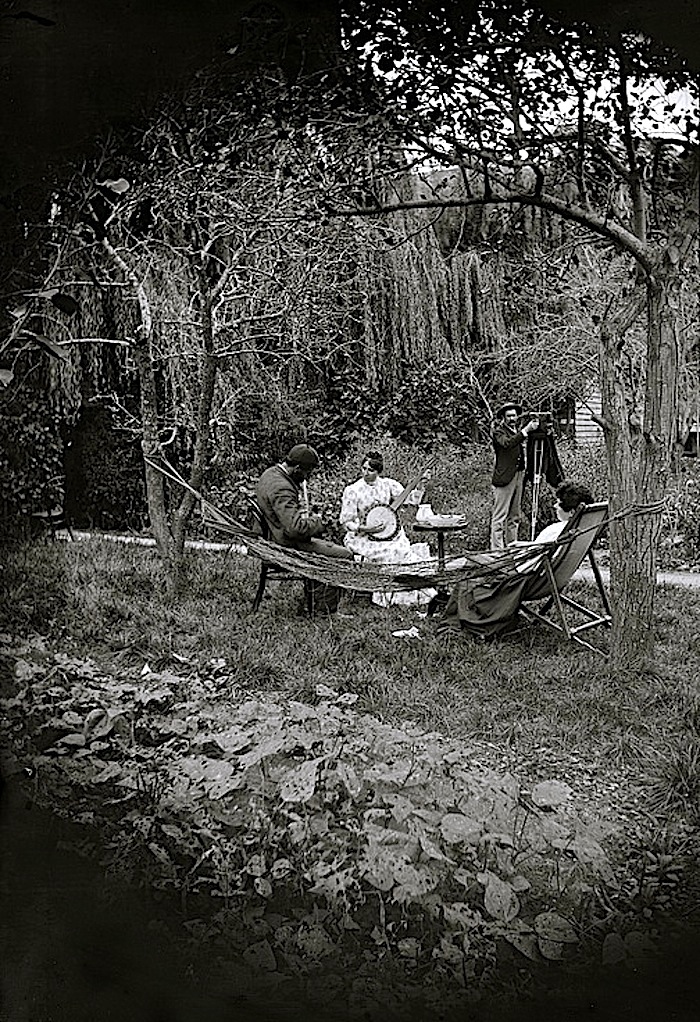 “Group in the garden of William and Lydia Williams, Carlyle Street, Napier,” ca. 1890, a stereographic image by William Williams, via the National Library of New Zealand Commons on flickr.
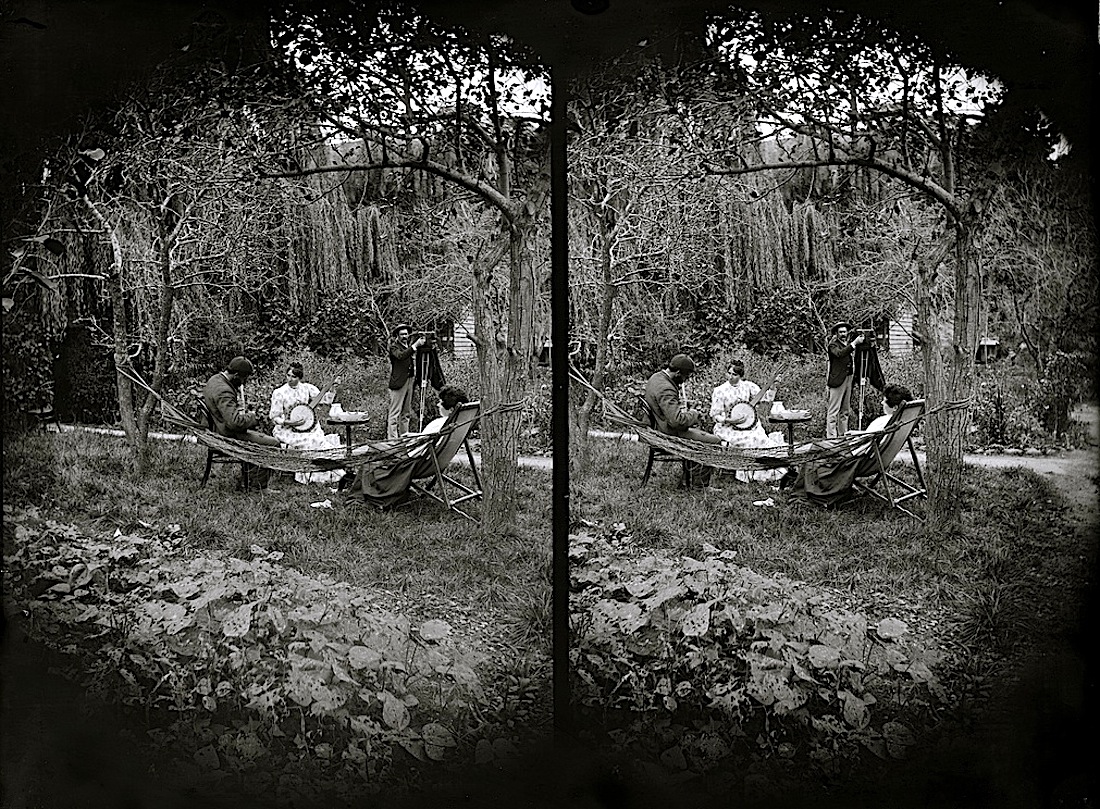
The online catalogue of the Alexander Turnbull Library in Wellington provides further details:
Lydia Williams is in the centre, playing the banjo. Seated at the right is her sister, Amy Devereux. The man with the camera is Russell Duncan. The other man’s identity is unknown but it is possible he was a member of a group such as the Fisk Jubilee Singers, a troupe of Negro singers and musicians who toured New Zealand in the late 1880s. Photograph taken by Lydia’s husband William Williams.
Russell Duncan was later to become a well known photographer and historian of Napier.
Another photo by Williams, below, also from the Alexander Turnbull Library, seems to show the same group, on the same day.
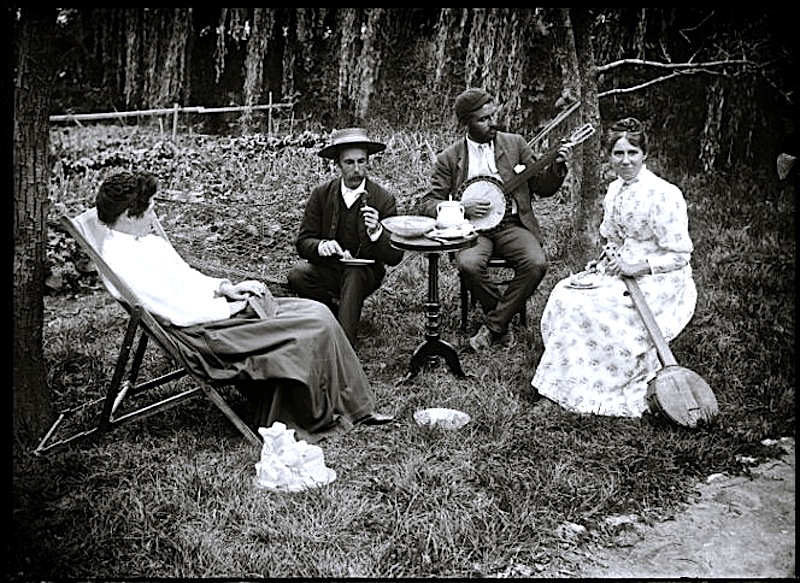 The man eating may be Williams, rather than Duncan.
What junipers are these, inlaid
With flame of the pomegranate tree?
The god of gardens must have made
This still unrumored place for thee
To rest from immortality,
And dream within the splendid shade
Some more elusive symphony
Than orchestra has ever played.— Grace Hazard Conkling, from “Symphony of a Mexican Garden“
 enclos*ure