January reading

Happy 2013!

January WPA posterA silkscreen poster of  the Illinois WPA Art Project (ca. 1936 – 1941), via Library of Congress Prints and Photographs Division.

On my nightstand for January reading:

Home Ground: Sanctuary in the City by Dan Pearson.  His city garden is the best example of what I want for our Washington, D.C., garden when we return.

Illustrated History of Landscape Design by Elizabeth Boults and Chip Sullivan

The American Meadow Garden by John Greenlee and Beautiful N0-Mow Yards by Evelyn J. Hadden

The City Shaped:  Urban Patterns and Meaning Through History by Spiro Kostof

Color by Design:  Planting the Contemporary Garden by Nori and Sandra Pope

The New Perennial Garden by Noël Kingsbury

— none particularly new, but indications of my current interests.

I just finished re-reading Peter Martin’s The Pleasure Gardens of Virginia:  From Jamestown to Jefferson.  I recommend it — along with Barbara Wells Sarudy’s Gardens and Gardening in the Chesapeake, 1700 – 1805 — if you garden in the U.S. mid-Atlantic.  Martin is particularly good on Mount Vernon and Monticello and on Jefferson’s changing enthusiasms and false starts.  (Martin and Sarudy differ somewhat on the extent of the influence of the English landscape garden style in 18th century America.)

(I also love Fergus M. Bordewich’s Washington: The Making of the American Capital for landscape/city planning history.)

Right now I’m really taken with the Game of Thrones books (I know, I’m behind the trend; I’m in Rwanda.)  I’m thinking of making the jump to an e-reader this month and then loading on the second book (aka Season Two) to watch in February.  I also want Hillary Mantel’s Bring Up the Bodies soon (I had to re-read Wolf Hall last month first — it’s so good).

What are your plans for winter reading?
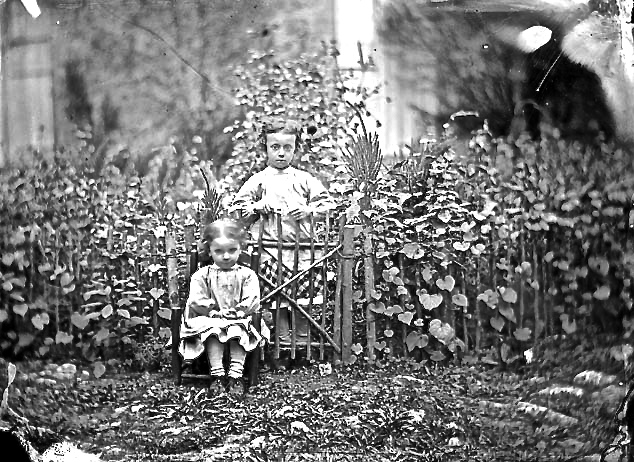
Vintage landscape: Paul et Henri

Paul et Henri

Paul and Henri at Cornusson, Parisot Commune, in the Pyrenees, France, ca. 1870, by Eugène Trutat, via the Bibliothèque de Toulouse Commons on flickr.

As from the house your mother sees
You playing round the garden trees,
So you may see, if you will look
Through the windows of this book,
Another child, far, far away,
And in another garden, play.
But do not think you can at all,
By knocking on the window, call
That child to hear you. He intent
Is all on his play-business bent.
He does not hear; he will not look,
Nor yet be lured out of this book.
For, long ago, the truth to say,
He has grown up and gone away,
And it is but a child of air
That lingers in the garden there.
Robert Louis Stevenson, “To Any Reader”

Vintage landscape: more snow in Washington, D.C.

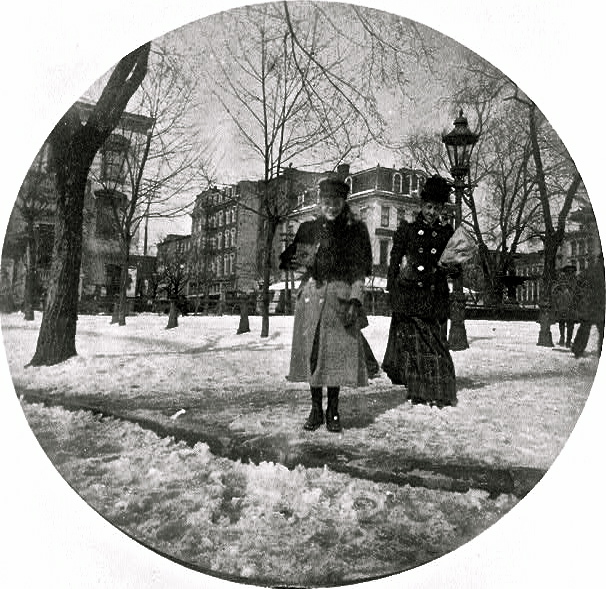
Hunt photo of snowy Washington

“Woman and girl standing in icy square, Washington, D.C.,” 1889, by Uriah Hunt Painter, via Library of Congress Prints and Photographs Division.

Uriah Hunt Painter, 1837-1900, took a number of snapshot photographs of his neighborhood around Franklin Square and of downtown Washington using the first Kodak cameras.  Painter was a businessman and retired newspaper reporter.

“[The p]hoto shows a woman and a young girl posing mid-square with bundles. The two may be Painter’s wife, Melinda Avery Painter, and older daughter, Eleanor, returning from a marketing trip. Or perhaps Painter took their portrait because the girl is holding another Kodak – exemplifying the growing corps of amateur photographers who took advantage of Eastman’s simple box camera.”

— from the LoC online catalog

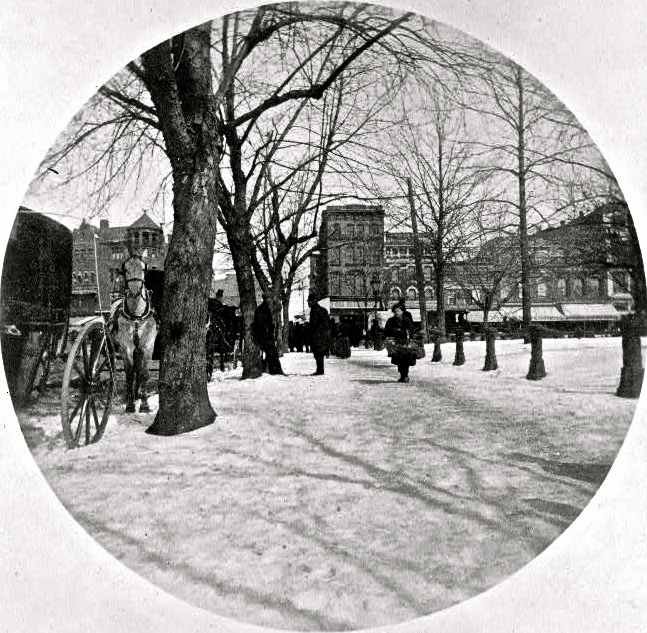
Washington market, 1989

Above: “Market scene, Washington, D.C., snow view,” 1889, by Uriah Hunt Painter. I don’t know which square is pictured in these photos.

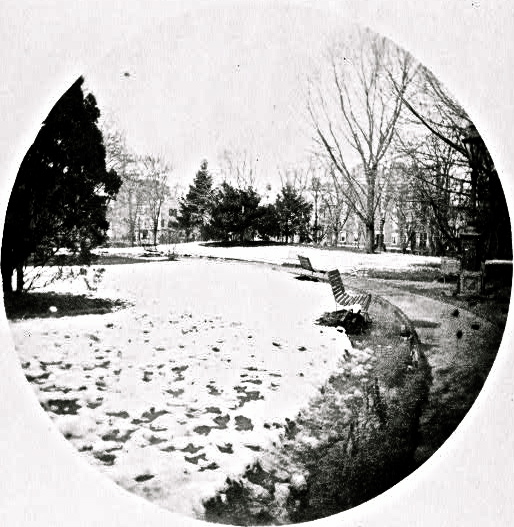
Franklin Square, 1989

Above: “Franklin Square, Washington, D.C., snow view,” 1989, by Uriah Hunt Painter.

Today’s quote

Pope’s famous lines, in his “Epistle to the Earl of Burlington,” on ‘the genius of the place,’ . . . surely evoke a conception of The Garden as an epiphany. For Pope, ‘the genius of the place’ does not refer, as it does for many later writers, to the ambiance or natural setting of a garden: rather, it is that which ‘Now breaks, or now directs, the intending lines’ and ‘Paints as you plant, and, as you work, designs.’ Palpable, here is a sense of The Garden as both a response to and an exemplification of something beyond the control and invention of human beings.

— David E. Cooper, from A Philosophy of Gardens
(Thanks to View from Federal Twist.)


Vintage landscape: snow in Washington

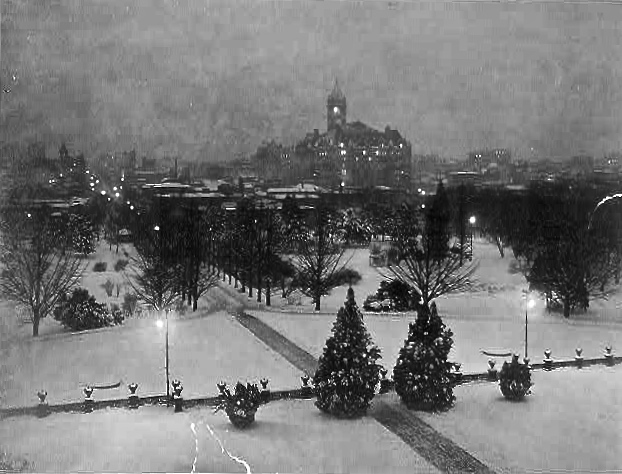
View from Post Office Building, 1911, Wash.D.C.

The view at night, under snow, of the Post Office Building, Washington, D.C., 1911. Via Library of Congress Prints and Photographs Division, photographer unknown.

Merry Christmas!

Vintage landscape: comfort and joy

horse xmas tree 1918

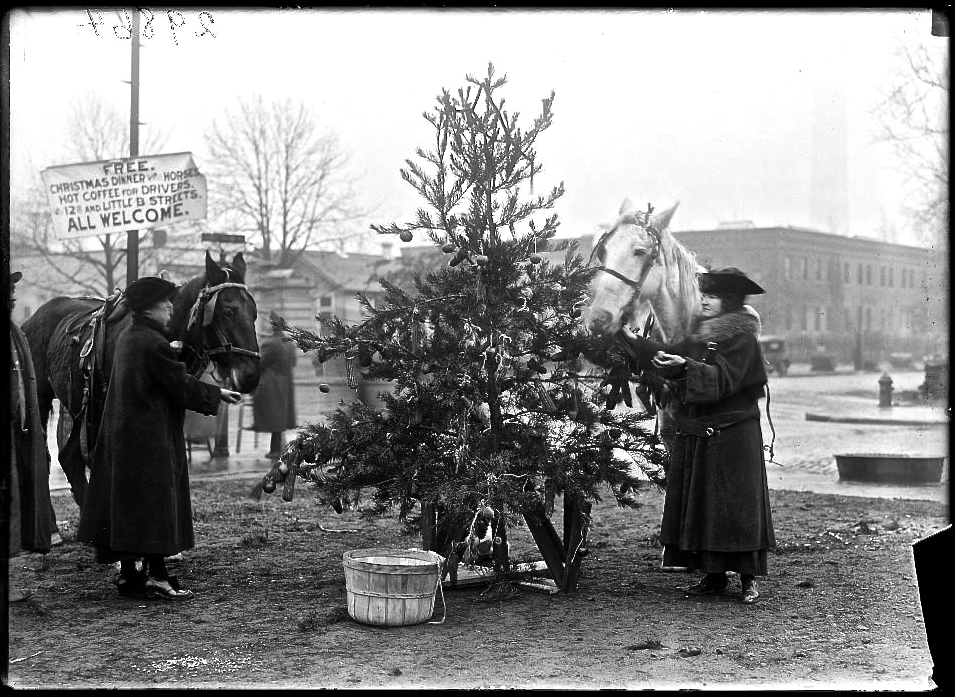
In the first decades of the 20th century, horses toiled to move almost everyone and everything around the city of Washington, D.C.   But one December day a year, for several years at least, they were rewarded with Christmas trees hung with apples and corn and accompanied by troughs of grain.

“Christmas Tree for Horses” was sponsored by the Washington Animal Rescue League.  The 1918 gathering, shown in the photo above, took place at 12th and Little B Streets — the current site of the IRS offices at 12th St. and Constitution Ave., N.W.,  just south of the Old Post Office.  A 1909 map of the area shows a “Horse Fountain” at 11th and Little B Streets.

These holiday horse dinners also took place in other American cities in the early 20th century.

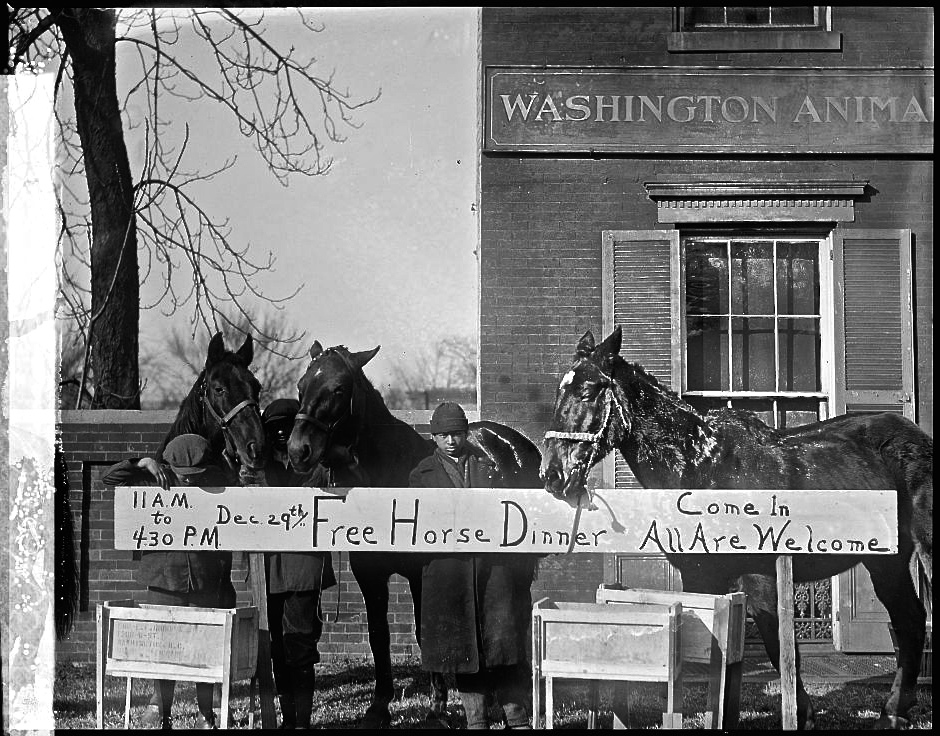
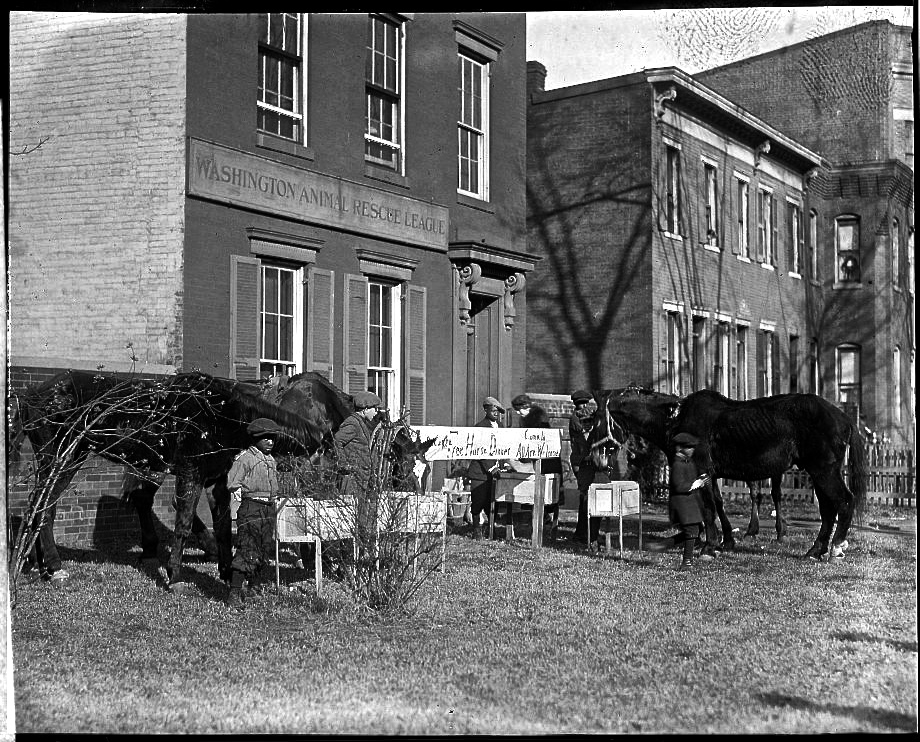
The photos below show the 1923 event in front of the League’s O Street, N.W., offices.

1923-1

The League was founded in 1914 and is the oldest animal shelter in Washington, D.C.  It is now located at 71 Oglethorpe Street, N.W.  (You can find out how to make a donation here.)

1923 -2

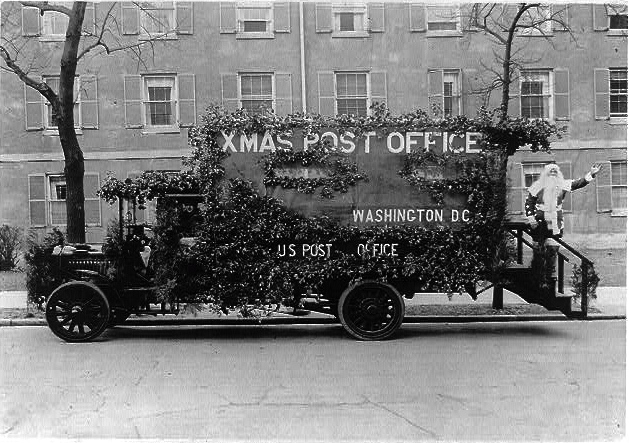
Another kind of antique seasonal cheer comes via this postal service truck liberally festooned with greenery.

mobile post office, LoC

In early December of 1921, it drove around Washington urging residents to mail their Christmas packages early.

All photos via the Library of Congress Prints and Photographs Division.  The three photos  just above  are from the National Photo Company Collection.  The top photo is by Harris & Ewing.