The Sunday porch: Houston, Texas

Old house in 1940s Houston, by John Vachon, Library of Congress

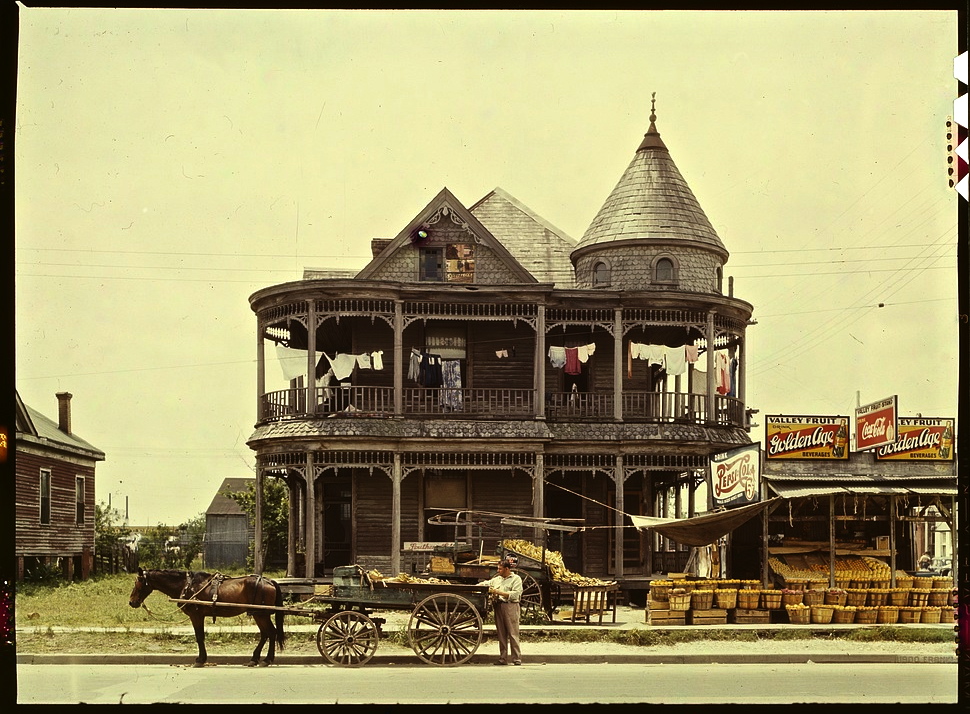
Another photo by John Vachon — an old house with a double porch in Houston, Texas, May 1943.*  I love the tower room.

You really need to click on the photo and enlarge it to enjoy all the details of this one.

Sharp-eyed commenters on the Library of Congress’s Flickr Commons project noticed that the address on the curb is 1900 Franklin Street. The location is currently a parking lot next to the US Route 59 overpass, close to Minute Maid Park.


*via Farm Security Administration/Office of War Information Color Photographs Collection, Library of Congress.

Vintage landscape: canal towpath

C&O Canal towpath, ca. 1900, Library of Congress
Towpath along the C & O Canal near Washington, D.C., about 1900.  The canal was still in operation at this time, principally transporting coal.

Photo by Detroit Publishing Co. via Library of Congress Prints and Photographs Division.

The Sunday porch: Omaha, Nebraska

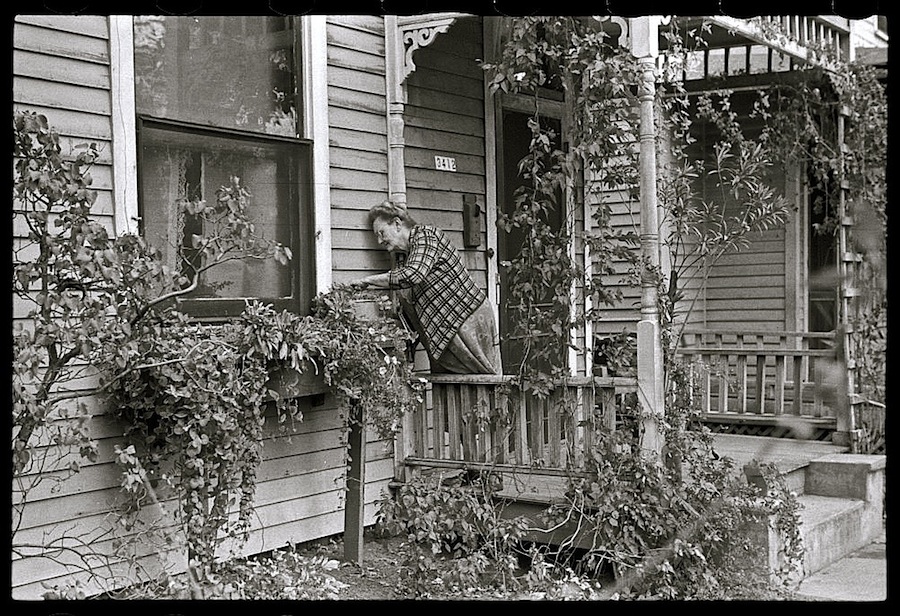
The Sunday porch/enclos*ure: Omaha, Nebraska, 1938, by John Vachon, Library of Congress“Lady tending her flower box, Omaha, Nebraska,” (probably October) 1938, by John Vachon, via Library of Congress Prints and Photographs Division.

(Click on the image to get a better look.)

The photographer, John Vachon, was on his first solo assignment for the Farm Security Administration in October and November 1938.  In addition to taking pictures of rural agricultural projects  in Nebraska, he was tasked with recording scenes of  life in Omaha for a book by Atlantic magazine writer George Leighton.

There is an interesting discussion of his Omaha work here.  His pictures in the city captured “portraits of Depression victims and scenes of comfortable everyday life,” like the one above.

Vachon later worked for Look magazine for 25 years, and he won a Guggenheim fellowship in 1973, two years before his death at age 60.

The Sunday porch: Mount Morne

Reed-Morrison Hse, Mt. Mourne, in North Carolina, 1938, via Library of Congress.Reed [or Reid] Morrison House, Mount Mourne, North Carolina, 1938, by Frances Benjamin Johnston, via Carnegie Survey of the South Collection, Library of Congress.

Click on the photo to enlarge it and check out the pretty little sconces on each side of the front door.

The house exists today as a private residence — in seemingly excellent condition, but, alas, the sconces and vines are gone.

The Sunday porch: Washington, D.C.

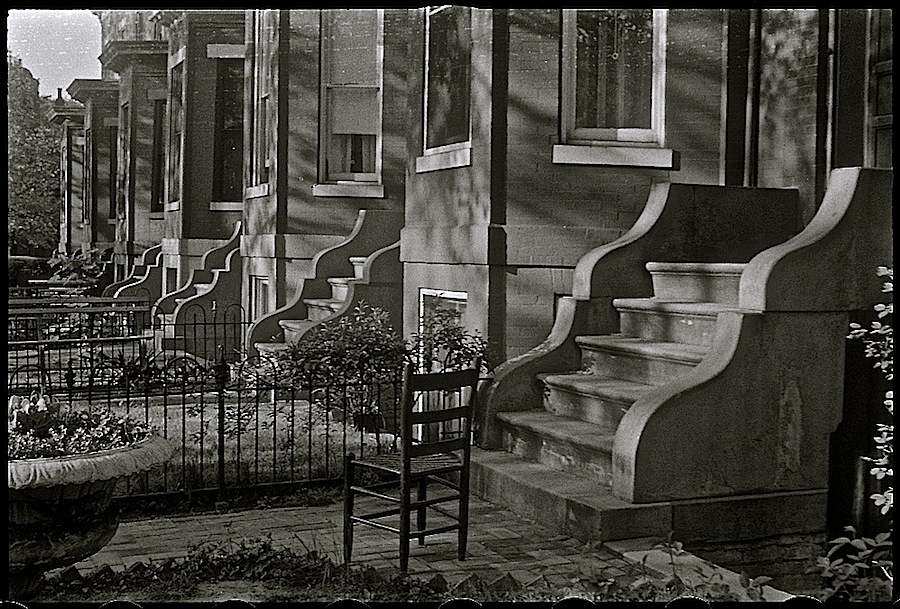
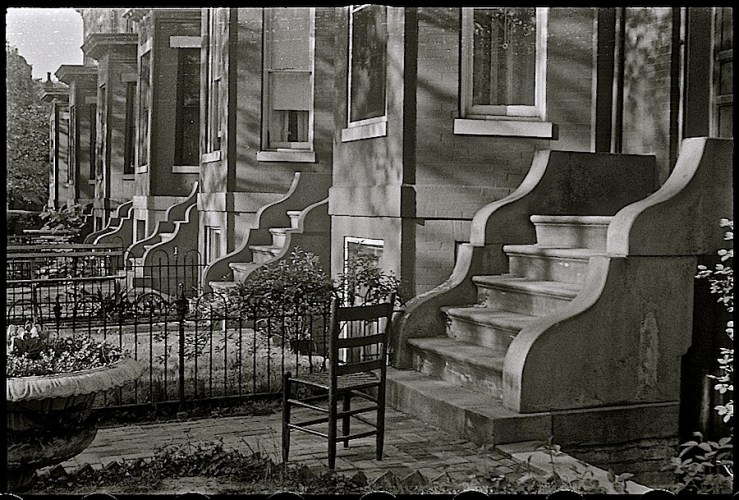
Wash. D.C., rowhouses, via Library of CongressSeven Washington, D.C., rowhouses in 1939, by David Myers, via Library of Congress Prints and Photographs Division.

The neighborhood is not given, although it looks like Capitol Hill to me.

In his book, The American Porch, Michael Dolan attempts to trace the European, African, and Asian origins of our many kinds of porches.  The front stoop — several steps and a small landing — came from the Dutch.

Down the coast [from New England], in Nieuw Amsterdam, a different entry was proliferating.  Made of stone or brick, the stoep — Dutch for “step” — was a roofless link between doorway and street.  Though municipal tradition required a building’s occupants to maintain the stoep, the Dutch deemed it public territory.  However, in Nieuw Amsterdam, the stoop acquired a private connotation:  “. . . before each door there was an elevation, to which you could ascend by some steps from the street,” an observer wrote.  “It resembled a small balcony, and had some benches on both sides on which the people sat in the evening, in order to enjoy the fresh air, and have the pleasure of viewing those who passed it.”

The stoops above lack benches, but the owner of the first one has brought down a chair, and two doors down there is a park bench in the tiny garden.  You can see a similar arrangement here.

I’m taking a break from blogging for a couple more weeks (except for “The Sunday porch”), but I’ll be back for GB Bloom Day in October.