Vintage landscape: boxwood drive

Boxwood hedge, by F.B. Johnston, Library of CongressDriveway, Castle Hill, Charlottesville, Virginia, 1926, by Frances Benjamin Johnston, via Library of Congress Prints and Photographs Division.

The original house on the plantation of Castle Hill was built in 1764 by Dr. Thomas Walker and his wife Mildred.  Walker was a friend of Peter Jefferson and later guardian to his son,Thomas.

At the time of this photo, the property was owned by his descendant, Amélie Louise Rives Troubetzkoy, a novelist married to a Russian prince who eventually ran somewhat short of funds.

By the fall of 1938, when future novelist Louis Auchincloss, then a law student at the University of Virginia, came to have tea with the aging princess, he found her living in “romantic, impoverished isolation in a decaying manor house.” To get to the house, he had to find his way through a double row of aromatic box hedges that rose up three stories high and were so enormous that his bulky Pontiac could barely pass through. The awe-inspiring hedges even became the subject of one of Amélie’s poems, which she wrote in middle age. She ends the poem with “Hedges of Box,/Hedges of Magic./…Behind your barrier of glad enchantment/I have rediscovered reality.” The reality Amélie envisioned had herself within the encircling wall of boxwood, still a young beauty of twenty-one, seated on the back of a unicorn.

— Donna M. Lucey, from “The Temptress of Castle Hill,” Garden and Gun

Today, the estate is still privately owned.  Its remaining 1,203 acres (from the original 15,000) have been permanently protected against development by a conservation easement with The Nature Conservancy.
The Sunday porch: Trondheim, Norway

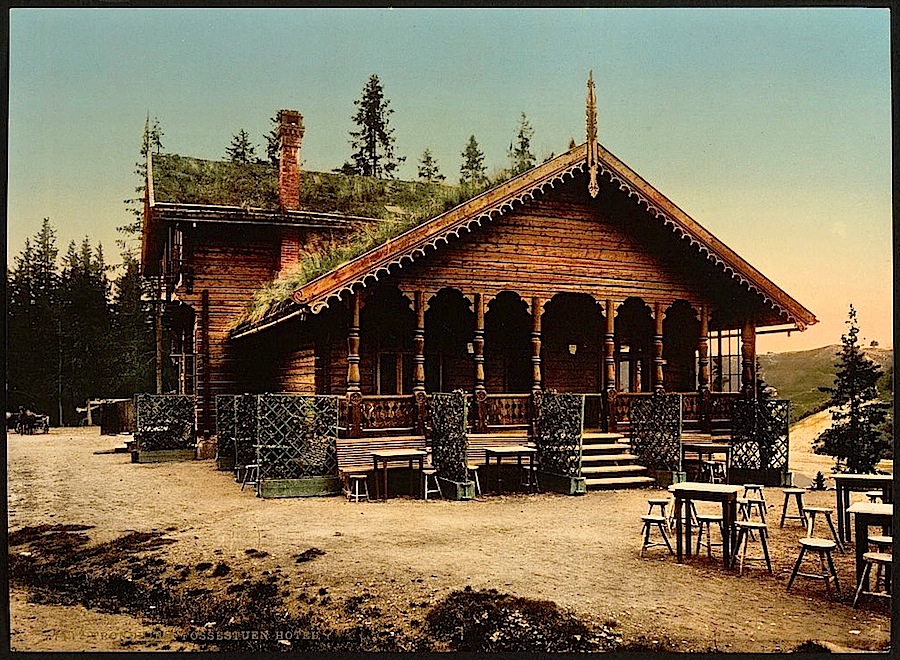
The Sunday porch/enclos*ure: Norwegian hotel, ca. 1900, Library of CongressFossestuen Hotel, Trondhjem, Norway, between ca. 1890 and ca. 1900, a photochrom by Detroit Publishing Co., via Library of Congress Prints and Photographs Division.

Click on the photo to get a better look at the building’s green roof and outdoor restaurant seating divided by planters and latticework.

 Nestled in the mountains near the lower tier of the Lienfoss waterfalls, the Fossestuen Hotel drew many foreigners to this picturesque region of Norway. Built in 1892, the hotel was actually a restaurant that served dinner and refreshments to tourists. The building reflects the traditional wooden architecture of Norway, with the sod roof a source of insulation against the harsh winter cold.

— from the image’s page on World Digital Library, a project of the Library of Congress.

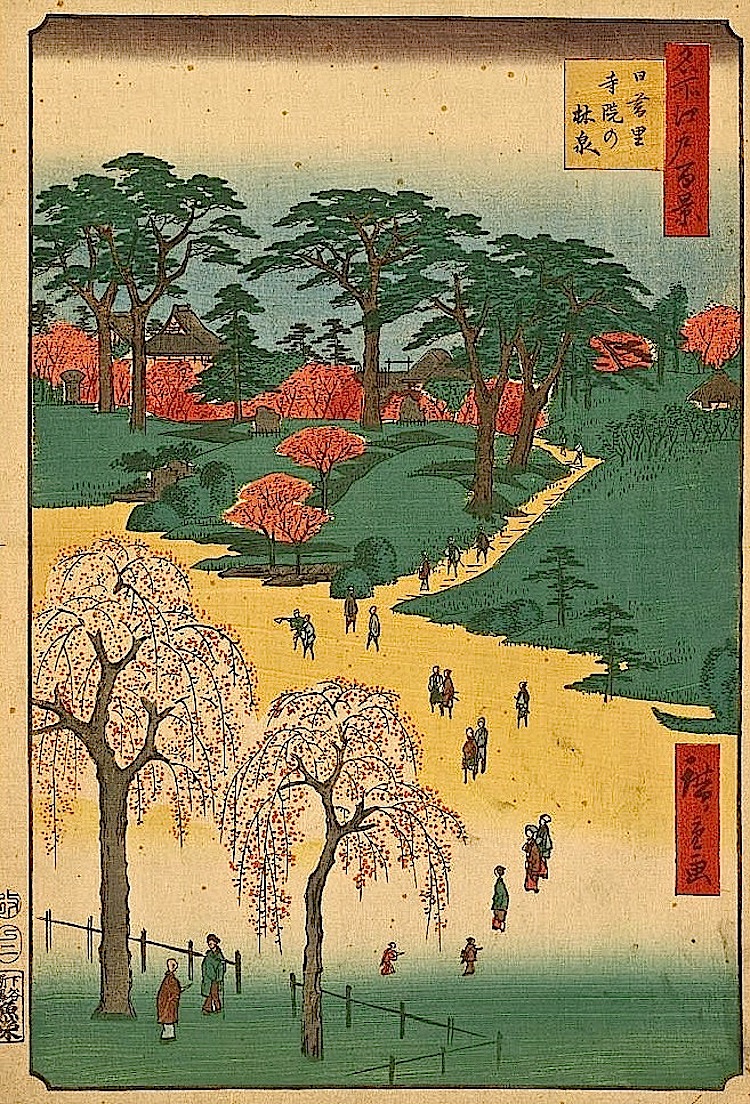
Vintage landscape: Edo blossoms

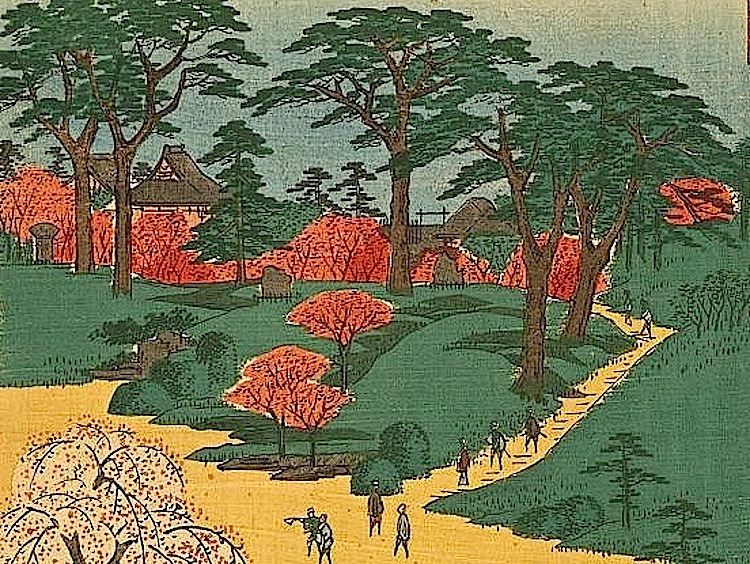
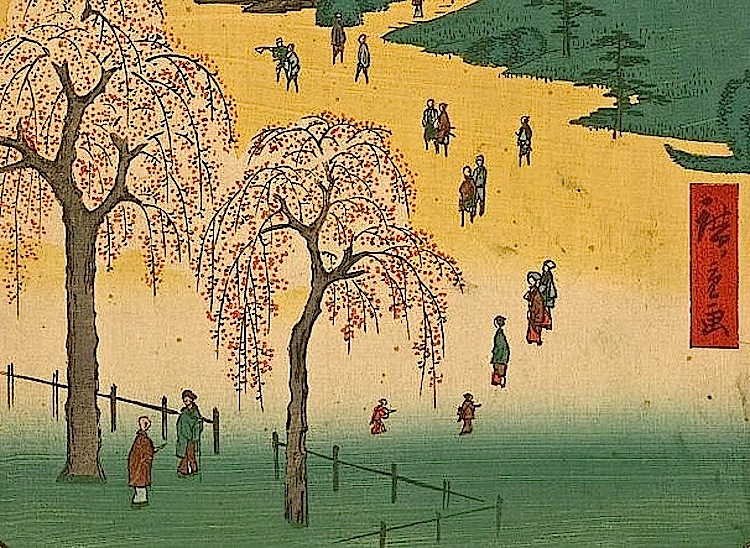
Cherry blossoms in Japan, Library of Congress“Higurashi no sato jiin no rinsen” (Temple Gardens, Nippori), 1857, a woodblock print by Andō Hiroshige, via Library of Congress Prints and Photographs Division.

The view is from Ueno Hill of Shūsō-in, one of three Buddhist temple gardens known as Hanamidera or Flower-viewing Temples. This print is one of fifty in an album of Edo (present day Tokyo) by Hiroshige.

Detail of print above.

There’s a nice essay on cherishing the brief beauty of the cherry blossoms by Diane Durston in today’s Washington Posthere.

Detail of print above.
The cherry trees in our neighborhood here in Stuttgart have just begun to bloom this week.

Life in gardens: colored eggs

chicken fed food color, Library of Congress“Possible now to color yolks of eggs “red, white and blue” by feeding hens different feeds,” April 7, 1939, by Harris & Ewing, via Library of Congress Prints and Photographs Division.

Washington, D.C., April 7. . . . Charles A. Denton, Junior Chemist, poultry nutrition laboratory of the National Agriculture Research Center, Beltsville, Maryland, feeding a hen a certain food to produce a definite colored yolk.

— from the original Harris & Ewing caption

Blue eggs and ham?

More photos of the Department of Agriculture in action in the 1930s here and here.

. . . Yesterday the egg so fresh
it felt hot in his hand and he pressed it
to his ear. . . .
riveted to the secret of birds
caught up inside his fist. . . .

— Naomi Shihab Nye, from “Boy and Egg

Vintage landscape: tulip magnolia

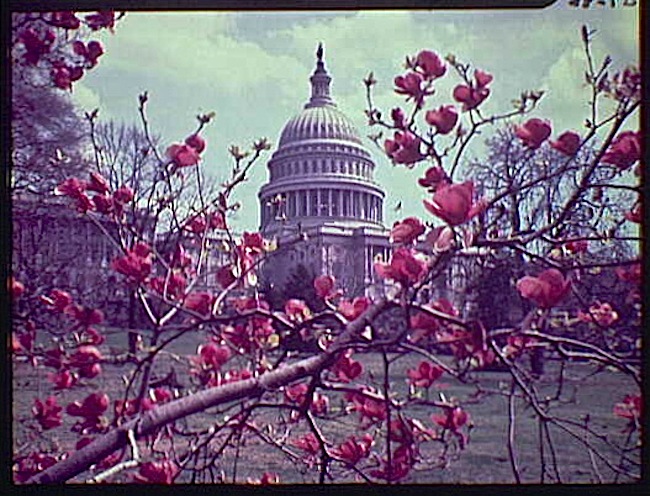
Magnolias at the Capitol, Library of Congress“U.S. Capitol through tulip magnolia,” ca. 1920 – ca. 1950, by Theodor Horydczak, via Library of Congress Prints and Photographs Division.

The late March and April blooms of tulip and saucer magnolias are a well-loved sign of spring in Washington, D.C.