The Sunday porch: French Legation

This slideshow requires JavaScript.

The front porch of the French Legation to the Republic of Texas, Austin, Texas, 1934, by Louis C. Page, Jr., via Historic American Building Survey (HABS), Library of Congress Prints and Photographs Division.

This house — now the French Legation Museum — is the oldest extant building in Austin.  It was constructed between 1839 and 1841 for Monsieur Jean Pierre Isidore Alphonse Dubois, a secretary at the French Legation in Washington, D.C., who was sent to Texas to investigate the benefits of establishing relations with the new Republic of Texas.

On Dubois’s advice, Texas was soon recognized as a sovereign nation by France and he himself was appointed as the King’s chargé d’affaires.  Unfortunately — and probably before he could ever occupy his house — he became involved in a number of political, financial, and personal controversies, culminating in the so-called “Pig War.” When the Republic’s capital moved to Houston in 1841, Dubois left for New Orleans, only occasionally returning to Texas.

The style of the house is a blend of vernacular Greek revival and Mississippi Valley French. It may have been designed by carpenter Thomas William Ward, who had previously worked in Louisiana.

At the time of the 1934 photos above, the house was owned and occupied by Miss Lillie Robertson, whose father had purchased it in 1848.  After Lillie’s death, the property was sold to the State of Texas in 1945.  It was then put into the custody of the Daughters of the Republic of Texas.  They restored it and opened it to the public in 1956.

This slideshow requires JavaScript.

The same views in 1961, by Jack E. Boucher, also via HABS, Library of Congress.

By 1961, the Legation house was surrounded by a formal arrangement of boxwood hedges — perhaps having taken a lesson from  M. Dubois, the son of a tax collector,  who styled himself Count de Saligny after he arrived in Texas.

Today, the museum looks much the same.  Its surrounding park is 2 1/2 acres and is open to the public. Its wide gravel paths are sometimes used for games of pétanque. From the front porch, visitors can see the Texas Capitol Building and downtown Austin.
Life in gardens: spring dance

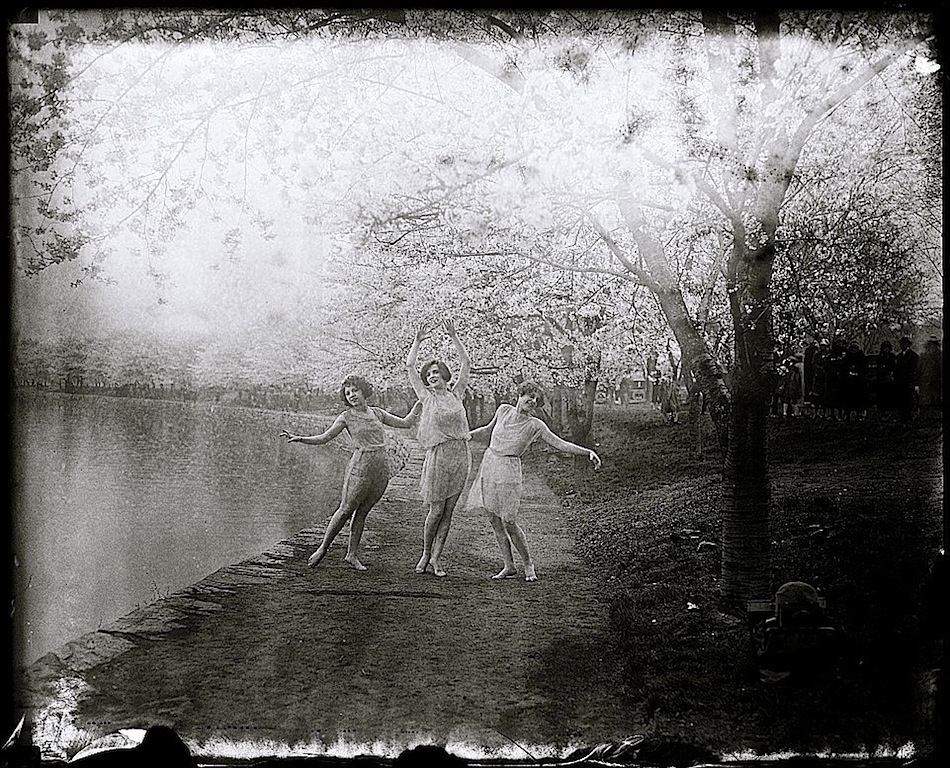
Rites of Spring, 1927, Wash.DC, Library of CongressDancers and cherry blossoms, [Tidal Basin,] Washington, D.C.,” between 1923 and 1929, by Harris & Ewing, via Library of Congress Prints and Photographs Division.

The National Cherry Blossom Festival in Washington, D.C., began on March 20 and continues until April 12. This year, the National Park Service is predicting that peak bloom will occur between April 11 and 14.

The first Tidal Basin Yoshino cherry trees — a gift from the city of Tokyo — were planted in 1912. The first organized celebration of them was held in 1927, when D.C. schoolchildren reenacted the planting.  The first Cherry Blossom Festival, which became the annual event, took place in 1935.

Vintage landscape: daffodils

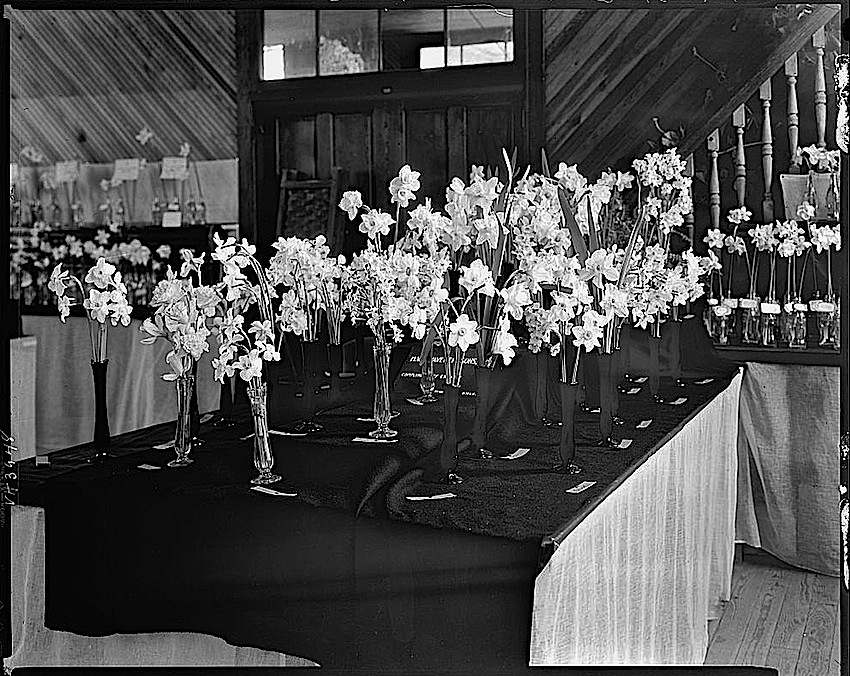
Middleburg, Va., flower show, 1931, Library of CongressMiddleburg Flower Show, Middleburg, Virginia, April 1931, by Frances Benjamin Johnston, via Carnegie Survey of the Architecture of the South, Library of Congress Prints and Photographs Division.

Right now, here in Stuttgart, a few daffodils have poked up from our front yard. I will probably pick them. I don’t usually like Narcissus in the landscape in early spring — the bright yellow is too much, too soon.  But, like those in the photo above, they look really nice in a vase.

There are also some fat cultivated Dutch hyacinths by our front door. They’re going to get the chop too.

In the fall, for next March and early April, I want to plant snowdrops and snake’s head fritillarias.

Life in gardens: sowing

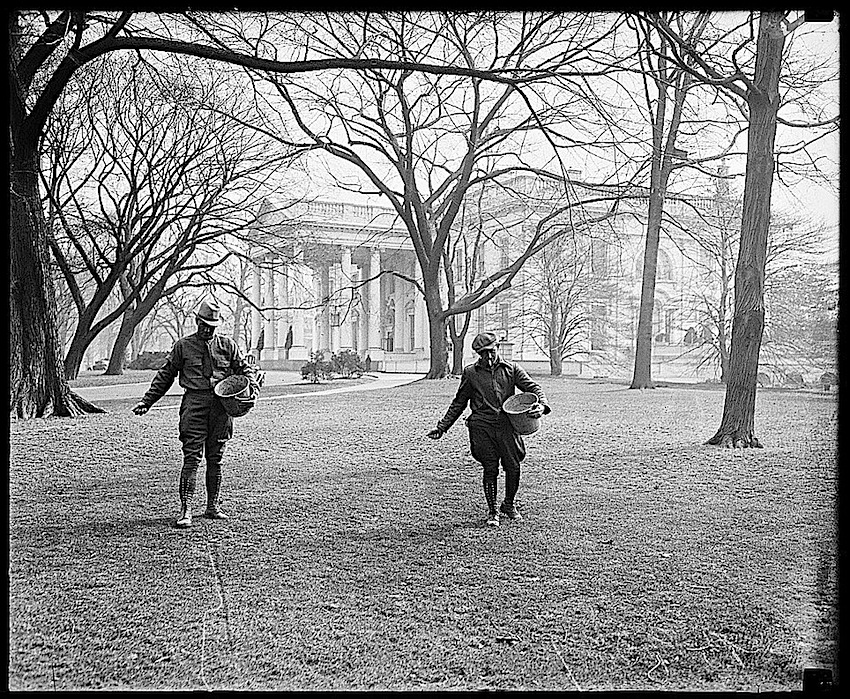
Gardeners at the 1936 White Hse., Library of Congress“Grounds workers at White House, Washington, D.C.,” March 1936, by Harris & Ewing, via Library of Congress Prints and Photographs Division. (You can click on the photo to enlarge it.)

The National Park Service has maintained the White House gardens since 1933.

. . . [W]hile lawns are cultural (in the sense that they are meaning-laden), they are not the product of some pre-existing “culture,” and are instead the meaningful expression of political and economic forces. . . . Lawns are propelled into the landscape both by economic imperatives (e.g., real estate growth) and also by intentional and thoughtful efforts to produce certain kinds of subjects. Lawns are a strategy, therefore, both for capital accumulation and making docile and responsible citizens.

— Paul Robbins, from Lawn People: How Grasses, Weeds, and Chemicals Make Us Who We Are (p. 32)

Vintage landscape: great deal

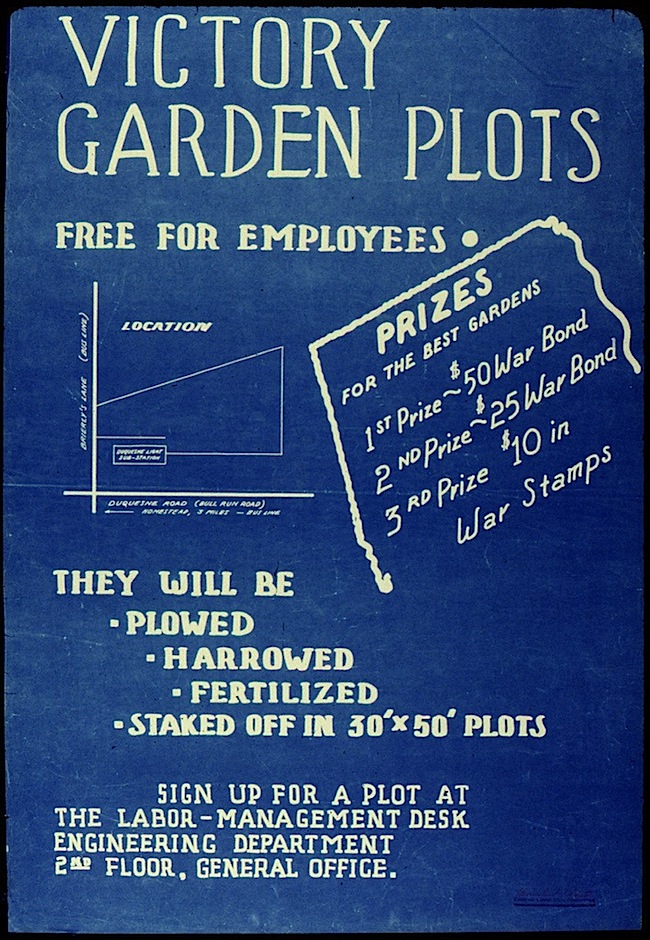
Victory garden poster, National Archives“Victory Garden Plots Free For Employees ca. 1942 – ca. 1943” poster, created by the Office of Emergency Management, War Production Boardvia U.S. National Archives Commons on flicker.

The location is Brierly’s Lane near the intersection with Duquesne Road (Bull Run Road).  I think this is in Munhall, Pennsylvania, a suburb of Pittsburgh.