Life in gardens: last look

As April’s cherry blossoms fade away, here is one more vintage scene.

This slideshow requires JavaScript.

“Street life in Yokohama park with blossoming cherry trees,” from the photo collection of  journalist Holger Rosenberg, who traveled to Japan in 1903, via National Museum of Denmark Commons on flickr.

In Japan this week, the flowers are at their peak only in the most northern regions.

Click on ‘Continue reading’ below to scroll through larger versions of the images.

the clouds of
a thousand skies from
cherry buds

Saigyo Hoshi

Continue reading “Life in gardens: last look”

Home sweet France

This slideshow requires JavaScript.

Of course France isn’t our home, but after years of passing through — on our way to and from Francophone African countries — visiting beautiful Strasbourg this weekend felt like a petit homecoming in general awareness.

Suddenly, I could speak to people in their own language* (albeit, simply and ungrammatically), understand signs, and go to Monoprix and read all the product labels. The skies opened. . . .

I love living in Germany, but, thus far, the German language is a stone wall to me. Thankfully, the school system here is so good that you can always find someone who speaks at least fair English. I do try to maintain an appropriately ashamed look every time I say, “I sorry, I don’t speak German.”

Anyway, Strasbourg was great, and I saw my first blooming wisteria this year there.

I can recommend Hôtel Gutenberg,  flammkuchen (aka tarte flambée) with a glass of pinot gris for lunch, and the boat tour of the River Ill, which circles the city center. And the spectacular cathedral is celebrating its 1,000th birthday this year.

What’s the French for “fiddle-de-dee”? . . .
The “Fiddle” we know, but what’s from “Dee”?
Le chat assis in an English tree?

John Hollander, from “For ‘Fiddle-de-de’


*in French, of course, but the native language of  Strasbourg is actually Alsatian, a dialect of German that is spoken by 43% of the region’s population, according to Wikipedia.

The Sunday porch: Trondheim, Norway

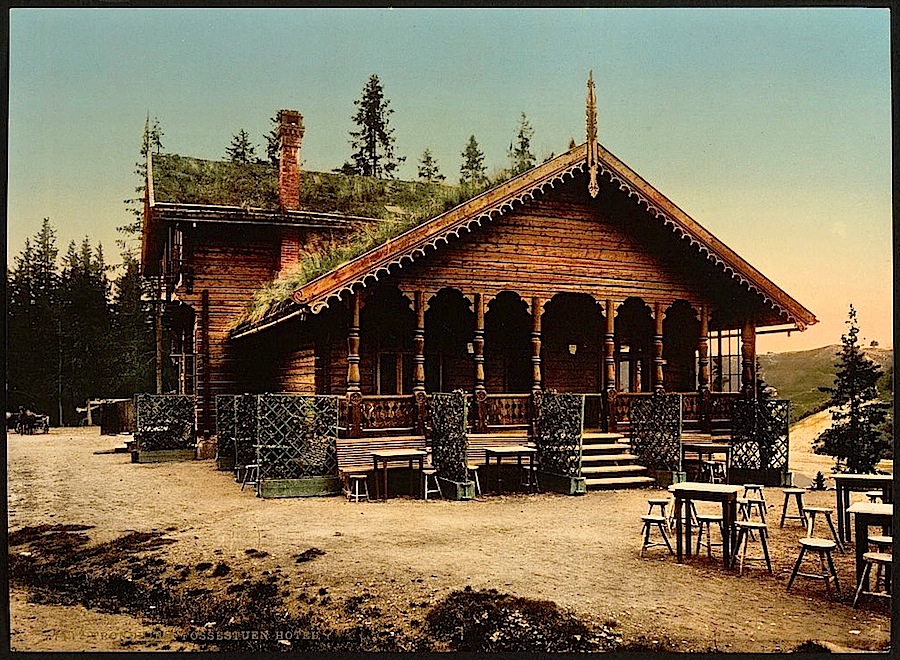
The Sunday porch/enclos*ure: Norwegian hotel, ca. 1900, Library of CongressFossestuen Hotel, Trondhjem, Norway, between ca. 1890 and ca. 1900, a photochrom by Detroit Publishing Co., via Library of Congress Prints and Photographs Division.

Click on the photo to get a better look at the building’s green roof and outdoor restaurant seating divided by planters and latticework.

 Nestled in the mountains near the lower tier of the Lienfoss waterfalls, the Fossestuen Hotel drew many foreigners to this picturesque region of Norway. Built in 1892, the hotel was actually a restaurant that served dinner and refreshments to tourists. The building reflects the traditional wooden architecture of Norway, with the sod roof a source of insulation against the harsh winter cold.

— from the image’s page on World Digital Library, a project of the Library of Congress.

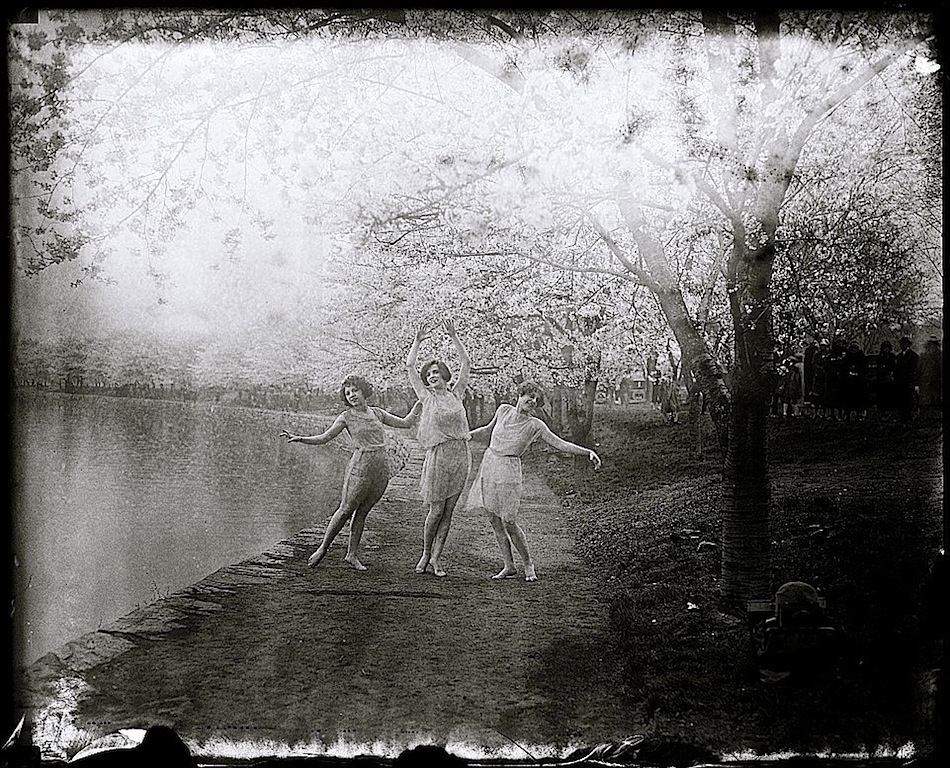
Life in gardens: spring dance

Rites of Spring, 1927, Wash.DC, Library of CongressDancers and cherry blossoms, [Tidal Basin,] Washington, D.C.,” between 1923 and 1929, by Harris & Ewing, via Library of Congress Prints and Photographs Division.

The National Cherry Blossom Festival in Washington, D.C., began on March 20 and continues until April 12. This year, the National Park Service is predicting that peak bloom will occur between April 11 and 14.

The first Tidal Basin Yoshino cherry trees — a gift from the city of Tokyo — were planted in 1912. The first organized celebration of them was held in 1927, when D.C. schoolchildren reenacted the planting.  The first Cherry Blossom Festival, which became the annual event, took place in 1935.

Castle garden in Meersburg

This slideshow requires JavaScript.

Castle garden, Meersburg, March 29, 2015.

I’m sorry that I had no porch for you on Sunday; we spent a long weekend in the town of Meersburg on Lake Constance, about an hour and a half south of Stuttgart.

Aside from its lakefront location (and a beautiful view of the Swiss Alps across the water), the town’s principal feature is the medieval Alte (old) Burg — Germany’s oldest inhabited castle.*

Its sweet little garden, tucked along a high wall, seems to reflect the presence of the castle’s most distinguished resident, the romantic poet Annette von Droste-Hülshoff. She frequently stayed there in the 1840s, when her brother-in-law owned it.

Her pretty rooms with their floral wallpapers have been carefully preserved — she died there in 1848.

You can see the position of the garden along the castle walls in this Wikipedia photo.


*Sections date as early as the 7th century.