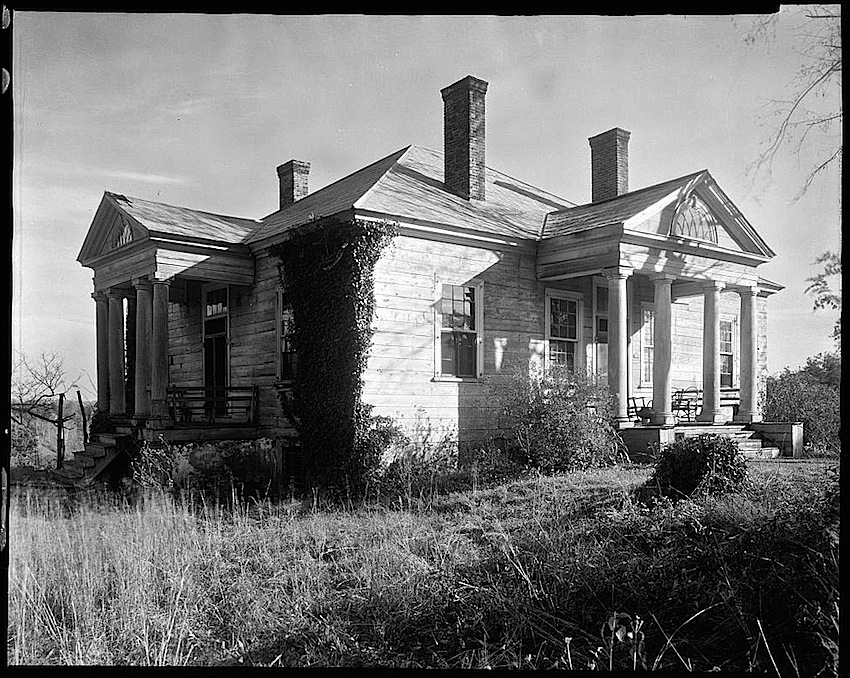
The Sunday porch: Edgemont

Edgemont, Covesville, VA, Library of CongressEdgemont (or Cocke Farm), Albemarle County, Virginia, 1935, by Frances Benjamin Johnston, via Library of Congress Prints and Photographs Division.

Built ca. 1796 for James Powell Cocke, Edgemont is significant as a very early example of a country residence in the combination Palladian and French manner promulgated by Thomas Jefferson. Although the design of the house has been credited to Jefferson for several decades, precise documentation of the authorship remains yet to be established. The character* of the compact and sophisticated dwelling is uniquely Jeffersonian, however, and exhibits the influence he had on the architecture of his region. . . .

from the 1980 nomination to the National Register of Historic Places

At the time of the photo, only two porticoes of the probable original four still existed. The house was restored and renovated in the late 1930s and 1940s. There are more F.B.J. photos here and 1996 photos here.

* “a formality and classical correctness devoid of monumentality. . .”

The Sunday porch: late afternoon

A repeat porch from June 2014. . .

A gathering on the south portico (or back porch) of the White House, probably between 1890 and 1910, photographer unknown, via the Library of Congress Prints and Photographs Division.

The portico was built in 1824, principally from an 1807 design by architect Benjamin Henry Latrobe, then Surveyor of Public Buildings.  Latrobe was appointed and supervised by Thomas Jefferson, who loved  neoclassical design and called Palladio’s books “the bible.”

The South of France

Roman temple
“simple and sublime”

Maria Cosway
harpist
on his mind

white column
and arch

Lorine Niedecker, from “Thomas Jefferson

The Sunday porch: Halloween

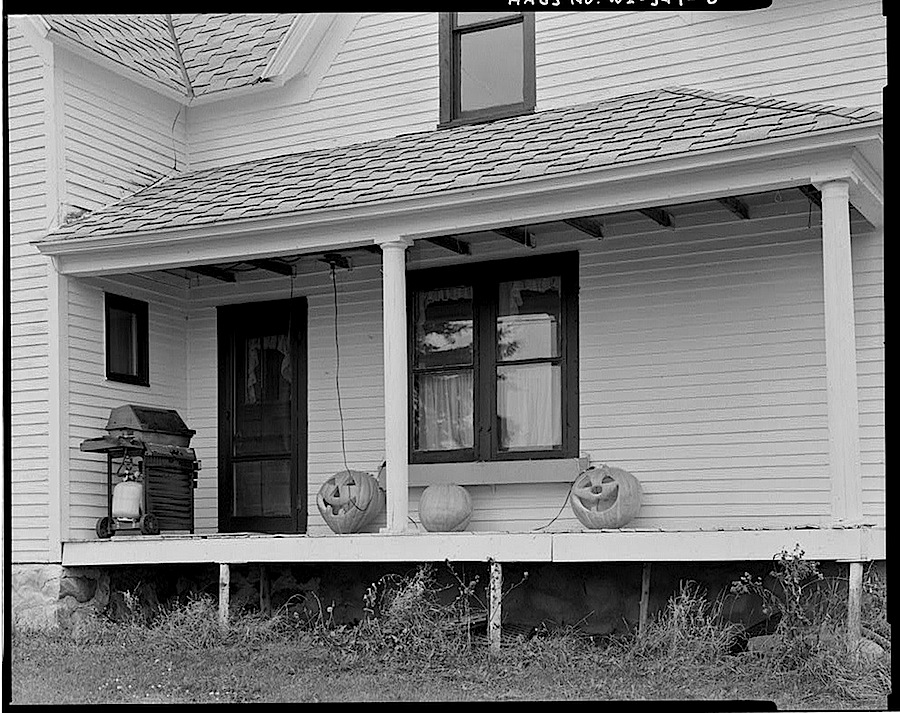
Halloween back porch, HABS, Library of Congress
Front porch of a farmhouse ready for Halloween, near Elderon, Wisconsin, 1994, by John N. Vogel for an Historic American Building Survey (HABS), via Library of Congress Prints and Photographs Division.

The HABS noted the house’s “prominent front porch with Tuscan columns and hipped roof” and called it “a good example of the Gabled Ell form” of Wisconsin vernacular architecture. There are wider views here.

The Sunday porch: Franklin, Louisiana

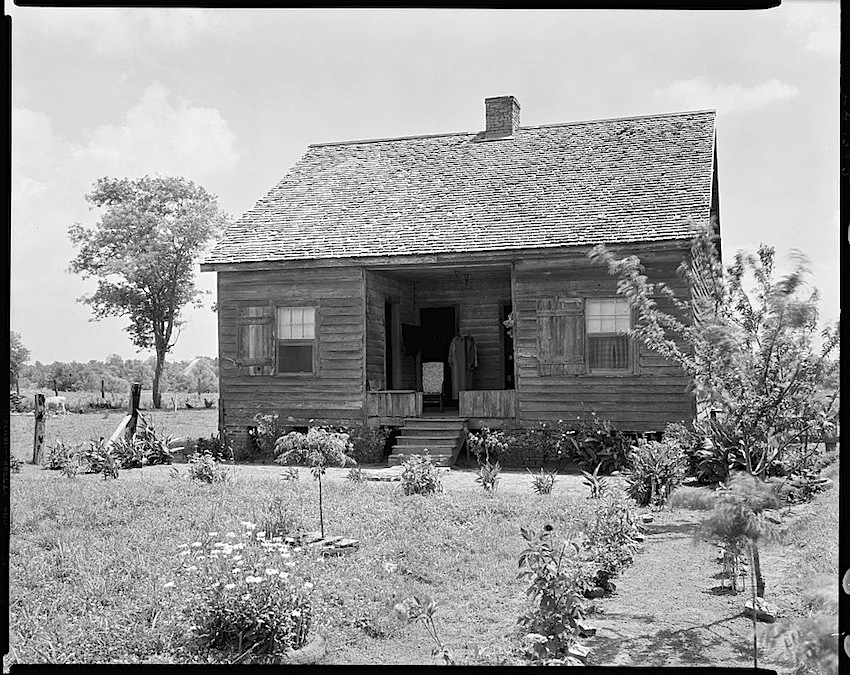
thibideaux-cabin-st-marys-parish-la-1930s-fb-johnston-library-of-congress“Thebideau cabin,” near Franklin, St. Mary Parish, Louisiana, 1938, by Frances Benjamin Johnston for her Carnegie Survey of the Architecture of the South, via Library of Congress Prints and Photographs Division.

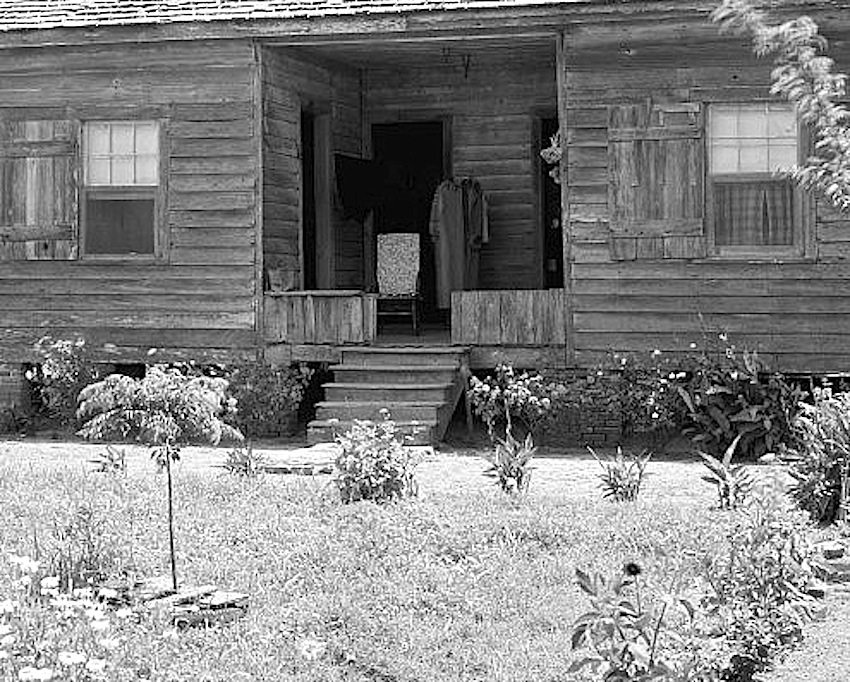
thibideaux-cabin-detail-st-marys-parish-la-1930s-fb-johnston-library-of-congress
Detail: a small recessed gallery or loggia porch

The front yard is very neat. Two old tires protect the daisies and the little tree.

The Sunday porch: Le Droit Park

Le Droit Park, 1974, Wash.DC, HABS, Library of CongressDetail of porch column, Le Droit Park, 3rd Street, N.W., Washington, D.C., 1974, by Ronald Comedy for an Historic American Building Survey (HABS), via Library of Congress Prints and Photographs Division.

Le Droit Park is an old Washington subdivision of large freestanding houses and duplexes of related architectural design, located just south of Howard University. When it was built in 1873, it was restricted to white buyers only and gated, but a series of protests brought the fences down in 1891, and by 1920 its residents were predominately African-American and included professors, politicians, and artists.  The area suffered decline in the 1980s, but today its renovated homes are selling quickly, according to The Washington Post. The neighborhood is on the Heritage Trail, a self-guided walking tour developed by Cultural Tourism DC.

The home pictured above — with its distinctive porch columns — still exists.