Roadside planters and imigongo

Town planters in eastern Rwanda/enclos*ure

While traveling in southeastern Rwanda on Thursday, we stopped for lunch in Nyakarambi.  I liked the town’s roadside planters, which are painted in the graphic patterns of imigongo art.

Town planters in eastern Rwanda/enclos*ure

All the planters held rather dusty palm trees. We are in the middle of the long dry season, which will last until early September.

Imigongo paintings traditionally decorated the interiors of houses in this part of Rwanda. The raised designs are made with cow dung and painted with white kaolin clay and a black substance made from aloe plant sap and the ash of burned banana skins and Solanum aculeastrum fruit.  Other natural colors — red, grey, and ochre — are also used, and today’s artists often add representations of people and houses.

Nyakarambi has a cooperative and shop devoted to imigongo.  I added to my little collection with the piece below, which is about 12″ x 14″.

Imigongo painting, Rwanda/enclos*ure

I didn’t take any photos of the cooperative while we were there; the women weren’t working and their stock of paintings was small. But, several months ago, we were at Nyungwe Forest Lodge, which has several walls in the lobby displaying imigongo.

Imigongo at Nyungwe Forest Lodge, Rwanda:enclos*ure

Imigongo on walls at Nyungwe Forest Lodge, Rwanda:enclos*urePhoto just above by M. Koran.

A far corner in Rwanda

The Rwanda-Tanzania border area, Rwanda:enclos*ure

If you imagine the shape of Rwanda as a rough square, as of Thursday I have been to three of its four corners: northwest, southwest, and now southeast.

Above is a view of the Rwanda/Tanzania border at Rusumo Falls. Tanzania is on the left side; Rwanda is on the right.

A one-lane bridge crosses the Akagera River — a natural line between the two countries at this corner.

The bridge at Rusumo Falls, Rwanda:enclos*ure

A second bridge is now being built just in front of the current span, with Japanese assistance.

The large empty area in the left top corner of the photo above is a parking area (under construction) for the many trucks that cross the border daily.

Just behind the bridge are the Falls.
Rusumo Falls, Rwanda:enclos*ureThe photo above and the two below were taken from the two sides of the bridge.

During the genocide in 1994, “an estimated 500,000 Rwandans — half of them within one 24-hour period” fled across this border to Tanzania, according to my guide book.*

Journalists standing on the bridge and looking down at the rushing water, counted the bodies of genocide victims “at a rate of one or two per minute.”

Shadow of the bridge at Rusumo Falls, Rwanda:enclos*ure

I took the very  first photo above from the top of the hill in the center of the picture below.

Hills above Rusumo Falls, Rwanda:enclos*ure


*Rwanda, The Bradt Travel Guide, by Philip Briggs and Janice Booth.

Our garden: baskets in the trees

Your head is a living forest
full of song birds.

e.e. cummings

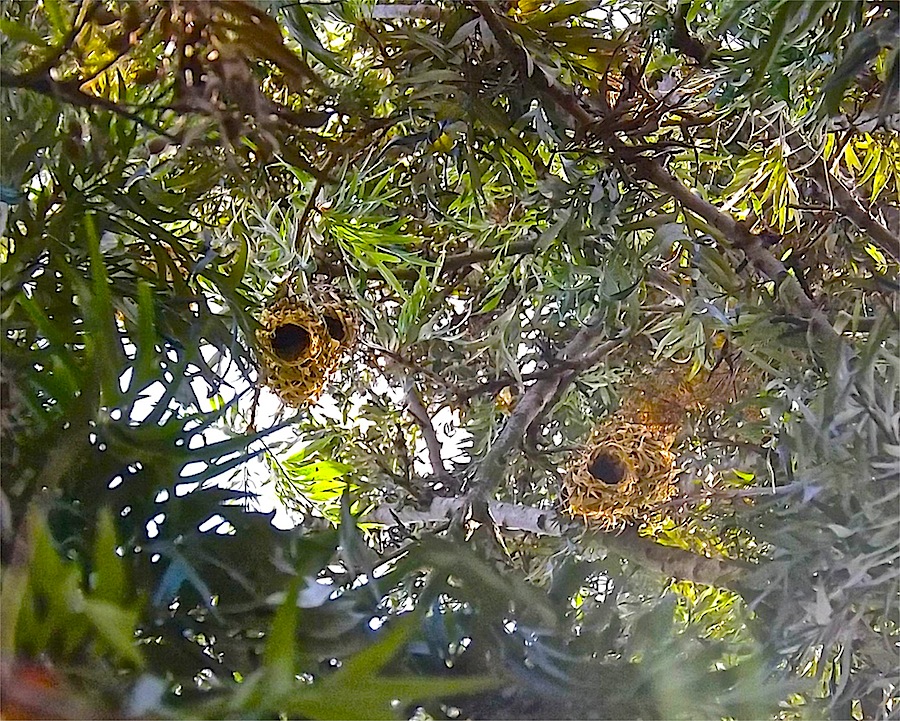
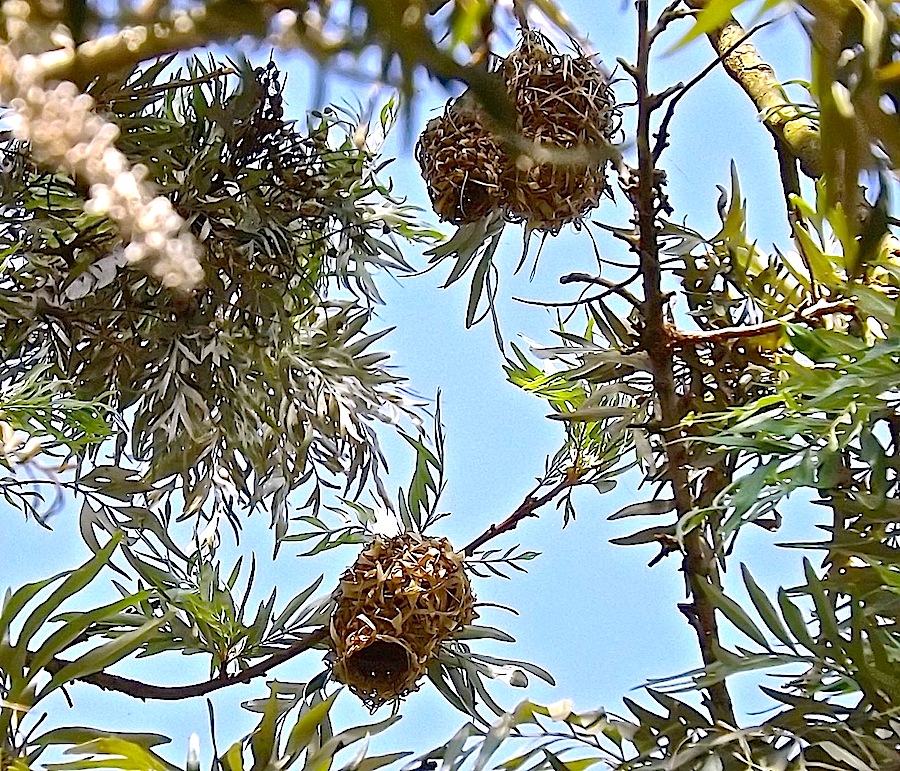
Weaver birds' nests in Rwanda/enclos*ure

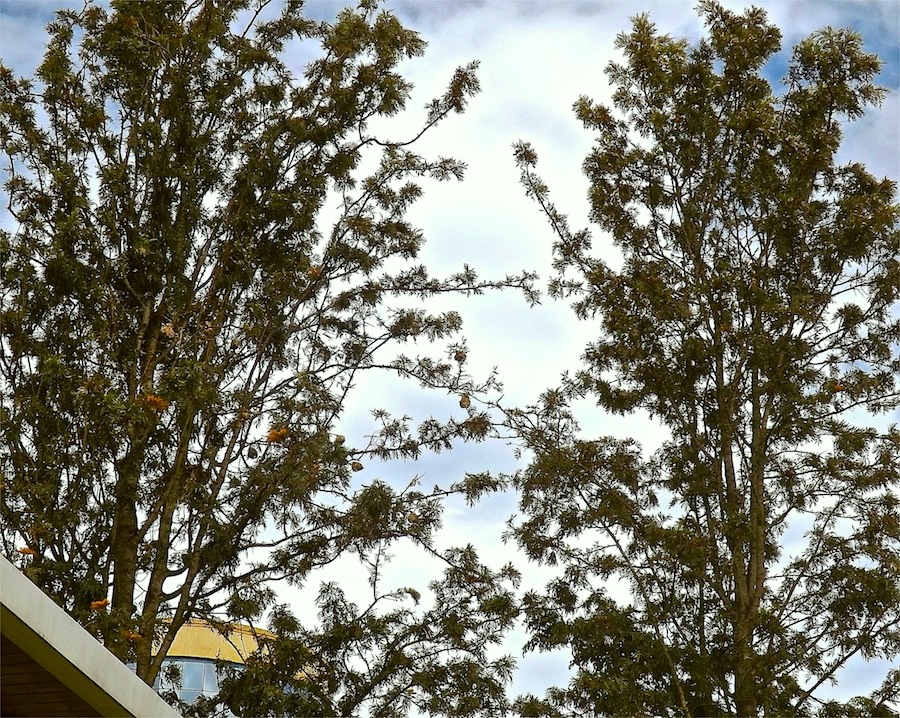
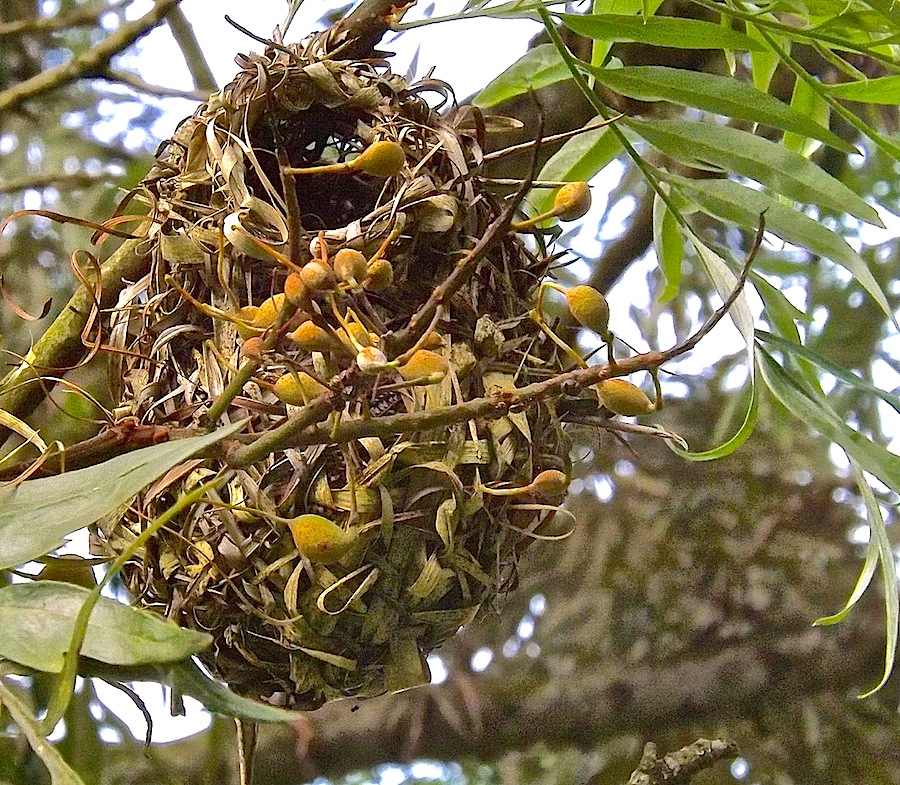
During the last several months, a colony of weaver birds has been living in a pair of tall trees at the end of the front terrace.

Now I am not much of a birdwatcher, but I do love baskets.

Weaver birds' nests in Rwanda/enclos*ure

Attach some handles, and we have got the beginnings of a small income-producing cooperative.

I estimate that they built two to three dozen nests, mostly in the tree on the left below.

Weaver birds' nests in Rwanda/enclos*ure

I  haven’t seen the birds for a few weeks, so they may have moved on.  The ones I noticed earlier looked like large brown sparrows — which some experts put in the same bird family of Ploceidae.

Weaver birds' nests in Rwanda/enclos*ure

However, I may have been seeing only the females.  Most Ploceus weavers “display a strong sexual dimorphism,” according to the Bradt guide book for Rwanda: the females are brown, and the males are often predominately yellow and can have a black facial mask.  I have seen yellow birds like that around the garden, but I hadn’t connected them with the nest-building group.

Weaver birds' nests in Rwanda/enclos*ure

According to the guide book, 21 of the 101 African weaver species live in Rwanda.

Weaver birds' nest in Rwanda/enclos*ure

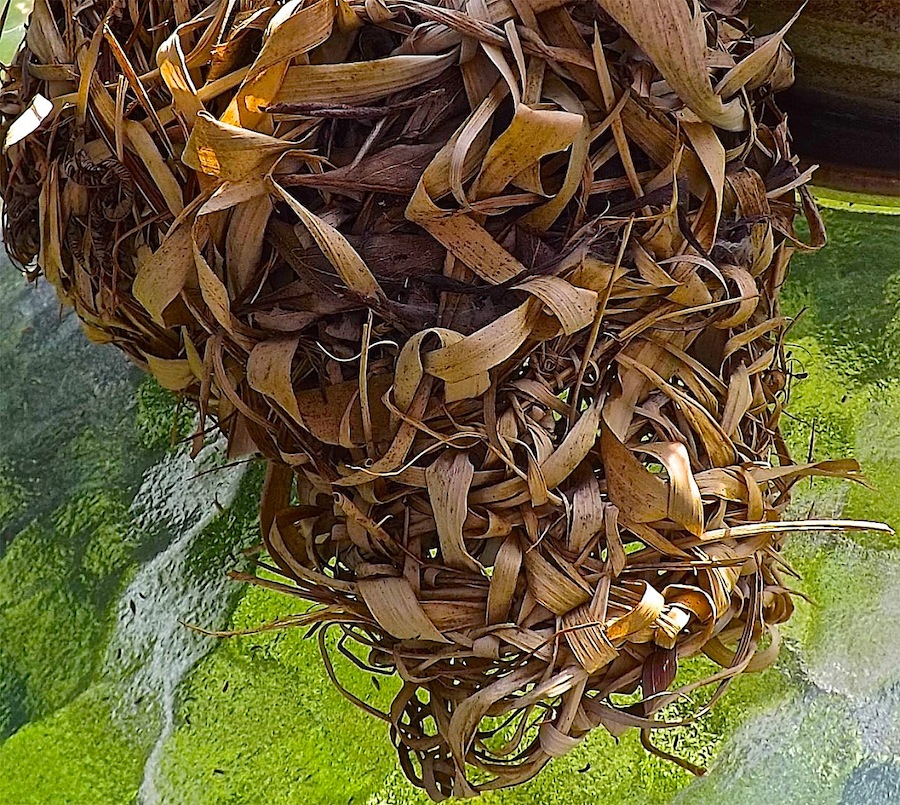
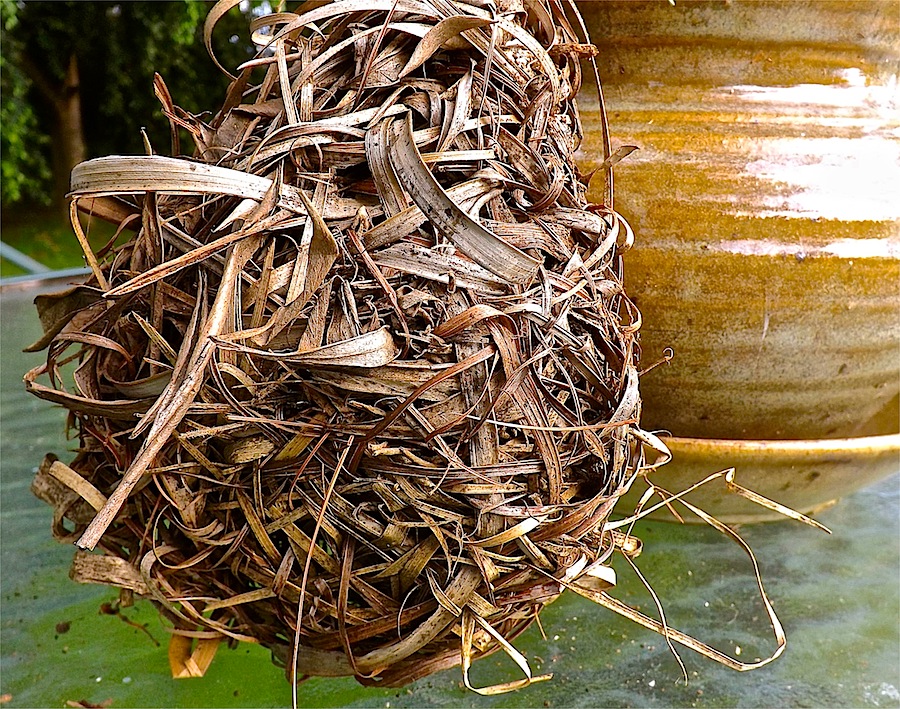
Several of the nests have fallen, so I’ve been able to get a better look at the weaving.  I found this one, in the photos above and below, just yesterday.

According to the Bradt* guide book,

[i]t can be fascinating to watch a male weaver at work. First, a nest site is chosen, usually at the end of a thin hanging branch or frond, which is immediately stripped of leaves to protect against snakes. The weaver then flies back and forth to the site, carrying the building material blade by blade in its heavy beak, first using a few thick strands to hang a skeletal nest from the end of a branch, then gradually completing the structure by interweaving numerous thinner blades of grass into the main frame. Once completed, the nest is subjected to the attention of his chosen partner, who will tear it apart if the result is less than satisfactory, and so the process starts all over again.

The first photo at the top of this post shows a part of a nest in the lower left side.  It may have been a victim of one episode of this “Nest Hunters Rwanda.”

Weaver birds' nest in Rwanda/enclos*ure

Above: a closer look at the weaving around the entrance hole — which I have seen placed anywhere along the side of the nest, from near the top to almost at the bottom.

Weaver birds' nest in Rwanda/enclos*ure

I took the photos of this fallen nest, above and below, a few weeks ago.

Weaver birds' nest in Rwanda/enclos*ure

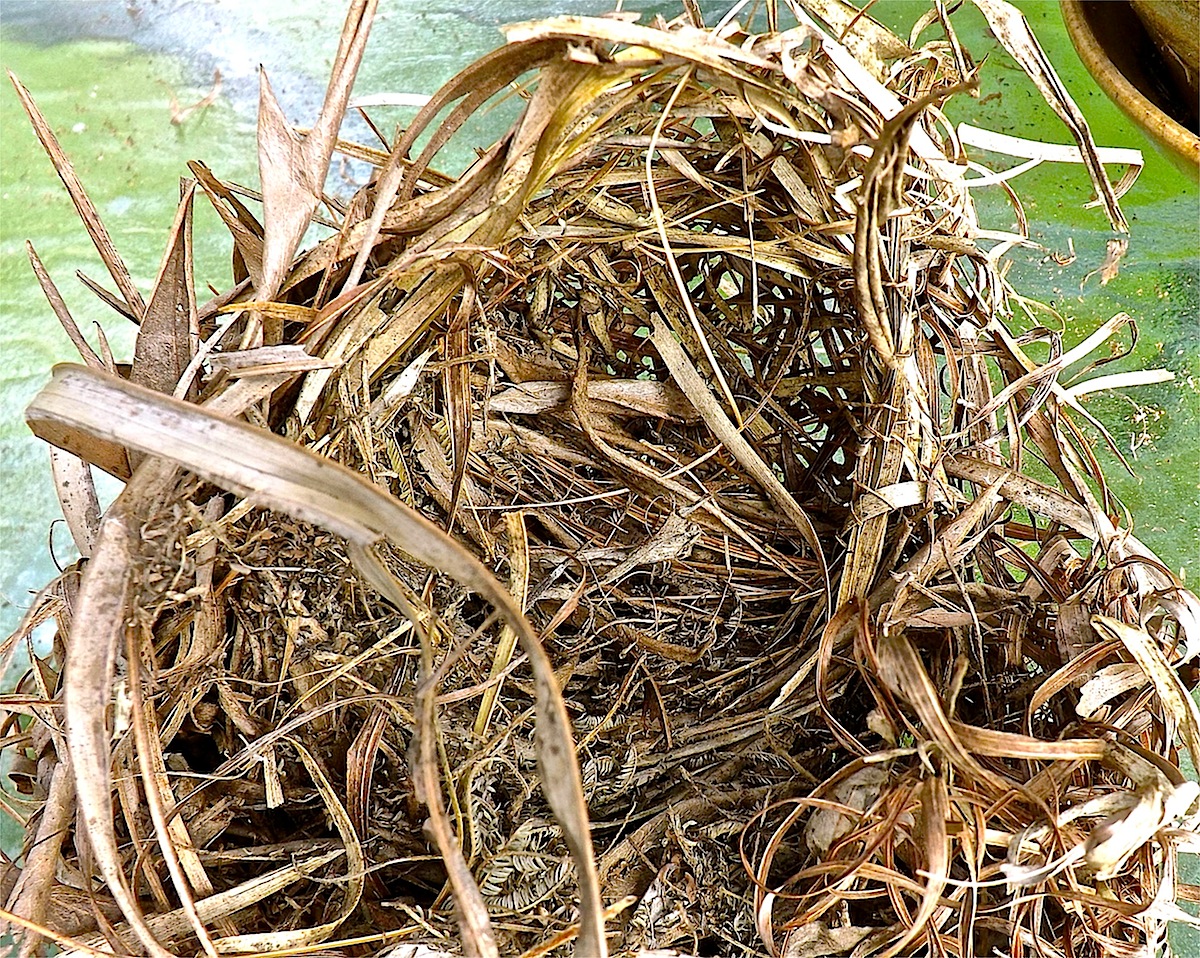
Looking in the entrance hole above, it looks like there is a partial internal basket as well (you can see the top just right of center of the picture; the nest is on its side).

Weaver birds' nest in Rwanda/enclos*ure

Above: I pulled this one apart — which was not easy — to see how many of my garden plants I could identify.  I see pine needles, some acacia tree leaves, and lemongrass.  They may have also pulled strips off the leaves of the traveler’s palms and the heliconias.

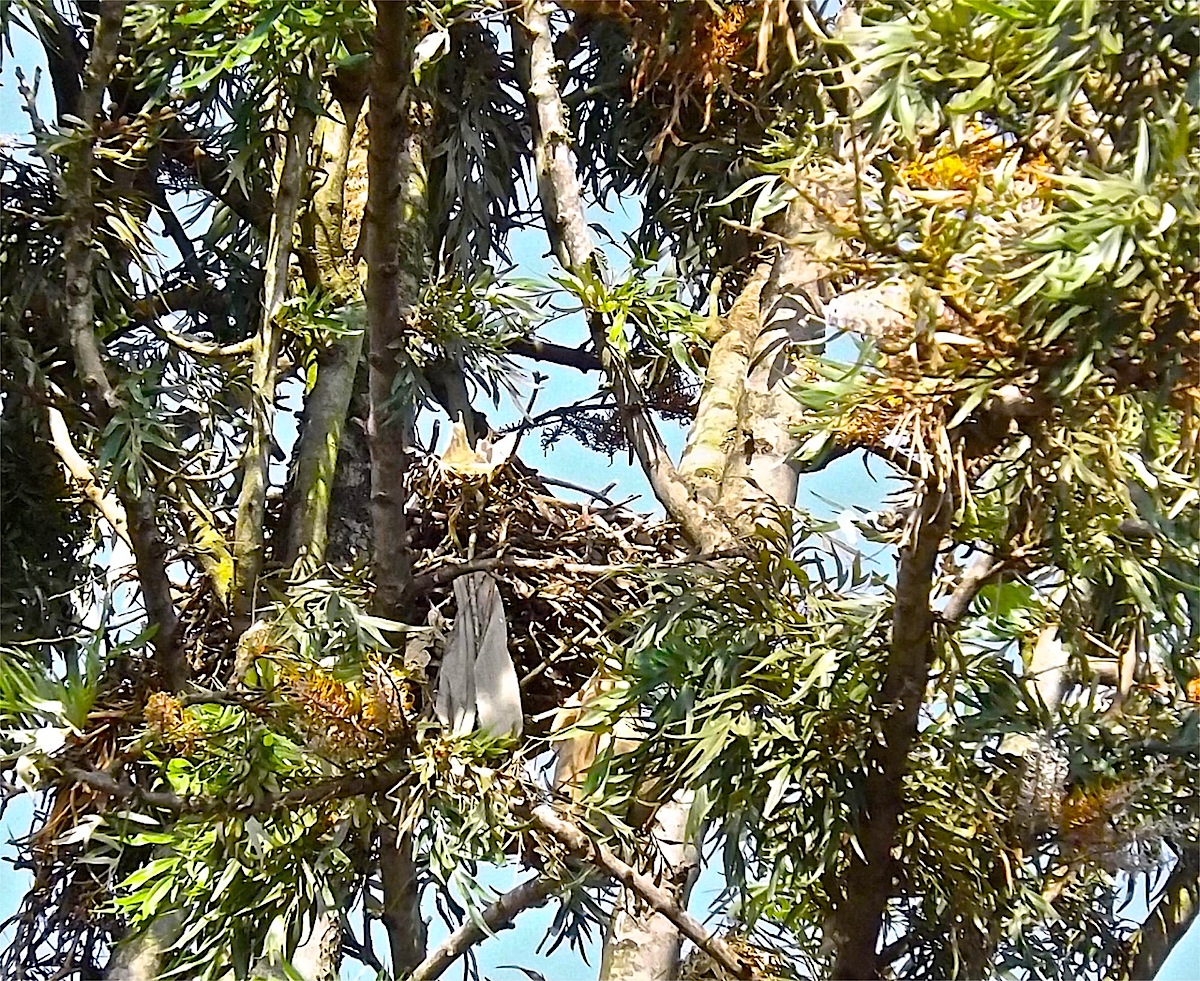
About the same time, two hawk-like birds built a very large, but more conventional, nest in one of the same two trees.  The pair are brown and have an almost 3′ wingspan (and evidently don’t eat weaver birds).

Hawks' nest in Rwanda/enclos*ure

See the strip of white cloth woven through the side of the nest in the photo above?  For a couple of months, I’ve been finding all kinds of trash near the foot of this tree.  It was a really annoying mystery until I spotted the nest and realized that the birds must weave in bits of cloth, plastic, and paper.

I haven’t seen the couple in a few days, but yesterday, I saw a smaller version of them on another tree in the garden. [August addendum:  They’re still there, but no sign of young ones.]

April 17, 2014:  The weaver birds are back; more here.

Birds were the original architects, creating fantastic and extreme examples of blobitecture and parametric design long before any architecture critic labeled these styles. They are also summa cum laude engineers, able to transform cheap, insubstantial building materials into the most durable and cozy of homes.

— Chee Pearlman, in “Twigitecture,” The New York Times


*Rwanda, The Bradt Travel Guide, by Philip Briggs and Janice Booth.  And I have decided that I really need to order the Princeton Field Guides’ The Birds of East Africa.

The canopy walk, Nyungwe Forest

13 Moss on tall tree, Nyungwe Park, Rwanda:enclos*ure

Last February, I wrote about our stay at the Nyungwe Forest Lodge.  Recently, however, I realized that I have never given you a look inside the forest.

The Nyungwe National Park, in the southwest of Rwanda, is 393 square miles of mountain forests, swamps, and moorland.

It has over 80 miles of constructed trails, but during our two-night stay at the lodge, we mainly wanted to relax — so we decided to walk the 1.3 mile Igishigishigi Trail, which includes a canopy walkway suspended 197′ above the ground.
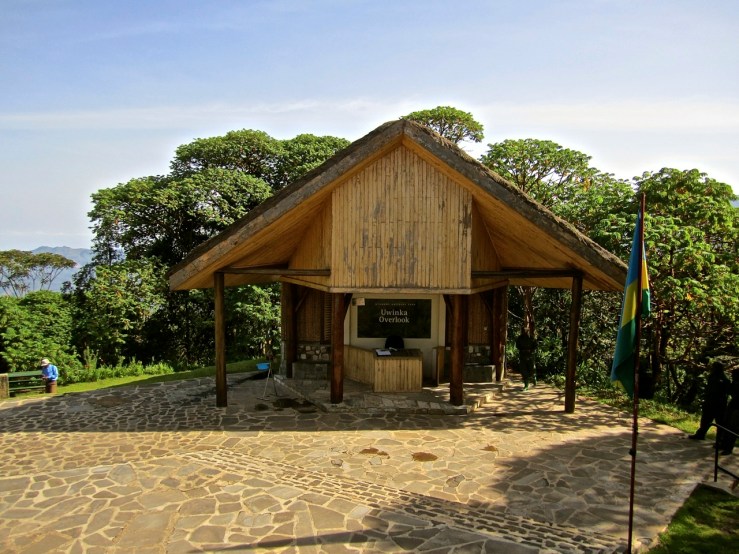
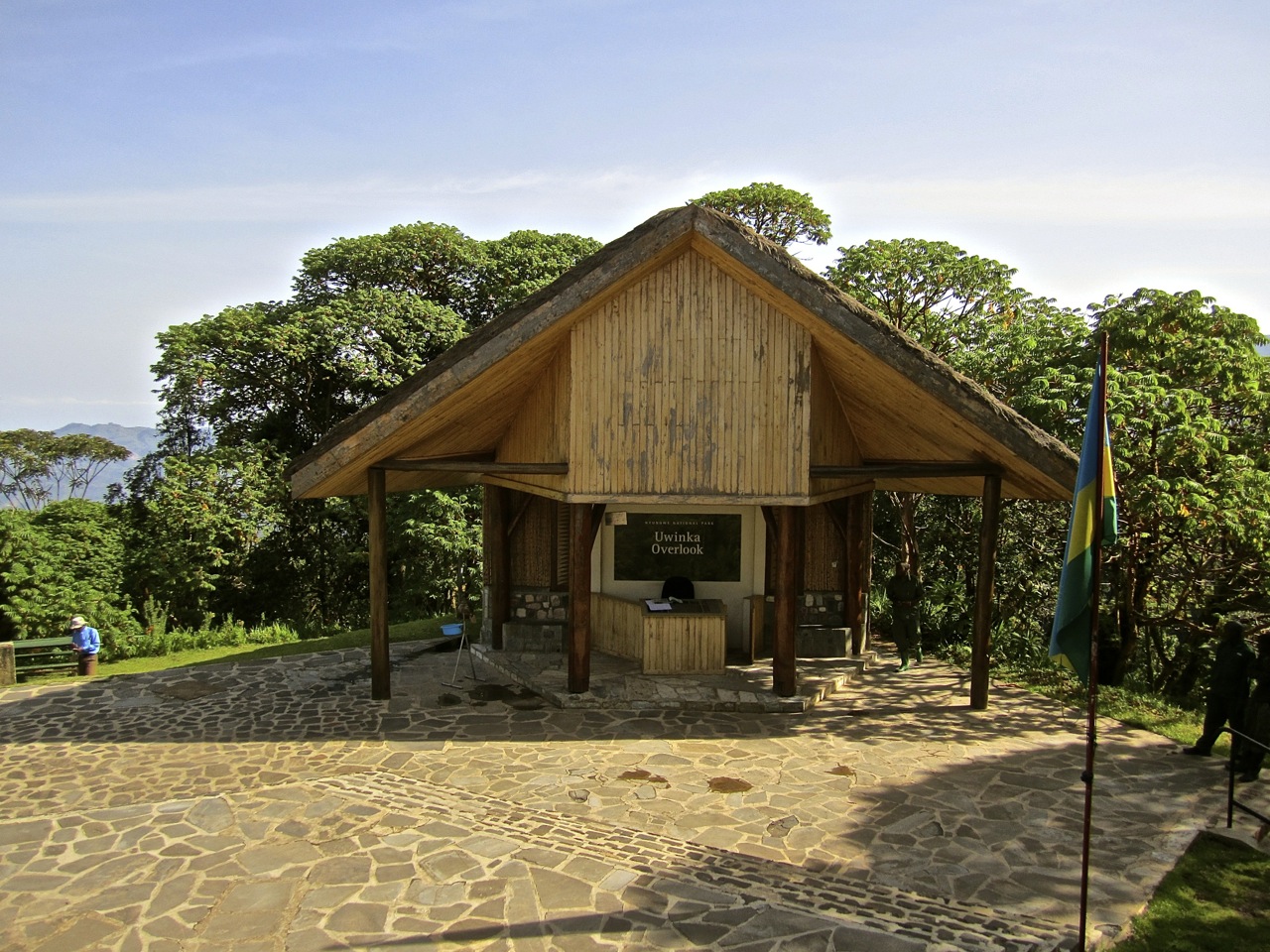
The Uwinka Visitor Center

The trail begins at the Uwinka Visitor Center, which was renovated three years ago with U.S. assistance.

The center’s  interpretative display features panels on the mountain rainforest and Nyungwe’s biodiversity, its people, and its role in the Congo-Nile watershed.  The text is in Kinyarwanda, English, and French.

2a Uwinka Visitor Center, Nyungwe Park, Rwanda:enclos*ure

Below are the steps leading to the Igishigishigi Trail.  The shadow with the camera was me, the one on the left was our visiting daughter, who was wondering what she had gotten herself into.

3 Steps to Igishigishigi Trail, Nyungwe Park, Rwanda:enclos*ure

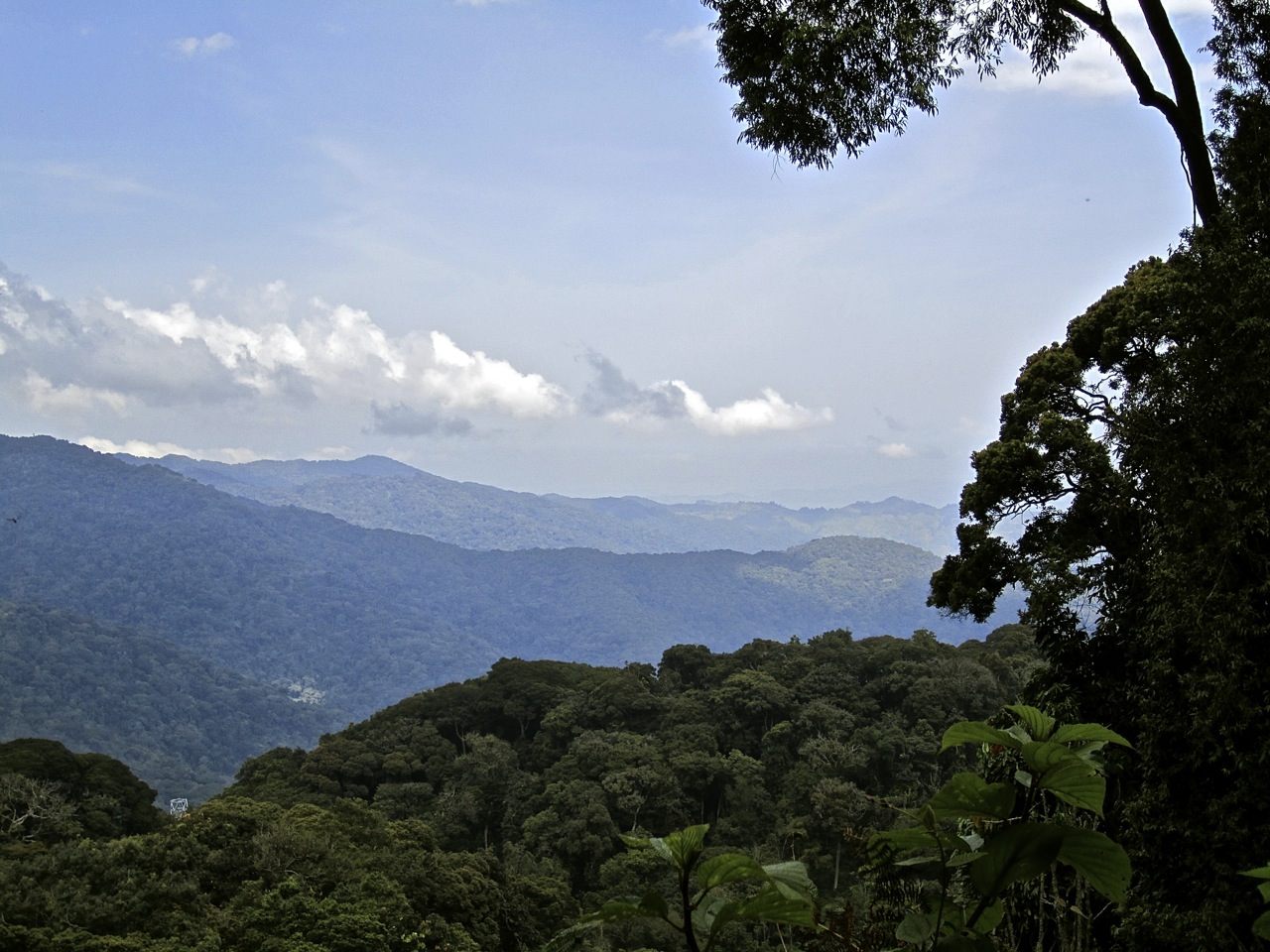
The view near the beginning of the trail is wonderful. Uwinka is at one of the highest points in the park.

7 View, Nyungwe Park, Rwanda:enclos*ure

In the left lower corner above, you can just see one of the towers that support the canopy walk.

Below is the trail,

7c Igishigishigi Trail, Nyungwe Park, Rwanda:enclos*ure

which includes several sections of steps.  The trail begins at 8,038′ and descends to 7,530′.

7d Trail steps, Nyungwe Park, Rwanda:enclos*ure

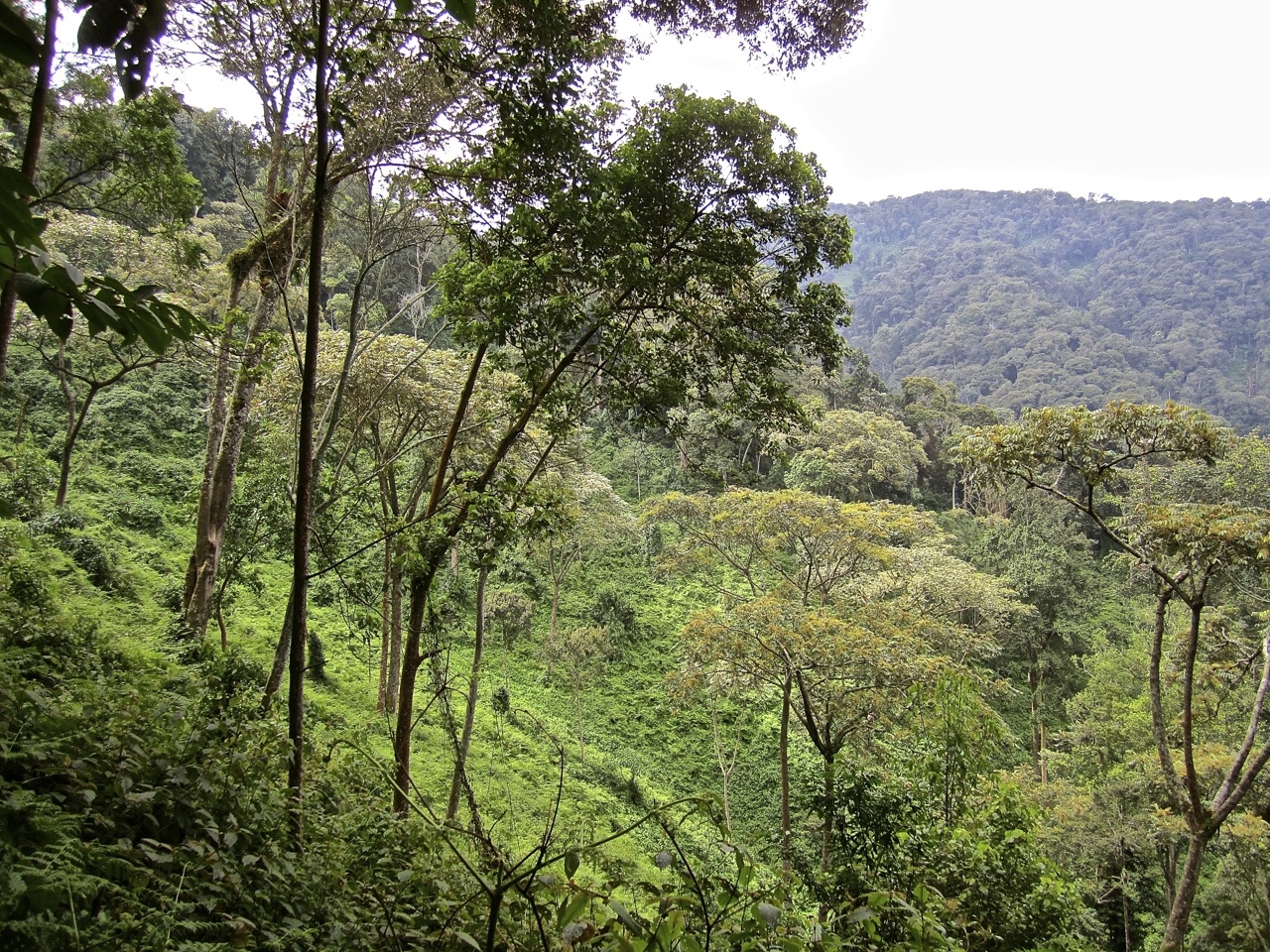
It sometimes passes along more open woodland, below.

7ba Hillside, Nyungwe Park, Rwanda:enclos*ure

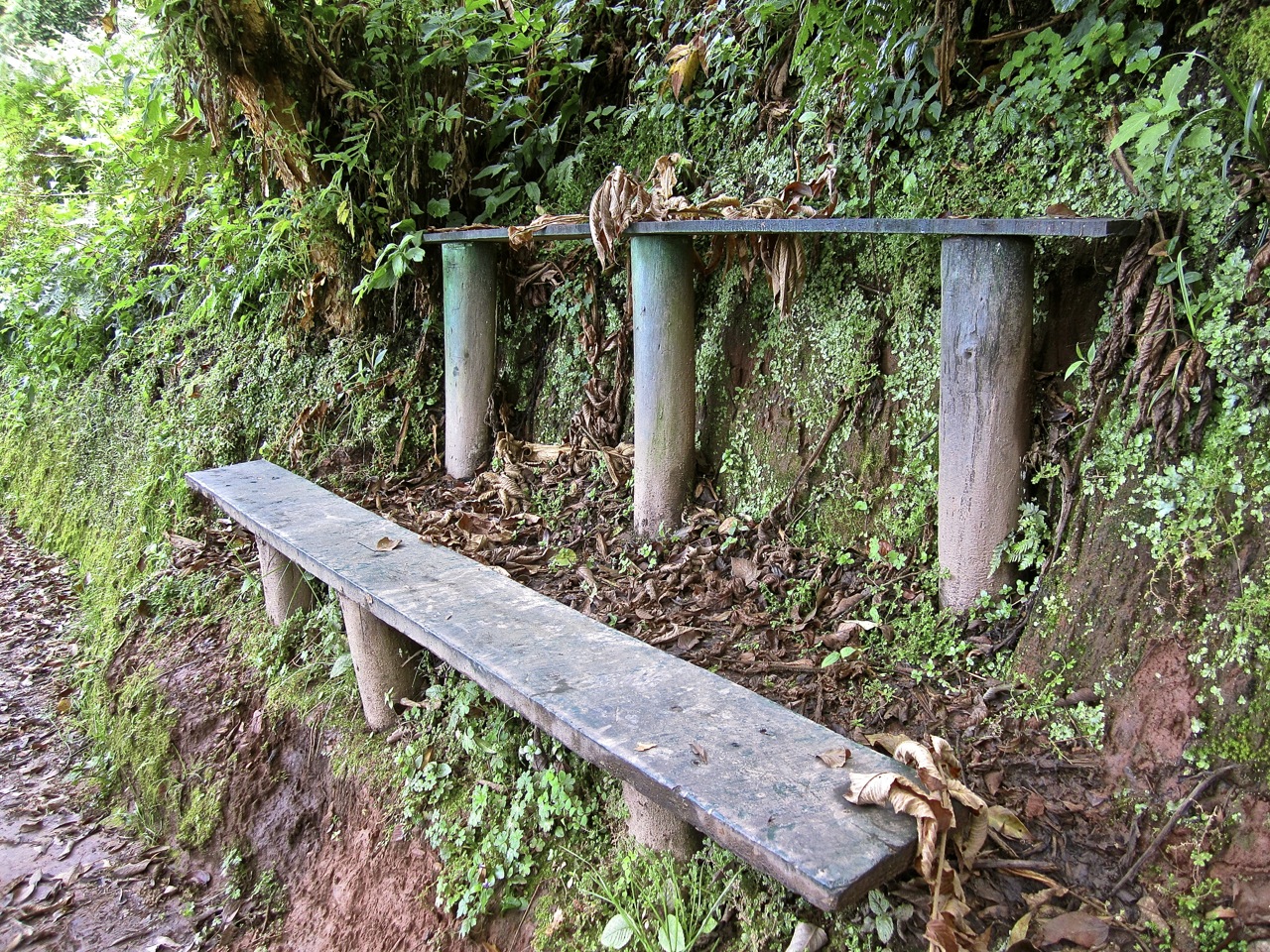
We came across benches from time to time, although this double arrangement, below, didn’t look very comfortable.

14 Trail benches, Nyungwe Park, Rwanda:enclos*ure

Several species of trees are labeled like this one.
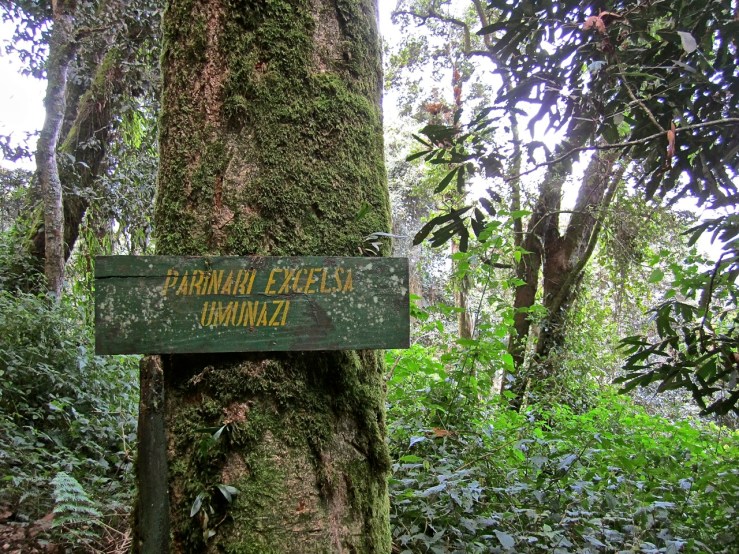
8 Labeled tree, Nyungwe Park, Rwanda:enclos*ure

The Parinari excelsa (or Umunazi in Kinyarwanda) grows to heights of 82′ to 131′ with a thick, cauliflower-shaped crown,

8a Parnari excelsa, Nyungwe Park:enclos*ure

way up there.

An assortment of ferns, mosses, lichens, and orchids live on the magnificent trees

13b Moss on tree, Nyungwe Park, Rwanda:enclos*ure

and on the forest floor.

13c Forest floor, Nyungwe Park, Rwanda:enclos*ure

One of the more common, and easily recognizable, plants along the trail is the giant lobelia, below.
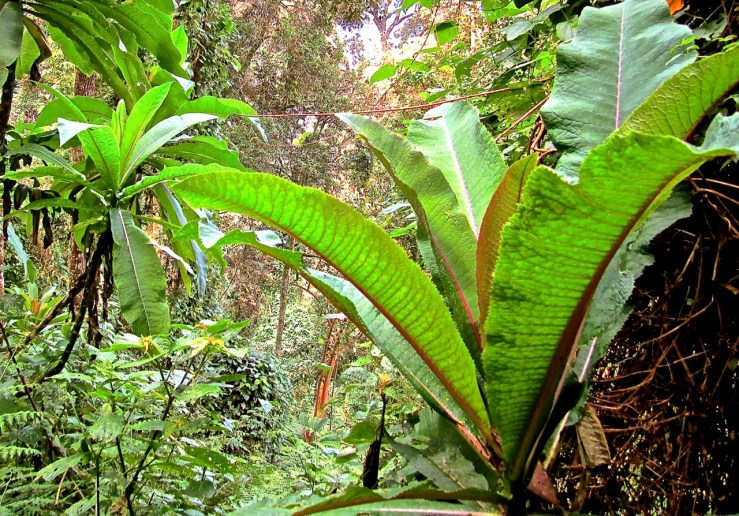
1 Giant lobilias in the Nyungwe Park, Rwanda:enclos*ure

There are two species of giant lobelias in the park.  I think these are Lobelia gibberoa (or Intomvu in Kinyarwanda).

After the explorer Johannes Mildbraed first saw this plant in Nyungwe in 1907, he wrote:

[It] would have awakened the interest of the veriest dullard at botany. . . .  When I first espied these strange shapes. . . my heart beat fast at the realization of a long-hoped-for sight, a feeling that is comparable only to that of a hunter at the first sight of some rare game.

13c Giant lobelia, Nyungwe Park, Rwanda:enclos*ure

The one above was only a few feet tall, but more mature specimens towered over our heads.

13d Giant lobelias, Nyungwe Park, Rwanda:enclos*ure

After about 45 minutes, we arrived at the canopy walk.

14a Canopy walk, Nyungwe Park, Rwanda:enclos*ure

In the photo below, our guide was explaining to us how the suspended bridges can support two cars, or twenty cars, or five elephants, or something like that.

15a Canopy walk, Nyungwe Park, Rwanda:enclos*ure

Oh, why not. . .

16b Canopy walk, Nyungwe Park, Rwanda:enclos*ure

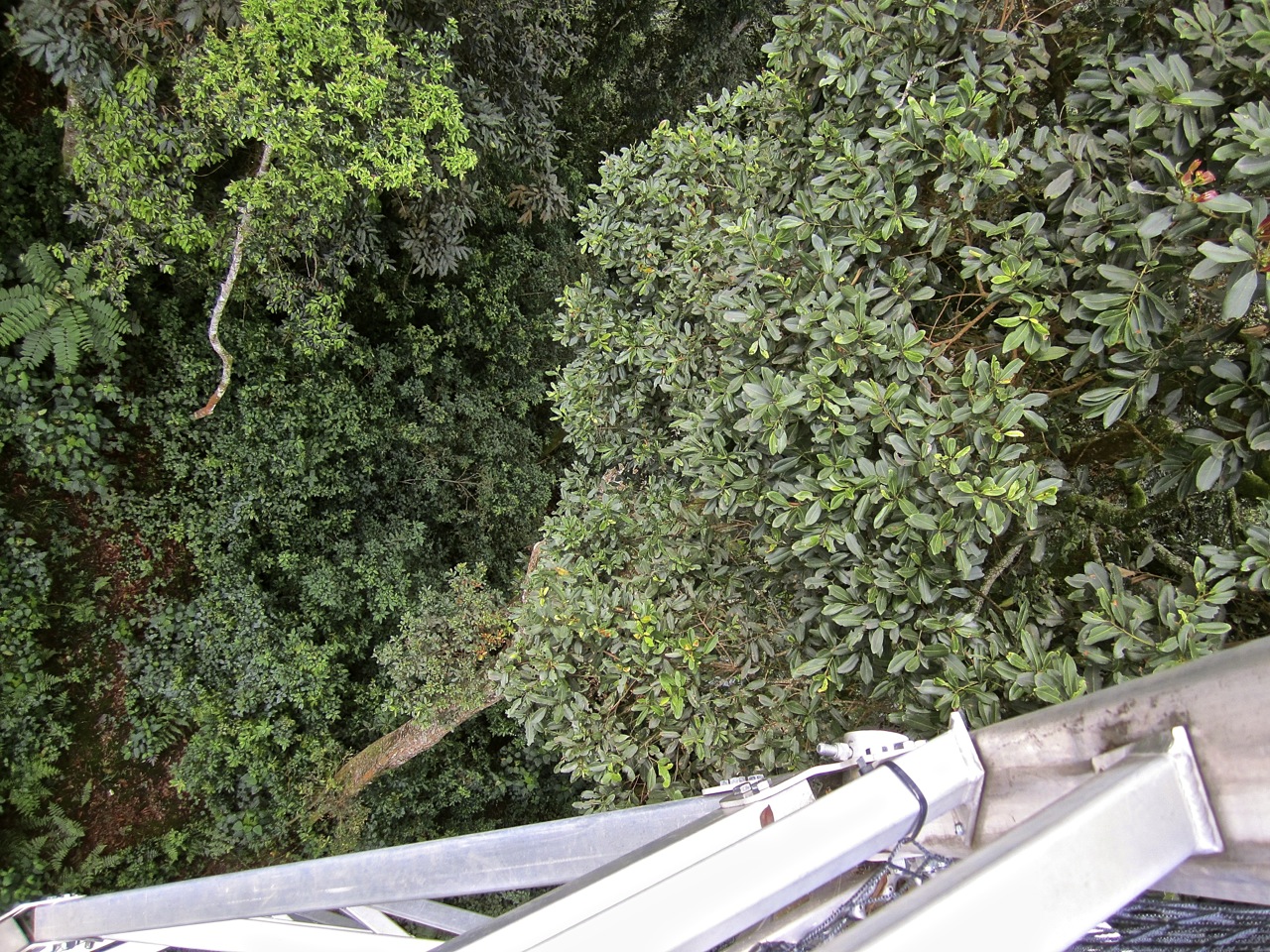
Below:  looking down from the platform of the first tower. . .

18 Look down, Canopy walk, Nyungwe Park, Rwanda:enclos*ure

Below, we started out onto the middle and highest section. . .

19 Treetops, canopy walk, Nyungwe Park, Rwanda:enclos*ure

and began to look down.

20 Look down, Canopy walk, Nyungwe Park, Rwanda:enclos*ure

22 Look down, Canopy walk, Nyungwe Park, Rwanda:enclos*ure

23 Look down, Canopy walk, Nyungwe Park, Rwanda:enclos*ure

It is unsurprisingly difficult to take pictures while standing on a 12″ wide swaying walkway.

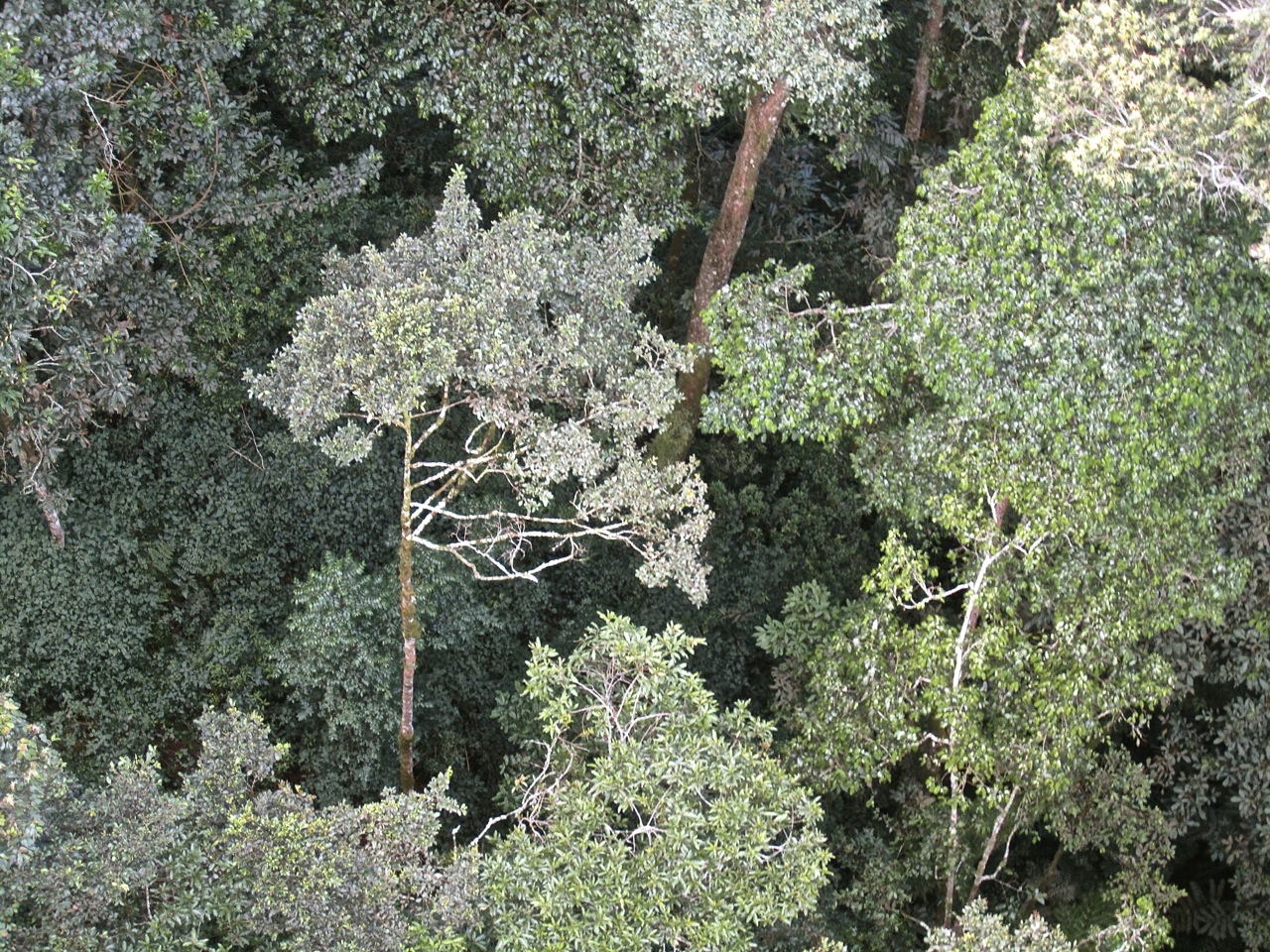
Below, you can see the tops of tree ferns, for which the trail is named (in Kinyarwanda), and we could hear water from a hidden stream.

25Look down, Canopy walk, Nyungwe Park, Rwanda:enclos*ures

A park guidebook says, “The walkway is strong and secure but will provide the visitor with a definite burst of adrenaline.”

26 View from canopy walk, Nyungwe Park, Rwanda:enclos*ure

In the photo above, taken from the walkway, you can see what I think are the young reddish-rose leaflets of Carapa grandiflora.  There is a wonderful full-color field guide on the plants of the park (here*), but, of course, mine was sitting back home on my desk during our trip.  However, I’m sure this was the best thing for my relationships with my husband and daughter, not to mention the guide.

Although the forest is home to many species of birds and monkeys, we did not see any along this trail — possibly because the popular walk is a bit noisy with humans talking.  But we saw both blue and L’Hoest’s monkeys along the road on the drive back to the lodge and from the balconies of our rooms.  And there is another park trail that features groups of chimpanzees.

And the next day, when we were almost out of the park, we spotted this guy, below, and a friend walking along the side of the road (photo by M. Koran).

Baboon in Nyungwe National Park. Photo by M. Koran/enclos*ure
To scroll through larger version of the images, click on ‘Continue reading’ below and on any thumbnail in the gallery.

*Sometimes you can find it here in Rwanda at bookstores or museum shops.  However, they were not selling it at the park or lodge when we were there.
Continue reading “The canopy walk, Nyungwe Forest”

A study in steps: Muhima

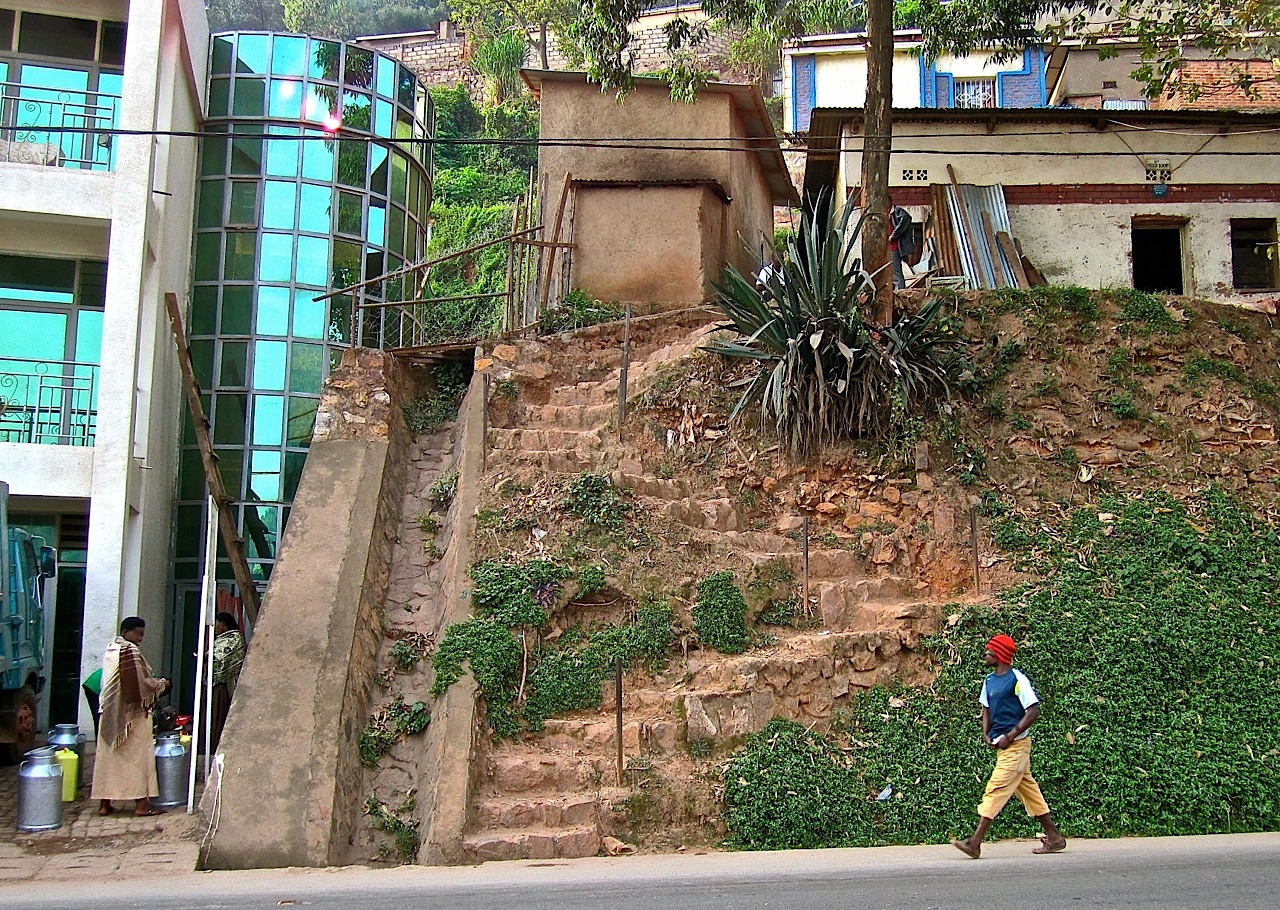
Roadside steps, Muhima sector, Kigali, Rwanda/enclos*ure
Boulevard de Nyabugogo, Muhima Sector, Kigali, Rwanda.

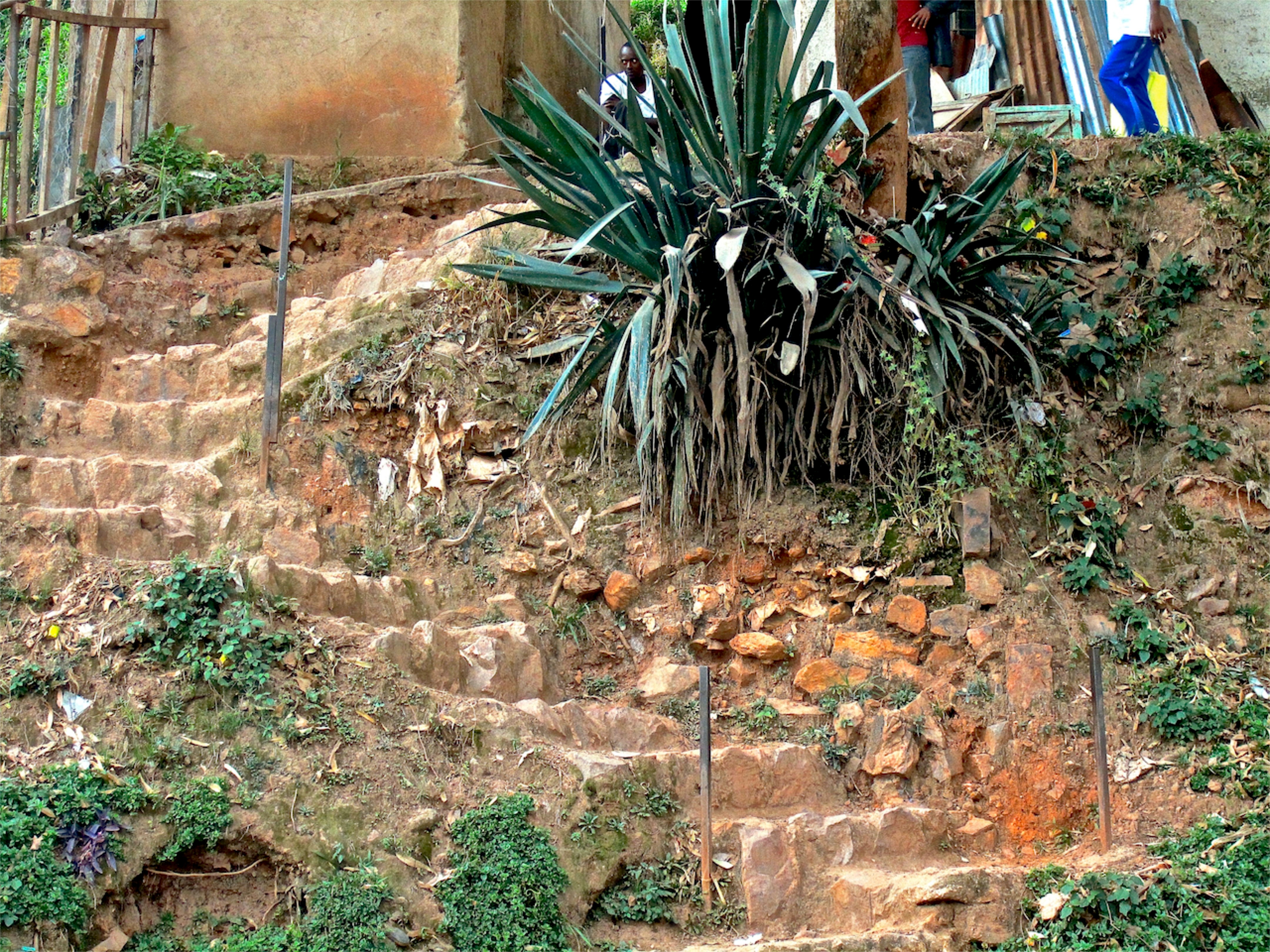
Detail of roadside steps, Kigali, Rwanda

Sprawling over numerous hills and valleys, with roads that wind crazily around and across the contours, Kigali can be a confusing city to navigate. Just when you think you know where you are going, your destination appears on the horizon in another direction! However, it’s a fairly compact city and assuming that you aren’t put off by the idea of steep slopes, over-friendly children and changeable weather, walking is a fantastic way to get about. If you have just arrived, don’t forget that Kigali lies at an altitude of around 1,600m, so take it easy on the hills!

— Caroline Pomeroy in the Bradt guide to Rwanda