Ready for action

Announced by all the trumpets of the sky,
Arrives the snow. . .

— Ralph Waldo Emerson, from “The Snow-Storm

This slideshow requires JavaScript.

Ford Motor Co. snow plows, ca. 1910 – 1925, possibly in Washington, D.C., National Photo Company Collection, Library of Congress Prints and Photographs Division.

“Most sources seem to agree that the basic street snow plow (not horse-drawn or built for trains) was created in 1913,” according to the blog Landscape Management Network.

“The first street snow plow, however, wasn’t patented until the early 1920s. At the time, a New Yorker by the name of Carl Fink was the leading manufacturer of plows mounted to motorized vehicles. Today, the company is known as Fink-America and its plows are still on the market.”

Current snow reports: here and here.

Continue reading “Ready for action”

Vintage landscape: Montross Hotel

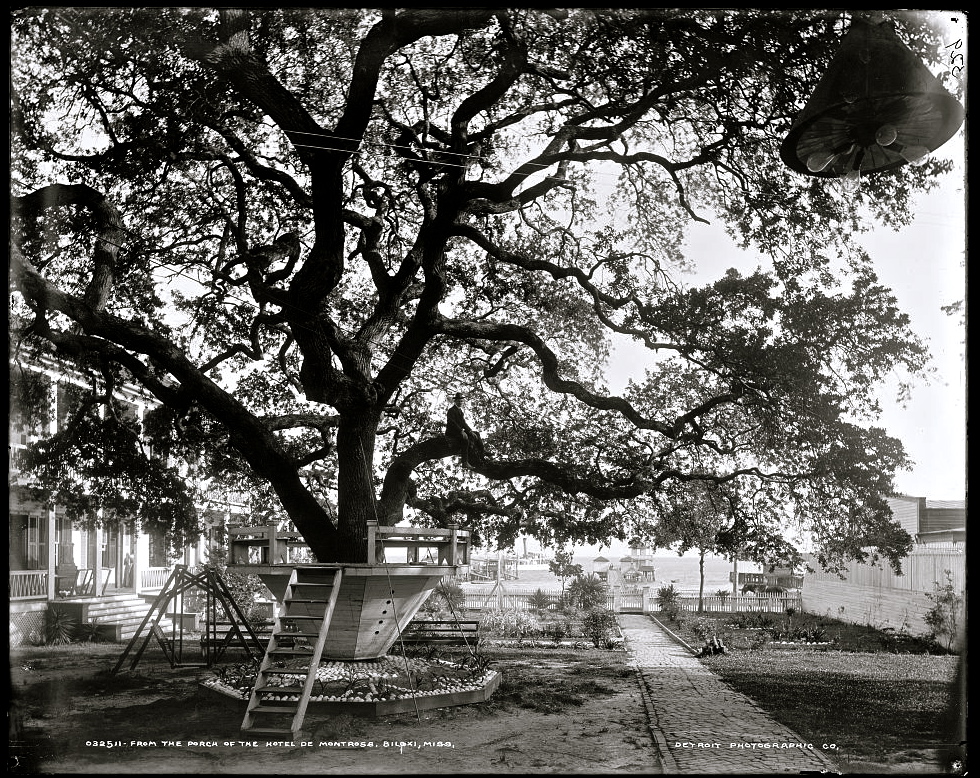
This hotel garden had an interesting combination treehouse-garden seat called a shoo fly. The 10′ to 12′ elevated platforms were popular along the Gulf Coast as places to catch the breezes and maybe avoid deer flies.

Montross Hotel, Library of Congress

The photo was taken from “the porch of the Hotel De Montrose [sic], Beloxi, Mississippi,” ca. 1895 – 1910, by the Detroit Publishing Co.* The Hotel de Montross (or Montross Hotel, later the Riviera Hotel) looked out on the waters of the Mississippi Sound.

“Anecdotal history of the early 20th century relates that the Hotel de Montross or Montross Hotel was the oldest hotel extant at Biloxi,” according to Ray Bellande of the Biloxi Historical Society. “It was operational before the first railroad was established between Mobile and New Orleans in 1870. Here on the central Beach of Biloxi and Lameuse Street, . . . the Montross Hotel was the focus of social life and fashion. Its pier was the disembarkation place for the society people arriving at Biloxi to enjoy its fine food, hospitality, and the gaiety of life, joie de vivre, that was offered to all visitors. The Montross Hotel flourished as a fine hostelry and boarding establishment until the late 1920s, when it became overshadowed by Biloxi’s modern beach front hotels. . . .”

I also like the light fixture.

A Hard Rock Hotel and Casino is located in approximately the same place today.

Beloxi has been a summer vacation resort since the first half of the 1800s.


*via Library of Congress Prints and Photographs Division.

Pinned . . .

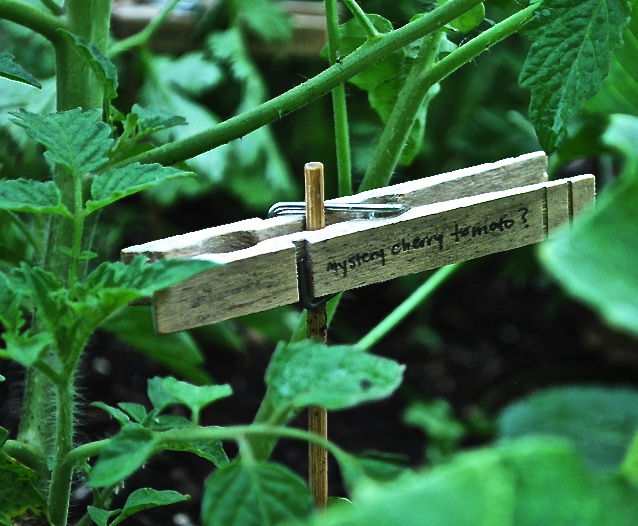
I like these plant labels — photographed by Stacey Shintani at a community garden in Chicago.
clothespin plant label, photo by S. ShintaniBoth photos are via flickr under CC license (and spotted on Pinterest).

clever plant label; photo by S. Shintani

More grows in the garden than the gardener sows.

— old Spanish proverb

Vintage landscape: snowy city street

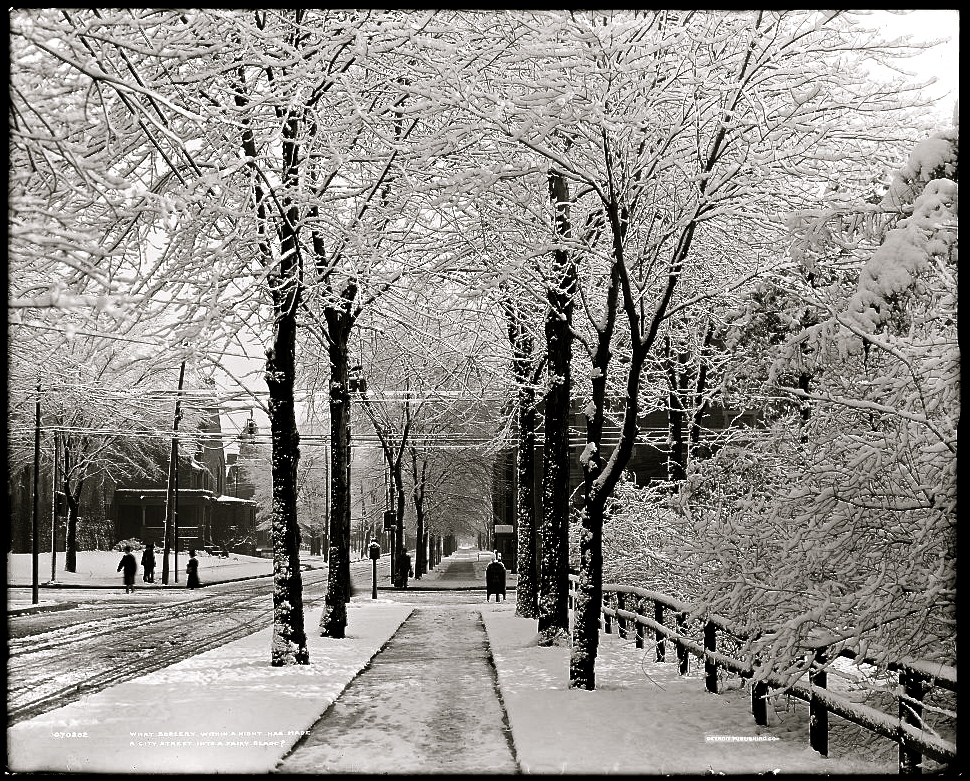
snowy city street, ca. 1900-1910, possibly Detroit, Michigan“What sorcery within a night has made a city street into a fairy glade?” Possibly Detroit, Michigan, ca. 1900-1910.

Photo and caption by Detroit Publishing Co. via Library of Congress Prints and Photographs Division.

Today we woke up to a revolution of snow,
its white flag waving over everything . . .

Billy Collins, from “Snow Day

Vintage landscape: Van Ness Park

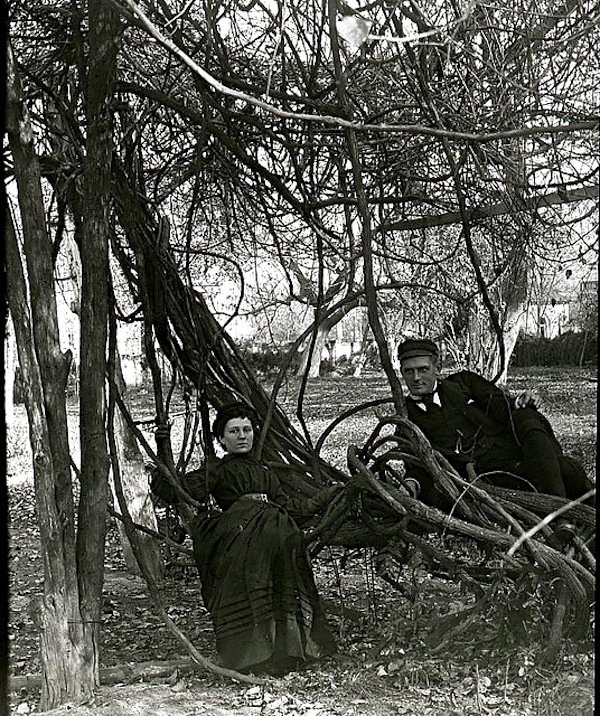
Van Ness Park, 1880, Washington, D.C.“Two people relaxing in Van Ness Park about 1880,” Washington, D.C.,  via D.C. Public Library Commons photostream on Flickr.

This park was not located in the present-day upper-northwest neighborhood known as Van Ness.  The photo was taken in an area southwest of the White House near the corner of C and 18th Sts., N.W. — which was then known informally as “Van Ness Park.”

According to the Library’s notation on the photo, the building that can be seen in the middle of the far right side (above the man’s legs) is a “dependency  of Van Ness Mansion.”

Van Ness House (Mansion) and its grounds were located on the block bordered by 17th and 18th Sts. and  C St. and Constitution Ave.  Built about 1816, the Greek Revival house was one of the finest in the city until the Civil War.  But afterwards, it served as a “German beer garden, florist’s nursery, headquarters of the city streetcleaners, and in the end, for the Columbia Athletic Club,” according to the blog Lost Washington.

The college that became George Washington University bought the property in 1903 but later decided that its location was too unhealthy for campus facilities.  At that time, the Potomac River and its marshes came up to B St., now Constitution Ave.

The State Department bought it in 1907, tore down the house, and built the Pan American Union (today OAS) Building.

I think the dependency in the photo is the old stable of the estate, which still exists at C and 18th Sts.  If that’s so, the couple may be lounging in what is now Bolivar Park.

According to the blog DC Ghosts, the stables have a connection to a local ghost story in which six white horses “run wildly around the grounds” and then group together to walk to the P St. Bridge crossing to Georgetown and Oak Hill Cemetery.  The full story is here.

It is good to be alone in a garden at dawn or dark so that all its shy presences may haunt you and possess you in a reverie of suspended thought.

— James Douglas, Down Shoe Lane