Vintage landscape: Tokyo

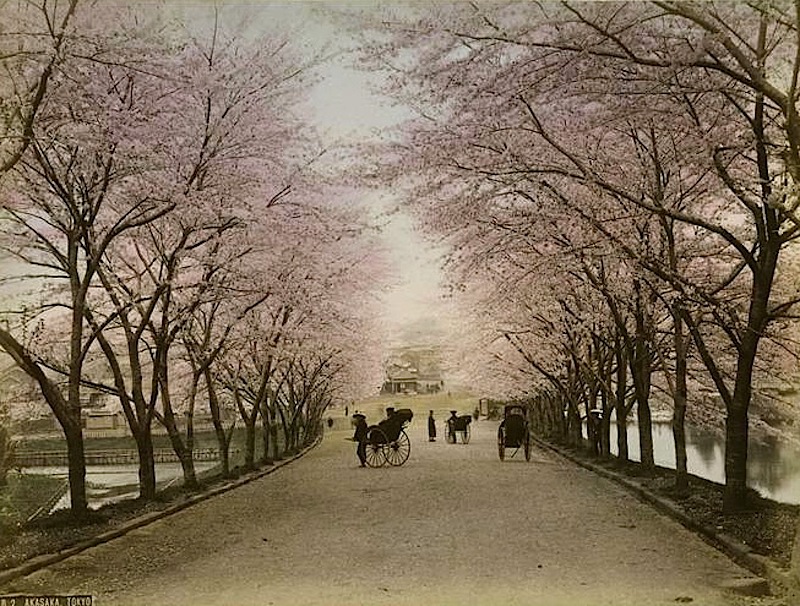
Akasaka, Tokyo, 1890s, from The New York Public Library Commons on flickrAkasaka, Tokyo, ca. 1890s, photographer unknown.  The image is part of “The Album of Photographs of Japan,” via The New York Public Library* Commons on flickr.

Cherry blossoms (sakura) in Tokyo are expected to open on March 30 this year, with the peak bloom being about April 6 to 15.

In Washington, D.C., The National Cherry Blossom Festival will begin on Thursday, March 20, and continue through April 13. Click here and here for more information on events and local accommodations.

The Washington Post has predicted this year’s peak bloom to be about April 9.


*Photography Collection, Miriam and Ira D. Wallach Division of Art, Prints and Photographs.

Glencar, Ireland

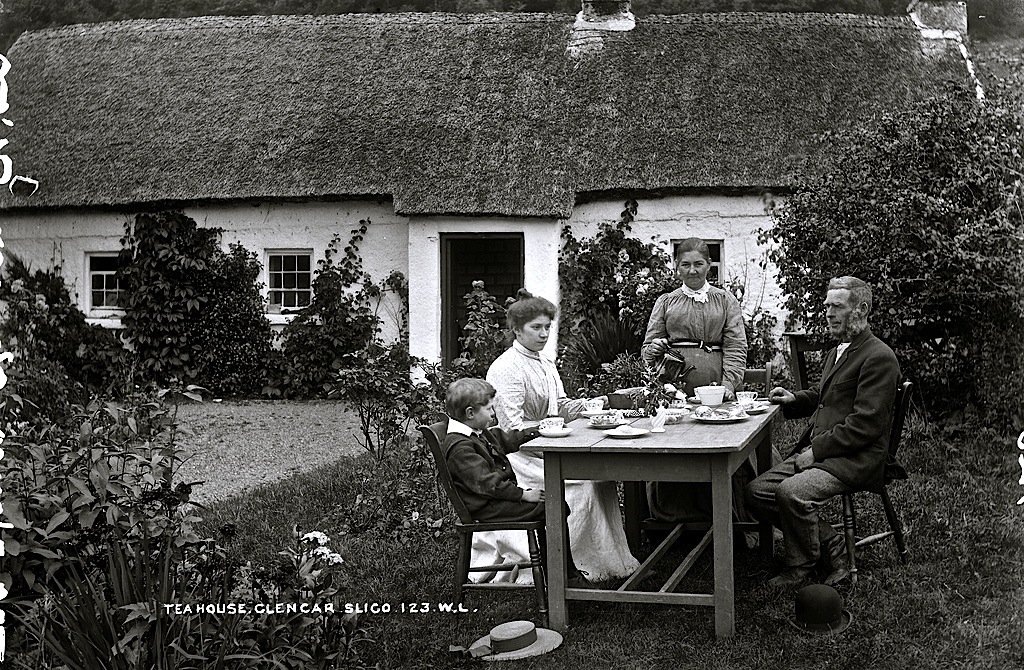
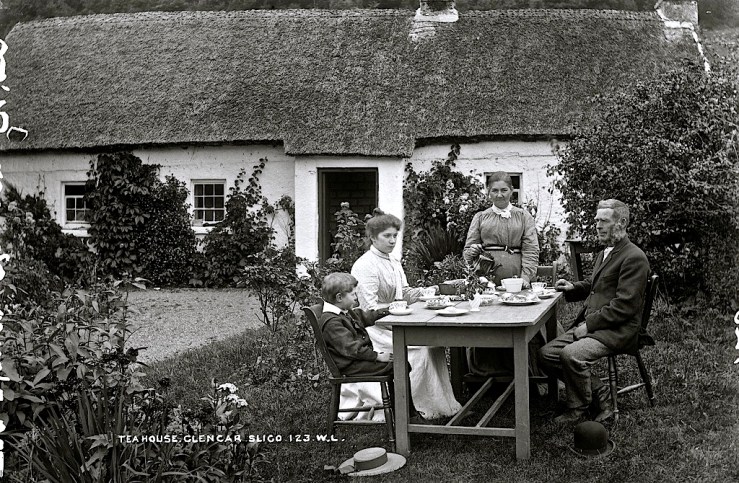
Tea House in Leitrim, Ireland via Nat'l. Library of Ireland, flickr Commons“[H]aving scones, butter and jam at the Glencar Tea House, Co. Leitrim (despite the fact that it says Sligo on the glass negative),” c. 1900, photographer not noted, via National Library of Ireland Commons on flickr.

A commenter on the flickr page pointed out that, from their looks, the two women might be mother and daughter, and, therefore, this could have been a publicity shot for the family’s tea house.

The women in the picture below may have been actual customers.
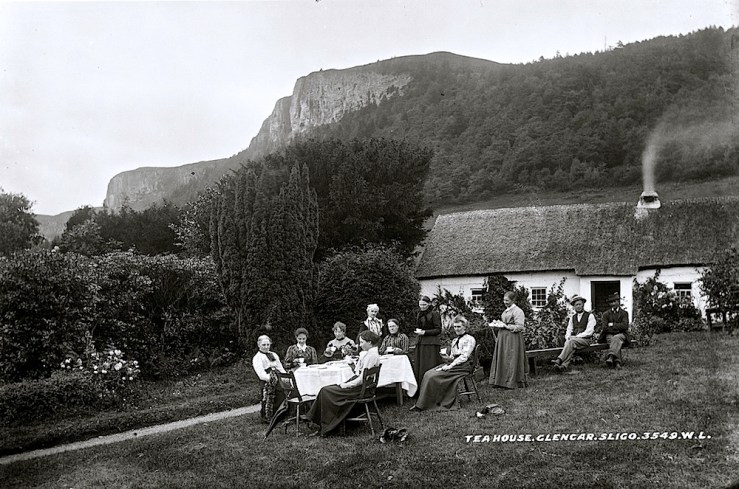
Glencar Tea House, c. 1890, Nat'l. Library of Ireland Commons on flickr“Tea House, Glencar, Co. Leitrim, circa 1890,” by Robert French, chief photographer of William Lawrence Photographic Studios of Dublin.

From the clothes and the way the vines are growing on the house, this photo appears to have been taken at almost the same time as the one above.  The mother from the top picture seems to be carrying the plate of scones here.

I wonder if the group being served was a ladies walking club who had been to see the Glencar waterfall, a local attraction?
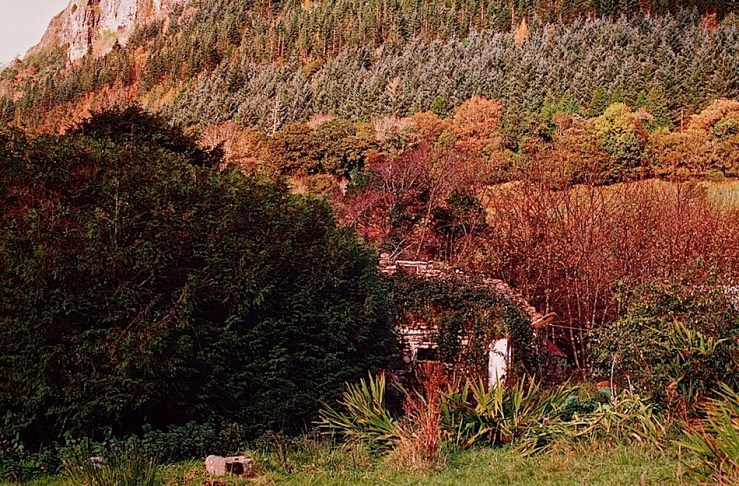
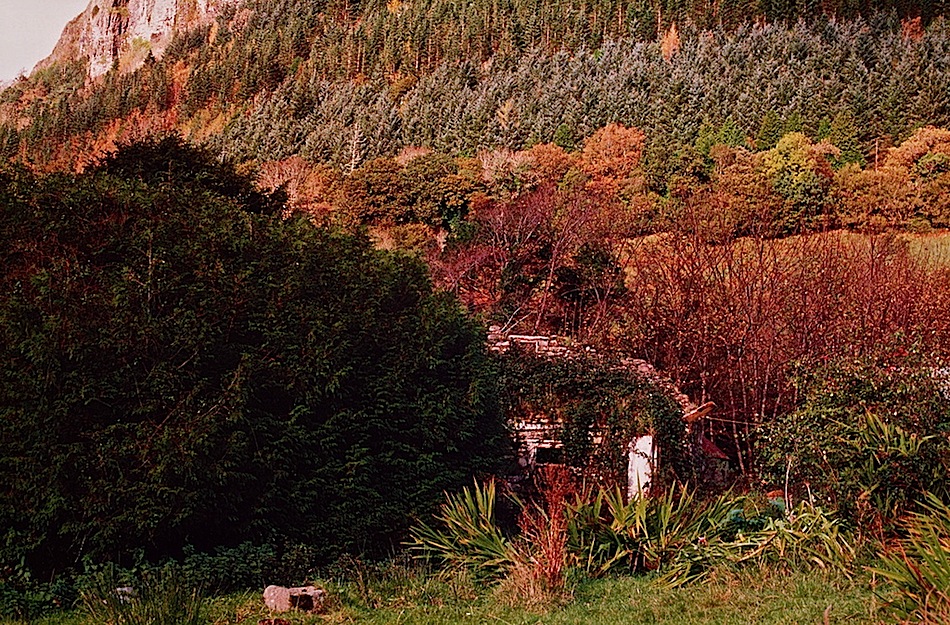
c. 1990 site of Glencar Tea House, via Nat'l. Library of Ireland Commons on flickr“Tea House, Glencar, Co. Leitrim, 1990,” by Mary Guckian for the Lawrence Photographic Project 1990/1991.

For the Project, volunteer photographers documented the sites of 1,000 100-year old photographs in the Lawrence Collection of the National Library of Ireland, “thereby creating a record of the changing face of the selected locations all over Ireland.”

For this picture, Guckian noted that a house on the site was “in  use until 1970s — Family Siberry not interested in re-opening at present, despite suggestions from local councillor that cottage be re-built in former style.”

You can read more about the Lawrence Photographic Project here.

Happy St. Patrick’s Day!

There’s an Isle, a green Isle, set in the sea,
Here’s to the Saint that blessed it!
And here’s to the billows wild and free
That for centuries have caressed it!

— Jean Blewett, from “St. Patrick’s Day


*All three photos here via National Library of Ireland Commons on flickr.

More Bloom Day in March

The borders along the upper lawn in our Kigali garden are blooming particularly well this month. I took these pictures yesterday.

This slideshow requires JavaScript.

(You can control the slideshow by hovering the cursor over it. Or you can scroll through larger versions of the photos by clicking on ‘Continue reading’ below and then on any thumbnail in the gallery.)

Our front garden is a rather formal arrangement of two long lawns that run parallel to each other and to the length of the house and its terrace. The narrow upper one is separated from the much wider lower one by two sets of 3′ retaining walls, which are joined in the center by a flight of steps. Irregularly curving planting beds border both sides of the lower lawn and one side of the upper.

I’ve tried to balance the formal layout with an informal, sort of “country garden” planting plan. The beds contain a closely planted mix of tropical and temperate plants and shrubs. Most are cultivated, but the “wild” plants and vines that work their self-seeding way up through the jumble can stay if they they add nice textures or colors.

The beds between the retaining walls and the one along the far side of the lower lawn are anchored by several large, often flowering, shrubs and lianas, and even some small trees.

Because of the vigorous plants and the constant warm weather, I’m always pruning or chopping something back.

Almost every plant repeats in the garden, often in several places.  But each 7′ to 15′ section of border has its own primary and secondary colors and then a bit of a third color trailing through the middle or around the edges.

The border along the upper lawn starts out orange and white (with a little pink) at its south end, then becomes yellow and blue/purple with some orange to the center steps. On the north side of the steps, it is yellow and blue/purple again with a stronger trail of orange (red hot poker, lantana, tropical hibiscus). At the north end, it is red and pink with blue around the edges.

Garden Bloggers’ Bloom Day is the 15th of every month. To see what’s blooming today in other bloggers’ gardens, visit Carol at May Dreams Gardens.

My earlier March Bloom Day post today is here.
Continue reading “More Bloom Day in March”

Our garden: springtime (again)

I had an odd January and February. Ever since we returned from our Christmas vacation, I’ve had very little interest in working in the garden, and I’ve been fascinated by the cold and snow back home in Washington, D.C.

The weather here in Kigali has been its usual just-about-perfect, but except for a couple of nice trips out of town, I haven’t wanted to be out in it that much.

I know those of you who live in North America and Europe will probably not have any sympathy for me, but gardening in a climate where it’s constantly late spring is relentless. . . and I think I was tired. So I did the same thing all of you are doing (although not by choice): I curled up inside with T.V., books, and the internet.

But now it’s March, and I’m determined to shake off my “winter” doldrums.

I won’t be posting anything this week. I’ve decided to take an electronic media break and work everyday at a number of overdue gardening tasks, as well as some domestic organization (my desk area is too messy to find anything).

I’ll be back next Sunday. In the meantime, here are some of my favorite photos from a walk I did take around the garden on February 24th, during a very light rain.

The lower, even light allowed me to capture both the long front hedge and the hills in our view. (Usually, I get either very dark hedge or whited-out view.)

This slideshow requires JavaScript.

You can pause the slideshow by hovering the cursor over it.

Please do leave comments, if you like. I’ll probably cheat and check back a few times.

You can scroll through larger versions of the images by clicking on ‘Continue reading’ below and then on any thumbnail in the gallery.
Continue reading “Our garden: springtime (again)”

Vintage landscape: tree delivery

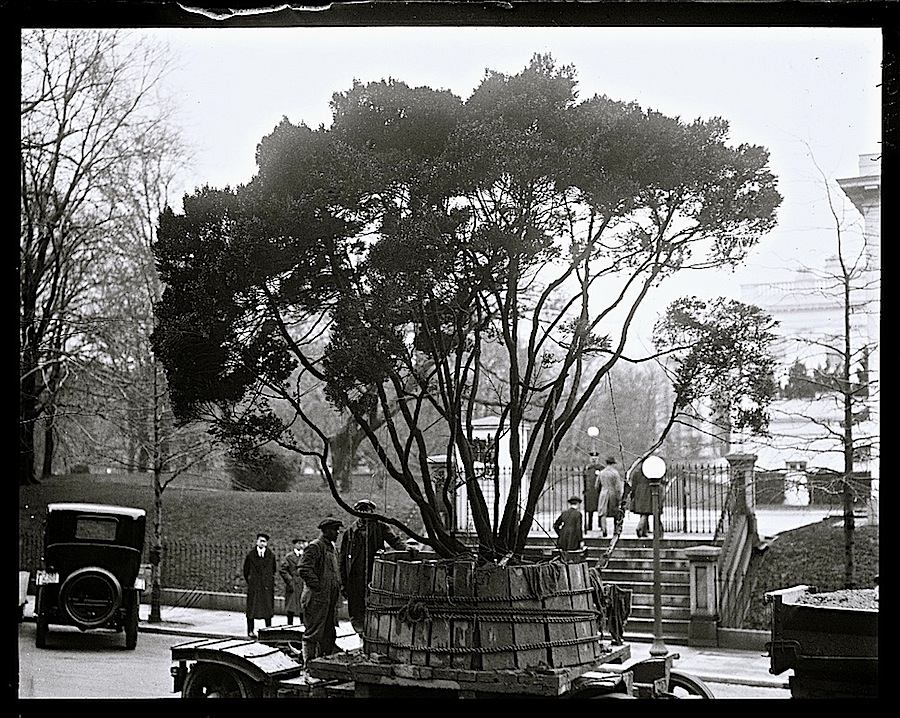
White House tree delivered, Mar. 1922, via Library of Congress. . . to the White House, Washington, D.C., March 1922, by Harris & Ewing, via Library of Congress Prints and Photographs Division.

Thomas Jefferson, the second President to occupy the White House, directed that hundreds of small trees be planted in groves around the grounds (none of them exist today).

John Quincy Adams was the first to add ornamental trees. Andrew Jackson brought in the first sycamores, elms, and maples.

There’s more about the history of the White House gardens and grounds here.

What kind of small tree/large shrub do you think this was?

I never before knew the full value of trees. My house is entirely embossomed in high plane-trees, with good grass below; and under them I breakfast, dine, write, read, and receive my company. What would I not give that the trees planted nearest round the house at Monticello were full grown.

Thomas Jefferson to his daughter, Martha, (from Philadelphia), 1793