Life in gardens: last look

As April’s cherry blossoms fade away, here is one more vintage scene.

This slideshow requires JavaScript.

“Street life in Yokohama park with blossoming cherry trees,” from the photo collection of  journalist Holger Rosenberg, who traveled to Japan in 1903, via National Museum of Denmark Commons on flickr.

In Japan this week, the flowers are at their peak only in the most northern regions.

Click on ‘Continue reading’ below to scroll through larger versions of the images.

the clouds of
a thousand skies from
cherry buds

Saigyo Hoshi

Continue reading “Life in gardens: last look”

Home sweet France

This slideshow requires JavaScript.

Of course France isn’t our home, but after years of passing through — on our way to and from Francophone African countries — visiting beautiful Strasbourg this weekend felt like a petit homecoming in general awareness.

Suddenly, I could speak to people in their own language* (albeit, simply and ungrammatically), understand signs, and go to Monoprix and read all the product labels. The skies opened. . . .

I love living in Germany, but, thus far, the German language is a stone wall to me. Thankfully, the school system here is so good that you can always find someone who speaks at least fair English. I do try to maintain an appropriately ashamed look every time I say, “I sorry, I don’t speak German.”

Anyway, Strasbourg was great, and I saw my first blooming wisteria this year there.

I can recommend Hôtel Gutenberg,  flammkuchen (aka tarte flambée) with a glass of pinot gris for lunch, and the boat tour of the River Ill, which circles the city center. And the spectacular cathedral is celebrating its 1,000th birthday this year.

What’s the French for “fiddle-de-dee”? . . .
The “Fiddle” we know, but what’s from “Dee”?
Le chat assis in an English tree?

John Hollander, from “For ‘Fiddle-de-de’


*in French, of course, but the native language of  Strasbourg is actually Alsatian, a dialect of German that is spoken by 43% of the region’s population, according to Wikipedia.

The Sunday porch: Pasadena

So thou dost riot through the glad spring days. . .*

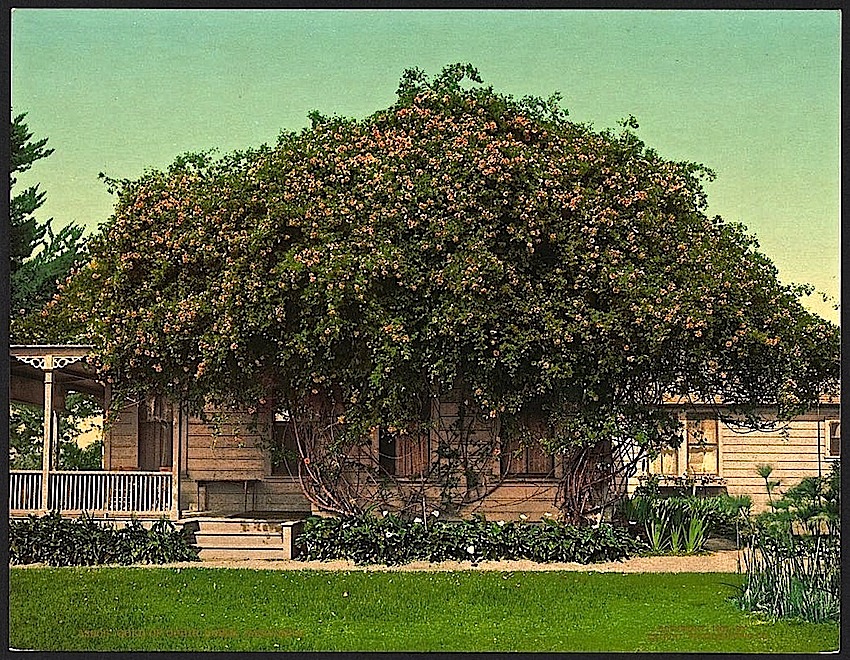
The Sunday porch:enclos*ure -- Pasadena, c. 1902, Library of Congress“Gold of Ophir roses, Pasadena[, California,]” ca. 1902, a photochrom by Detroit Photographic Co., via Library of Congress Prints and Photographs Division.

The climber Gold of Ophir — also known as Fortune’s Double Yellow and Beauty of Glazenwood — moved to southern California with the settlers and flourished there.

“I remember great heaps of them in every backyard, blazing like moons on fire, yellow, gold, pink. . .,” wrote M. K. Fisher in her introduction to Growing Good Roses by Rayford C. Reddell.


* from “Gold of Ophir Roses” by Grace Atherton Dennen, editor/publisher of The Lyric West

Vintage landscape: boxwood drive

Boxwood hedge, by F.B. Johnston, Library of CongressDriveway, Castle Hill, Charlottesville, Virginia, 1926, by Frances Benjamin Johnston, via Library of Congress Prints and Photographs Division.

The original house on the plantation of Castle Hill was built in 1764 by Dr. Thomas Walker and his wife Mildred.  Walker was a friend of Peter Jefferson and later guardian to his son,Thomas.

At the time of this photo, the property was owned by his descendant, Amélie Louise Rives Troubetzkoy, a novelist married to a Russian prince who eventually ran somewhat short of funds.

By the fall of 1938, when future novelist Louis Auchincloss, then a law student at the University of Virginia, came to have tea with the aging princess, he found her living in “romantic, impoverished isolation in a decaying manor house.” To get to the house, he had to find his way through a double row of aromatic box hedges that rose up three stories high and were so enormous that his bulky Pontiac could barely pass through. The awe-inspiring hedges even became the subject of one of Amélie’s poems, which she wrote in middle age. She ends the poem with “Hedges of Box,/Hedges of Magic./…Behind your barrier of glad enchantment/I have rediscovered reality.” The reality Amélie envisioned had herself within the encircling wall of boxwood, still a young beauty of twenty-one, seated on the back of a unicorn.

— Donna M. Lucey, from “The Temptress of Castle Hill,” Garden and Gun

Today, the estate is still privately owned.  Its remaining 1,203 acres (from the original 15,000) have been permanently protected against development by a conservation easement with The Nature Conservancy.

Vintage landscape: Edo blossoms

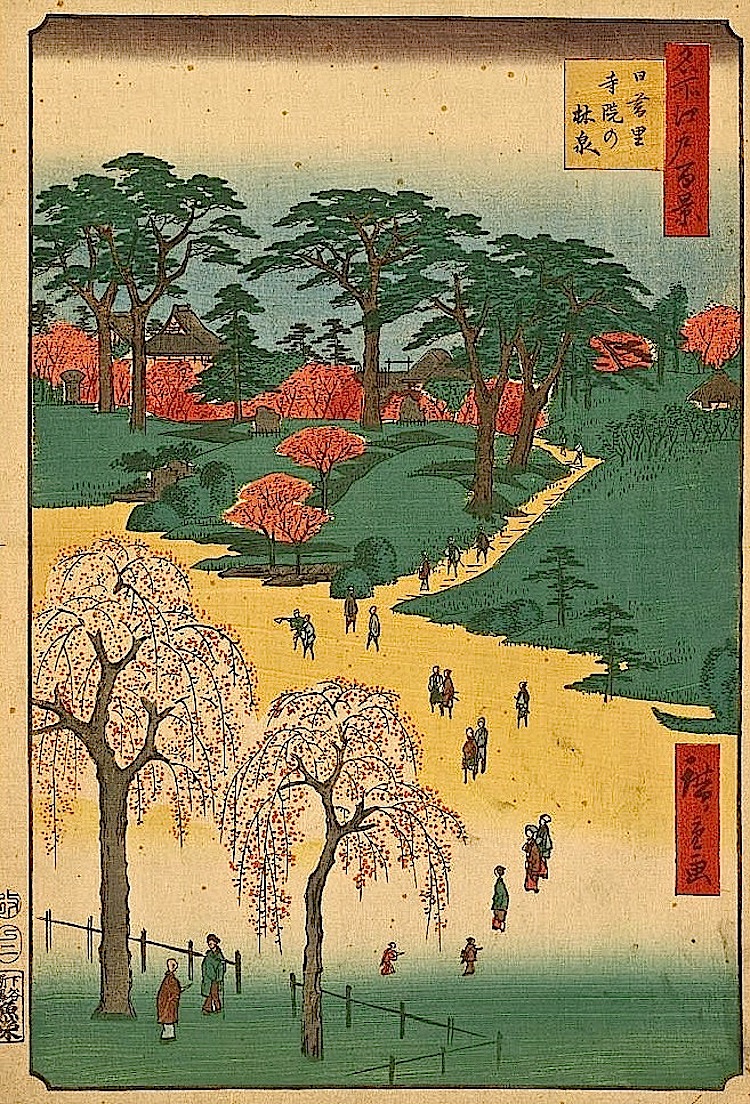
Cherry blossoms in Japan, Library of Congress“Higurashi no sato jiin no rinsen” (Temple Gardens, Nippori), 1857, a woodblock print by Andō Hiroshige, via Library of Congress Prints and Photographs Division.

The view is from Ueno Hill of Shūsō-in, one of three Buddhist temple gardens known as Hanamidera or Flower-viewing Temples. This print is one of fifty in an album of Edo (present day Tokyo) by Hiroshige.

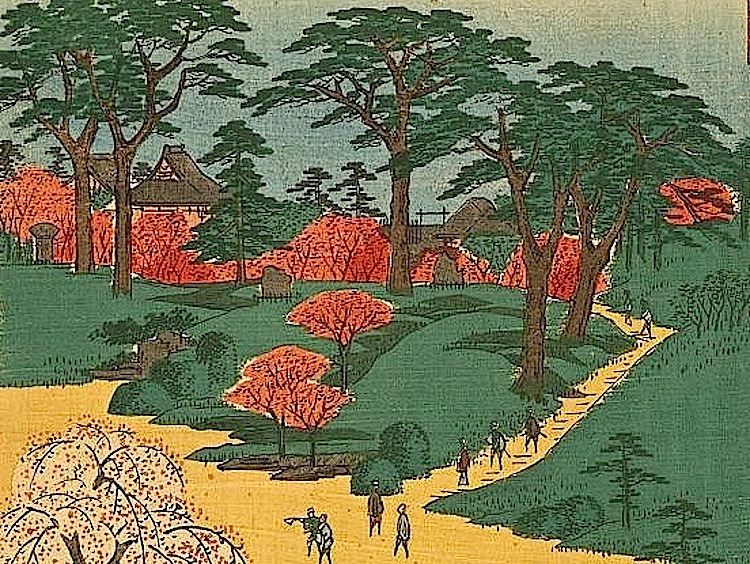
Detail of print above.

There’s a nice essay on cherishing the brief beauty of the cherry blossoms by Diane Durston in today’s Washington Posthere.

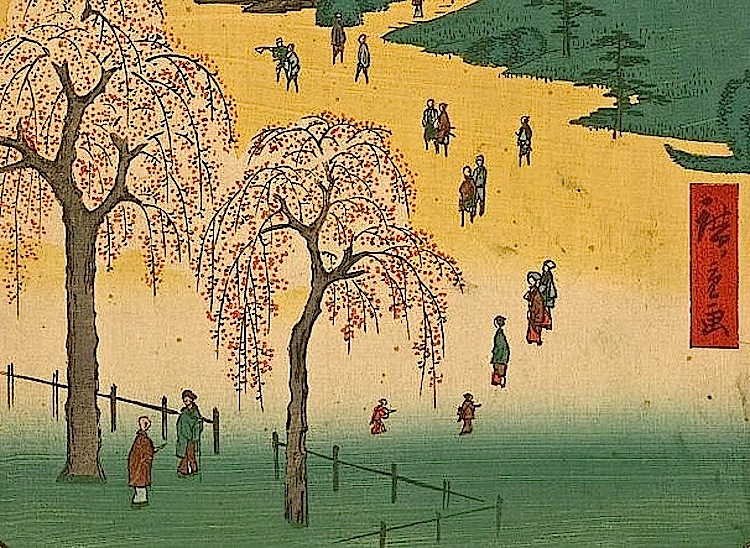
Detail of print above.
The cherry trees in our neighborhood here in Stuttgart have just begun to bloom this week.