Vintage landscape: 1890s Paris in photochroms

Among the many treasures of the Library of Congress’s online catalogue are several thousand digital images of antique photochrom prints.

The prints were colored images made from black-and-white photographic negatives transferred onto lithographic printing plates.  The process was invented at a Swiss printing company in the 1880s.  By the mid 1890s, it had been licensed it to many other companies, including the American Detroit Publishing Company, which had exclusive rights in the U.S.
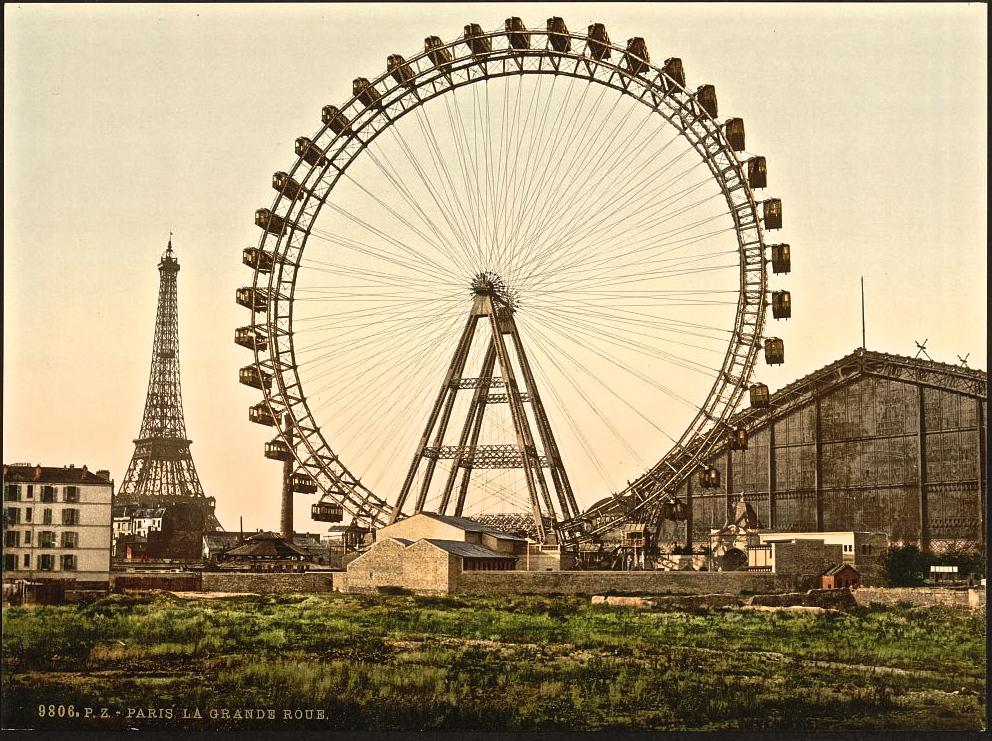
A ferris wheel (la grande roue) in Paris, near the Eiffel Tower, ca. 1890-1900.

In 1898, Congress passed an act allowing private publishers to print postcards that could be mailed for only a penny each — half the rate of a letter.  Millions of photochrom postcards were purchased — and often collected in albums or framed — in the first two decades of the nineteenth century.

Wikipedia describes the process:

A tablet of lithographic limestone, known as a “litho stone,” is coated with a light-sensitive coating, comprising a thin layer of purified bitumen dissolved in benzene. A reversed half-tone negative is then pressed against the coating and exposed to daylight for a period of 10 to 30 minutes in summer, up to several hours in winter. The image on the negative allows varying amounts of light to fall on different areas of the coating, causing the bitumen to harden and become resistant to normal solvents in proportion to the amount of light that falls on it. The coating is then washed in turpentine solutions to remove the unhardened bitumen and retouched in the tonal scale of the chosen color to strengthen or soften the tones as required. Each tint is applied using a separate stone bearing the appropriate retouched image. The finished print is produced using at least six, but more commonly from 10 to 15, tint stones.
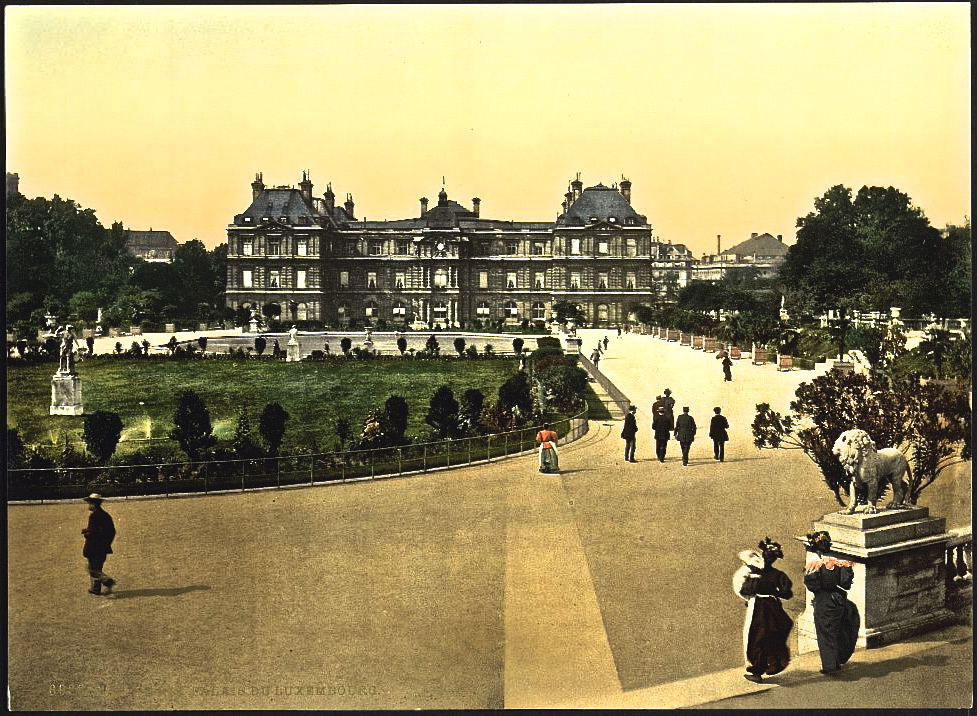
The Luxembourg Garden.

Often the printer was provided with notes about realistic colors, but sometimes he had to work from his imagination alone.  However, Detroit Publishing’s catalog said that its photochrom prints joined “the truthfulness of a photograph with the color and richness of an oil painting or the delicate tinting of the most exquisite water color.”

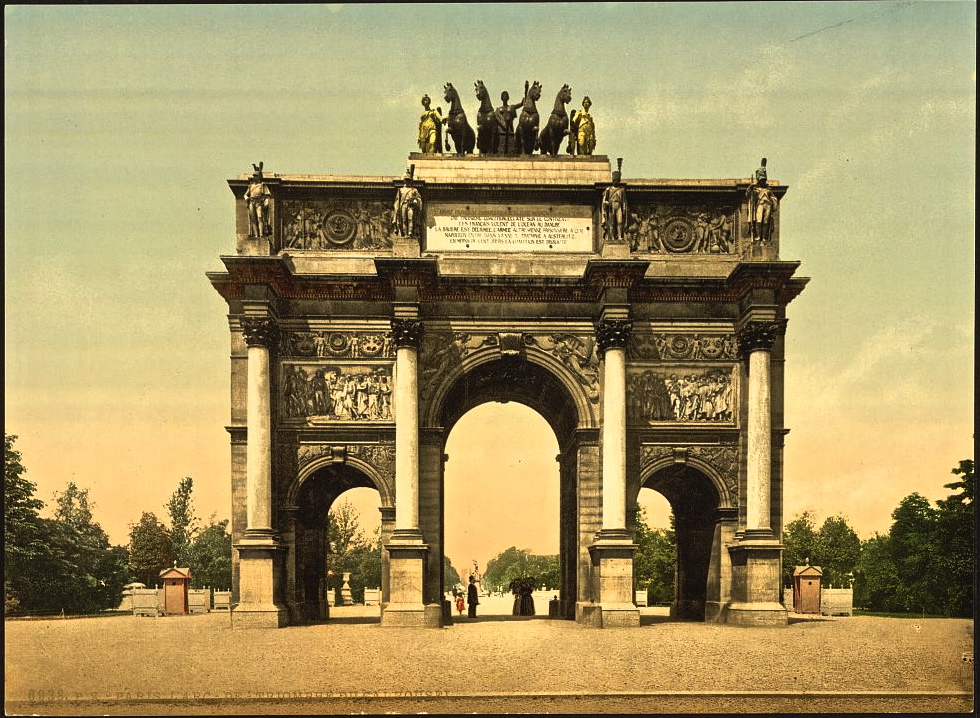
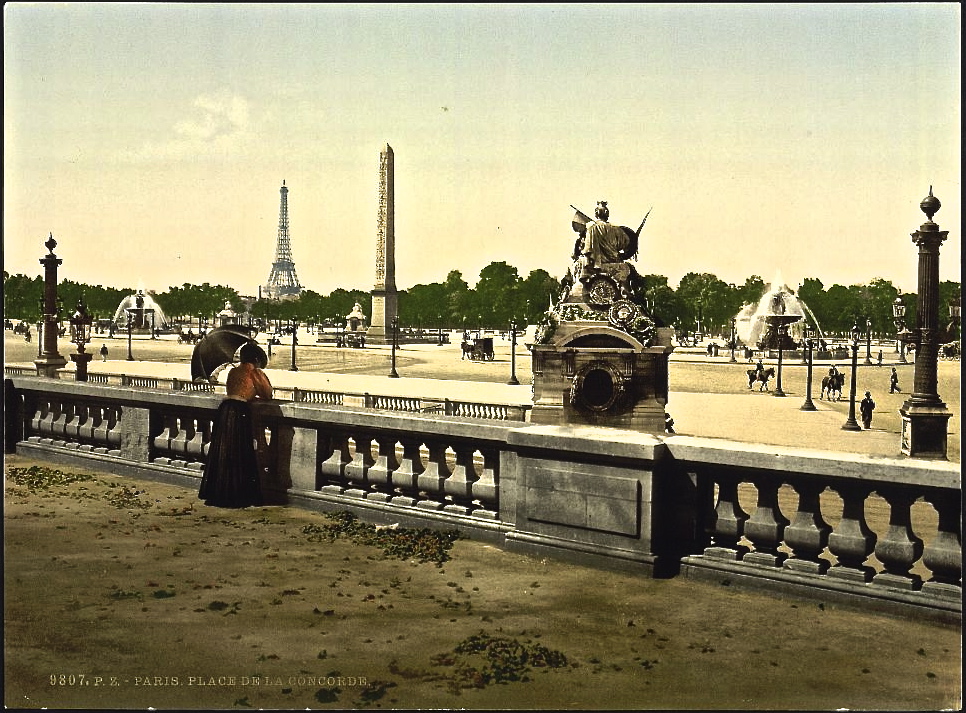
In these images of Belle Epoque Paris, the printer used ivory, pink, and apricot for the buildings and ground, quiet blues and greens for water and sky, and put a buttery light at the horizons.  The tints soften and still the monumental spaces on this walk from the Louvre to the Arc de Triomphe at L’Etoile.
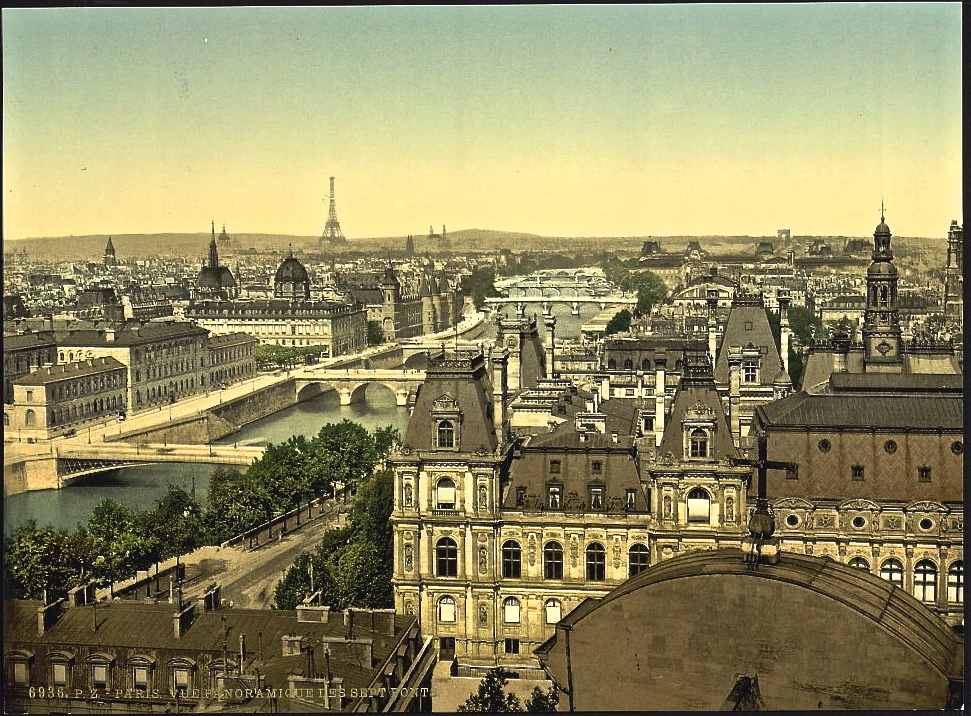
A panorama of the seven bridges over the Seine River. The Eiffel Tower in the distance was built in 1889.

(All photos were taken by the Detroit Publishing Company, ca. 1890-1900; all via the Library of Congress Prints and Photographs Division. To scroll through the images in full size, click on ‘Continue reading’ below and then on any of the thumbnails in the gallery.)
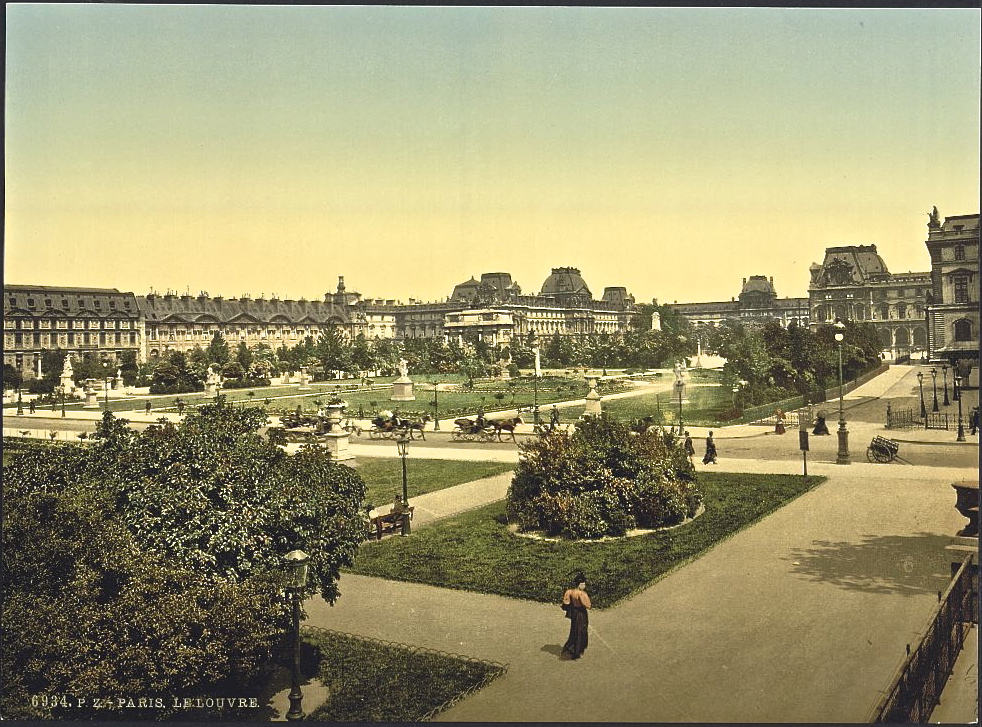
The Louvre.

The Carrousel. This arch was built in 1805 to celebrate Napoleon’s victories.
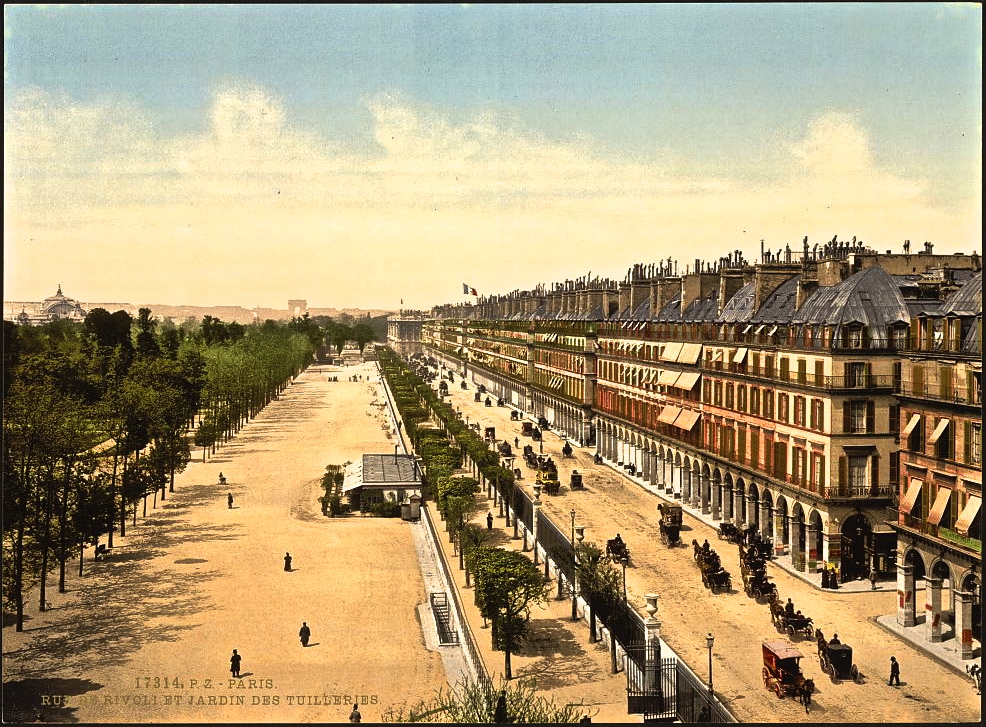
Rue de Rivoli. The arcades and shops along the street were built between the early 18th century and the 1850s.
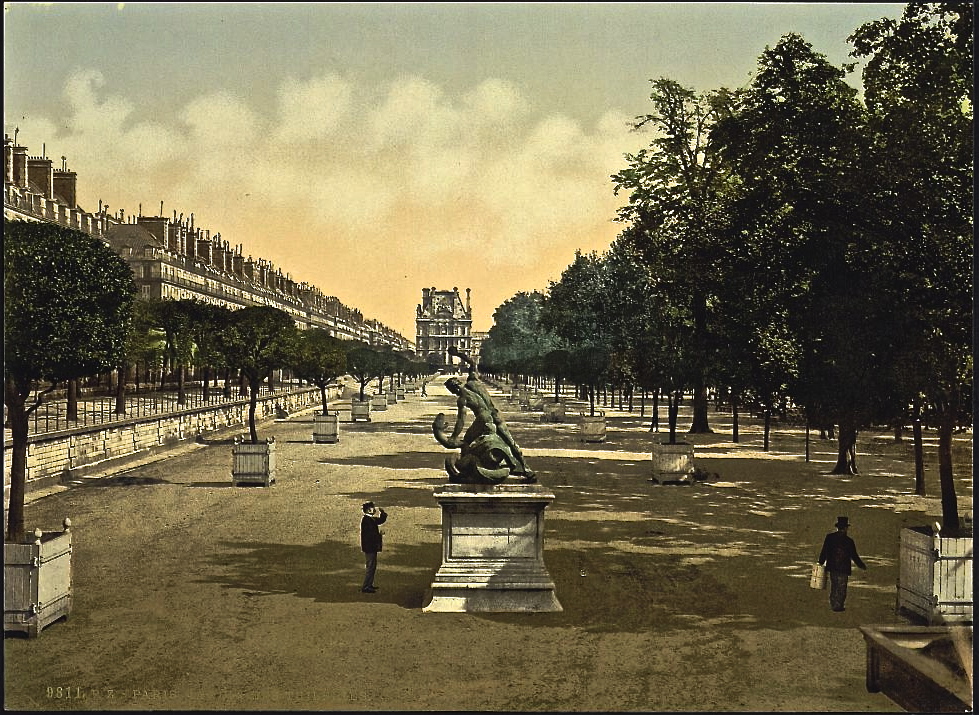
The Tuileries Garden.  Its name came from the tile makers (tuileries) who were removed  from the site on Catherine de Medicis’s orders so that she could build a (later-destroyed) palace and grounds.   The palace garden was redesigned in the 17th century by André Le Nôtre for Louis XIV.
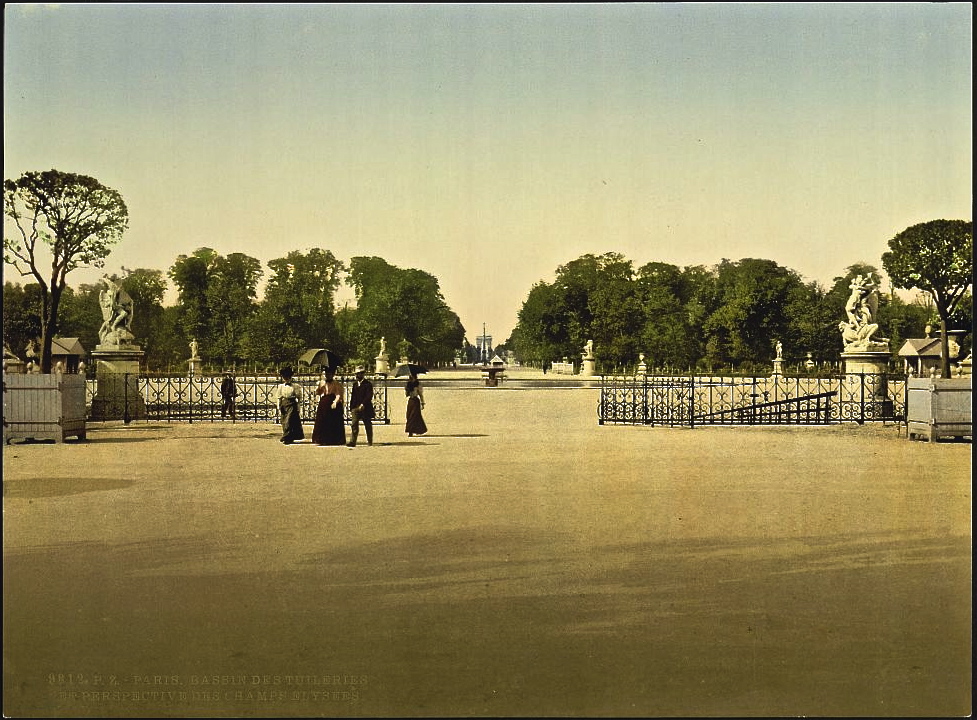
The Tuileries Garden.

Place de la Concorde.  During the revolution, the guillotine was placed here and took over a thousand lives. Later, the space was named la Concorde in a gesture of reconciliation. Since 1833, its central feature has been the 3,200-year-old obelisk from Luxor, Egypt.
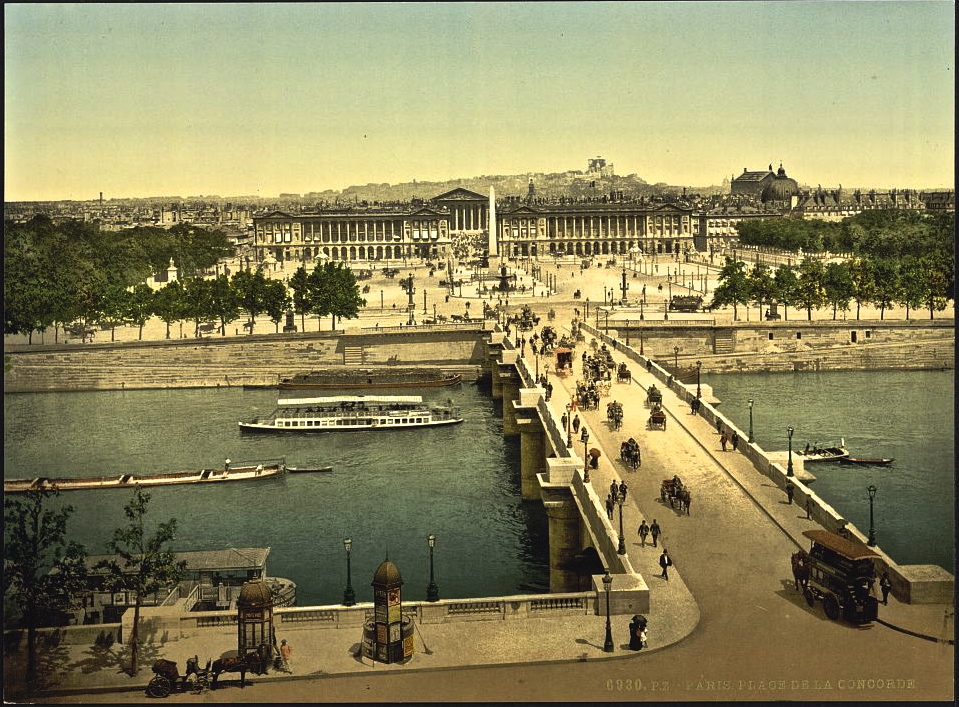
Place de la Concorde and Pont (bridge) de la Concorde.
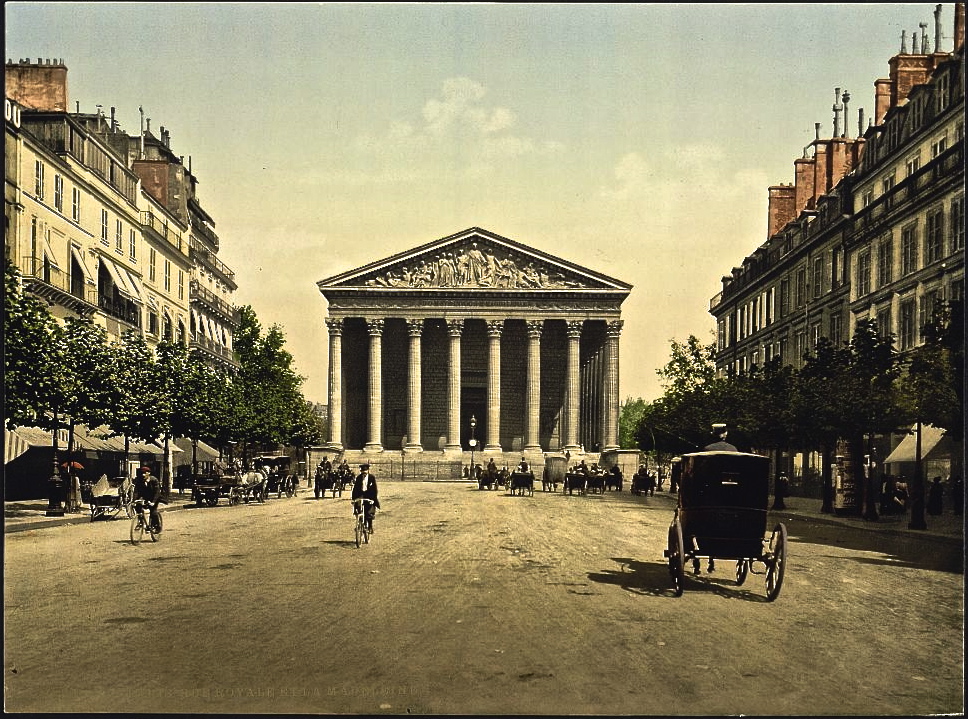
Rue Royale and Place de la Madeleine. This church is dedicated to Mary Magdalene. Its construction began in 1764, but it was not consecrated until 1845.
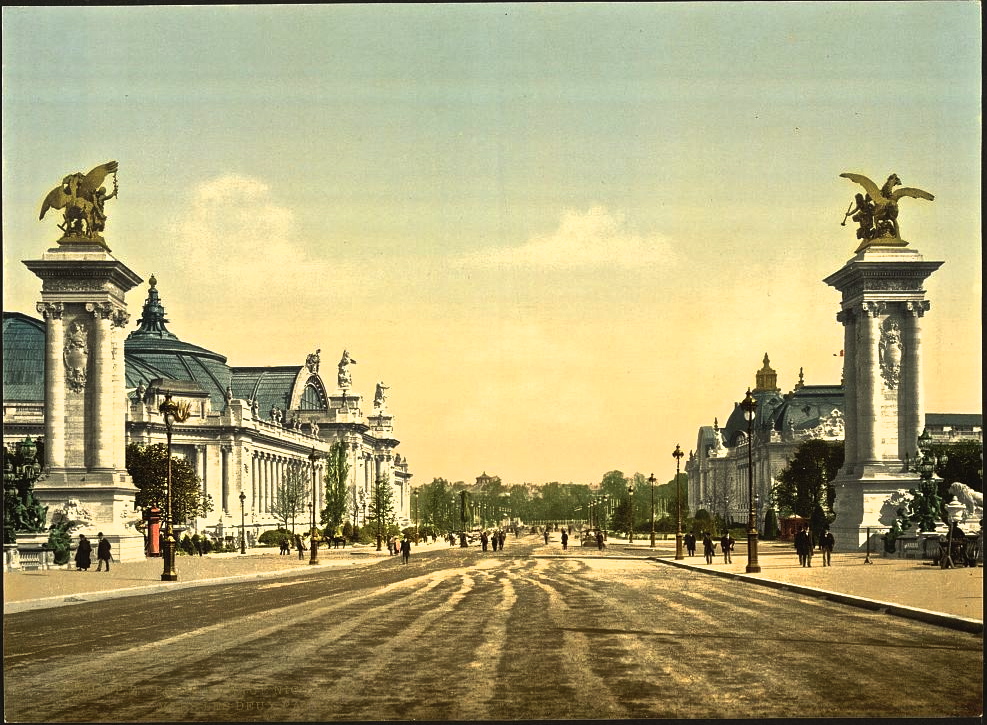
Ave. Napoleon III (now Ave. Winston Churchill) and the Grand Palais (left) and Petit Palais (right). The two display halls were built between 1896 and 1900 for the Universal Exhibition of 1900.
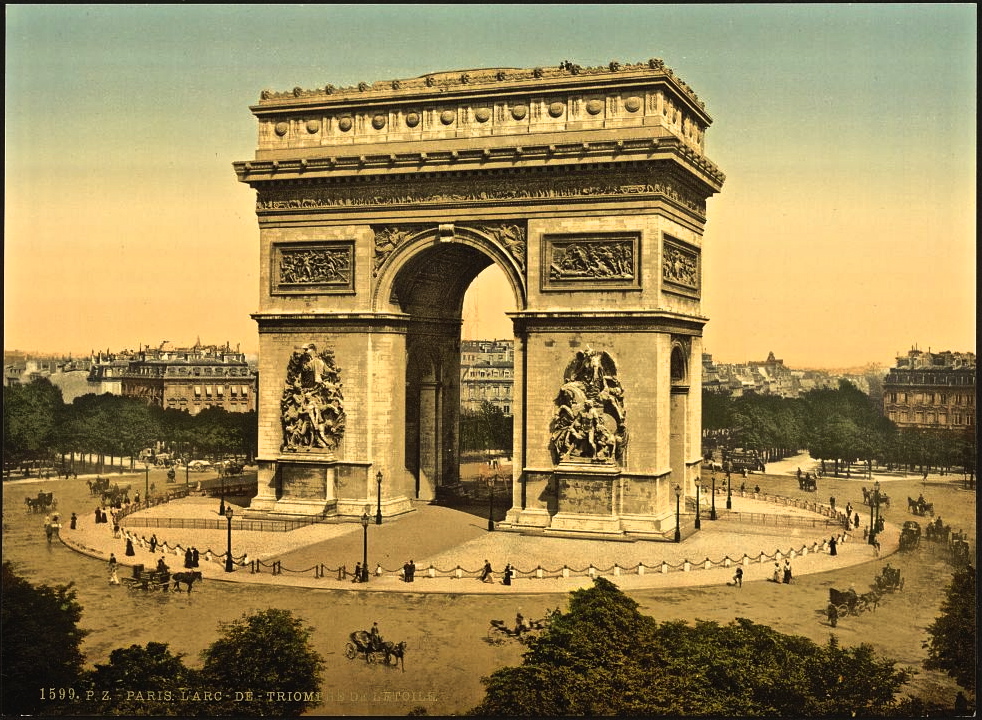
The Arc de Triomphe. The first stone of the arch was laid in 1806, but it was only completed in 1836 and dedicated to the French army.
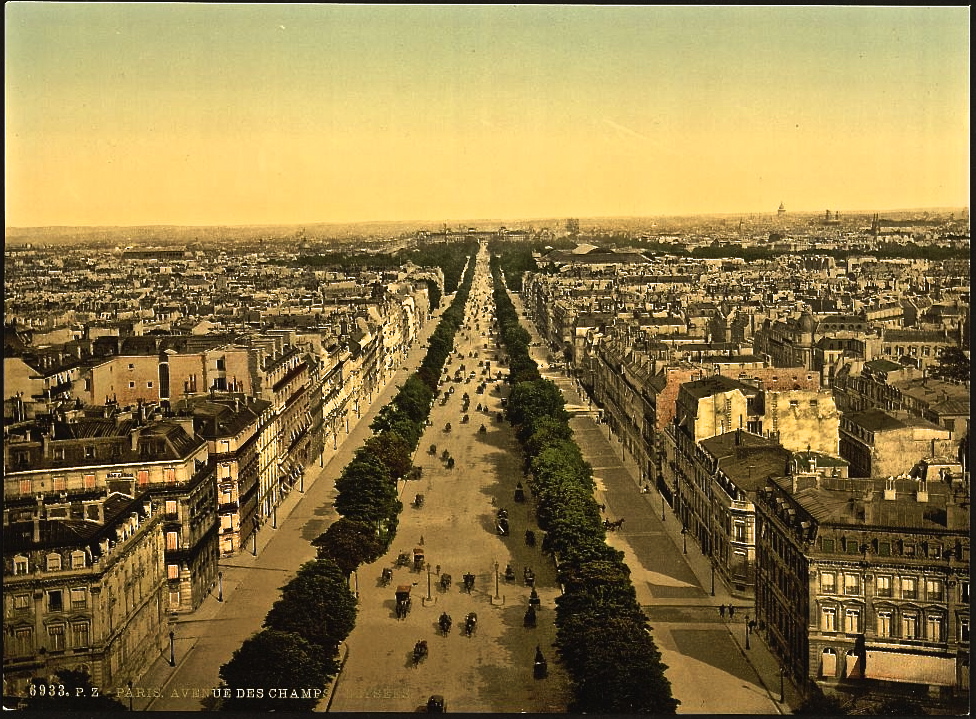
Avenue Champs Elysees, looking back toward the Tuileries Garden and the Louvre. The tree-lined boulevard was originally designed about 1667 by André Le Nôtre to extend the view from the Tuileries.


Quiet corners in foreign lands

Each time we’ve travelled to the north of Rwanda, we’ve passed the small Chinese cemetery in the Rulindo District. Last month, we stopped for a few minutes.
The cemetery is located just off the road to Muzanze, about 50 minutes from Kigali. It holds the remains of 10 Chinese citizens who died in Rwanda during the 1980s and 1990s, while they were working on development projects of road construction or health services.
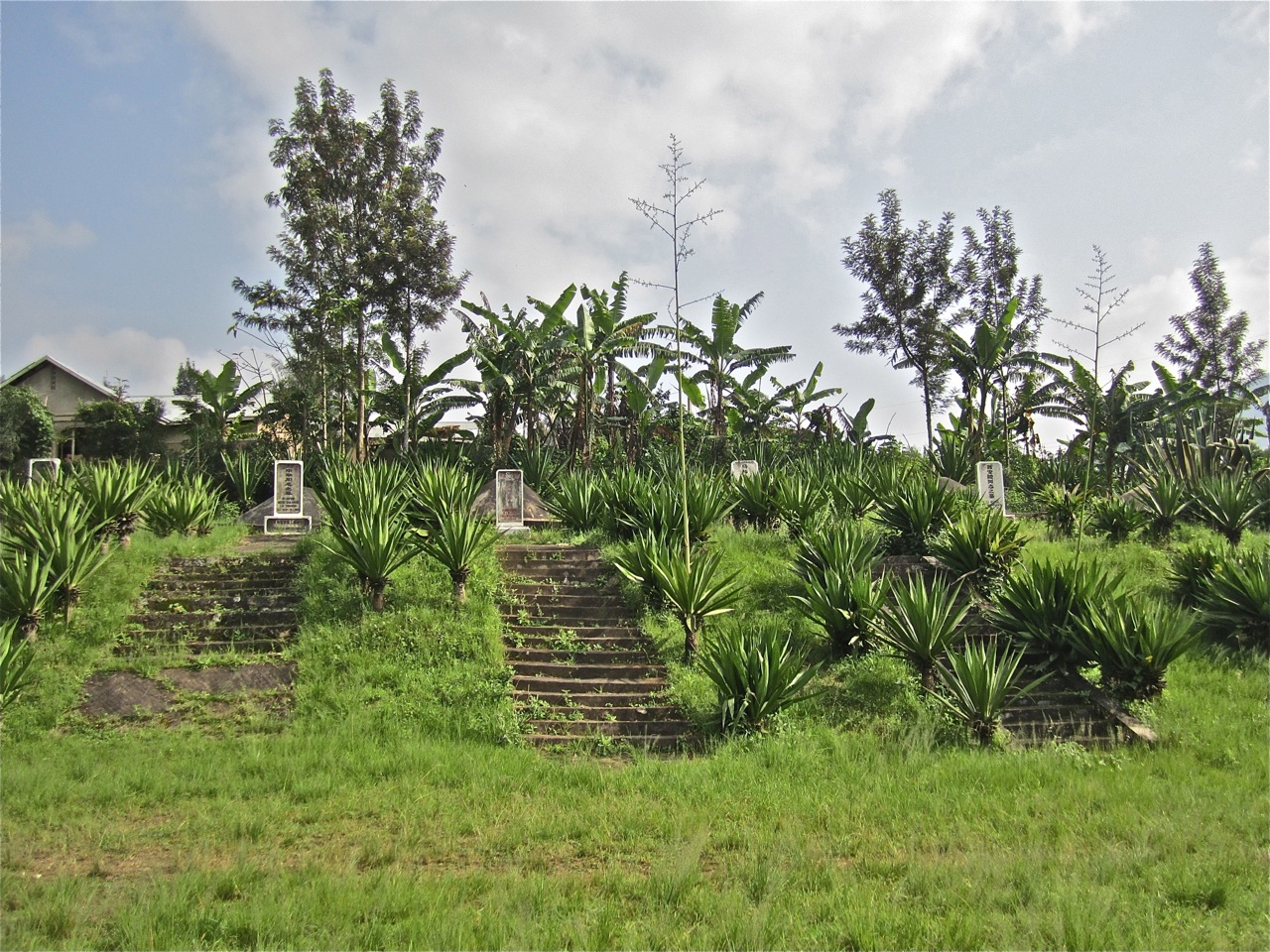
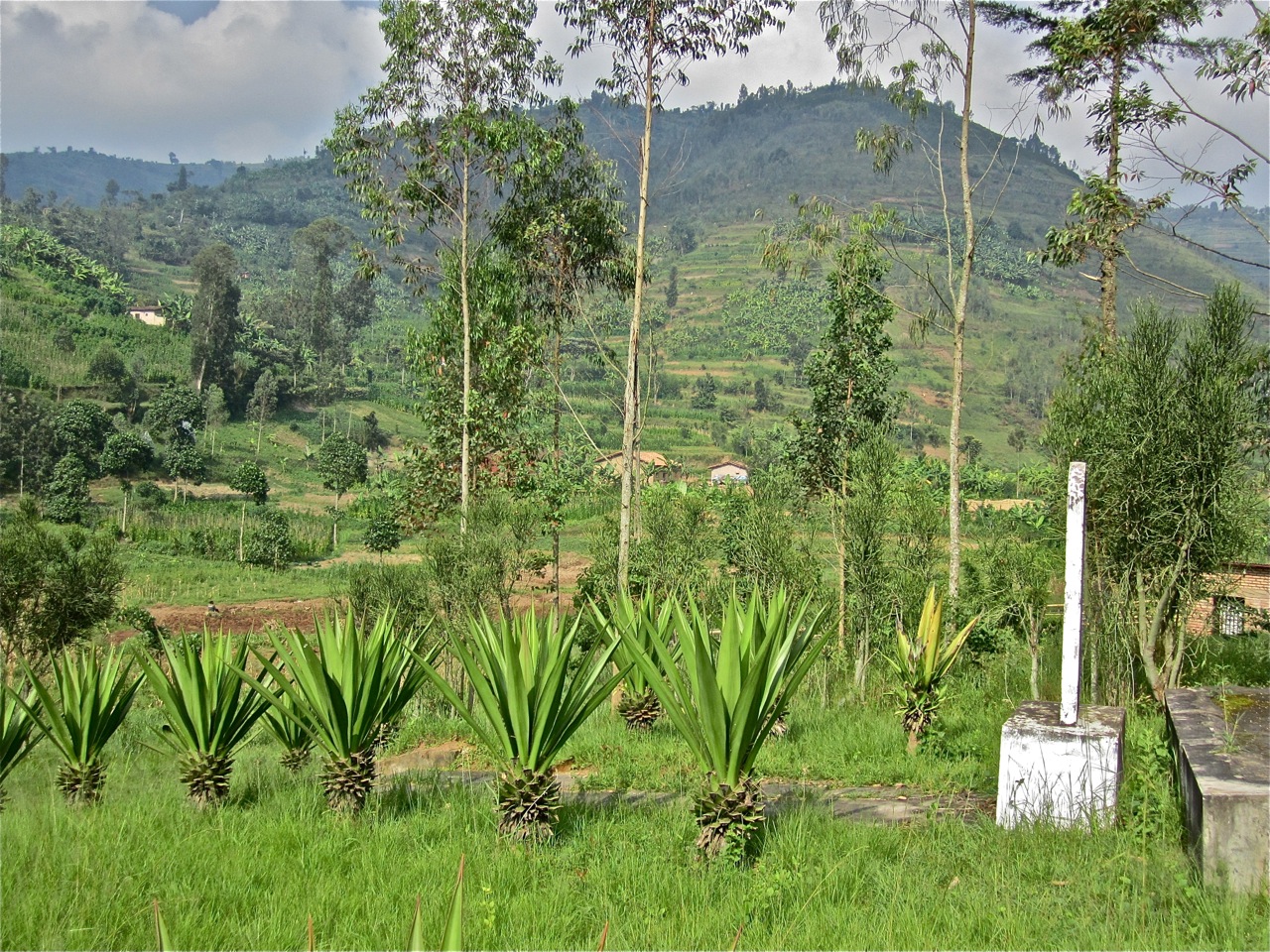
The graves are in a row near the top of a hill, with a set of stairs leading up to each one.
The material elements are now-weathered concrete, grass, and agaves.

The arrangement is simple, the effect poignant.

The cemetery is cared for, and the Chinese community, led by Ambassador Shll Zhan, held a ceremony there for the Qingming Festival on April 5 of this year.

When I looked at these pictures, I remembered two photos I had taken in 2007 of another small, touching cemetery garden. It holds the graves of eighteen Algerian retainers who had followed their Emir into imprisonment in France in 1848.

Abd al-Qadir and his household were held in the Château d’Amboise in the Loire Valley. Those who died before he was released in 1852 were buried there.

The memorial garden on the grounds of the château is beautiful. It was built in 2002, according to one source, but I have been unable to find out any more about it.

The square markers are set in a rectangle planted with low mounding plants. A hedge of rosemary diagonally intersects the space.

Our garden: site analysis

I’m afraid I’ve let all the work we’ve done on our Kigali garden recently move well ahead of writing posts about it.

We — the gardener, two temporary workers, and I — made some substantial changes during June.  So much so that we’re now taking a week  or so of relative rest before the gardener and I start phase two.  (When I got up in the middle of the night about a week ago, I thought I was going to die, my muscles were so sore.)

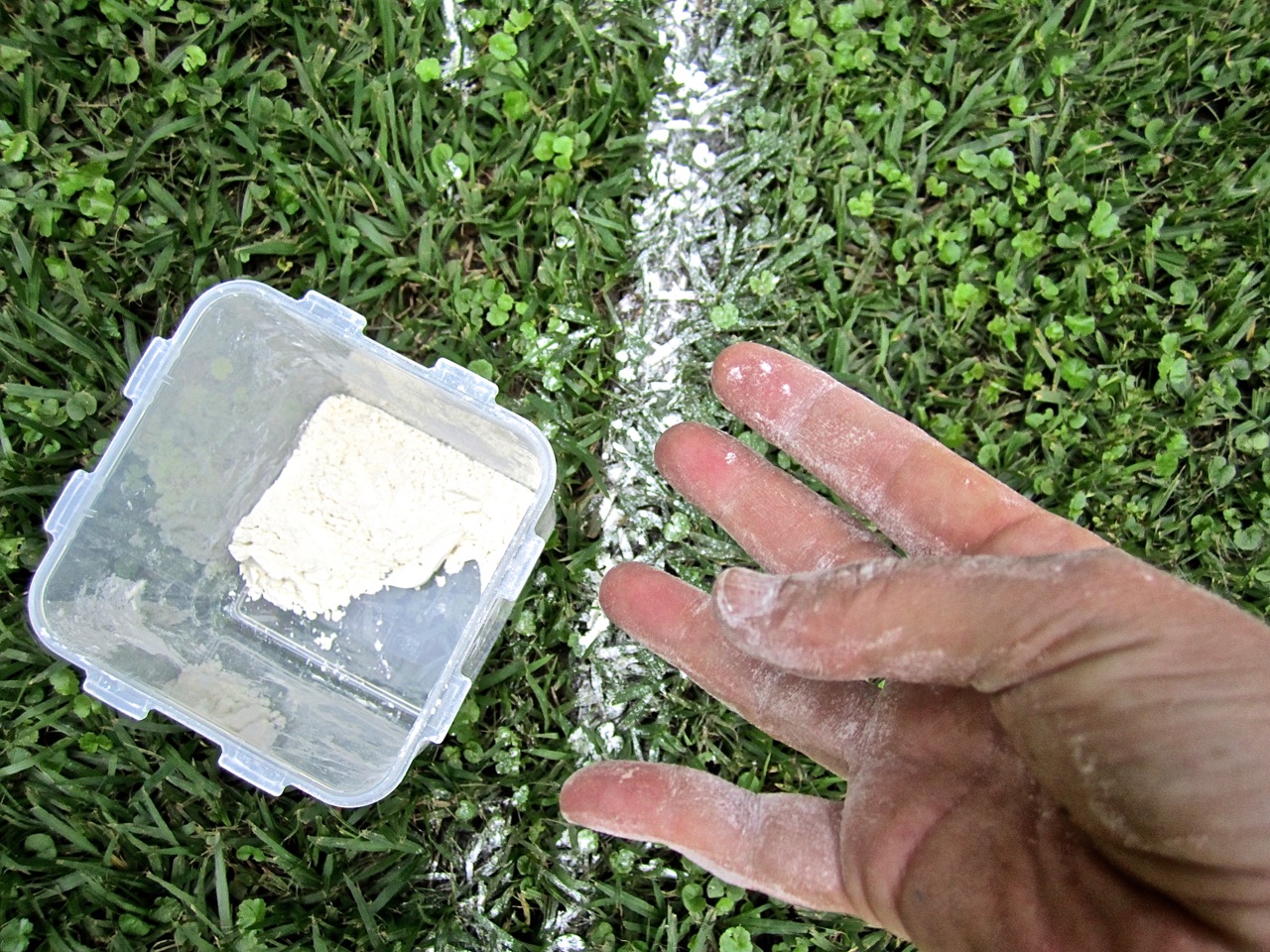
Hint: I’ve been using flour to mark the new outlines of planting beds.

So while we pause, I’ll back up and give you some “before” pictures and a little site analysis.

(I’m going to use the present tense while describing the old garden features, so as not to give away the changes we’ve made).

This is a good-sized, “working” diplomatic garden that hosts two or three receptions or ceremonies a month.  It’s very pretty and lush, with mature trees and many flowering shrubs.  But it also has some problem areas — places where purpose is ill-defined, opportunities for drama or charm are missed, transition points are weak, and many plants are too old or badly pruned or overcrowded.

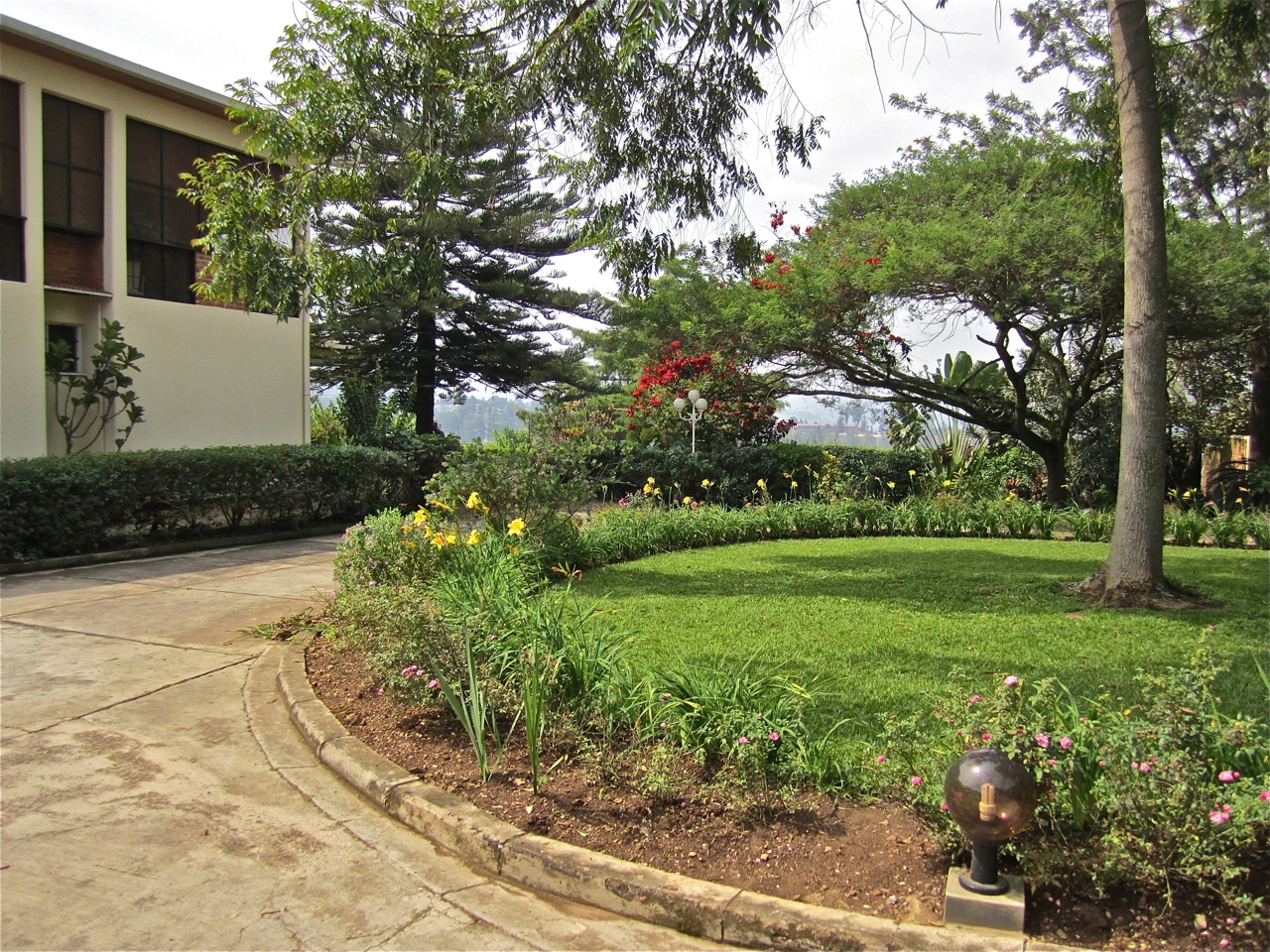
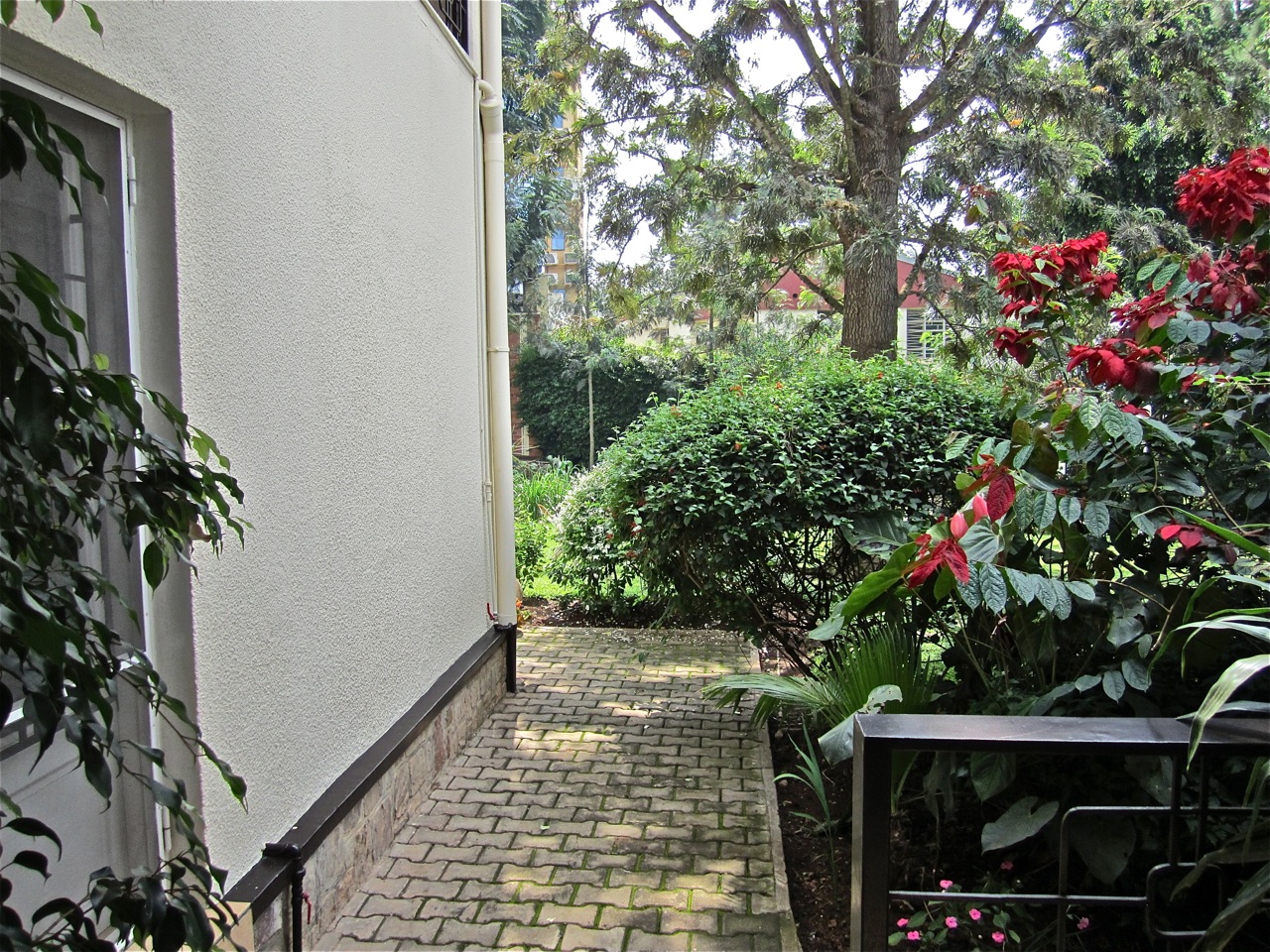
The first photo below shows the view when you enter the gate to the property: one end of the house, the circular driveway, and a semicircle of grass edged by day lilies and miniature roses. (If you look left, you see the back of the house and a parking area.)

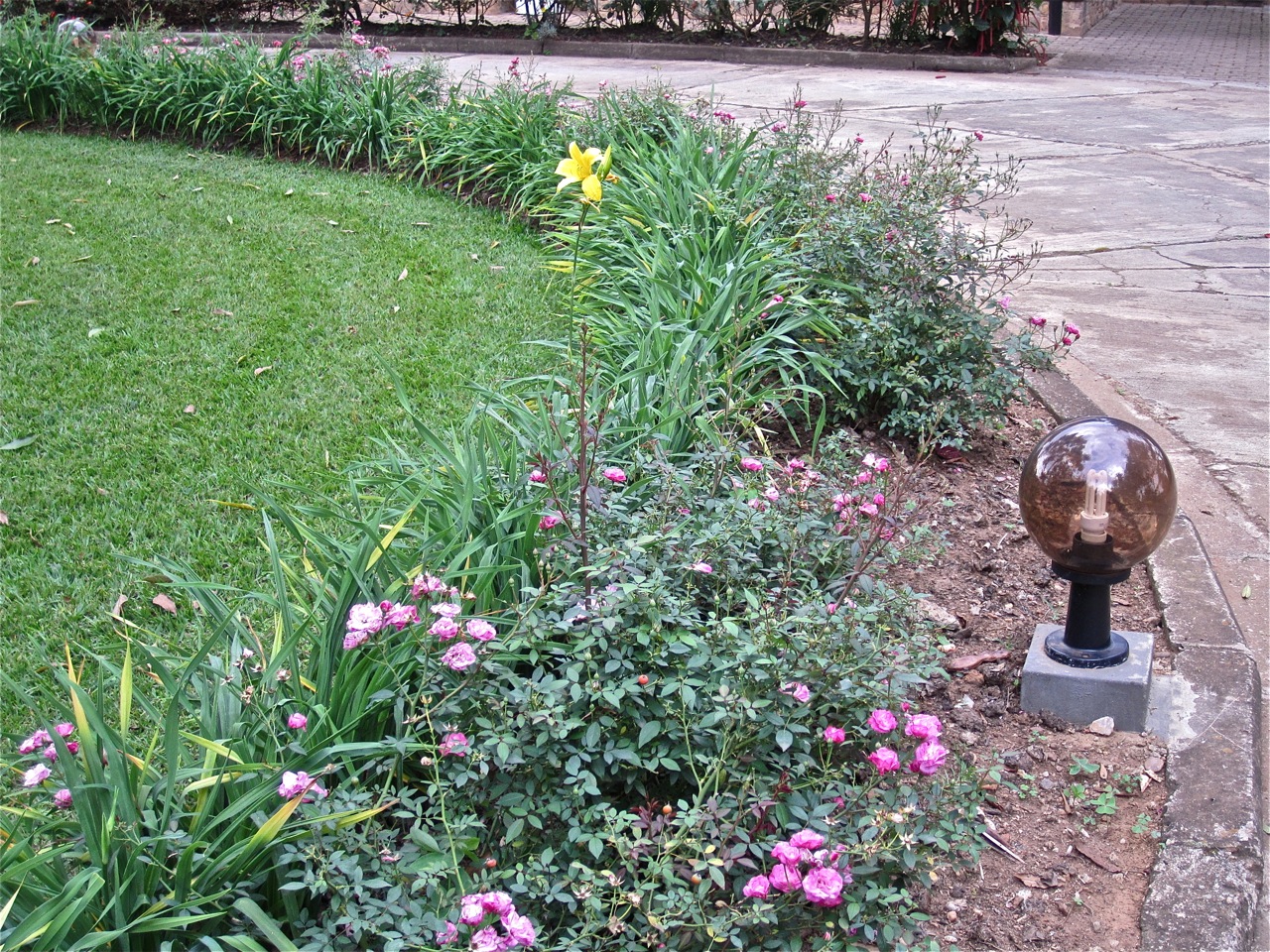
In the semi-circle, shown above and below, the miniature pink shrub roses (possibly “The Fairy” variety) are planted in a line along the curb, and the yellow day lilies are lined up right behind them.  I’m not fond of the yellow/pink combination, but my main concern is that the single-file arrangement  — the first thing you see when you walk or drive into the enclosure — is skimpy and makes a weak  impression.

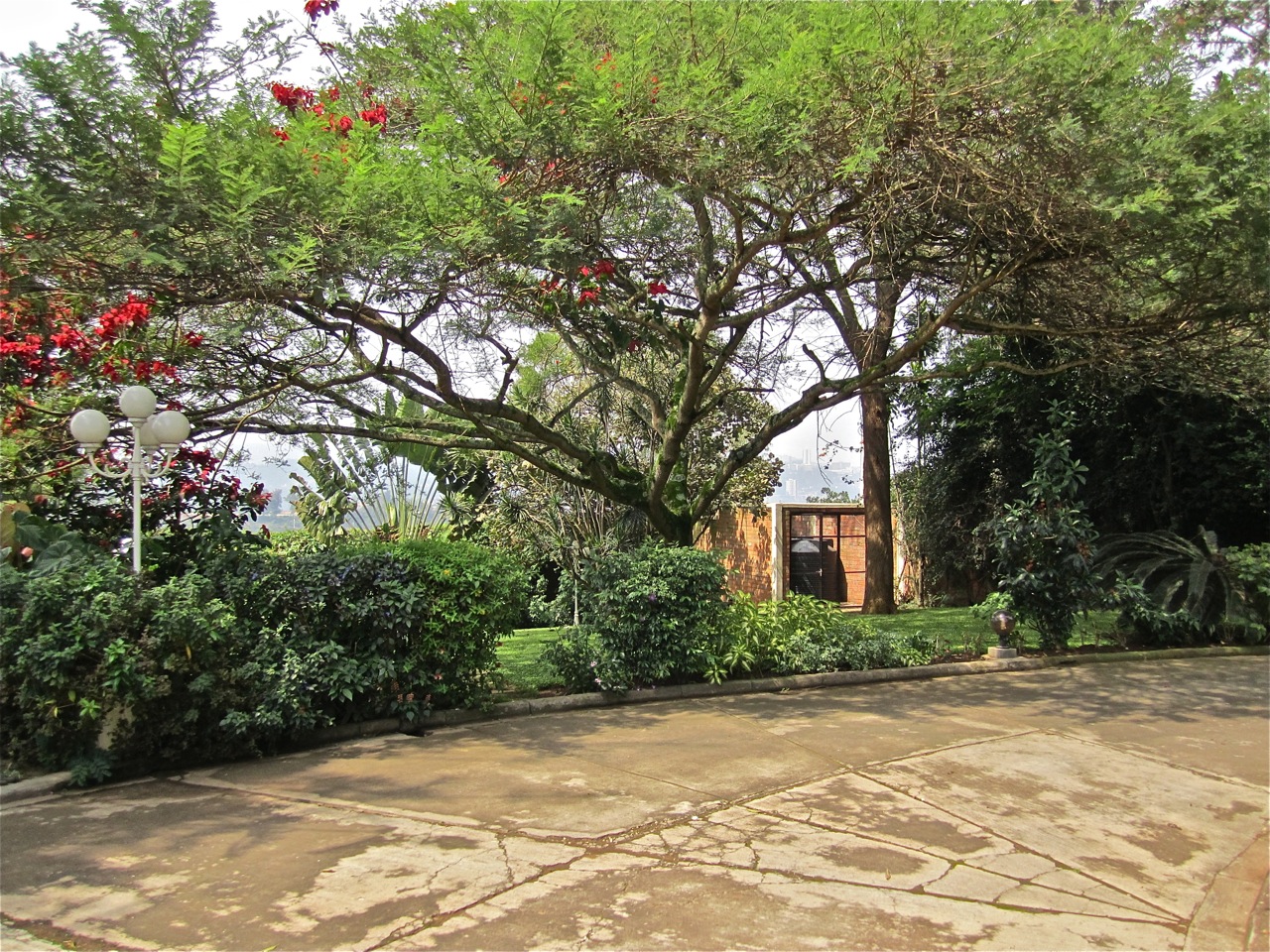
Looking right across the semi-circle, below, you see a beautiful  spreading acacia tree, but its impact is obscured by the shrubs and plants growing along the edge of the drive.

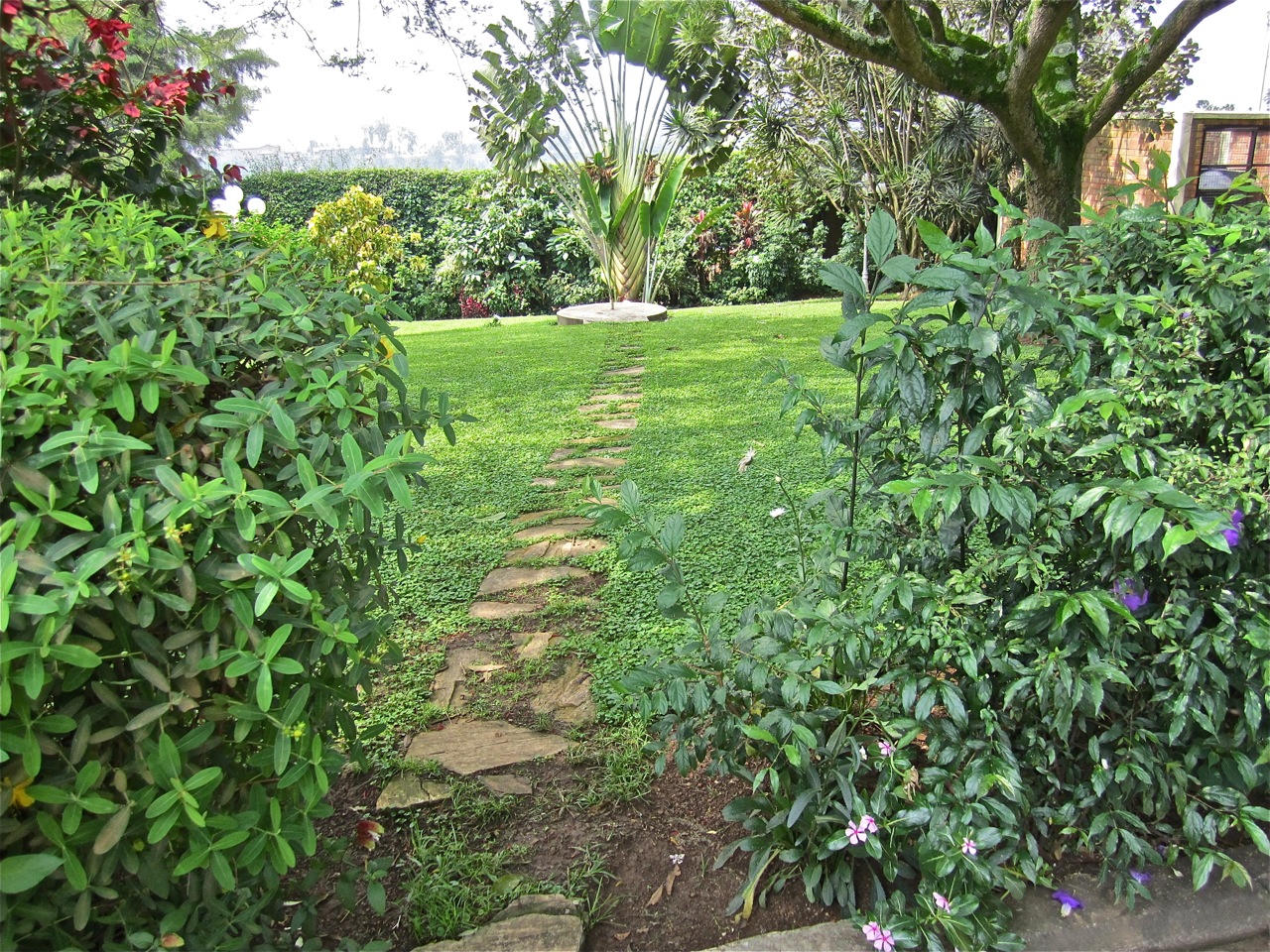
If you slip in a small space between a couple of those shrubs, as in the photo below, you find an old stone path leading to a no-longer-used concrete flagpole base.  And to the left of the concrete base are steps to the long front lawn.

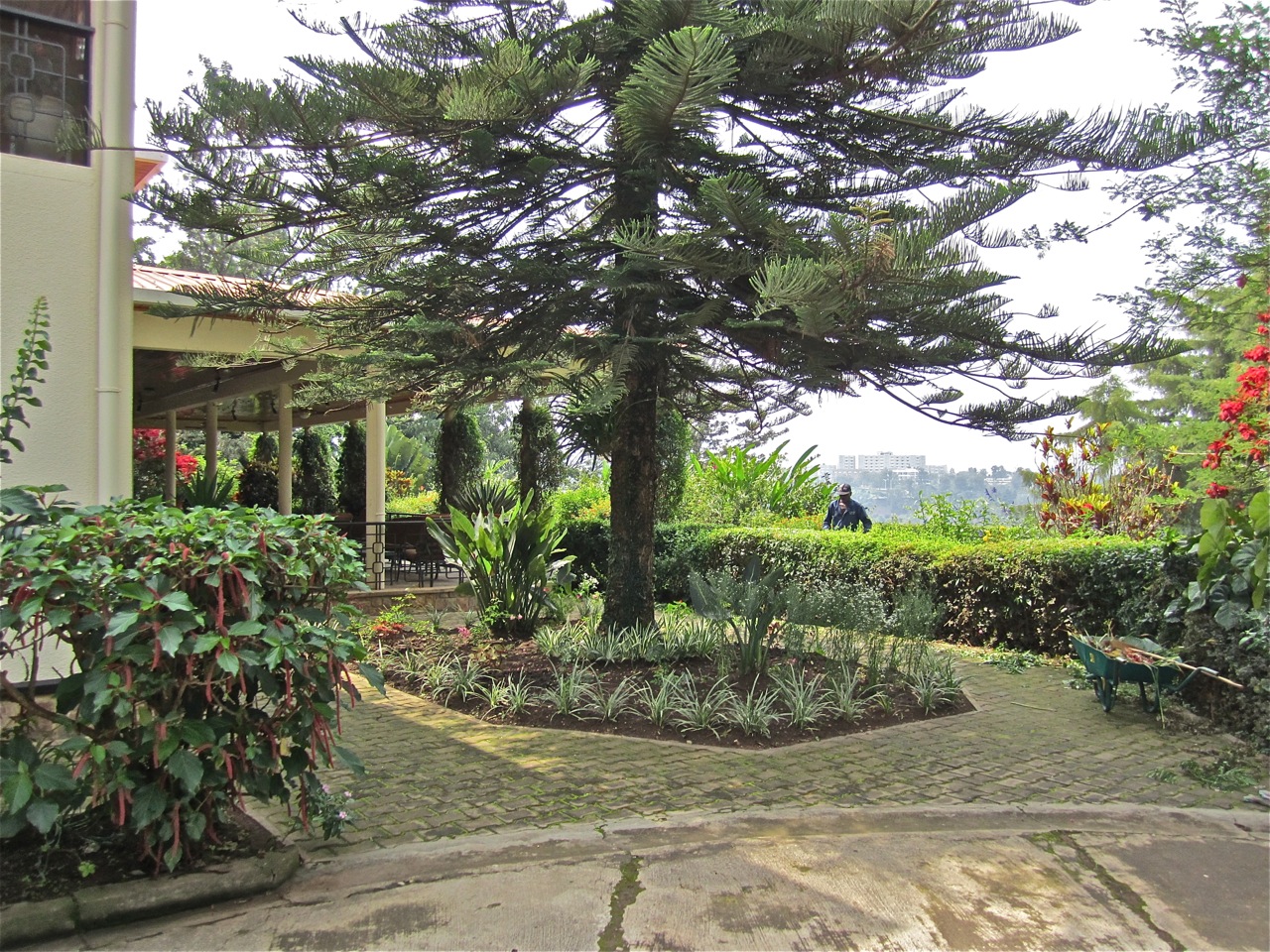
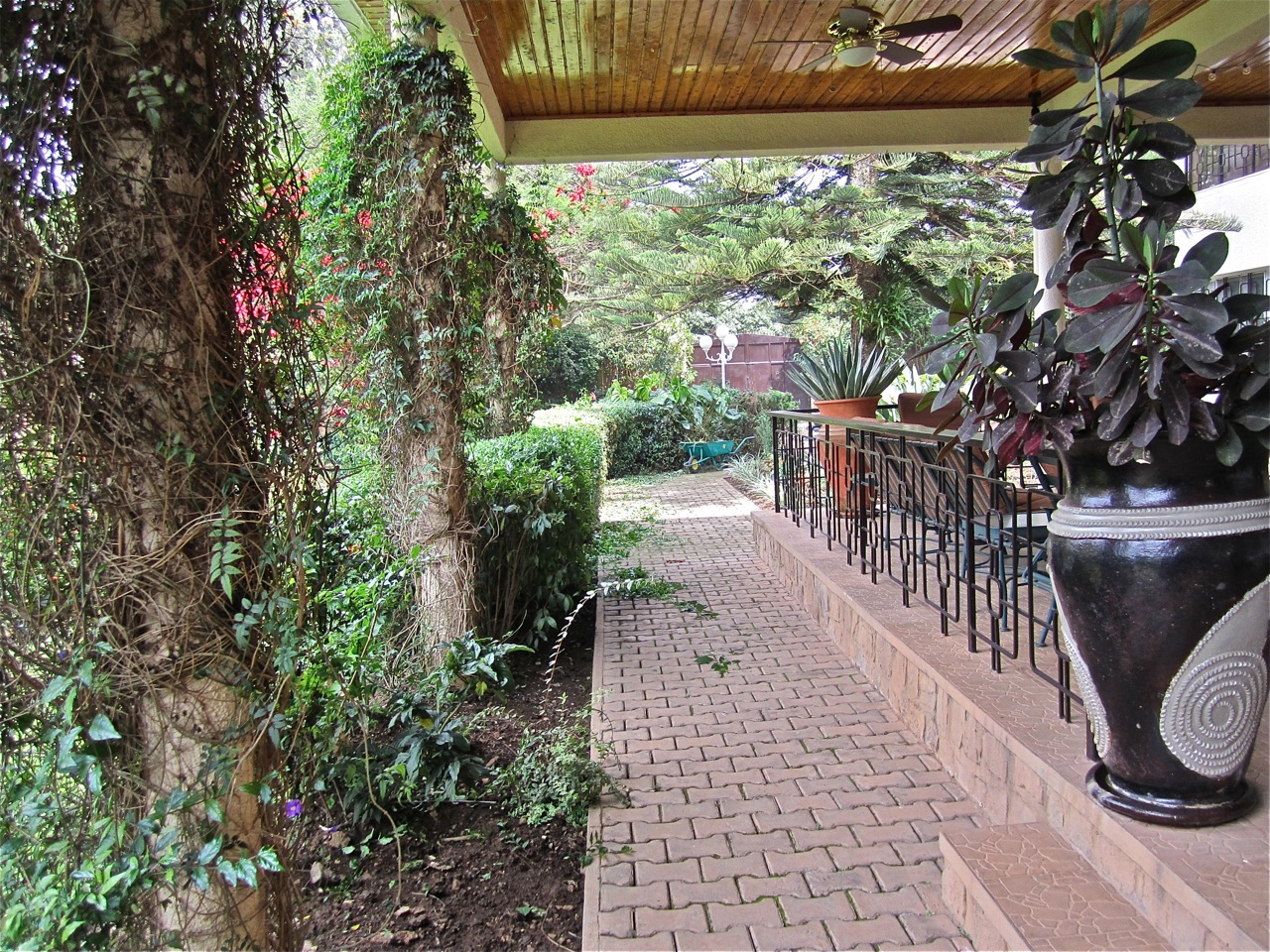
Below, the photo shows the side entrance to the front terrace.  (If you back up to the starting point in the first photo above, walk down the drive along the side of the house, you reach this point.)  This is where we welcome guests.  Because of the planting bed in the center, and the clipped hedges at the edge, the paved walkways only comfortably allow for two people to stand side by side.

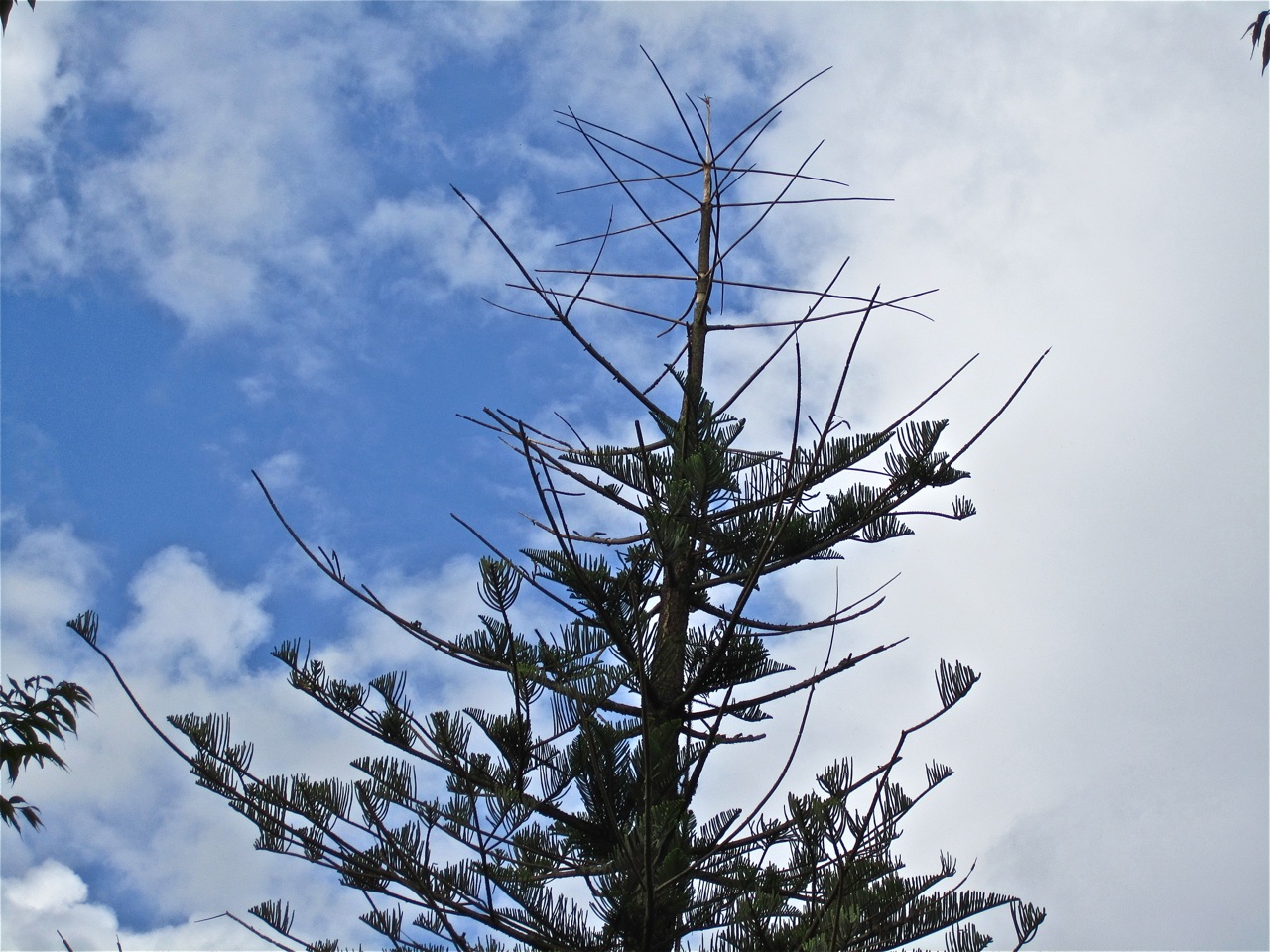
The hedge is made up of plumbago, lantana and other flowering plants, but the blooms are mostly sheared off.   In center of the planting bed is a tall Norfolk pine and a rather skimpy assortment of small roses, asters (I think), lirope, coleus, and a bird of paradise.

Unfortunately, the tree is dying.

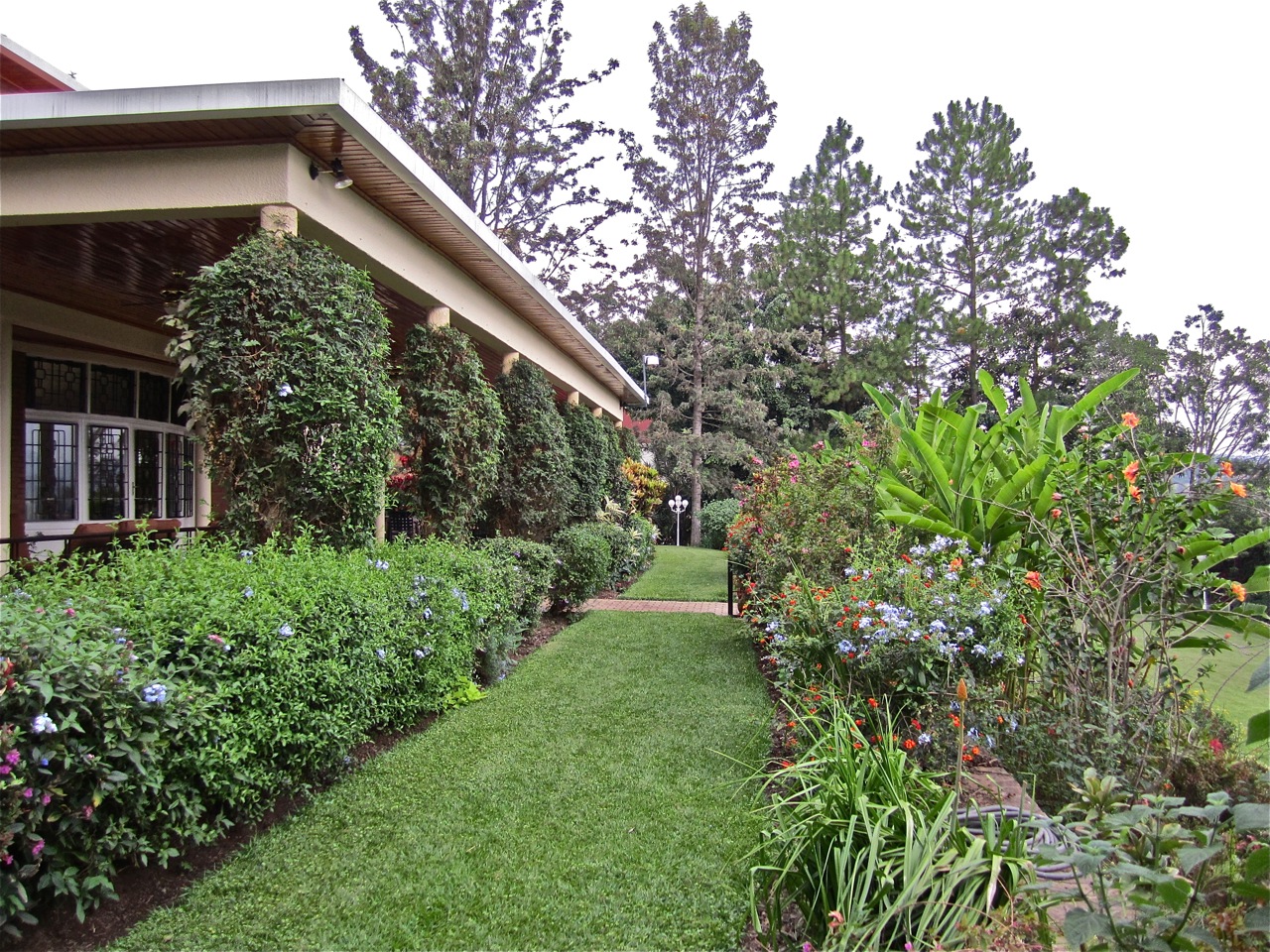
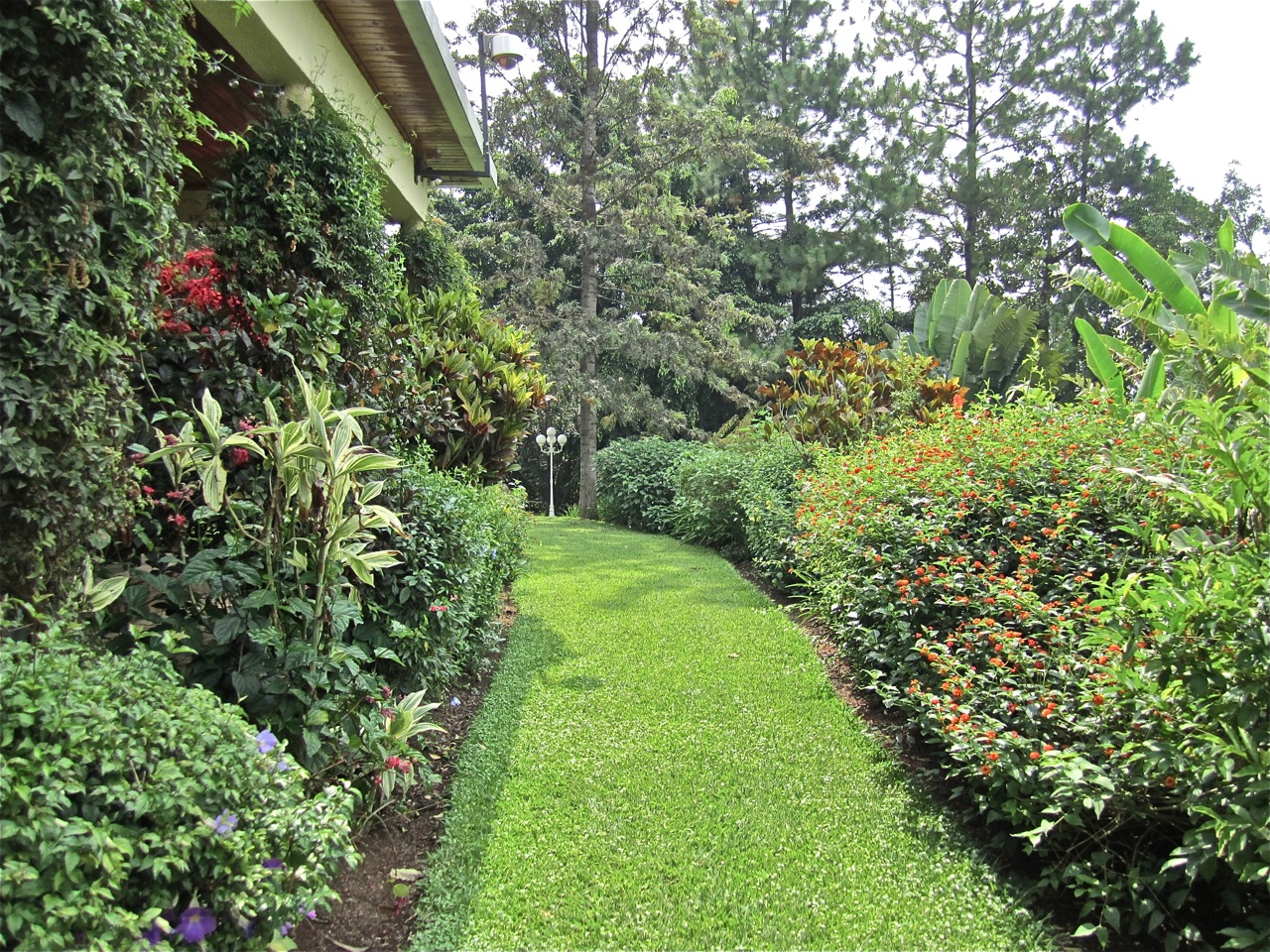
If you step through this area, you’ll be on a long terrace along the front of the house.  As you can see in the photo below, in  front of the terrace are two rows of (mostly) clipped shrubs and a path of grass between them.  Plumbago and jasmine are growing up the house columns.  The vines and shrubs attract colorful little birds right up to the terrace.  However, the vines on the backsides of the columns are bare and brown from constant shearing and a lack of light.

The shrubs right along the terrace make it feel closed in, and I believe that mosquitoes hide in there in the evening.

While the arrangement is rather pretty, the grass path serves little purpose — it’s mostly blocked by the shrubs on one end, and it’s too narrow for seating.  The tall plants on the right in the picture above — particularly the 6’+ lobster claws (Heliconia rostrata) — obscure the view of the hills and the city.

There are a lot of great plants in the beds on either side.  And I always imagine Alice running through some part of  Wonderland when I look down this side of the path (above).

Unfortunately, the terrace side of this strip (above) gives me an unpleasant crowded feeling, and the leaves of the vines die off from lack of good light.

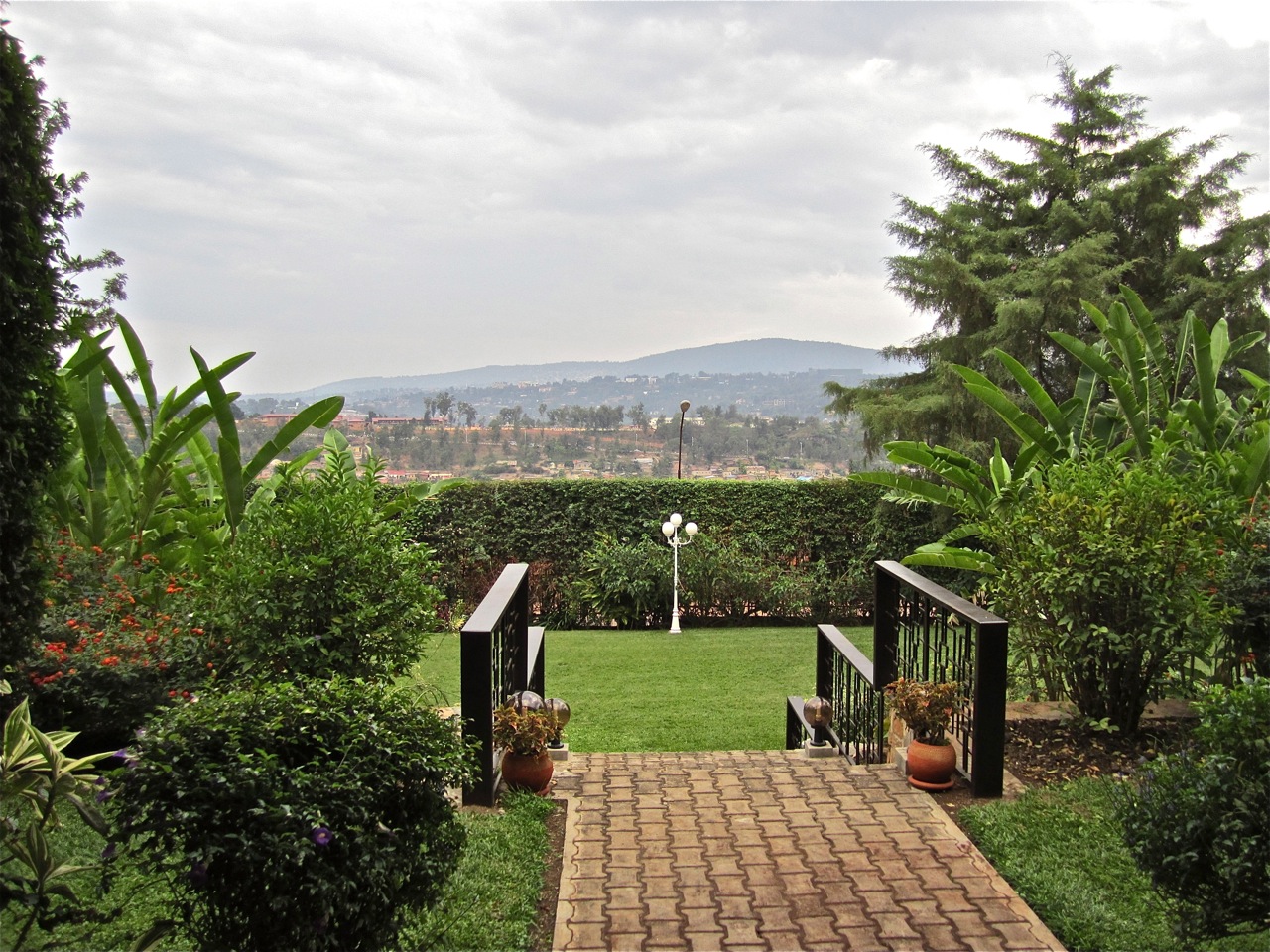
Above is the view from the center of the terrace.  It’s somewhat blocked by the tall lobster claws on either side of the steps.  Down those steps are two levels of stone retaining walls and then a long lawn.

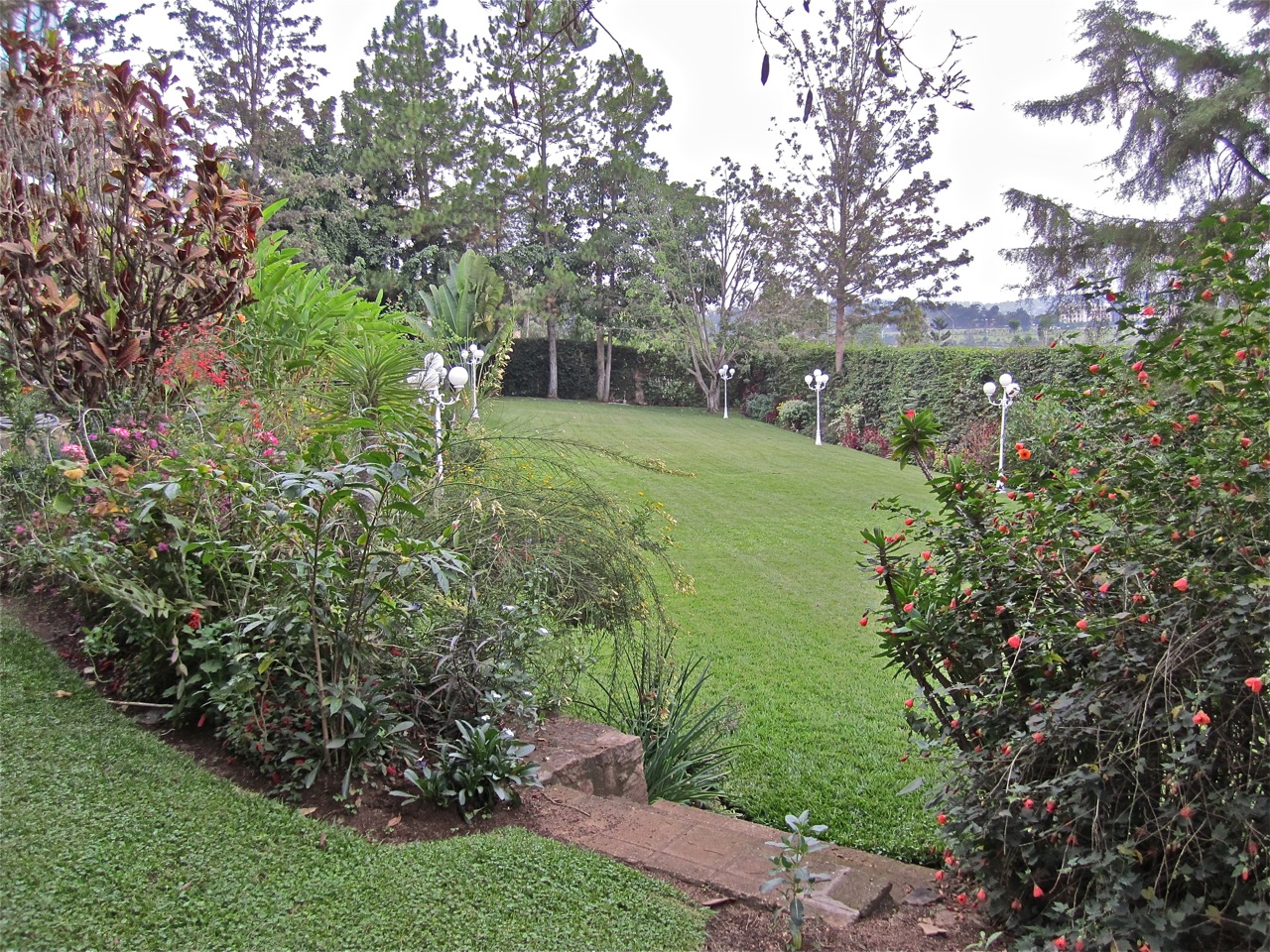
Above is a view of the lawn from one end (at the steps just to the left of the flagpole base in the earlier picture).  When we entertain large groups, the embassy puts up one or two tents in the center of the lawn.

On the right side of the lawn, at the front of the property, there is a clipped bourgainvillea hedge and a variety of interesting shrubs and plants, all sharing a very narrow strip of ground.  The slight dip at the edge of the lawn makes it look like the plants in front are sliding under the hedge.

In the photo above, you can see how pretty the shrubs are, but again how little room they have.  Since this picture was taken, the gardener has cut these bushes along their sides to keep them from intruding onto the grass.  Now you see a lot of bare stems — not very attractive.

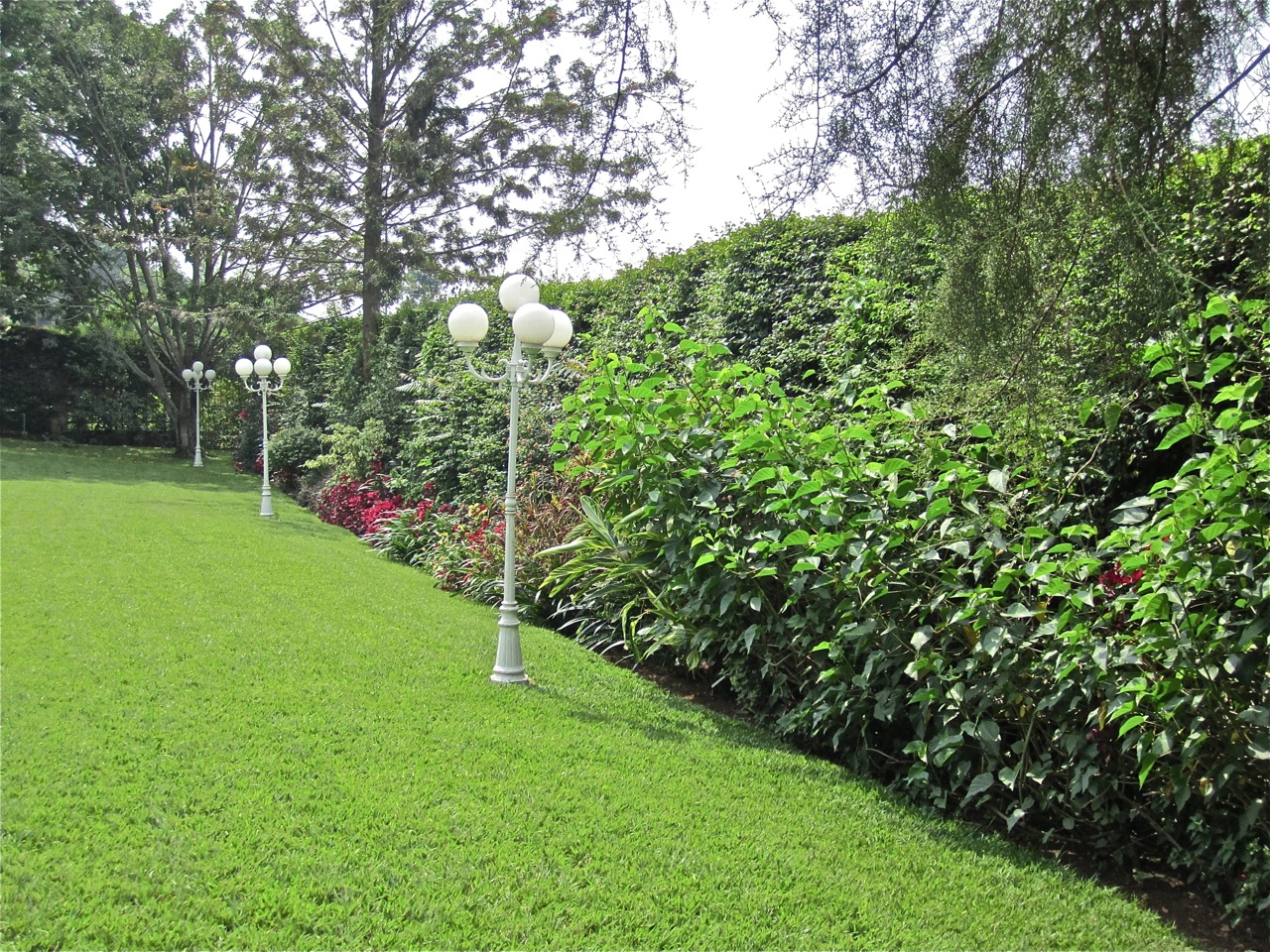
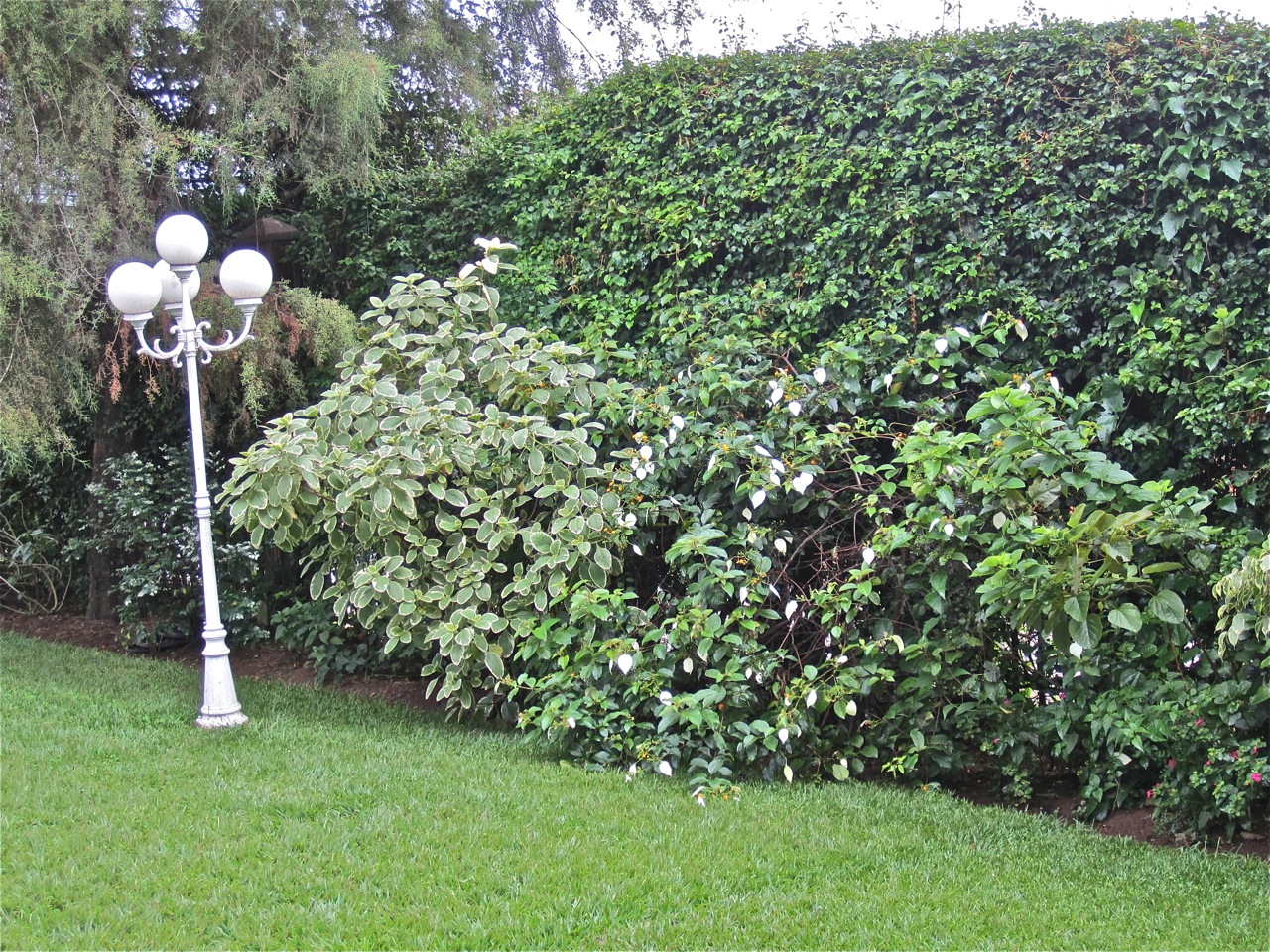
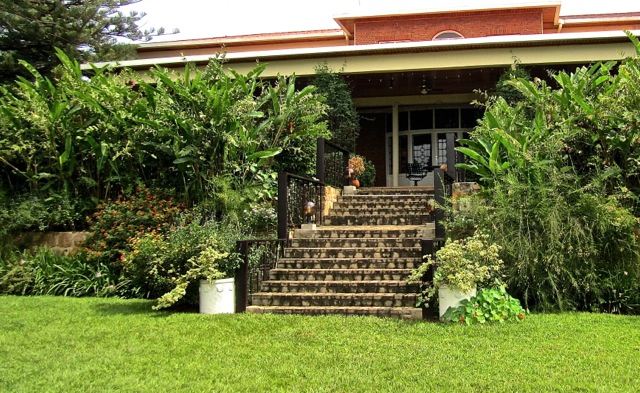
The white, curlicue, Victorian light posts in the above photos really bug me, I must admit, because, as you can see in the picture below, the lines of the house are attractively modern and simple.

Above is the view from the lawn at the bottom of the center terrace steps.  You can see, to the right and left, how tall and thick the lobster claws are. (Are you getting the idea that maybe something’s going to happen to those plants?)

You can also see from this photo how the two levels of stone retaining walls that branch out from either side are an important feature of this part of the garden.

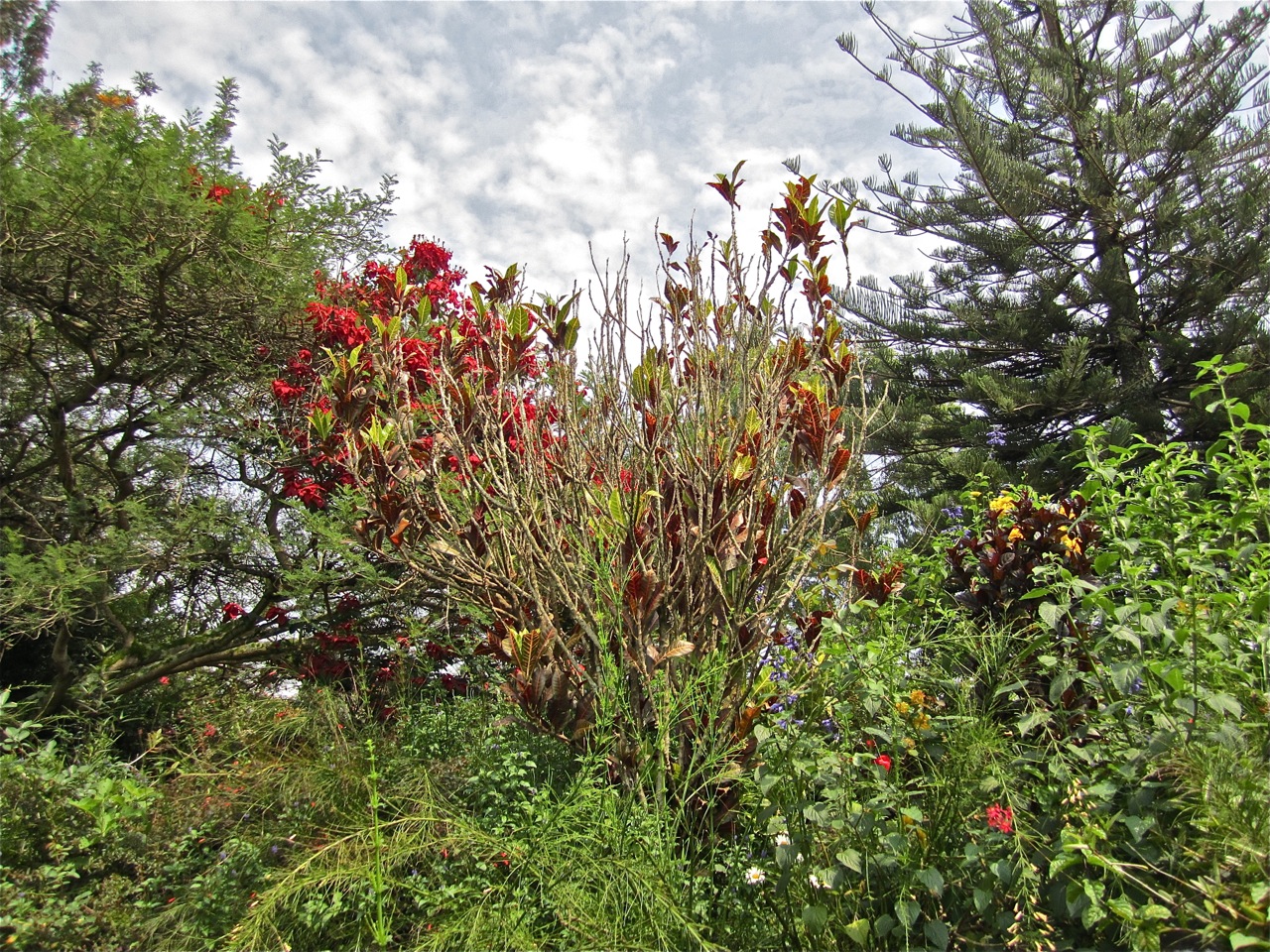
The planting beds at the top of the lower retaining walls are full  of great plants, but it’s a real thicket in there.  I have sometimes found three shrubs growing out of the same 8″ spot of ground.  And this old croton (above) is so overgrown that it’s lost half its leaves.  And at its current height, you look up onto the undersides of the remaining leaves, rather than down onto the colorful tops.

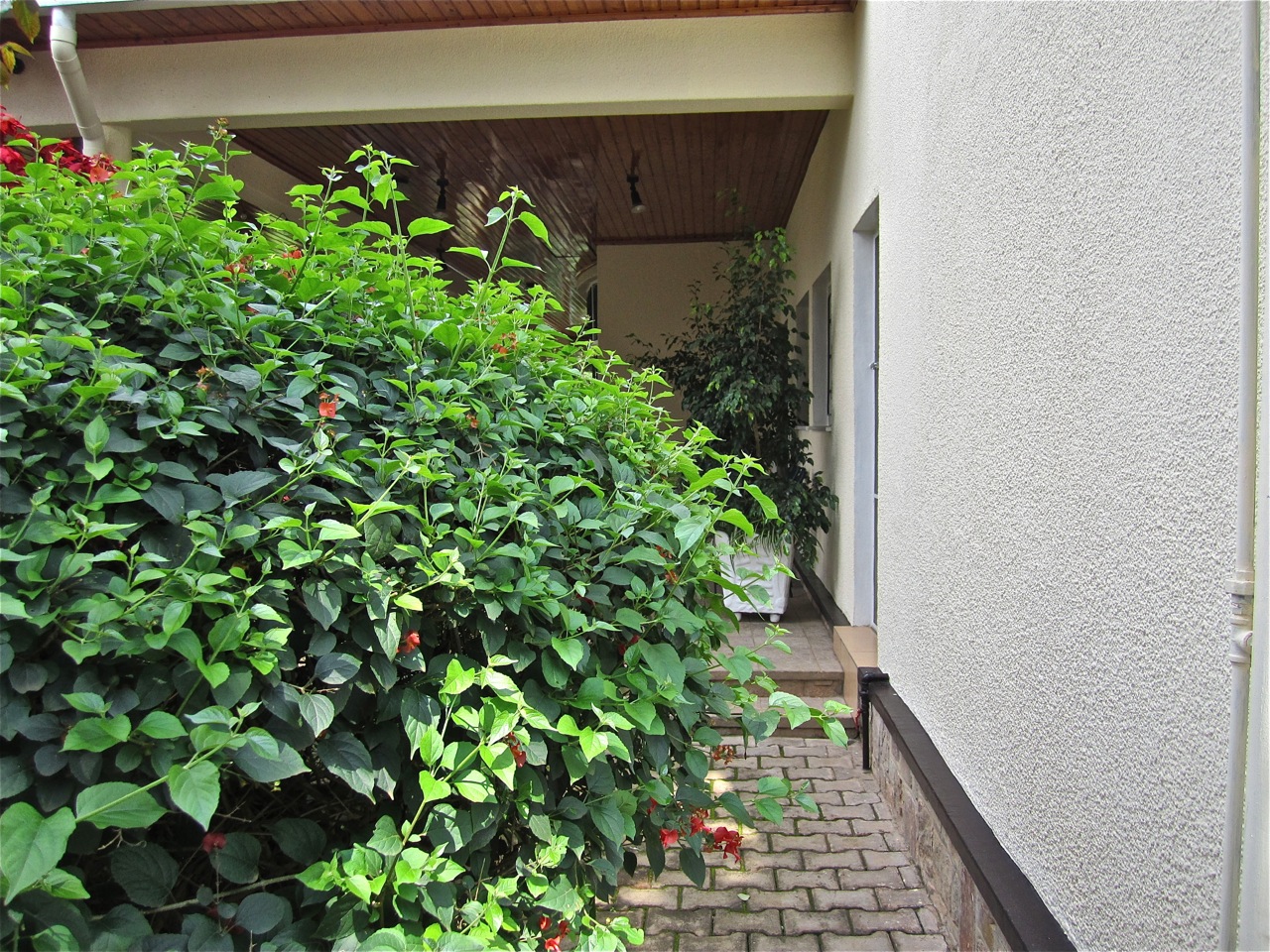
Above, going back up to the terrace and walking its length to the opposite end of the house, the path to the side yard is almost blocked by a very large, very clipped shrub (also shown below).

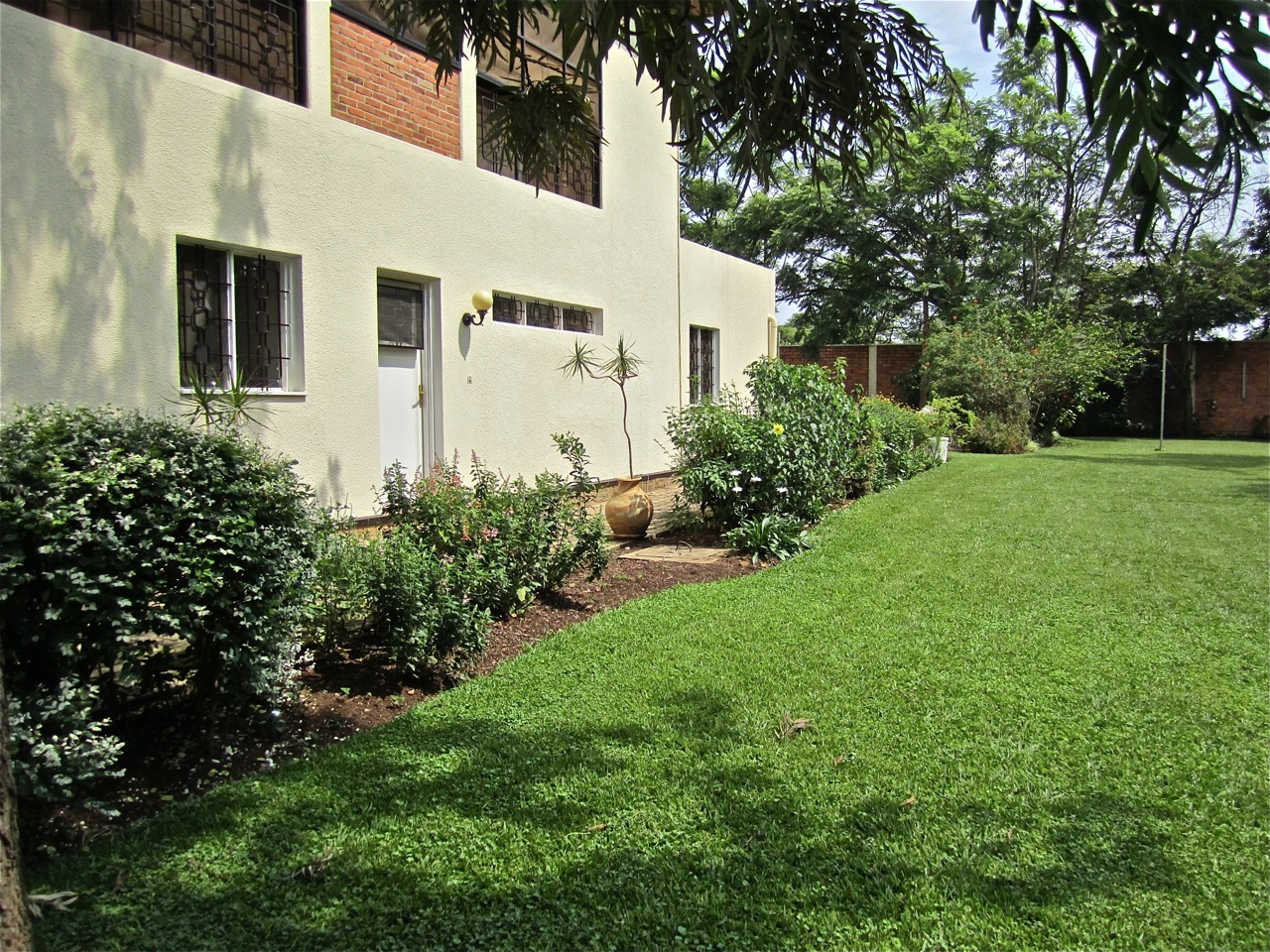
Squeezing past the bush, you come to the side yard  and the other end of the house (below), which has a narrow planting strip along the sidewalk . . .

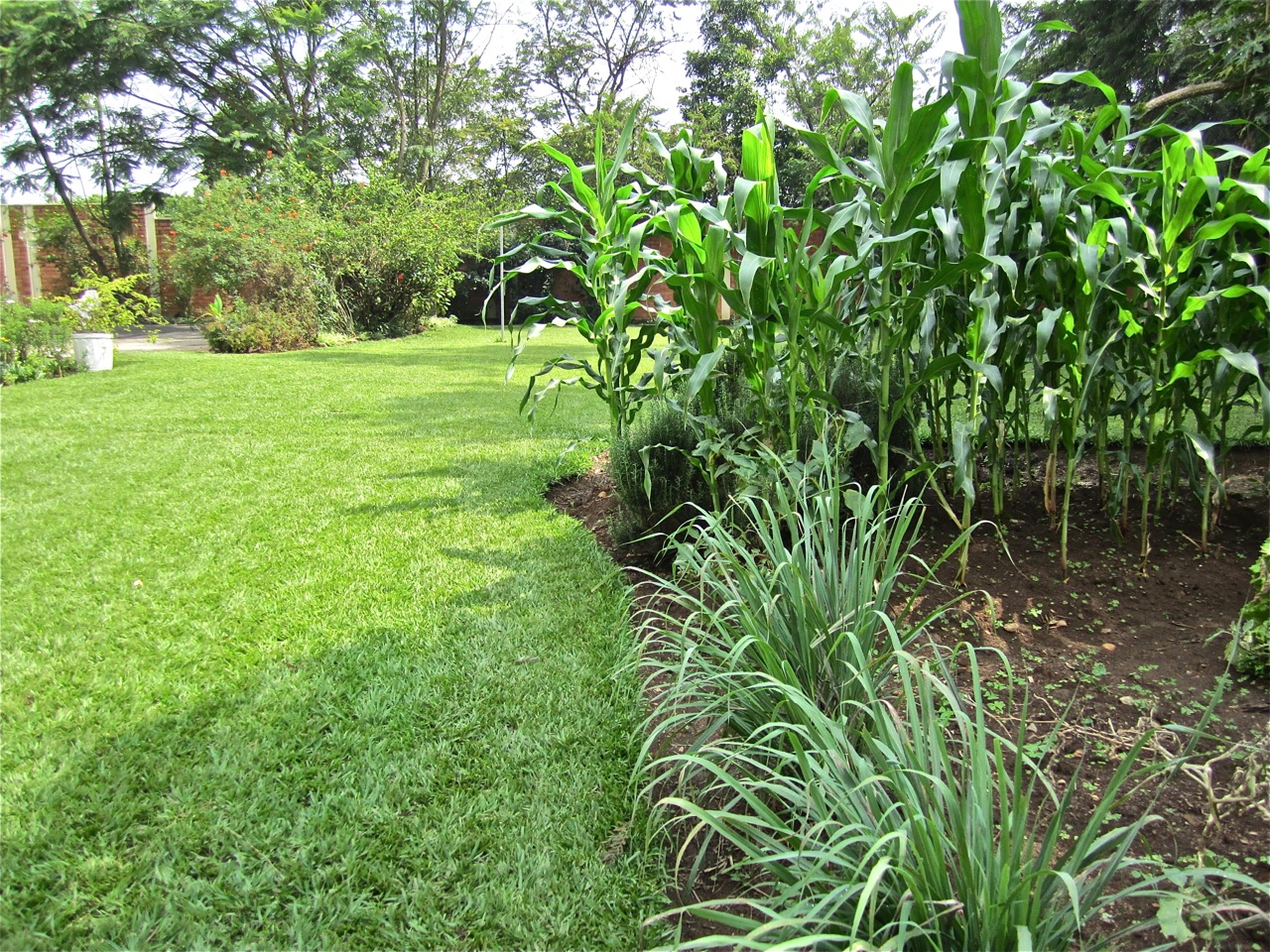
and, across from that (below), a large vegetable garden whose edges have become rather freeform over the years.  There’s a lot of sunny grassy space between these two beds, which isn’t needed for entertaining.

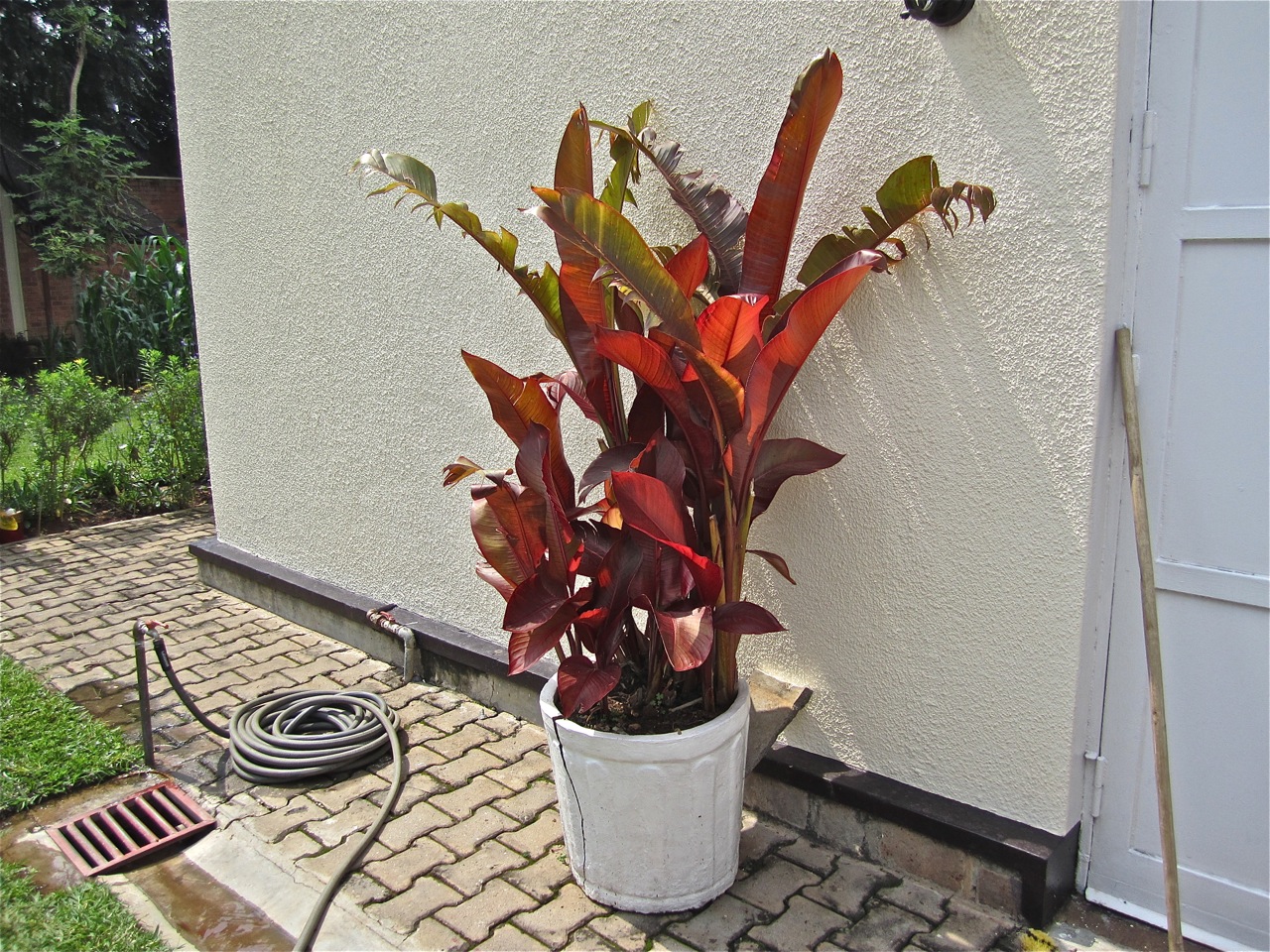
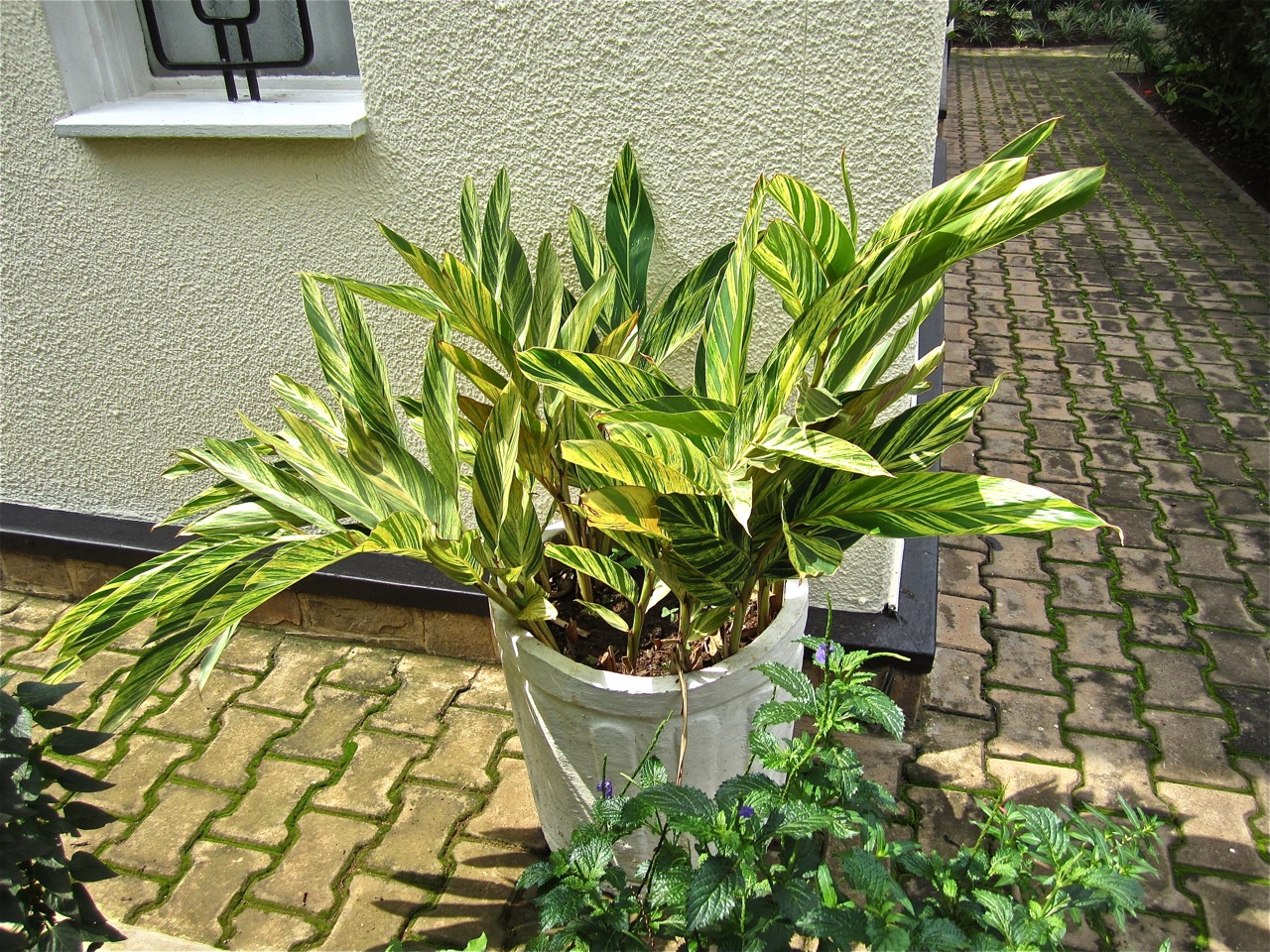
There are a number of potted plants in the garden, including these two (below), which have been left at the back of the house.  They hold burgundy cannas (which are breaking their pot) and bright variegated gingers, but almost no one sees them.  On the terrace, we also have variegated yuccas planted in very nice tall pots, but so deeply that only the ends of their squished up spiky leaves show (and they’re  a bit dangerous at upper-body level).

Soon: a concept and change.

Vintage landscape: Gethsemane

I’ll take one more pass at the interesting photographs of the Library of Congress Matson Collection  (American Colony of Jerusalem).

“Garden of Gethsemane in snow,” February 28, 1938.

The American Colony photographers took many pictures of the Garden of Gethsemane during the first half of the 20th century. Presumably, they were big sellers in the Colony’s tourist shop near Jaffa Gate.

“Garden of Gethsemane semi-distant with overhanging olive branch,” c. 1898-1946.  The garden is in the middle of the photo.  Click the image to enlarge it.

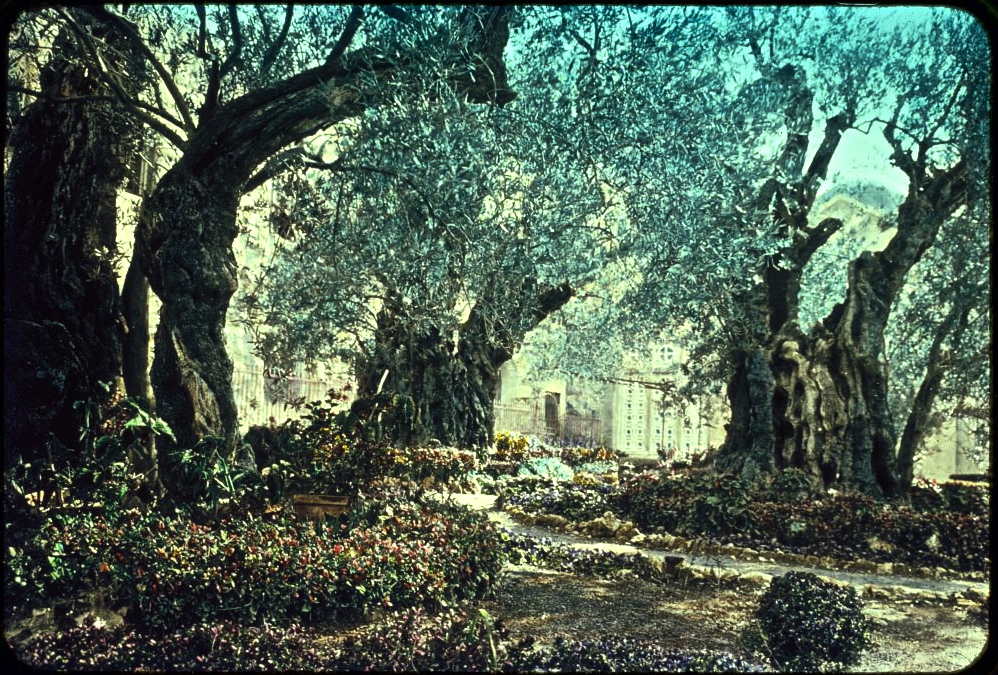
‘Gethsemane’ is a Greek word derived from an Aramaic word for ‘oil-press.’ The Roman Catholic-administered garden is located at the foot of the Mount of Olives. It is one of four locations in the area currently claimed by different religions as the place where Jesus prayed the night before the crucifixion.

“Jerusalem. Gethsemane from convent roof showing city wall and Golden Gate.” Image hand-colored c. 1950 – 1970, but original black and white photo was probably taken earlier.

In the gospels of Matthew and Mark, it is called by a word meaning ‘place,’ ‘property,’ or ‘estate.’ In the gospel of John, the Greek word ‘kepos’ is used; it can mean ‘garden,’ but also ‘cultivated tract of land.’

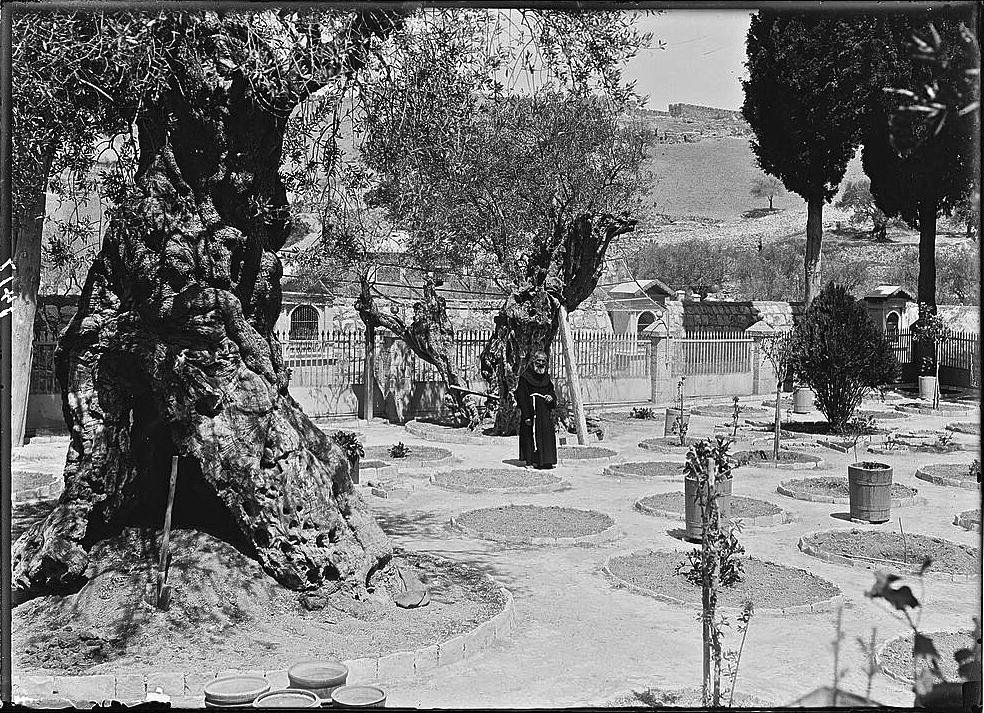
“Garden of Gethsemane, inside enclosure.”

The first recorded pilgrimage to the site was made in 333 A.D. by the anonymous “Pilgrim of Bordeaux,” who recorded his travels in the Holy Land in Itinerarium Burdigalense.

“Jerusalem (El-Kouda, Garden of Gethsemane, interior),” c. 1898-1914.

The building attached to the garden, the Church of All Nations, was built in the 1920s. The garden’s olive trees are said to be 2,000, 1,000, or 900 years old, depending on the source.

“The terrible plague of locusts in Palestine, March-June 1915. The same garden after visitation by the locust.”

In 1915, a plague of locusts swept through Palestine, stripping areas — including the garden — of all vegetation. The American Colony was asked to photograph the devastation, which caused food shortages, by the Ottoman-Turkish governor for “Syria and Arabia.”

The Garden of Gethsemane remains a popular tourist and pilgrimage destination today.

Vintage landscape: city parks

Almost as soon as their medium was invented in 1839, early photographers sought to make panoramic images that would capture a field of view as wide as or wider than that of the human eye.

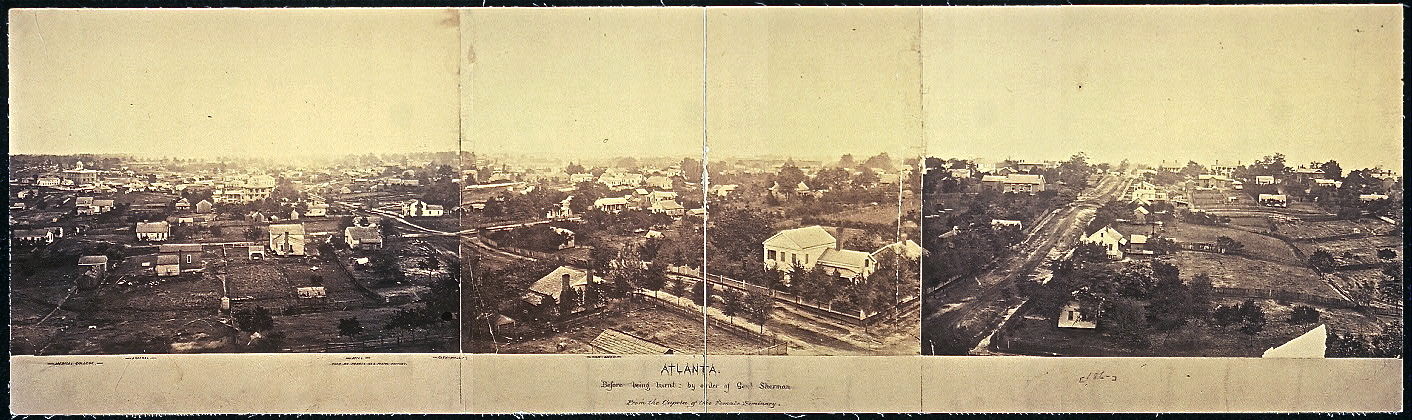
Specialized panoramic cameras with extra long negatives and rotating lenses were available by the 1840s, but the simplest method (well, actually nothing was simple with early photography) was to take a series of photographs and paste them together side by side to form one long picture, as shown in the image below.

“Atlanta, before being burnt; by order of Gen’l. Sherman, from the cupola of the Female Seminary” by George N. Barnard, October 1864.  Click on the photo to enlarge it.

By 1899, Kodak had developed a panoramic camera for amateurs.   In 1904, the Cirkut camera, based on improved 1840’s technology, was introduced and soon became popular with commercial photographers.

The Library of Congress has a collection of approximately 4,000 panoramic photographs, mainly assembled during the late 19th and early 20th centuries, when panoramic scenes were most popular.  It includes landscapes, group portraits, and cityscapes.

I made a search of city parks and other urban recreational spaces and found a number of interesting images from 1902 to 1921.

(You can click each photo to enlarge it or click on “Continue reading” below and then on the first thumbnail in the gallery to scroll through all the larger versions.)


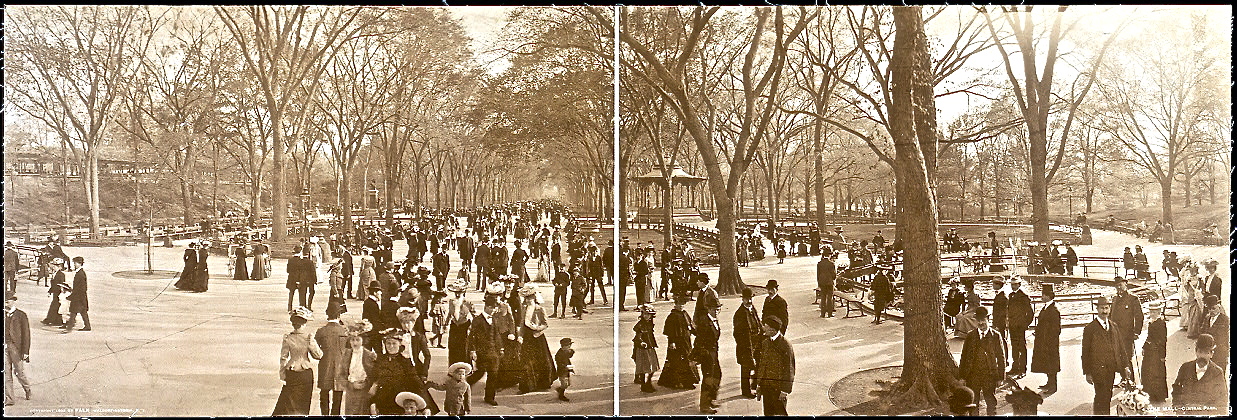
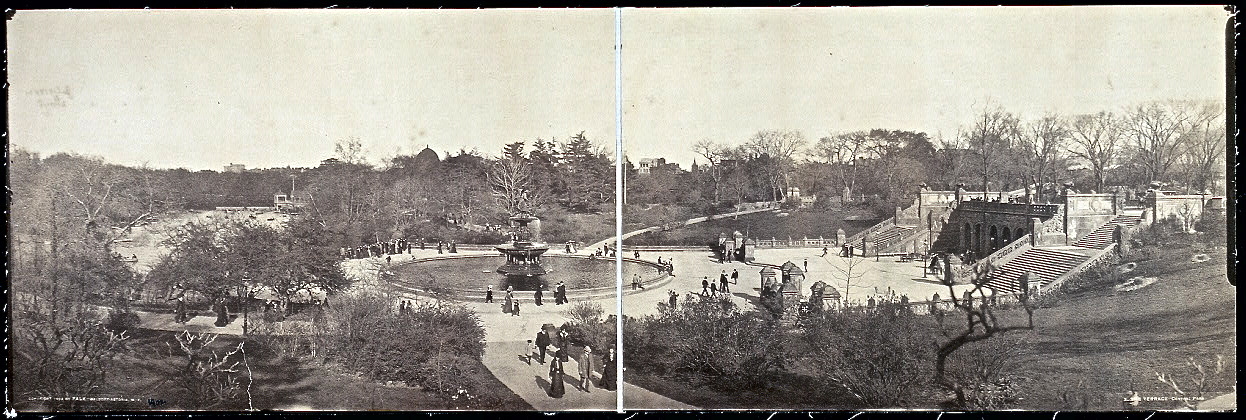
The photo above shows The Mall in Central Park, New York City.  This part of the park was designed by Olmstead and Vaux to be an “open air hall of reception,”  and it certainly was on this day in 1902.

Such a “grand promenade” was considered an “essential feature of a metropolitan park,” even by the designers, who created a more naturalistic plan for most of the rest of the park.

The Mall leads to The Bethesda Terrace, shown above.  Both Central Park pictures were taken by Benjamin J. Falk.


Diamond Park in Meadville, Pennsylvania, had the same features as Central Park’s Mall, although on a smaller, simpler scale. The photo above was taken c. 1910 by W.R. Hites.  The round pool and gazebo exist in the park today.

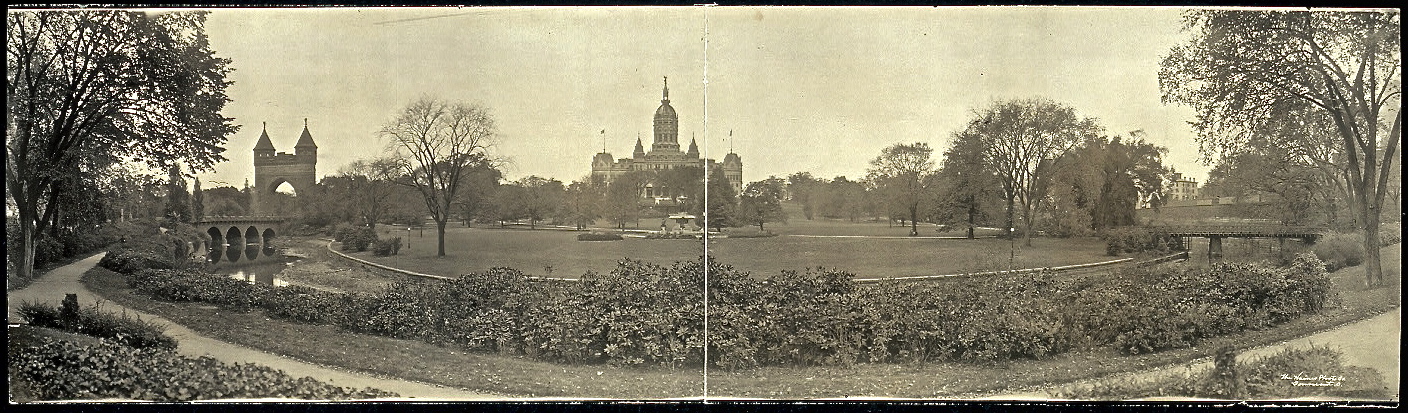
The photo of Diamond Park, and those of the two pictures below, may have been taken with a Cirkut camera, which distorted images and made straight paths  or roads in the centers of its photos appear curved.


Bushnell Park of Hartford, Connecticut, shown above, was the first municipal park in the U.S. to be conceived of and paid for with public funds.  It was designed in 1861 by  Jacob Weidenmann in a natural style that featured informal clusters of 157 varieties of evergreen and deciduous trees, which buffered the sights and sounds of the city.

This photo was taken  c. 1909, by Haines Photo Co.  The state capitol building can be seen in the background.


Grand Circus Park  was a social center of  Detroit, Michigan, when the photo above was taken by Manning Bros. in 1921.  It was surrounded by eight theaters, as well as ornate hotels.

At the time of the picture, the Russell Alger Memorial Fountain would have just been completed.  It was designed by Henry Bacon, who also designed the Lincoln Memorial in Washington, D.C.  The fountain featured a sculpture by Daniel French, who also sculpted Abraham Lincoln for the Memorial.


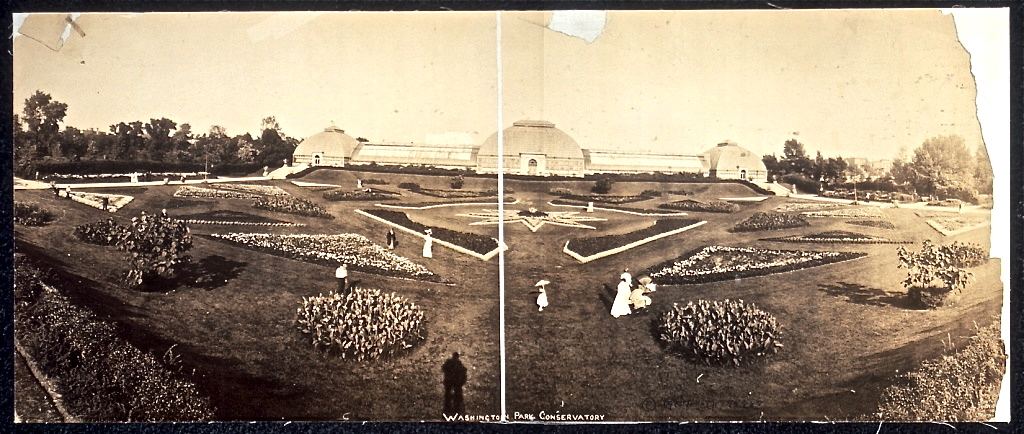
This 1907 picture of Victorian “bedding out” at the Conservatory in Washington Park  seems at odds with Olmsted and Vaux’s original 1870 vision for the park in south Chicago, Illinois.  (Their blueprint was destroyed in the Great Fire of 1871.)  Olmsted designed a natural feel to the park, including a meadow surrounded by trees and maintained by grazing sheep.

The conservatory and ornate sunken garden were designed by D.H. Burnham & Co. and built in 1897.  By the Great Depression, the building was too expensive to maintain and was torn down.  The photo was by George R. Lawrence Co.


In this 1909 photo, Oxnard, California, still shows its roots as an agricultural boomtown.  About 1897, local ranchers had thought that growing sugar beets would be profitable and had convinced Henry Oxnard to  build a factory in the midst of the new fields.  A town, with plaza, rapidly sprung up alongside it.

The city was incorporated in 1903, and by 1907, it even had a classically styled Andrew Carnegie library — which I think can be seen above the park about a third of the way from the photo’s left side, partly covered by a tree.  The photo was taken by West Coast Art Co.


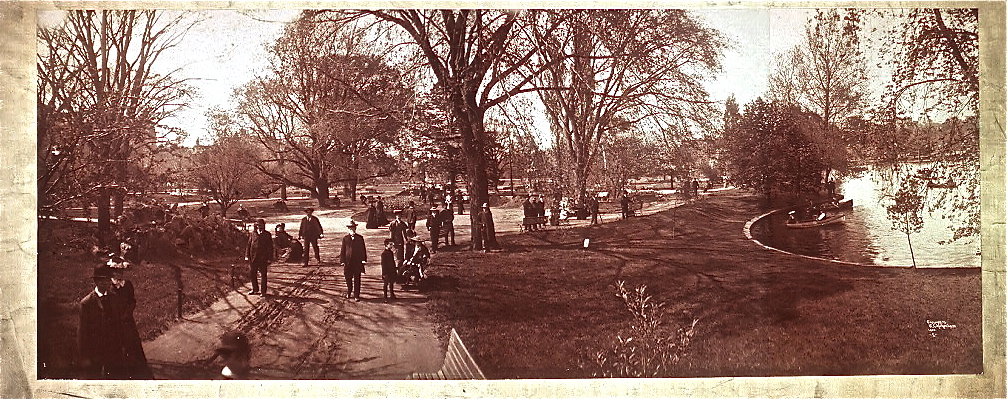
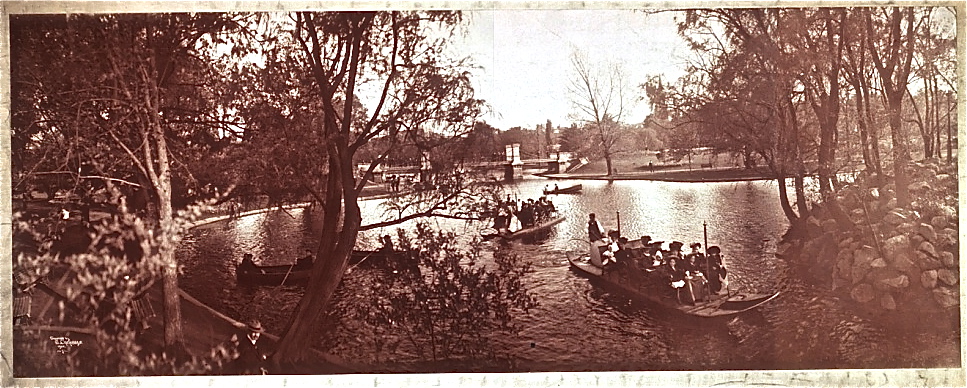
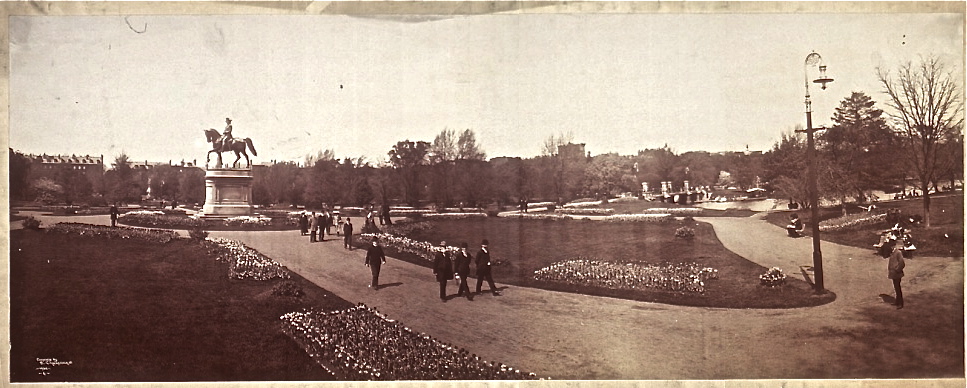
The Boston Public Garden, designed by George F. Meacham, was first proposed to the city fathers in 1837, but construction did not begin until the early 1860s.

It has always been an ornamental pleasure garden, famous for its flower beds, meandering paths, and swan pond and boats.


With the adjoining Boston Common, it forms the northern end of Olmsted’s great string of parks called the Emerald Necklace.  The three photos above were taken c. 1904, by E. Chickering & Co.


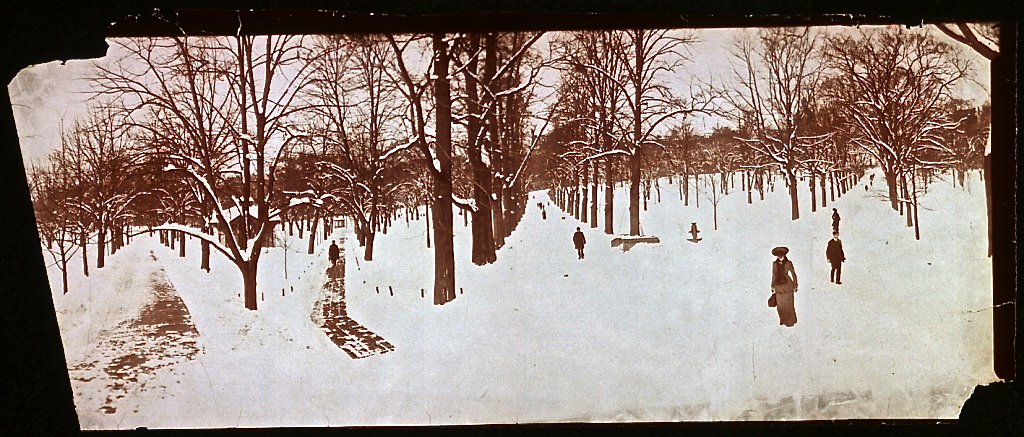
This snow scene taken of Boston Common, taken January 10, 1904, by E. Chickering & Co., has the feel of a post-impressionist painting.

The Common was a public livestock grazing space from 1634 to 1830.  In 1836, it was enclosed by an ornamental iron fence, and its five perimeter malls or recreational promenades were completed.  In contrast to the Public Garden, it is laid out with straight lines and open areas for recreation and public gatherings.


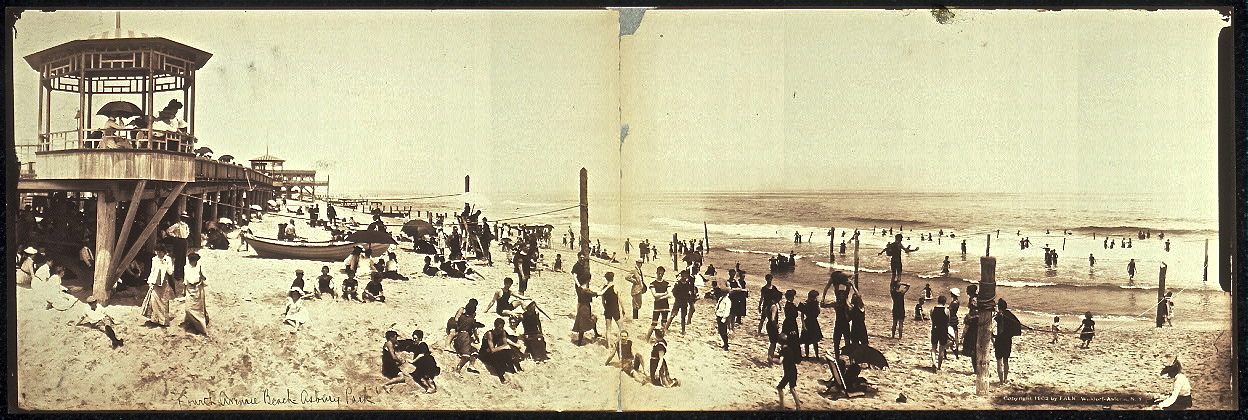
In the three decades after 1871, developers took Asbury Park, New Jersey, from a small seaside community to a residential resort of more than 600,000 vacationers.  They built a boardwalk, orchestra pavilion, changing rooms, and a pier along its beachfront, as well as a number of grand hotels.  The above photo by Benjamin J. Falk shows the Fourth Avenue Beach c. 1902.


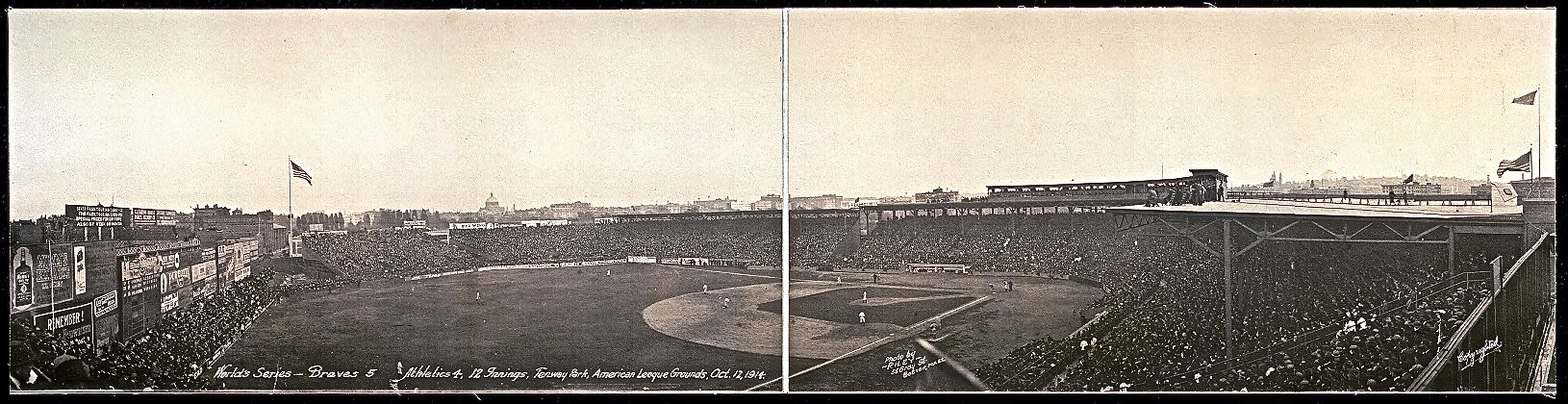
This photo shows another kind of Boston park, the American League Grounds at Fenway Park, and the World Series game of October 12, 1914.   The score was [Boston] Braves 5 – [Philadelphia] Athletics 4 in 12 innings.  The photo is  by John F. Riley.

The first World Series had taken place ten years earlier, also in Boston, on what is now the campus of Northeastern University. A panoramic photo of one of those games is here.


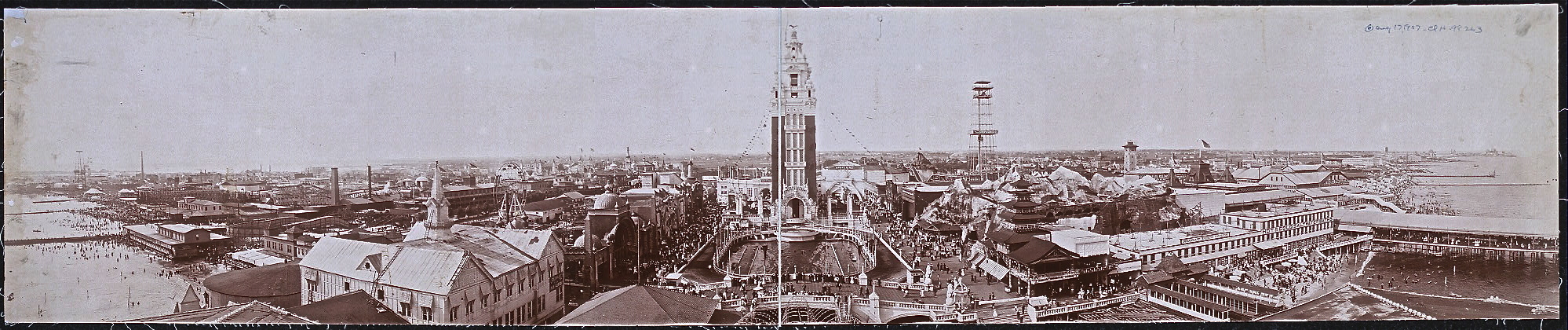
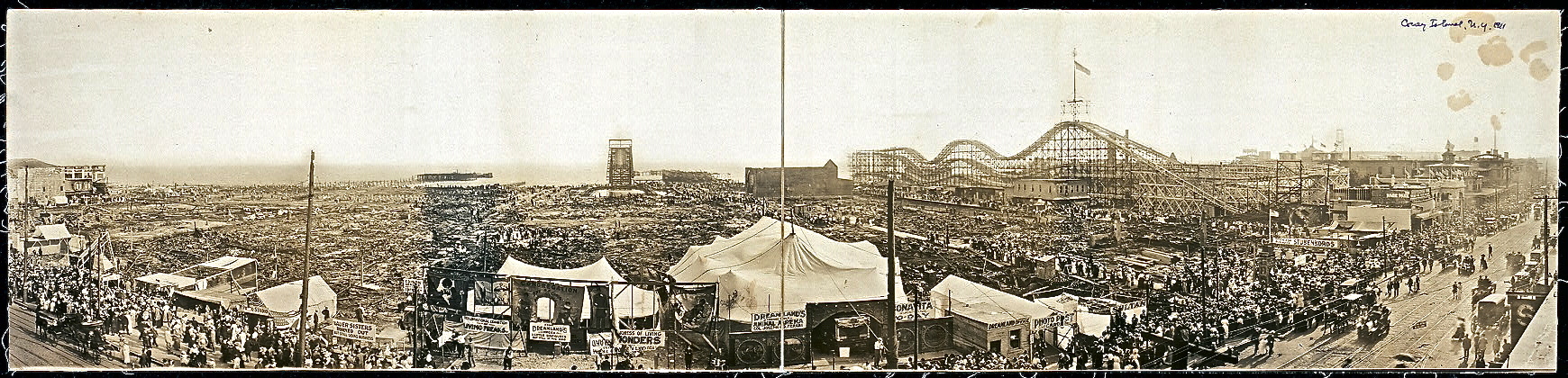
The above photo shows Brooklyn’s  Coney Island and Luna Park (also known as Dreamland) around 1907.  This picture and the one below were taken by Charles E. Stacy.

Luna Park was created by Frederick Thompson and Elmer Dundy and opened in 1903. There’s a very interesting history of the enterprise at this link.

By 1915, another inventor, Frederick Ingersoll, had opened Luna Parks all over the world, and the term “luna park” became a generic name for amusement parks.  The blog Poemas del rio Wang features a series of photos of Paris’s Luna Park in 1910.


The above photo shows the destruction of part of the park after a fire on December 11, 1911.

We’ll take a trip up to the moon
For that is the place for a lark
So meet me down at Luna, Lena
Down at Luna Park.

— recorded by Billy Murray, 1905 (hear him singing it here)

All photos in this post via the Library of Congress Prints and Photographs Division. Continue reading “Vintage landscape: city parks”