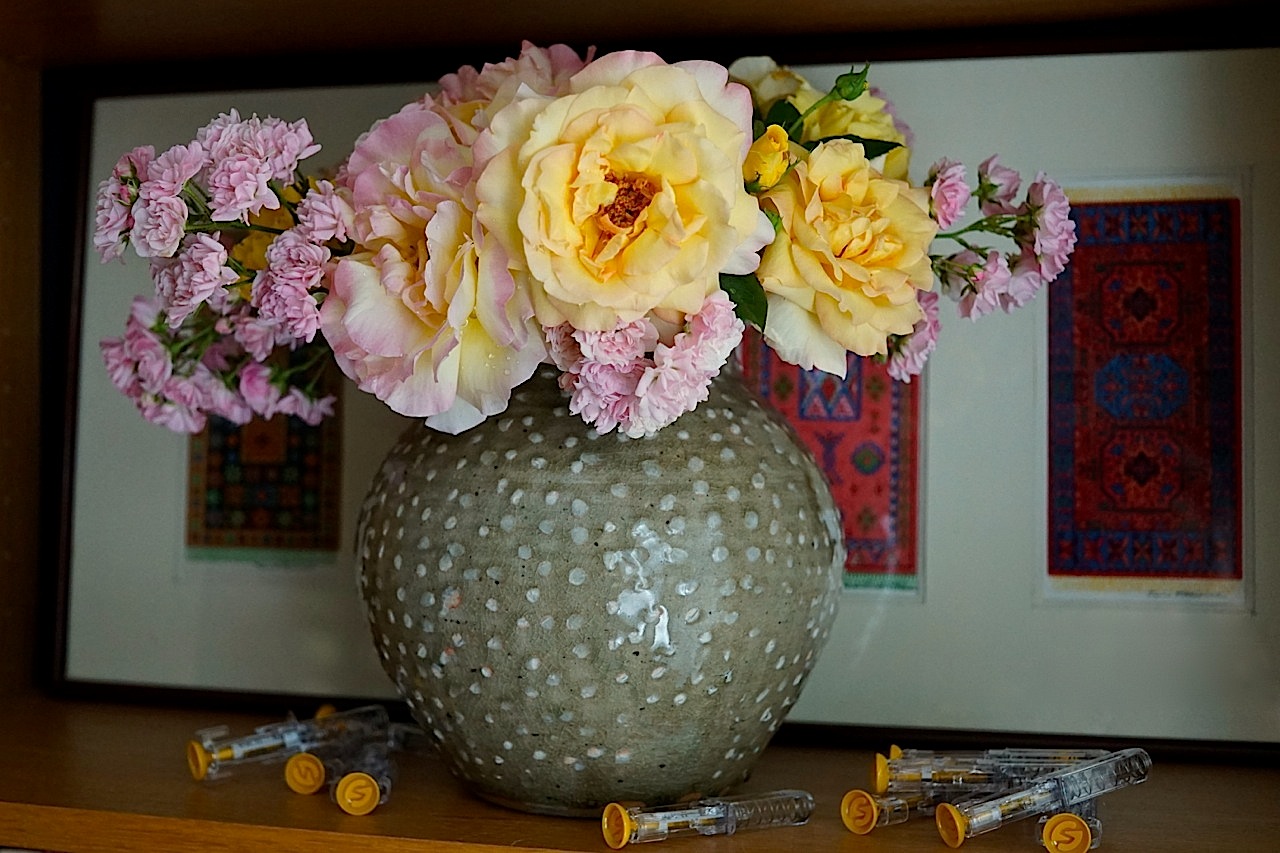
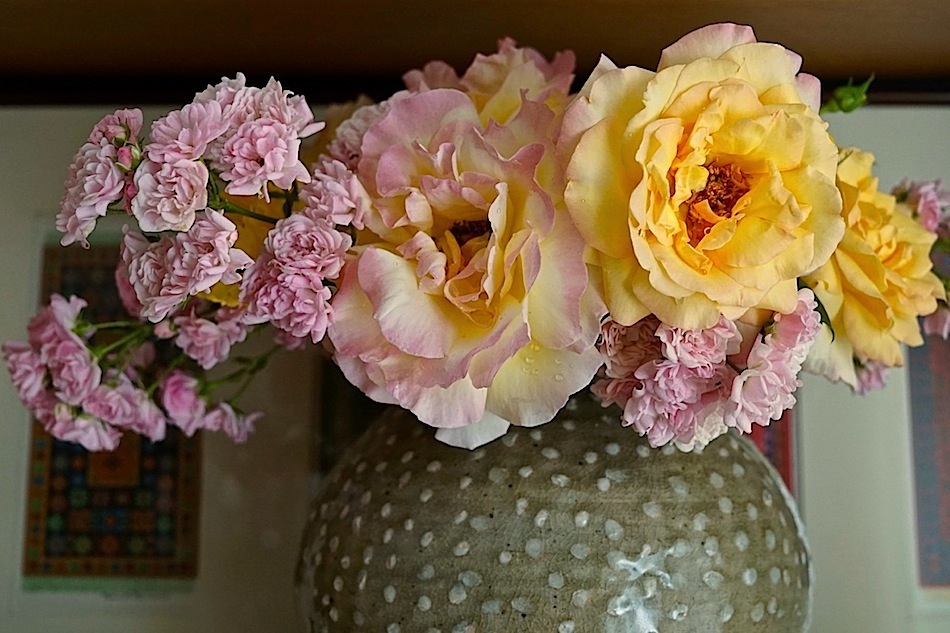
Not an arrangement for the ages, but I did manage this morning to hobble out into the backyard and cut these roses (re: foot surgery), so it represents progress.
The vase is from Gatagara Pottery in Rwanda. The “accessories” are some of my used Mono-Embolex syringes, which, strangely, I find appealing as design.*
The big yellow and pink blooms are giving this end of the dining room a nice rosy smell.
To see what other bloggers have put in a vase today, please visit Cathy at Rambling in the Garden. She hosts this Monday theme.
*Also, I’m not sure how to throw them away — garbage/recycling sorting is a very serious business here in Germany. I still have a collection from my last operation.
Round enclosure on Eeuwigelaan (street) in Bergen, The Netherlands, 1926, by A. J. Bonda, via Archief Alkmaar Commons on flickr.
I have been wondering about the purpose of this really nice rustic fence in a wooded area (there’s another view here). In a much larger version of the photo, you can see barbed wire all around the top rails. The ground inside has either been dug out or worn away. There are two benches nearby, with more barbed wire fencing behind them. What appears to be a road in the background is actually a canal. (And you can also see that the man standing on the right is wearing wooden shoes.)
It could have been the site of a large tree of special local significance, which then died and was removed. Or the spot of some other removed shrine or monument. But why not take away the fence and fill the hole after dismantling what was inside? Then I thought it might have been the small crater itself that was important — perhaps the remains of a WWI shelling in the area.
Today, this street is lined with very large homes.
ADDENDUM: Nope, wrong all round. 🙂 Please see the very interesting comment below.
A group of children with flowers in the cloister of San Zeno, Verona, Italy, May 10, 1918, by Fernand Cuville, via Archives of the Planet Collection – Albert Kahn Museum /Département des Hauts-de-Seine.
Tradition has it that the crypt of San Zeno is where Romeo married Juliet.
The autochrome above is one of about seventy-two thousand that were commissioned and then archived by Albert Kahn, a wealthy French banker and pacifist, between 1909 and 1931. Kahn sent thirteen photographers and filmmakers to fifty countries “to fix, once and for all, aspects, practices, and modes of human activity whose fatal disappearance is no longer ‘a matter of time.'”* The resulting collection is called Archives de la Planète and now resides in its own museum at Kahn’s old suburban estate at Boulogne-Billancourt, just west of Paris. Since June 2016, the archive has also been available for viewing online here.
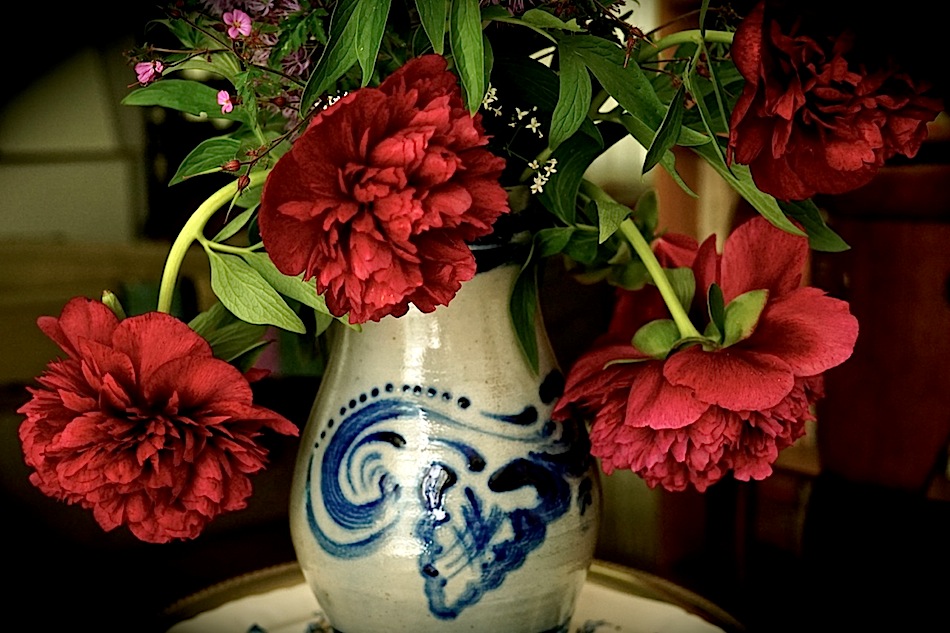
For each of the last two springs in this house, the peony plant in the back yard has given me exactly one bloom. This week, there were eight — all but two opening fully on the same day. Their stems are very curved from being knocked over earlier in the month by a late snow and then rain and wind. Next year, I will try to remember to rig up some sort of support before they emerge.
The blooms look red, but they’re actually a very dark pink, and they have a nice light scent. I arranged them with some wild pink geranium that comes up along the back fence (maybe G. palustre?) and some sweet woodruff. The Westerwald salt-glazed pottery pitcher is from this Saturday’s flea market.
To see what other bloggers have put in a vase today, please visit Cathy at Rambling in the Garden. She hosts this Monday theme.
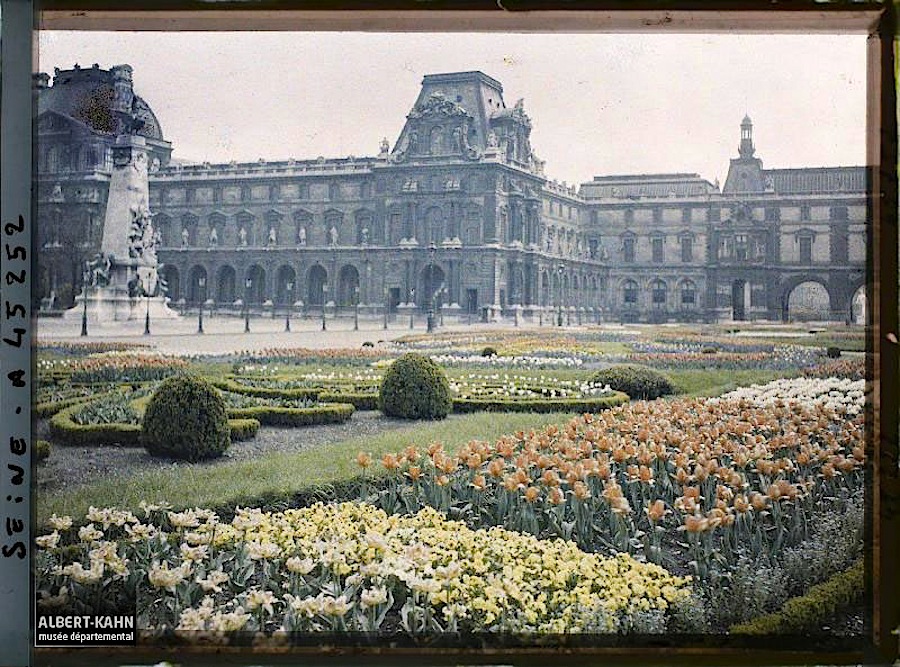
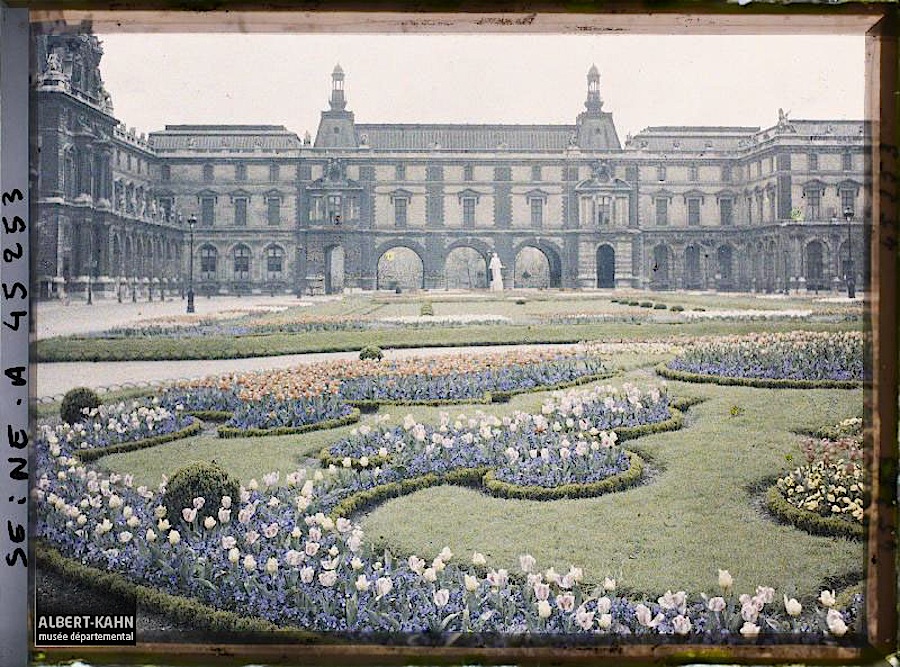
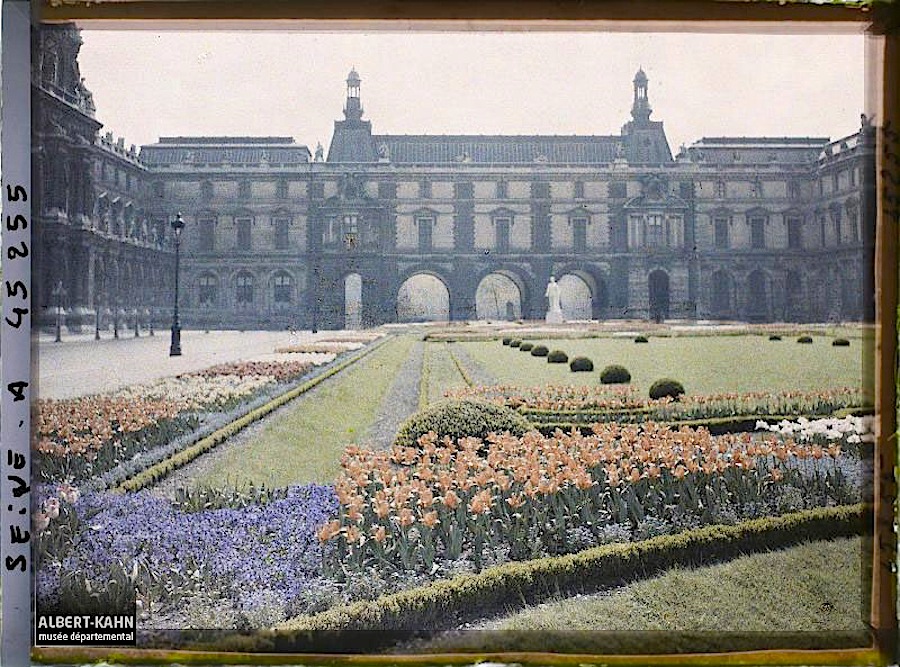
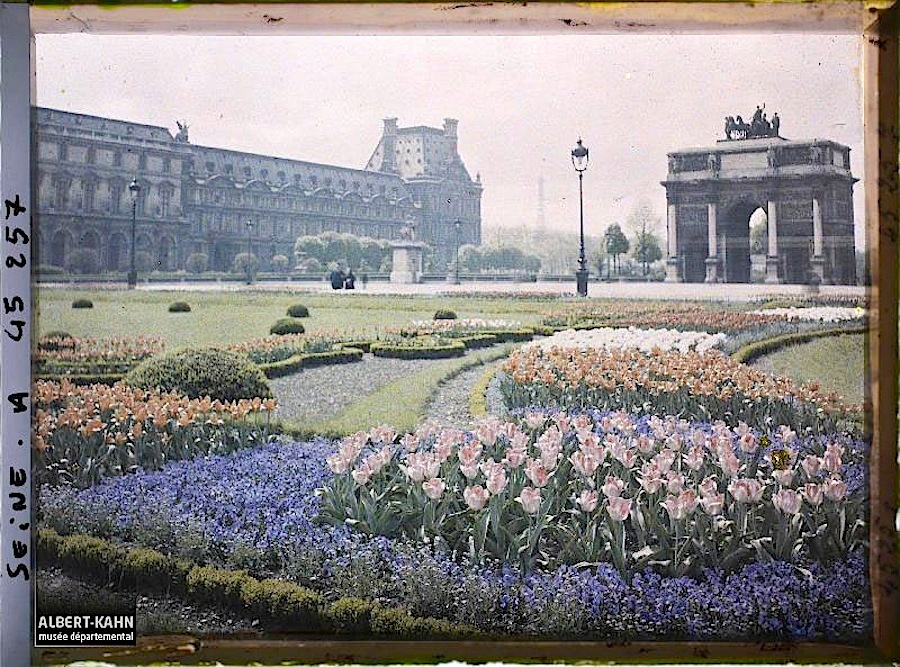
Arrangement of tulips in the Tuileries Garden, Paris, May 8, 1925, by Auguste Léon, via Archives of the Planet Collection – Albert Kahn Museum /Département des Hauts-de-Seine.
These autochromes were taken at the Place du Carrousel, looking south to the Seine River. Today, there is a road and a roundabout (with a skylight for the underground shopping mall below) on this spot, which is just west of where I.M.Pei’s Pyramide du Louvre now stands.
It is also where Emmanuel Macron and his supporters celebrated his victory in the French presidential election runoff last night.
Looking southwest.
Today is La Fête de la Victoire in France. The public holiday commemorates the date of Germany’s unconditional surrender to the Allies in 1945, ending World War II in Europe.
The images above are four of about seventy-two thousand that were commissioned and then archived by Albert Kahn, a wealthy French banker and pacifist, between 1909 and 1931. Kahn sent thirteen photographers and filmmakers to fifty countries “to fix, once and for all, aspects, practices, and modes of human activity whose fatal disappearance is no longer ‘a matter of time.'”* The resulting collection is called Archives de la Planète and now resides in its own museum at Kahn’s old suburban estate at Boulogne-Billancourt, just west of Paris. Since June 2016, the archive has also been available for viewing online here.



 enclos*ure
