The Sunday porch: Mechanicsville, Md.

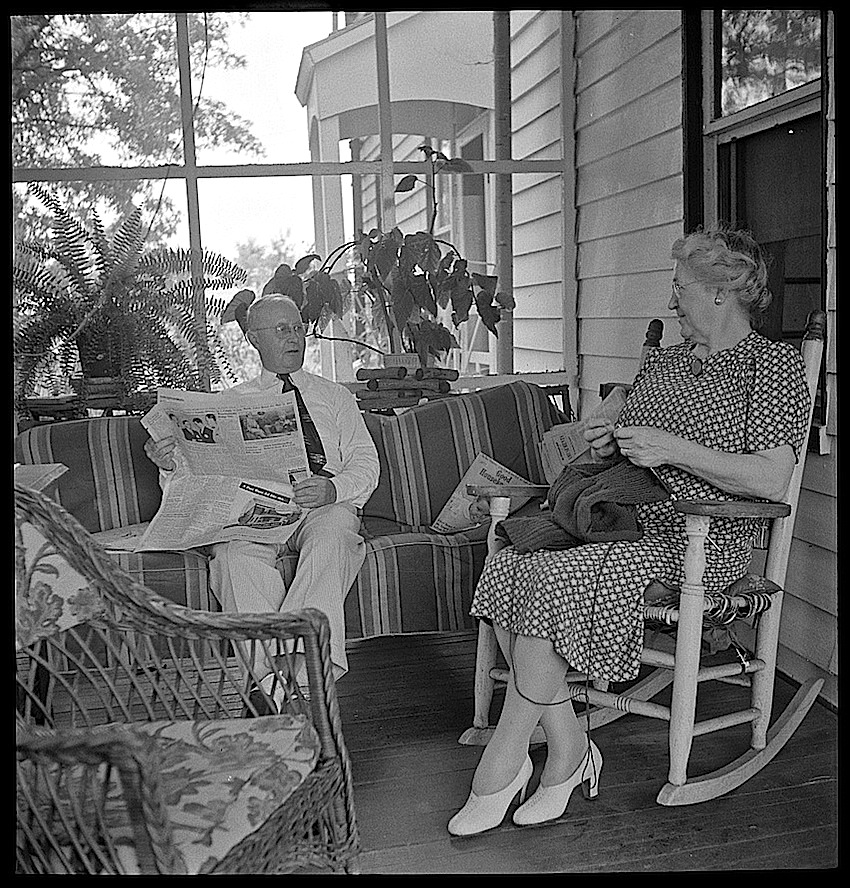
Mechanicsville MD 2, Library of CongressMr. and Mrs. Herbert on their porch in Mechanicsville, Maryland, June or July 1942, by Marjory Collins, via Library of Congress Prints and Photographs Division (all three photos).
Mechanicsville MD, Library of Congress

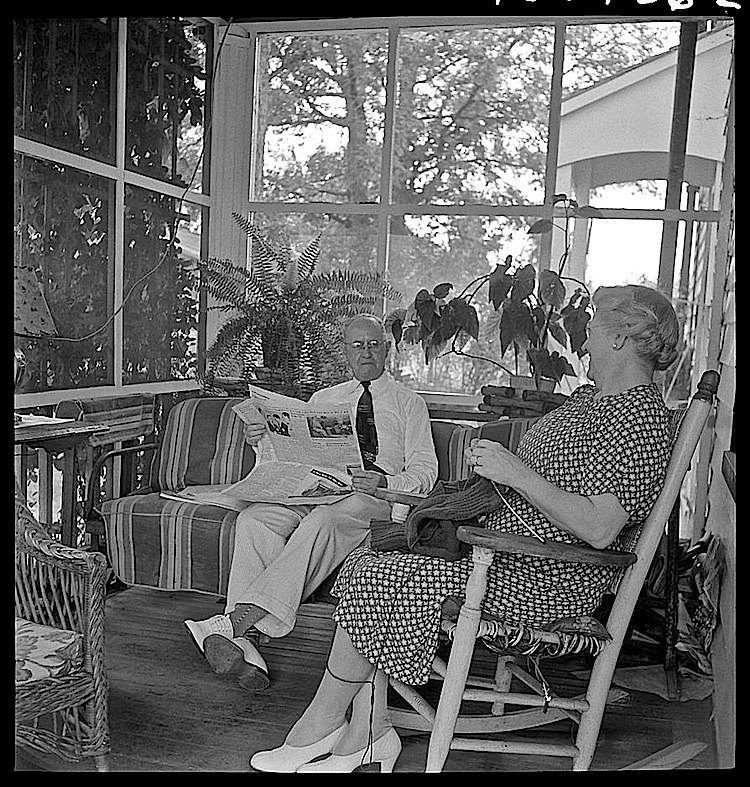
All the elements of a good screened porch are here: a slipcovered glider and a wicker chair, a rocker with a cushion (because the caned seat is nearly gone), a Boston fern and an angel-wing begonia, a newspaper and a copy of Good Housekeeping.  Both Herberts are wearing summertime white shoes.

Only a little iced tea could make it any nicer. Judging from the way they are dressed, I would guess this is a Sunday afternoon.
Mechanicsville MD house, Library of Congress

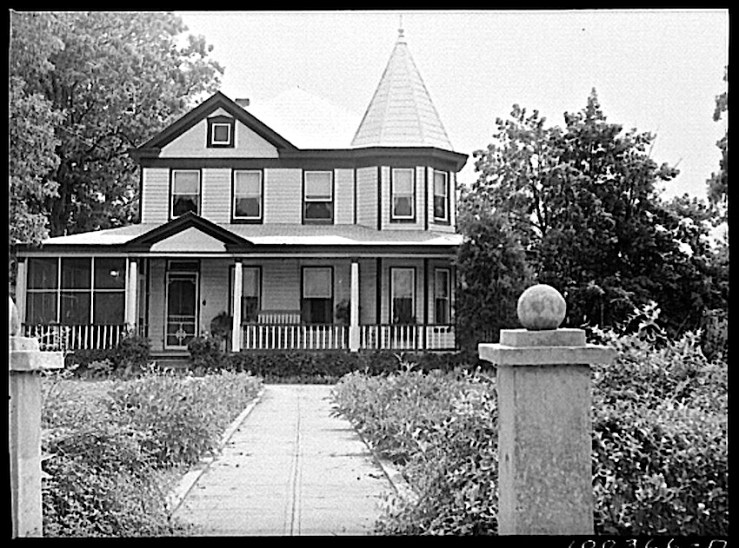
The couple — Charles P. and Bessie D. — built their Queen Anne house in 1909, although, curiously, it appears that they only bought the land beneath it in 1914, according to a Maryland Historic Sites Inventory Form filled out in the 1990s or later.

Charles had moved to the the area to be an express agent for the railroad.  Bessie was the town dressmaker. They lived in the house until their deaths during the 1960s.

A photo attached to the Inventory Form shows that the screening on the east side of the porch was later removed and some lacy trim was added along the entire front.  I could not find the house in a current Google Maps satellite view, however.

As usual, I wish we could see more of the garden.

Marjory Collins took these pictures about six months after moving to Washington, D.C., to join the documentary photographers of the U.S. Office of War Information.  Her “upbeat, harmonious images” of that time “reflected the OWI editorial requests for visual stories about the ideal American way of life,” according to a biographical essay about her by the Library of Congress.

Our garden in July

How to convey the very, very discreet charm of our garden of rough grass and weeds?

This slideshow requires JavaScript.

I often think of this other bit of German ground painted by Albrecht Dürer.

Yesterday, a repairman came over to fix the window/door behind my desk chair. It turned out to be fine; I just did not know how to operate it properly. (German windows are wonderful, but this one is a bit over-engineered.)  He pushed the handle and pulled the frame and said, “And now you can go out into the beautiful . . . looks out, slight pause. . . garden.”

You can read about the beginning of my “garden without (much) gardening” here.

The middle of the month brings Garden Bloggers’ Bloom Day (the 15th) and Foliage Follow Up (the 16th). Please visit Carol at May Dreams Gardens and Pam at Digging to see what’s blooming and leafing out in July.

You can scroll through larger versions of the photos above by clicking on ‘Continue reading’ below.

I grow in places
others can’t,

where wind is high
and water scant. . . .

I make my humble,
bladed bed.

And where there’s level ground,
I spread.

Joyce Sidman, from “Grass

The Sunday porch: Sagamore Hill

T. Roosevelt porch, Library of CongressThe porch of President Theodore Roosevelt’s country home, Sagamore Hill, ca. 1905, photographer unknown, via Library of Congress Prints and Photographs Division (both photos here).

The rug was a mountain lion.

Roosevelt purchased the land in Oyster Bay, New York, in the early 1880s and began planning the Queen Anne house with his first wife, Alice. But she died in 1884, and it was second wife Edith who moved into the newly completed home two years later.

Sagamore Hill, ca. 1905, Library of Congress

Sagamore Hill was their family’s primary residence, except from 1901 to 1909, when it was known as the “Summer White House.”

Theodore died there in 1919, as did Edith in 1948.  The family continued to own it until the 1950s, when it was passed to the Theodore Roosevelt Association and later to the National Park Service.

The house reopens to the public today, after being closed for three and a half years for renovation.

Streifzug 3: on high

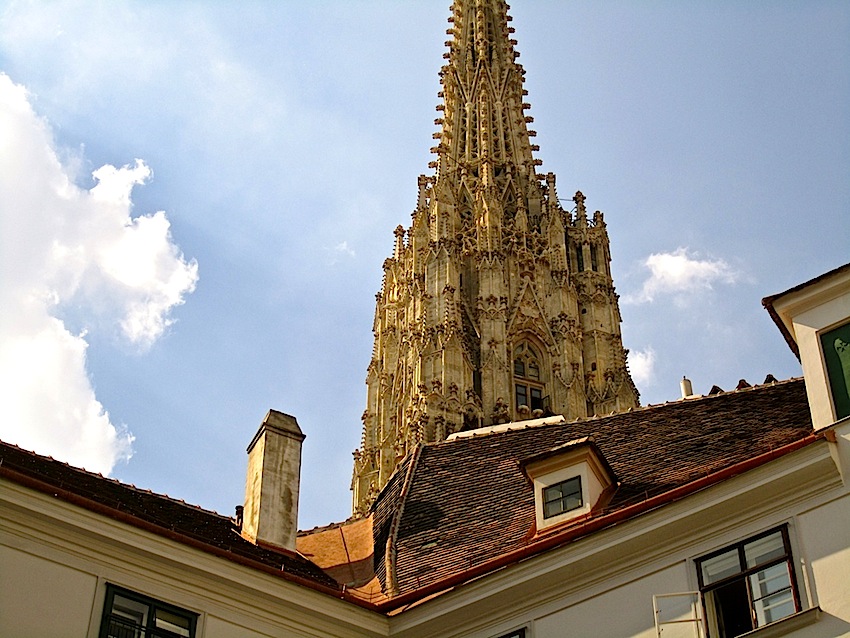
The south tower of St. Stephen's Cathedral in Vienna, by enclos*ure.We were up there.

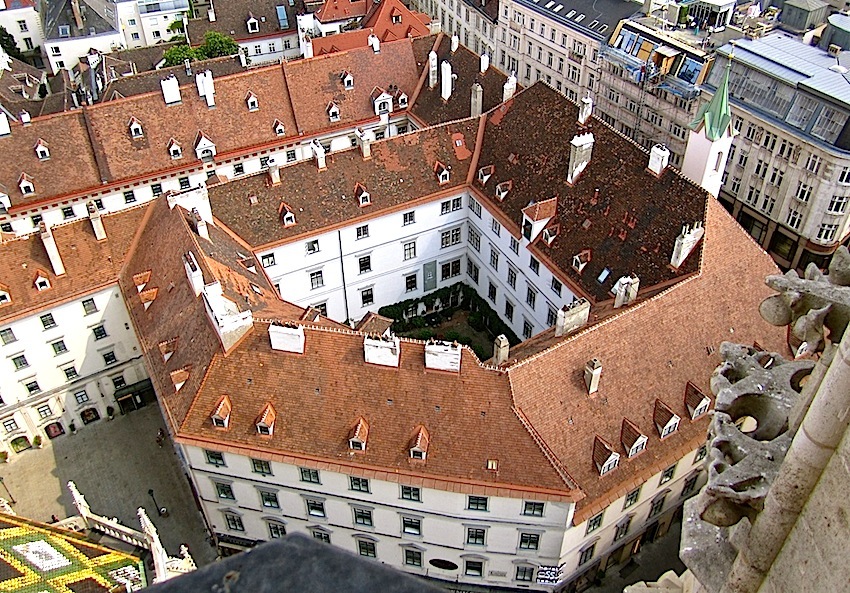
IMG_4358Looking down here.

Last week, we were in Vienna and climbed the south tower of St. Stephen’s Cathedral.

My husband loves climbing these high towers.  I do not — being both a little afraid of heights and a little claustrophobic. However, lured by the promise of a great view, I almost always follow him up. And I always think, after about 30 steps, how this is absolutely the last tower I will ever climb. . . at least this year (I’ve climbed two this year). . . at least in this city.

The view from the watch room (343 steps up) was tremendous.  A night watchman actually occupied the room until 1955.  If he saw a fire in the city, he would ring the tower bells.

IMG_4355Looking southeast, I spotted this pretty courtyard garden and took a few pictures.

After the climb down, we went around the corner, looking for the Mozart House (Mozarthaus).

IMG_4363

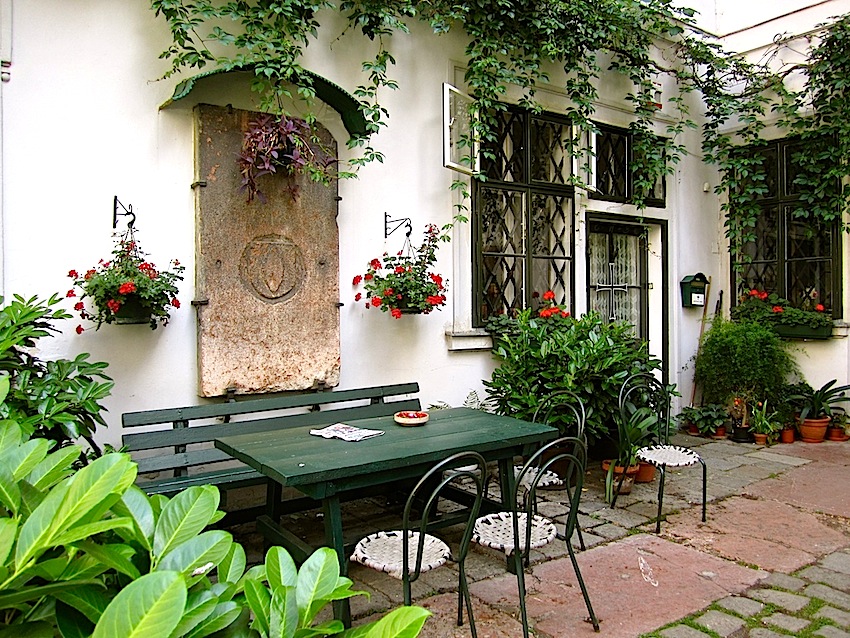
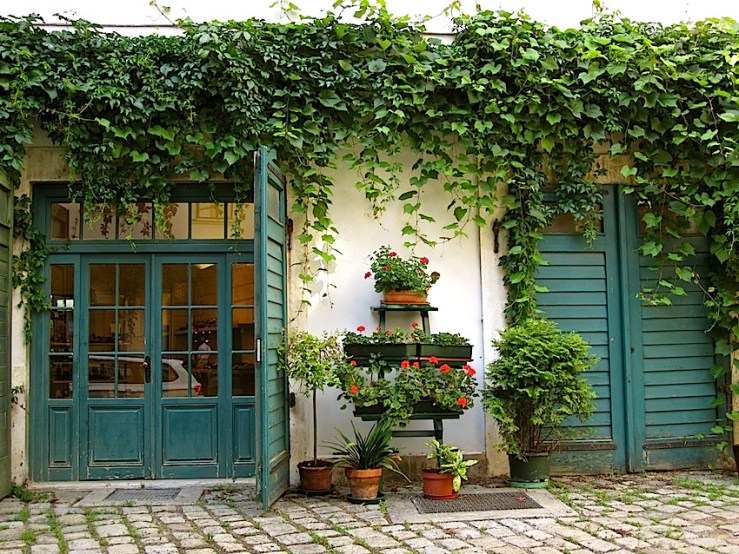
We went through a passageway off Singerstraße and found ourselves in the same courtyard seen from above.

IMG_4364

It was not the Mozart House, but the seat of the Grand Master of the Order of the Teutonic Knights of St. Mary’s Hospital in Jerusalem (or Deutscher Orden).

IMG_4361

The Order has been associated with this site since 1204. The present building dates from the second half of the 18th century.

IMG_4365

Mozart did briefly live on the premises from March to May 1781 — and Johannes Brahms from 1863 to 1865.

IMG_4369

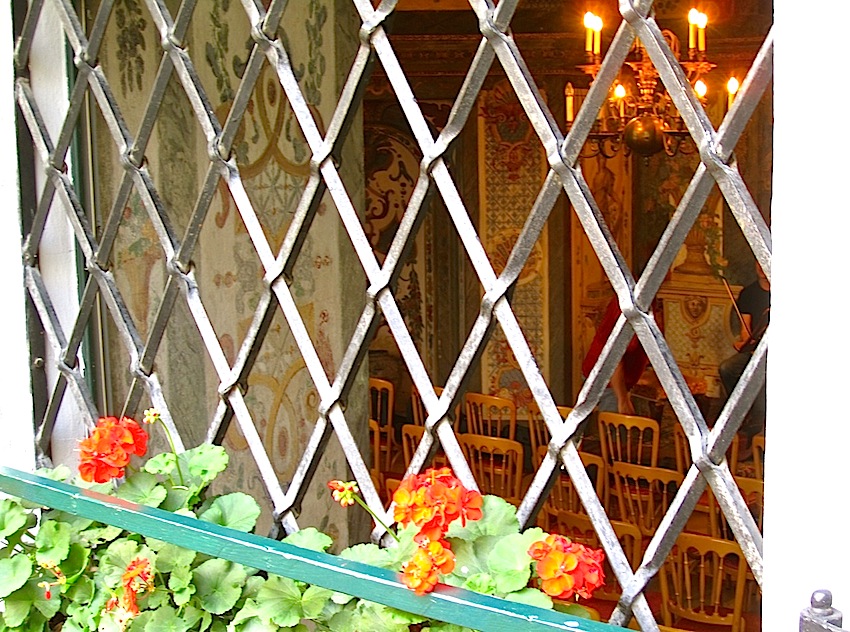
From one window on the courtyard, you can get a peek into the Sala Terrena, a frescoed room next to the chapel and the oldest concert hall in Vienna.

Mozart played there, and it now hosts the Mozart Ensemble Wien several days a week.

(Streifzug means ‘foray,’ ‘ brief survey,’ or ‘ramble.’)


Life in gardens: standing watch

Hoeing garden w:music, Library of Congress“W. D. Terrell in garden with radio,” probably in the Washington, D.C., area, July 7, 1926, by National Photo Company, via Library of Congress Prints and Photographs Division.

Mr. Terrell was Chief of Inspection Service of Radio at the U.S. Department of Commerce during the 1920s.

Just as Ariel, in the fables of the Middle Ages, was a spirit guardian of the air, so in this day of wireless, the Radio Inspector, a modern Ariel, stands a silent watch over the ether. But though he may be silent and, indeed, an angel, he is far from a fable, as those who attempt to dispute his wavemeter soon find out.

— from “Guiding the Good Ship Radio,” an October 1925 interview with Terrell in Radio Broadcast magazine