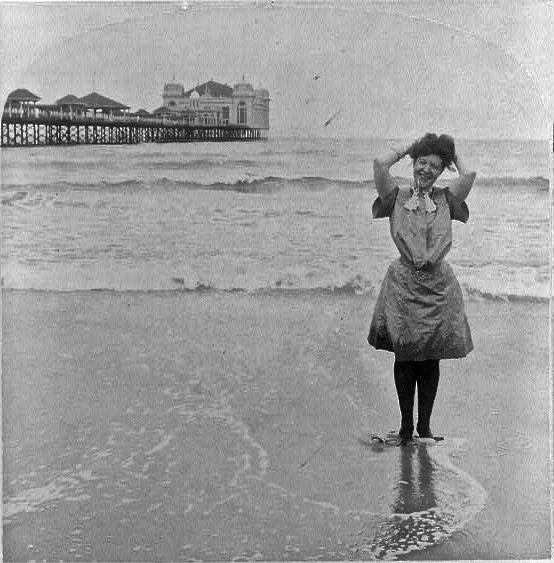
The Jersey shore

“Happy and beautiful, Atlantic City, N.J.,” 1903.

To give to the American Red Cross, click here. You can also donate through the iTunes Store.

There are links to other organizations, like the Methodist Church and the Salvation army, at this post by Foot’s Forecast.  (Thanks to Pigtown Design for the tip.)

Photo possibly taken by B.W. Kilburn, via Library of Congress Prints and Photographs Division.

Vintage landscape: the benches

“Roominghouse district, Washington,” a Kodachrome slide by Charles W. Cushman, mid-September 1940.*

In the two years leading up to the U.S. entering World War II, the population of Washington, D.C., went from 621,000 to over 1,000,000, according to journalist David Brinkley.

Most of the new arrivals were women, many of whom were hired “before they had even found a place to leave their bags.”  Thousands of townhouses were turned into roominghouses and several women shared each room.  (According to one of them, Enid Bubley,  it was “social suicide” to violate the morning schedule of eight minutes each in the bathroom.)

By 1941, Malcolm Cowley described the city this way:  “Washington in wartime is a combination of Moscow (for overcrowding), Paris (for its trees), Wichita (for its way of thinking), Nome (in the gold-rush days) and Hell (for its livability).”

So the two or three benches placed in each little yard above are significant. They were undoubtedly places of real reprieve from the crowded conditions inside the houses and the chaos of the city.

These gardens still have their wrought iron fences.  During the war, the metal was much needed, and many D.C. residents gave up their black railings for wooden pickets.

The photographer, Charles Cushman, was a talented amateur who traveled across the U.S. and other countries and took more than 14,500 Kodachrome slides from 1938 to 1969.  He bequeathed his images to Indiana University, his alma mater.


*Used with the permission of  the Charles W. Cushman Photograph Collection of the Indiana University Archives.  Please do not “pin” or re-blog without contacting them here.

Vintage landscape: Bluff Hall gate

What a great old gate at Bluff Hall, Demopolis, Alabama, in 1936. I love the fat finials.

The playwright Lillian Hellman may have passed through this gate in the first decades of the 20th century.  Her mother’s family was from Demopolis, and she visited there as a child.  She later used the town as inspiration for the setting of The Little Foxes.  Lionnet is said to have been based on Bluff Hall and another local mansion.

Today the house is on the National Register of Historic Places and is open to the public as a museum.

Photo: by Alex Bush for the Historic American Buildings Survey (HABS), via Library of Congress Prints and Photographs Division.

Leicester Square

In London, in September, we went to TKTS at Leicester Square to buy discounted theater tickets.*

This slideshow requires JavaScript.

While there, I really admired this sinuous bench/hedge/fence combination, which enclosed the central garden areas of the square — particularly the use of highly polished steel for the railings.

(You can put your cursor over the slideshow to bring up a ‘pause’ button.)

The square was recently re-designed by Burns+Nice, with the installation completed in May of this year.

*We saw “Yes, Prime Minister,” which probably ought to have remained a half-hour sitcom, but was a lot of fun nevertheless.

In which we learn some elegant French

Well, maybe not, but this French government ad carries an important message.

Below, the tagline in the lower right corner roughly translates as ‘eating, that’s good; throwing away, that sucks (ça craint!*).’

“I love food, I respect it.”

Chaque Français jette . . . “Every French person throws an average of 20 kgs. of food in the trash can each year.”

According to the FAO,  a European generates 60-110 kgs. (130-240 lbs.) of food waste yearly; an American, 95-115 kgs. (210-250 lbs.); a person from a developing country, 6-11 kgs. (13-24 lbs.).

“Don’t waste a crumb, finish your plate.”

For more information, see the campaign webpages here and here.  And there’s more about French food at French Food in the U.S.

I spotted these posters on the wonderful blog about gardening in Paris, Paris coté jardin, by Alain Delavie.

*Also means ‘that’s dangerous.’  ‘That sucks’ can also be ‘c’est nul.’