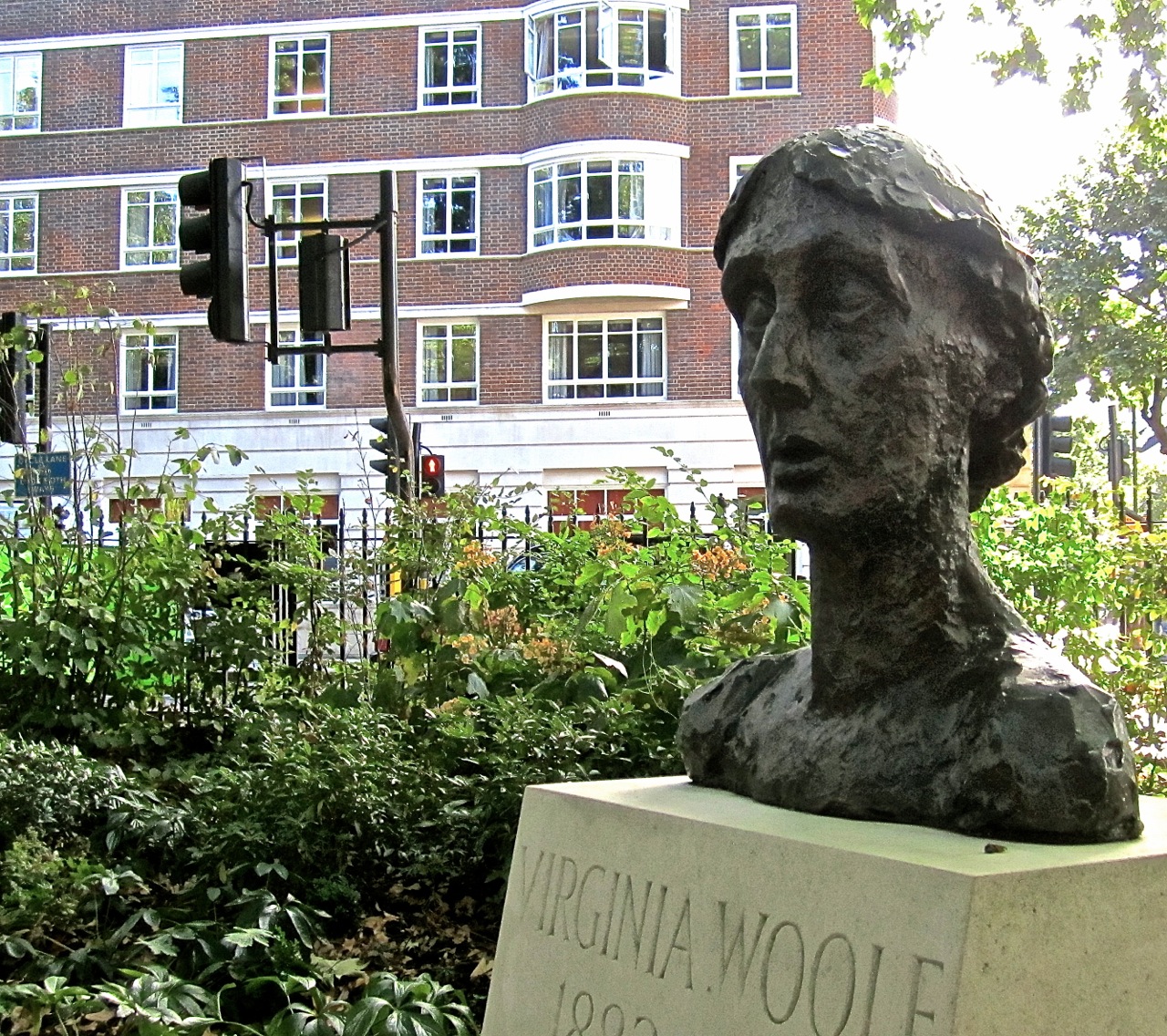
Then one day walking round Tavistock Square I made up, as I sometimes make up my books, To the Lighthouse; in a great, apparently involuntary, rush.
— Virginia Woolf

During our visit to London about a month ago, we stayed in a hotel in Bloomsbury, and on our last morning there, being a good former English major, I had to go looking for Virginia.
I found her small monument, inscribed with the above quote, in the south corner of Tavistock Square. From 1924 to 1939, she and her husband lived in a house located on the site of the hotel that you can see behind her head in the photo above.
Leonard Woolf has his own memorial in the square: a Gingko biloba tree, planted in 2004 to mark his work as a colonial administrator in Sri Lanka.
Originally laid out about 1800, the square today is bordered by a wide path shaded by both tall and pollarded trees. In the center of the park are flower beds and lawn, many benches, and a large sculpture. It is conventional, but pretty, and a very nice place to stroll and think.

On the day when Virginia Woolf conceived her great book, only residents of the houses surrounding the square would have been able to enter its gates. In an essay written during the hot summer of 1933, she approved “[t]he sensible and humane suggestion . . . that the squares should be opened … to those who would otherwise have no place to walk or sit but in the street.”
In 1940, Tavistock Square was temporarily opened to all when its iron fence was melted down for war use. (The park was officially opened to the public in the 1950s.)
The square is also associated with Charles Dickens, who lived in a house across from the north corner from 1851 to 1860. There, he wrote Bleak House, Hard Times, Little Dorrit, and A Tale of Two Cities. The residence was demolished in 1901 and was replaced by an office building designed by Sir Edwin Lutyens. It is now the headquarters of the British Medical Association (BMA).
Lutyens also designed a large monument to Dame Louisa Aldrich-Blake, the first British woman to qualify as a surgeon, which was placed in the east corner in 1926.
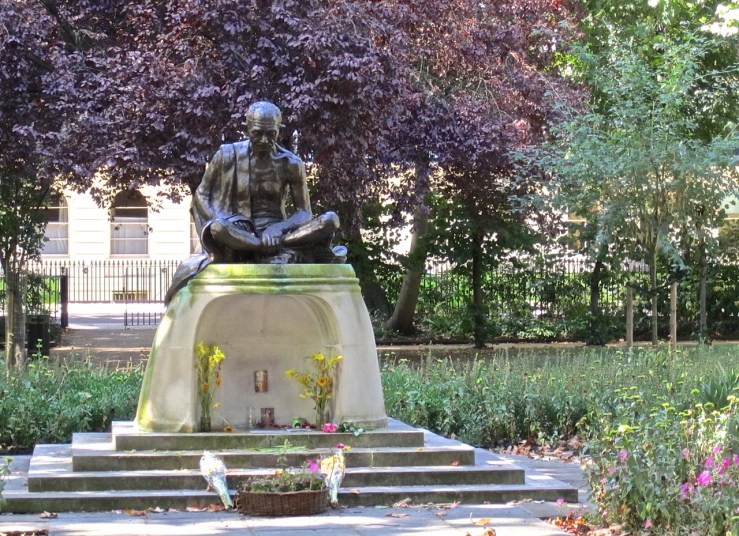
From the 1960s, Tavistock Square has been known for its various memorials to peace and non-violence, including
- a sculpture of Mahatma Gandhi by Fredda Brilliant (shown above) (1968);
- a cherry tree planted in memory of the victims of the nuclear bombing of Hiroshima (1967);
- a maple tree planted by the League of Jewish Women in honor of the U.N.’s International Year of Peace (1986);
- and the Conscientious Objectors Stone, installed by the Peace Pledge Union (1995).
Four of the park’s planting beds also honor memorial subjects — two with plants from India and Japan, one with English shrubs for Woolf, and one with medicinal plants for Aldrich-Blake.
Several years ago, another memorial was added to the square, in the form of a small plaque affixed to the current iron fence. It marks the section of street in front of the BMA where the last of the four July 7, 2005, suicide bombers blew up the Number 30 double-decker city bus and killed thirteen of the fifty-two commuters who died that day.
Gordon Square
Most of the social and intellectual activity that we associate with the Bloomsbury Group took place about a block west of Tavistock Square in a row of houses on Gordon Square.
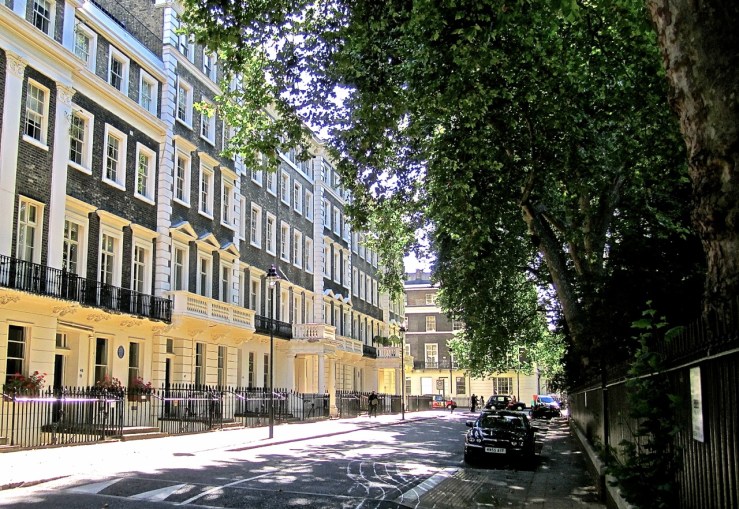
From 1904 to 1907, Virginia and Vanessa Stevens (later Woolf and Bell) lived in #46 Gordon Square with their brothers, Thoby and Adrian. The siblings held regular ‘at homes’ on Thursday and Friday evenings with such guests as Lytton Strachey, George Bernard Shaw, Maynard Keynes, E.M. Forester, Clive Bell, Duncan Grant, Roger Fry, and John Nash. (After their marriage, Vanessa and Bell took over the house from 1907 to 1916.)
From 1920 to 1925, Vanessa lived at #50 with her children and then at #39 with both her husband and lover Duncan Grant. Strachey and other members of his family lived at #51 from 1919 to 1956.
In the photo above, #46 is the first house on the left side (with the oval plaque), four doors down is #50 and then #51.








 “Highway U.S. 30, Sweetwater County, Wyoming” by Arthur Rothstein, March 1940,

 enclos*ure