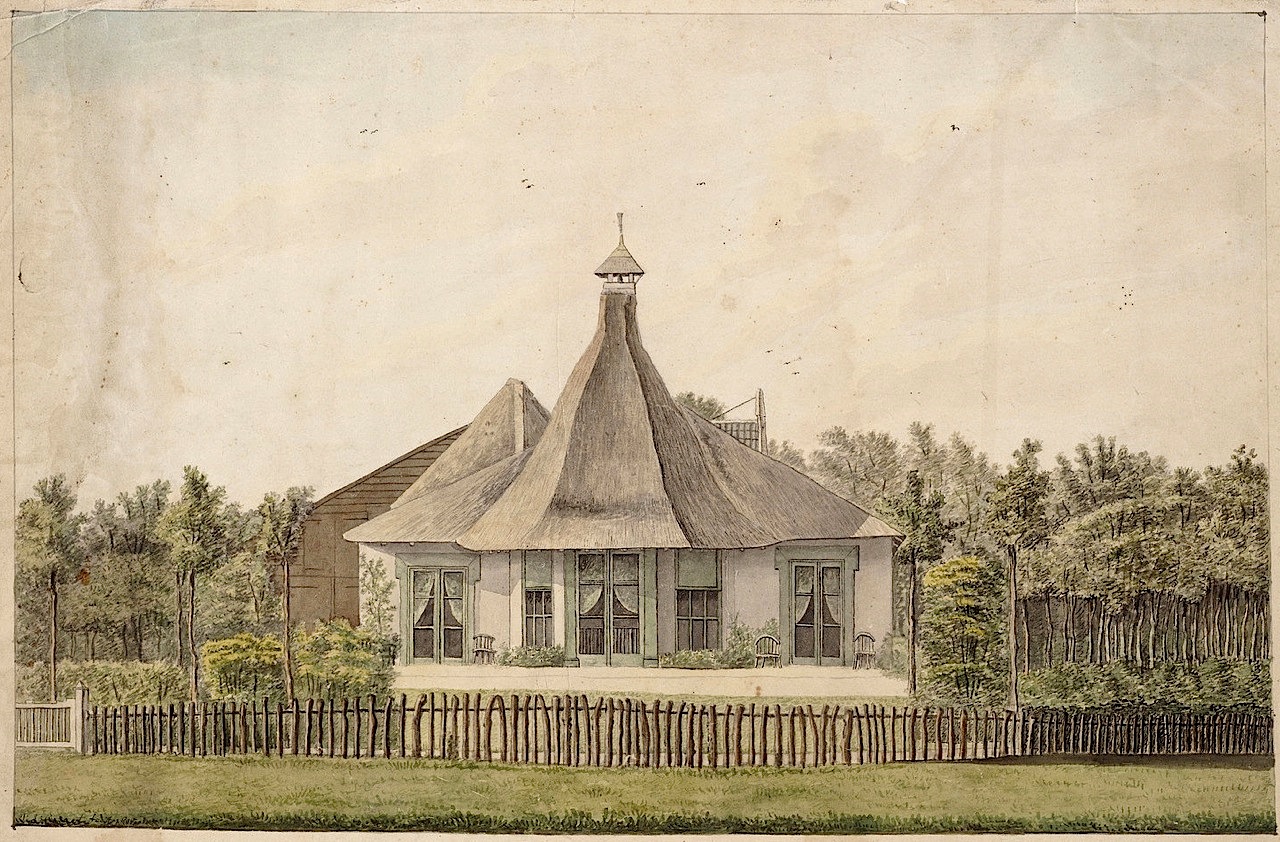
Vintage landscape: a terrace

Heiloo, 1815, via Alkmaar Archives on flickrA farmhouse of To (or Ter) Coulster, in the town of Heiloo, Netherlands, 1815, by J. A. Crescent, via Regionaal Archief Alkmaar Commons on flickr.

You can click on the image to enlarge it. There are more of Crescent’s charming watercolors here.

A garden is the interface between the house and the rest of civilization.

Geoffrey B. Charlesworth

The Sunday porch: Lake City

Summer porch, c.1900, by Theresa. Babb, via Camden Public Library“Fenderson cottage at Lake City on Megunticook Lake in Camden, Maine, in September 1900,” by Theresa Parker Babb, via Camden Public Library Commons on flickr.

Lake City seems to have been a neighborhood of summer homes. From the late 1880s, “a flood” of people from the eastern cities –often rich and prominent– built cottages in and around Camden, drawn by the surrounding scenery and the town’s romantic seafaring past.

. . . Waved in the west-wind’s summer sighs.

— Sir Walter Scott, from “The Lady of the Lake


The Sunday porch: Kalaupapa, Hawaii

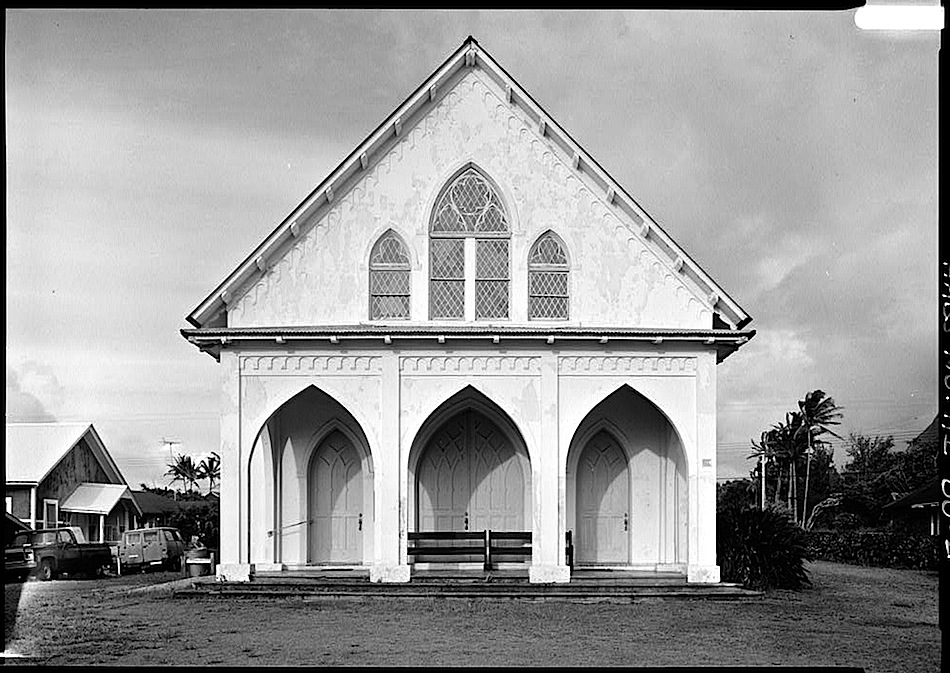
1 St. Francis Catholic Church, Kalaupapa, HI, HABS, Library of CongressThe west front of St. Francis Catholic Church, Moloka’i Island, Kalaupapa, Hawaii, July 1991, by Jack E. Boucher for an Historic American Buildings Survey (HABS), via Library of Congress Prints and Photographs Division (all photos here).

2 St. Francis Catholic Church, Kalaupapa, HI, HABS, Library of Congress

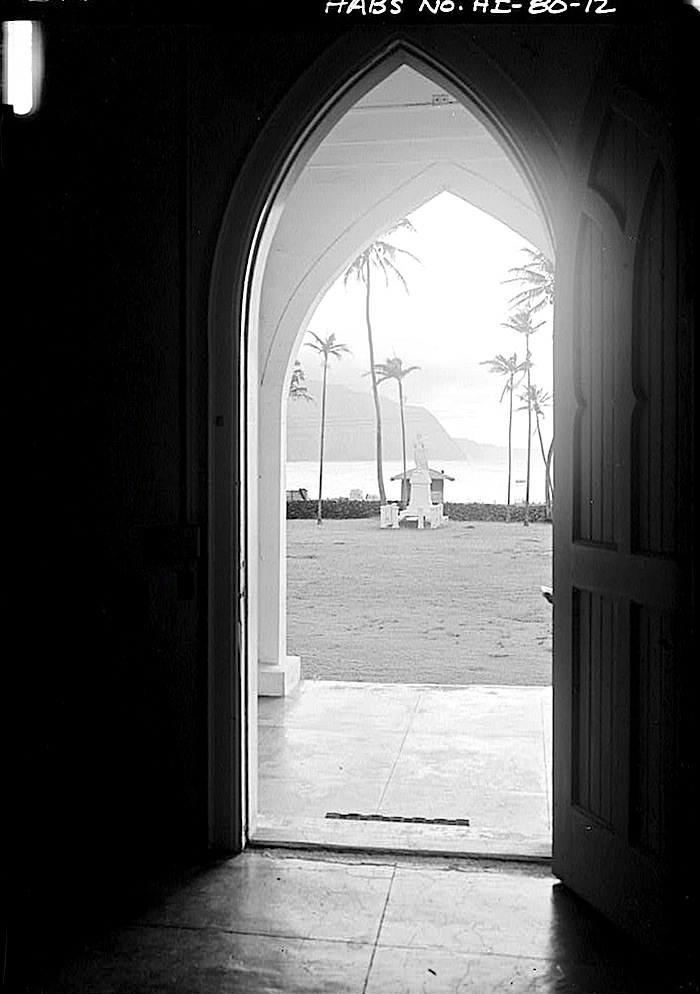
The church was built in 1908 to serve the Kalaupapa Leprosy Settlement, now part of Kalaupapa National Historical Park.

3 St. Francis Catholic Church, Kalaupapa, HI, HABS, Library of Congress

4 St. Francis Catholic Church, Kalaupapa, HI, HABS, Library of Congress

The word porch — “1250-1300; Middle English porche < Old French < Latin porticus porch, portico” — was originally used to indicate the covered entrance to a church, usually on the south side.

The Sunday porch: Oak Hill, Alabama

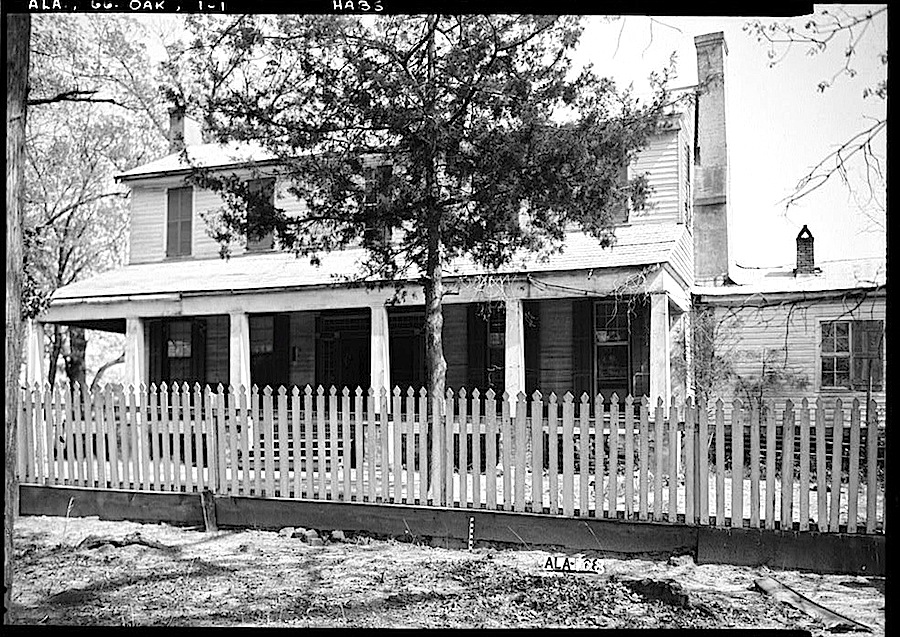
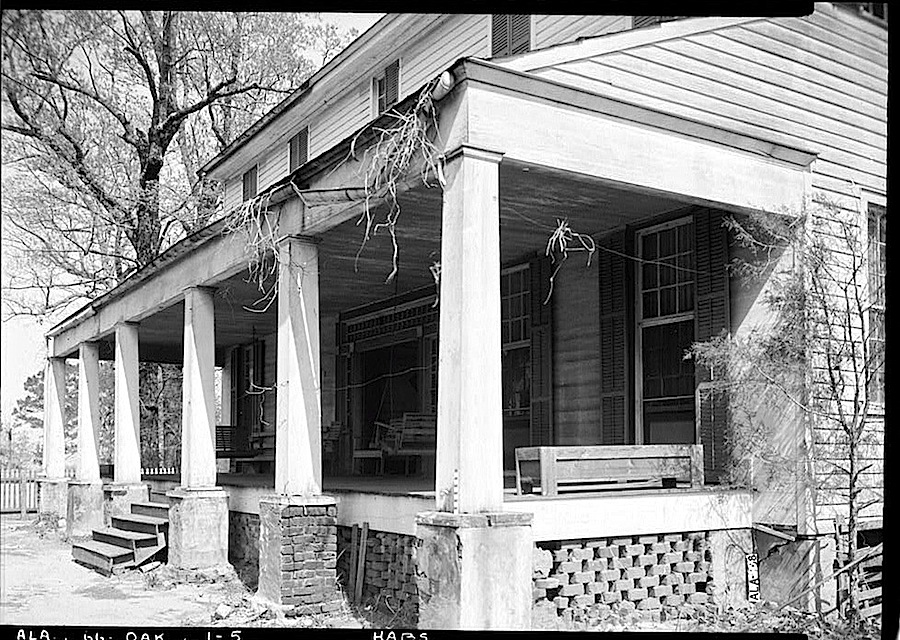
Old Ramsey Hse., 1937, A. Bush, HABS, Library of CongressThe Ramsey-Jones-Bonner House, Oak Hill, Alabama, March 24, 1937, by Alex Bush for an Historic American Buildings Survey (HABS), via Library of Congress Prints and Photographs Division (all photos here).

A nice front porch, but not especially interesting — except that it is a Carolina (or rain) porch.

Old Ramsey Hse., 1937, A. Bush, HABS, Library of Congress

Its columns rest on masonry bases set “directly on the ground . . . in front of the foundation of the porch floor. This is a distinctive regional characteristic,” according to the registration form (1998) for the National Register of Historic Places for the Oak Hill Historic District.

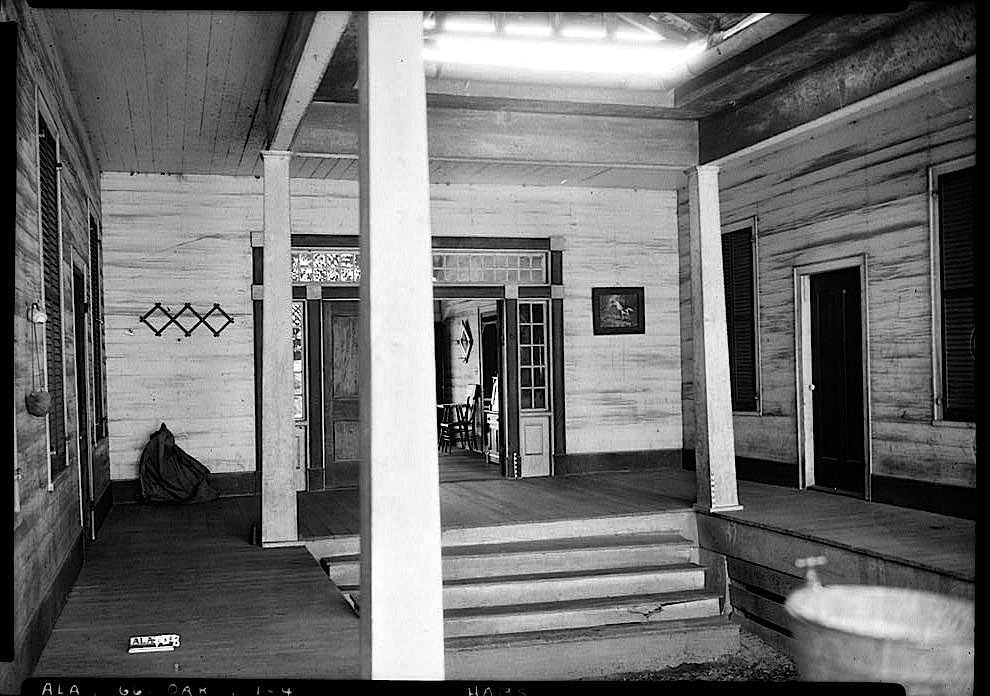
The back porch, however, is more unusual.

This slideshow requires JavaScript.

Old Ramsey Hse., 1937, A. Bush, HABS, Library of Congress

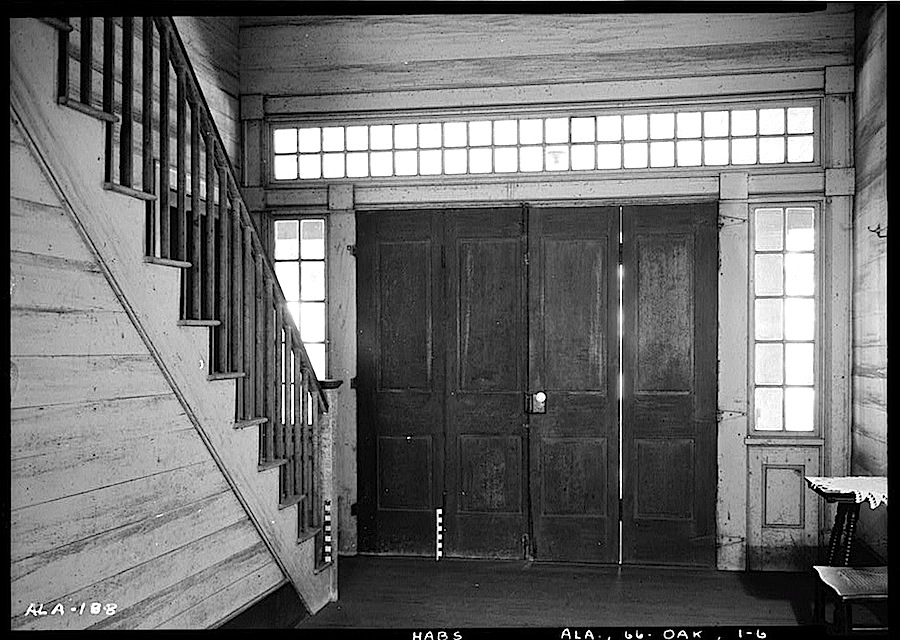
“[The] rear wings have integral recessed porches facing inward and creating an atrium-like space which has been roofed [with] corrugated metal. . . . [The] . . . first floor   [is] essentially an enclosed dogtrot. . . .”

Old Ramsey Hse., 1937, A. Bush, HABS, Library of Congress

The house was built in 1836 by Abiezer Clarke Ramsey, a school teacher and Methodist circuit rider.  In 1937, he married Elizabeth Amanda Wardlaw, a widow with four children.  She and Abiezer had seven more before her death in 1854.

The house still stands in the Oak Hill Historic District.
Continue reading “The Sunday porch: Oak Hill, Alabama”

Vintage landscape: Lob’s Wood

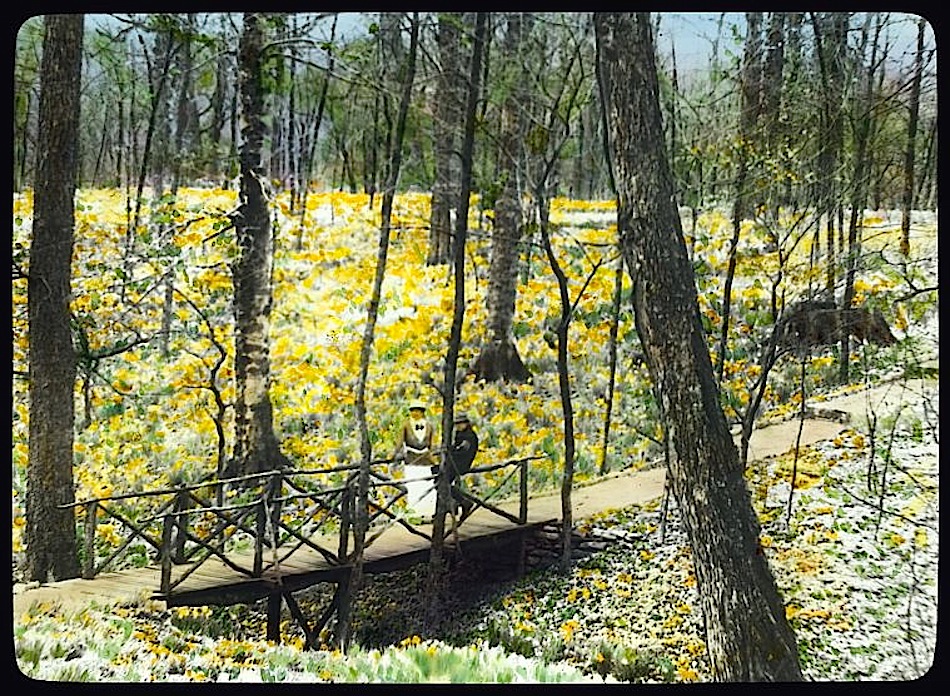
Lob's Wood, Ohio, ca. 1920, via Library of Congress“‘Lob’s Wood,’ . . . Perintown (Milford), Ohio. Woodland daffodils,” ca. 1920, a hand-colored lantern slide by Frances Benjamin Johnston, via Library of Congress Prints and Photographs Division.

The 97-acre property pictured above was purchased in 1898 by Carl H. Krippendorf, a Cincinnati businessman who had spent childhood summers in the surrounding area.  He wanted to save the woodland from being turned into a tobacco field.

Krippendorf soon built a house there for his new wife, Mary Greene, and began planting daffodils and other bulbs. They originally called the land Karlsruhe, meaning “Karl’s place of peace” in German. After World War I, the name was changed to Lob’s Wood.  

In 1919, during “Daffodil Days at the Krippendorf Farm at Perintown,” $2,700* was raised for war-devastated France. In one afternoon, they sold 15,000 cut daffodils.

Carl became a friend and correspondent of the garden writer Elizabeth Lawrence.  She wrote about his garden in The Little Bulbs and Lob’s Wood.

 The Krippendorfs lived on the property (eventually 175 acres) for 64 years.  Today the house and woods are part of the Cincinnati Nature Center.

What explains poetry is that life is hard
But better than the alternatives,
The no and the nothing. Look at this light
And color, a splash of brilliant yellow

Punctuating an emerald text. . .

Alicia Ostriker, from “Daffodils

*about $34,000 today.