
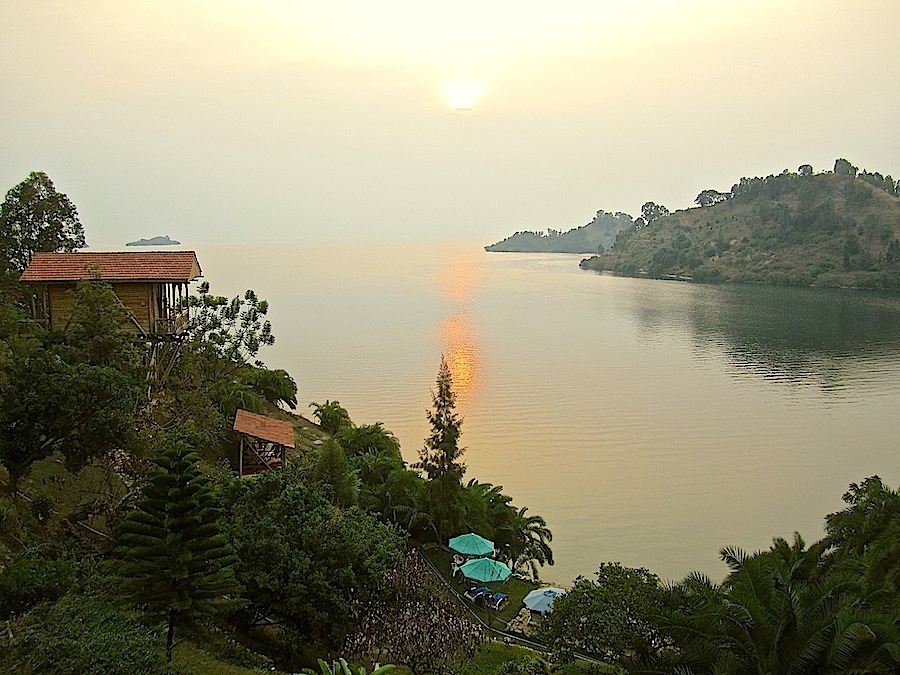
 July 29, 2013, Cormoran Lodge on Lake Kivu, Kibuye, Rwanda.
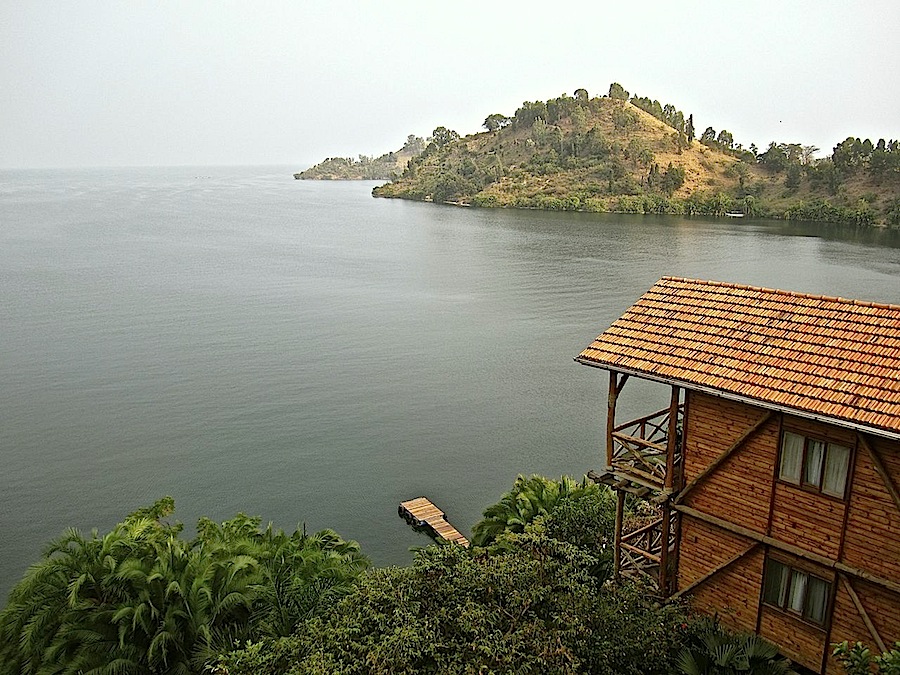 The next morning.
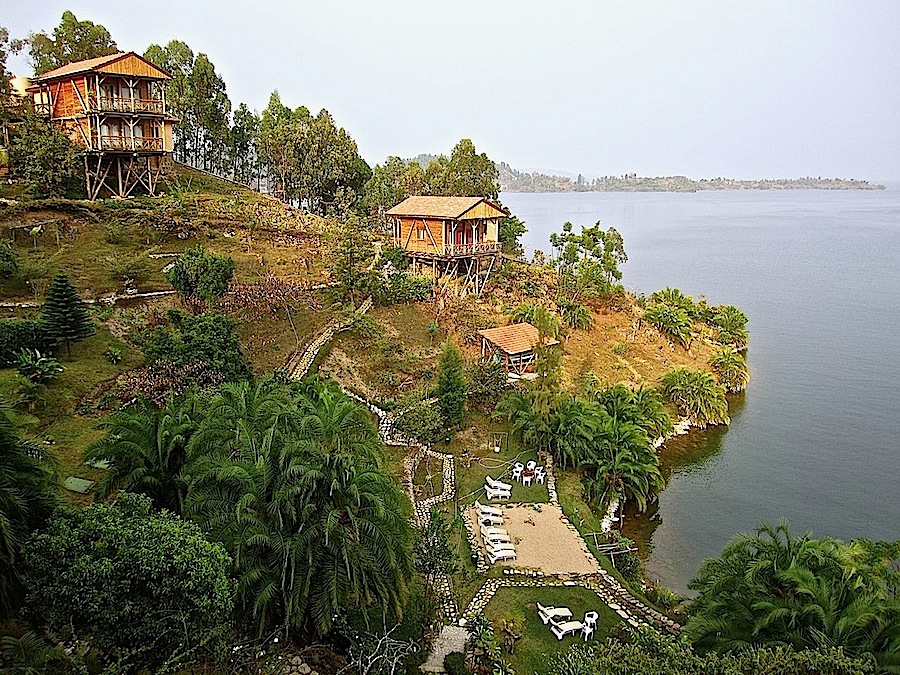 More here.
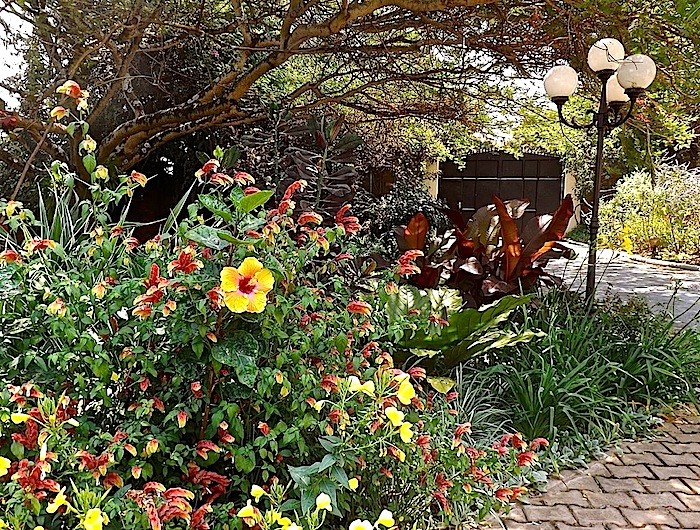
I thought I would give you a look at the plants surrounding the hibiscus and shrimp plants from yesterday’s Bloom Day.
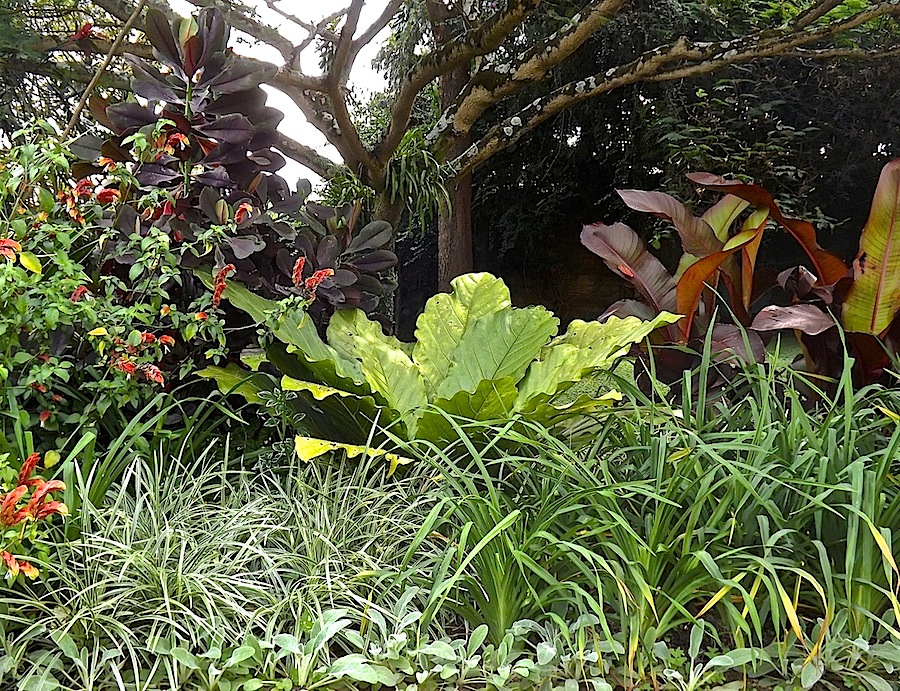
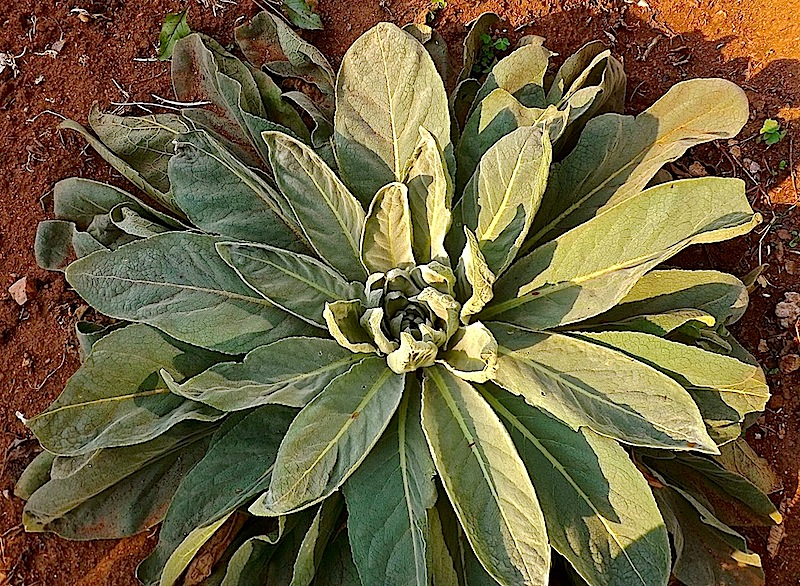
First, I would be grateful if anyone could identify the tropical plant with the very large leaves in the center above — and below with clover poking up through the leaves.

When we arrived in Kigali, it was in a big pot on an upstairs porch, where I felt it was not getting the attention it deserved. It was also really in the way — it’s over 4′ across.
On its left above and in the photo below is a large burgundy-colored succulent — sedum? kalanchoe? — which I also haven’t yet identified. Does anyone recognize it Euphorbia grantii (aka Synadenium grantii), possibly the Rubra variety. It’s also called African milk bush and is native to East Africa.
[Thanks to Alison in Australia, who wrote me with the I.D. in November 2014.]

This one is about 5′ tall, but I have seen specimens in Rwanda the size of a small tree.

The burgundy leaves (red, green, and pink when the backlit by the sun — above) look good almost everywhere, so I have cuttings spread throughout the garden.
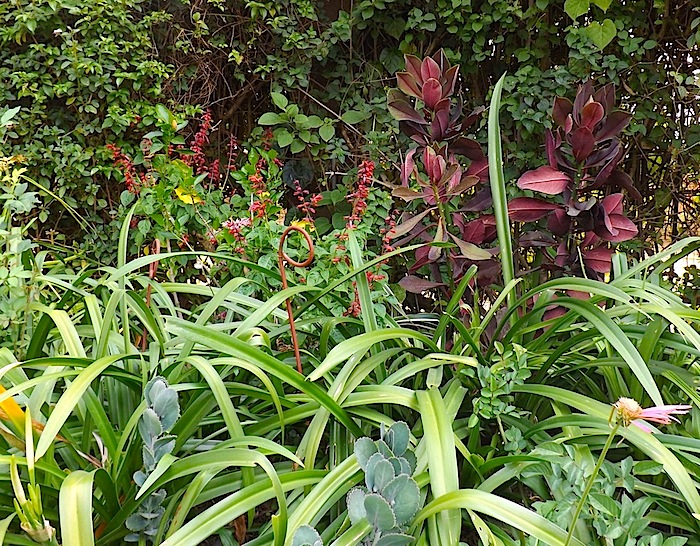
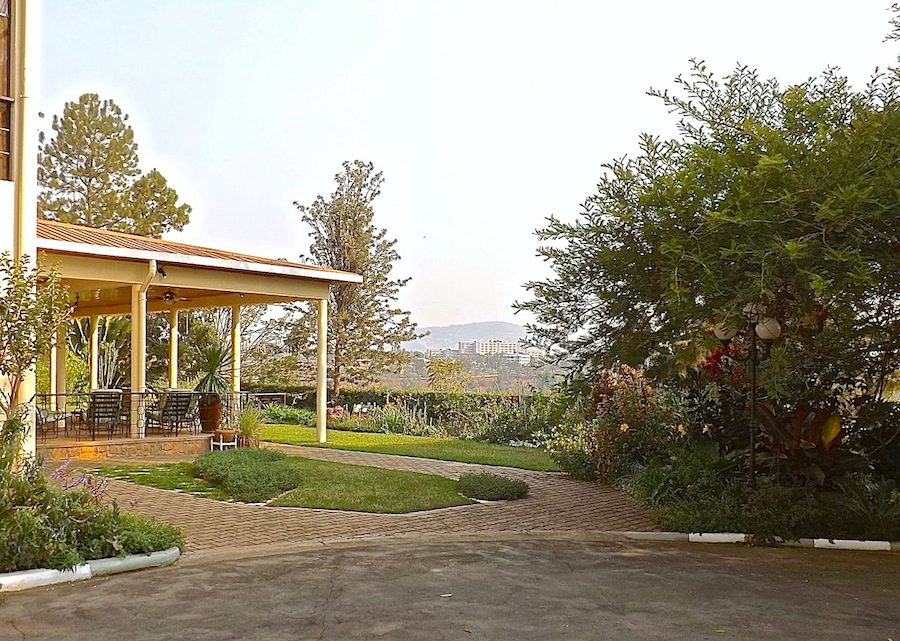
In the picture above, there’s one in the back of a pink section of the long flower border — or it will be pink if the small shrub roses planted there will oblige me by growing and blooming. They are supposed to push up through the beach spiderlilies (Hymenocallis littoralis).
Below is one of two original plants that were here when we moved in.

In the same planting bed with my two mystery plants are burgundy cannas, variegated liriope, yellow daylilies, and some lamb’s ear that I grew from seed from my parent’s garden in Virginia.
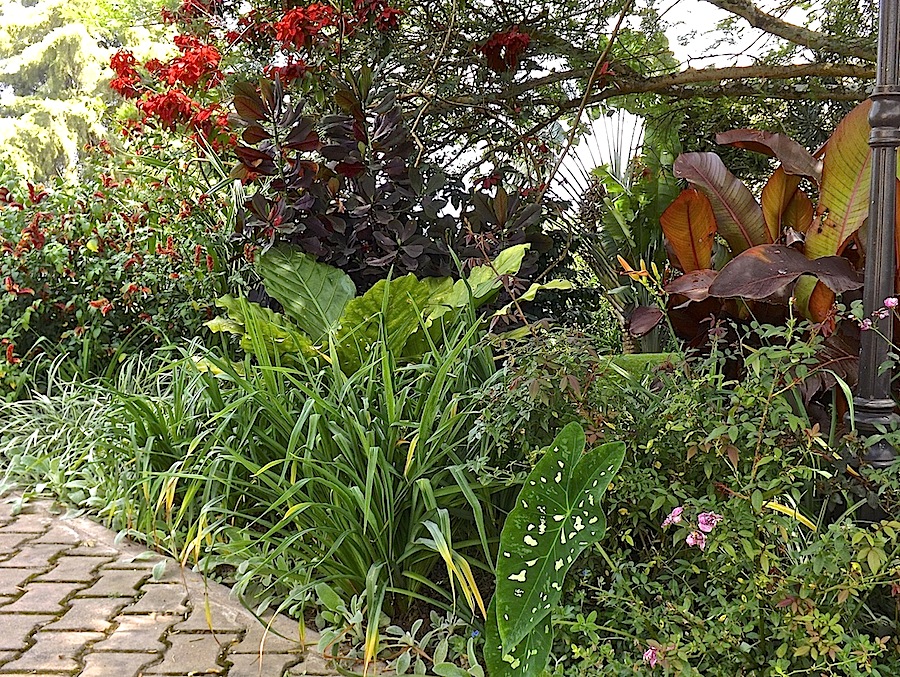
At the ends are shrimp plants, “Fairy” roses, a caladium, and a small cycad (not in the picture).
This planting bed is on the right in the photo below.
I also wanted to show you one of the common mulleins (Verbascum thepus) that I grew from seed taken from my parent’s garden last year.
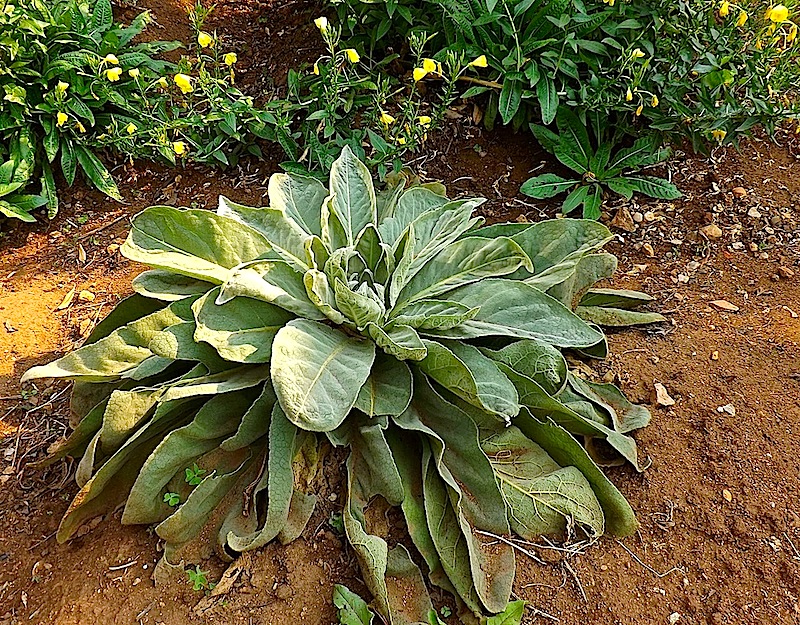
This one (located not very artistically in the vegetable garden) is 3′ across. The other plants are only 12″.
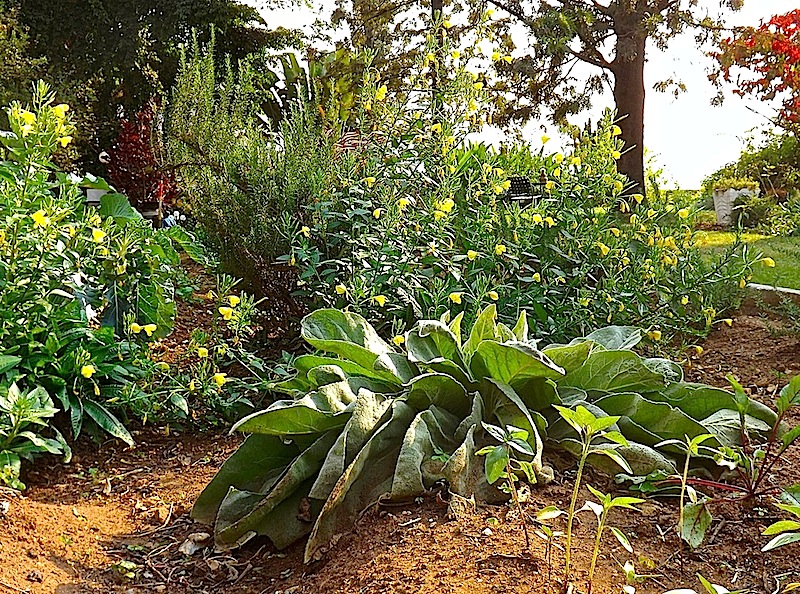
The plant is something of a roadside weed in the mid-Atlantic region of the U.S., but it can send up a yellow flower stalk to 10′ tall. The garden writer, Henry Mitchell* liked tall mulleins so much that he wrote, “O for a lute of fire to sing their merits.”
Thanks to Pam at Digging for hosting Garden Bloggers’ Foliage Follow Up the 16th of every month.
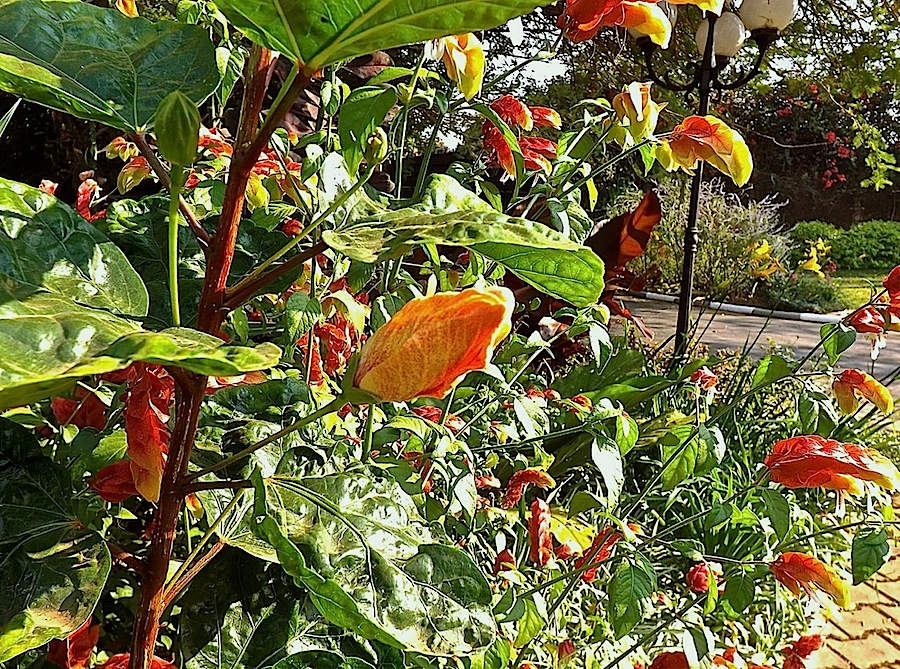
About 8:30 this morning:
Five hours later:
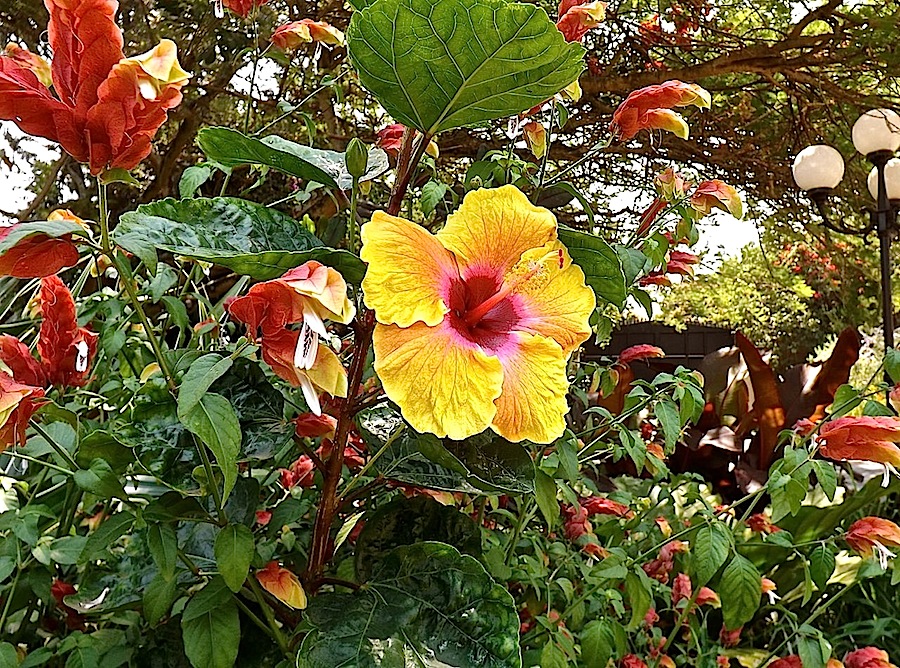
Well. . . aloha.
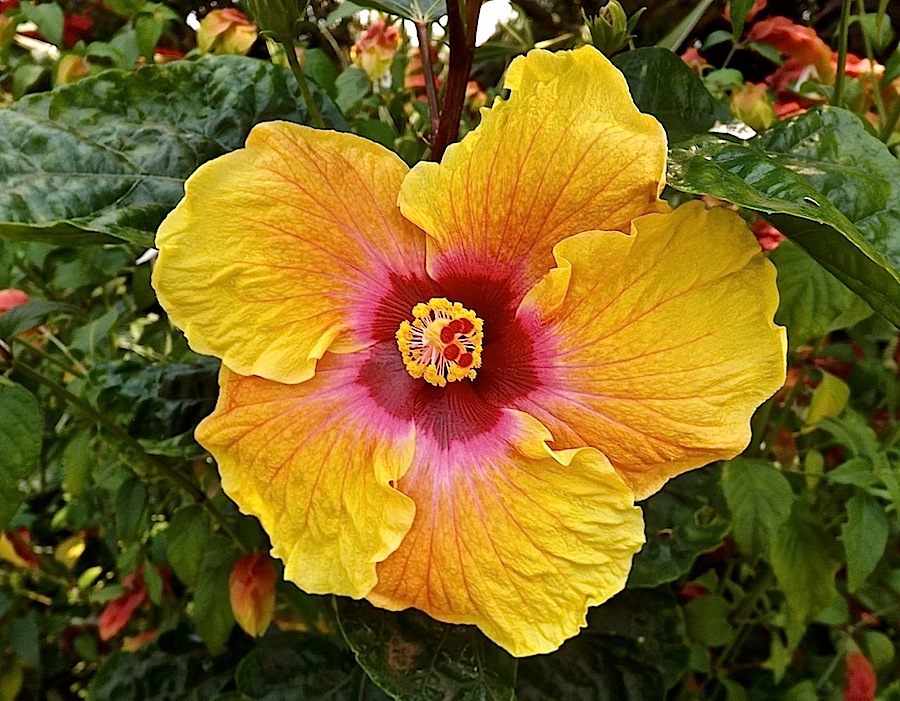
This is the second bloom I’ve seen on this particular tropical hibiscus. None of my others are this flashy dramatic.
Surrounding it are several Justicia brandegeeana or shrimp plants, which are always in bloom.
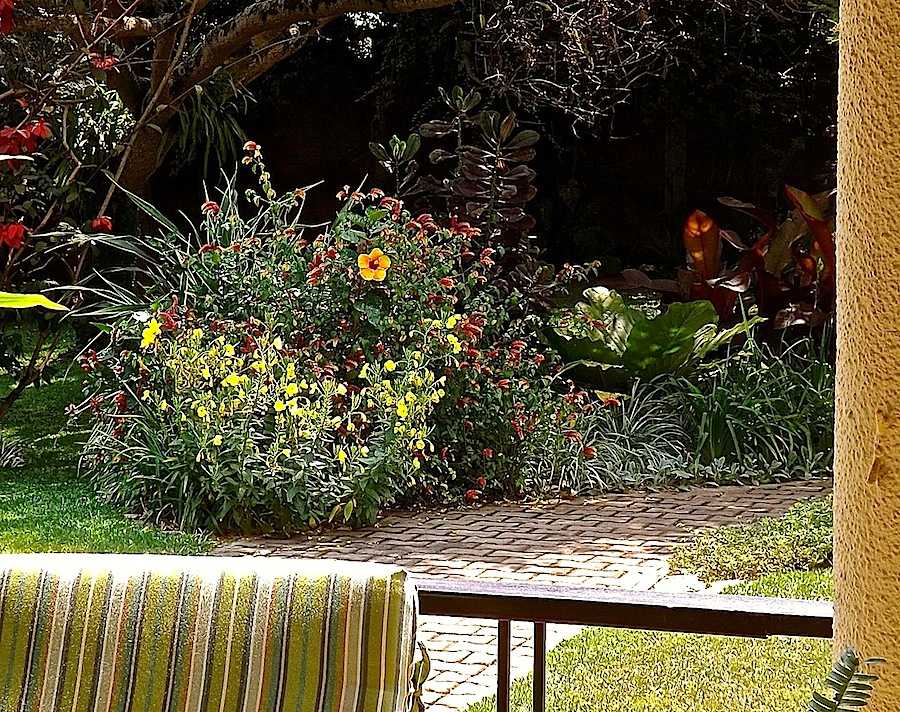
This is a small planting bed near the entrance to the front terrace. We removed* all the old clipped shrubs from this area early last summer, but in a combination of fatigue and indecision, I just cut this bush to the ground, thinking it could die (or not) in place.
A couple of months ago, I noticed that it had sent up two stems and that flower buds were developing. I was a little amazed about a week and a half ago when the first one opened.
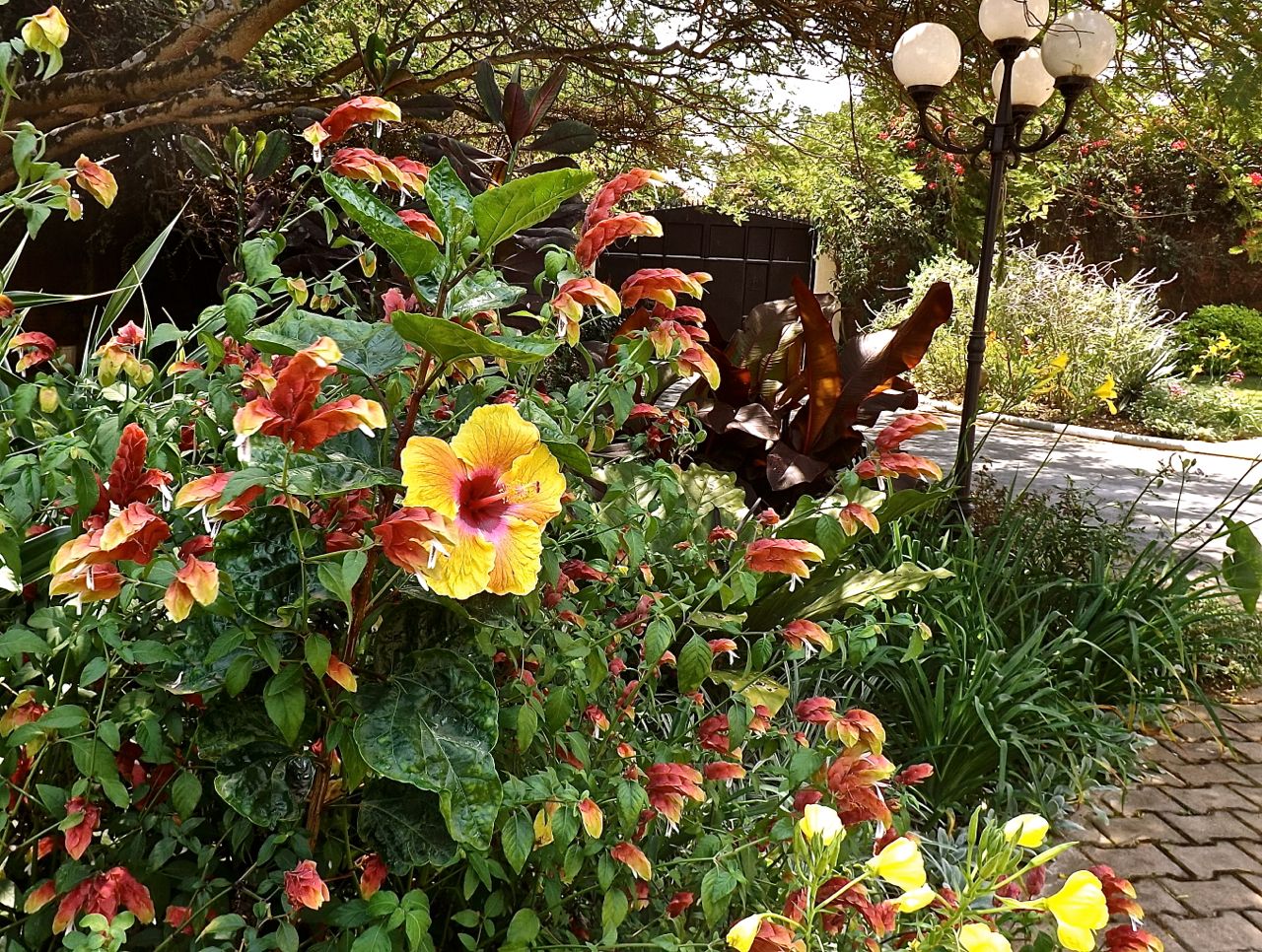
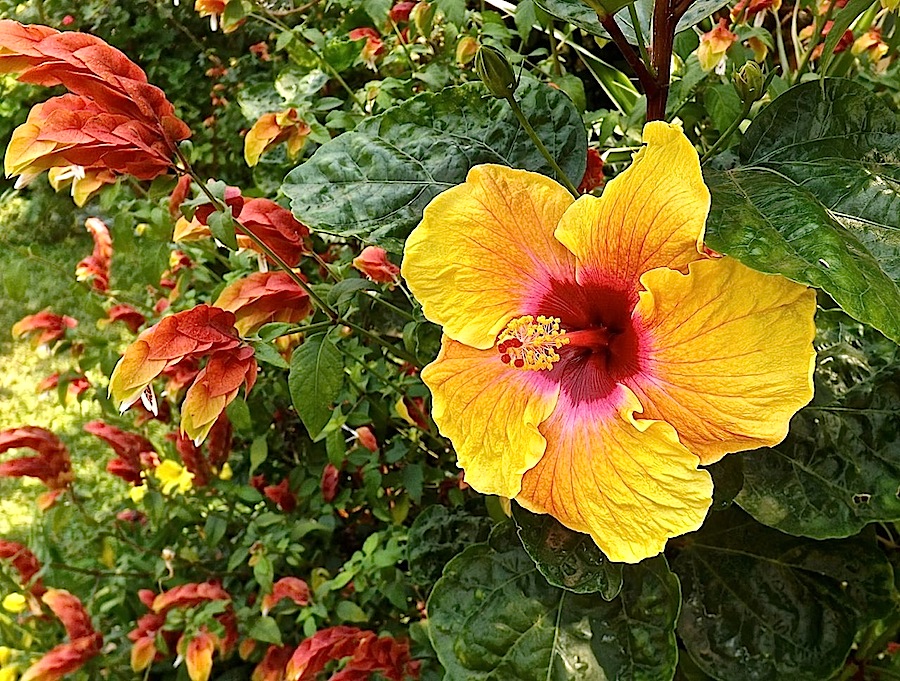
It goes well with the shrimp plants, so I’ll just leave it here and keep it pruned to about 4′ – 5′ tall. The yellow-flowering plant in front of it is a Missouri primrose (Oenothera missouriensis). It is an American native annual that self-seeds around the garden.
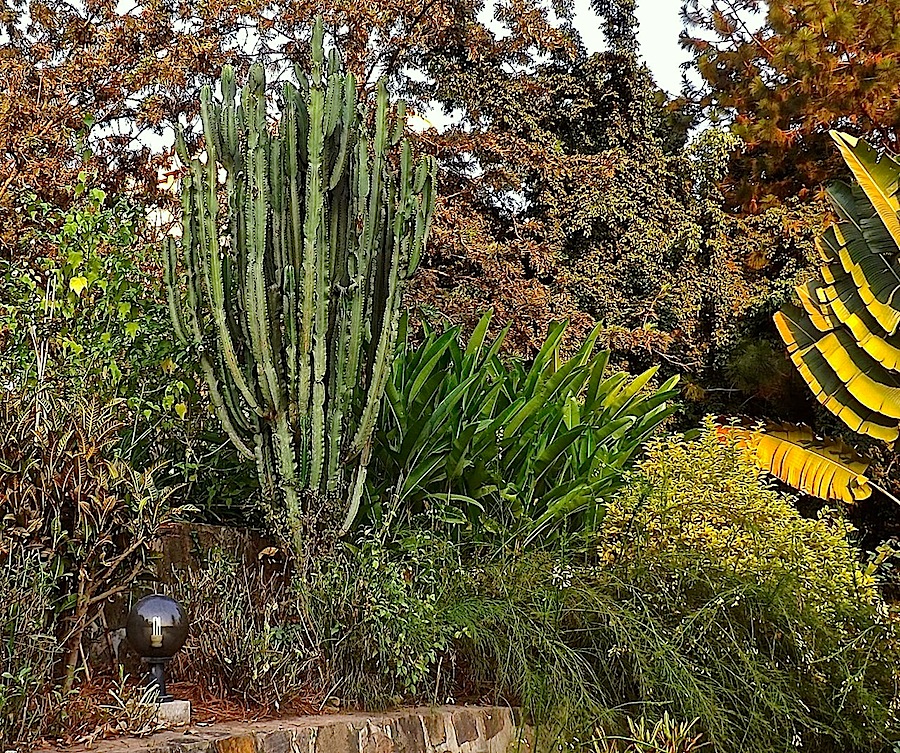
On the opposite end of the showy-ness scale, I discovered last week that our cactus-like Euphorbia (above and below) is blooming.
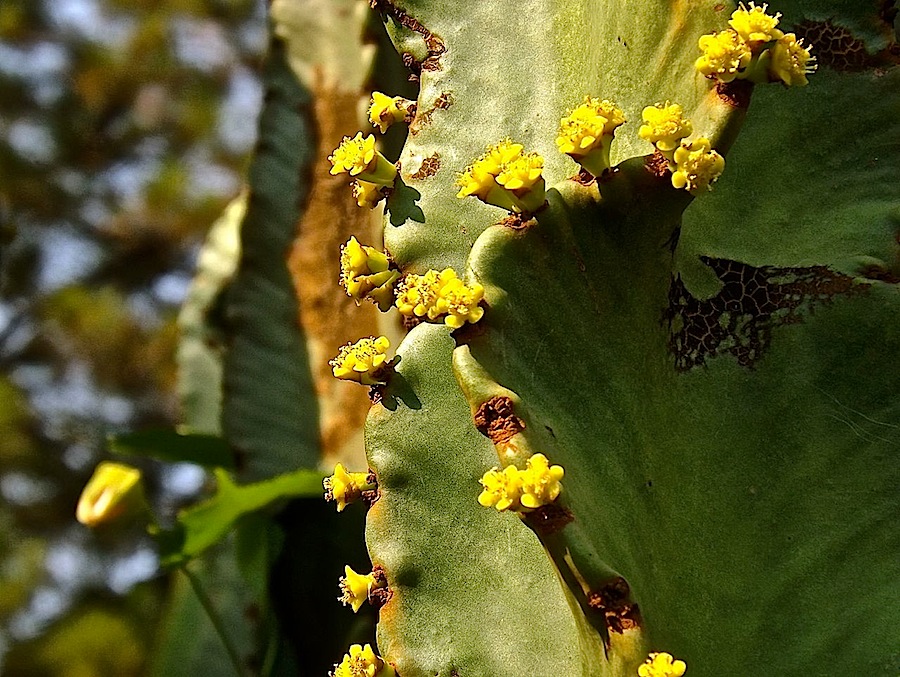
The flowers are a little over a 1/4″ across.
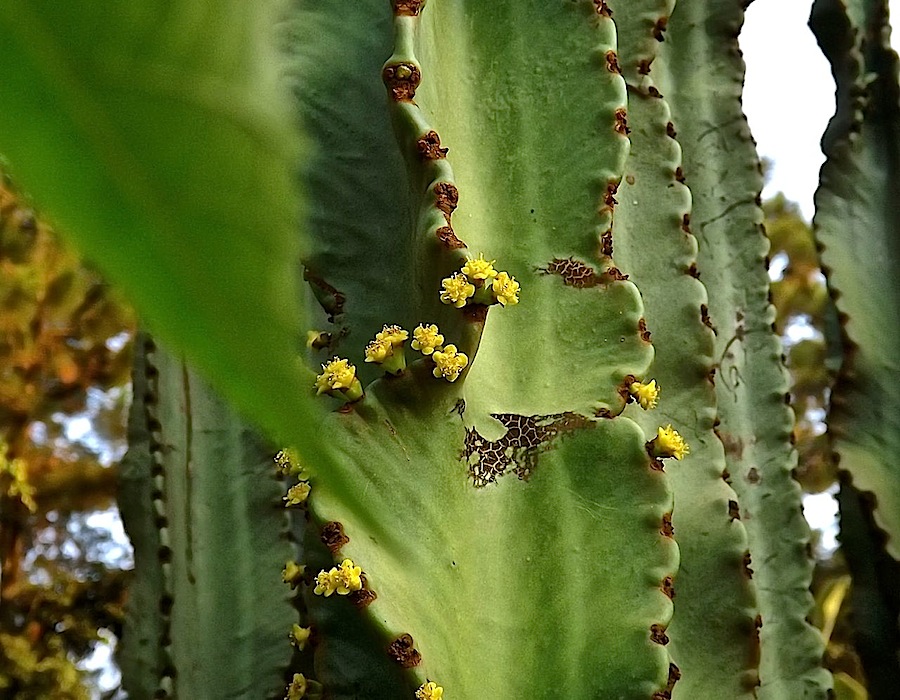
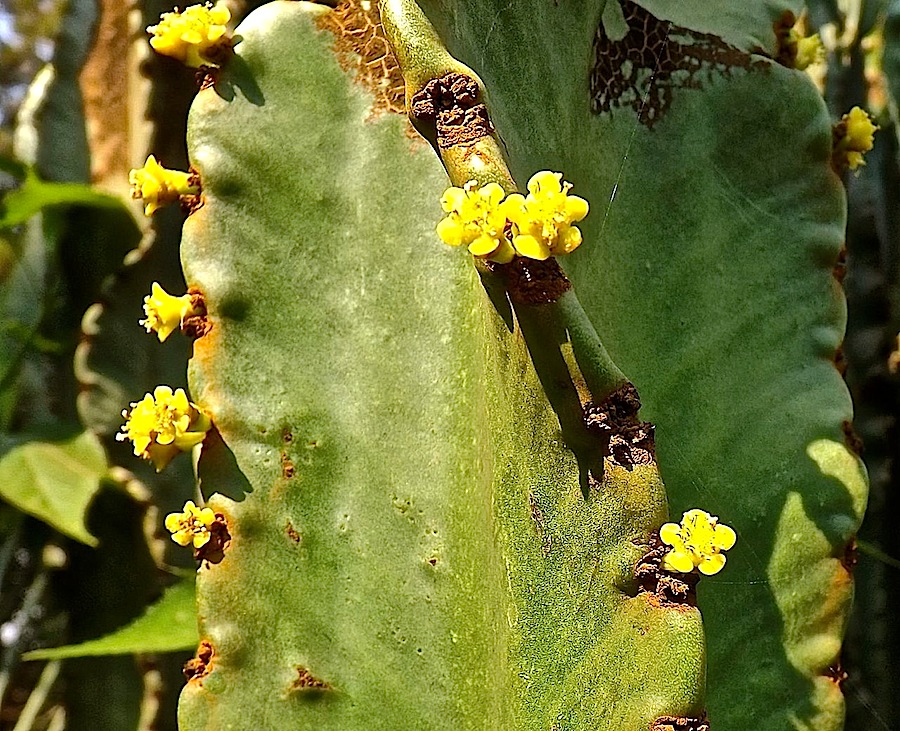
GBBD — the 15th of every month — is hosted by Carol at May Dreams Gardens. Click here to see other garden bloggers’ mid-July flowers.
*It was among the bushes on the right in this photo. It was always clipped, so it probably hasn’t bloomed for a long time.
After our recent drive to the southeast corner of Rwanda, we backtracked and then headed north to Akagera National Park to spend the night.

It was about 4:30 p.m. when we arrived at the park’s welcome center, and I was anxious to get some photos before the light disappeared. Here, near the equator, dark comes between 6:00 and 6:30 all year round. No extra long summer days for us.
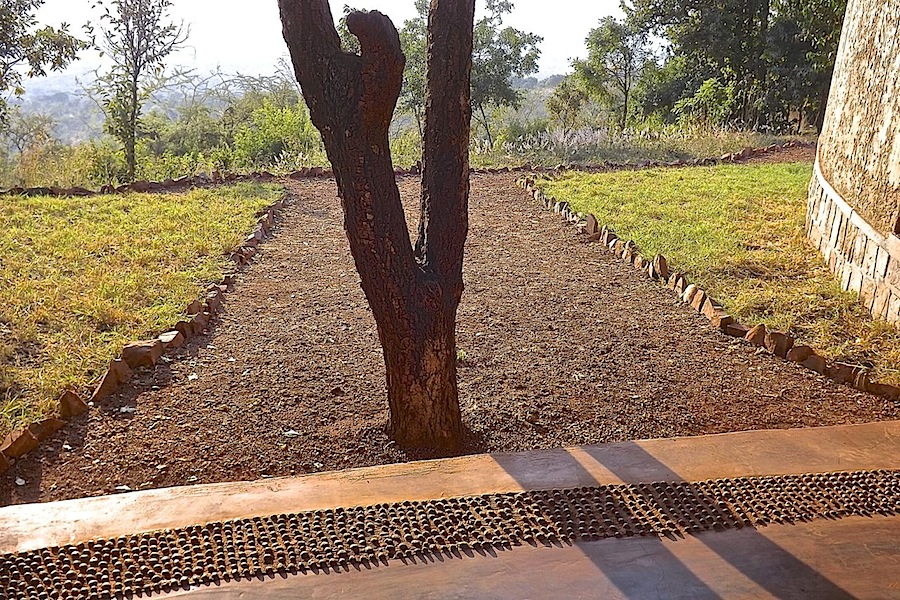
I liked the pebble border to the welcome center’s concrete floor, which had been colored red, like the surrounding dirt.
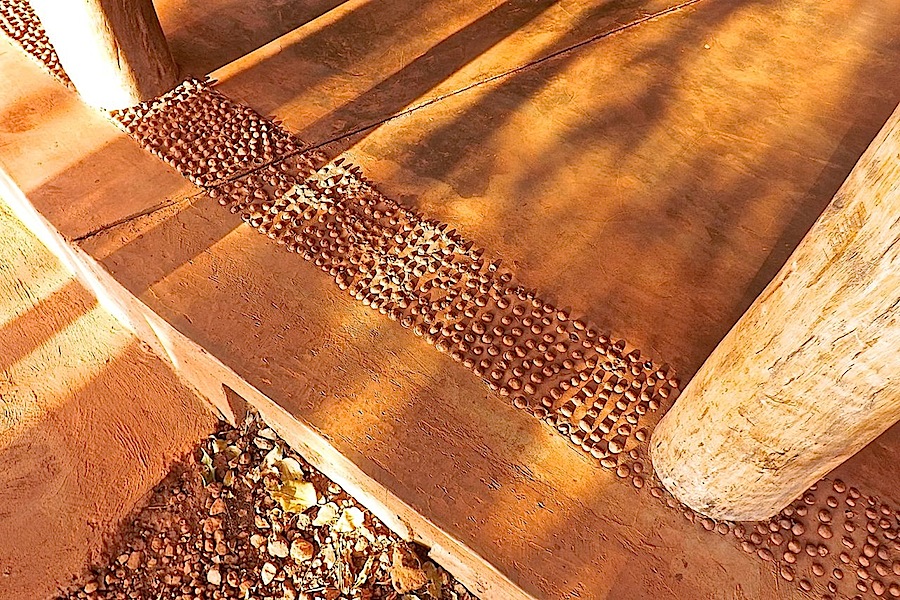
The attractive building, which for some reason I failed to photograph, was stone and stucco and had a thatched roof, like the lodge pictured below.
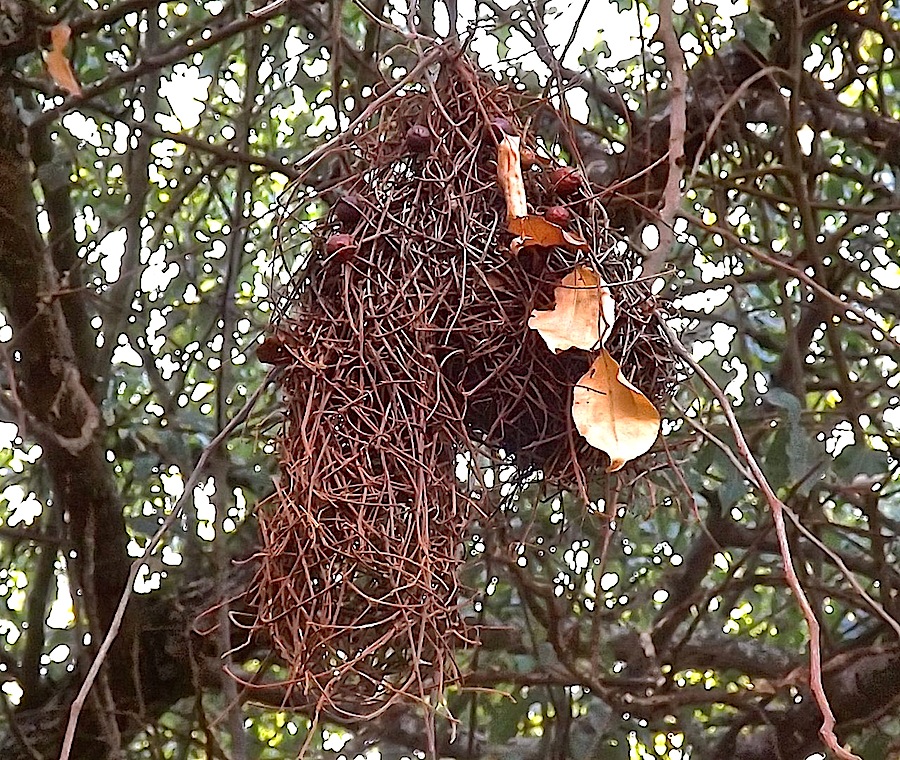
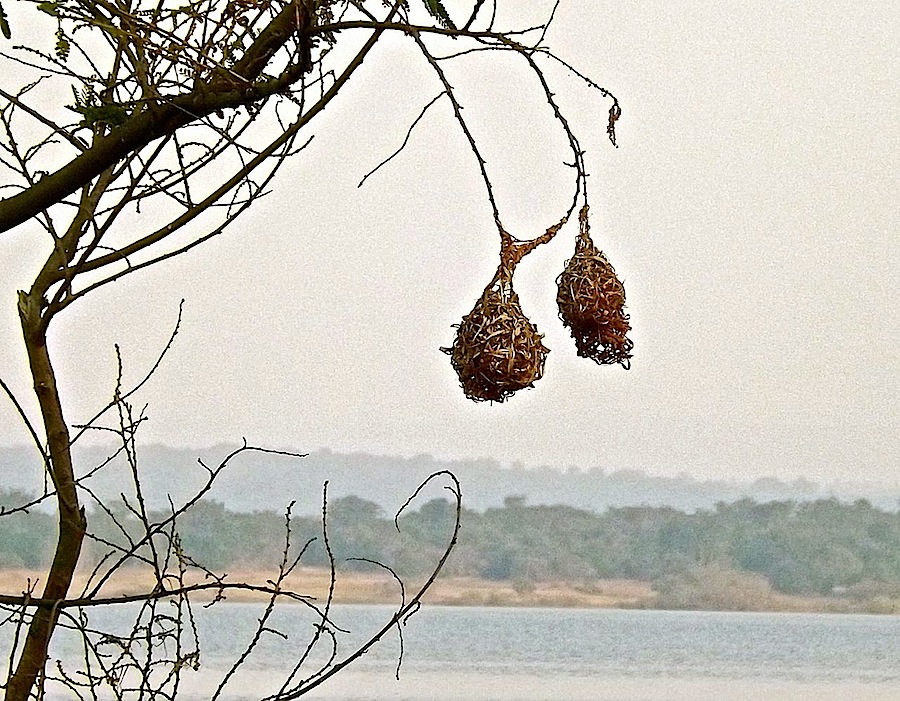
In a tree just outside the welcome center, there was a weaver bird nest (above) — this one with a very long entrance tunnel, a protection against predators.
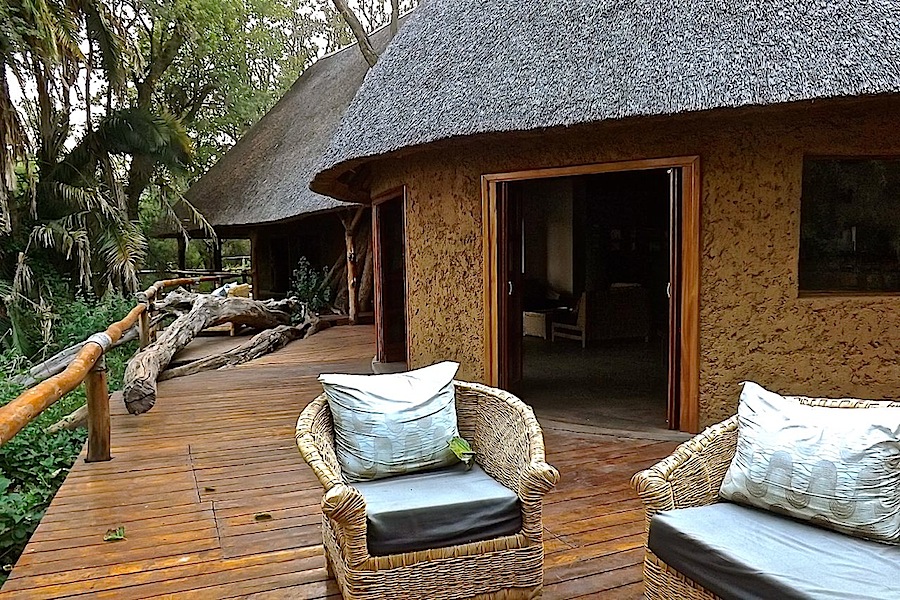
The Ruzizi Tented Lodge — which opened inside the park just this year — is on a small strip of largely undisturbed land along the edge of Lake Ihema.
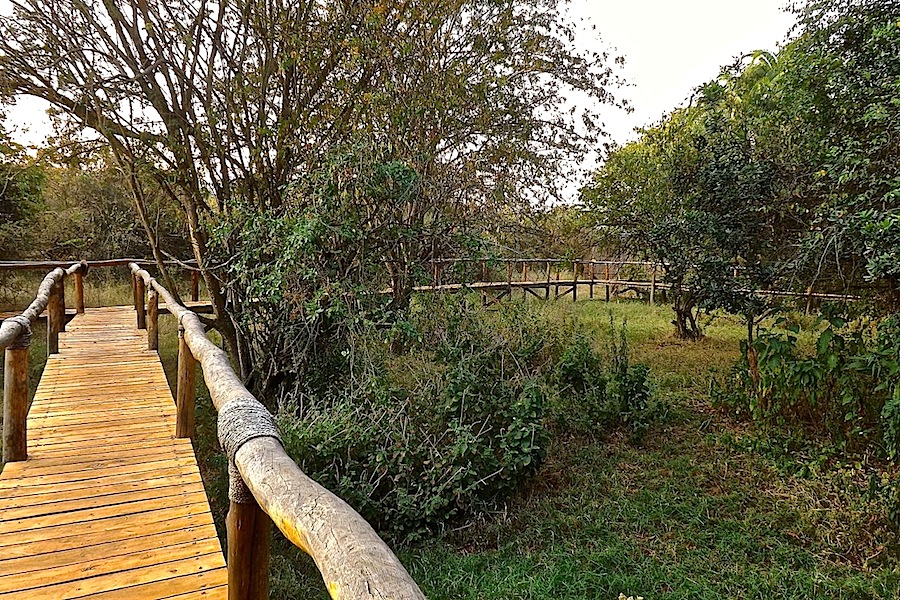
Boardwalks keep visitors off the native plants, not to mention away from the equally native crocodiles and hippos. (An electric fence keeps other large animals out on the inland side of the lodge.)
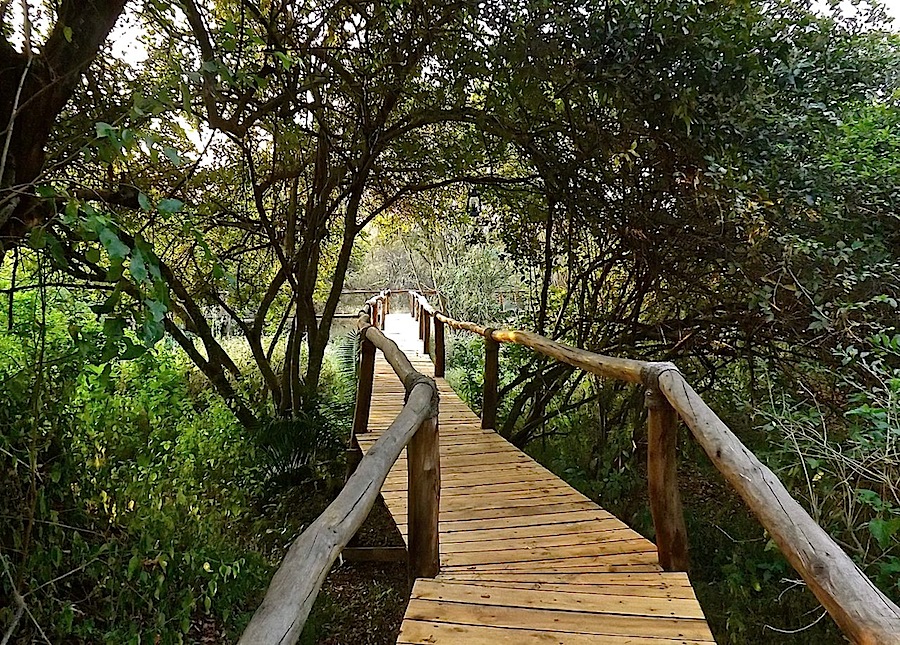
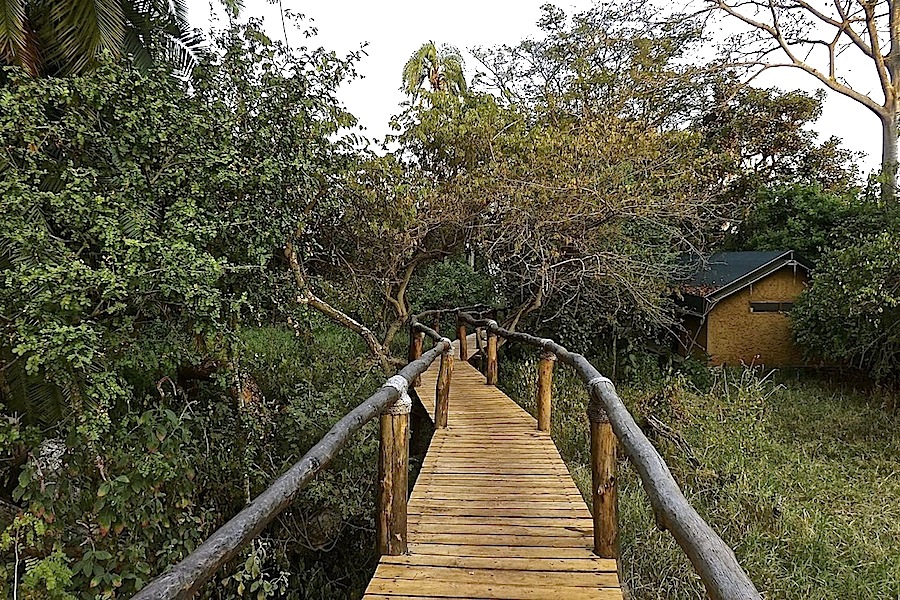
The camp has seven tented cabins, each with a full bath, one or two real beds (with reading lamps), and an outlet for recharging phones.
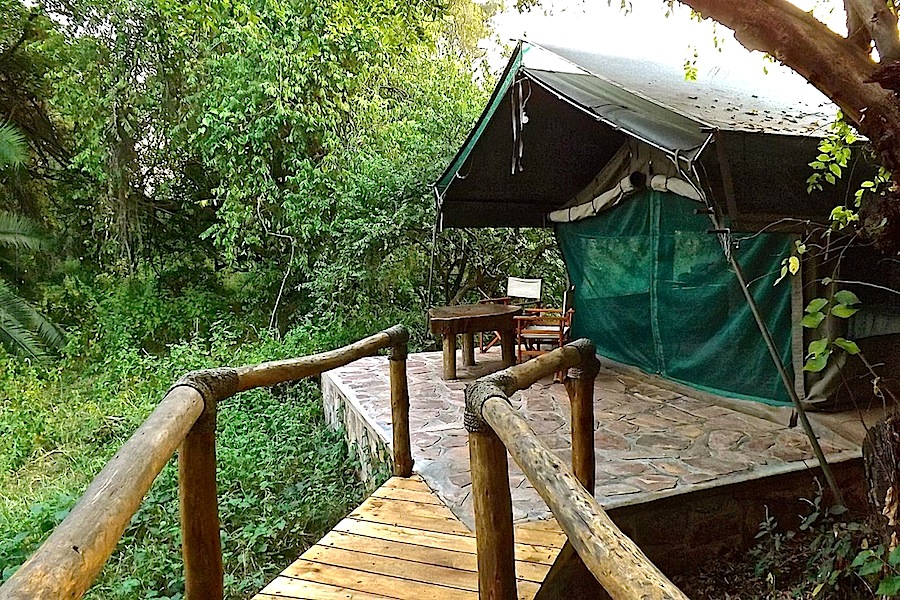
Below is our tent’s “front yard,” which was quite close to the water’s edge. That night, we heard, but did not see, hippos near our tent.
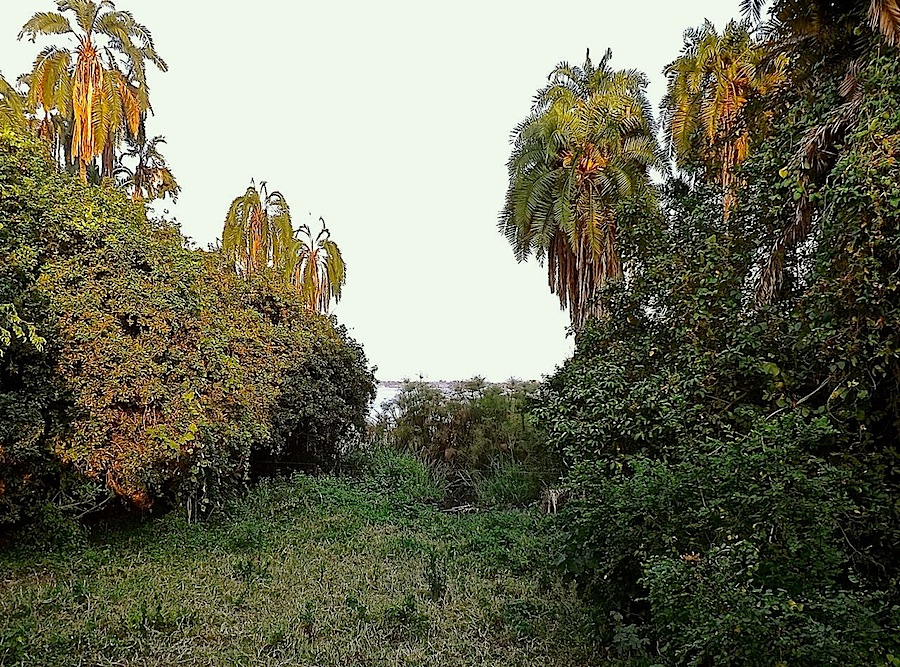
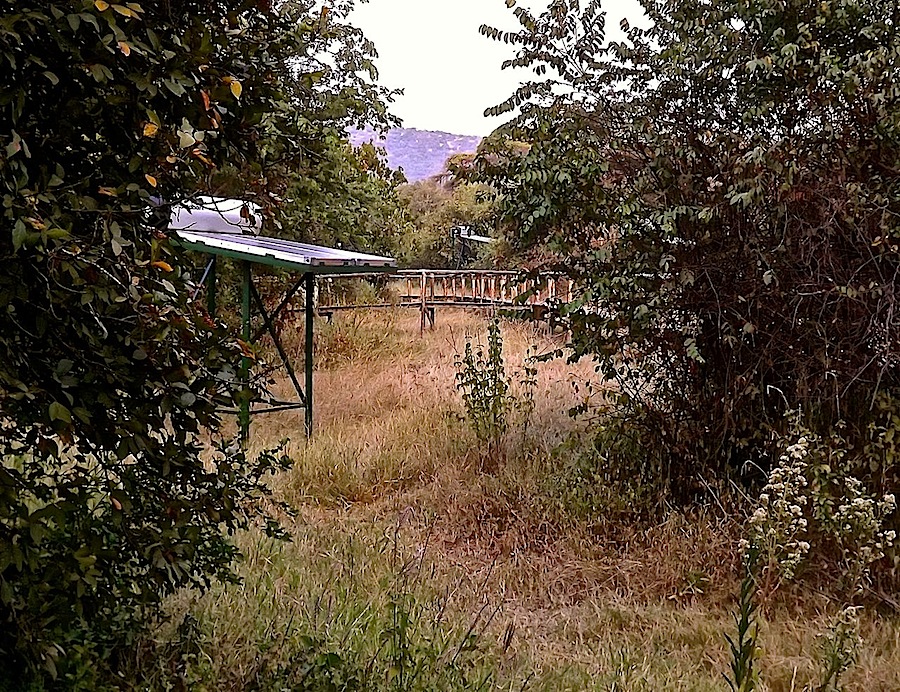
Each tent has a solar panel for lights and hot water — shown above.
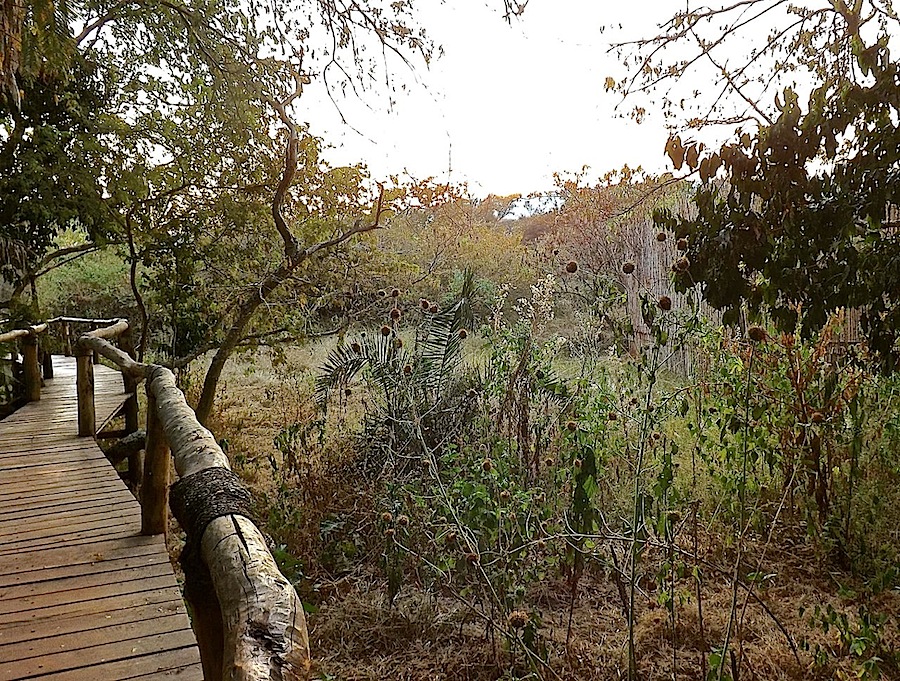
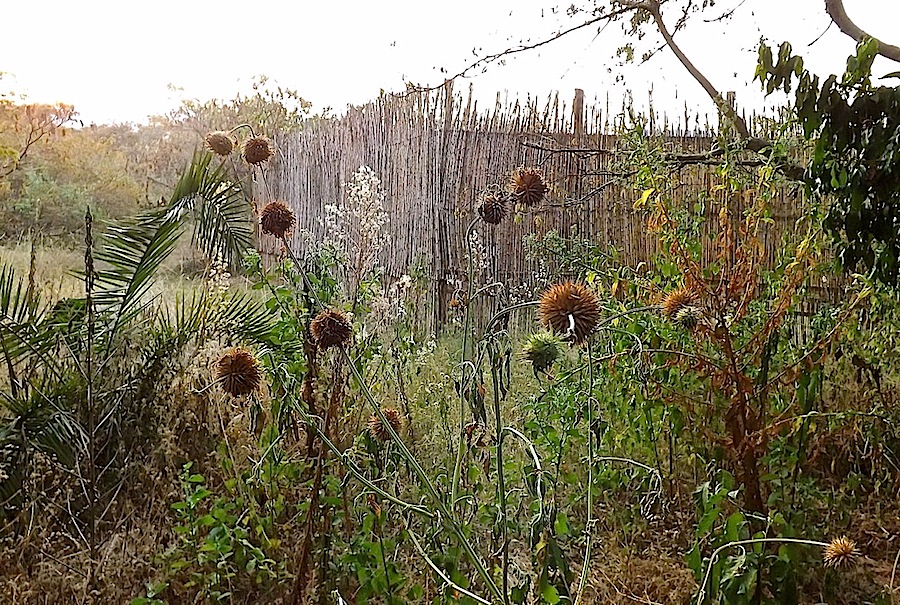
Even in the dry season, there were some wildflowers catching the last of the day’s light.
In the evening, we had cocktails around a fire on the riverside deck, below.
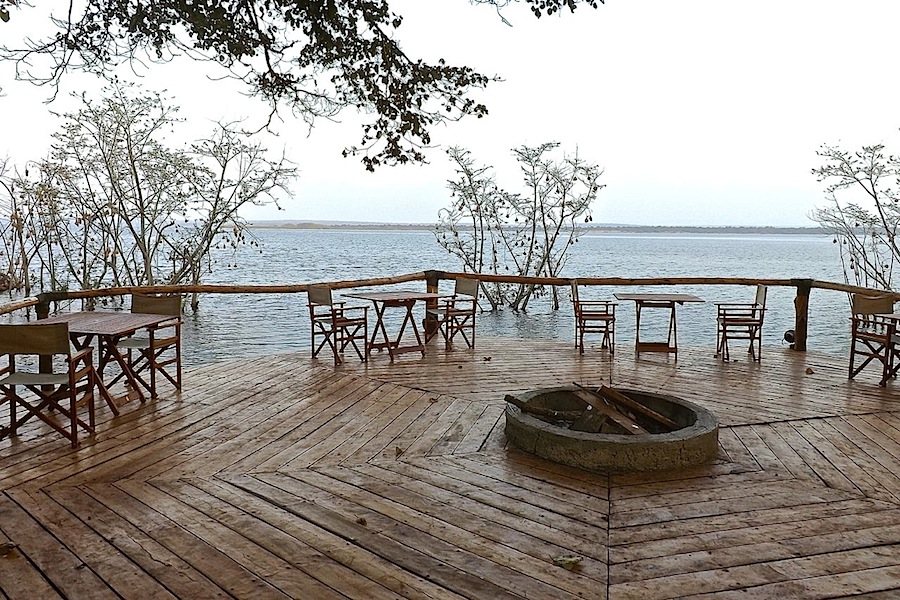
Breakfast was also served there — while monkeys ate fruit off a big tree above us.
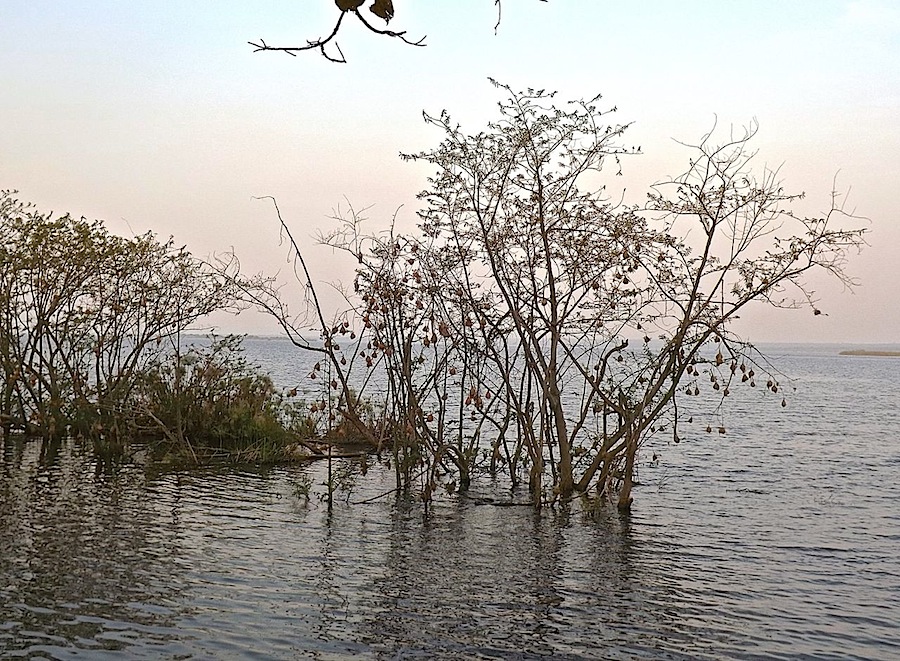
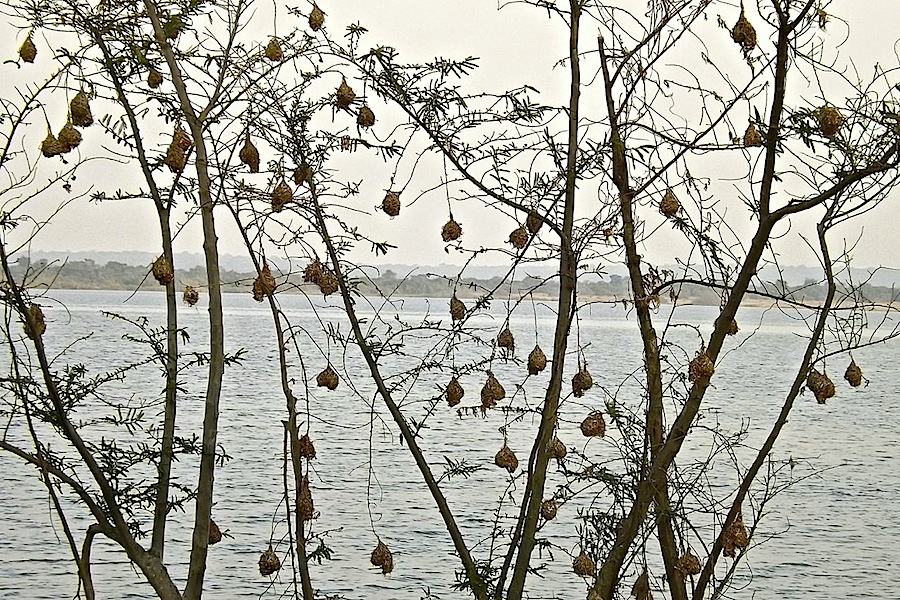
In the shrubby trees just beyond the deck, there were dozens of (empty) weaver birds’ nests.
Located along Rwanda’s eastern border with Tanzania, Akagera National Park presents quite a different landscape from the mountainous forests and farms of western and central Rwanda. (It is one of four large national parks in the country.)
“[I]ts undulating plains support a cover of dense, broad-leafed woodland interspersed with lighter acacia woodland and patches of rolling grassland studded evocatively with stands of the superficially cactus-like Euphorbia candelabra [aka E. ingens] shrub,” according to the Bradt guide to Rwanda.
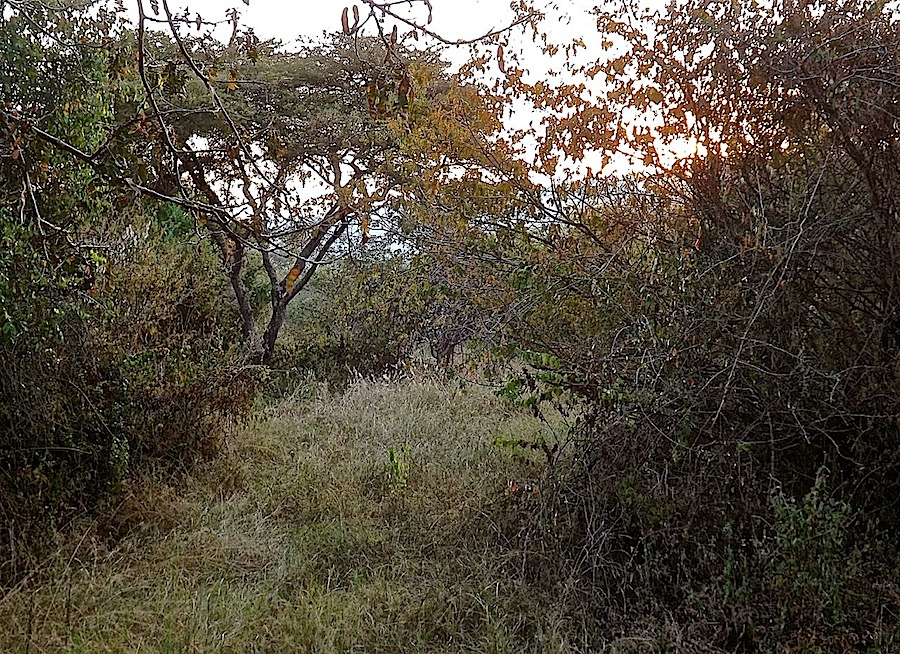
There are also large wetlands surrounding several lakes and the channels of the Akagera River, which runs along the border between the two countries.
The game-viewing is not up the standards of the great savanna parks in neighboring countries, but every visitor I have talked to recently has seen elephants, hippos, zebra, and giraffes, as well as antelopes and impalas. (Unfortunately, we did not have time to tour the park during our stay.)
Currently, there may or may not be lions and leopards in small numbers, but there are reportedly plans to restock them — and add black rhinos — eventually.
According to the Bradt guide, the birdlife is “phenomenal.” The landscape is particularly scenic, with forests, lakes, swamps, and low mountains. Perhaps best of all, the park is fairly empty of other tourists.
Camping (in real tents) is allowed in various locations. It is also possible to take boat safaris on Lake Ihema.
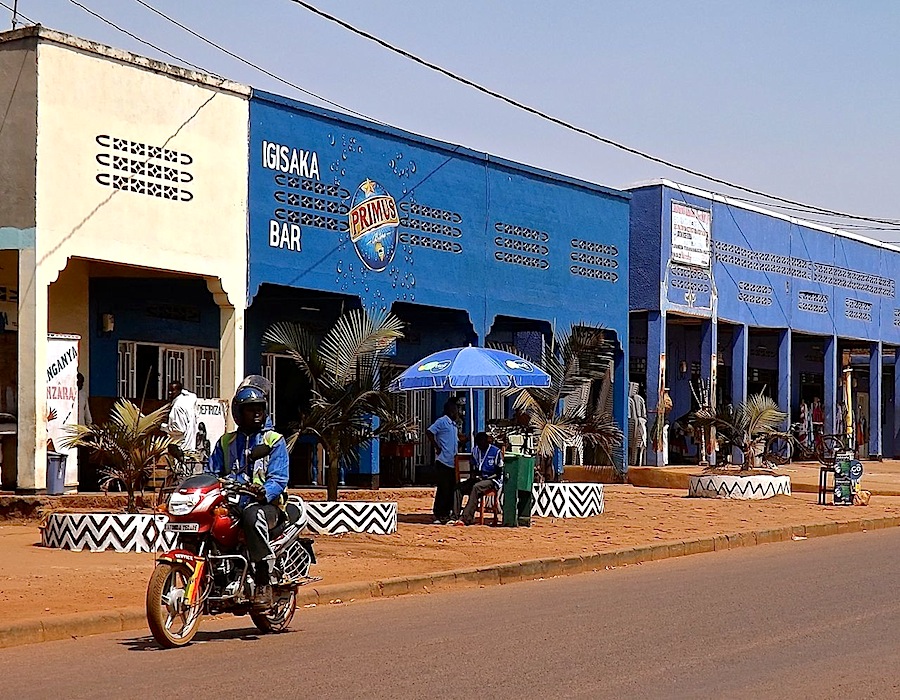
While traveling in southeastern Rwanda on Thursday, we stopped for lunch in Nyakarambi. I liked the town’s roadside planters, which are painted in the graphic patterns of imigongo art.

All the planters held rather dusty palm trees. We are in the middle of the long dry season, which will last until early September.
Imigongo paintings traditionally decorated the interiors of houses in this part of Rwanda. The raised designs are made with cow dung and painted with white kaolin clay and a black substance made from aloe plant sap and the ash of burned banana skins and Solanum aculeastrum fruit. Other natural colors — red, grey, and ochre — are also used, and today’s artists often add representations of people and houses.
Nyakarambi has a cooperative and shop devoted to imigongo. I added to my little collection with the piece below, which is about 12″ x 14″.

I didn’t take any photos of the cooperative while we were there; the women weren’t working and their stock of paintings was small. But, several months ago, we were at Nyungwe Forest Lodge, which has several walls in the lobby displaying imigongo.

 Photo just above by M. Koran.
 enclos*ure