The Sunday porch: Piazza San Marco

This slideshow requires JavaScript.

On Monday. . . running a little late this week.

We spent December 23 to 27 in Venice, Italy. The photos above show the arcades along Piazzetta di San Marco and Piazza San Marco on Christmas and on Boxing Day (in fog).

The current colonnaded buildings enclosing the square on three sides (and the west side of the Piazzetta) were built in the 16th century.  Their arcades front a number of coffee houses, including two of the oldest and most famous in Italy: Florian (1720) and Gran Caffè Quadri (1775).

Of course, we had due caffè espresso at Florian, which was easily possible because tourists are far fewer during Christmas week. The coffees were €6.50 each, but they were very good (and there was a cookie and water).

(The water carafe was adorable, and I now regret that I didn’t buy one and hold it on my lap on the plane.  I’m very tempted to order it from their website. Also, check out the wonderful terrazzo floor at their entrance here; I forgot to take a photo of it.)

To scroll through more (and larger) images, click on ‘Continue reading’ and on any thumbnail in the gallery.

Continue reading “The Sunday porch: Piazza San Marco”

Montmartre Cemetery, Paris

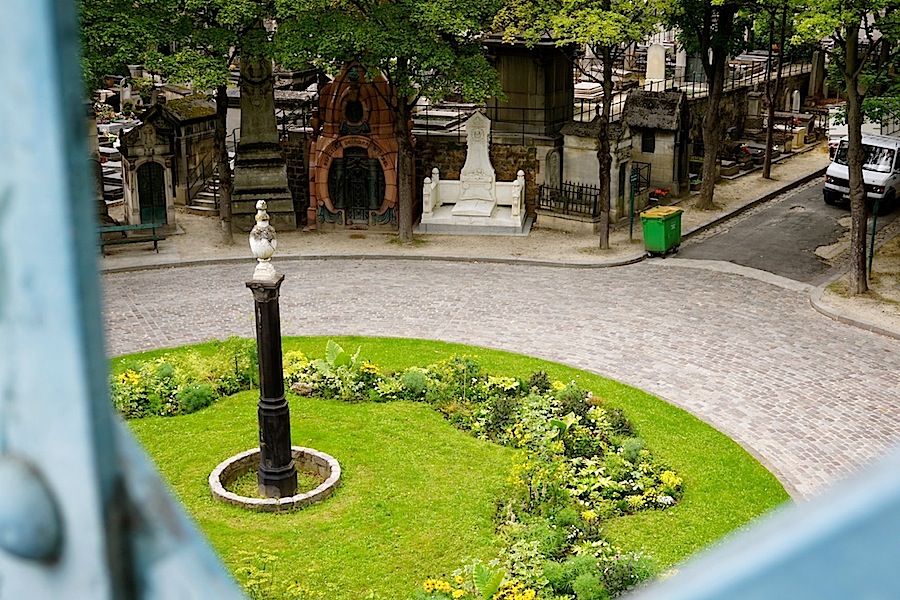
Montmartre Cemetery, Sept. 2015, by enclos*ureAnother quick look down.

We were walking along the Rue Caulaincourt bridge over the south end of the cemetery when we spotted this pretty planting arrangement in yellow below.

Cimetière de Montmartre is the third largest of four necropolises built in the early 19th century, just outside the Paris city boundaries.

Montmartre Cemetery glimpse, Sept. 2015, by enclos*ur

It was placed below street level, in an abandoned gypsum quarry, which had previously received the hundreds of bodies of those killed in the riots of the French Revolution.

The entrance is at the end of Rue Rachel, under Rue Caulaincourt.

The Birkenkopf, Stuttgart

This mountain, piled up after World War II from the rubble of the city, stands as a memorial to the victims and a warning to the living.
— plaque at Birkenkopf

This slideshow requires JavaScript.

Allied bombing raids on Stuttgart during World War II  destroyed at least 45% of the city, including nearly all the city center.*

In the mid-1950s, 1.5 million cubic meters of the resulting rubble were moved to a hill in the southwest of the city — raising it by about 40 meters and making it the highest point in central Stuttgart.

This is the Birkenkopf or Rubble Hill, which we visited two weekends ago.  It is sometimes also called Monte Scherbelino or Mount Shards.

A wide spiraling asphalt path leads walkers, runners, and cyclists up through the woods that have grown over the debris. At the summit, a semi-circular berm of broken concrete and ornamental stonework forms a terrace or shallow amphitheater facing a spectacular view of the city.

There are many post-WWII rubble hills (aka Schuttberge or Trümmerberge) in Germany.  London has some as well, and there’s an interesting essay about this kind of ‘made ground’ (“a sort of spatial redistribution of violence”) here.

I have not been able to find the name of the company or person who directed the design of the Stuttgart hilltop area.

You can watch a beautiful short video of the Birkenkopf from the air hereIf you visit Stuttgart, you can reach the site via the no. 92 bus from the Rotebühlplatz U-bahn stop.

To scroll through larger versions of the slides above, click on ‘Continue reading’ below and then on any thumbnail in the gallery.

Roofless walls
Rooks overlook
I told you so
Babbles the brook

Samuel Menashe, from “Ruins

ADDENDUM:  From the Facebook page Birkenkopf-Stuttgart, I learned that the Birkenkopf was designed by Manfred Pahl, a painter and architect working for the city’s Department of Landscape Planning and later with the Verschönerungsverein Stuttgart (beautification association).

There’s an interesting picture of the construction of the hill here.


*Over 4,500 people on the ground and 2,400 Allied aircrew (300 planes) are estimated to have died during the Stuttgart attacks, according to Wikipedia. The city had important industrial resources and several military bases and was a railway hub for the southwest.


Continue reading “The Birkenkopf, Stuttgart”

Life in gardens: 1967

Tompkins Square Park, 1967, George Eastman HouseTompkins Square Park, East Village, New York City, 1967, by James Jowers, via George Eastman House Commons on flickr.

Tompkins Square Park . . .  was reconstructed [in the mid 1960s,] just in time for an era of sweeping changes. The surrounding neighborhood became the east coast version of ‘Haight-Ashbury.’ Rock musicians, poets, hippies, and political activists transformed downtown Manhattan into a center for counter-cultural activities and political protest. It was during the mid- to late-1960s that the area surrounding Tompkins Square Park came to be called ‘The East Village.’ . . .

Tompkins Square had once before been the site of powerful expressions of joy and rebellion. A century earlier, German-Americans had transformed the square with their volkefestes and mass demonstrations. Their spirit and command of the space were being revived— only now in 1960s terms. Young people demonstrated at the bandshell against American involvement in Vietnam and in favor of women’s and third world liberation movements. They gathered to hear bandshell concerts put on by the Fugs, the Grateful Dead and Charles Mingus. They were certainly ignoring signs that cautioned ‘keep off the grass.’ . . .

— Laurel Van Horn, from “A History of Tompkins Square Park

The Sunday porch: French Riviera

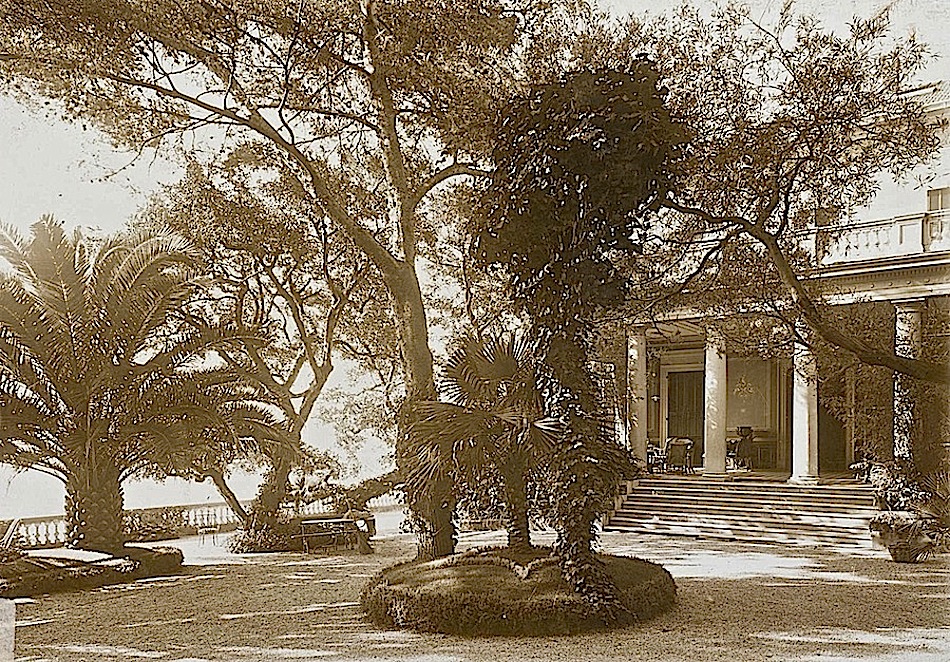
1 full view, Poincare Residence, Eze, France, ca. 1914, University Caen Basse…The property of M. [Raymond] Poincaré in Èze.  The gardens and the main entrance of the house,” ca. 1914 – ca. 1918, photographer unknown, via the Université de Caen Basse-Normandie Commons on flickr.

Èze is located on the southeastern coast of France, not far from Nice. The Mediterranean was just beyond the railings above.

Detail, Poincare Residence, Eze, France, ca. 1914, University of Caen Basse-Normandie

(To scroll through a number of larger versions of the photo, click on ‘Continue reading’ below and then on any thumbnail in the gallery.)

Raymond Poincaré was President of France from 1913 to 1920.  He had been both Prime Minister and Foreign Minister (simultaneously) during all of 1912.

. . . I  decided this time not to go to Sampigny but to stay somewhere on the Mediterranean. After brief research, I rented, in the Alpes-Maritimes, at the foot of the small town of Saracen Eze-sur-Mer, a quiet villa, hidden in the pine trees. . . . [I]t has an incomparable view of the sea. By winning this early retirement, I am not unhappy to escape a little to the embrace of my job, but at least I have the impression that the state of Europe, while still unstable, allows me to breathe more freely. Peace seems restored in the Balkans. Our relations with all Powers are normal. Whatever the new influences acting on William II, France was determined not provide any pretext for war. It’s almost a feeling of rest and security I feel, when I’ll salute the French Riviera the spring of 1914.

— Raymond Poincaré, from his memoirs.

You can see an image of the long terrace of the house in April 1914 here.

Continue reading “The Sunday porch: French Riviera”