My parents were visiting us last week, and we took an overnight trip to the north of Rwanda. We made a stop at Mugongo, the former home and plantation of long-time American resident Roz Carr, who founded Imbabazi Orphanage in 1994, reworking her old farm buildings.
You can read about Roz’s life in Rwanda, from 1949 to 2006, here.
The long English-style flower borders looked particularly colorful as we near the end of the rainy season. Among the many plants blooming were calla lilies, hybrid tea roses, crocosmias, cannas, calendulas, fuchsias, violets, ageratum, hydrangeas, borage, sedum, Santa Barbara and Shasta daisies, azaleas, irises, dahlias, begonias, and day lilies.
It is a credit to Roz’s good strong design and to the continuing dedication of the gardeners she trained that the garden is still so beautiful, almost eight years after her death.
Click here for more information about the Imbabazi Foundation and how to visit the Mugongo garden.
You can scroll through more (and larger) photos by clicking on ‘Continue reading’ below and then on any of the thumbnail images.
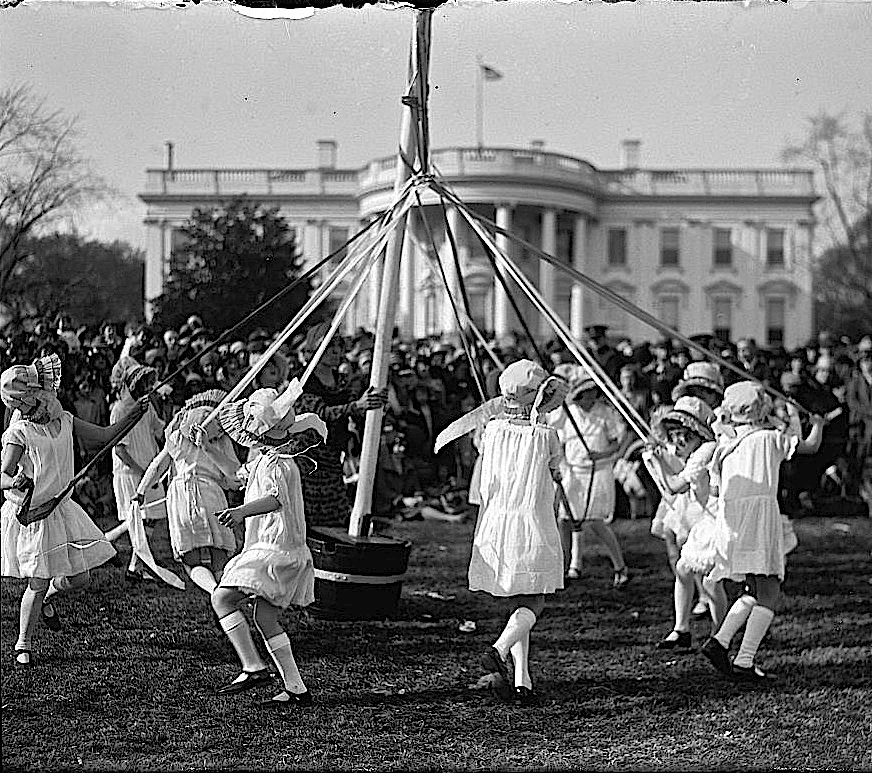
May pole dance at the White House Easter Egg Roll, Monday, April 1, 1929, National Photo Company Collection, via Library of Congress Prints and Photographs Division.
First Lady Lou Hoover added May pole and folk dancing to the annual event — but only briefly. Apparently, the Depression was bad enough on its own.
(If you click on the photo and enlarge it, you can see the wonderfully fierce expression of one of the girls on the right side.)
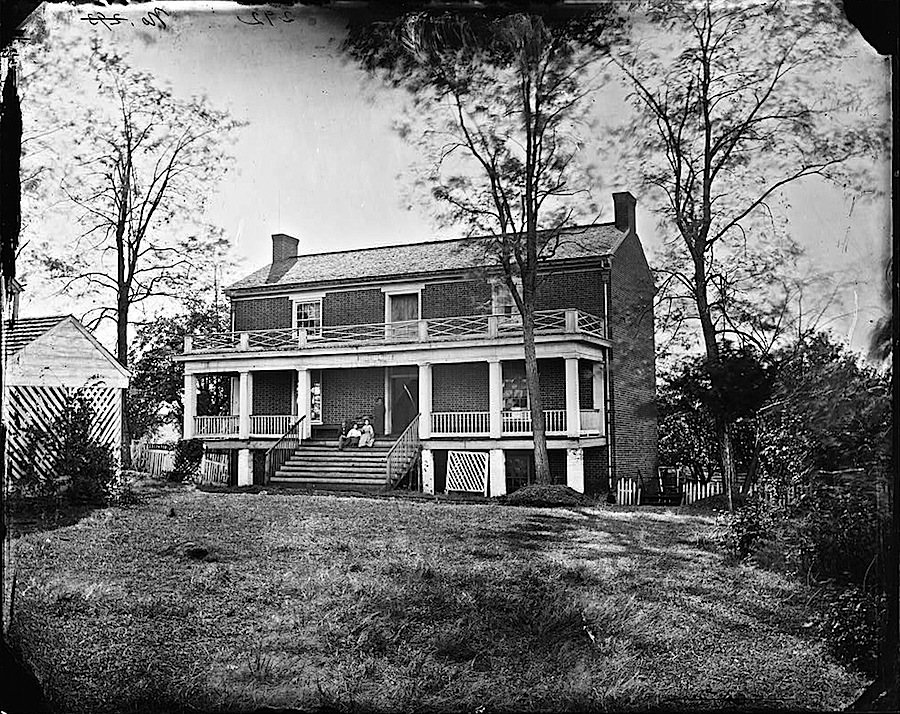
The McLean house, Appomattox Court House (previously Clover Hill), Virginia, April 1865, by Timothy H. O’Sullivan, via Library of Congress Prints and Photographs Division (all photos here).
On Palm Sunday, April 9, 1865, General Robert E. Lee crossed the porch of this house and entered the parlor to surrender his army to Lieutenant General Ulysses S. Grant — effectively ending the American Civil War.
Detail of photo above.
The house — built in 1848 and previously a tavern — was owned by Wilmer McLean, a retired major in the Virginia militia and a wholesale grocer.
Back in 1861, the first major battle of the war had been fought on McLean’s farm in Bull Run, Virginia. (A cannonball had landed in the kitchen fireplace, and afterwards the house was taken over as a Confederate hospital.)
Hoping to avoid the rest of the war,* the McLeans moved to the small southern Virginia village of Clover Hill in 1863. However, during Easter Week of 1865, the family not only hosted the surrender signing, but also the Surrender Commissioners’ meeting the next day. Union Major General John Gibbon and his officers then quartered in the house for a few days.
“The [Civil] War began in my front yard and ended in my parlor,” McLean is reported to have said later.
One can well imagine that he sometimes sat on this porch, reflecting and shaking his head.
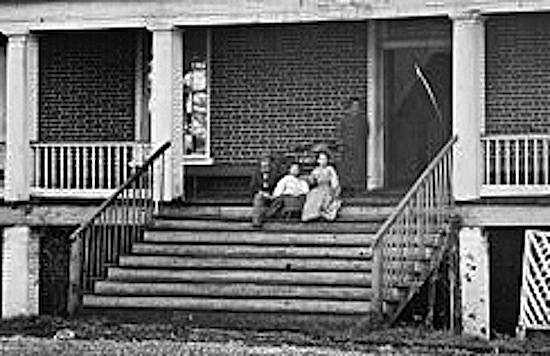
Detail of photo above — possibly the McLean family. Mrs. McLean had two daughters from an earlier marriage and at least three children with Wilmer.
As soon as the surrender was signed, officers of the Army of the Potomac began buying the family’s furniture (whether they wanted to sell or not). Major General Philip Sheridan paid $20 for the little table on which Grant signed the document of surrender terms. George Armstrong Custer took it away on his horse, and Sheridan later gave it to Mrs. Custer, who bequeathed it to the Smithsonian Institution.
That fall, McLean, nearly bankrupt, moved away from the “Surrender House,” as it was now popularly called. He was found in default of his loans, and the house was sold by the bank.
In 1891, it was sold again to Captain Myron Dunlap, who, with other investors, formed several schemes to profit from the fame of the house. By 1893, it was dismantled to become a tourist attraction in Washington, D.C. However, the money ran out before it could be shipped. For 50 years, the pieces were just left on the ground, exposed to the elements, vandals, and thieves.
In 1949, the house was reconstructed on its original site and opened to the public by the National Park Service. There are recent photos of the house and yard here and here.
*McLean was 47 when the war began and was considered too old to fight. A slave owner, he made a lot of money running sugar through the Union blockade. Unfortunately, it was Confederate money, which was worthless by 1865. After moving away from Appomattox, the family returned to Bull Run and then later settled in Alexandria, Va. McLean worked for the Internal Revenue Service from 1873 to 1876 and died in 1882.
“President Jimmy Carter and Egyptian President Anwar Sadat have refreshments in the garden of the White House,” April 8, 1980, Washington, D.C. Photo credited to Marion S. Trikosko and Warren K. Leffler,via Library of Congress Prints and Photographs Division.*
The previous spring, Sadat and Israeli Prime Minister Menachem Begin had signed the Egypt-Israel Peace Treaty on the White House lawn.
*U.S. News & World Report Magazine Photograph Collection.
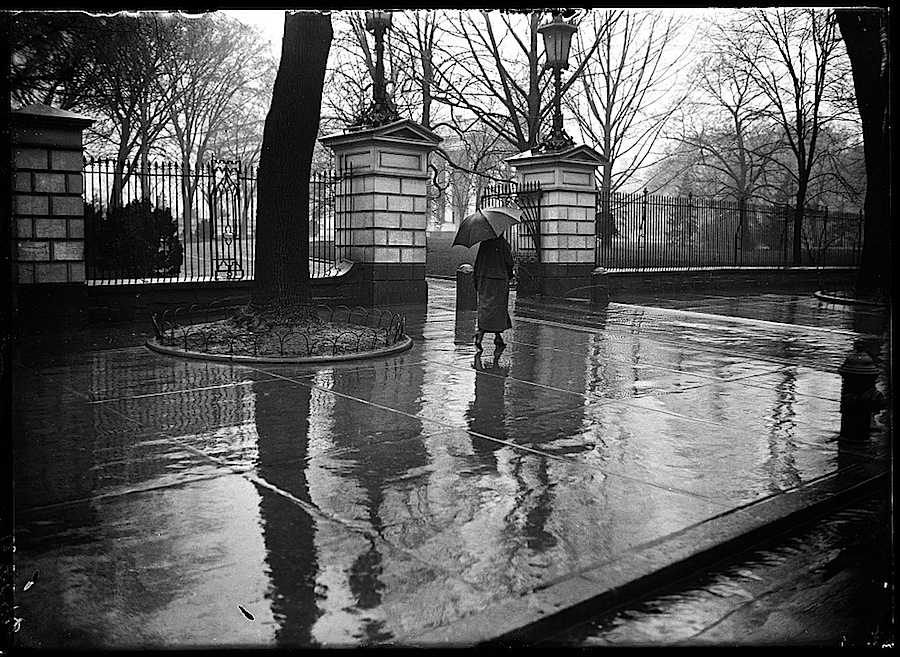
“Sidewalk in front of White House, Washington, D.C.,” early 1920s, by Harris & Ewing, via Library of Congress Prints and Photographs Division.
Whan that Aprill with his shoures sote
The droghte of Marche hath perced to the rote,
And bathed every veyne in swich licour,
Of which vertu engendred is the flour. . .
Today is Whan that Aprille Day — a day to enjoy “alle langages that are yclept ‘old,’ or ‘middel,’ or ‘auncient,’ or ‘archaic,’ or, alas, even ‘dead.’” This is the idea of @LeVostreGC (or Chaucer Doth Tweet), who blogs at Geoffrey Chaucer Hath a Blog.



 enclos*ure