Vintage landscape: stump fences

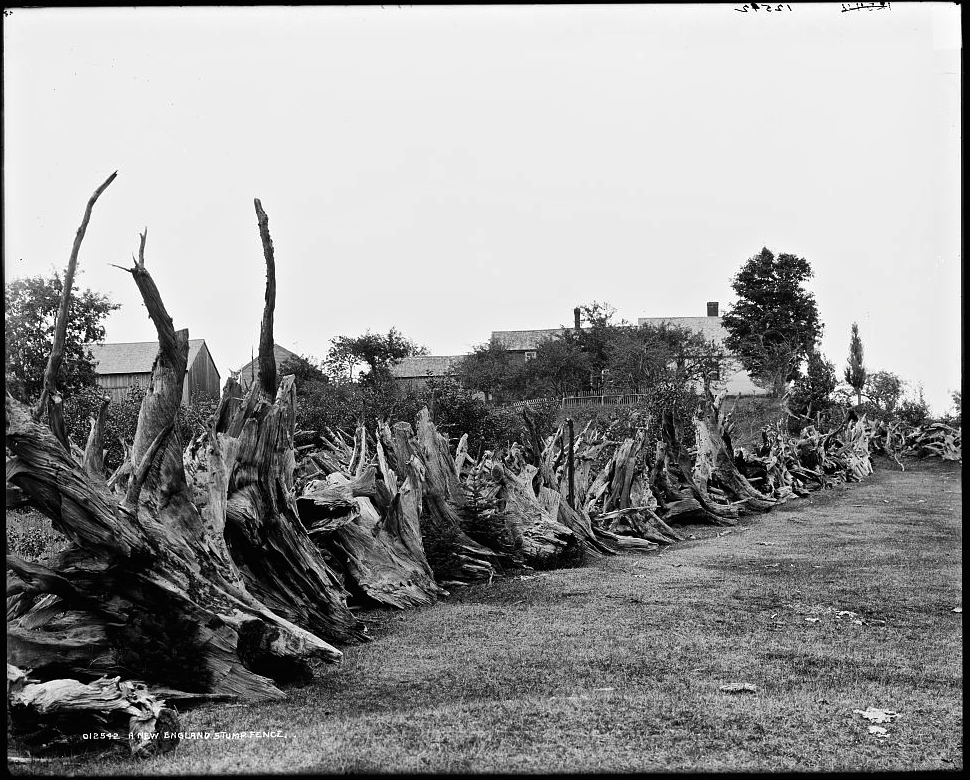
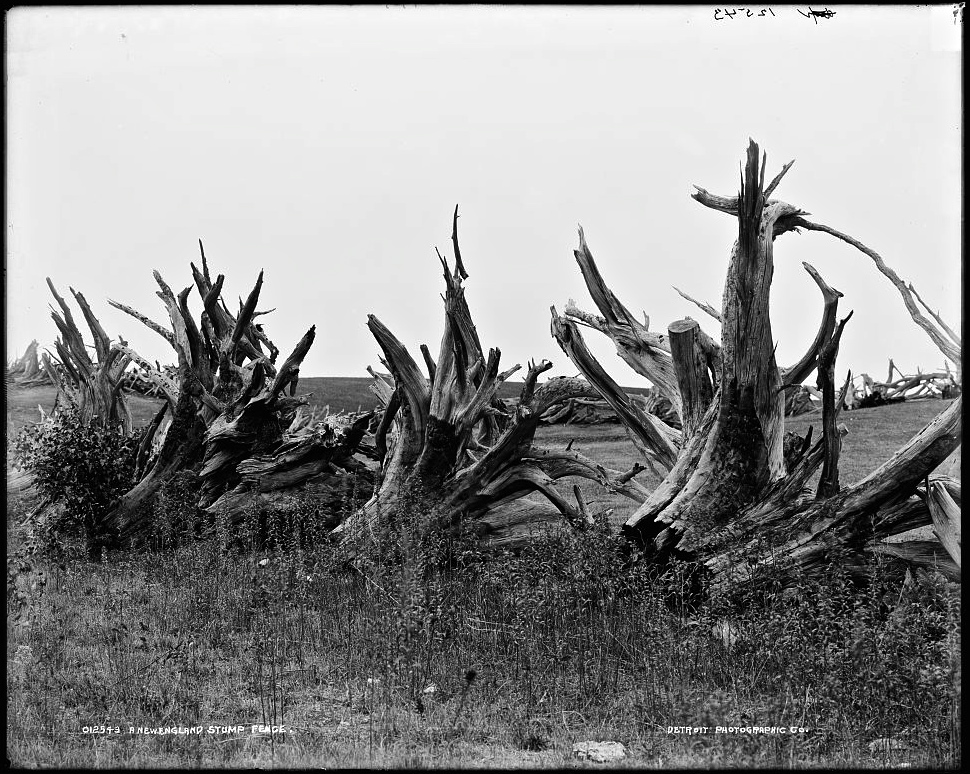
The stump or root fences on the Corner road remind me of fossil remains of mastodons, etc., exhumed and bleached in sun and rain.
— Henry David Thoreau, Journal (July 19, 1851)

Both photos: “A New England stump fence,” ca. 1890-1901, by Detroit Publishing Co., via Library of Congress Prints and Photographs Division.

I had heard of  ‘stumperies,’ but not of stump fences (sometimes called root fences), however now I’ve learned that . . .

[s]tump fences, as their name implies, were made by dragging the stumps of trees to the edge of a field and placing them side by side, with their interlacing roots facing outward and their trunks inward. In the days when “ugly as a stump fence” was a simile in common usage, the stump fence had its critics, but in 1837 one observer called it “a singular fence…needing no mending, and lasting the ‘for ever’ of this world.” “The devil himself couldn’t move a stump fence,” farmers used to say, an opinion borne out by the fact that stump fences well over a hundred years old can still be seen in parts of Canada and in the Midwest.

Stumps were often the product of the first clearing of the land, but stump fences didn’t appear in the first generation of a settlement’s fences because stumps need to sit in the ground for six to ten years before they are loose enough to be pulled out and hauled away. Extracting even a loosened stump was never easy; it required oxen and strong chains, something that many settlers lacked at first. In the 1800s, stump pulling would become a cash business and one way that a man could make a good living. Twenty-five cents a stump was the standard price in 1850 when men operating such mechanical stump pullers as the “Portable Goliath,” “The Little Giant,” and “Roger’s Patent Extractor” could extract from twenty to fifty stumps a day.

–Susan Allport, Sermons in Stone: The Stone Walls of New England and New York  (older edition here)

Quotes via the blog Laudator Temporis Acti.

I’m traveling for the next couple of weeks, but I’ll be posting a ‘vintage landscape’ from time to time.

Our garden: summer changes

It’s been some time since I posted the site analysis of our Kigali garden — it was July, in fact. It’s been difficult for me to write about the changes we’ve made since then. I take pictures, look at them and feel that they look so raw and empty — because newly divided, transplanted shrubs and perennials never present that well, especially here, where I can’t run down to a garden center for a few bags of chipped mulch. So I reject them and go out and move some more plants around, hoping the next set of pictures will really represent the improvements that we’ve made this summer.

But I’ve reached the point where I need to stop fiddling with things and just let the garden grow on its own for a while (and it will: the rains have started and the gardener just spread two truckloads of manure this week).

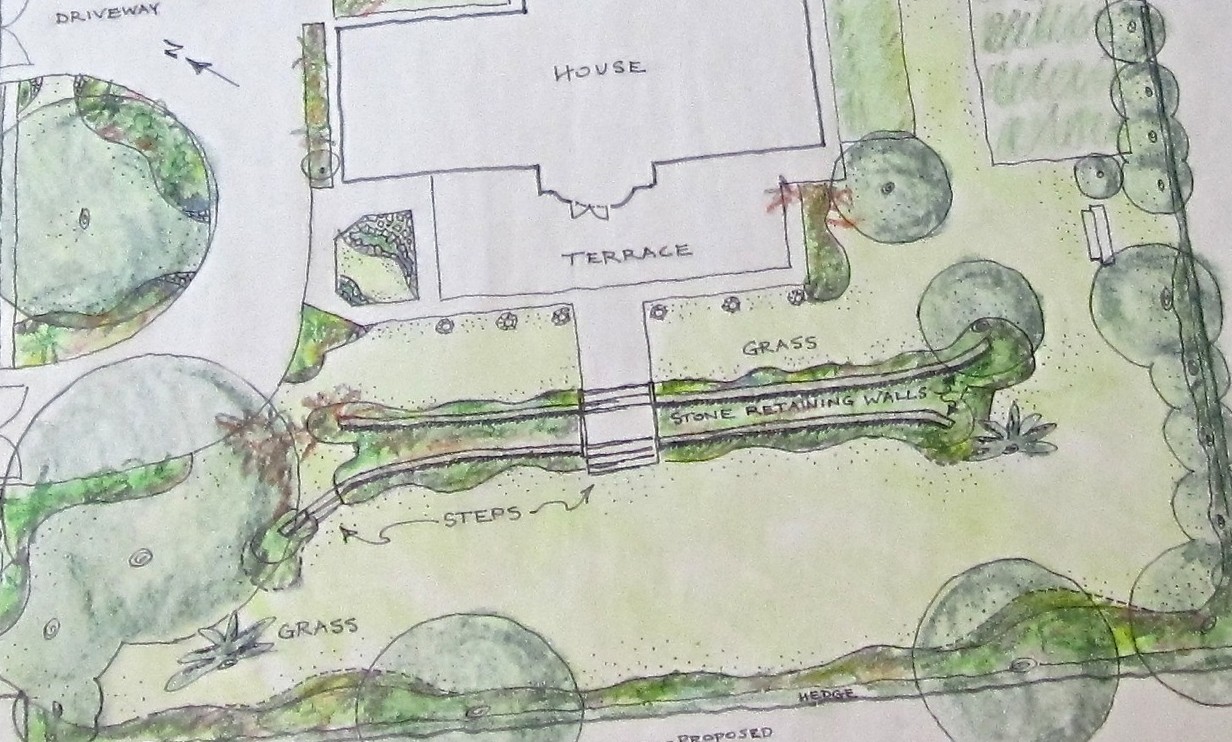
So I went out this week and took more photos and then made the sketch below so that they will make more sense.
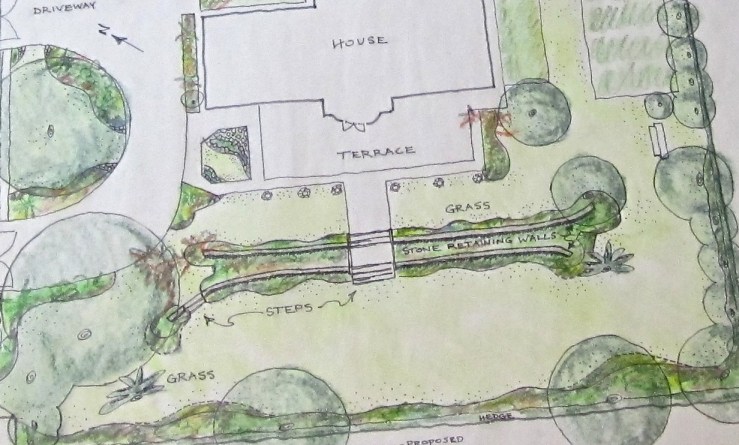
The unifying element for the upper and lower areas in front of the house and near the side driveway is an irregularly curving line (of planting bed) against a straight line (of clipped bougainvillea hedge, stone wall, or pavement).

I originally drew the curves on the grass (using flour) inspired by water waves. However, one day I was explaining to the gardener how I wanted the shape of an area to be curved like waves, and he said, “oh, like the mountains.” Then I looked up at the outline of the hills just over our walls and said, “of course.”

So this garden layout may make you think of water (if you grew up near a bay or ocean like me) or the hills and mountains (if you grew up in a place like Rwanda). Either way, it seems to be working nicely, although I will make a few adjustments to the curves in the next couple of months. It’s harder to draw convincing irregular waves on the ground than I first thought.

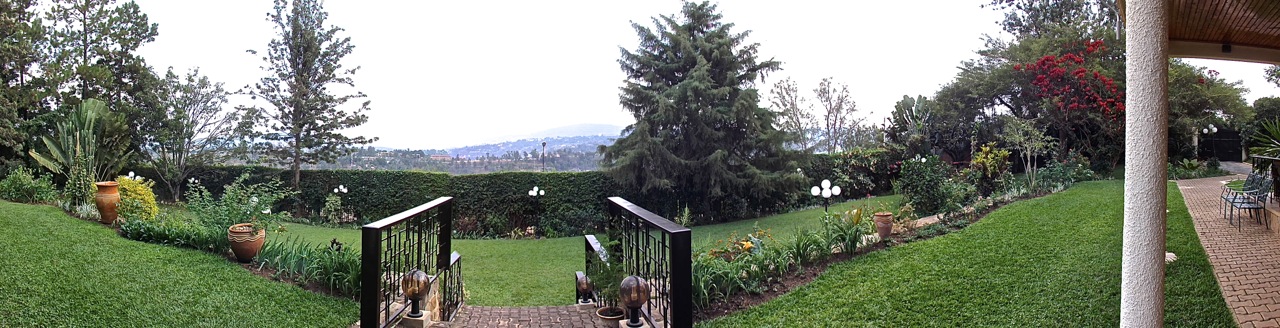
Below is a panoramic photo I took from the terrace, just out from the front door of the house. The camera distorts the scene into a wide angle, so please imagine it as straight across (and click the photo to enlarge it). You can just see the hills in the distance over the front hedge.
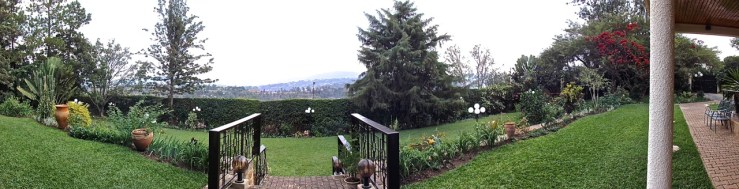
The picture shows how open this area is since we removed the two rows of 4′ hedges that ran along the front of the terrace. We replaced them with grass — and with a very narrow planting bed just along the first retaining wall. This gives us a bigger entertaining area near the house. We get a better breeze and fewer mosquitoes at night, as well.

We also removed all the 6’+ false bird of paradise plants that grew on either side of the handrails and blocked the wonderful view of the city.

I feel like I can really breath now, and it’s such a pleasure to come downstairs every morning to increased light and air.

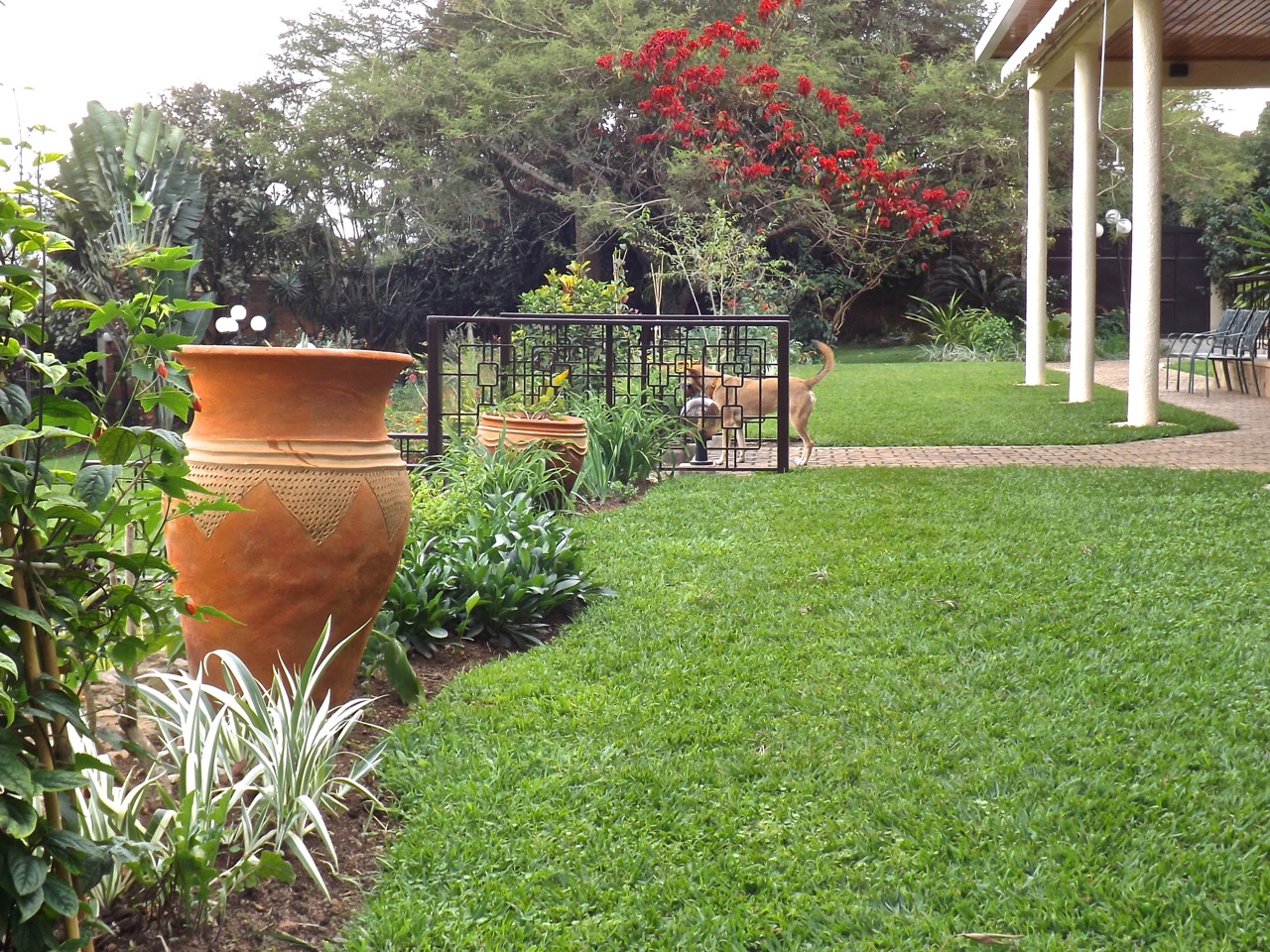
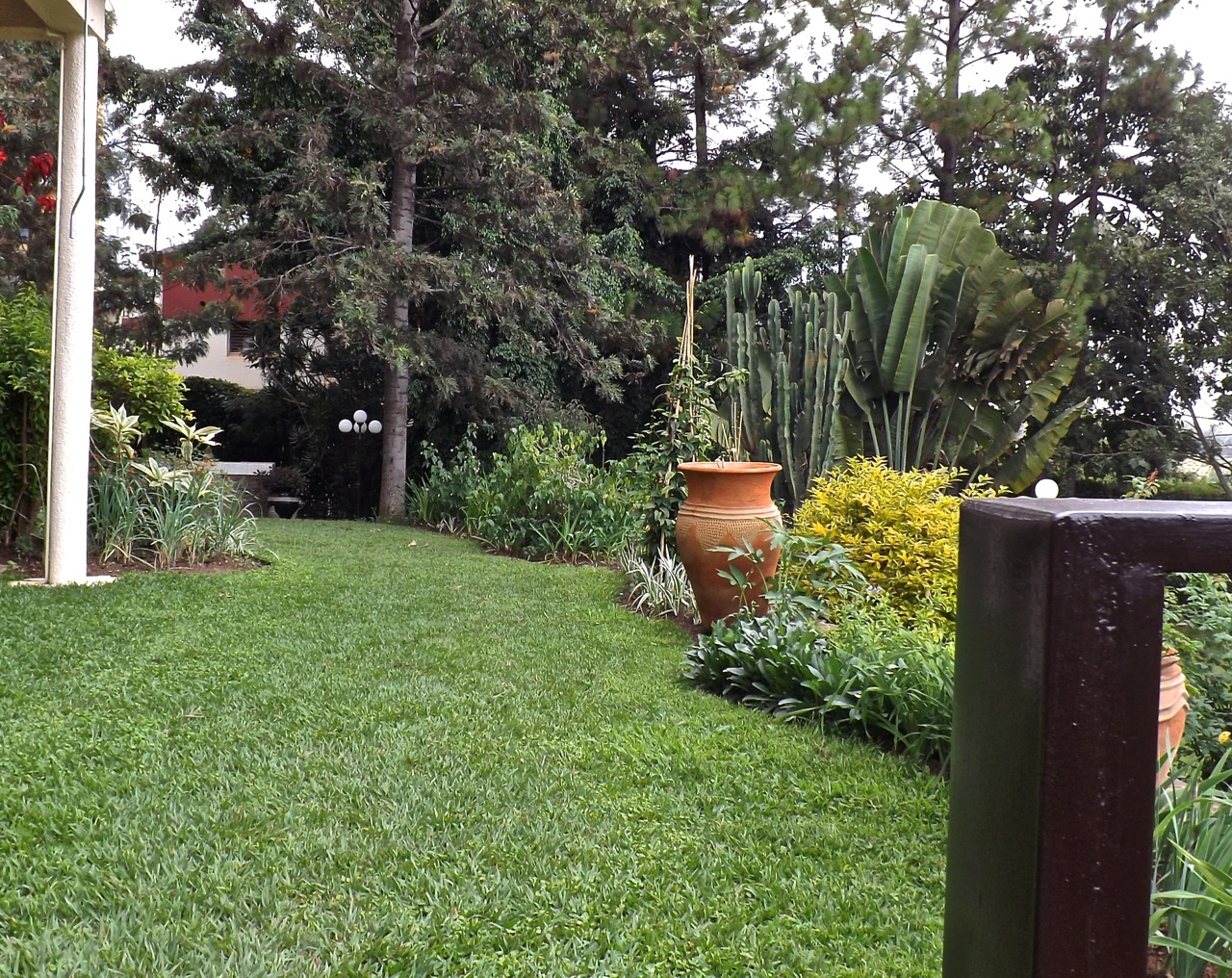
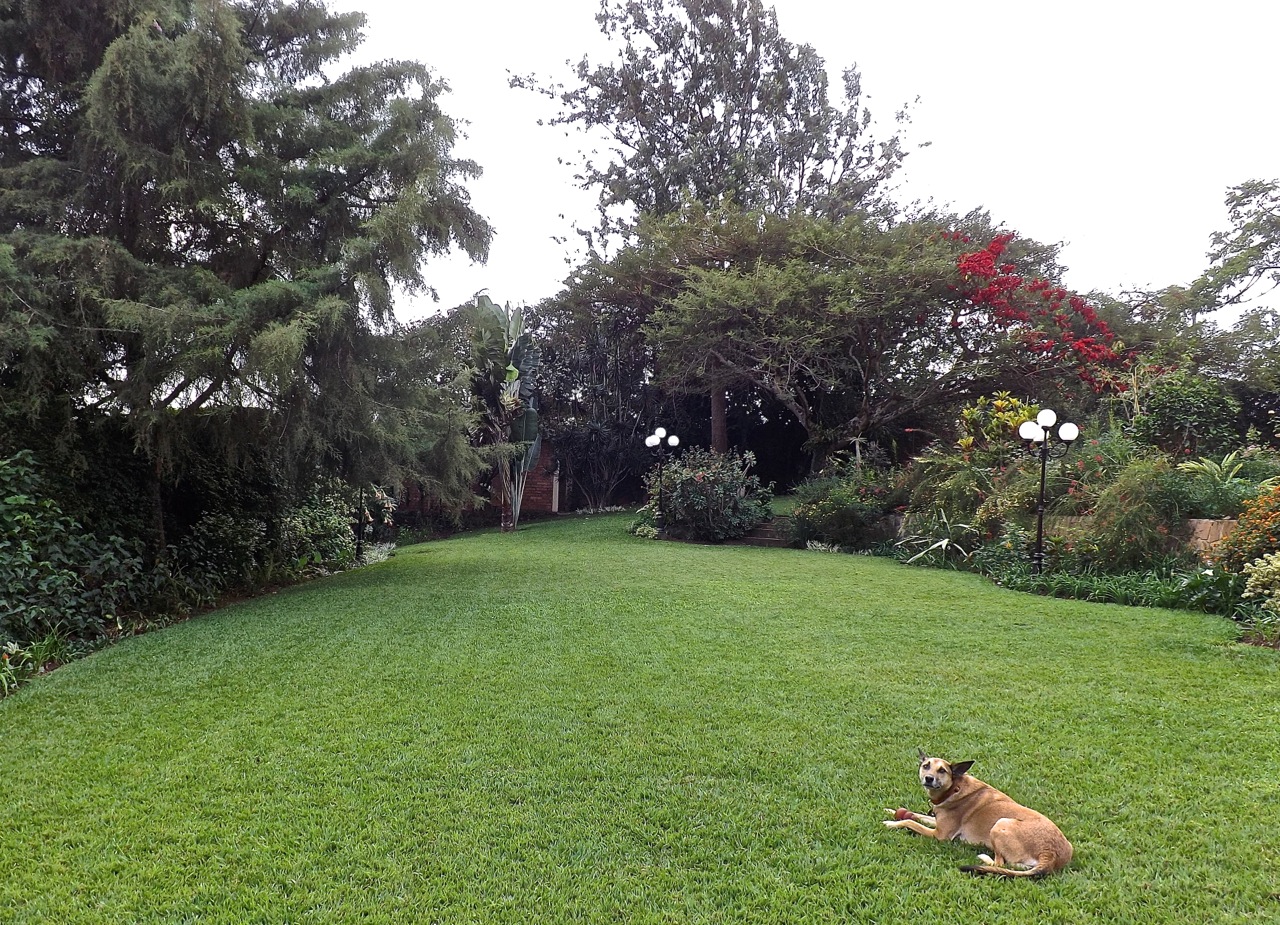
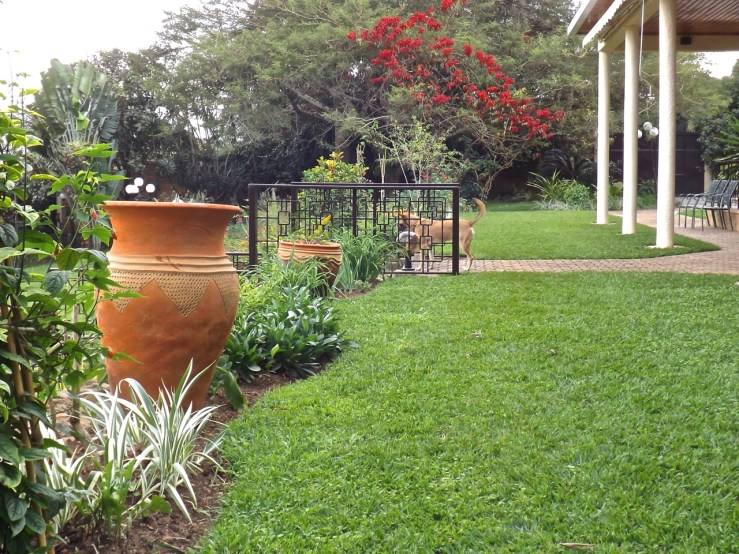
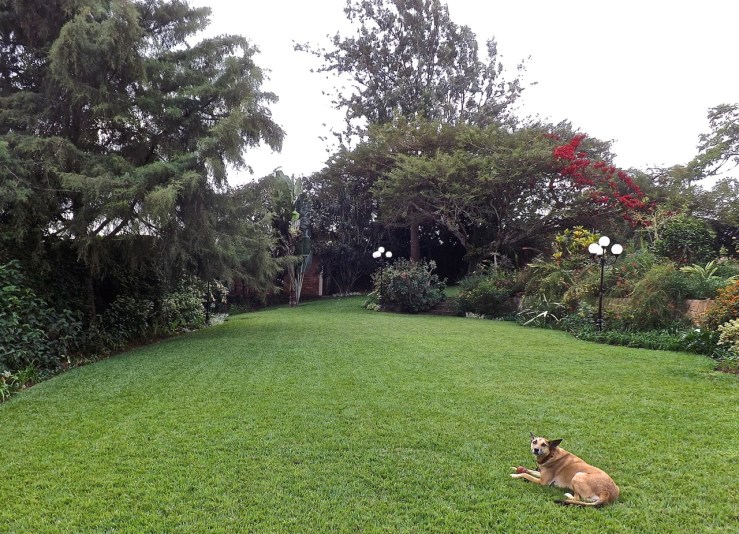
The photo below shows the length of the new grassy area as you look toward the driveway (and also see a bit of our summer loaner dog, Riley — we have been dog-sitting).
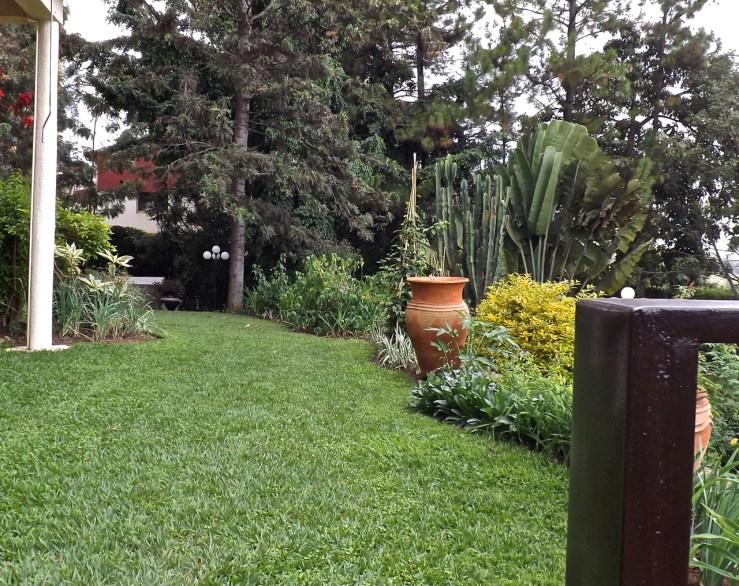
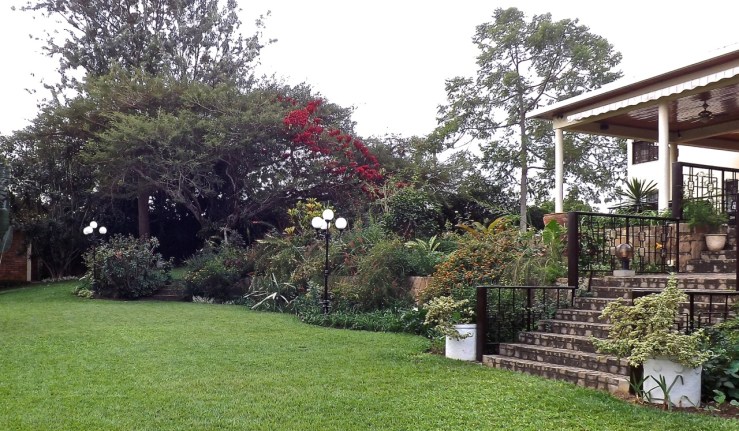
Below you can see some of the same area looking in the other direction, standing at the center handrails. As we cut new, wider planting beds from the lower lawn, we transferred the sod right up to this top area, so the grass has looked good from the beginning.
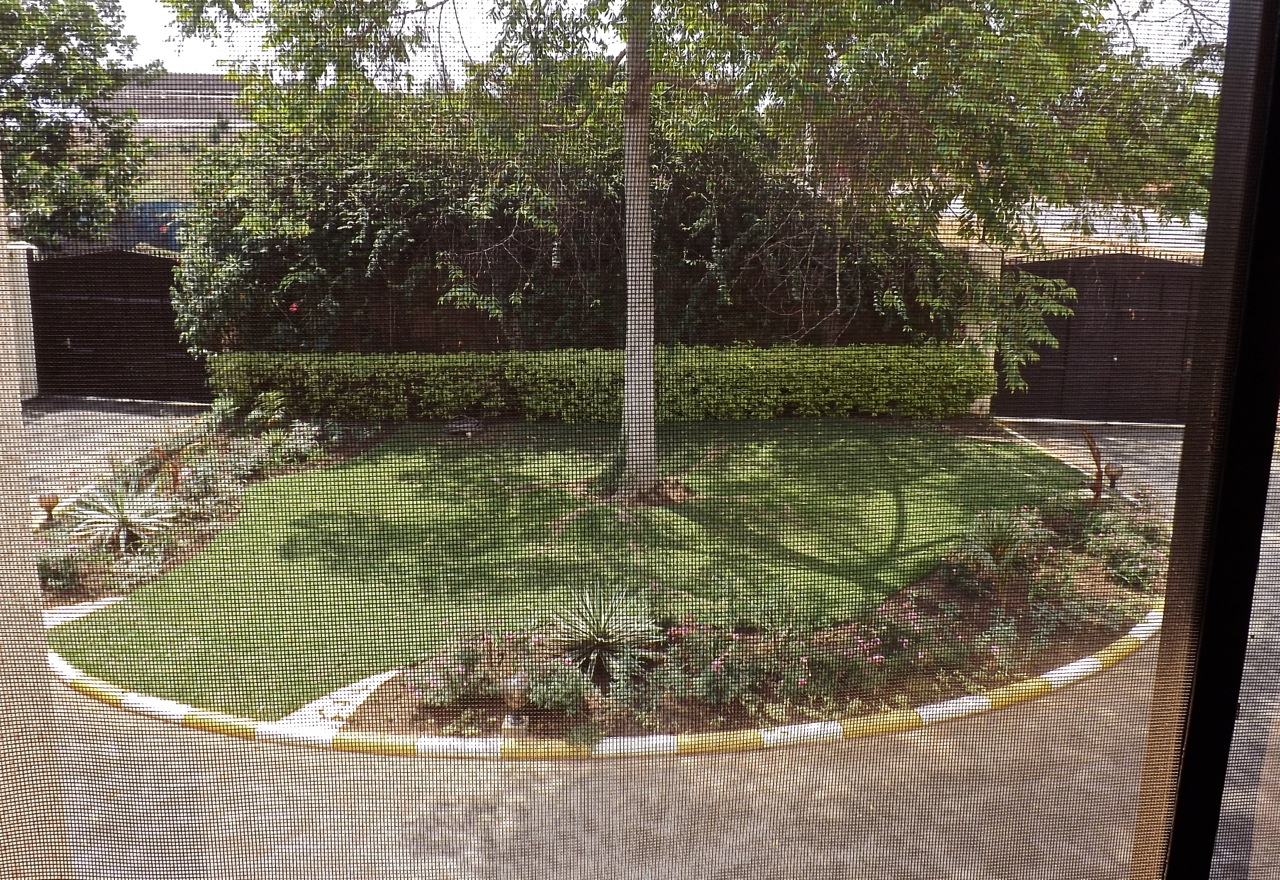
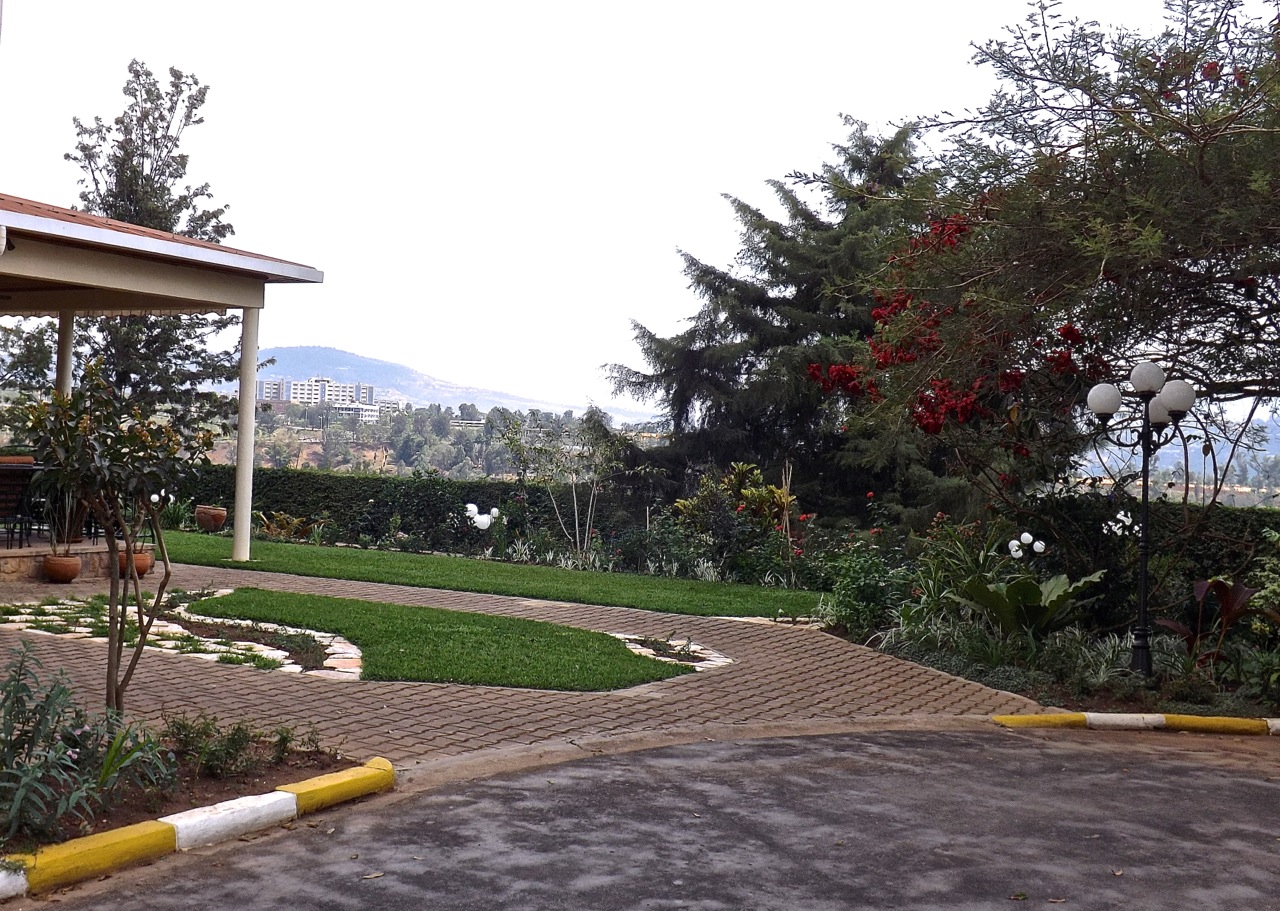
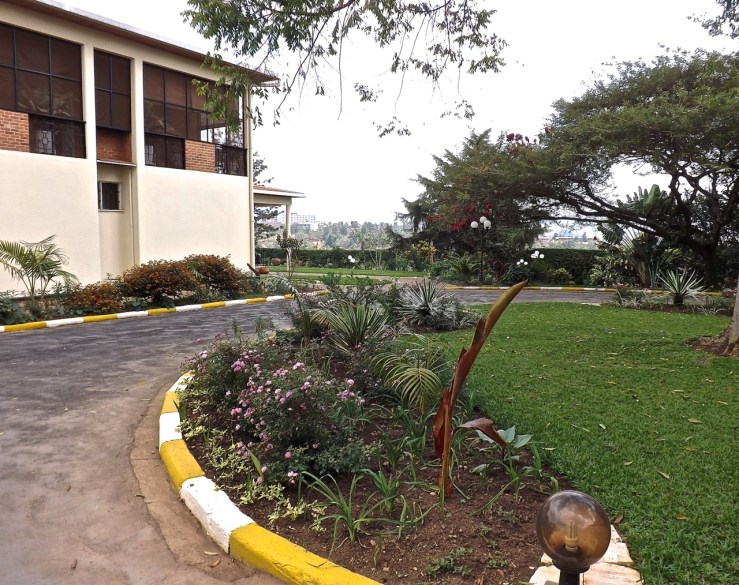
Now, if we back up to the left edge of the drawing above, to the top gate that is the entrance to the property, you can see, below, how we have created two planting beds in the semi-circular area between the two gates. They replace a very narrow bed that ran all the way around, along the edge of the driveway. Now guests can actually enter this center area on the gate side and cross directly to the house on the grass if they choose.
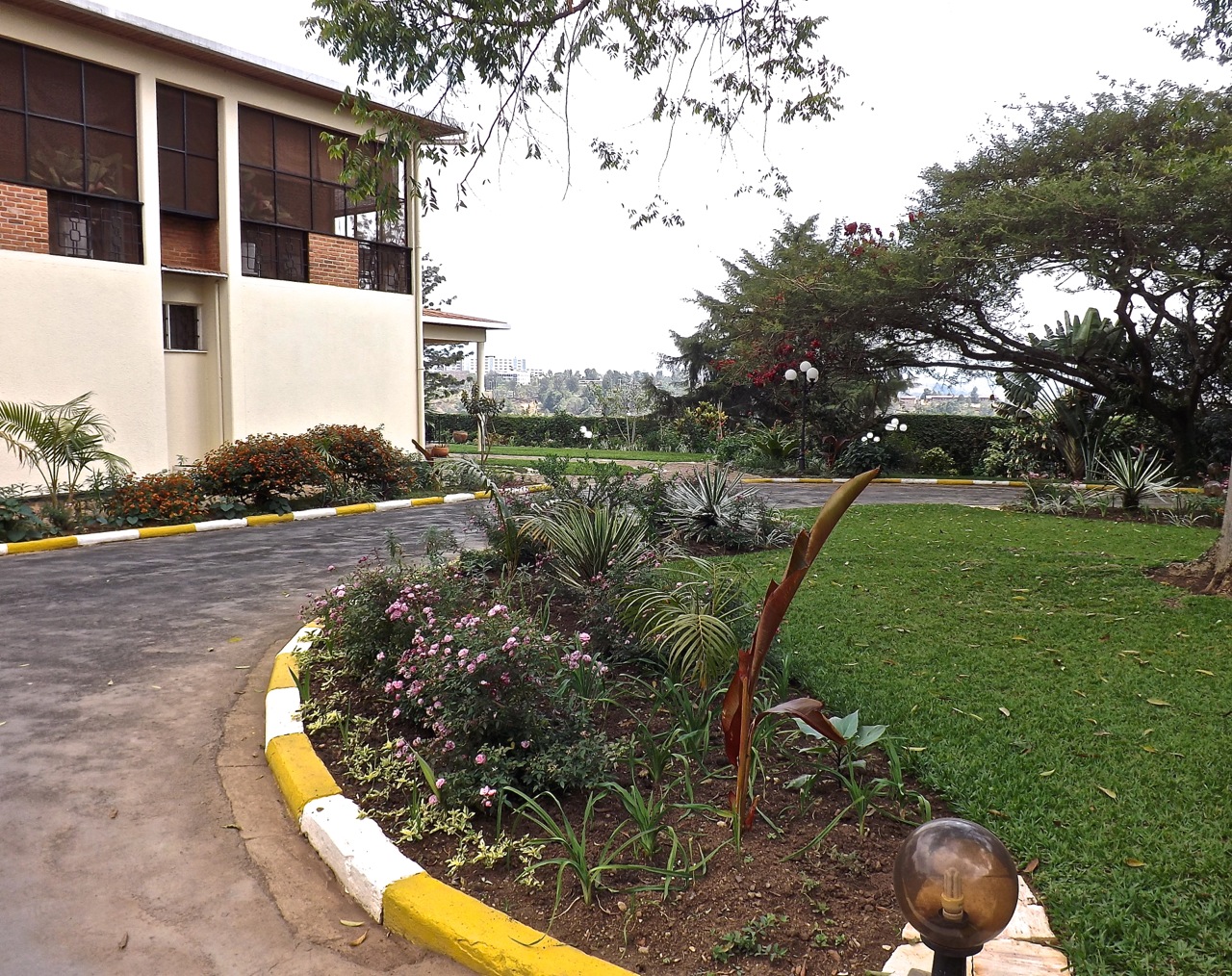
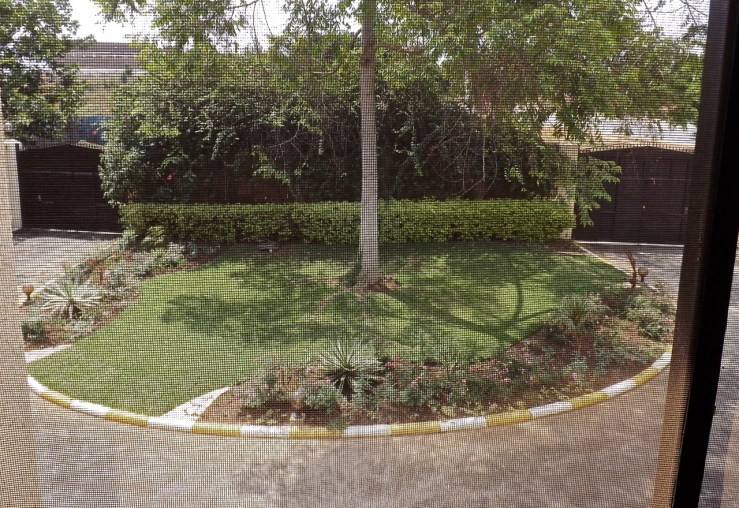
Below, you can see the layout from the upstairs porch. The yellow and white curbs were painted while we were on vacation in March (without consulting us); I’m just not thinking about them right now.
We also capped the points of these flower beds with stones.
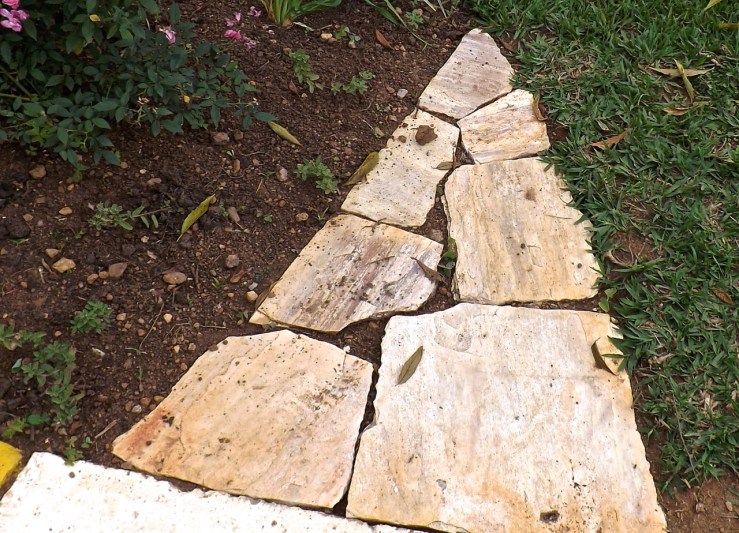
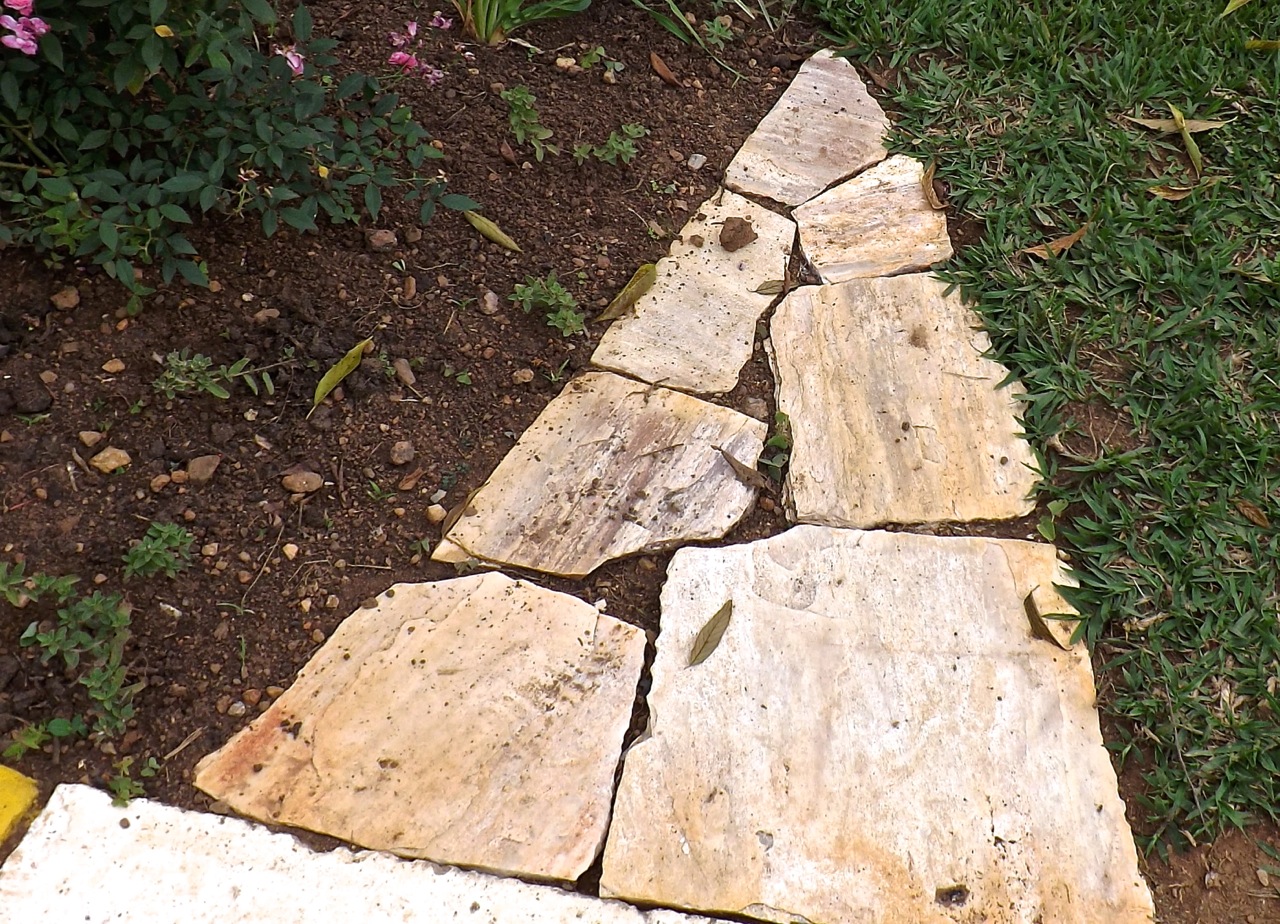
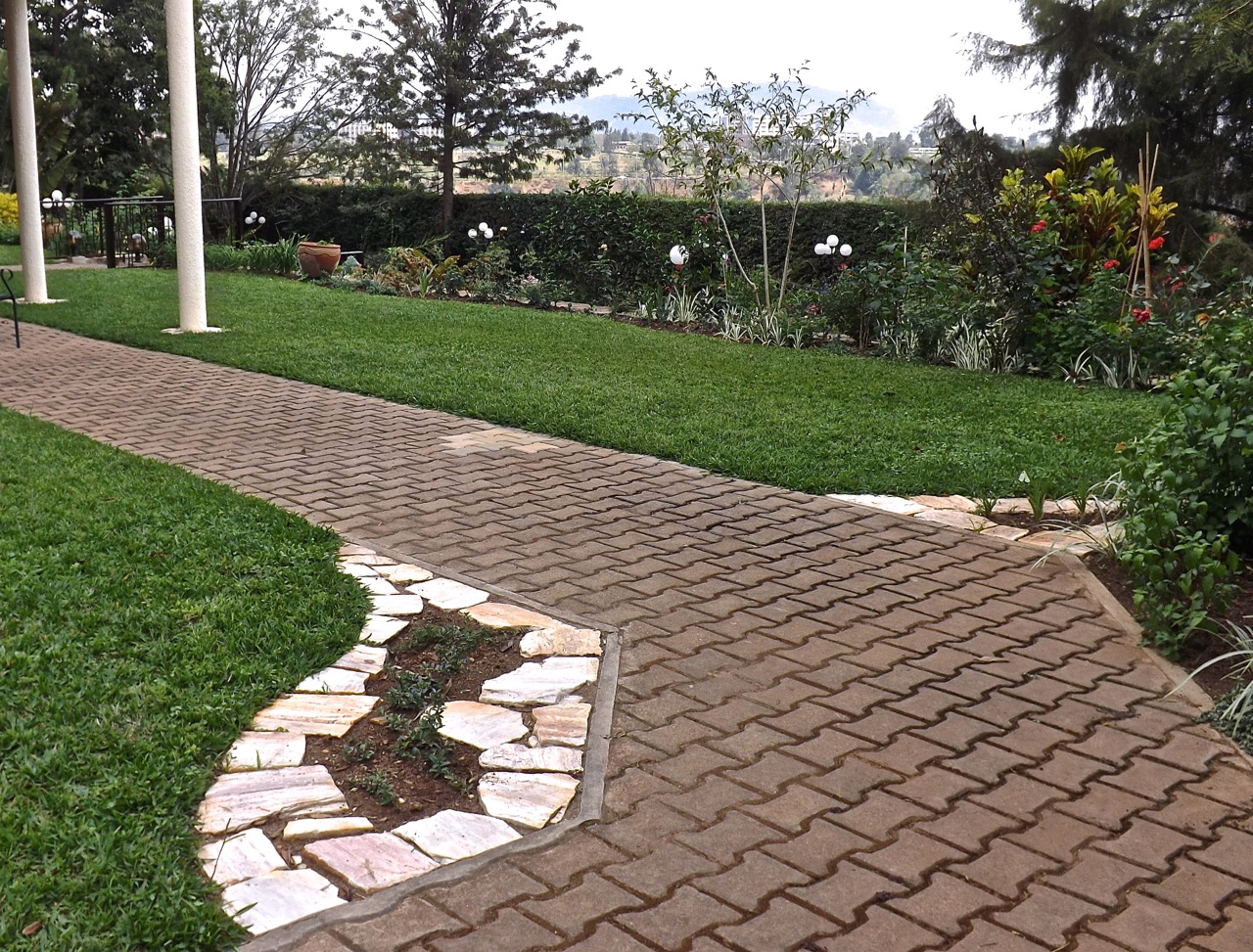
You can draw an imaginary curving line from the stone caps of the semi-circular area across the driveway to the first point of the stepping stones area at the now-open entrance to this side of the terrace (see below). A tall tree that used to grow in this area was dying and was removed in June.

There are low-growing plants with blue flowers in the open areas of the stone paving, but they are still filling in and are hard to see in the photo below.
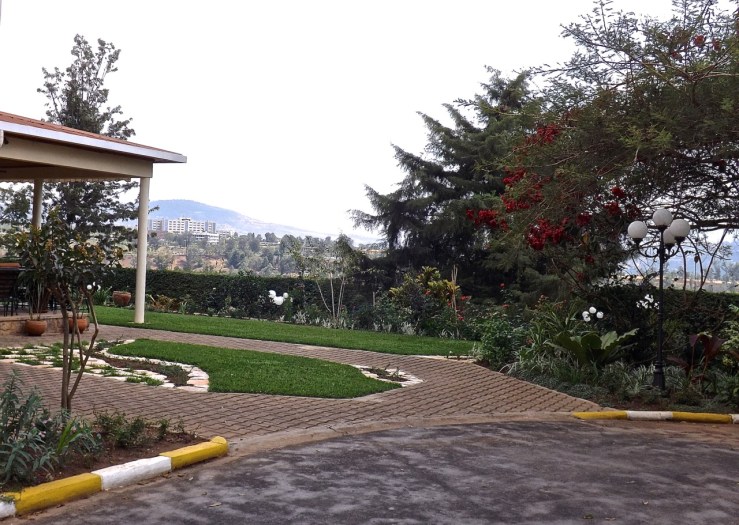
It looks a bit bare at the moment, but I think it will be fine when the surrounding plants fill out and the little crape myrtle on the left grows up, and we get a tall pot or two.
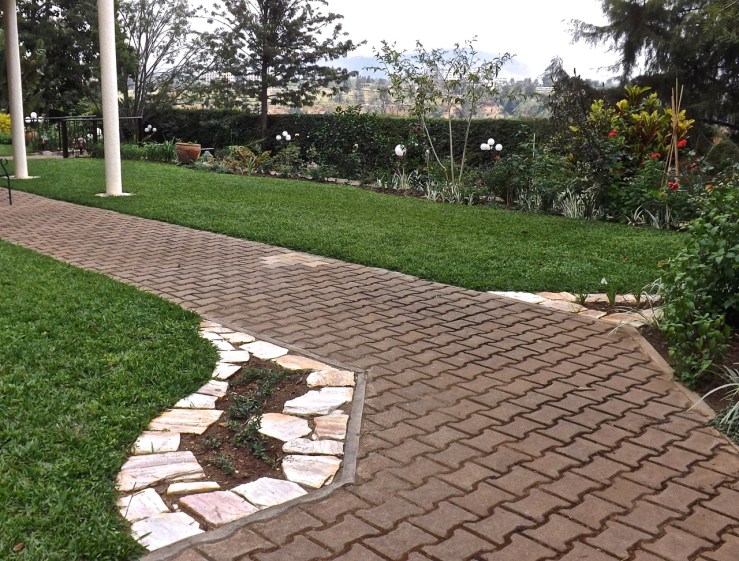
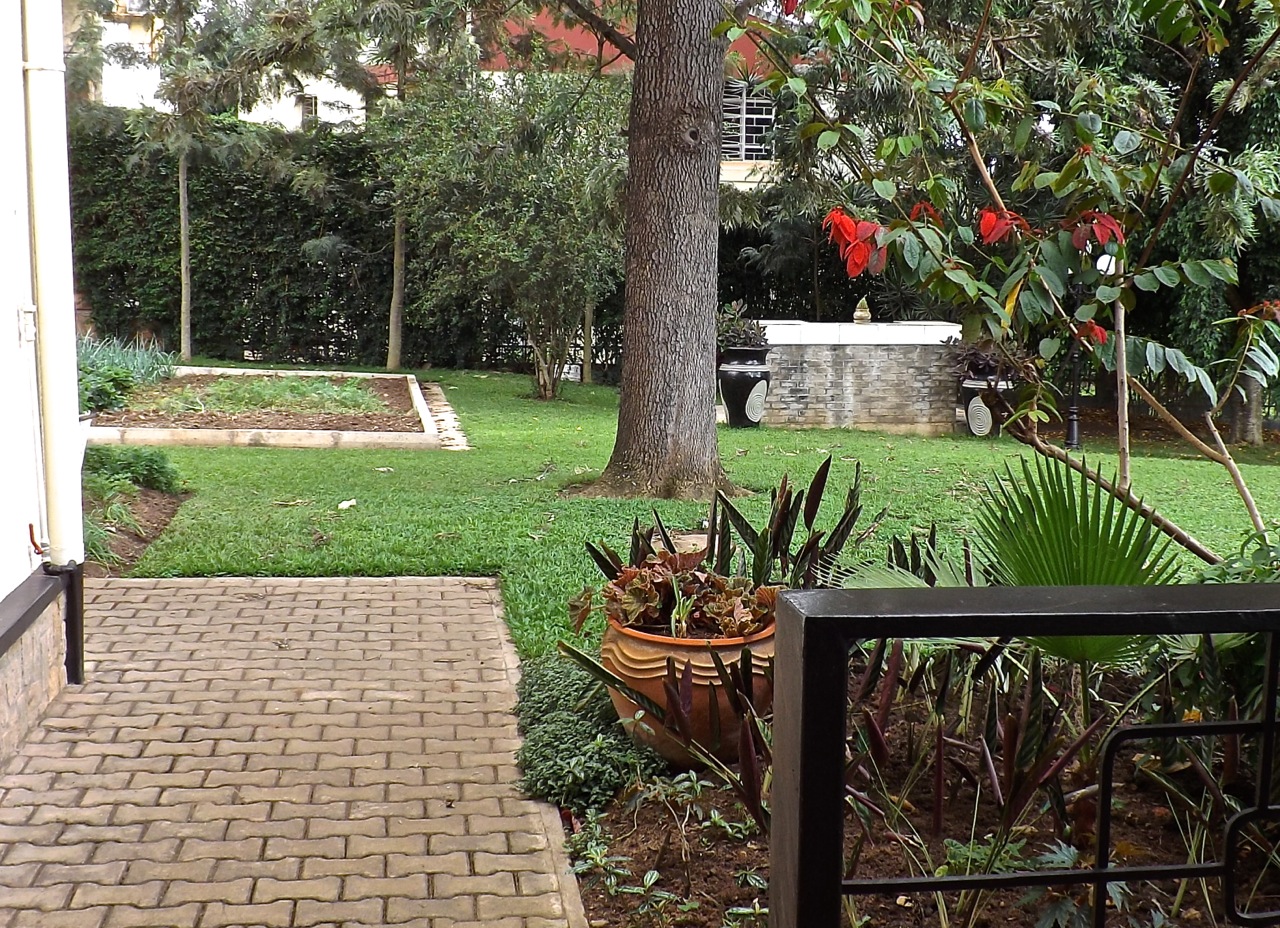
If you now cross the length of the terrace to the other side, you will see the transition to the side area of the property (see below), with the vegetable garden and cutting/herb garden. This passage used to be partly blocked by two very large shrubs.
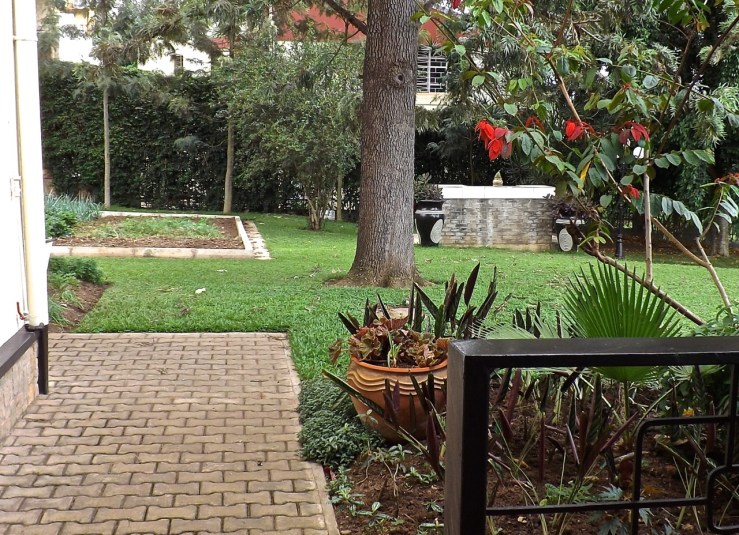
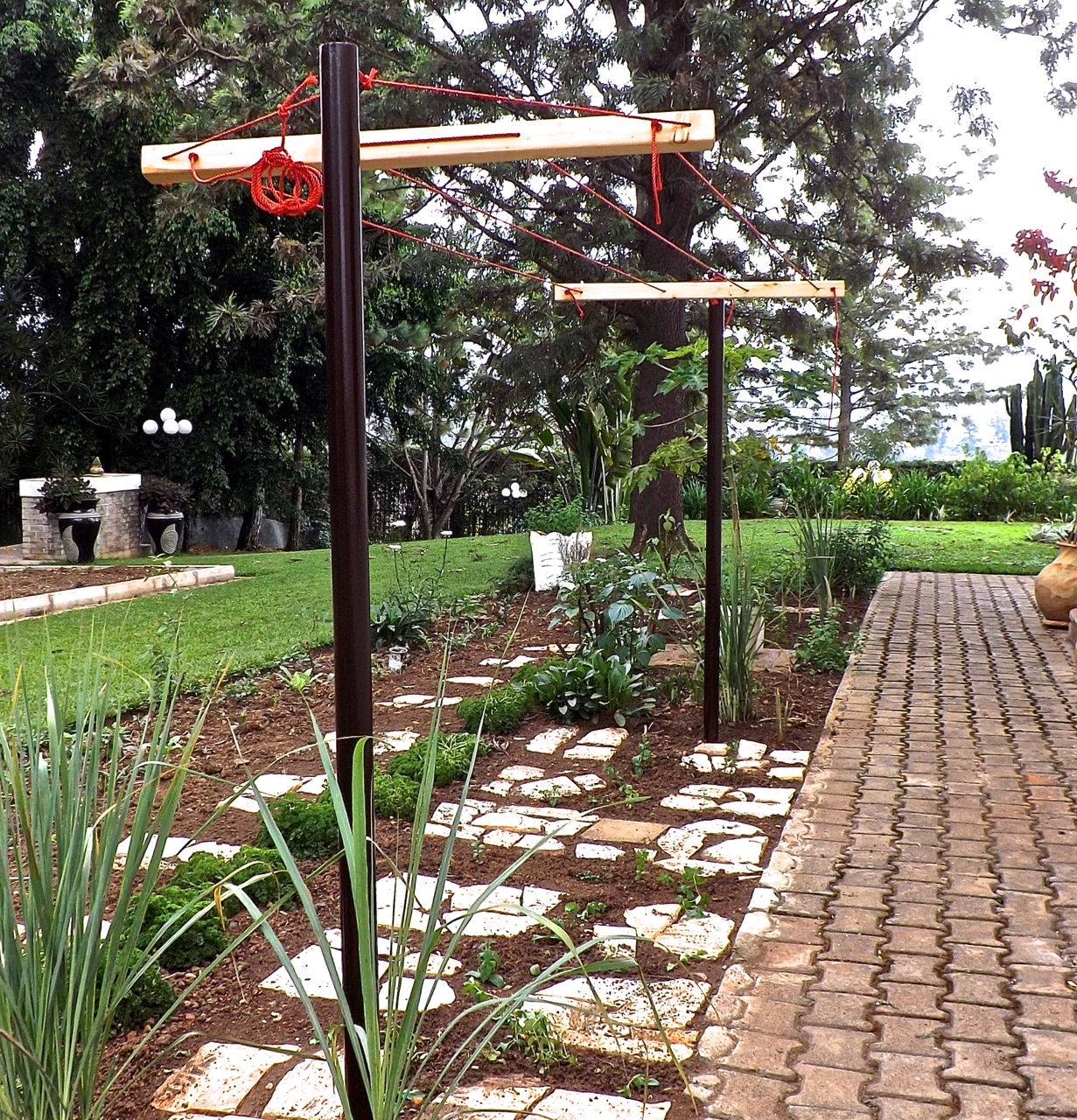
On this side of the house, shown below, we straightened up the edges of the vegetable garden, which had begun to wander, and created a wide bed to grow herbs and flowers for the house. The curving lines end here and everything is squared off, indicating the more practical purpose of the area.
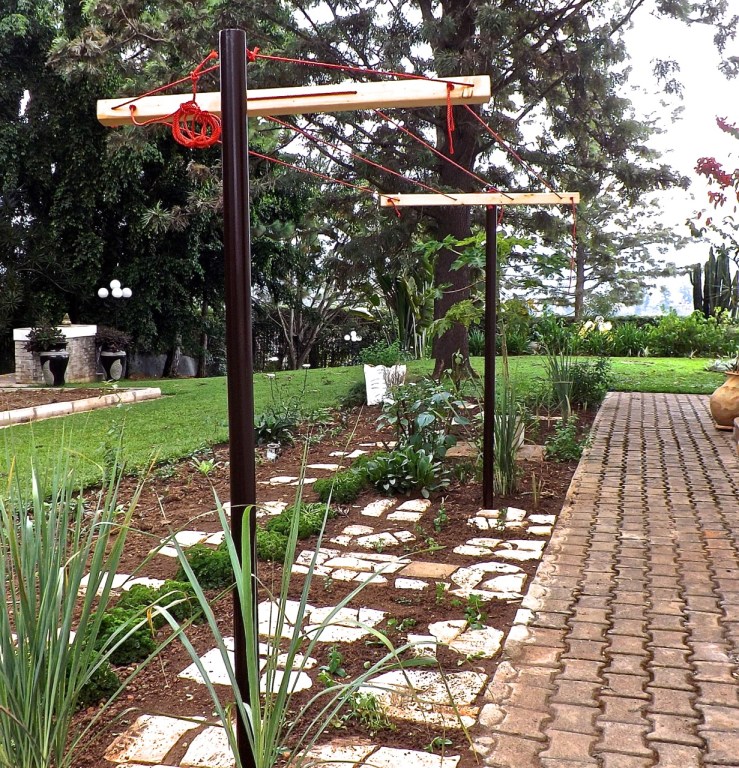
I am very proud of the new clothesline, which a carpenter built from a picture I found on Design*Sponge. The red cord was his good idea though (I still need to trim up the ends).

The photo below shows the view from the corner of the vegetable garden looking back to the terrace area.
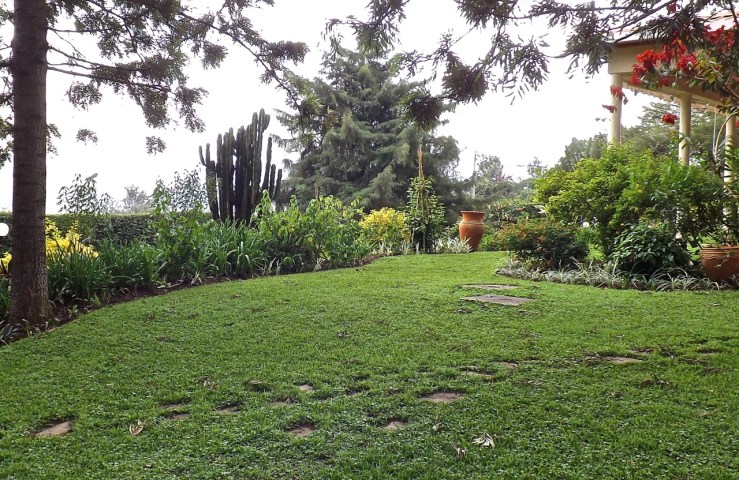
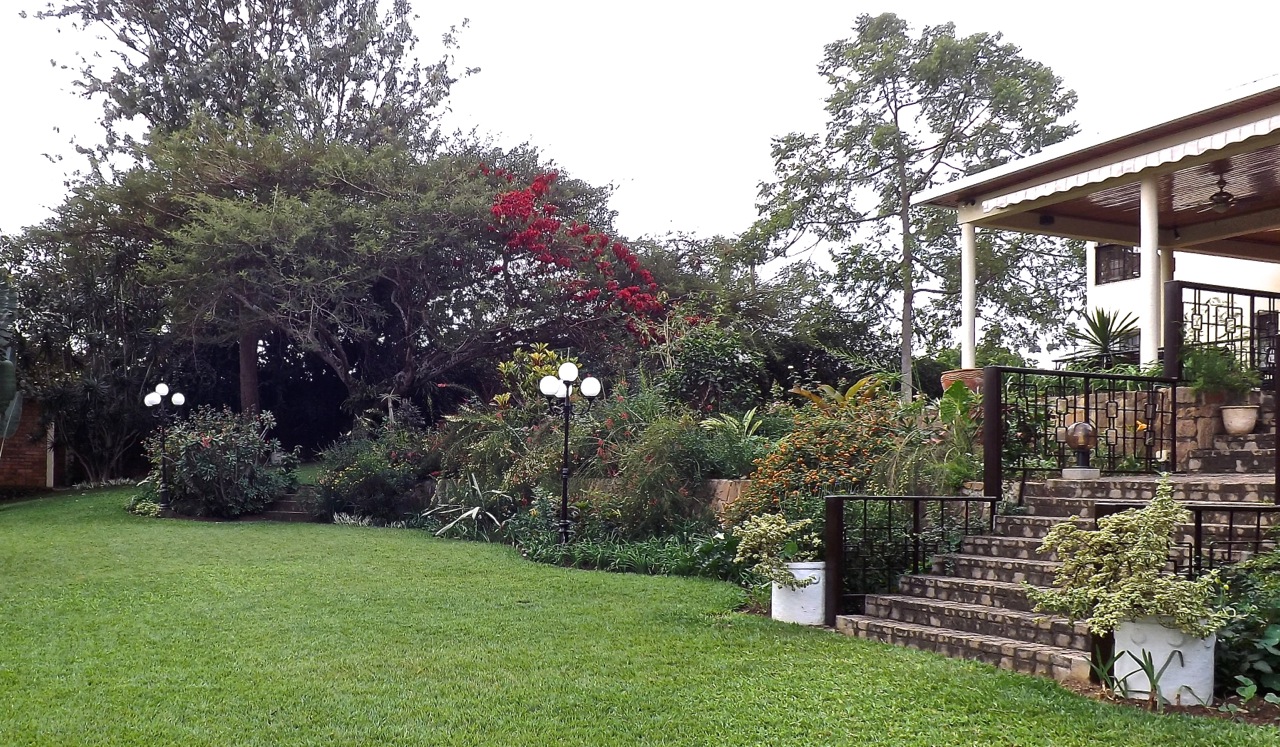
If you moved from that view point down along the south side of the yard to the bottom of the lower front lawn, you would be standing looking down the long view of the lower lawn, as in the photo below.
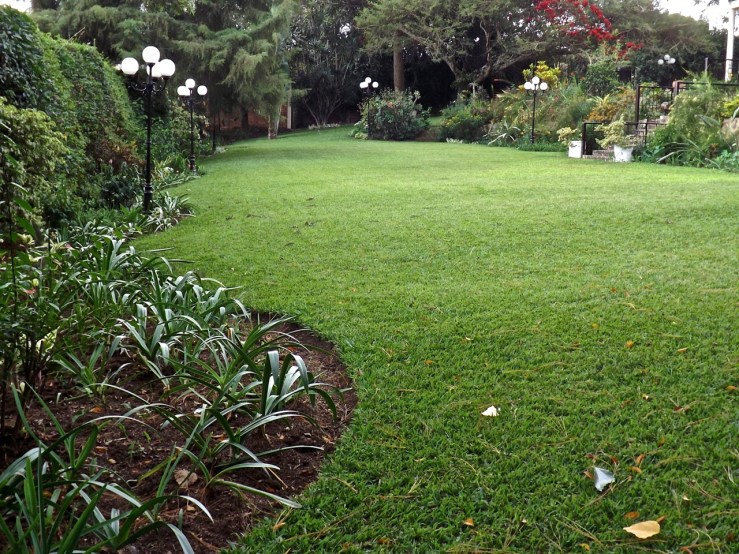
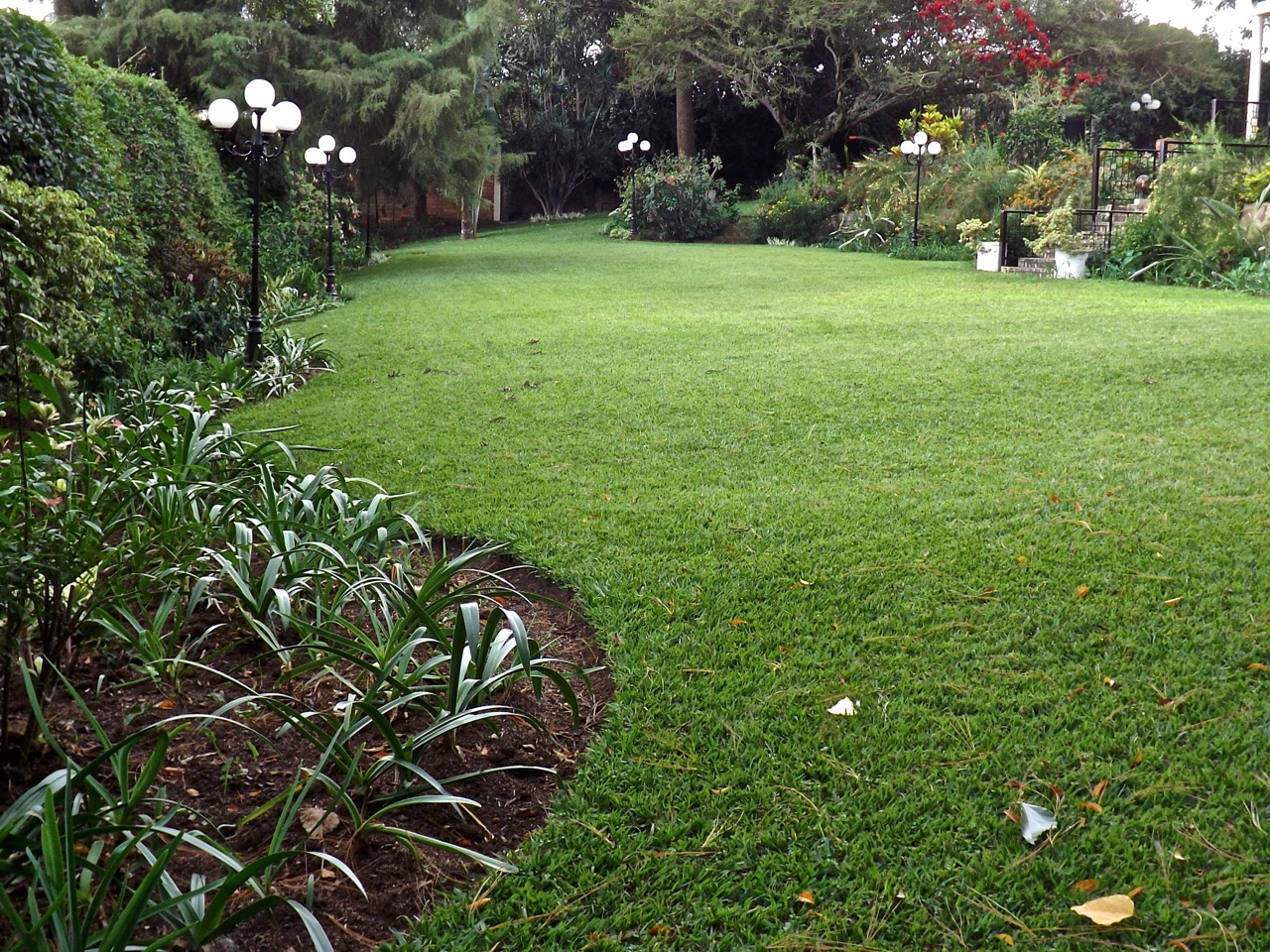
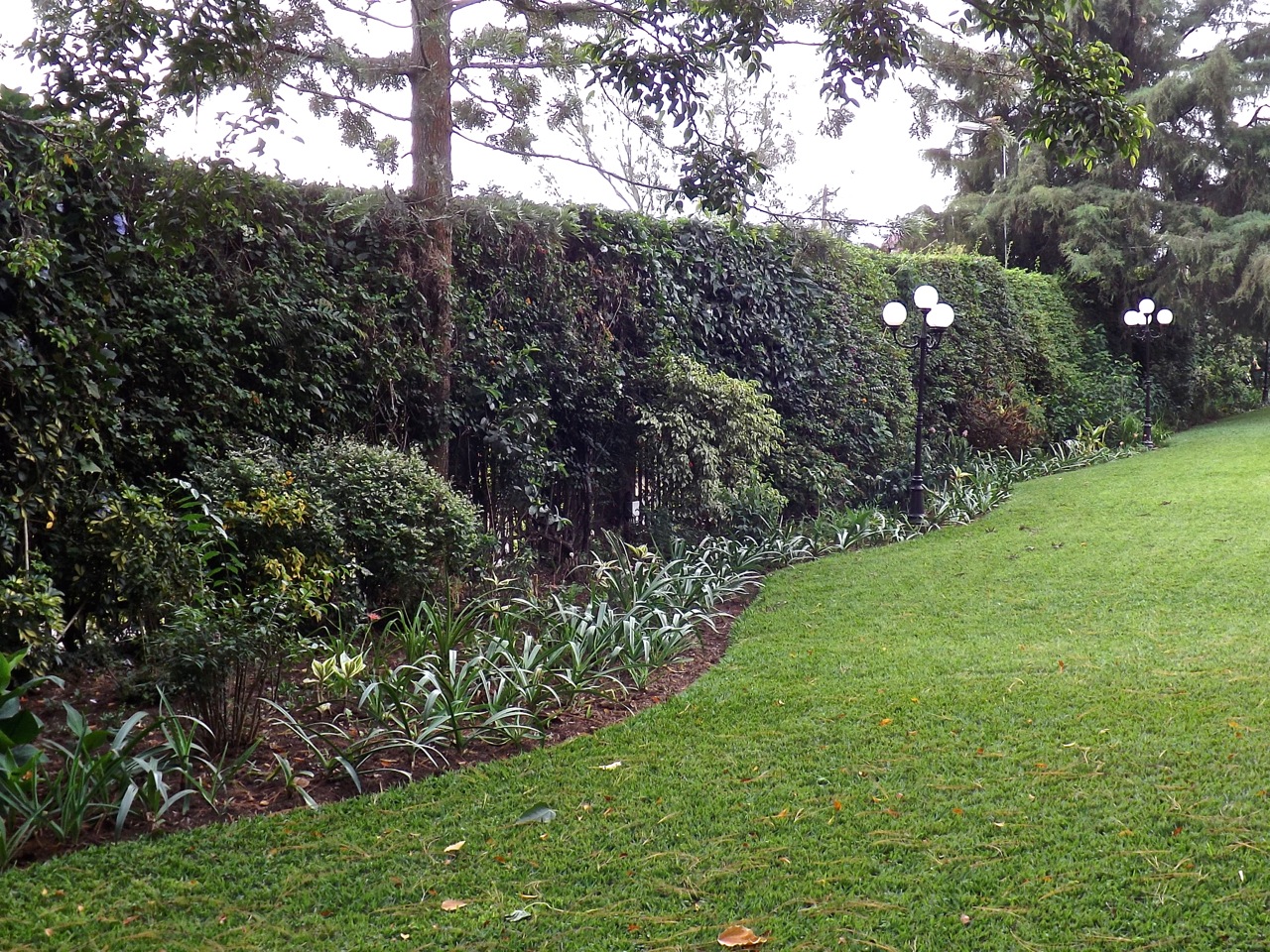
This is where the idea of the curving line got its start. I wanted to add some sense of movement and a lot more volume and texture to this long, wide grassy area that needs to stay wide in order to accommodate party tents from time to time. The long border on the left side used to be a skinny straight strip that barely held the nice shrubs planted in front of the bougainvillea-covered wall.

We kept almost all the various shrubs that made up the old hedges near the terrace and added them to this new wider border.
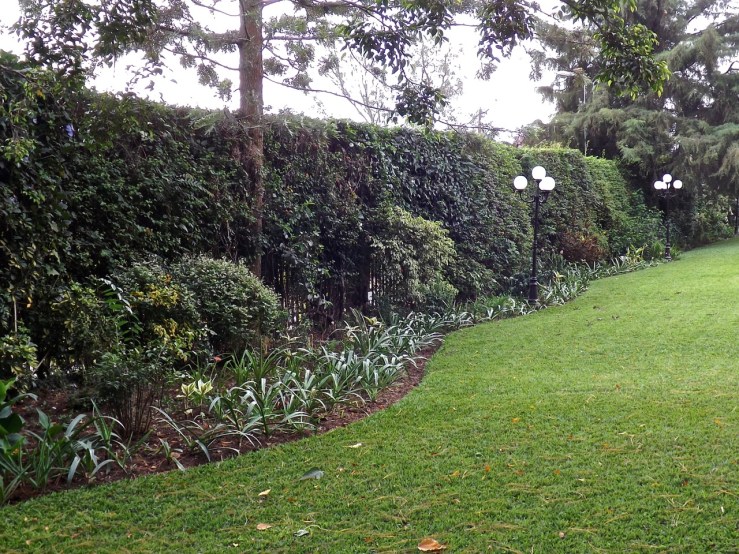
The first large curve in the photo above does not “wave” out far enough. I want to widen it soon by about 2′. I want to do the same to one of the “hills” at the other end of the lawn. The proposed changes are shown by the dashed lines on the drawing at the top.
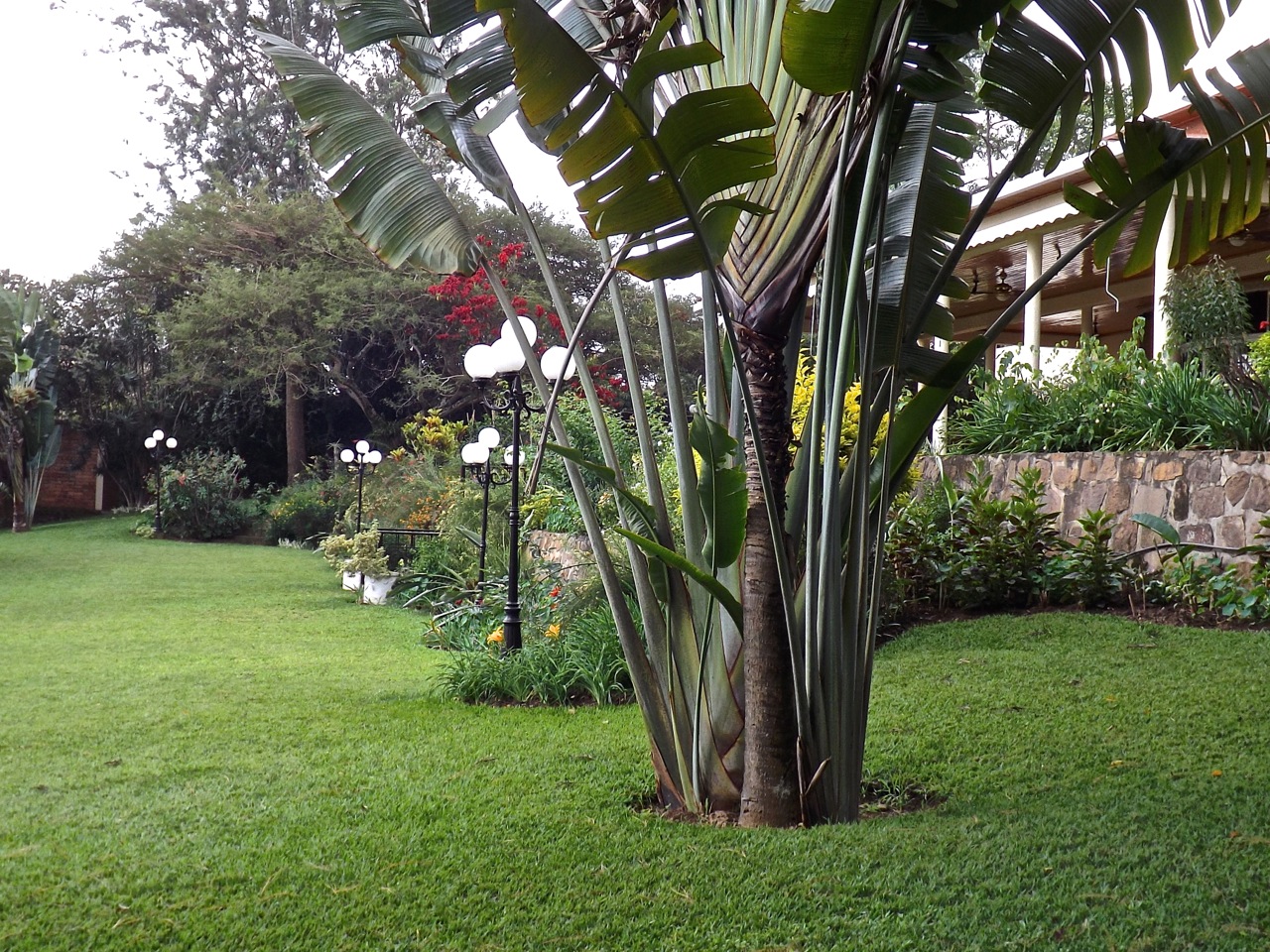
Did you notice that the lampposts are no longer glaring white? They were painted dark brown, like the trim on the house and the handrails to the center steps. I am really pleased that they now blend into the surrounding foliage. At night, you just see the round white globes floating.
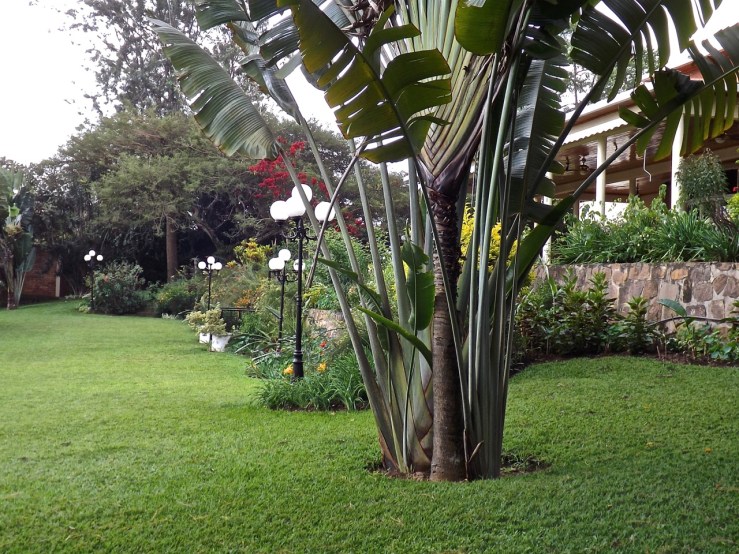
In the last photo below, to the right and behind the traveller’s palm, is the area where we put the tall false bird of paradise that we removed from the sides of the center steps. There is a similar planting at the other end of the lawn. I think they will make a nice frame for the long beds between the two stone retaining walls.
I’ll write about my planting plan next month. This is just the beginning.

Mount Vernon’s garden and a Wednesday miscellany

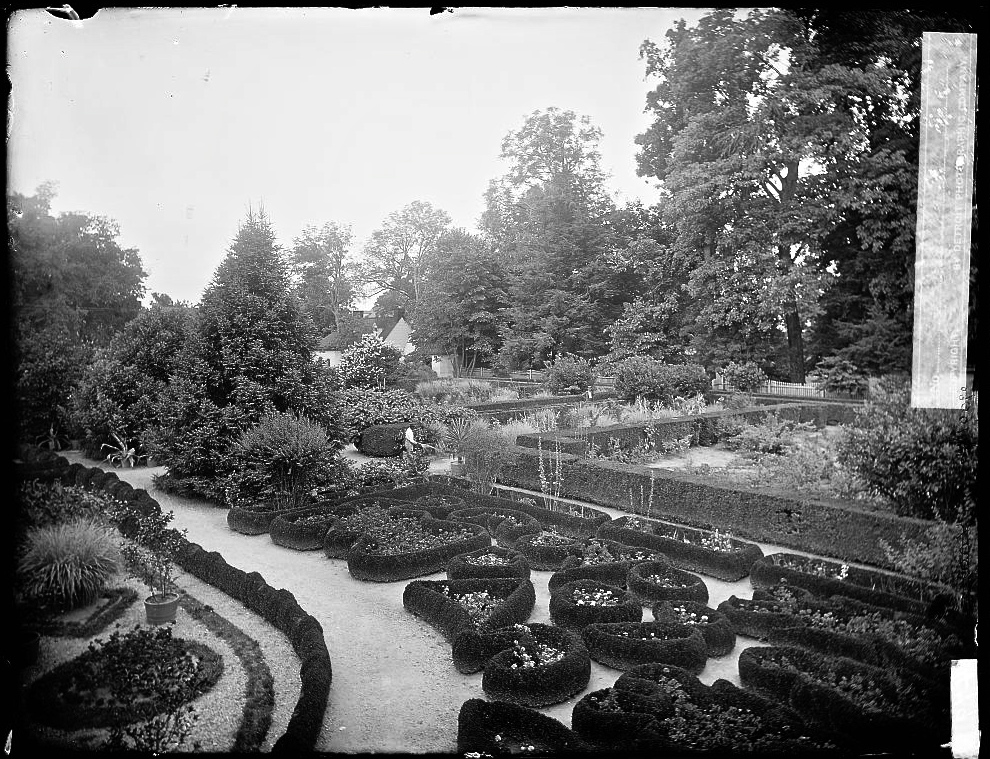
I love this 1902 photograph of the Upper Garden at George Washington’s home, Mount Vernon. It’s so high Colonial Revival.

Early American Gardens has a post this week,  “Mount Vernon after George Washington’s death,” with images from the 19th century.  While looking at them I remembered the picture above and the two below.

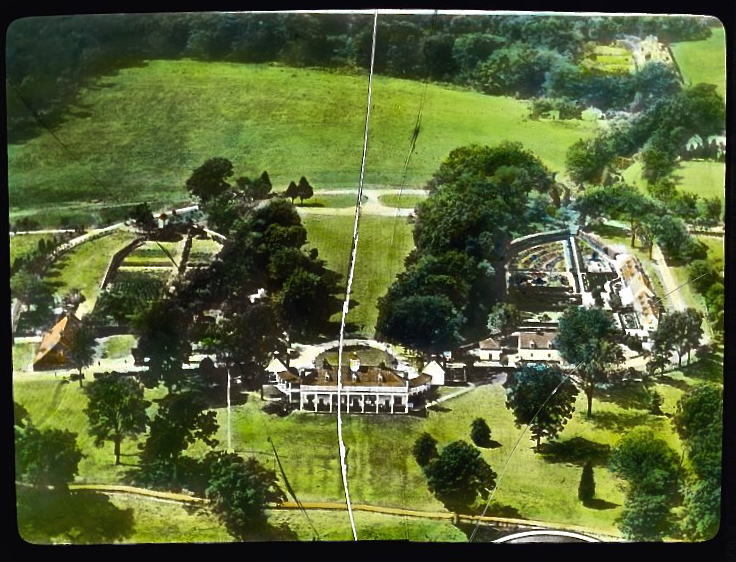
Above is a hand-colored slide from a 1929 aerial photo, part of the lantern slides collection of Frances Benjamin Johnston.  The Upper Garden is on the right side.

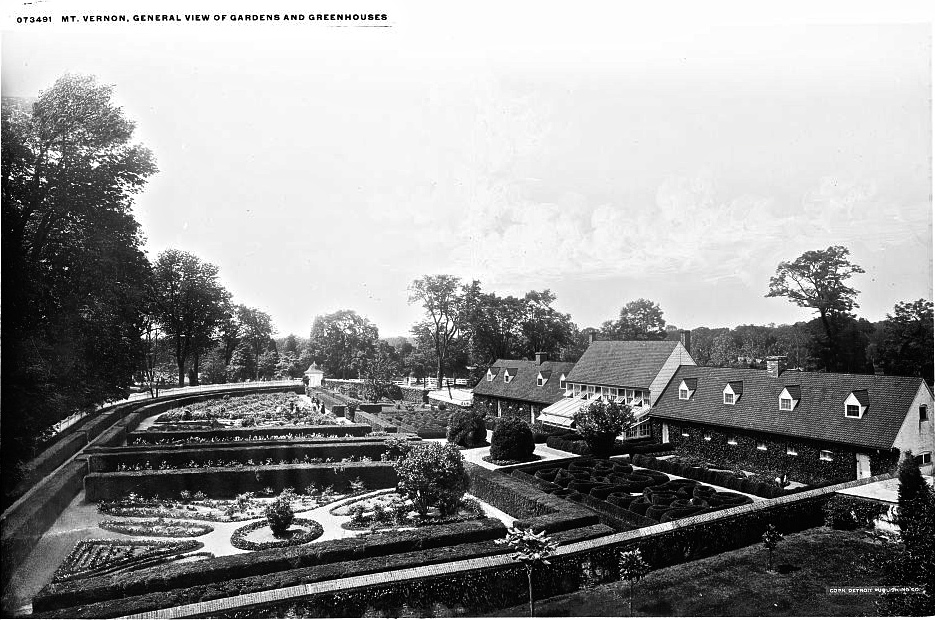
And here is a general view (c.1910 – 1920) of the the Upper Garden by the Detroit Publishing Co.  All three images above via the Library of Congress Prints and Photographs Division.

The 20th century photos are pretty, but they don’t accurately represent the Upper Garden of Washington’s time.  In the late 19th century, restorers thought that the boxwood parterres (many filled with hybrid tea roses) were original to Washington’s time, but research in the 1980s found that they were actually planted in the 1860s or 70s (although they may have been rooted from Washington’s boxwood).

The garden was substantially re-worked in 1985 (the greenhouse was restored in the 1950s), but such is the romantic power of a boxwood hedge that they were largely “kept in place by their own mythology and the mythology they supported of Washington as American royalty,” according to The History Blog, here.

By the early 2000s, the boxwoods were dying, so the Mount Vernon Ladies’ Association, which owns the estate, decided to make an extensive (six-year) archaeological dig on the site.  This culminated in a “new” (1780s) design in 2011.  The area now holds large open beds of vegetables and flowers.  They are bordered by low boxwood hedges and centered by a 10′ wide gravel walkway.

You can read about the restoration in this Washington Post article, here.  However, I really recommend watching this very interesting 30-minute C-Span video about the research and archaeology that informed it.

Miscellany

I’ve almost finished reading the excellent Gardens and Gardening in the Chesapeake, 1700 – 1805, by Barbara Wells Sarudy (aka Early American Gardens).  You can read its first chapter, about the 18th century garden of Annapolis, Maryland, craftsman William Faris, here.

For Anglophiles: thousands of aerial photos of Great Britain have recently been made available online; read about it here.

I recently found this 2010 (inside) art installation by Beilu Liu, which I think is just lovely, here.  It’s called “Red Thread Legend.”  (My Pinterest page — link on the right — is red today.)

In 2011, artist and former urban planner, Kathryn Clark, made a series of map quilts, shown here, representing neighborhoods that have had high foreclosure rates in recent years. Earlier this year, she gave an interesting interview with The Atlantic blog, Citieshere.

I also recently found the blog Miss Design Says, about “all good things Danish.”  It currently has a post about Rabalder Parken, a park that combines a street skate area  with an overflow water drainage system, here.

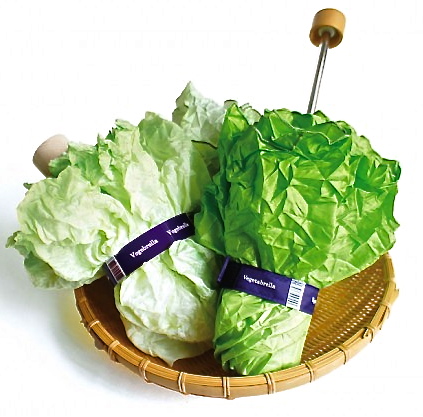
Of course I saw this on Pinterest: an umbrella that looks like a head of lettuce, here.  It’s from Japan, but the link will help you order it from other countries.

I liked this Q & A  information on rose hips in the New York Times,  here.  And I have recently been looking for some good flower frogs, and I found them here, from a tip from Gardenista.

Finally,  O-Dark-Thirty, the online literary journal of the Veterans Writing Project, launched in August.   The VWP is a 501(c)(3) non-profit based in Washington, D.C.  It provides no-cost writing seminars and workshops for veterans, service members, and military family members. Please visit them here.

ADDENDUM:  Today, Thursday, Washington Post garden columnist Adrian Higgins discusses boxwood blight, a disease that comes from Europe and has infected shrubs in nine states, here.

Going green in 1938

“Golf course grass now dyed green for nervous putters. Washington, D.C., Aug. 5 [1938].

“Nervous golfers who have complained that some insecticides used on greens turned the grass brown, thus creating a mental hazard which spoiled their game, have no excuse now. Experts of the U.S. Department of Agriculture, working with the United States Golf Association, have combined an insecticide with a green [dye], which, when sprayed does not harm healthy grass but improves both the color of uneven greens and the tempers of the golfers who blame their putting on the uneven color of the greens. The new dye is being used on football gridirons and baseball fields.

“A.E. Rabbit, grass specialist of the United States Golf Association, is pictured spraying the new dye on an experimental green at the Department of Agriculture.”

First of all:  Mr. Rabbit, a grass specialist?!  And he’s very nattily dressed to be out spraying colored poison.

Here’s a link to a brief history of pesticides, and here’s a link to “How Green is Golf?” by John Barton, which ran in the May 2008 Golf Digest and features a variety of voices from golf course superintendent to environmental activist.

There’s also this.

The further adventures of Mr. R. here.

Photo and text in quotes via Library of Congress Prints and Photographs Division.