
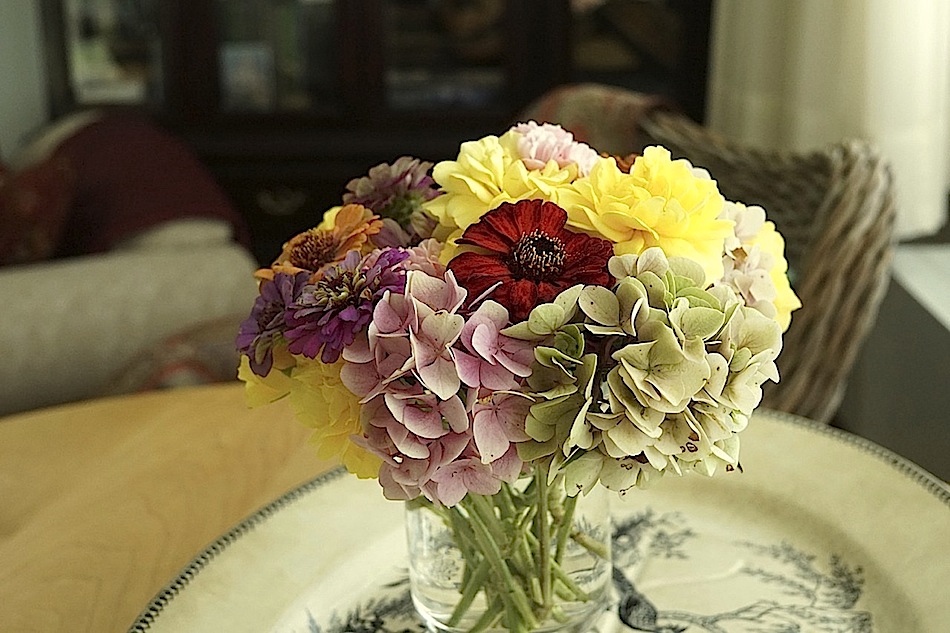
 Yellow and pink roses and pink and pale green hydrangea blooms from the yard; zinnias from last week’s Stuttgart flower market.
To see what other garden bloggers have put in vases today, please visit Cathy at Rambling in the Garden.
Yellow and pink roses and pink and pale green hydrangea blooms from the yard; zinnias from last week’s Stuttgart flower market.
To see what other garden bloggers have put in vases today, please visit Cathy at Rambling in the Garden.
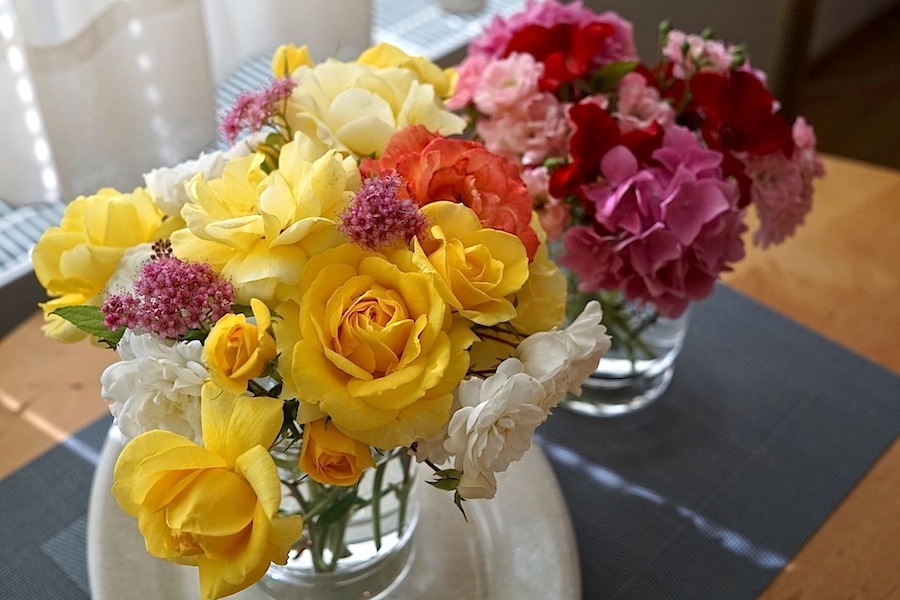 This weekend, I made two arrangements with roses, spirea, and hydrangea — all from our yard.

I like red and pink together, but I find dark red so difficult to photograph. It just swallows all the light.
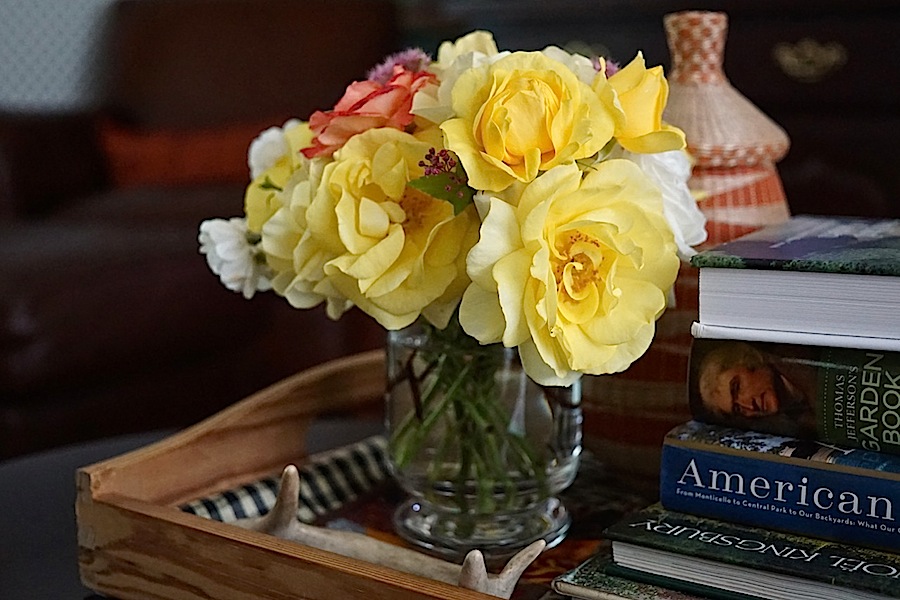
I put the yellow arrangement on the coffee table.
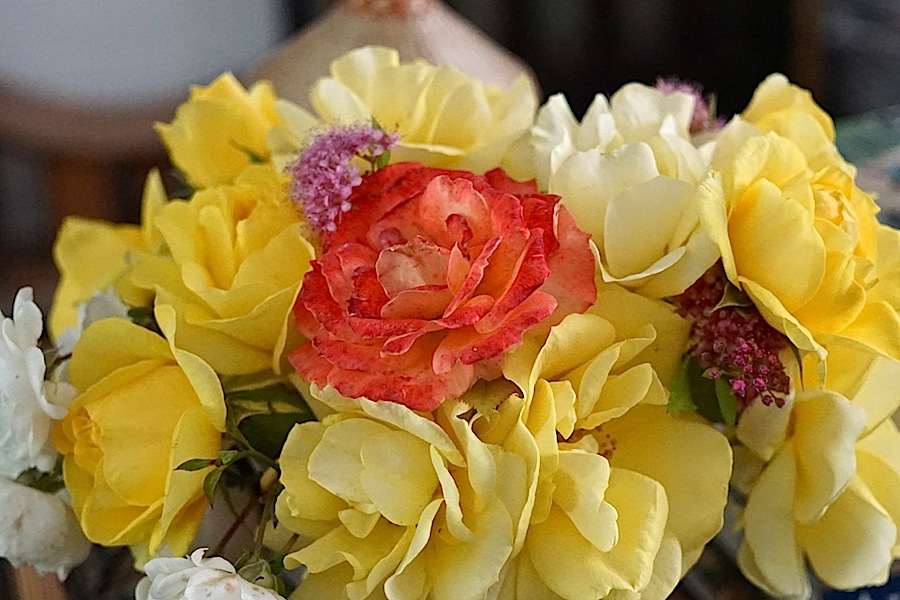
That orange rose is the only one that’s fragrant.
To see what other garden bloggers have put in vases today, please visit Cathy at Rambling in the Garden.
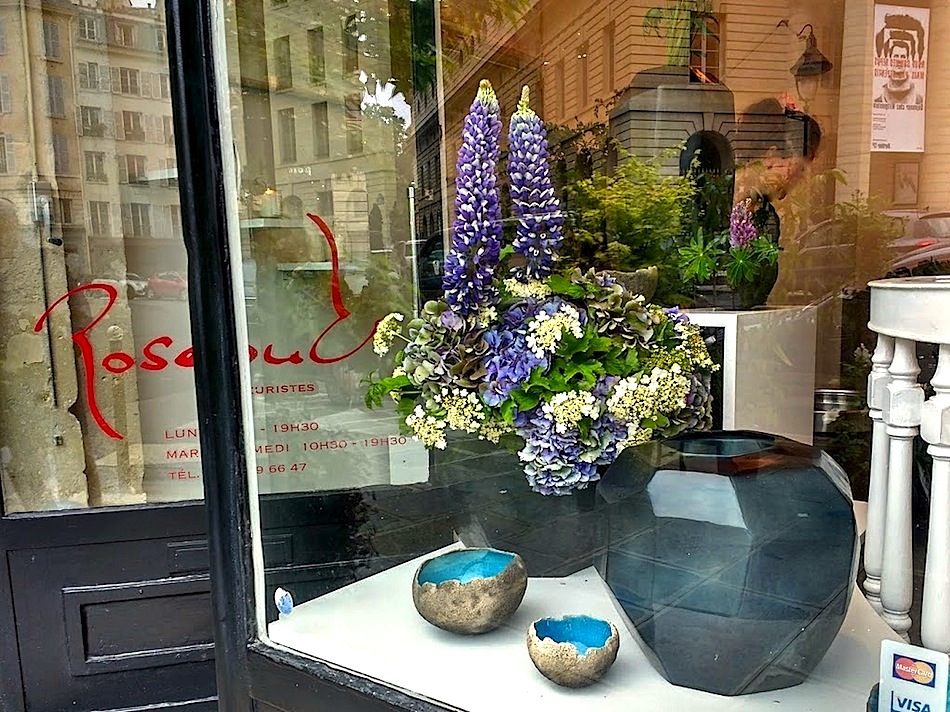
We spent the long holiday weekend in Paris, just getting back this afternoon — so I don’t have a flower arrangement of my own today. But I can offer a few pictures of the windows of two florists in the area north of the Luxembourg Garden: Rosebud and Stanislaus Draber.

On the train to France, I read an article in Paris-Match magazine, “La Fleur Fait Sa Révolution!”
“The flower has become a symbol of an urban renaissance, creative and super-cool,” it said. “One talks flowers with the same appetite that characterizes the foodistas for cooking. The opening of peonies, the Japanese [pruning] knife, and the art of the bouquet are now at the heart of urban conversations.” The trend is “embodied by the explosion of the neo-artisans who are also called the ‘makers’ (les «makers»).”
The article also mentions that the flower-market gardens around Paris “have almost disappeared in favor of the industrialized Dutch market. If nothing is done within ten years, there will be no bouquets of real scented garden roses for the high fashion Parisian florists.”

To see what other gardeners/bloggers/makers have put in vases today, please visit Cathy at Rambling in the Garden.
ADDENDUM: There’s an interesting video clip by Rick Steves of a giant Dutch commercial flower auction here.
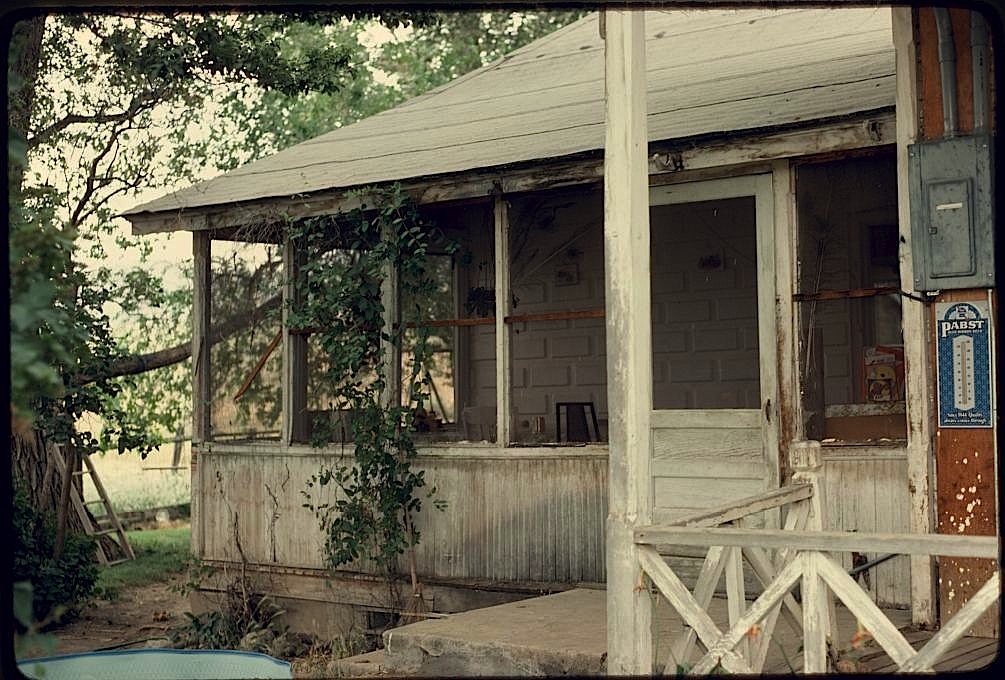 Ranch House with Porch, Paradise Valley, Humboldt County, Nevada, July 1978, (35mm slide) by Suzi Jones, via American Folklife Center of the Library of Congress (all photos here).
The house — of adobe construction — served as the officer’s quarters of Fort Scott in the late 1860s. In 1978, it was the main residence of Fort Scott Ranch.
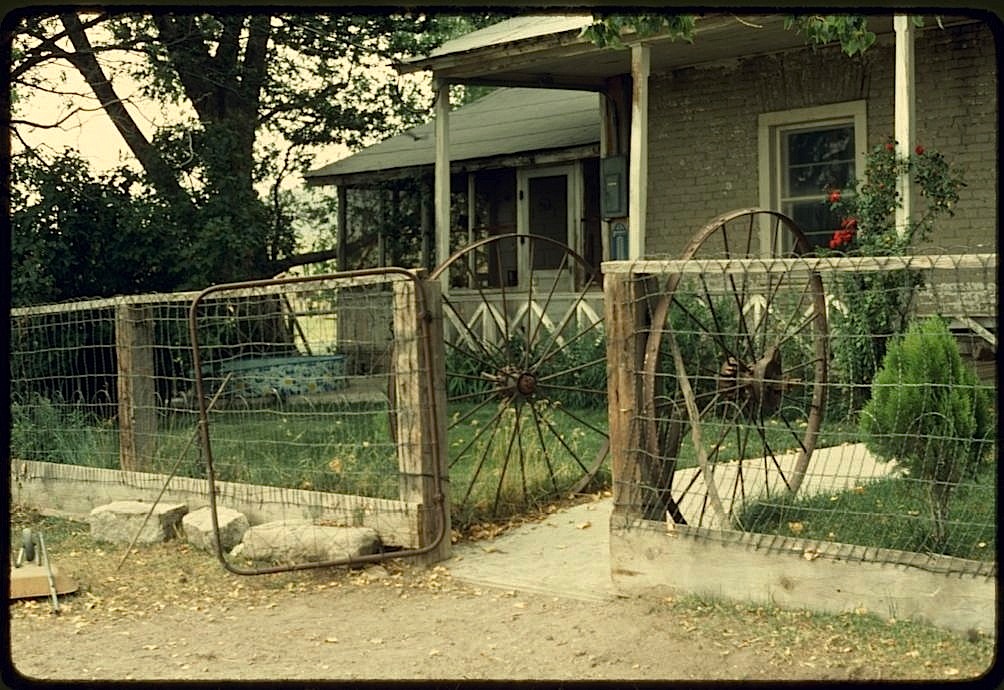
There is another view here, by Howard W. Marshall.
The photos here are three of over two thousand taken or collected for the Folklife Center’s 1972-1982 ethnographic field project on the Paradise Valley area. The work became the collection* “Bucharoos in Paradise: Ranching Culture in Northern Nevada, 1945-1982.”

There’s another photo of the ranch house and its outbuildings here.
For the last two Sundays, I ran a little poll asking how readers look at enclos*ure — 1) on a desktop computer or Mac; 2) on an e-reader; or 3) on a smartphone? Of those who responded, 82% use a desktop and the others use an e-reader.
*It also contains sound recordings and motion picture film.
So thou dost riot through the glad spring days. . .*
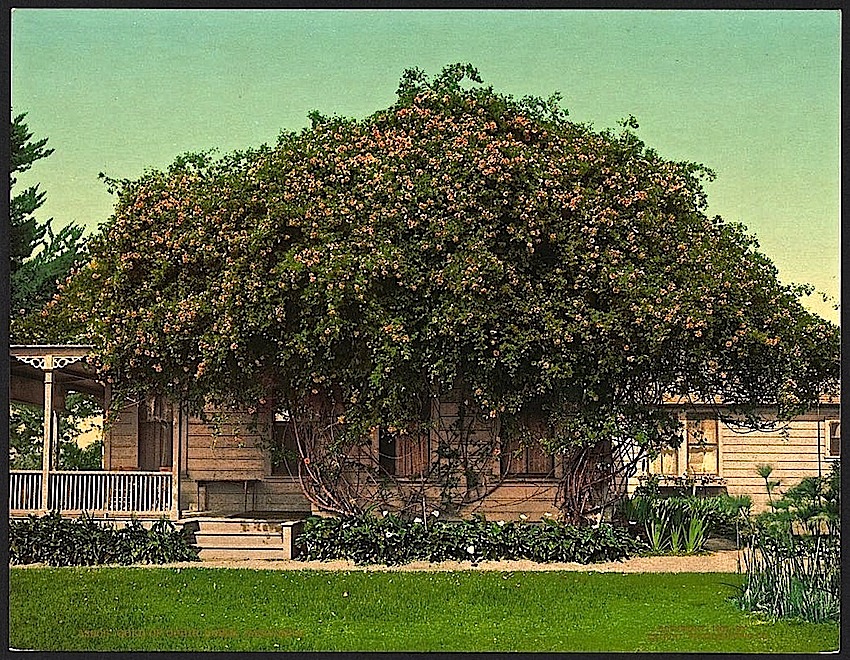 “Gold of Ophir roses, Pasadena[, California,]” ca. 1902, a photochrom by Detroit Photographic Co., via Library of Congress Prints and Photographs Division.
The climber Gold of Ophir — also known as Fortune’s Double Yellow and Beauty of Glazenwood — moved to southern California with the settlers and flourished there.
“I remember great heaps of them in every backyard, blazing like moons on fire, yellow, gold, pink. . .,” wrote M. K. Fisher in her introduction to Growing Good Roses by Rayford C. Reddell.
* from “Gold of Ophir Roses” by Grace Atherton Dennen, editor/publisher of The Lyric West
 enclos*ure