The Sunday porch: Danville, Virginia

Danville, Virginia farmhouse, 1935, Library of CongressFarmhouse on Michaux Plantation, Danville area, Virginia, 1935, by Frances Benjamin Johnston, via Library of Congress Prints and Photographs Division. (There are two more views here.)

I could not find out when this simple house* was built or if it still exists. It is somewhat similar to this house in the same area, which Johnston’s notes say was built between 1776 and 1850.

Michaux was one of eleven plantations in southern Virginia owned by the Hairston family, one of the largest slaveholders in the South. Its name probably indicates that the land was also once owned by a member (this one?) of the local branch of the Michaux family.

This is the kingdom that you find
When the brave eye-holes stare
impartially against the air. . .

Joy Davidman, from “Stark Lines-Resurrection”


*It reminds me of the old house or schoolhouse quilt block pattern.
The Sunday porch: conditori

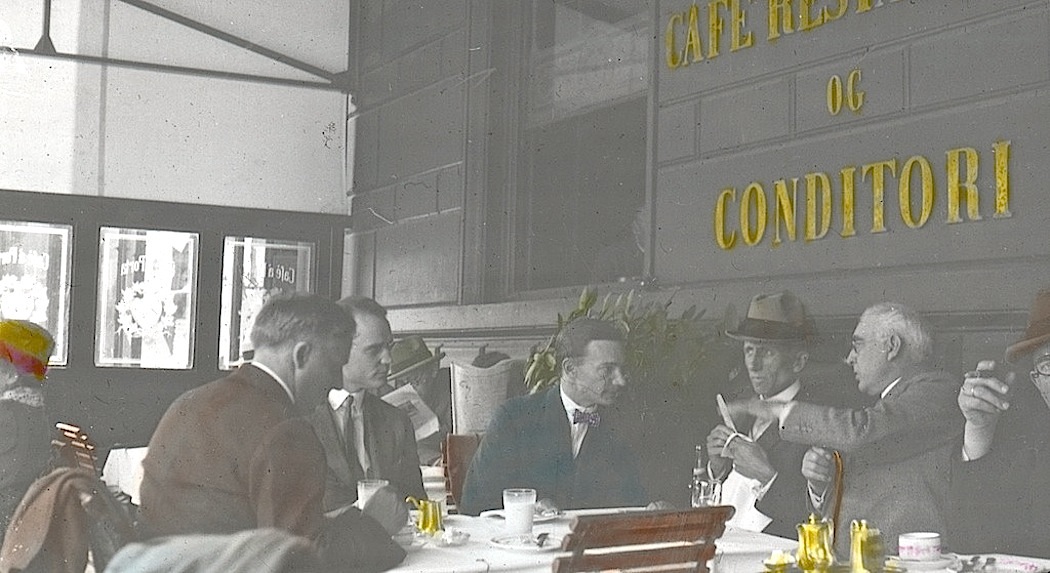
Copenhagen cafe, OSU on flickr“Outdoor Restaurant,” Copenhagen, ca. 1915, via Oregon State University Special Collections & Archives on flickr. The image is from a collection of lantern slides of the “Visual Instruction Department.”

The accompanying bit of the class lecture observed that “[European] eating places have less of the haste and nervous tension which characterize cafeterias and cafes in American cities. In Copenhagen it is common for tables to be set out under an awning on the broad sidewalk. Here folk can eat leisurely and watch the happenings in the neighborhood.”

In the lettering above the tables, “og Conditori” means “and cake/pastry shop.” There’s another cake shop with nice outdoor seating (in Sweden) here.

I used to mock my father and his chums
for getting up early on Sunday morning
and drinking coffee at a local spot
but now I’m one of those chumps.

Edward Hirsch, from “Early Sunday Morning

The Sunday porch: recorded

Lomax Collection 2, Library of Congress“Mrs. Alberta Kimball, Mrs. Minnie Smith, and Mrs. Emily Elizabeth Fulks, at the home of Mrs. Fulks, Prairie Lea,* Texas,” September 1940, by Ruby Terrill Lomax, via Lomax Collection, Library of Congress Prints and Photographs Division.

The three women were folk musicians. Alone or in duets, they sang songs like “Swedes Blessing,” “There was a Wealthy Merchant,” “Way Out West in Texas,” “Barbara Allen,” and “The Gypsy’s Warning.”  Unfortunately, I can’t find an online recording of them. They look delightful in these pictures, however, particularly in those flowered dresses.

Lomax Collection 31, Library of Congress
Mrs. Minnie Smith, Mrs. Elizabeth Fulks, Mrs. Albertina Kimball, at Mrs. Fulks’s home.

These are four snapshots from four hundred made during the sound recording expeditions of the Lomax family.  From 1934 to around 1950, John Avery Lomax, Ruby Terrill Lomax, and Alan Lomax traveled the southern United States and the Bahamas collecting folk music and folklore for the Library of Congress.

Lomax Collection 4, Library of Congress
Mrs. Fulks on her porch.
Lomax Collection 5, Library of Congress
Mrs. Fulks in her garden.

There’s a previous “Sunday porch” from the Lomax Collection here.

Our world, so worn and weary,
Needs music, pure and strong,
To hush the jangle and discords
Of sorrow, pain, and wrong.

Frances Ellen Watkins Harper, from “Songs for the People


*These photos were labeled with the location as Prairie Lea or Prairie Lea R.F.D., but also as Stanton, Texas.  Prairie Lea and Stanton are in different parts of Texas, and I have been unable to find out which town is correct.  The labels on the sound recordings the women made say “Prairie Lea” — which certainly sounds like a place in a folk song.

The Sunday porch: Munich

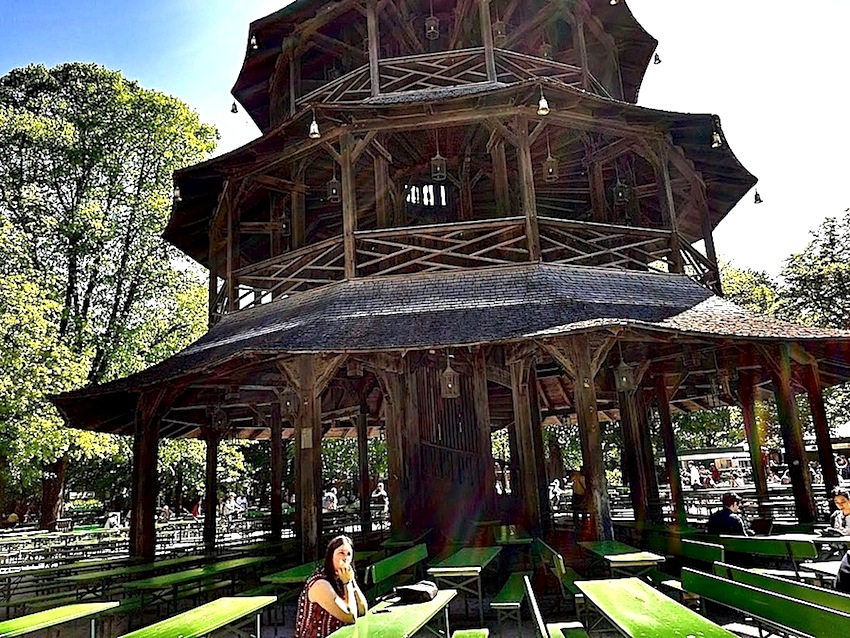
Chinese Tower, Munich, May 2016, enclos*ureChinesischer Turn and beer garden in the Englischer Garten park, Munich, Germany.

Not a porch, of course, but a grand garden pavilion first built in 1790 — the year the park itself was laid out (officially opening in 1792).

Chinese Tower detail, Munich, May 2016, enclos*ure
The all-wooden tower is five storeys and eighty-two feet tall.

The tower was designed by Joseph Frey, a military architect.  He was inspired by the “Great Pagoda” of the Kew Royal Botanic Gardens in London.

The 1790 structure burned down in 1944 after a heavy bombing of Munich.  The current tower, true to the original, was built in 1951.

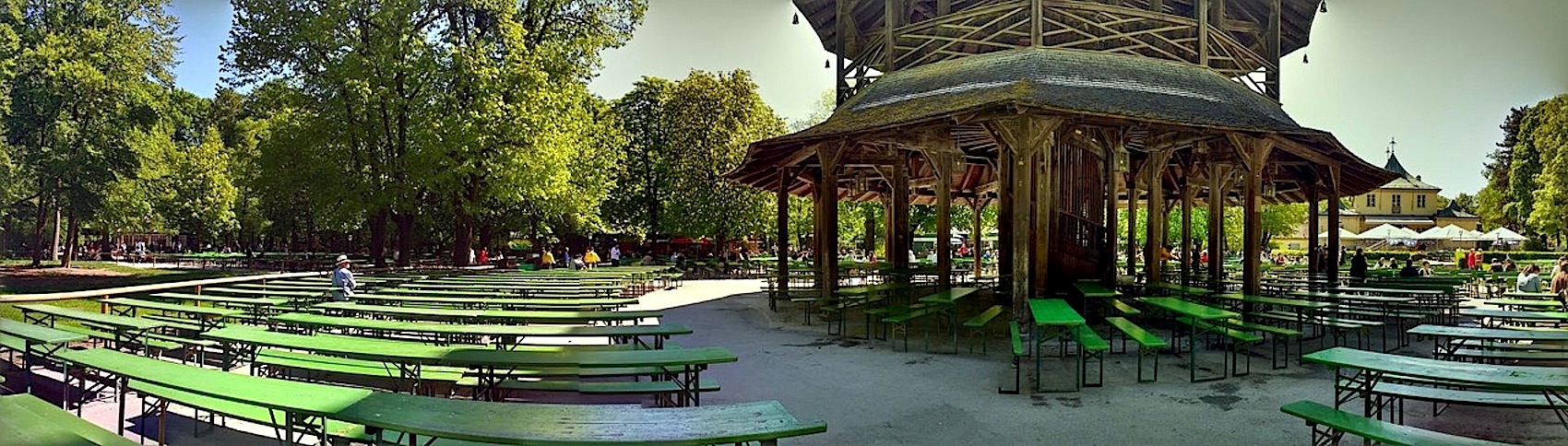
panoramic Chinese Tower, Munich, May 2016, enclos*ure
Click on the image to enlarge it.

The beer garden surrounding the Chinese Tower seats 7,000 people.

On early Sunday mornings in the late 19th century, up to 5,000 servants, soldiers, students, and other working-class people would gather at the tower to dance to a brass band.  These Kocherlball or cooks’ balls would end by 8:00 a.m., so that the attendees could get back to work or go to church.  The dances were outlawed in 1904, but were revived in 1989 as a annual event every third Sunday in July.

Munich, early May 2016, enclos*ure

As its name implies, the Englischer Garten public park (the oldest in Germany) was laid out in the English landscape style associated with the work of Capability Brown.  Its principal designer was Royal Gardener Friedrich Ludwig von Sckell, who had studied in England.

The park has an area of 910 acres — making it larger than New York City’s Central Park.

I took these photos with my phone while biking through the park last Sunday morning. (There are over 48 miles of paths in the park.)

There’s a brief history of beer gardens in America here.

The Sunday porch: Usborne, Ontario

John Cottel's house, via Huron County Museum

John Cottel‘s Home, Usborne Township, Ontario, ca. 1910, via Huron County Museum & Historic Gaol Commons on flickr.

John Cottel, presumably to the right of the door, was born in England in 1836.  His wife was Margaret Turnbull, and they had four daughters, three of whom may be in the photo. There is a much wider view of the house and farm here.