The Sunday porch: Miami, Florida

House in Miami, Florida, July 11, 1955, via Florida Memory (State Library and Archives of Florida) Commons on flickr (cropped slightly by me).

Widely available by the 1950s, aluminum awnings were touted as longer-lasting and lower-maintenance than traditional [canvas] awnings. . . . [T]hey were especially popular with homeowners. Aluminum awnings were made with slats called “pans” arranged horizontally or vertically. For variety and to match the building to which they were applied, different colored slats could be arranged to create stripes or other decorative patterns.

— U.S. National Park Service “Preservation Brief

Vincennes, Indiana

This slideshow requires JavaScript.

Hollyhocks in Vincennes, Indiana, July 1941, by John Vachon, via Library of Congress Prints and Photographs Division.

The Sunday porch: Vincennes, Indiana

Sunday afternoon on the front porch, Vincennes, Indiana, July 1941, by John Vachon, via Library of Congress Prints and Photographs Division.

Nice striped socks.

Interrupted by visitors.
At least it looks like he didn’t have to leave his book and go inside with them.

The Sunday porch: Hill End


“Two women on veranda of rendered* cottage with shingle roof and front garden, Hill End, New South Wales, ca. 1872,” by Charles Baylissvia National Library of Australia Commons on flickr.

Hill End was a gold rush town. At the time of this photo, “it had a population estimated at 8,000 served by two newspapers, five banks, eight churches, and twenty-eight pubs,” according to Wikipedia. The rush was over by the early 20th century. In 2006, the town was down to 166 people.

The photographer came to Hill End as an assistant to a traveling photographer who had been contracted to take pictures of the area that could be used to advertise the mining colony and attract new residents.


*Render is stucco.

The Sunday porch: County Armagh

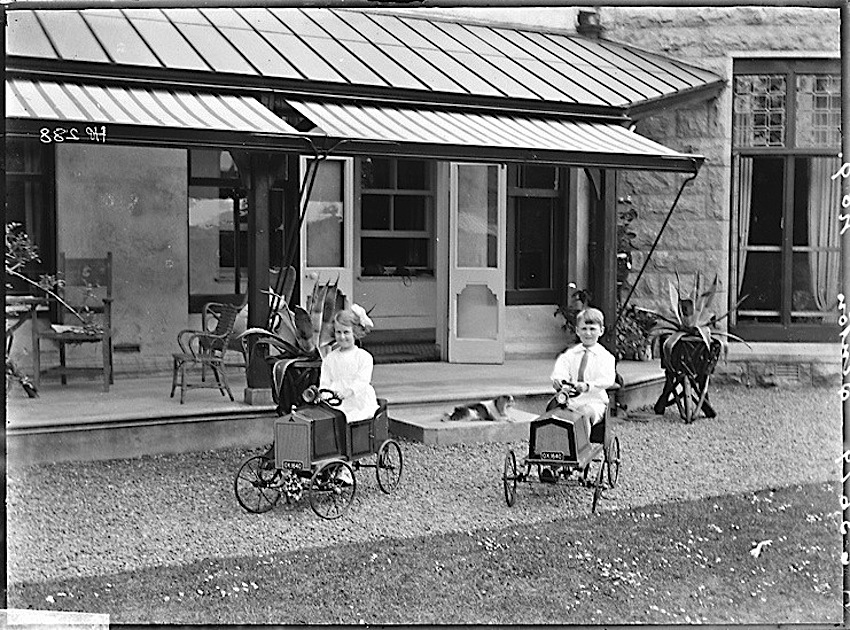
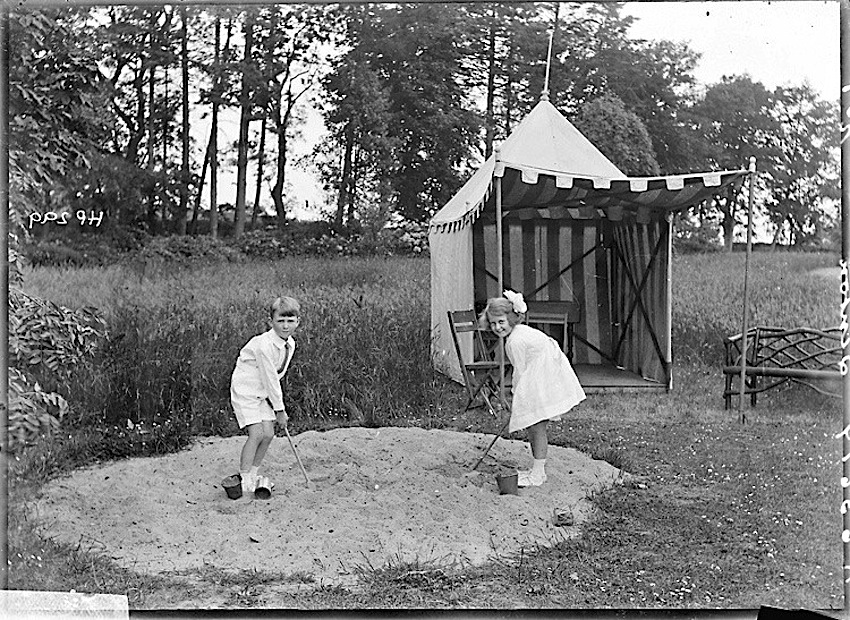
Bridget and Maynard Sinton at their family home of Ballyards, County Armagh, June 17, 1921, by H. Allison & Co. Photographers, via Public Record Office of Northern Ireland Commons on flickr.

That retractable striped awning emerging from the terrace roof looks very sleek and was brand new.  A ca. 1920 photo of the house in this biography of the children’s father shows the terrace with no cover. (You can read a brief history of awnings here.)

Ballyards was built in 1872 and sold to the father, a linen manufacturer, in 1908. He almost doubled its size and called it “Ballyards Castle.”

The children playing in a sandpile. (This photo has been printed in reverse from the others.)

Maynard was killed in WWII, but Bridget (age 7 in these photos) lived until 1975.