Bowling, 1861


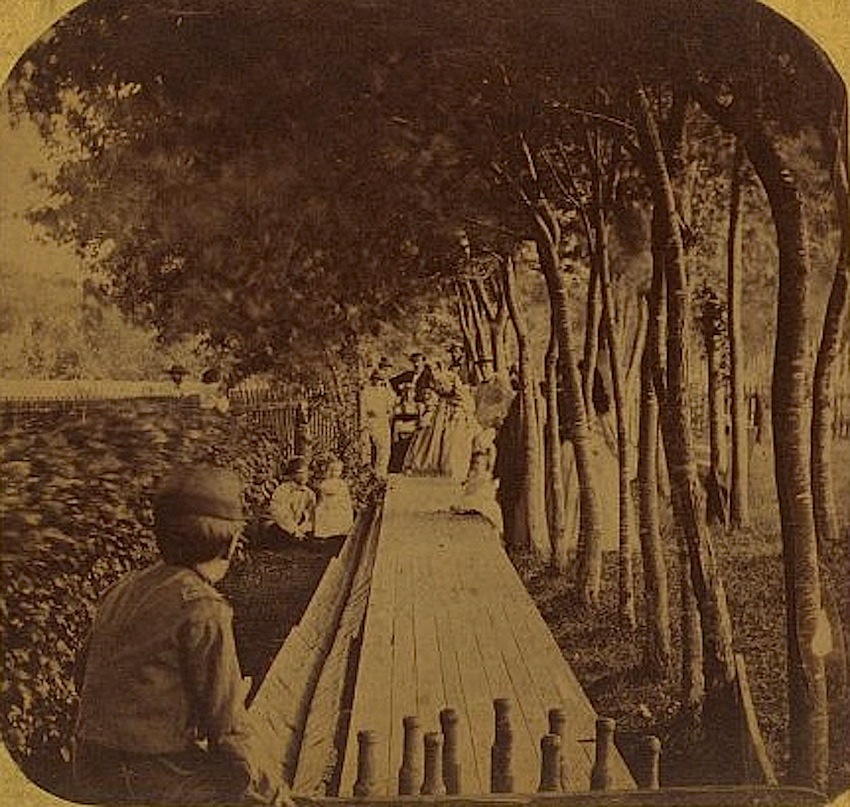
“Group of people bowling on a wooden lane erected in a yard,” July 4, 1861, via Library of Congress Prints and Photographs Division.

I just found this photo. It was taken exactly one year before yesterday’s picture, probably by James Hunter,* who would host the 1862 picnic.

The Library’s online catalogue says that “Mrs. H. Bowling and Coleman Sellers, Jr.,” have been identified in this image, although it doesn’t say where they are — probably the woman bowling (Mrs. H., bowling†) and perhaps the boy in charge of setting up the pins.
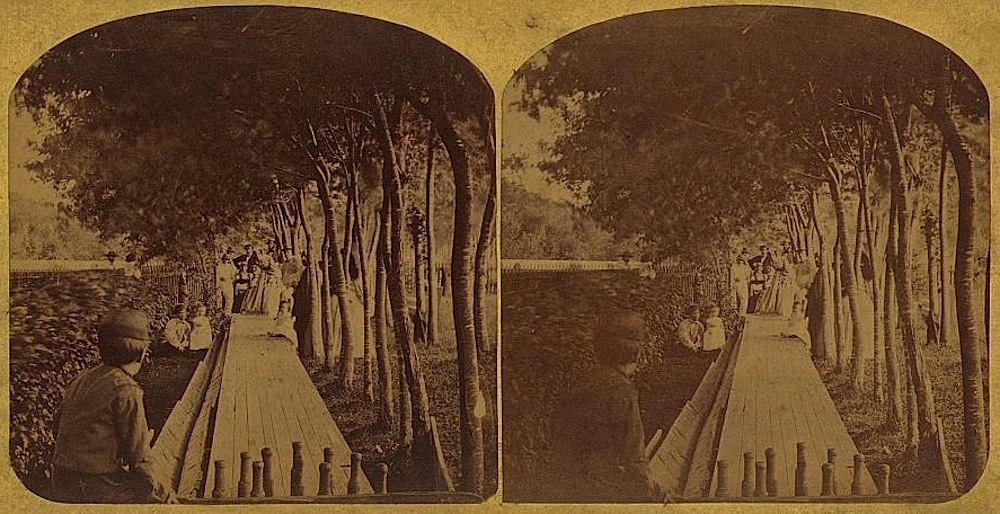
The full stereograph. I do hope they removed the baby from the lane before she bowled.

“By the mid-1800s, the game of ninepins was so popular that wealthy families installed bowling lanes at their estates. . . , ” according to American Profile. “When some states outlawed ninepins [in the 1830s and 40s] because it encouraged gambling, the modern game of tenpins evolved to skirt the laws.” I’m not sure if there are nine pins in this picture or ten. What looks like one middle pin may be two pins lined up.

The image is part of the Charles F. Himes collection of stereographs by amateur photographers, primarily members of the Pennsylvania Photographic Society (1860-61) and the Amateur Photographic Exchange Club (1861-63).


*James Hunter may have been co-owner of the Print and Dye Works in Hestonville, Pennsylvania.

†H. for Hunter? Coleman Junior’s father was Coleman Sellers II, a prominent engineer and inventor from Philadelphia. — as well as an amateur photographer.

Nantucket, Massachusetts

3-picket-fences-nantucket-ma-habs-library-of-congressWhitewashed picket fence, Pleasant Street, Nantucket, Massachusetts, 1969, by Jack E. Boucher for Nantucket Historical Study, HABS, via  Library of Congress Prints and Photographs Division (both photos).

Fence on Upper Main Street, Nantucket.

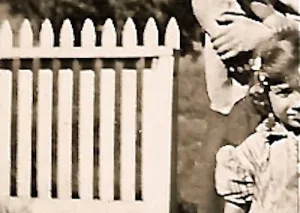
Is there a name for this style of picket fence — with three to four saw-tooths (saw-teeth?) on each wide board?  I feel like there must be, but I can’t find it.

The Sunday porch: Cherry Spring, Texas

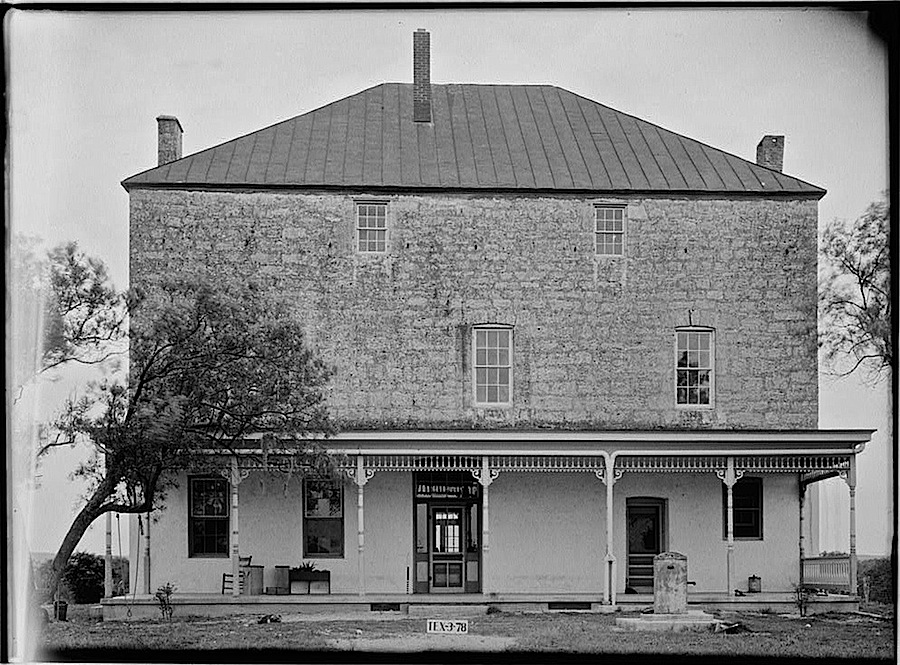
North (back) side of Rode-Kothe House, Cherry Spring, Gillespie County, Texas, May 29, 1936, by Richard MacAllister for an Historic American Buildings Survey (HABS), via Library of Congress Prints and Photographs Division (all three photos).

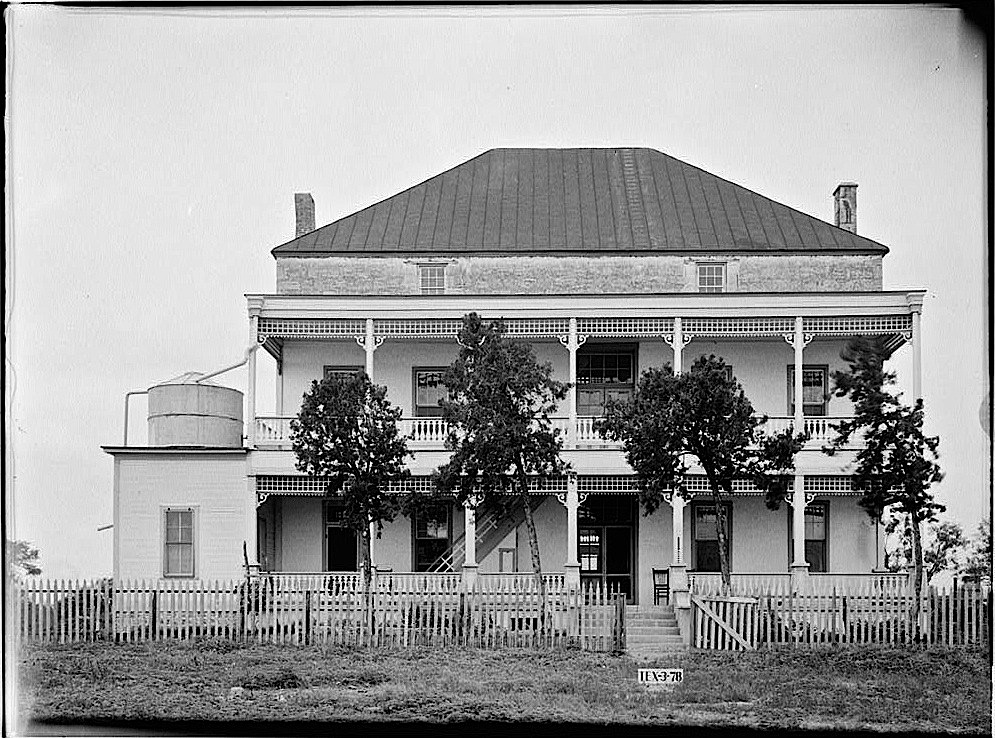
South (front) side of house.

The HABS says the limestone house was at least partly built in 1855 by German immigrant Dietrich Rode. (He completed it in 1879.) Rode was one of the founders of nearby Fredericksburg, as well as Cherry Spring.  He was also a lay Lutheran minister and a teacher, first in his students’ homes at night and then on the second floor of his ranchhouse shown here.

Detail of front porch.

The house may still stand near Christ Lutheran Church, which Rode helped found, but I cannot find a current picture of it.

The HABS says the building was “[s]ited to dominate its surroundings.”

The Sunday porch: Georgia

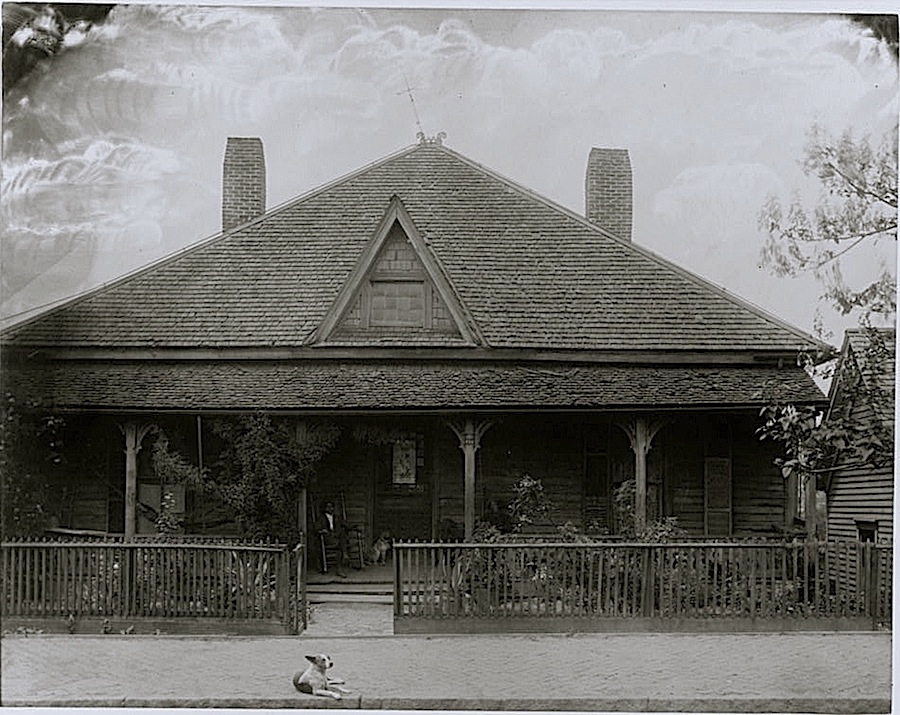
House with picket fence, man and dog seated on the porch.“[H]ouse with picket fence, man and dog seated on porch and a dog lying on the sidewalk,” Georgia, ca. 1899, photographer unknown, via Library of Congress Prints and Photographs Division.

This photo was in one of the several albums depicting African-American life that W. E. B. Du Bois compiled to exhibit at the 1900 Paris World’s Fair.

Click on the image for a little better view.

Tilba Tilba portrait

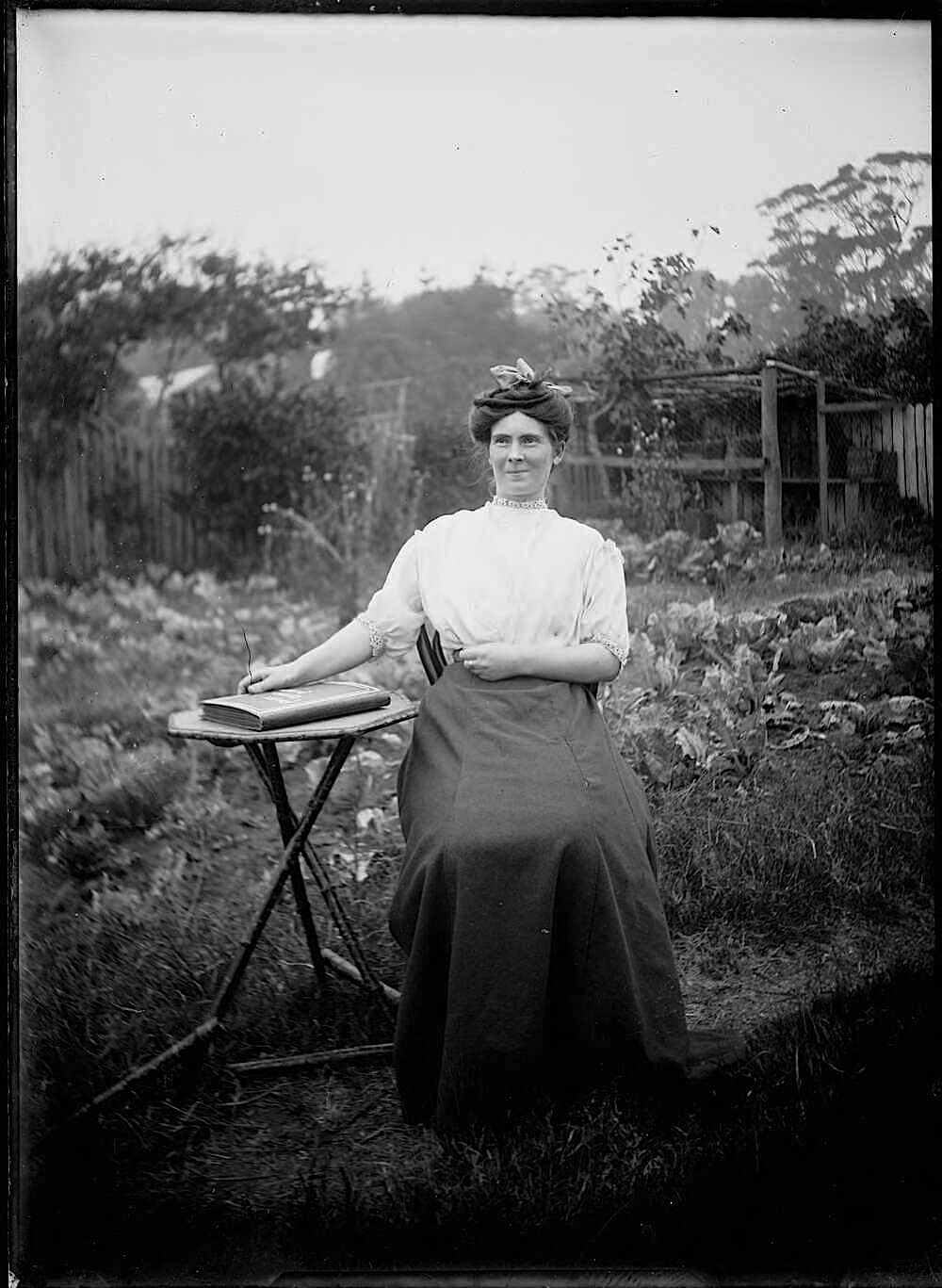
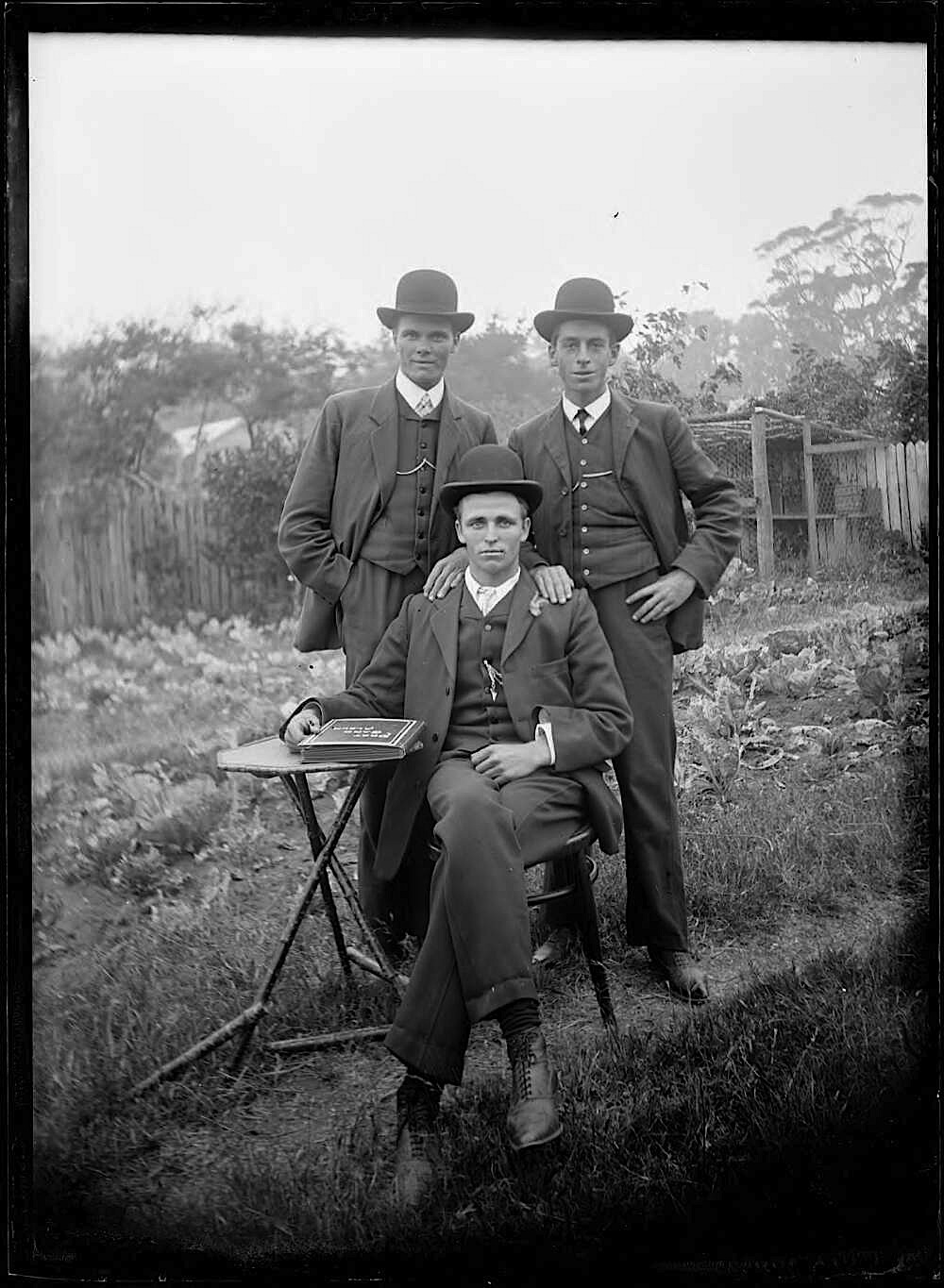
“Charlie Ferguson’s sister,” Tilba Tilba, New South Wales, ca. 1895, by William Henry Corkhill, via Trove of the National Library of Australia.

I love this formal pose in front of a vegetable garden — and it’s very typical of the photographer’s work.

“Charlie Ferguson and William (Wallaga) Arthur Mead with an unidentified man. Click to enlarge.

Corkhill was an amateur who took thousands of pictures of his prosperous dairy farming community between 1890 and 1910.

His images were rediscovered in 1975, when his daughter gave his surviving glass plate negatives to the National Library. Among the 840 that could still be printed were portraits of family and neighbors of a “special intensity and intimacy,” according to the book, Taken at Tilba.

For the natural light, Corkhill had to work outside, in gardens and farmyards. But he often posed his subjects as if they were in a studio, with small tables, chairs, and books. His backdrops were sometimes shrubs and flowers, but he also seemed satisfied with rough fences, water tanks, or the space between two farm sheds. Occasionally, the sitters look a little amused by the process, but the photographer’s approach is not ironic.

“Corkhill’s familiarity with and affection for his subjects is evident . . . and imbues his photographs with a strange combination of authority and informality. He has a rather casual approach to the backgrounds in his portraits, as if his familiarity with the scenes he records makes him impervious to some of their oddities,” according to his biography on the Library’s website.

You can click on the linked titles below to see more of his pictures, or you can browse through the online catalog here.

Woman with a dog
Woman by a cane table
Daisy Mead
Boy by a chair
Mrs. Elizabeth Kendall Bate, aged about 83
Man sitting in a garden
Two young men
Frank Stanley Griffiths
Corkhill’s wife and their children
Byrnes family
Young woman by a table
Two children
Two young men