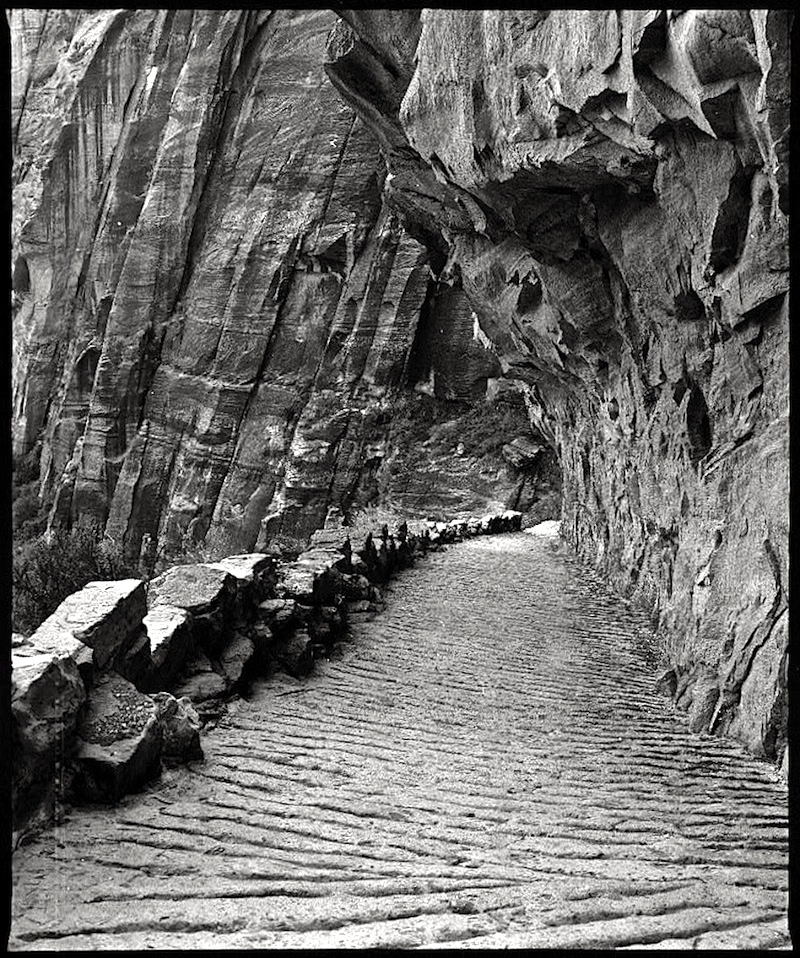
It’s National Trails Day. Detail of the West Rim Trail, looking southwest, Zion National Park, Washington County, Utah, 1984, by Clayton B. Fraser, via Historic American Engineering Record, Library of Congress Prints and Photographs Division.
The trail opened in 1926 and was paved in 1929 with oil mixed with sand and rock. It was later repaved in concrete, most recently in 2007.
“Built of native stone and associated with the “National Park Service-Rustic” architectural style, the West Rim Trail possesses architectural integrity,” says the Record. “Rock used in the masonry switchback walls was quarried locally and shaped as little as possible to provide a rough appearance, yet stable construction.” You can read more here.
Wordless Wednesday pictures from an August 2012 post. . .
Northern Virginia, August 2011.
Click on any thumbnail below and enjoy.
The garden and view from the patio on the first of three terraces. A small pond is hidden by the arbor.
The view from the pond. The area is planted with lamb’s ear (Stachys byzantina), Russian sage (Perovskia atriplicifolia), and a bright green small creeping sedum. You can also see the spent stalks of naked lady lilies (Lycoris squamigera) and some irises.
The arbor, built by my father, holds Clematis montana. In the foreground is beautyberry, Hellebores, and wild violets. The center holly has been limbed up by the deer. My father also built the stone retaining walls, using stone from the woods. On the top terrace (hidden by the arbor) is a patio area covered by a pergola.
Clear filament protects Viburnums and Hostas. The dark green plants in the background are Hellebores.
Hellebores border a path from the woods to the pond.
The pond.
A tall persimmon tree and a perennial bed that covers the site of an old sinkhole. Beyond is the old Christmas tree farm.
The view of distant mountains.
Sophie hunts in the Miscanthus; a grove of persimmon trees is in the background.
A birdhouse surrounded by Buddleia, goldenrod, and Miscanthus.
View from the house.
Looking down from the top terrace level and pergola.
My grandparent’s garden chairs.
“Tread lightly.”
Stepping stones with the imprints of grandchildren’s hands and feet.
The holly over the bench was limbed up by the deer.
Lichens on the bench.
A high fence protects the vegetable garden.
We brought this sculpture made from old auto parts back from Niger.
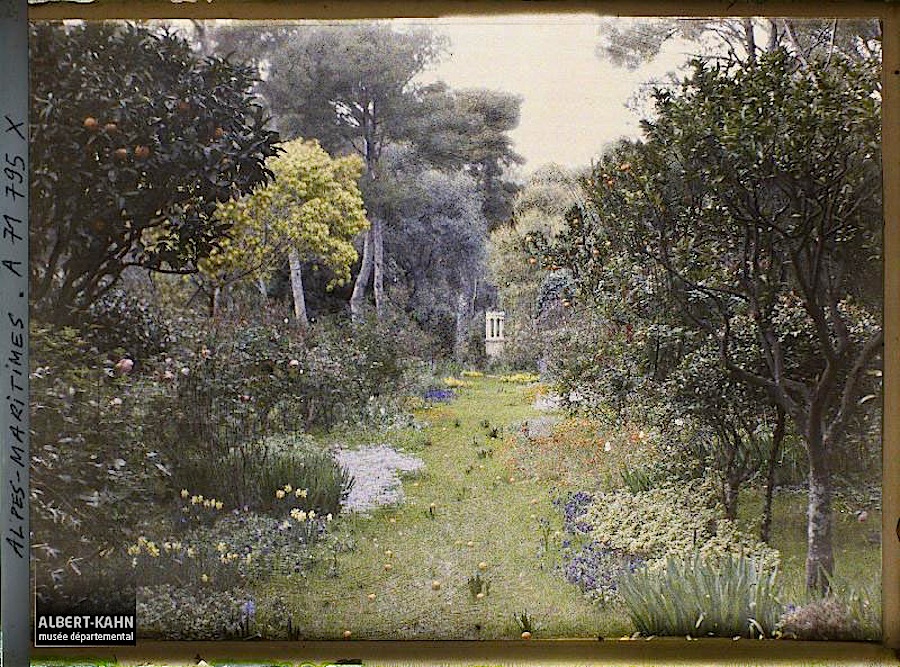
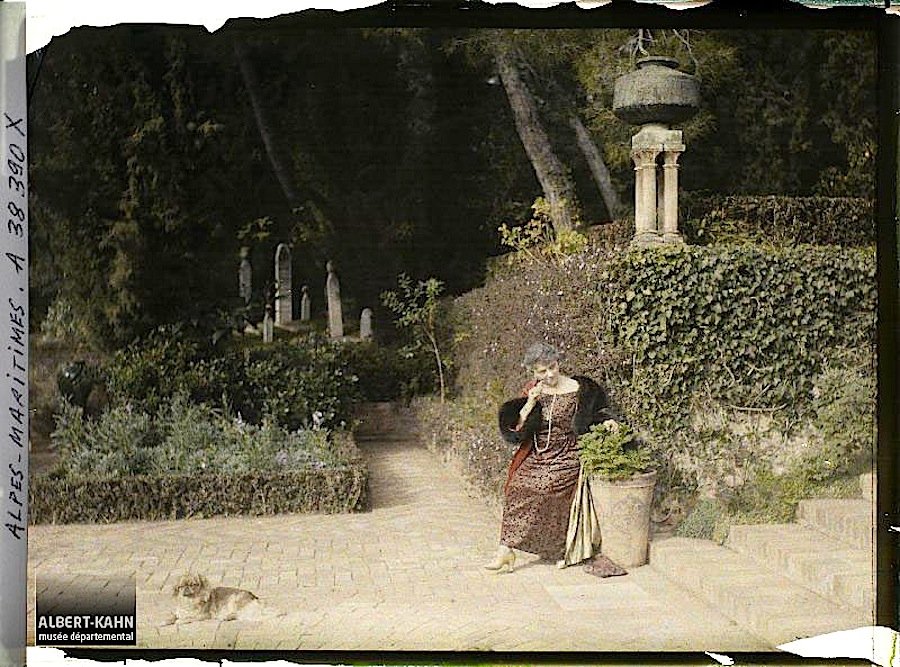
“The property of Madame Douine, Cap Martin, France,” January 1923, by Roger Dumas, via Archives of the Planet Collection – Albert Kahn Museum /Département des Hauts-de-Seine (both photos).
If you watched The Paradise (2013) on either BBC America or Masterpiece and wondered what happened to Denise after the series ended . . . well, perhaps it was this.
The series was based on Au Bonheur des Dames (The Ladies’ Paradise) by Émile Zola. It is novel about a saleswoman in one of the grand Paris department stores — Denise — who eventually marries the store’s owner. Her story mirrored the real life of Cyprienne Dubernet, a saleswoman at Grand Magazins du Louvre who married the owner, Olympe Hériot, in 1887.*
Cyprienne in her garden.
In 1909, Cyprienne — now widowed and re-married to Roger Douine — decided to build a villa in Cap Martin on the French Riviera. Her architect designed a Neo-Byzantine house inspired by her travels to Naples, Smyrna, Cairo, Jerusalem, and Constantinople. She named it “Villa Cypris” in tribute to the Greek goddess of love and her own name. Italian painter Raffael Mainella designed the interiors and the garden, which included a stone bridge along the seafront, a cloister, a “Venetian Sanctuary,” a Mauritanian pergola, and sunken Dutch-style parterres with a canal/swimming pool.
You can see more pictures of the estate here, on its website (it seems to be for sale). There’s a video here.
The autochromes above are two of about seventy-two thousand that were commissioned and then archived by Albert Kahn, a wealthy French banker, between 1909 and 1931. Kahn sent thirteen photographers and filmmakers to fifty countries “to fix, once and for all, aspects, practices, and modes of human activity whose fatal disappearance is no longer ‘a matter of time.'”† The resulting collection is called Archives de la Planète and now resides in its own museum at Kahn’s old suburban estate at Boulogne-Billancourt, just west of Paris. Since June 2016, the archive has also been available for viewing online here (search “Madame Douine” to see more of Villa Cypris).
*It seems doubtful that Cyprienne (born just plain Anne Marie) was the direct inspiration for Denise, as the novel was published in 1883. She and Olympe had at least one (maybe two) of their four children before their marriage. Their oldest son, Auguste, was an inspiration for the main character of Colette’s novel Cheri. Cyprienne died in 1945.
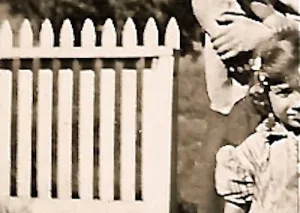
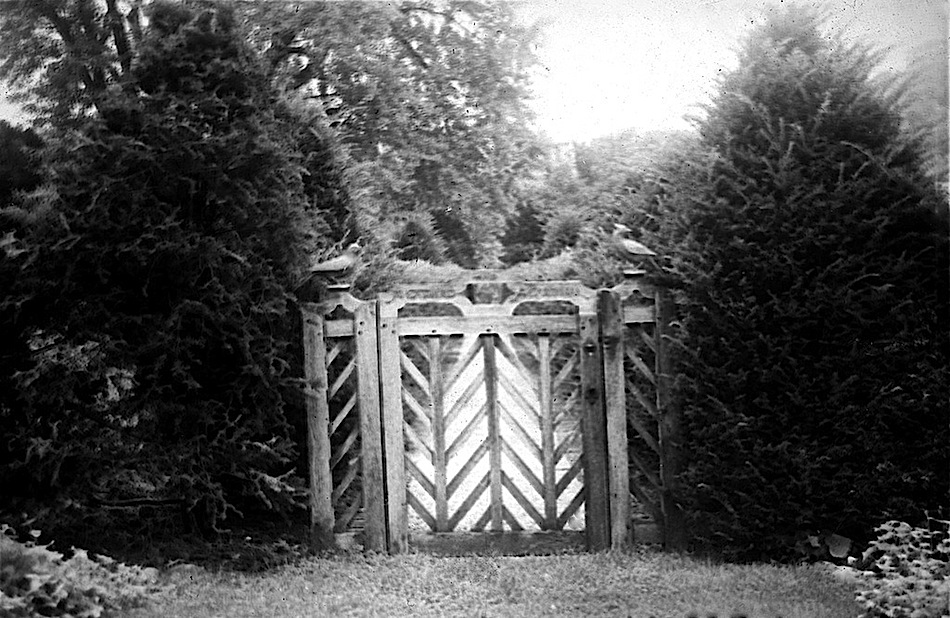
Wooden garden gate, Dumbarton Oaks Gardens, Washington, D.C., 1938, from the Arthur Peck Photograph Collection, via Oregon State University (OSU) Special Collections and Archives Commons on flickr.
Arthur Peck was a Professor of Landscape Architecture at the Oregon Agricultural College from 1908 to 1948. During his long career, he created a teaching library of 24 boxes of glass lantern slides — now in OSU’s archives.
Does anyone know if this gate still exists in the Gardens?
 Detail of the West Rim Trail, looking southwest, Zion National Park, Washington County, Utah, 1984, by Clayton B. Fraser, via Historic American Engineering Record, Library of Congress Prints and Photographs Division.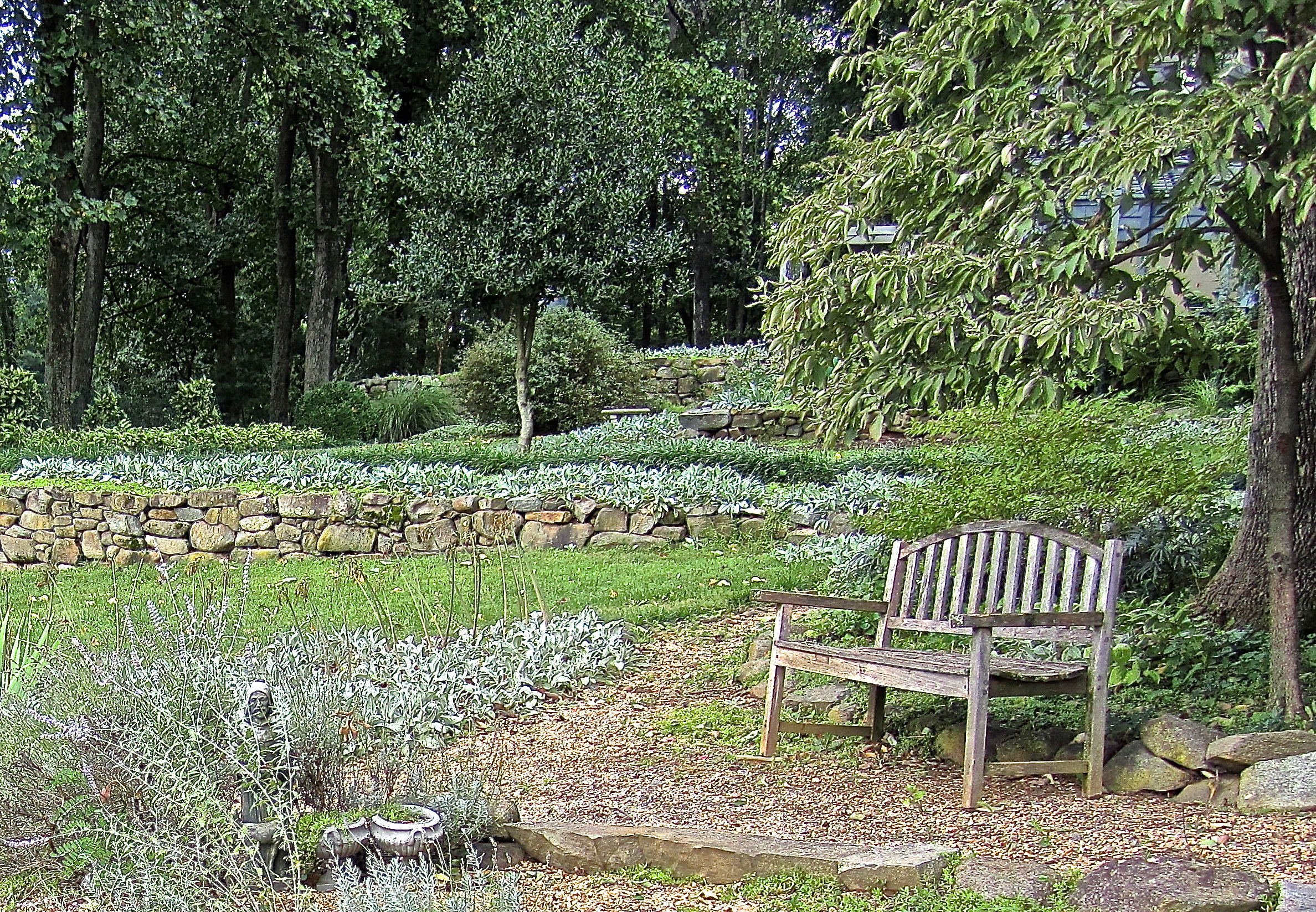


 enclos*ure