Life in gardens: family and friends

Västra Götaland, Lysekil, Lysekil, Bohuslän, Övrigt-Sällskapsliv

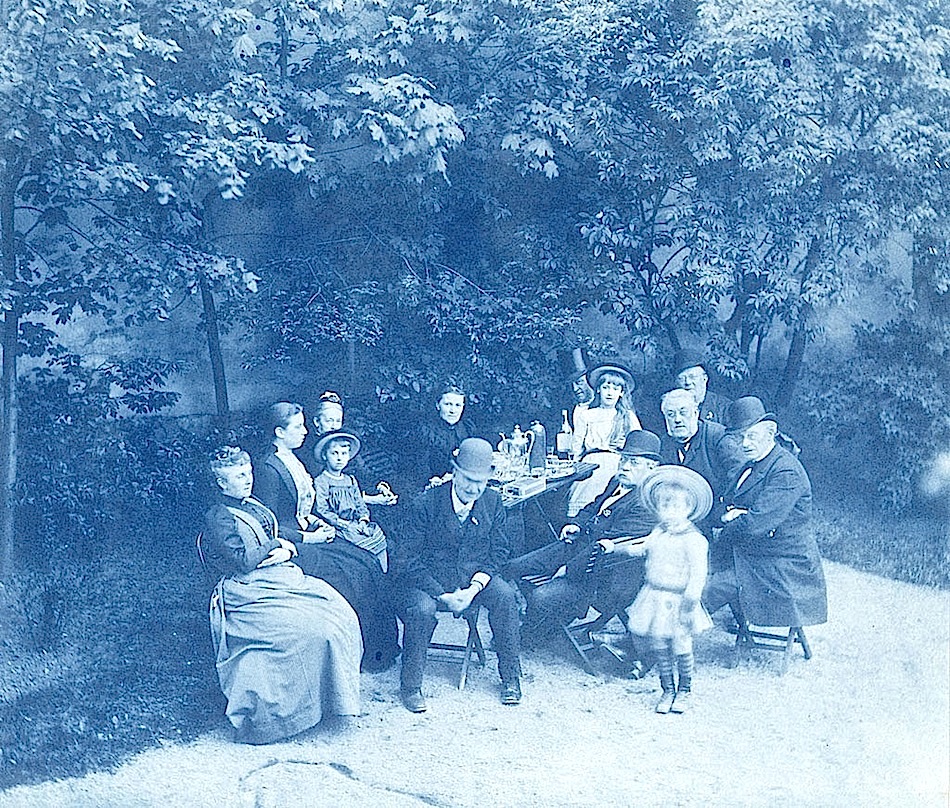
Människor som sitter i en trädgård” (people sitting in a garden), Lysekil, Sweden, ca. 1890, a cyanotype by Carl Curman, via Swedish National Heritage Board Commons on flickr.

Carl Curman was a physician, specializing in the science of health baths (balneology).  He also became a prominent amateur photographer, leaving behind a collection of about 700 photos.  He lived with his wife, Calla (possibly the first person on the left above), and their children in Stockholm and, during the summers, in the seaside town of Lyskil.

The group above may be in an outdoor cafe of the park in Lyskil, rather than in a private garden. The spot looks very much like the one in this photo by Curman.

By the numbers, Geneva

This slideshow requires JavaScript.

We were traveling all last week in Switzerland and France, stopping for three days in Geneva.

Walking back and forth from our hotel to the city’s old town, I several times passed the floral clock (L’horloge fleurie) located near the spot where the Rhône River leaves Lake Léman. It was built in 1955 to honor Geneva’s watchmaking industry, and its design, formed by approximately 6,500 plants, changes seasonally. With a diameter of 5 meters (16.4′), the clock was said to be the largest in the world until 2005 — when it was surpassed by a 15-meter version in Tehran, Iran.*

It’s not a style of garden that I particularly like, but as I examined it, I had to admire the careful layout and clipping required to make it possible. (Click on any image above to scroll through enlarged versions.)

Floral sundials have been around since at least the 16th century, but the first-known floral display with mechanical clock hands was created in 1892 in the Trocadéro gardens in Paris. A second was constructed at Water Works Park in Detroit in 1893. By the early 20th century, examples could be found across the U.S., Great Britain, and Europe.

A number of these clocks were abandoned during WWI, but in the 1920s and 1930s, as motoring tourism developed, towns began to build them again as attractions.

How well the skillful gard’ner drew
Of flow’rs and herbs this dial new.  .  .  .
How could such sweet and wholesome hours
Be reckon’d but with herbs and flow’rs!

— Andrew Marvell, from “The Garden


*Geneva’s second hand is still the longest, at 2.5 m.

Vintage landscape: Istanbul

Taksim, Istanbul, 1930s, via SALTOnlineThe Republic Monument at Taksim Square, Istanbul, ca. 1930s, via Ali Saim Ülgen Archive, SALTOnline Commons on flickr.

Vintage landscape: iris row

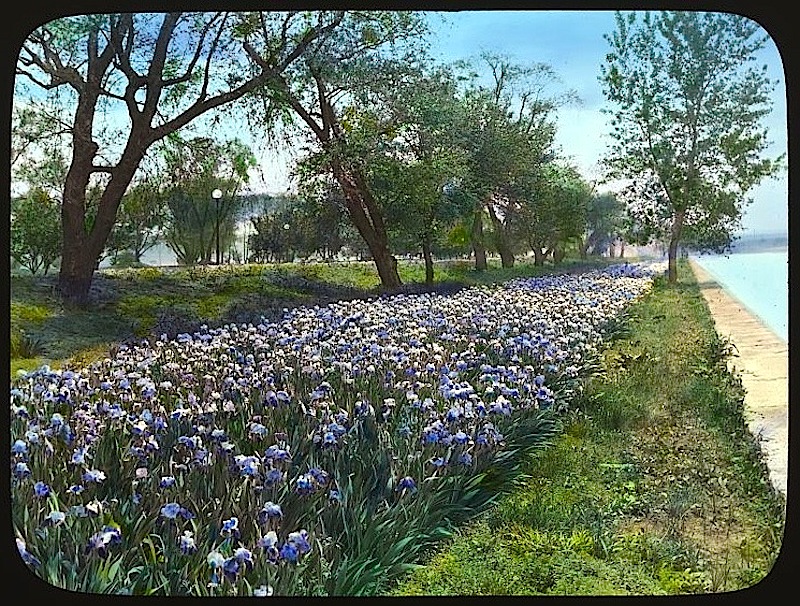
Irises, West Potomac Park, Library of CongressIrises along the embankment, West Potomac Park, Washington, D.C., 1921, a hand-colored glass lantern slide by Frances Benjamin Johnston, via Library of Congress Prints and Photographs Division.

Therefore, on every morrow, are we wreathing
A flowery band to bind us to the earth. . .

–John Keats, from “A Thing of Beauty

Vintage landscape: Louisville, Kentucky

Colonade, Louisville, Ky, park, Library of CongressColonnade, Central Park, Louisville, Kentucky, between 1900 and 1910, Detroit Publishing Co., via Library of Congress Prints and Photographs Division.

The park’s 17 acres were owned by the Dupont family in the 1870s, yet open for public use as “Dupont Square.”  In 1883, the space — temporarily “roofed in” — was used to demonstrate Thomas Edison’s light bulb.

In 1904, the Duponts sold the land to the city, and Frederick Law Olmsted, who was already working in Louisville, designed a large open-air shelter and colonnade for the park’s high point.  The colonnade still exists and is undergoing restoration.