Parc Monceau, Paris

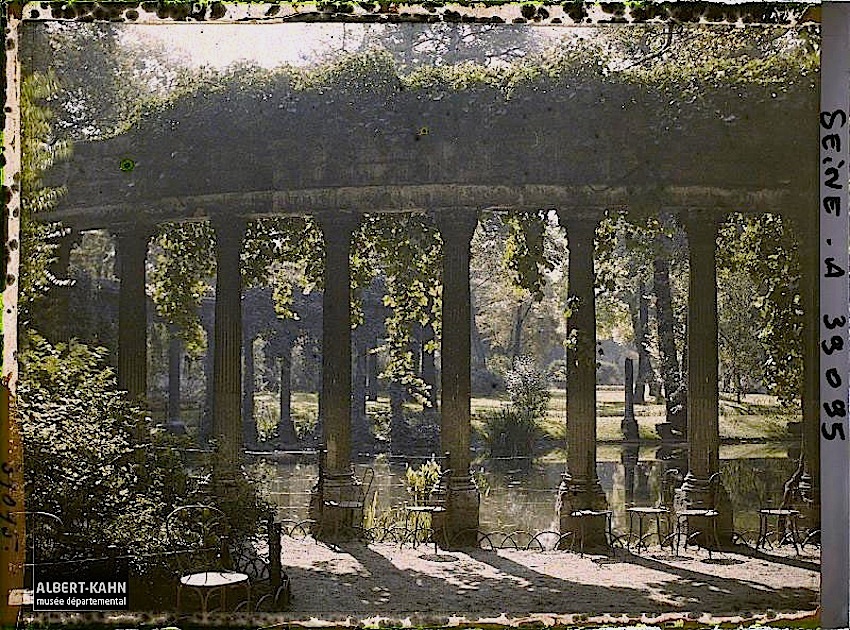
Colonnade dans le parc Monceau, la Naumachie, Paris (VIIIe arr.), France, 12 septembre 1923, (Autochrome, 9 x 12 cm), Auguste Léon, Département des Hauts-de-Seine, musée Albert-Kahn, Archives de la Planète, A 39 095 S
La Naumachie Colonnade in Parc Monceau, Paris, September 12, 1923, by Auguste Léon, via Archives of the Planet Collection – Albert Kahn Museum /Département des Hauts-de-Seine (both photos).

In Ancient Rome, a naumachia was a large basin dug for staging naval battles* as public entertainment. In Parc Monceau, La Naumachie is a tranquil oval pool framed on one end by a Corinthian colonnade.
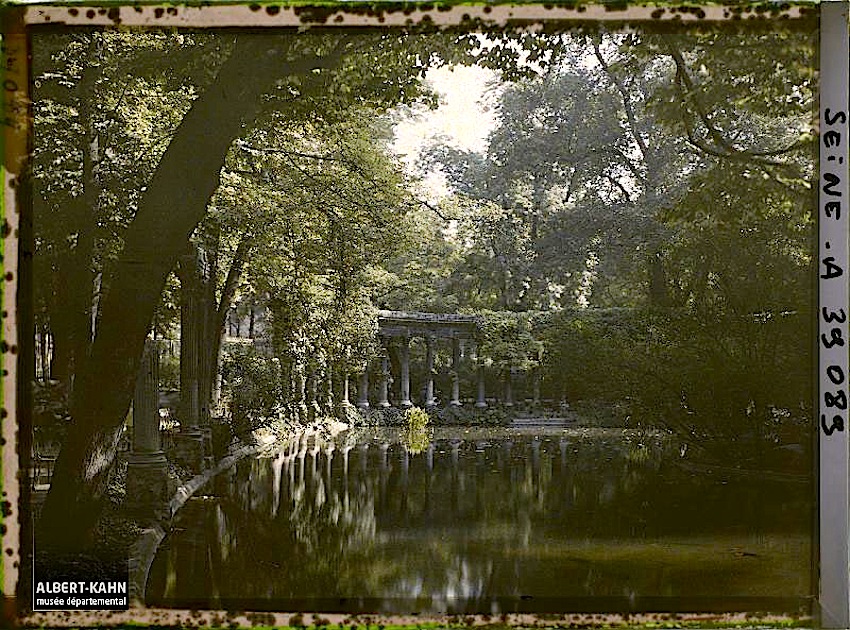
Colonnade dans le parc Monceau, la Naumachie, Paris (VIIIe arr.), France, 12 septembre 1923, (Autochrome, 9 x 12 cm), Auguste Léon, Département des Hauts-de-Seine, musée Albert-Kahn, Archives de la Planète, A 39 089 S

The columns were once part of a never-completed late 16th century mausoleum attached to the Basilica of Saint Denis. In the late 1770s, they were acquired by the Duke of Chartres for an elaborate “Anglo-Chinese” public garden he was creating in northwest Paris. He filled it with architectural follies (see here) — one of them being a “Roman” colonnade.

The Duke was guillotined in 1793. His land was first confiscated and then returned to his heirs, who sold about half of it to developers. In the 1850s, the city bought the last 20 acres of the old garden, and Parc Monceau opened in 1861 as a largely informal “English-style” park. Today, there are still a few follies, although only the colonnade/naumachia and a small Egyptian pyramid remain from the 18th century.

The autochromes above are two of about seventy-two thousand that were commissioned and then archived by Albert Kahn, a wealthy French banker, between 1909 and 1931. Kahn sent thirteen photographers and filmmakers to fifty countries “to fix, once and for all, aspects, practices, and modes of human activity whose fatal disappearance is no longer ‘a matter of time.'”† The resulting collection is called Archives de la Planète and now resides in its own museum at Kahn’s old suburban estate at Boulogne-Billancourt, just west of Paris. Since June 2016, the archive has also been available for viewing online here.


*The word also refers to the spectacle itself.

words of Albert Kahn, 1912. Also, the above photos (A 39 095 S and A 39 089) are © Collection Archives de la Planète – Musée Albert-Kahn and used under its terms, here.

The flower seller, Paris

Une marchande de fleurs, au niveau du 64 avenue Hoche, Paris (VIIIe arr.), France, 1924 (?), (Autochrome, 9 x 12 cm), Auguste Léon, Département des Hauts-de-Seine, musée Albert-Kahn, Archives de la Planète, A 69 599 X

Buying flowers at 64 Avenue Hoche, Paris, ca. 1924, by Auguste Léon, via Archives of the Planet Collection – Albert Kahn Museum /Département des Hauts-de-Seine.

This autochrome is one of about 72,000 that were commissioned and then archived by Albert Kahn, a wealthy French banker, between 1909 and 1931. Kahn sent thirteen photographers and filmmakers to 50 countries “to fix, once and for all, aspects, practices, and modes of human activity whose fatal disappearance is no longer ‘a matter of time.'”* The resulting collection is called Archives de la Planète and now resides in its own museum at Kahn’s old suburban estate at Boulogne-Billancourt, just west of Paris. Since June 2016, the archive has also been available for viewing online here.

I wasn’t able to make a flower arrangement this week for “In a vase on Monday,”‘ but to see what other garden bloggers have created today, please visit host Cathy at Rambling in the Garden.


*words of Albert Kahn, 1912. Also, the above photo (A 69 599 X) is © Collection Archives de la Planète – Musée Albert-Kahn and used under its terms, here.
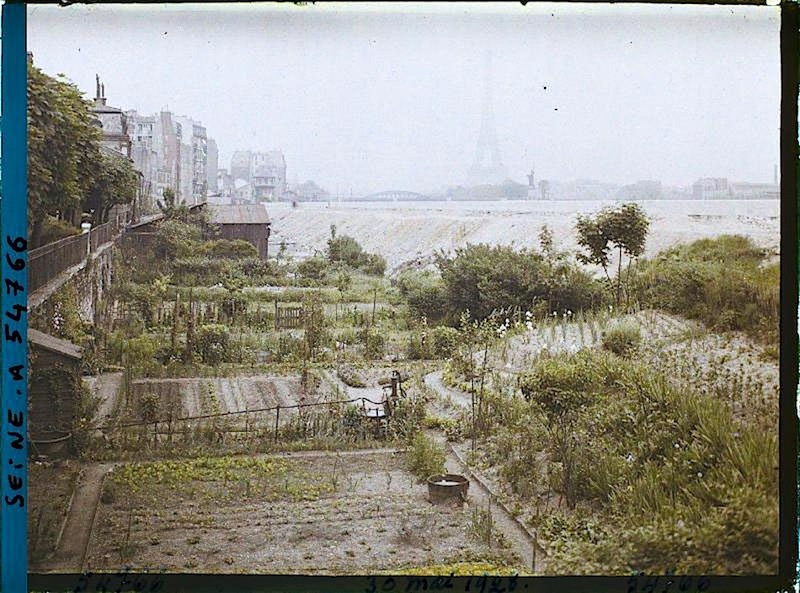
Quai d’Auteuil, Paris

Jardins potagers, quai d'Auteuil (actuel quai Louis-Blériot), Paris (XVIe arr.), France, 30 mai 1928, (Autochrome, 9 x 12 cm), Auguste Léon, Département des Hauts-de-Seine, musée Albert-Kahn, Archives de la Planète, A 54 766The little vegetable gardens near pont Mirabeau, behind quai d’Auteuil (now quai Louis-Blériot), Paris,  on May 30, 1928, by Auguste Léon, via Collection Archives of the Planet – Albert Kahn Museum/Département des Hauts-de-Seine.

The Auteuil wharf or quai, next to the Seine River, was situated at the top of the sandy-looking embankment on the right side above (also see here, third photo).  Then there was a drop down to the gardens, and, on the left, Avenue de Versailles was at the top of the wall (I think). In the distance, you can see the Eiffel Tower and before it, a little to the right, the small Paris replica of the Statue of Liberty at the southwest end of the Île aux Cygnes.

There’s another view here (the 15th photo down). The area was filled in and covered by the highway Voie George Pompidou and modern apartment buildings in the 1960s.

This lovely autochrome is one of about seventy-two thousand that were commissioned and then archived from 1909 to 1931 by French banker and pacifist Albert Kahn. He sent thirteen photographers and filmmakers to 50 countries “to fix, once and for all, aspects, practices, and modes of human activity whose fatal disappearance is no longer ‘a matter of time.'”*  The resulting collection is called Archives de la Planète and now resides in its own museum at Kahn’s old suburban estate at Boulogne-Billancourt, just west of Paris. Since June 2016, the archive has also been available for viewing online here.


*words of Albert Kahn, 1912. The above photo (A 54766) is © Collection Archives de la Planète – Musée Albert-Kahn and used under its terms, here.

Luxembourg Gardens

women-children-in-luxembourg-gardens-paris-getty-museumWomen and Children in the Luxembourg Gardens, Paris, 1898, by Eugène Atgetvia The J. Paul Getty Museum Open Content Program.

Wordless Wednesday: Paris

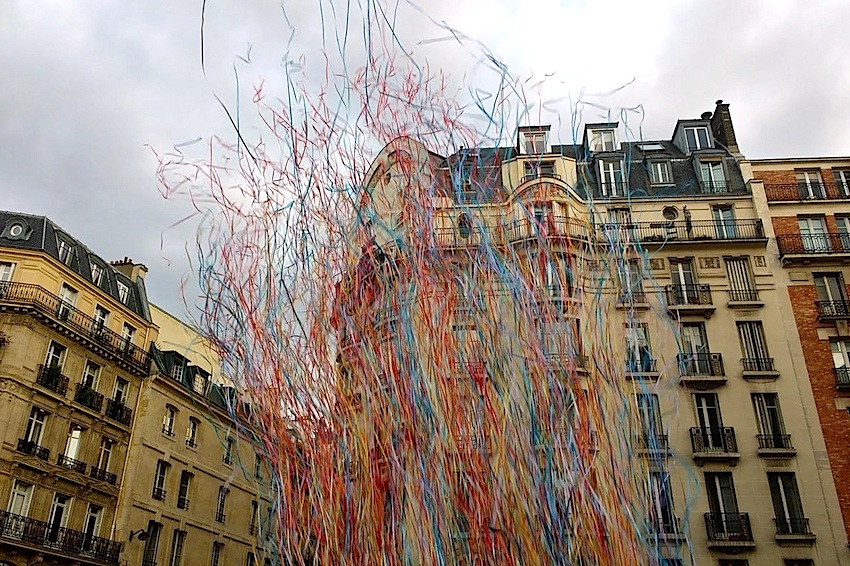
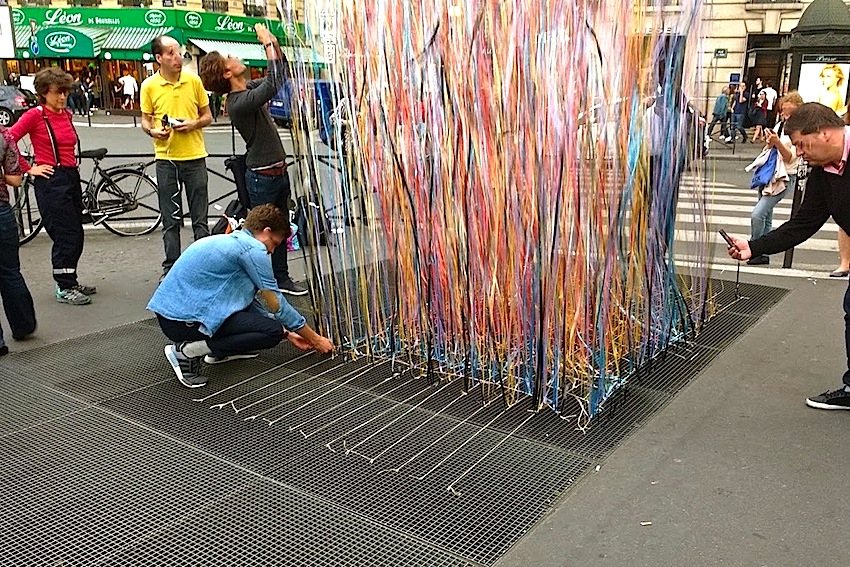
Ribbon flame 1, Paris, May 2016,, enclos*ureCorner of Boulevard Saint-Germain and Rue du Four, May 27, 2016.